ZLD costs 3 to 5x more than MLD to build and operate. The case for ZLD vs MLD cost comparison hinges on brine disposal fees, discharge permits, and ESG exposure.
When a single brine disposal permit is revoked, the shutdown cost for a mid-sized power plant typically lands between $150,000 and $500,000 per week in lost production. That exposure is why more procurement and operations teams are now reopening a question they thought was settled: is zero liquid discharge (ZLD) actually cheaper than minimum liquid discharge (MLD) over the project life, once disposal fees, regulatory risk, and ESG targets are priced in? The answer in 2026 is: sometimes yes, and the crossover point is closer than most capital budgets assume.
The instinct is to stop at the headline CAPEX comparison. ZLD systems cost $5 million to $25 million per million gallons per day (MGD) of treated flow; MLD systems run $1 million to $5 million per MGD for the same throughput. On that basis alone, MLD wins every capital approval meeting. But that framing ignores brine disposal costs, which have risen 40 to 80% in many US and EU jurisdictions since 2020, and discharge permit attrition, which is shrinking the addressable market for MLD at roughly 8 to 12% per regulatory cycle. A pattern that recurs across industrial installations is that plants which locked in MLD on a 15-year contract are now renegotiating their brine hauling fees from $35 per ton to $90 to $130 per ton, turning a favorable OPEX model into an unplanned capital project.
This guide covers the full cost-benefit mechanics of the ZLD vs MLD cost comparison for industrial plants: how the two strategies work, where the economics actually cross over, the failure scenarios that kill each approach, and a threshold-based decision framework procurement teams can take into an RFP or CAPEX approval. It is aimed at operations directors managing uptime exposure, capital projects leads building vendor-agnostic specifications, and sustainability teams with water-reduction commitments on their ESG scorecard.
## The decision in brief
- Switch to ZLD if brine disposal is at or above $80 per ton. If your plant is currently on MLD with brine disposal at or above $80 per ton, switching to ZLD at 1 MGD capacity saves $600,000 to $1.1 million per year in disposal costs net of the ZLD OPEX premium. - Expect payback on the CAPEX delta in 8 to 12 years. Under conservative assumptions, the $8 million to $14 million CAPEX delta reaches full payback in 8 to 12 years on that annual disposal saving. - Plan the retrofit before a permit forces it. The biggest cost-of-doing-nothing is permit revocation: a single non-renewal forcing an unplanned ZLD retrofit costs 60 to 120% more than a planned installation.
Add $150,000 to $500,000 per week in production disruption during the engineering and build period of that unplanned retrofit.
## What MLD and ZLD mean in operational terms
MLD (minimum liquid discharge) reduces the volume of liquid waste leaving a site to the lowest level permitted by local regulation, without targeting zero. ZLD takes that further: no process liquid leaves the boundary at all, with all water recovered as reusable permeate and all dissolved solids converted to a dry solid cake for landfill or byproduct sale. The distinction sounds absolute, but in practice the two strategies sit on a spectrum, and many sites operate a hybrid that targets 95 to 98% liquid recovery without committing to true ZLD.
The operational difference matters because it determines the end-stage unit operations. MLD plants stop at brine concentration, typically after reverse osmosis (RO) and sometimes a secondary membrane pass. ZLD plants add a brine concentrator, mechanical vapor recompression (MVR) evaporator, and in many cases a crystallizer or spray dryer. Each additional unit operation adds capital cost, energy draw, and maintenance complexity. The question is not which technology is better in the abstract; it is which total cost of ownership is lower given your specific site constraints, feed water chemistry, discharge permit status, and strategic horizon.
Understanding this distinction is the foundation of any credible ZLD vs MLD cost comparison. Without pinning down where your plant sits on the liquid discharge spectrum today, cost benchmarks are unmoored.
## How the treatment trains differ
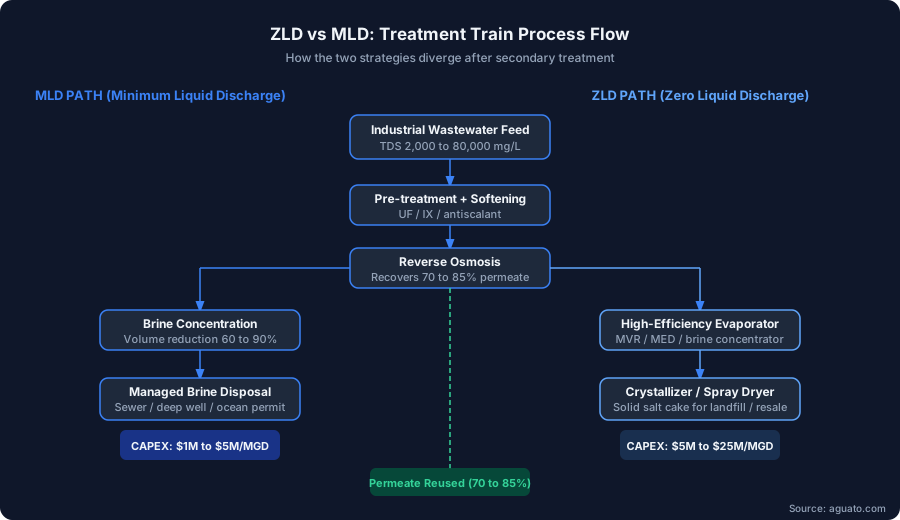
Both MLD and ZLD share a common upstream treatment sequence: pre-treatment (clarification, softening, media filtration), followed by ultrafiltration (UF) membranes, then one or more passes of RO. The divergence starts at the RO concentrate outlet.
MLD plants treat the RO concentrate through a brine concentration step, then discharge the reduced-volume residual under permit. The most common brine concentration technologies are high-pressure RO (HPRO), forward osmosis (FO), or electrodialysis reversal (EDR). These bring the residual liquid volume down to 5 to 15% of the original feed before it leaves the site. Disposal methods include sewer discharge under consent, deep-well injection, surface water discharge under permit, or trucked brine hauling to a licensed disposal site.
ZLD plants divert the RO concentrate into a thermal or advanced mechanical stage. [Mechanical vapor recompression evaporators](/resources/desalination-energy-consumption) recover latent heat by recompressing steam, cutting the energy cost of evaporation from 25 to 35 kWh/m3 down to 10 to 18 kWh/m3. At very high TDS concentrations above 200,000 mg/L, a crystallizer forces salt to its saturation point and precipitates a dry solid. The solid cake, typically 70 to 90% salt content, goes to landfill or, where chemistry allows, to a salt buyer at $15 to $40 per ton.
The critical engineering choice inside ZLD is whether to use thermal evaporation, membrane-based concentration (HPRO + FO in series), or a hybrid. Thermal MVR is proven and the most common choice for plants above 0.5 MGD, but it carries a high energy penalty. Membrane-only ZLD is emerging for feeds below 70,000 mg/L TDS and has a lower capital cost at small scale, but membrane scaling remains a limiting constraint. The feed water chemistry, specifically [calcium](/elements/calcium), magnesium, silica, and sulfate concentrations, determines which route is viable before any cost comparison makes sense.
## ZLD vs MLD cost comparison: the full number set
The numbers below are for a reference plant treating 1 MGD of industrial wastewater at a feed TDS of 5,000 to 15,000 mg/L, which covers the majority of power, petrochemical, and general manufacturing cases. Costs are in USD 2025, reflecting current equipment quotes and reagent pricing.
| Parameter | MLD (RO + brine concentration) | MLD + brine hauling | ZLD (MVR-only) | ZLD (full train with crystallizer) | |---|---|---|---|---| | CAPEX (installed, $/MGD) | $1M to $3M | $1M to $3M | $8M to $14M | $15M to $25M | | OPEX ($/m3 treated) | $0.80 to $1.80 | $2.50 to $6.00 | $2.20 to $4.50 | $4.00 to $8.00 | | Energy consumption (kWh/m3) | 3 to 7 | 3 to 7 | 12 to 22 | 18 to 35 | | Water recovery rate | 70 to 90% | 70 to 90% | 95 to 99% | 98 to 99.5% | | Brine disposal cost ($/year, 1 MGD) | $80K to $400K | $300K to $1.2M | Near zero | Near zero | | 15-year TCO ($/MGD) | $8M to $14M | $18M to $28M | $20M to $26M | $28M to $42M | | Discharge permit required | Yes | Yes, trucking permit | No | No | | Carbon footprint (relative) | Low | Low to medium | High | Highest | | Best for | Low disposal cost, stable permit | Tight permit, low-volume brine | No permit option, moderate volume | Regulated or high-value recovery sites | | Risk profile | Permit revocation, hauling fee escalation | Hauling cost volatility | High energy OPEX, scaling events | Crystallizer downtime, salt cake disposal |
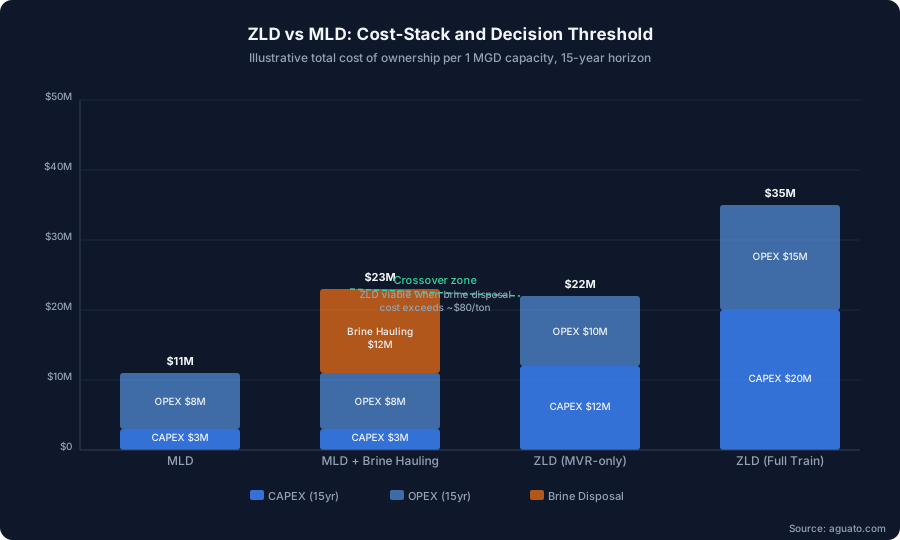
Several things stand out in this table that the headline CAPEX comparison obscures. First, MLD with a reliable low-cost disposal route is genuinely the cheapest option across the 15-year period by $6 million to $14 million per MGD. Second, that advantage collapses when hauling fees exceed $80 per ton, which is already the case in California, the Netherlands, and parts of the UK. Third, ZLD MVR-only and MLD-plus-hauling converge in total TCO at a hauling rate of roughly $90 to $110 per ton, a level that is already in effect for many inland industrial sites.
[cta:nepti-dark]
## The crossover calculation: when ZLD wins the lifetime math
The crossover is not a fixed number; it is a function of four site-specific variables: brine disposal cost, feed volume, water purchase cost (what is recovered), and permit risk premium. A simplified crossover formula is:
ZLD becomes competitive when: [Annual brine disposal cost] + [Annual water purchase cost avoided] + [Annual permit compliance cost] > [ZLD OPEX premium over MLD] + [ZLD CAPEX amortization premium]
At a 1 MGD site with brine disposal at $50 per ton, ZLD never pays back within a 15-year horizon. At $90 per ton, ZLD typically pays back in 8 to 12 years. Above $120 per ton, ZLD often pays back in 5 to 7 years. These thresholds shift materially when the site is in a water-stressed region where municipal water costs $4 to $8 per m3; the recovered permeate from ZLD then offsets $800,000 to $1.6 million per year in water purchase costs at 1 MGD, which pulls the crossover down to the $60 to $80 per ton brine disposal range.
The water-cost lever is the one most frequently underweighted in initial feasibility studies. A plant in the Middle East paying $6 per m3 for desalinated water should almost always run ZLD. A plant in the US Midwest paying $0.50 per m3 for municipal water should run MLD unless disposal costs are exceptional. The arithmetic is not subtle.
The right answer depends on your feed chemistry, disposal cost, and water tariff structure. [Post your project](/post-project) and qualified ZLD and MLD vendors will model the crossover against your actual numbers before you commit to a specification.
## Threshold-based decision framework
A clear decision framework avoids months of pre-FEED analysis. Use these cut-points to determine which strategy to specify first:
Step 1: Discharge permit status. If the site has no viable liquid discharge permit and the regulatory pipeline shows no approval within 24 months, skip MLD entirely. ZLD is the only compliant path. This applies to most new greenfield sites in India, China (certain provinces), and US states where NPDES surface water permits have been frozen for industrial applicants.
Step 2: Brine disposal cost. If current or projected brine hauling or disposal costs exceed $80 per ton, model ZLD before committing to MLD. If disposal is below $40 per ton with a 10-year contract, MLD is almost always the lower-cost option.
Step 3: Feed TDS. If feed TDS exceeds 40,000 mg/L, thermal ZLD (MVR + crystallizer) becomes necessary regardless of cost, because membrane systems cannot achieve adequate rejection at those concentrations. If feed TDS is below 10,000 mg/L, membrane-only ZLD (HPRO + FO) may be viable and cuts capital cost by 30 to 40% compared to thermal ZLD.
Step 4: Water scarcity. If the site is in a Tier 3 or higher water-stressed basin (per the [World Resources Institute Aqueduct tool](dofollow:https://www.wri.org/aqueduct)) and pays above $2.50 per m3 for municipal or hauled water, ZLD water recovery economics improve the case materially. Add recovered water value to the crossover calculation.
Step 5: ESG commitment. If the organization has a public water-positive or water-neutral target, ZLD may be the only option that satisfies the commitment at the site level, regardless of pure economic return. This is increasingly a board-level override of the pure finance case.
If your site clears steps 1 and 2 toward MLD but steps 3 to 5 point toward ZLD, a hybrid approach (MLD now, ZLD-ready design with pre-installed footprint) is a rational hedge. The incremental cost of designing MLD infrastructure to be ZLD-upgradeable is typically 8 to 15% of initial CAPEX, a fraction of the retrofit cost if the upgrade is forced later.
## Failure scenarios: what goes wrong with each approach
MLD failure scenario 1: Permit revocation after a regulatory cycle. A mining company in South Africa specified MLD in 2019 based on a valid surface water discharge permit. The permit was not renewed in 2023 due to a revised basin water quality standard, leaving the plant with 200,000 liters per day of brine it could no longer legally discharge. Emergency hauling at $145 per ton cost $3.2 million over 18 months while a retrofit ZLD module was engineered. The correct decision at the original design stage would have been a ZLD-ready pre-treatment layout that could accept a brine concentrator addition for $1.8 million rather than the $6.4 million full-rebuild cost.
MLD failure scenario 2: Brine hauling contractor failure. A food processing plant in the UK contracted brine hauling at GBP 45 per ton (~$56 per ton at the prevailing rate) in 2021. The hauling contractor entered administration in 2024. The replacement contractor quoted GBP 115 per ton, a 156% increase. The plant's compliance team had 30 days to find an alternative or face an enforcement notice. Single-vendor dependency on brine hauling is a frequently underestimated operational risk in MLD economics.
ZLD failure scenario 1: Crystallizer scaling and unplanned downtime. A power plant in Texas installed a ZLD system in 2020 with a forced-circulation crystallizer handling high-sulfate brine. Within 14 months, calcium sulfate scale was blinding the heat exchanger tubes, requiring a 6-day acid cleaning cycle every 8 to 10 weeks at $95,000 per event. Total unplanned maintenance cost over 3 years: $1.4 million. The root cause was an undersized softening pre-treatment stage. Skimping on pre-treatment to reduce CAPEX is the single most common ZLD commissioning failure.
ZLD failure scenario 2: Energy cost escalation making OPEX unviable. A textile plant in India installed ZLD in 2018 when industrial electricity was $0.06 per kWh. By 2023, the rate had risen to $0.11 per kWh. At 28 kWh/m3 average consumption, the OPEX increase alone added $1.9 million per year in energy cost, wiping out the projected disposal saving and triggering a board review of the investment case. Energy price hedging and renewable integration (solar PV to offset evaporator load) should be part of every ZLD financial model over a 10-year horizon. According to the [US Department of Energy Industrial Decarbonization Roadmap](dofollow:https://www.energy.gov/eere/amo/industrial-decarbonization-roadmap), thermal evaporation is a priority electrification and renewable-integration target for exactly this reason.
## Real-world examples
Example 1: Power plant in the US Southwest. A 600 MW coal-ash processing facility faced non-renewal of its NPDES discharge permit in 2022. Feed TDS ran 18,000 to 22,000 mg/L. The team modeled MLD with trucked brine at the prevailing $95 per ton rate and ZLD with MVR. ZLD CAPEX was $18.5 million for 0.8 MGD; MLD-plus-hauling annual OPEX was $1.4 million. The crossover occurred at year 11, but the absence of any compliant liquid discharge path made the comparison academic. ZLD was the only viable option. The system has operated at 96.5% uptime since commissioning.
Example 2: Pharmaceutical manufacturer in Ireland. A multinational pharma site in Cork treated 0.3 MGD of high-COD process water with a membrane bioreactor (MBR) feeding RO. Feed TDS post-RO concentrate was 9,500 mg/L. A brine hauling contract at EUR 52 per ton (~$57 per ton) was in place. The ZLD capital cost was EUR 4.1 million (~$4.5 million) against a current disposal spend of EUR 280,000 per year. Payback without any water recovery premium: 14.6 years. The site elected MLD and negotiated a 5-year hauling contract extension with a $65 per ton cap. The correct decision given the numbers, though the ESG team flagged that a 2030 water-neutral commitment may force a revisit.
Example 3: Textile cluster in Gujarat, India. A common effluent treatment plant (CETP) serving 340 textile dyeing units was mandated by state pollution control to achieve ZLD by 2021. Feed TDS ranged from 8,000 to 65,000 mg/L depending on season and dye batch. A phased approach was adopted: MLD with brine concentration to 2024, then crystallizer addition. Total CAPEX phased over 3 years was $11.2 million across 1.4 MGD combined flow. Phasing cut peak funding pressure by 38% and allowed the crystallizer design to be refined using 2 years of actual concentrate chemistry data, avoiding the scaling failure pattern documented in Example ZLD-1 above.
## Water recovery rates and their business implications
Water recovery is the ratio of permeate (usable water out) to feed (raw water in). It is the metric that connects discharge volume, disposal cost, and water supply cost in a single number. Understanding recovery rates is central to any credible ZLD vs MLD cost comparison.
A conventional single-pass RO system achieves 70 to 80% recovery. MLD with high-pressure RO brine concentration pushes that to 85 to 92%. ZLD reaches 95 to 99.5% depending on the final stage. The incremental value of each percentage point of recovery depends entirely on the cost of the water being replaced. At $0.50 per m3, recovery above 90% adds modest financial value. At $5 per m3, every percentage point from 90% to 99% is worth roughly $18,000 per year per 1 MGD of feed flow.
The recovery rate also directly determines brine volume and, therefore, disposal costs. A plant at 80% recovery generates 200,000 gallons per day of brine per MGD of feed. At 95% recovery, that drops to 50,000 gallons per day. At $90 per ton, that volume difference is worth approximately $390,000 per year per MGD. This is the core arithmetic that makes ZLD compelling at elevated disposal costs.
[Zero liquid discharge systems](/resources/zero-liquid-discharge) targeting 99%+ recovery require careful feed chemistry management, particularly for silica and calcium carbonate saturation indices. A [brine management strategy](/resources/brine-management-disposal) that runs ahead of the technology selection, not after it, is what separates systems that hit target recovery from those that plateau 5 to 8 points below design.
[Industrial water reuse strategies](/resources/industrial-water-reuse-recycling) that combine ZLD permeate recovery with on-site polishing loops routinely achieve effective water consumption reductions of 85 to 95%, which is what most Tier 1 ESG water targets require by 2030.
## Regulatory and ESG dimensions that shift the math
The financial model for ZLD vs MLD has always been sensitive to regulatory risk, but the pace of change has accelerated since 2022. Three regulatory vectors are materially shifting the ZLD vs MLD cost comparison in ZLD's favor:
Discharge permit tightening. The US EPA's Effluent Limitation Guidelines (ELG) review cycle has tightened TDS limits for several SIC codes since 2022. In the EU, the Industrial Emissions Directive (IED) recast effective 2026 introduces Best Available Techniques (BAT) conclusions for several industries that effectively mandate ZLD or near-ZLD for new permitting. Industrial plants planning major expansions in the EU should model ZLD as the baseline for any greenfield specification above 2026. According to the [European Environment Agency's IED implementation guidance](dofollow:https://www.eea.europa.eu/en/topics/in-depth/industrial-pollution), water discharge from large industrial installations is a primary enforcement priority through 2030.
Carbon pricing. ZLD's energy intensity (15 to 35 kWh/m3) means it carries a significant carbon footprint per cubic meter treated. At EU ETS carbon prices above EUR 60 per tonne (~$66), the carbon cost of thermal ZLD adds $0.09 to $0.23 per m3 treated, a material OPEX line that did not appear in ZLD models written before 2021. This factor modestly improves MLD's position, but it is offset by the carbon cost of brine trucking, which is rarely fully accounted for in MLD comparisons.
ESG and water stewardship reporting. CDP Water Security, the CEO Water Mandate, and the Science Based Targets initiative (SBTi) water track all require site-level water consumption intensity reporting. A ZLD plant reports near-zero freshwater consumption intensity for the process it treats. An MLD plant still reports a consumption figure equal to the water locked in its brine disposal volume. For multinational manufacturers with public water-neutrality targets, this reporting delta is increasingly a strategic reason to choose ZLD independent of the pure finance case.
The most efficient specification approach for [large industrial water reuse projects](/most-efficient-water-solution) considers the regulatory trajectory over the asset life, not just the current permit status. A 20-year facility committing to MLD today should model what happens at year 8 if the discharge permit is not renewed, and include the retrofit cost in the risk-adjusted NPV.
## How to specify and procure the right system
Procurement of ZLD and MLD systems has a poor track record of vendor-independent specifications. The dominant pathology is that a plant runs a performance-based RFP, receives bids from three vendors each proposing a different process train, and lacks the internal capability to evaluate whether the bids are comparable. A system modeled for MLD at $2.1 million is not the same as a system modeled for ZLD at $14.8 million, and yet both may appear in the same RFP response matrix.
The solution is a technology-neutral performance specification. Define the output state (permeate quality for reuse, final concentrate TDS or solid fraction), the feed boundary conditions (TDS, temperature, pH, key foulants), and the operational envelope (peak flow, minimum flow, uptime SLA). Do not specify the technology. Let vendors propose their preferred train and compare on output, OPEX, energy, and maintenance commitment.
A common procurement failure is treating ZLD and MLD as interchangeable specifications. They are not. If a site specifies "ZLD or equivalent," it will receive MLD bids dressed as ZLD in language and priced as MLD in practice. The procurement document must define ZLD explicitly as zero liquid effluent to drain, with a solid cake or dry salt as the only site output. Ambiguity here creates contractual disputes that cost $200,000 to $800,000 in claims resolution on mid-sized projects.
Decision-intelligence platforms such as [Nepti](/nepti) model your actual water matrix, regulatory context, and cost inputs to produce a ranked comparison of ZLD, MLD, and hybrid treatment options with 15-year cost projections, sensitivity analysis against brine disposal cost escalation, and a vendor-agnostic technology shortlist. That output is what you need before opening an RFP, not after receiving bids.
The right specification for your plant depends on feed chemistry, disposal route, permit exposure, and strategic horizon. [Post your project on Aguato](/post-project) to connect with ZLD and MLD vendors who can provide site-specific cost proposals against a defined performance spec.
## FAQ
### What is the main cost difference between ZLD and MLD systems?
ZLD systems cost 3 to 5 times more in CAPEX than MLD systems, typically $8 million to $25 million per MGD versus $1 million to $5 million per MGD. OPEX is also 2 to 3 times higher due to energy-intensive evaporation stages consuming 15 to 35 kWh/m3 compared to 3 to 7 kWh/m3 for MLD. However, ZLD eliminates liquid discharge costs entirely, which shifts the 15-year total cost of ownership comparison when brine disposal fees exceed $80 to $100 per ton or when no discharge permit is available.
### When does ZLD become cheaper than MLD over the project life?
ZLD typically becomes cost-competitive with MLD on a 15-year total cost of ownership basis when brine disposal costs exceed $80 to $90 per ton, when the site pays more than $2.50 per m3 for replacement water, or when no liquid discharge permit is available. Above $120 per ton for brine disposal, ZLD often shows a 5 to 7 year payback on the CAPEX premium. Sites in water-stressed regions paying $4 to $8 per m3 for desalinated or hauled water can see ZLD crossover at disposal rates as low as $60 per ton when water recovery value is included in the model.
### What is the energy cost of ZLD compared to MLD?
ZLD using mechanical vapor recompression (MVR) evaporation consumes 12 to 22 kWh per m3 of feed water treated, compared to 3 to 7 kWh/m3 for MLD with brine concentration. Full-train ZLD with a crystallizer stage can reach 18 to 35 kWh/m3. At an industrial electricity rate of $0.08 to $0.12 per kWh, the ZLD energy premium costs $0.70 to $2.10 per m3 more than MLD. Carbon pricing above EUR 60 per tonne adds a further $0.09 to $0.23 per m3 for thermal ZLD, a cost vector absent from models written before 2021.
### What feed water TDS level makes ZLD necessary?
When feed TDS entering the final concentration stage exceeds 40,000 to 50,000 mg/L, thermal ZLD becomes necessary because membrane systems cannot sustain adequate rejection above that range. Below 10,000 mg/L, membrane-only ZLD using high-pressure RO and [forward osmosis](/resources/forward-osmosis-industrial) in series is viable and cuts capital cost by 30 to 40% compared to thermal ZLD. Between 10,000 and 40,000 mg/L, the choice between thermal and membrane-only ZLD depends on feed chemistry, particularly silica and calcium sulfate saturation indices, as well as the acceptable energy profile.
### What are the most common ZLD system failure modes?
The two most common ZLD failure modes are crystallizer scaling from inadequate pre-treatment, and energy OPEX escalation that exceeds the disposal cost saving the ZLD was installed to eliminate. Calcium sulfate scale in crystallizer heat exchangers is the leading cause of unplanned downtime, costing $80,000 to $120,000 per cleaning event when the softening pre-treatment is undersized. Energy cost escalation risk is most acute for sites on grid electricity in regions with volatile power pricing; long-term renewable energy procurement or on-site solar PV integration should be modeled as part of any ZLD investment case. See the [US DOE guidance on industrial decarbonization](dofollow:https://www.energy.gov/eere/amo/industrial-decarbonization-roadmap) for energy integration options applicable to thermal ZLD systems.
### How does MLD differ from ZLD in regulatory compliance terms?
MLD requires an active liquid discharge permit, which may be a surface water discharge consent, a sewer trade effluent consent, a deep-well injection permit, or a brine hauling arrangement with a licensed disposal facility. ZLD requires none of these, because no liquid leaves the site boundary. The regulatory risk profile of MLD is therefore dependent on permit renewal cycles, which vary from 5 to 20 years depending on jurisdiction. In the EU, the Industrial Emissions Directive recast effective 2026 is tightening BAT conclusions for several industries toward near-ZLD standards. MLD plants in scope should model a ZLD-upgrade scenario as a planning contingency, not a reactive project.
### Can a plant transition from MLD to ZLD after the initial installation?
Yes, but the cost and complexity of retrofitting ZLD onto an existing MLD plant depend heavily on the original design. A plant designed with a ZLD-ready footprint (adequate space for evaporator and crystallizer, correctly rated utilities and civil foundations) can add ZLD end-stage equipment for $4 million to $9 million per MGD. A plant with no ZLD provision typically costs $8 million to $16 million per MGD to retrofit, as the pre-treatment, piping, and civil structure need to be modified or rebuilt. The incremental cost of designing MLD for future ZLD upgrade at the outset is 8 to 15% of initial CAPEX, a structurally cheaper option than forcing a retrofit 7 to 10 years later under regulatory pressure.