Forward osmosis moves water across a membrane using osmotic pressure, not hydraulic force. It handles feed streams that would foul or exceed the pressure limits of conventional RO. Here is where the technology has genuine traction, and where the vendor claims run ahead of the evidence.
Forward osmosis has been described as the membrane technology that solves the problems RO creates. That framing is partly right, partly oversold. The honest version is that forward osmosis solves a specific subset of problems that RO cannot address, and it introduces a different set of problems, principally around the cost and energy of regenerating the draw solution that drives the process. Understanding where those boundaries lie is the difference between selecting FO for a project that benefits from it and paying a premium for a technology that an upgraded RO system would have handled at lower cost.
The defining characteristic of forward osmosis is that no hydraulic pressure is applied across the membrane. Water moves from the feed side to the draw side purely because the osmotic pressure difference between the two solutions is high enough to drive the flux. This means FO can process feed streams at extremely high total dissolved solids concentrations where the osmotic pressure would make RO hydraulically impractical, and it produces a membrane fouling pattern that is largely reversible because the driving force is not compressing the fouling layer against the membrane surface.
This guide covers what forward osmosis actually is, how it differs from RO and nanofiltration, where it has genuine commercial traction in industrial applications, the draw solution regeneration challenge that determines system economics, and the hybrid configurations that are making FO commercially viable at scale.
## The decision in brief
- Frame FO against the alternative that actually applies, not against RO. The FO system does not need to be cheaper than RO, only cheaper than what applies to the feed stream, which for high-TDS concentrates and difficult wastewaters is often thermal treatment or disposal. - Count the avoided disposal cost. If RO concentrate is trucked to disposal at 80 euros per m3 and FO pre-concentration reduces the volume entering disposal by 50%, the avoided cost is 40 euros per m3 of RO feed water treated. - Net 32 euros per m3, or 5.8 million euros a year. With FO OPEX at 8 euros per m3 including draw regeneration, the net saving is 32 euros per m3, which on a plant treating 500 m3/day of concentrate is 5.8 million euros per year.
The funding conversation is rarely about osmotic pressure but about the treatment or disposal cost of a stream that currently sits outside the economic range of conventional treatment.
[Browse operations and maintenance specialists on Aguato](/operations-and-maintenance) who have experience commissioning FO systems in industrial settings. [Post your challenge](/post-project) to compare proposals from vendors who have deployed FO commercially, not just demonstrated it in pilots.
## What forward osmosis actually is
In reverse osmosis, pressure is applied to the feed side of a membrane to overcome the osmotic pressure of the feed water and force purified water through. The minimum energy required is determined by the osmotic pressure of the feed, which rises sharply with TDS. At 35,000 mg/L TDS (seawater), the minimum osmotic pressure is about 27 bar. A practical SWRO system operates at 55 to 80 bar. At 70,000 mg/L TDS, the osmotic pressure roughly doubles, and the system becomes uneconomic for most applications.
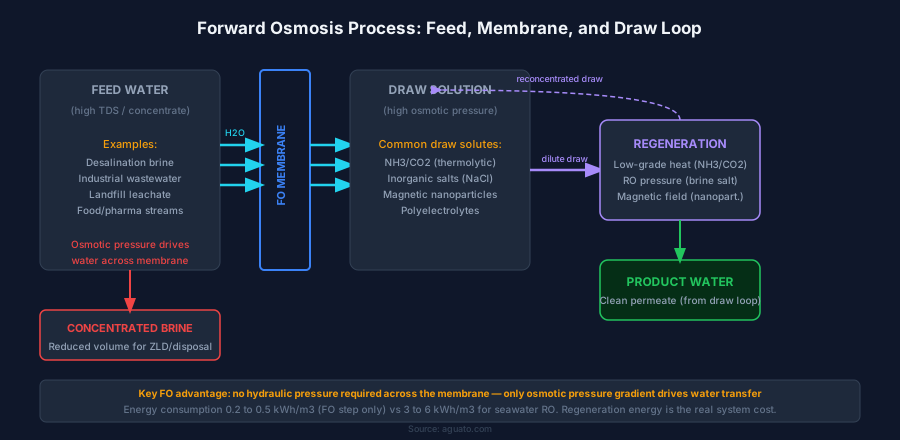
Forward osmosis operates on the opposite principle. The membrane is placed between a feed solution (the water to be treated) and a draw solution (a highly concentrated solution with osmotic pressure deliberately higher than the feed). Water moves spontaneously from the lower-osmotic-pressure feed to the higher-osmotic-pressure draw. No applied hydraulic pressure is needed across the membrane.
The key distinction is that FO does not produce purified water directly. It produces a diluted draw solution. The purified water is only recovered when the draw solution is regenerated, which requires an energy input. The total energy cost of an FO system is not just the osmotic driving step but the draw regeneration step as well. For thermolytic draw solutions like ammonia-[carbon dioxide](/elements/carbon) mixtures, regeneration uses low-grade heat. For salt-based draw solutions, regeneration typically uses a secondary RO pass on the diluted draw.
The process flow diagram below shows the two-loop structure of a forward osmosis system.
The FO membrane itself resembles an RO membrane in structure: it is a thin-film composite or cellulose triacetate semi-permeable barrier that rejects dissolved solutes while allowing water to pass. What distinguishes FO membranes is their orientation and internal concentration polarisation management. In RO, the dense rejection layer faces the high-pressure feed. In FO, the orientation depends on the operating mode: PRO mode (pressure-retarded osmosis, used for power generation) or FO mode (used for concentration and purification), each with different fouling characteristics.
## The osmotic membrane: materials and configuration
The two dominant FO membrane materials are cellulose triacetate (CTA) and thin-film composite polyamide (TFC-PA). CTA membranes, pioneered by HTI (now Hydration Technology Innovations), were the original commercial FO membrane. They have moderate water flux and salt rejection but tolerate [chlorine](/elements/chlorine) disinfection and are resistant to biofouling relative to polyamide. TFC-PA membranes offer higher water flux and better salt rejection but are chlorine-intolerant and more susceptible to biofouling, the same trade-off familiar from RO membrane selection.
Hollow fibre FO modules pack more membrane area per unit volume than flat-sheet elements. They are used in applications where compactness is important, such as emergency water treatment and osmotic dilution for beverages. Flat-sheet spiral wound elements dominate larger industrial installations where robustness and cleanability are priorities.
The critical engineering challenge in FO membrane design is internal concentration polarisation (ICP). Because the draw solution must penetrate into the porous support layer of the membrane to access the active rejection layer, the effective osmotic driving force is reduced by concentration gradients that build up within the porous structure. ICP is the main reason that real-world FO fluxes are significantly lower than theoretical calculations based on bulk osmotic pressures would suggest. Reducing ICP requires membranes with highly porous, low-tortuosity support layers, which is why FO membrane development has focused on substrate engineering as much as rejection layer chemistry.
## Draw solution selection and the regeneration challenge
Draw solution selection is the most consequential engineering decision in an FO system design. The draw solution must have an osmotic pressure substantially higher than the feed (by at least 10 to 20 bar to achieve reasonable flux), must be compatible with the membrane, must not cause reverse diffusion of solutes into the feed water at unacceptable levels, and must be regenerable at acceptable energy cost.
The energy cost of draw regeneration is where most FO projects fail economically. If the draw solution cannot be regenerated efficiently, the apparent advantage of low hydraulic pressure in the FO step is negated by high energy or high chemical consumption in regeneration.
For desalination and water treatment applications, the most-studied draw solutions fall into three categories:
Inorganic salts (NaCl, MgCl2, NH4HCO3): High osmotic pressure, inexpensive, but require an RO or nanofiltration step for regeneration. Essentially, using NaCl as a draw solution converts an FO system into a two-stage process (FO + RO for draw recovery) with the product water coming from the RO permeate of the diluted draw. The energy savings from operating the RO against a diluted draw rather than the original high-TDS feed are real but modest.
Thermolytic solutions (NH3/CO2 mixtures): The ammonia-carbon dioxide system can be regenerated by mild heating to around 60 degrees Celsius, which drives off the gases that can be re-absorbed to regenerate fresh draw solution. This is attractive for systems with access to low-grade waste heat. The limitation is that residual NH3 contamination in the product water requires careful stripping, and the chemicals handling requirements for ammonia at industrial scale are significant.
Stimuli-responsive polymers and nanoparticles: Magnetic nanoparticles that can be separated by magnetic field, and thermoresponsive polymers that precipitate above their lower critical solution temperature, have been studied extensively in academic literature. Commercial deployment at meaningful scale has been limited. These are solutions looking for a manufacturing problem, not a manufacturing-ready technology.
According to [research published by the IDA (International Desalination Association)](dofollow:https://www.idadesal.org), the levelised cost of forward osmosis desalination systems remains 15 to 40% higher than conventional SWRO for most applications due to draw regeneration energy, but the gap narrows significantly in niche applications where the feed TDS exceeds 70,000 mg/L or where low-grade heat is available at near-zero cost.
## Industrial applications where FO has genuine traction
The applications where FO is genuinely competitive, not just theoretically interesting, are defined by two conditions: either the feed water TDS is above the practical RO range, or the feed water has a fouling character that makes RO membrane life unacceptably short and FO's reversible fouling gives a meaningful operational advantage.
Concentrate treatment and zero liquid discharge pre-concentration: When an RO system produces a brine concentrate at 40,000 to 70,000 mg/L TDS, further volume reduction for ZLD requires thermal evaporation or high-pressure HPRO. FO can concentrate this RO reject further before the thermal step, reducing the volume entering the evaporator and cutting evaporator energy consumption. The FO unit operates against the high-osmotic-pressure concentrate as the feed, using a higher-concentration draw solution, and passes water to a secondary RO for draw regeneration. This hybrid FO-RO configuration for concentrate treatment has seen commercial installations in mining, power generation, and industrial wastewater in the 2018 to 2024 period.
Landfill leachate treatment: Landfill leachate is among the most difficult industrial wastewaters, typically containing 5,000 to 50,000 mg/L TDS with high concentrations of ammonia, recalcitrant organics, heavy metals, and suspended solids. RO fouling in leachate treatment is severe and membrane life is short. FO's largely reversible fouling, combined with its ability to concentrate leachate before an evaporation step, has driven pilot and commercial installations at landfill sites in Europe and Asia. The [FO leachate treatment work documented by the EU-funded research consortium HORIZON WATER](dofollow:https://ec.europa.eu/research/) demonstrated 70% volume reduction of leachate using FO pre-concentration at a Belgian landfill site, reducing evaporation costs by approximately 60%.
Brine mining and resource recovery: When the draw solution is selected to also have value, FO can concentrate a target resource from a dilute feed while simultaneously concentrating a valuable stream. Applications include extracting ammonium sulphate from wastewater streams where the draw solution is the ammonium sulphate product, and pre-concentrating lithium-bearing brines for DLE (direct lithium extraction) systems where concentrated brine reduces downstream processing volumes.
Emergency water treatment: Hydratable pouches using FO membranes with sugar or salt draw solutions were the original commercial FO application. The soldier's water pouch, which can extract water from contaminated river or pond water through an FO membrane using a concentrated sports drink as the draw, is a genuine FO commercial product. At industrial scale this application is niche, but it demonstrates the core advantage of FO for unelectrified field applications.
Food and beverage concentration: Thermal concentration of fruit juices, dairy products, and other heat-sensitive streams degrades flavour and destroys heat-labile nutrients. FO concentration, which operates at ambient temperature, can concentrate these streams without the thermal impact. The draw solution in food applications is typically a food-grade concentrated solution, most commonly sucrose. The product is the concentrated feed, and the water that migrates to the draw is treated separately.
## FO in concentrate management and ZLD pre-concentration
Zero liquid discharge is the application where forward osmosis has the clearest economic case against conventional alternatives. The challenge in ZLD systems is that mechanical vapour recompression (MVR) evaporators and crystallisers are very energy-intensive, typically consuming 12 to 20 kWh per m3 of water evaporated. Their capital cost is also high, roughly 2 to 5 million euros per m3/day of evaporator capacity. Reducing the volume that enters the evaporator is therefore extremely high-value.
If an RO system produces concentrate at 35,000 mg/L TDS and the goal is ZLD, the evaporator must handle 100% of the concentrate volume. If FO can concentrate that stream from 35,000 to 80,000 mg/L TDS before the evaporator, the evaporator handles roughly 50% less volume, halving its capital and operating cost. Whether the FO system is cheaper than the avoided evaporator capacity depends on the specific draw solution and regeneration economics, but for high-salinity industrial applications the calculation often favours the FO-MVR hybrid over a standalone MVR system.
The [zero liquid discharge guide](/resources/zero-liquid-discharge) covers the full ZLD technology stack in detail. The key insight specific to FO in this context is that FO pre-concentration is most valuable when the RO concentrate is already at moderate to high TDS, and the volume entering the thermal step is large enough that the FO capital cost is amortised across meaningful evaporator savings.
Browse [membrane filtration specialists on Aguato](/membrane-filtration-companies) who can evaluate whether FO pre-concentration suits your specific concentrate chemistry and volume.
## FO for food, beverage, and pharmaceutical concentration
Pharmaceutical concentration is a genuinely important FO application. Biopharmaceutical manufacturers produce protein concentrates, vaccine intermediates, and API solutions that must be concentrated without the denaturation that heat treatment causes. Traditional ultrafiltration concentration works for many proteins but cannot reach very high concentration factors before osmotic back-pressure limits the process. FO, by contrast, can concentrate against a high-osmotic-pressure draw without the pressure limitations of UF, and operates at ambient temperature throughout.
The pharmaceutical application uses the reverse of the typical desalination logic. In desalination, the product is the water. In pharmaceutical concentration, the product is the concentrated feed (the protein or API solution), and the water that crosses the membrane to the draw is a by-product. Draw solution compatibility with pharmaceutical cleanliness requirements (no leakage of draw solute into the product) is critical, and this constraint pushes pharmaceutical FO systems toward inert, non-toxic draw solutions that can be fully detected and removed if trace contamination occurs.
For food applications, osmotic concentration of fruit juices, tomato paste, coffee, and dairy has been demonstrated at pilot scale. The advantage is flavour preservation. The limitation is that food-grade draw solutions tend to be expensive, and the regulatory requirements for ensuring no draw solute migration into the food product add complexity. Commercial deployments in food processing have been limited to date, primarily because conventional thermal evaporation is well-understood, cheap, and familiar to food industry operators who are conservative about novel process technologies.
## Hybrid FO-RO systems
The FO-RO hybrid configuration, where FO concentrates a difficult feed and RO regenerates the draw while producing product water, is the architecture that has produced the most credible industrial deployments. The logic is that the FO membrane operates against a feed that would foul or exceed the pressure limits of a direct RO system, while the RO operates against a much cleaner, lower-TDS draw solution (the diluted draw) than it would face if processing the original feed directly.
The canonical FO-RO hybrid for seawater RO energy recovery uses FO as the pre-treatment step for seawater desalination where a high-salinity wastewater can be used as the draw. The wastewater, which would normally require expensive treatment before discharge, instead serves as the driving force for extracting fresh water from seawater via FO. Product water comes from an RO pass on the diluted wastewater stream. This configuration has been piloted at multiple sites but has not reached full commercial scale, partly because the economics depend on having a co-located high-TDS wastewater stream and a seawater feed, which is a specific combination not widely available.
For ZLD and concentrate treatment, the FO-RO hybrid is closer to commercial reality. [Evaporation and crystallisation systems for ZLD](/resources/evaporation-crystallization-zld) are increasingly being paired with FO pre-concentration to reduce thermal step duty. Post your water treatment challenge and [compare specialist proposals on Aguato](/post-project) to evaluate whether FO-RO hybrid economics work for your specific application.
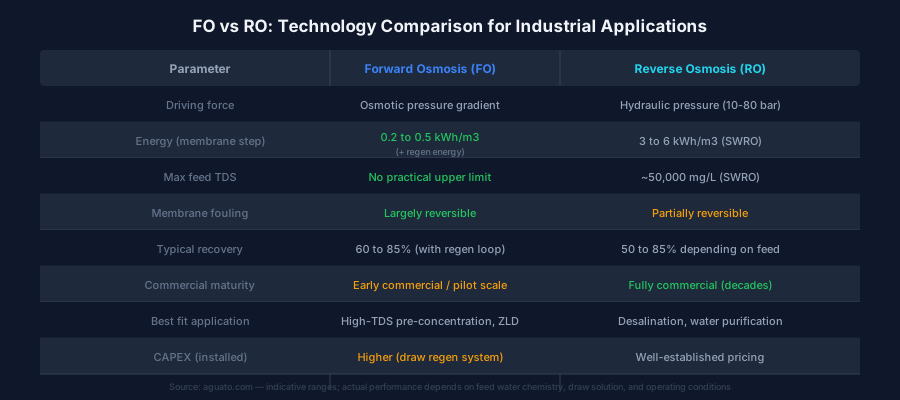
The comparison table below summarises FO versus RO characteristics across key dimensions.
## Technology and cost comparison
The cost structure of FO differs fundamentally from RO in ways that make direct comparison difficult. An RO system's dominant cost is energy (pumping to operating pressure) and membrane replacement. An FO system's dominant cost is the draw regeneration system and its energy or chemical consumption.
For a system treating a feed at 80,000 mg/L TDS that would require high-pressure RO or FO:
High-pressure RO (HPRO): CAPEX approximately 2,000 to 4,000 euros per m3/day capacity. Energy 10 to 15 kWh/m3. High membrane replacement frequency due to osmotic pressure and scaling.
FO with thermolytic NH3/CO2 draw: CAPEX approximately 3,000 to 6,000 euros per m3/day capacity (draw regeneration system adds cost). Energy 0.3 to 0.5 kWh/m3 for FO step plus 80 to 120 kWh per tonne of water for low-pressure steam regeneration. If the steam is available as waste heat at near-zero cost, total energy can be lower than HPRO. If steam must be generated from fuel, total energy cost is higher.
FO with salt-based draw plus RO regeneration: CAPEX approximately 2,500 to 5,000 euros per m3/day. Energy 0.3 to 0.5 kWh/m3 (FO) plus 0.5 to 1.5 kWh/m3 (secondary RO on diluted draw). Total 0.8 to 2.0 kWh/m3 if the secondary RO operates against a manageable draw concentration.
The numbers show that FO is not inherently cheap. Its advantage is either enabling treatment of streams that RO cannot handle at any price, or reducing the volume entering expensive downstream thermal steps.
## Where forward osmosis projects fail
FO project failures follow predictable patterns, and almost all of them trace back to one of four root causes.
Draw solution not evaluated rigorously before commitment: Academic literature is full of draw solutions that look promising in laboratory settings. Magnetic nanoparticles, thermoresponsive polymers, and organic draw solutes have all been published extensively. Most do not survive contact with real industrial conditions: fouling of the draw recovery system, chemical incompatibility with the feed, prohibitive cost at scale, or regeneration efficiency that drops sharply at full-scale flow rates. Projects that select a draw solution based on literature data without running a thorough pilot are at high risk.
FO membrane internal concentration polarisation underestimated: Real-world FO flux is typically 30 to 60% of the flux predicted by bulk osmotic pressure calculations because of ICP. Projects that size FO systems based on theoretical flux require significant membrane area correction when actual performance is measured. A conservative design factor of 2 to 3 times the theoretical flux for the required membrane area is appropriate for preliminary sizing.
Draw regeneration energy not included in total cost: This is the most common error in FO economic analysis. Comparing the energy of the FO membrane step (0.2 to 0.5 kWh/m3) with the energy of a competing RO system (3 to 6 kWh/m3 for SWRO) without adding draw regeneration energy creates a false impression of FO's advantage. The fully integrated energy calculation always includes the draw side.
Pilot duration too short to observe long-term fouling: FO's advantage of reversible fouling is real, but reversible does not mean absent. Biofouling of FO membranes, especially in feed streams with high organic loads such as wastewater and leachate, accumulates over time. Pilots shorter than 6 months do not capture the full fouling trajectory. Projects that scale up from 3-month pilots and discover that cleaning frequency increases sharply after 12 months have systematically underestimated the operating cost.
Use [Aguato's Nepti tool](/nepti) to model your water matrix and run scenarios that include draw solution regeneration energy before committing to an FO system configuration.
## FAQ
### What is the main advantage of forward osmosis over reverse osmosis?
Forward osmosis operates without applied hydraulic pressure across the membrane, which means it can treat feed streams at TDS concentrations above the practical range of RO (typically above 50,000 to 70,000 mg/L) and it produces a fouling pattern that is largely reversible, extending membrane life in difficult feed streams. The disadvantage is that an FO system requires a draw solution regeneration loop that adds capital cost and, depending on the draw chemistry, significant energy or chemical cost.
### What draw solutions are used in commercial forward osmosis systems?
Commercial FO systems primarily use concentrated inorganic salt solutions (commonly sodium chloride or ammonium bicarbonate) as draw solutions, with regeneration by a secondary RO or NF pass. Thermolytic ammonium-carbon dioxide solutions, regenerated by mild heating, are used in systems with access to low-grade waste heat. Academic research has explored magnetic nanoparticles, thermoresponsive polymers, and ionic liquids, but these have not reached commercial industrial scale as of 2025.
### Is forward osmosis more energy-efficient than reverse osmosis?
For the membrane step alone, yes: FO consumes 0.2 to 0.5 kWh/m3 versus 3 to 6 kWh/m3 for seawater RO. But the FO membrane step produces a diluted draw solution, not product water. The product water is only recovered after draw regeneration, which consumes additional energy. When draw regeneration energy is included, total FO system energy is comparable to or higher than RO for most applications. The exception is systems where low-grade waste heat is available for thermolytic draw regeneration, in which case effective energy cost is lower.
### What is internal concentration polarisation and why does it matter?
Internal concentration polarisation (ICP) is the buildup of concentration gradients within the porous support layer of an FO membrane. It reduces the effective osmotic driving force and significantly lowers real-world water flux compared to theoretical calculations based on bulk osmotic pressures. ICP is the primary reason that FO membrane area requirements at full scale are 2 to 3 times higher than theoretical sizing would suggest, with direct implications for CAPEX. Reducing ICP through membrane substrate engineering is the central challenge in FO membrane development.
### Where is forward osmosis commercially deployed today?
As of 2025, the most commercially established FO applications are emergency water treatment pouches for remote or military use, brine concentration for ZLD pre-treatment in power and mining sectors, and landfill leachate concentration before thermal treatment. FO-RO hybrid systems for seawater desalination and pharmaceutical concentration are at the commercial pilot and early commercial stages. Food processing osmotic concentration remains primarily at pilot scale.
### How does the cost of forward osmosis compare to conventional RO?
For applications where both are technically feasible, FO systems typically have 20 to 50% higher CAPEX than equivalent RO systems due to the draw regeneration system. OPEX depends heavily on draw regeneration energy and chemistry. For applications where RO is not technically feasible due to feed TDS or fouling character, the comparison is not RO versus FO but FO versus thermal treatment or disposal, where FO often has a strong economic case.