Mis-sized RO plants miss 25 to 30% of capacity every winter and cost $300K to $900K over their life. Here are the six design inputs, the capacity bands, and the procurement framework to specify correctly.
Reverse osmosis sizing is where capital cost, energy cost, and operational risk are locked in for the next 15 years. A 1,000 m3/day RO system specified at the wrong recovery rate carries $80,000 to $150,000 of unnecessary annual OPEX. A system sized at the wrong design temperature operates 12 to 18% below its nameplate output every winter. A system with the wrong number of trains carries an unplanned redundancy gap that surfaces the first time a membrane element fails out of cycle. Most of these errors are made in the first 48 hours of a procurement, in a spreadsheet that nobody outside the vendor's engineering team will see again.
The default approach across the industry is to give vendors a single number, "we need 1,000 m3/day RO permeate", and let them propose. That gives the vendor full latitude to optimise for their own product line, not for the buyer's lifecycle cost. A vendor selling 8-inch elements will propose a configuration that consumes more elements. A vendor whose pumps are oversized for the duty will propose more pressure margin than the system needs. A vendor without a strong design team will copy the last project's bill of materials and call it the answer.
This guide gives engineering, operations, and procurement teams the framework for sizing an industrial RO system correctly before any vendor is in the room: the six design inputs that determine the configuration, the recovery and flux mathematics that constrain the answer, the capacity bands that span 100 m3/day to 10,000 m3/day, the temperature and fouling margins that prevent winter underperformance, the redundancy logic that protects uptime, and the procurement structure that forces vendors to bid against the buyer's specification rather than their own.
## The decision in brief
- Specify the RO plant on the six-input characterisation, the cold-design rule and 15-year TCO procurement. You typically save $300,000 to $900,000 on a 1,000 m3/d plant across the asset's life, split across three avoided costs that show up in operations. - Design for winter, and for the right recovery and flux. $100,000 to $300,000 of that is avoided winter capacity shortfall remediation, and $80,000 to $250,000 is avoided premature membrane replacement from recovery- or flux-misspecification. - Specify the flux margin correctly. The largest single line, $120,000 to $350,000, is the CIP overhead you avoid across the asset's life when the flux margin is correctly specified at the outset.
The biggest cost of doing nothing is letting the vendor with the largest sales footprint configure the plant from their preferred bill of materials and discovering the cost impact in operations year 2.
## What "sizing an RO system" actually means
Sizing an RO system means determining seven configuration parameters that together define the plant: total permeate flow at design conditions, recovery rate (permeate divided by feed), number of stages (1, 2, or 3), element count and arrangement (typically 6 or 7 elements per pressure vessel, vessels per stage in a staged array), pump pressure and flow, train count with redundancy, and storage tank capacity for downstream demand shaping. Each of these is constrained by feed water chemistry, target permeate quality, and the operating envelope the membrane manufacturer will warrant.
The output of correct sizing is not "the right RO plant". It is a specification document that lets three or four vendor teams propose comparable systems, against which the buyer can run a like-for-like 15-year TCO comparison. Without that specification document, the procurement becomes vendor-led: each vendor proposes their preferred configuration, the comparison sheet has incompatible cells, and the buyer ends up picking the lowest-bid quote without knowing what was traded off.
The closest cousin technology context is described in our [reverse osmosis systems](/resources/reverse-osmosis-systems) article, which covers the technology fundamentals, membrane chemistry, and a high-level technology overview. The current article focuses specifically on the sizing math and procurement framework.
## The six design inputs that drive the configuration
The six inputs below determine 80 to 90% of the final plant cost. Each one independently shifts CAPEX, OPEX, or recovery by 10 to 40%, and getting any one of them wrong cascades into the others. They must be characterised before any vendor proposal is meaningful.
A pattern recurs in industrial RO procurements: the buyer characterises feed water TDS, gives the vendor the target permeate flow, and treats the other four inputs as defaults the vendor sets. That handoff gives the vendor structural latitude to optimise for their product line and not for the buyer's lifecycle cost. The fix is to define all six inputs upfront in a specification document the vendor responds to with a configuration, not the other way around. The diagram below summarises each input and the dimension of plant cost it drives.
The cost-impact bands shown are not industry averages; they are the median observed shifts when an input changes by one standard band (e.g. cold design temperature dropping from 25 °C to 15 °C, or recovery target rising from 75% to 85% on the same feed water). Use them as the order-of-magnitude check on any vendor proposal: a proposal where a 10 °C temperature shift produces a 5% capacity change is a proposal whose sizing math does not match physical chemistry.
The six inputs are presented as independent because, mathematically, each one shifts the configuration in a distinct dimension. In practice they interact. A higher recovery target combined with a colder feed temperature compounds: the cold derate forces more membrane area, the higher recovery forces tighter saturation management, and the resulting plant carries both penalties simultaneously. A duty profile with sharp peaks combined with a cold-design rule forces both more trains and more membrane area, layering CAPEX margin twice. The procurement specification has to treat the inputs as a system, not as a checklist, and the vendor proposal has to respond to the system rather than to each input independently.
A common procurement failure mode is to characterise the inputs with single-point estimates (one TDS number, one temperature, one duty rate) and ignore the seasonal and load-dependent variation that the operating plant will see. The right approach is to characterise each input as a band (TDS range with seasonal high; temperature range with cold-design value; duty range with peak factor) and let the vendor explicitly show how their proposed configuration handles each band. A vendor that responds with only the design-point performance and not the off-design behaviour is signalling that the sizing is optimised for the brochure, not for the plant's actual operating year.
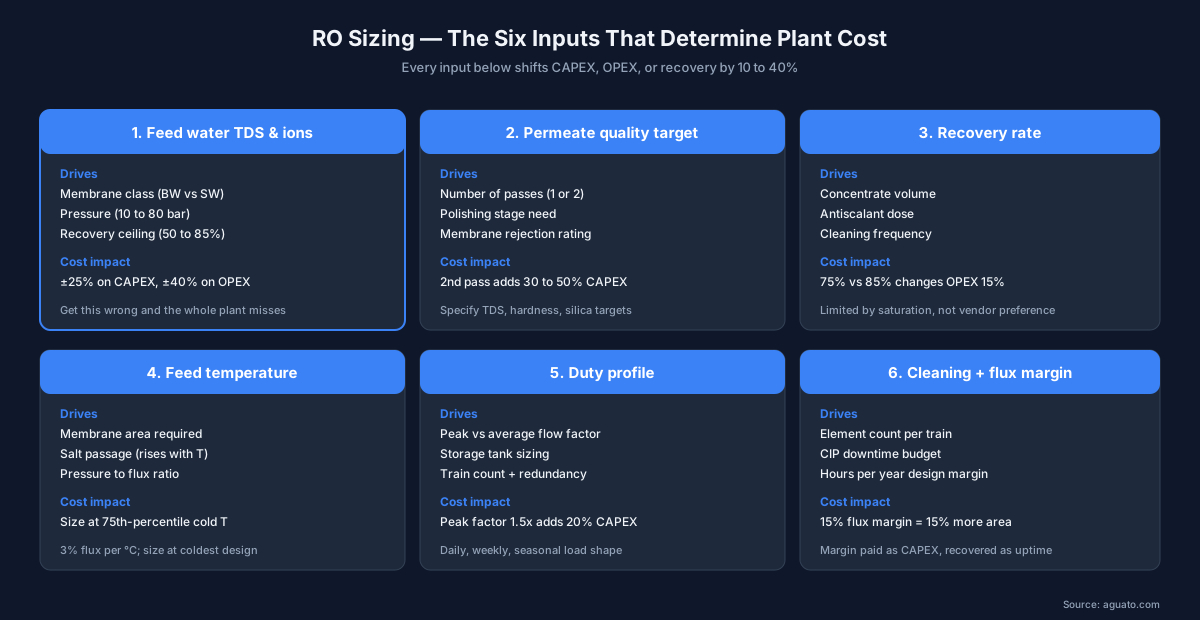
Input 1: Feed water TDS and ionic composition. Drives membrane class (brackish water vs seawater), feed pressure (10 to 80 bar), and recovery ceiling. A TDS of 500 mg/L with low silica supports 85% recovery on a brackish-water membrane at 12 to 18 bar; a TDS of 35,000 mg/L on seawater membranes demands 55 to 70 bar and caps recovery at 40 to 50%. The full ionic profile ([calcium](/elements/calcium), [magnesium](/elements/magnesium), sulfate, silica, iron, barium, strontium) matters as much as the TDS number because the saturation limits of sparingly soluble salts cap recovery before the osmotic pressure does.
Input 2: Permeate quality target. Drives the number of passes (single-pass for most industrial duty; double-pass for boiler feed, semiconductor UPW, pharma WFI prep, or RO-EDI feed) and the polishing stage downstream. A 90% TDS rejection from one membrane class is fine for cooling tower makeup; the same rejection on a UPW plant is two orders of magnitude away from target and triggers a double-pass plus EDI polish, which roughly doubles plant CAPEX.
Input 3: Recovery rate. The single most consequential output of the sizing exercise. Driven by feed chemistry (saturation indices for CaCO3, CaSO4, BaSO4, SrSO4, silica), antiscalant chemistry, and the buyer's tolerance for concentrate disposal cost. Recovery rates above 75% require careful sparingly-soluble-salt management; above 85% they require advanced antiscalant regimes that are duty-tested rather than default-specified.
Input 4: Feed temperature. Membrane flux changes roughly 3% per °C. A plant sized at 25 °C summer feed conditions will produce only 70 to 75% of its nameplate output at 5 °C winter feed. The cold-design rule below addresses this.
Input 5: Duty profile. Continuous 24x7 duty versus daytime-only operation versus seasonal variation each demand a different train count and storage tank sizing. Plants sized at average flow without considering the peak factor produce intermittent supply gaps that are diagnosed only after commissioning.
Input 6: Cleaning and flux margin. Every RO plant accumulates fouling between CIPs, which reduces flux. The design flux must include a 10 to 20% margin above the post-CIP recovered flux to support stable operation between cleanings. The margin is paid as CAPEX (more membrane area, more elements) and recovered as uptime. Plants sized without flux margin run their pressure higher to maintain output, which accelerates fouling, which shortens CIP intervals, in a feedback loop that operations teams cannot fix without a redesign.
The [Water Research Foundation's reports on industrial RO design](dofollow:https://www.waterrf.org) explicitly recommend characterising all six inputs as a pre-procurement design step, and the same source notes that 60 to 70% of underperforming RO plants in their field survey traced the problem to one of these six inputs being defaulted by the vendor rather than specified by the buyer.
## Recovery, flux, and the limits the chemistry imposes
Recovery is the percentage of feed water that becomes permeate. The remainder is concentrate (also called reject or brine). A 75% recovery plant turns 100 m3/h of feed into 75 m3/h of permeate and 25 m3/h of concentrate. The arithmetic is simple; the constraints are not.
Recovery is limited by saturation, not by vendor preference. As feed water is concentrated through the system, dissolved salts become progressively more concentrated in the reject stream. When the concentration in the last element exceeds the saturation index of any sparingly soluble salt, that salt precipitates onto the membrane surface and the plant fouls within weeks. The relevant indices are LSI (calcium carbonate), S&DSI (calcium sulfate), and silica solubility. Each membrane manufacturer publishes the recovery ceiling at the feed chemistry the plant will see; respect that ceiling.
Flux is the permeate flow per unit membrane area. Typical industrial RO design flux is 12 to 20 LMH (litres per square metre per hour) at 25 °C. Higher flux means fewer membrane elements (lower CAPEX) but accelerated fouling and higher cleaning frequency. Lower flux means more elements (higher CAPEX) but longer runs between cleanings. The right flux for a given duty depends on the feed water silt density index (SDI) and the operations team's tolerance for CIP frequency. A vendor that proposes 22 LMH on a feed water with SDI > 4 is leading the buyer to a 6-month-into-operation problem.
## Capacity bands and what they cost
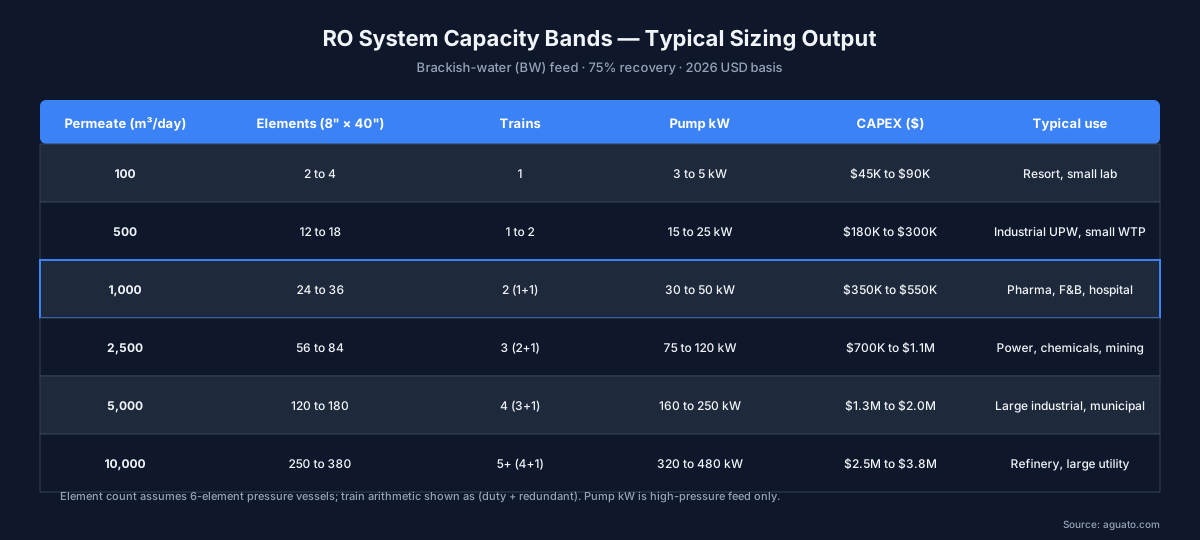
The table below summarises typical industrial RO sizing outputs across six capacity bands. Figures assume brackish-water feed with TDS 800 to 3,000 mg/L, 75% recovery on a single-pass system, 2026 USD basis. The cost band reflects the spread between budget vendor configurations and premium configurations with full instrumentation, redundancy, and commissioning support.
Two non-obvious patterns drop out of this comparison.
First, per-cubic-metre CAPEX falls roughly 35% from a 100 m3/d plant to a 10,000 m3/d plant ($450/m3/d to $300/m3/d in the bands above). Economies of scale exist but plateau above 2,000 to 3,000 m3/d as the system architecture stops compounding (the same pump count, the same instrument set, the same controls package serves a wider range of element counts). The implication: small plants pay a real cost-of-being-small that doesn't go away with vendor selection.
Second, the train arithmetic shifts at the 1,000 m3/d threshold. Below that, single-train configurations are common; above it, 2 or 3 trains running in parallel become the default because the redundancy logic of an N+1 arrangement (one extra train standing by) gives operations cover for CIP and membrane replacement without losing the whole plant. The CAPEX premium for N+1 redundancy is typically 25 to 40% on small plants and 15 to 20% on plants above 5,000 m3/d.
## Temperature derating and the cold-design rule
Temperature is the most frequently mis-specified input in RO sizing. Membrane permeability changes approximately 3% per degree Celsius, so a plant designed at 25 °C feed will produce only 70 to 75% of its nameplate output at 5 °C feed water. In any climate with winter feed water below 15 °C, this is the difference between an RO plant that meets demand year-round and one that requires emergency capacity additions every December through March.
The cold-design rule: size the membrane area for the coldest design feed temperature the site sees in a typical winter, not the annual average or summer maximum. If the site's feed water profile is 25 °C summer, 18 °C average, 8 °C winter, the design temperature for sizing is 8 °C. The plant will then run with excess capacity in summer (a margin that can be used for CIP scheduling or for absorbing demand spikes) and meet nameplate output in winter. A plant designed at 25 °C will run flat-out in winter, which accelerates fouling, increases pressure, shortens membrane life, and produces intermittent supply gaps that operations cannot resolve without a redesign.
The CAPEX penalty for cold-design sizing is typically 15 to 25% in temperate climates and 25 to 40% in cold-climate sites. That penalty is paid once at construction; the lifetime cost of skipping it (winter capacity shortfall, accelerated fouling, repeated emergency CIPs, premature membrane replacement) is 2 to 4 times higher over the asset's life.
## Train count, redundancy, and uptime targets
The train count decision is where uptime targets meet capital constraint. A plant with one train cannot lose membrane capacity without losing the whole plant. A plant with two equal trains (2 × 50% duty) loses half its capacity during a CIP or membrane change-out. A plant with three trains at 1/3 duty each loses only a third. A plant with N+1 redundancy (e.g. 3 duty trains plus 1 standby of equal size) can lose any one train without losing capacity.
The threshold logic:
- Plants below 500 m3/d typically run as a single train with hot-spare elements on site; downtime during membrane work is acceptable. - Plants 500 to 2,000 m3/d run as 1+1 (one duty, one standby) or 2 × 50% configurations, with operations choosing between downtime tolerance and CAPEX overhead. - Plants 2,000 to 5,000 m3/d run as 2+1 or 3-train-equal configurations, with N+1 increasingly standard above 3,000 m3/d. - Plants above 5,000 m3/d almost always run N+1 with all trains hot-swappable, because the downtime cost of a single train outage at this scale is in the $50,000 to $200,000 per day range.
The redundancy decision is also where the operations team's profile matters. A site with a junior operations team or limited spares logistics needs more train-level redundancy than a site with a dedicated membrane-services contract. Vendors who quote in the [reverse osmosis provider category](/reverse-osmosis-companies) should be asked to present their train arithmetic explicitly, not embedded inside a bill of materials.
According to the [International Desalination Association's design guidelines](dofollow:https://idadesal.org) the typical uptime target for industrial RO is 95 to 98% on a 24x7 basis, which usually requires N+1 redundancy at any plant size where the duty exceeds 1,500 m3/d. The same reference notes that membrane replacement cycles, CIP frequency, and pump operating bands materially shift the achievable uptime even at the same train count, which is why the redundancy decision is incomplete without the surrounding bill-of-materials choices.
[cta:nepti-dark]
The next section maps the common sizing errors observed in industrial RO procurements over the past decade. Each one is upstream of operations, and each one is preventable with a tighter procurement specification.
## Common sizing errors and what they cost
Five errors account for almost every underperforming RO plant in the field. None of them are exotic engineering failures; all of them are upstream decisions that the procurement document should have prevented.
Error 1: Sizing at the wrong feed temperature. Plant sized at 25 °C, operated at 8 °C. Cost: 25 to 30% capacity shortfall in winter, repeated emergency capacity additions, accelerated fouling.
Error 2: Pushing recovery above the chemistry limit. Vendor proposes 85% recovery on feed water with silica at 25 mg/L and the wrong antiscalant. Plant runs fine for 8 to 12 weeks, then silica fouling appears, then CIP frequency rises, then membrane replacement at year 2 instead of year 5. Cost: $80,000 to $200,000 of premature replacement plus 6 to 12 months of operating under degraded performance.
Error 3: Specifying flux above what the SDI supports. Vendor proposes 22 LMH on feed water with SDI 4 to 5. Plant fouls 2 to 3x faster than design, CIP intervals drop from quarterly to monthly, chemistry OPEX doubles. Cost: $40,000 to $120,000 per year in extra CIP cost plus accelerated membrane wear.
Error 4: Skipping the cold-design rule. Already covered above; the most common single cause of winter capacity shortfall.
Error 5: Buying the lowest-bid configuration without scrutinising the bill of materials. Two vendors quote the same nameplate; one uses 7-year-life premium membranes and the other uses 3-year commodity elements; the second wins on Day-1 CAPEX and loses by $250,000 over 10 years on accelerated replacement. Cost: typically $100,000 to $400,000 over a decade on a 1,000 m3/d plant.
The pattern that unites all five errors is asymmetric information at the procurement table. The vendor knows their product line, their warranty trigger points, and their replacement cycle assumptions in detail. The buyer typically knows the headline number and trusts the rest. The fix is structural: write a procurement specification that forces the vendor to disclose what they would otherwise default. Every error above is preventable with one document; ignoring that document is what makes the errors statistically inevitable.
A useful pre-procurement exercise is to ask the in-house engineering team to draft what they think the right configuration is, then compare it to vendor proposals. Where the proposals diverge from the in-house draft on any of the six inputs, the vendor must justify the divergence with evidence. This single procedural step typically catches 80 to 90% of the upstream sizing errors before they enter the bill of materials.
## How to specify the procurement so vendors compete on the same problem
The procurement specification is what converts vendor competition into buyer leverage. Three rules govern it:
Rule 1: Specify the six design inputs as fixed values, not vendor decisions. Feed water characterisation (TDS, full ionic profile, SDI, temperature range, peaking factor), permeate quality target (TDS, hardness, silica, organics), recovery target (or recovery range with a saturation constraint), duty profile (24x7 vs intermittent), uptime target, and design temperature. With these fixed, vendors propose configurations against the same problem.
Rule 2: Demand the bill of materials in a fixed disclosure template. Element model and warranty period, pump make and model, instrument list, control system, CIP system architecture, antiscalant and chemistry vendor, performance guarantee on flux and rejection. A vendor that resists this disclosure is a vendor whose configuration cannot survive a like-for-like comparison.
Rule 3: Require a 15-year TCO response in a fixed format. CAPEX, annual energy at the specified flux and pressure, annual chemistry cost, replacement cycle and unit cost for membranes, and CIP frequency assumption. Without this template the buyer cannot reconstruct lifecycle cost; with it, the buyer can run the comparison on a single spreadsheet.
For a structured starting point on writing the procurement, [post your project](/post-project) and qualified RO specialists will scope the configuration against your actual feed chemistry, temperature profile, and duty rather than generic ranges. The [US Department of Energy's industrial water management guidance](dofollow:https://www.energy.gov/eere/iedo/industrial-water-management) recommends documenting design assumptions and the lifecycle cost basis for any membrane system as part of an industrial water audit, which gives the procurement team additional cover in any subsequent capital review.
## FAQ
### What is the most important input when sizing an industrial RO system?
Feed water chemistry, specifically the full ionic profile (calcium, magnesium, sulfate, silica, iron, barium, strontium) at the worst-case seasonal condition. This determines the membrane class, the recovery ceiling, and the antiscalant regime. A common mistake is specifying TDS as a single number and treating the ionic composition as a default; that handoff caps recovery 10 to 15 percentage points below where it should be on benign chemistry and pushes recovery 10 to 15 points above where it should be on unfriendly chemistry.
### How do I calculate the recovery rate for an RO system?
Recovery is the ratio of permeate flow to feed flow, expressed as a percentage. The correct recovery target is the highest value at which no sparingly soluble salt in the reject stream exceeds saturation under the chosen antiscalant regime. Typical brackish water RO runs at 70 to 85% recovery; typical seawater RO runs at 40 to 50% recovery. The chemistry calculation should be done by the membrane manufacturer's projection software or an independent design engineer, not estimated by rule of thumb.
### How many membrane elements do I need for a 1,000 m3/day RO system?
Typically 24 to 36 standard 8-inch by 40-inch elements arranged in pressure vessels (6 to 7 elements per vessel, vessels in a 2:1 or 4:2 staged array). The exact count depends on the design flux, feed water temperature, recovery target, and the membrane manufacturer's flux derating. A vendor proposal should justify the count with a flux-and-recovery calculation, not just present a number.
### What is the design feed temperature I should use for sizing?
The coldest seasonal feed temperature the site sees in a typical winter. Membrane flux drops roughly 3% per degree Celsius below 25 °C; a plant sized at the annual average will produce 20 to 30% below nameplate every winter. Sites with feed temperatures consistently above 18 °C year-round can size to a higher reference; sites with cold-water periods below 12 °C must size at that condition or accept seasonal capacity shortfall.
### Should the RO system have one train or multiple trains?
Multiple trains for any plant above roughly 1,000 m3/d, with N+1 redundancy increasingly standard above 3,000 m3/d. The train count decision is driven by uptime tolerance, CIP duration, and the operations team's ability to handle single-train outages. A single-train plant cannot lose the train without losing the whole supply; the cost of that outage scales with plant duty and downstream impact.
### How much does an industrial RO system cost?
CAPEX ranges from roughly $45,000 to $90,000 for a 100 m3/d skid up to $2.5M to $3.8M for a 10,000 m3/d plant. Per-cubic-metre CAPEX falls with scale but plateaus above 2,000 to 3,000 m3/d. The ranges include the RO skid, pumps, instrumentation, and basic CIP infrastructure; civil works, building shell, feed-water pre-treatment, and downstream tankage are typically separate line items in the project budget.
### How do I avoid being upsold on RO equipment by a vendor?
Specify the six design inputs (feed chemistry, permeate target, recovery, temperature, duty, flux margin) and the bill-of-materials disclosure template before any vendor proposal arrives. Demand a 15-year TCO response in a fixed format. The leverage in the procurement is in the specification document, not the negotiation; once the vendor is proposing freely against a vague brief, the buyer has already lost the comparability advantage that makes competition meaningful.