Pharmaceutical manufacturers operate three distinct water grades, each with different USP limits, system architectures, and validation requirements. Getting the wrong grade into the wrong process step does not just fail an audit. The complete guide to PW, WFI, and pure steam selection, system design, and continuous compliance.
Pharmaceutical water is not commodity utility water with a tighter specification. It is a manufactured intermediate: it carries its own pharmacopoeia monograph, its own validation lifecycle, and its own set of failure modes that have caused product recalls, regulatory warning letters, and facility shutdowns. Getting the grade right, designing the system correctly for that grade, and maintaining the validation envelope over the system's operational life is one of the most consequential engineering decisions a pharmaceutical plant makes.
This guide covers the three grades that matter most in pharmaceutical manufacturing: Purified Water (PW), Water for Injection (WFI), and Pure Steam. It covers the USP, EP, and JP limits in precise numerical terms, the system architectures that reliably meet those limits, the validation framework regulators expect to see, and the failure patterns that appear most frequently in FDA 483 observations and EMA inspection reports.
If you are looking for a broader overview of pharmaceutical water treatment technologies, [pharmaceutical water treatment for USP compliance](/resources/pharmaceutical-water-treatment-usp) covers the full technology landscape. This article goes deeper on grade selection, standard limits, and system architecture.
## The decision in brief
- Treat a water system failure as a financial event. An FDA warning letter for water system deficiencies puts any lot produced with that water potentially at risk, and can mean voluntary recalls, delayed facility approval and consent decree risk. The average recall cost for a pharmaceutical product is USD 10 million to USD 50 million for a mid-sized recall event. - Price prevention, which is entirely predictable. A properly designed, validated and monitored WFI system for a mid-sized sterile manufacturing facility costs EUR 600,000 to EUR 1,500,000 in capital and EUR 60,000 to EUR 150,000 per year in OPEX. The annual monitoring and validation maintenance programme costs EUR 30,000 to EUR 80,000 for a well-documented facility. - Revisit the ROI under the EP 2017 membrane change. A membrane-based WFI system at 40 to 60 percent lower capital than distillation, combined with lower operating energy costs, typically achieves payback versus the distillation alternative within 3 to 5 years while meeting the same regulatory standard.
Against those numbers a single product recall or warning letter makes the cost of water system excellence look immaterial, and the question is not whether you can afford a validated system but whether you can afford not to.
For facilities evaluating their current water system investment against alternatives, the [CAPEX vs OPEX framework for water treatment](/resources/water-treatment-capex-opex) provides the structured financial comparison methodology. The [United States Pharmacopeia (USP) pharmaceutical water standards](dofollow:https://www.usp.org/chemical-medicines/pharmaceutical-water) are the primary regulatory reference for US pharmaceutical manufacturers and for export to the US market.
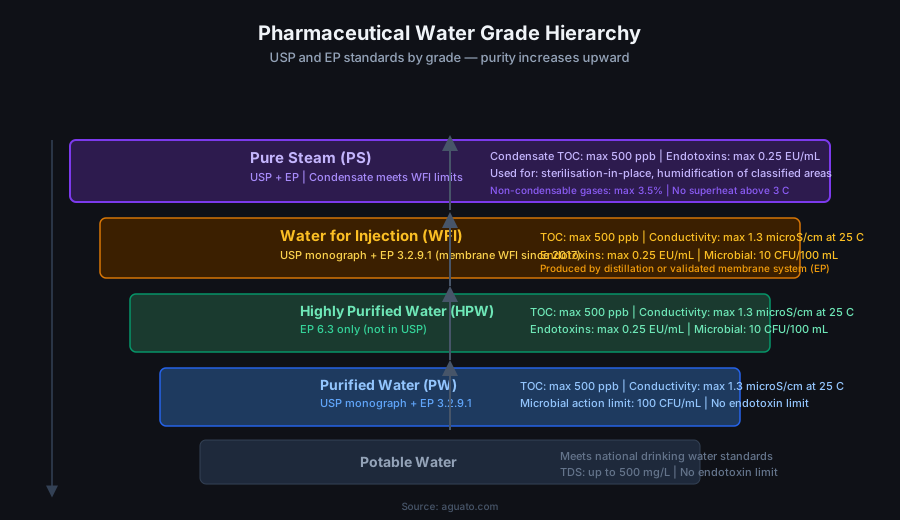
## The pharmaceutical water hierarchy: five grades and what they treat
USP <1231>, the primary reference document for pharmaceutical water in the United States, defines multiple grades of water for pharmaceutical use. Understanding where each sits in the hierarchy prevents the most common specification error: using a lower grade where a higher grade is required, or specifying a higher grade where a lower grade would meet the process need at lower cost.
Potable water (also called drinking water or utility water) is the starting point. It meets national drinking water standards such as EPA NPDWR in the United States. It is acceptable for equipment cleaning where product contact is indirect, and it is the feed source for all downstream purification trains. It is not an official USP pharmaceutical water grade and should never contact pharmaceutical product or product-contact surfaces.
Purified Water (PW) is the first official USP grade. It is produced from potable water by distillation, ion exchange, reverse osmosis, or a combination of these processes. It is used for preparation of non-parenteral pharmaceutical dosage forms, for analytical testing, for cleaning of non-sterile product-contact equipment, and as feed for the WFI still or membrane system. PW does not have an endotoxin limit in USP, which is the defining regulatory difference between PW and WFI.
Highly Purified Water (HPW) is a grade defined by the European Pharmacopoeia but not by USP. It sits between PW and WFI in quality terms. It carries an endotoxin limit of 0.25 EU/mL, the same as WFI, but does not require distillation or validated membrane equivalence for production. HPW is used in some European manufacturing contexts where WFI is not strictly required but endotoxin control is necessary.
Water for Injection (WFI) is the highest purity liquid water grade in all three major pharmacopoeias. It carries both an endotoxin limit and the full PW chemical limits. It is required for parenteral drug preparation, for reconstitution of parenteral dosage forms, and for final rinsing of equipment that contacts sterile product. Until 2017, USP and most national pharmacopoeias required WFI to be produced by distillation. The European Pharmacopoeia update in 2017 (EP 3.1.9.1) opened the door to membrane-based WFI production, fundamentally changing the capital cost equation for new pharmaceutical plants.
Pure Steam is often treated as a minor utility, but it is a pharmaceutical water grade in its own right. The condensate of pure steam must meet WFI limits. It is used for sterilisation of product-contact equipment and containers, for autoclaving of pharmaceutical preparations, and for humidification in clean room environments where steam contacts product or product-contact surfaces. Its absence from some facility validation programmes is one of the most common regulatory observations in sterile manufacturing inspections.
The selection matrix is not complex in principle, but it is frequently misapplied:
- Non-sterile product, no endotoxin concern: Purified Water - Sterile product preparation, parenteral route: Water for Injection - Steam sterilisation of product-contact surfaces: Pure Steam - European manufacturing with endotoxin control but not parenteral: consider HPW vs WFI
## Purified Water: USP limits, system design, and when to use it
USP Purified Water must meet the following chemical and microbiological limits under USP <1231> and the PW monograph:
- Total Organic Carbon (TOC): 500 ppb (0.5 mg/L) maximum - Conductivity: 1.3 microS/cm maximum at 25°C (Stage 1 limit; Stage 2 and Stage 3 limits apply to in-process and bulk testing) - Microbial action limit: 100 CFU/mL (action limit, not a pharmacopoeial specification limit) - Heavy metals, nitrates, sulfates: limits defined in the PW monograph
There is no endotoxin limit for Purified Water in USP. This is the regulatory boundary that separates PW from WFI. A manufacturing site that uses PW for a process that actually requires endotoxin control is operating outside its validated process, even if the TOC and conductivity results are perfect.
The standard system architecture for a Purified Water system involves:
Pre-treatment train: Multimedia filtration or cartridge filtration to remove suspended solids, followed by activated carbon or sodium metabisulfite dosing to remove chlorine residual that would damage downstream membranes. Softening may be included if hardness is high and an RO system is the primary purification step.
Primary purification: Either [reverse osmosis](/resources/reverse-osmosis-industrial) (single or double pass) or distillation. Double-pass RO is the dominant choice for new PW systems because it reliably achieves conductivity targets and reduces TOC below 500 ppb when properly sized and operated. [Ion exchange systems](/resources/ion-exchange-systems-industrial) using mixed bed deionisation can also produce PW-grade water but require careful management of resin regeneration cycles and microbial risk during resin bed idle periods.
Polishing and distribution: Electrodeionisation (EDI) is increasingly used after single-pass RO to achieve target conductivity without chemical regeneration. The distribution loop is typically stainless steel 316L, sanitised periodically by hot water flushing (70 to 80 degrees C for at least one hour) or by ozonation followed by UV destruction before use points. Ambient loops with periodic chemical sanitisation are also used but carry higher microbial risk and require more rigorous trending programmes.
A critical point on system sizing: a PW system sized for average demand will fail its microbial action limit during demand peaks if the system is designed with insufficient flow velocity in the distribution loop. The minimum continuous loop velocity to prevent biofilm formation in 316L piping is 1.0 to 1.5 m/s. For guidance on sizing the RO stage correctly, see [how to size an RO system](/resources/how-to-size-ro-system).
The operating cost of a PW system is predominantly membrane replacement, energy, and sanitisation labour. For a system producing 5 to 20 m3/day, expect annual OPEX in the range of EUR 15,000 to EUR 45,000, depending on feed water quality and sanitisation frequency.
## Water for Injection: why the standards are stricter and what it means for your system
Water for Injection carries two additional requirements beyond the PW specification that change the system design entirely:
- Bacterial endotoxins: 0.25 EU/mL maximum (USP, EP, JP) - Production method: historically distillation only; EP 3.1.9.1 (2017) now also accepts membrane processes that produce water of equivalent or better quality; USP <1231> was revised to align with EP on membrane-based WFI production
The endotoxin limit of 0.25 EU/mL is not a cosmetic addition to the PW specification. Endotoxins (lipopolysaccharides from gram-negative bacteria) are not removed by TOC or conductivity testing, are not destroyed by standard chemical sanitisation, and cause pyrogenic reactions in patients even at very low concentrations. A WFI system that passes TOC and conductivity but fails endotoxin is a system that is dangerous to patients, even though the water looks analytically clean by most parameters.
What the EP 2017 change actually means for system design:
Before 2017, all WFI had to be produced by distillation. Multi-effect distillation stills are reliable, well-validated, and generate pure steam as a by-product, but they are expensive: capital cost for a distillation-based WFI system producing 500 to 2000 L/hour runs EUR 400,000 to EUR 1,200,000 including the still, storage tank, and distribution loop. They also have high energy demand.
The EP 2017 update (and the subsequent USP alignment) allows membrane-based WFI production provided the system can demonstrate that it produces water meeting WFI limits, including endotoxin, with consistent reliability. The practical system architecture for membrane-based WFI is double-pass RO followed by electrodeionisation, with continuous ozonation of the storage and distribution loop, and UV destructors at each use point. This system:
- Achieves TOC consistently below 100 ppb (well below the 500 ppb limit) - Achieves conductivity below 0.2 microS/cm at point of production - Controls endotoxin by combination of RO membrane rejection (endotoxins are large molecules, typically 10,000 to 20,000 Da, well within RO rejection range), ozone disinfection of the loop, and restricted microbial growth conditions in the distribution system
The capital cost for a membrane-based WFI system producing 500 to 2000 L/hour is typically EUR 200,000 to EUR 650,000, representing a 40 to 60 percent capital reduction versus distillation-based systems of equivalent output. The operating cost advantage is also significant: no steam generation, no cooling water for condensers, no heat-up cycles for the still.
The trade-off is validation complexity. Regulatory agencies expect a more extensive validation package for membrane-based WFI than for distillation-based WFI, because distillation is a well-understood unit operation with decades of pharmacopoeial history. A membrane-based WFI system requires documented demonstration of endotoxin rejection consistency across all operating conditions, including membrane ageing, and a clear response protocol for membrane failure modes.
WFI distribution loop design choices:
WFI loops are almost universally operated hot, at 70 to 80 degrees C continuously, to prevent biofilm formation. The high temperature is the primary microbiological control. Cold WFI loops with ozonation are permitted and are increasingly used in European facilities following the EP change, but they require validated ozone residual management and UV destruction at use points. For most new facilities, hot WFI loops remain the lower-risk choice from a regulatory perspective, even with higher energy costs.
Distribution loop piping must be 316L electropolished stainless steel, with slope-to-drain design, no dead legs exceeding 6 diameters in length, and orbital-welded joints throughout. These are not guidelines; they are de facto requirements based on ISPE Baseline Guide for Water and Steam Systems and FDA expectations codified in inspection history.
## Pure Steam: the grade pharmaceutical plants forget to validate
Pure Steam receives less attention in facility design and validation than PW or WFI, which is a mistake. Steam that contacts product-contact surfaces must produce condensate that meets WFI limits. A contaminated pure steam line that contacts sterilised equipment is a direct product quality risk, and contamination in a steam line is exceptionally difficult to detect in routine monitoring because you are sampling a vapour phase, not a liquid.
USP <1231> defines Pure Steam (also called Clean Steam in some European contexts) as steam that, when condensed, meets WFI quality requirements: TOC 500 ppb or less, conductivity 1.3 microS/cm or less, endotoxins 0.25 EU/mL or less. The condensate test is the primary quality test for pure steam.
Pure Steam is generated from Purified Water or WFI feed in a dedicated pure steam generator. It must not be generated from boiler feed water treated with filming amines, corrosion inhibitors, or other boiler chemicals, because these chemicals will carry over in the steam and will not meet the condensate quality limits.
The uses of Pure Steam in pharmaceutical manufacturing include:
- In-place sterilisation (SIP) of tanks, piping, filters, and heat exchangers used in sterile manufacture - Autoclaving of bulk product, containers, and product-contact components - Humidification of clean room supply air in Grade A and Grade B environments
Validation of a pure steam system requires:
- Condensate quality testing at each steam use point, covering TOC, conductivity, endotoxin, and (typically) pH - Non-condensable gases measurement (air entrapment in steam reduces sterilisation effectiveness) - Superheat measurement (excess superheat above 25 degrees C indicates insufficient heat transfer and incomplete sterilisation) - Dryness fraction measurement (wet steam carries liquid droplets that can recontaminate sterilised surfaces)
The monitoring frequency for pure steam is a common point of negotiation with regulators. At minimum, condensate quality at critical use points (those that directly contact sterile product contact surfaces) should be tested quarterly in the performance qualification phase and at a risk-based frequency during routine operation, typically every 6 to 12 months per point, with more frequent testing if any process change has occurred upstream.
Budget cuts that defer pure steam generator maintenance or delay validation of new steam use points are a recurring pattern in facilities under cost pressure. The regulatory consequence -- a 483 observation or, in repeat cases, a warning letter -- consistently costs more than the validation programme would have. This is a pattern well documented in FDA inspection databases.
## TOC, conductivity, and endotoxin: understanding the limits by grade
The table below summarises the primary analytical limits for each pharmaceutical water grade under USP, EP, and JP:
| Parameter | Potable Water | Purified Water (PW) | Highly Purified Water (HPW) | Water for Injection (WFI) | Pure Steam (condensate) | |---|---|---|---|---|---| | TOC | No USP limit | 500 ppb max | 500 ppb max | 500 ppb max | 500 ppb max | | Conductivity | No USP limit | 1.3 microS/cm at 25 degC | 1.1 microS/cm at 20 degC | 1.3 microS/cm at 25 degC | 1.3 microS/cm at 25 degC | | Bacterial endotoxins | No USP limit | No limit | 0.25 EU/mL max | 0.25 EU/mL max | 0.25 EU/mL max | | Microbial (action limit) | Potable standard | 100 CFU/mL | 10 CFU/100 mL | 10 CFU/100 mL | N/A (vapour phase) | | Nitrates (as NO3) | Potable standard | 0.2 ppm max | 0.2 ppm max | 0.2 ppm max | 0.2 ppm max | | Heavy metals | Potable standard | 0.1 ppm max | 0.1 ppm max | 0.1 ppm max | 0.1 ppm max |
Critical interpretation notes:
TOC and conductivity limits are identical between PW and WFI at the pharmacopoeial limit level. The bacterial endotoxin limit is what separates them. This means that a PW system producing water with 50 ppb TOC and 0.3 microS/cm conductivity is not automatically WFI-compliant if it has no endotoxin barrier designed into the system.
The conductivity limit in USP uses a three-stage approach: Stage 1 is an in-line measurement at the point of production (1.3 microS/cm at 25 degC); Stage 2 applies when Stage 1 fails, using an off-line measurement with temperature correction; Stage 3 applies when Stage 2 fails, requiring a full ion chromatography analysis. In practice, a well-designed system should consistently pass Stage 1.
The microbial action limits (100 CFU/mL for PW, 10 CFU/100 mL for WFI) are action limits, not specification limits. Exceeding them does not automatically fail the batch of water, but it triggers an investigation, potential system sanitisation, and root cause analysis. A site that consistently operates near the action limit is a site that is close to losing microbial control. Alert limits should be set at approximately 50 percent of the action limit, with trending programmes designed to catch adverse trends before the action limit is breached.
The [water disinfection methods comparison](/resources/water-disinfection-methods-comparison) article covers the technical options for disinfection within pharmaceutical water loops in more detail.
## System design: ambient loops, hot sanitation, and ozonated recirculation
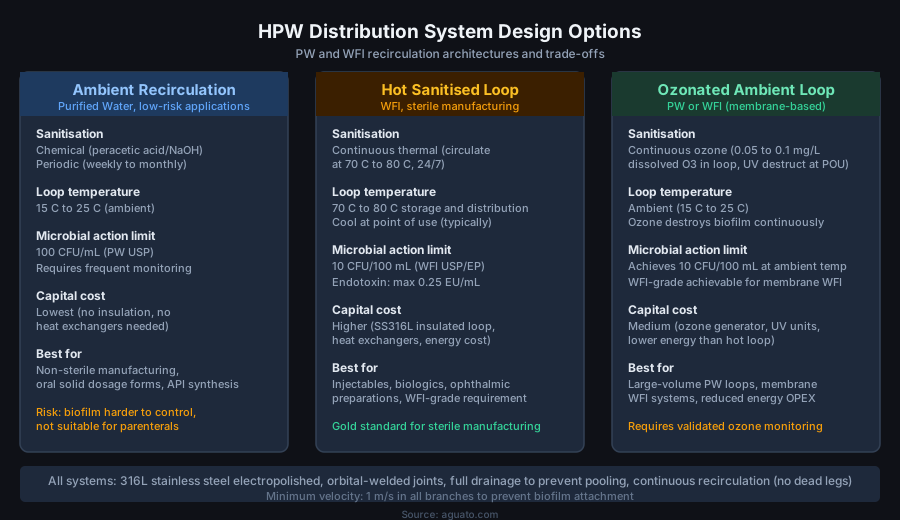
The distribution loop is where most pharmaceutical water system failures originate. The membrane or still can produce perfect water and the loop can contaminate it before it reaches the use point. Three main loop architectures are in widespread use.
Hot recirculating loop (70 to 80 degrees C continuous):
This is the standard architecture for WFI distribution and is also used for some PW systems where microbial risk is high. Continuous operation at 70 to 80 degrees C prevents biofilm formation by thermally inactivating bacteria continuously. Key design requirements:
- Storage tank with heated jacket or direct steam injection to maintain temperature - Circulation pump sized for minimum loop velocity of 1.0 m/s - Use point cooling (typically via heat exchanger at each use point or via an ambient loop branch with a cooler) where cool water is needed for product contact - 316L electropolished piping, orbital welds, slope-to-drain - Temperature monitoring at minimum at the coldest point in the loop (return leg)
Capital cost premium versus ambient loop: approximately 20 to 35 percent higher for the piping and insulation system. Operating cost premium: steam or electrical heating energy, typically EUR 8,000 to EUR 25,000 per year for a medium-sized loop. Regulatory risk: lowest of all three architectures.
Ambient ozonated recirculating loop:
Ozone (O3) at 0.02 to 0.05 ppm residual is maintained continuously in the distribution loop to prevent biofilm formation. UV destructors (254 nm) at each use point destroy ozone in the water before it contacts product or product-contact surfaces. This architecture is used for both PW and membrane-based WFI systems.
Capital cost is comparable to the hot loop, with the addition of the ozone generator (EUR 15,000 to EUR 40,000 depending on loop volume) and UV destructors at use points (EUR 2,000 to EUR 5,000 each). Operating cost is lower than the hot loop because no continuous heating is required. The ozone generator has consumables (UV lamps for generation or corona discharge electrode replacement) that add to OPEX.
The critical risk with ozonated loops is ozone residual monitoring. If ozone falls below effective residual -- due to generator maintenance, high demand periods, or elevated feed water TOC -- the microbial control barrier is lost temporarily, and recovery may take days. Validation of this architecture requires demonstrating ozone residual control across all operating scenarios.
Ambient loop with periodic hot or chemical sanitisation:
This is the lower-capital option, typically used for PW systems with lower production volumes or lower microbial risk profiles. The loop operates at ambient temperature with periodic (weekly to monthly) hot water sanitisation at 80 to 85 degrees C for one to two hours, or chemical sanitisation using hydrogen peroxide or peracetic acid followed by thorough rinsing and TOC verification.
The risk profile is higher than continuous hot or ozonated operation. Biofilm can establish between sanitisation cycles, particularly in dead-leg areas or at sample ports. Microbial excursions are more likely, and the remediation when they occur is more disruptive. For new system designs, ambient periodic sanitisation loops are increasingly difficult to justify to regulators for WFI applications.
The [reverse osmosis industrial systems](/resources/reverse-osmosis-industrial) guide covers feed water pre-treatment options, and [ultrafiltration industrial](/resources/ultrafiltration-industrial) covers UF as an alternative pre-treatment to cartridge filtration for high-turbidity feed waters.
For [CAPEX versus OPEX analysis](/resources/water-treatment-capex-opex) of different system architectures, the linked article covers the financial framework in detail.
## Validation framework: IQ/OQ/PQ and continuous monitoring requirements
Pharmaceutical water systems require validation under the 21 CFR Part 211 framework (US) and equivalent EU GMP Annex 15 (Europe). The validation lifecycle has three phases: Installation Qualification (IQ), Operational Qualification (OQ), and Performance Qualification (PQ). The PQ phase for water systems is more extensive than for most other pharmaceutical utilities because water quality can vary with seasons, feed water quality changes, and system ageing.
Installation Qualification (IQ):
IQ documents that the system has been built as designed. This includes:
- Verification of piping isometric drawings against as-built piping - Material certificates for all product-contact wetted surfaces (316L stainless steel mill certificates, PTFE and elastomer certifications for seals and diaphragms) - Weld log with certification of all orbital welds - Slope verification (minimum 1:100 slope-to-drain on all product-contact piping) - Dead leg audit (no dead leg exceeding 6 diameters) - Instrument calibration certificates for all TOC analysers, conductivity sensors, flow meters, and temperature probes - Component certification (RO membranes, UV lamps, filter housings)
IQ is typically executed by the system builder in collaboration with the site quality team. It should be completed before OQ begins, with all deviations formally closed.
Operational Qualification (OQ):
OQ demonstrates that the system operates within defined operating parameters across all normal and edge-case operating conditions. For a pharmaceutical water system, this includes:
- Demonstration of design flow rates at all use points simultaneously - Confirmation that loop velocity meets minimum specification under full demand - Verification that temperature is maintained throughout the loop under all production scenarios (for hot loops) - Ozone residual profile mapping (for ozonated loops) at all loop positions - Alarm and interlock verification: high conductivity alarm, TOC alarm, low flow alarm, temperature alarm (hot loops) - Recovery time testing: how long after a sanitisation cycle does the system return to normal operating parameters?
Performance Qualification (PQ):
PQ is the most demanding phase and the one most often under-resourced. The ISPE Baseline Guide for Water and Steam Systems recommends a three-phase PQ protocol:
- Phase 1 (2 to 4 weeks): Daily sampling at all use points. The objective is to demonstrate that the system can consistently meet quality limits across all use points under all normal operating conditions. All results must be within limits. - Phase 2 (4 to 8 weeks): Sampling frequency reduced to 3 times per week. The objective is to demonstrate sustained performance over a longer period, encompassing more variability in feed water quality and production demand. - Phase 3 (minimum 1 year): Routine monitoring at a frequency defined in the monitoring plan, typically weekly for TOC and conductivity, monthly for microbial, and quarterly for full compendial testing. Phase 3 never ends; it becomes the ongoing monitoring programme.
Continuous monitoring and trending:
Modern pharmaceutical water systems use in-line continuous monitoring for TOC and conductivity at the point of production and at the loop return. This continuous data feeds into the pharmaceutical quality system for real-time alert and action limit management. [WHO Technical Report Series on pharmaceutical water](dofollow:https://www.who.int/publications/i/item/978-92-4-009060-4) provides detailed guidance on monitoring programme design.
Seasonal variation in feed water quality is a common source of OOS results in the first year of operation. A well-designed validation programme captures at least one seasonal transition (summer to autumn or winter to spring) in the PQ period to demonstrate that the system responds correctly to feed water quality changes.
## Vendor qualification: what to audit before signing
Selecting a vendor for a pharmaceutical water system is a procurement and quality decision of equal weight. The system integrator's track record in pharmaceutical environments, their documentation quality, and their ability to support validation are as important as the technical specification of the equipment.
The pre-qualification audit should cover:
Reference site verification: Request a list of pharmaceutical water systems the vendor has designed and installed in the last five years, in facilities regulated by FDA, EMA, or PMDA (Japan). Request permission to conduct reference calls. A vendor with a strong pharmaceutical portfolio will agree immediately. One with a weak portfolio will deflect.
Documentation capability: Review a sample IQ/OQ protocol package from a previous pharmaceutical project. Does it meet the structure expected by 21 CFR Part 211 and EU GMP Annex 15? Is it site-specific or a generic template with minimal customisation? Generic documentation that the vendor re-labels for each client is a significant risk indicator.
Material certification traceability: Can the vendor provide mill certificates for every piece of 316L product-contact pipe and fitting, with traceability to the specific system being built? This is a basic requirement that some vendors fail at.
Weld certification: What is the welder qualification programme? Orbital welding of all product-contact joints is standard; manual TIG welding should be used only where geometry prevents orbital access, and each manual weld should be individually videoscoped and certified.
Ongoing service capability: Who services the RO membranes, EDI modules, UV lamps, and ozone generators after handover? Is the vendor's service team local, or is there a third-party service agreement? Pharmaceutical water system service should not be handled by a generic water treatment service company without pharmaceutical-specific training.
Commissioning and validation support: Does the vendor's fee structure include commissioning support during IQ and OQ? Some vendors include this; others charge separately. Agree in writing before signing.
The [water treatment O&M outsource](/resources/water-treatment-om-outsource) article covers the ongoing operational decision framework for pharmaceutical water systems once they are validated and operational.
If you are at the specification or vendor selection stage, [post a project on Aguato](/post-project) to receive structured proposals from qualified pharmaceutical water system vendors, or use [Nepti](/nepti), the Aguato AI decision tool, to compare system architectures before issuing an RFP.
To see which providers have validated pharmaceutical water experience in your region, the [high purity water treatment companies](/high-purity-water-treatment-companies) directory and [water purification companies](/water-purification-companies) directory are searchable by technology and geography.
## Where pharmaceutical water systems fail
The failure modes that generate FDA 483 observations and EMA inspection findings are remarkably consistent across facility types, geographies, and company sizes. Understanding them in advance is the most direct path to a system that passes inspections on the first cycle.
Failure mode 1: Wrong grade specified for downstream process
A non-sterile oral solid dosage manufacturer specifies PW for granulation, then introduces a parenteral product line using the same water system without upgrading the grade. Or a sterile manufacturer specifies WFI for non-parenteral processes, pays for WFI infrastructure, then cuts the WFI loop short of certain equipment points to reduce cost, creating a gap where the process actually requires WFI.
Grade specification should be locked to the process requirement of each individual use point, not applied uniformly to a facility. A use-by-use grade assignment matrix, reviewed by quality and engineering together, prevents this class of failure.
Failure mode 2: Dead legs and biofilm
Dead legs are the primary physical mechanism for microbial excursions in pharmaceutical water loops. A branch pipe that ends in a closed valve 12 diameters from the main loop is a stagnant water pocket. Even in a hot loop, the temperature at the end of the dead leg drops to ambient if there is no flow. Biofilm establishes, endotoxins accumulate, and the next time the valve opens, contaminated water enters the distribution system.
The 6-diameter rule (no dead leg longer than 6 pipe diameters from the main loop centreline to the branch end) is the standard design control. Applying it consistently during design review, then verifying compliance during IQ, prevents this failure mode.
Failure mode 3: Inadequate monitoring frequency during PQ
Phase 1 PQ is conducted at daily sampling frequency. When PQ results look good for the first two weeks, there is pressure to advance quickly to Phase 2 or even to skip Phase 2. Regulators notice this pattern. A PQ that jumps from two weeks of Phase 1 to Phase 3 routine monitoring has a compressed validation evidence base that will be challenged in inspection.
Failure mode 4: Pure Steam not validated
The pure steam generator was installed. Its condensate quality was tested at commissioning. There is no ongoing monitoring programme, no documented qualification for each steam use point, and no protocol for what happens when a new SIP connection is added to the system. This pattern generates observations consistently.
Failure mode 5: Feed water quality changes not captured
The RO system was designed for a feed water with 300 mg/L TDS and low silica. The municipal utility changes its source (seasonal river draw versus well water) and TDS increases to 600 mg/L with elevated hardness. The RO system runs at 90 percent recovery, hardness scaling begins, conductivity at the RO permeate rises, and it eventually crosses the Stage 1 conductivity limit. The root cause is not the RO system -- it is the absence of a feed water monitoring programme linked to system performance limits.
Failure mode 6: O&M handover gap
The validation team completes PQ and hands the system to operations. The operations team was not involved in validation and does not understand the operating parameter limits or the sanitisation protocol. Within six months, hot loop temperature setpoints drift, sanitisation frequency decreases from weekly to "when there's time," and microbial monitoring results begin trending upward. This is a management and training failure, but it is the most common cause of post-validation performance degradation.
Facilities that maintain validated pharmaceutical water systems reliably over multi-year periods share one characteristic: the quality system owns the water system, not the engineering department. The quality owner reviews all trend data, approves all deviations, and signs off on any change that touches the validated system -- including maintenance actions, membrane replacements, and instrument recalibrations.
[EMA guidelines on water in pharmaceutical manufacturing](dofollow:https://www.ema.europa.eu/en/quality-guidelines) provide the European regulatory framework for water system design and monitoring.
## FAQ
### What is the difference between Purified Water and Water for Injection?
Both Purified Water and Water for Injection must meet the same TOC limit (500 ppb maximum) and the same conductivity limit (1.3 microS/cm at 25 degrees C) under USP. The defining difference is the bacterial endotoxin requirement: WFI must not exceed 0.25 EU/mL, while PW has no endotoxin limit in USP. This means a PW system can pass all chemical tests while having endotoxin levels that would make it unsafe for parenteral use. Any process that involves parenteral drug preparation, final rinsing of sterile product-contact equipment, or reconstitution of injectable dosage forms requires WFI, not PW, regardless of how clean the PW tests chemically.
### Can membrane-based systems produce Water for Injection under current USP rules?
Yes. USP <1231> was revised to align with the European Pharmacopoeia (EP 3.1.9.1), which was updated in 2017 to allow membrane-based WFI production. Prior to 2017, both USP and EP required WFI to be produced exclusively by distillation. The current standard allows production by distillation or by membrane processes (typically double-pass RO followed by EDI) provided the system can consistently produce water meeting all WFI limits, including the endotoxin limit of 0.25 EU/mL. Validation requirements for membrane-based WFI systems are more extensive than for distillation-based systems because distillation has a longer regulatory precedent. However, the capital cost reduction of 40 to 60 percent versus distillation typically justifies the additional validation investment for new facilities.
### What does Phase 1, Phase 2, Phase 3 PQ mean for a pharmaceutical water system?
Performance Qualification (PQ) for a pharmaceutical water system is conducted in three phases based on ISPE Baseline Guide recommendations. Phase 1 (typically 2 to 4 weeks) involves daily sampling at all use points to demonstrate baseline system capability under normal operating conditions. Phase 2 (typically 4 to 8 weeks) reduces sampling to approximately three times per week and demonstrates sustained performance over a longer period. Phase 3 is the ongoing monitoring programme, which continues for the operational life of the system. Each phase requires a formally documented protocol and report, with no phase being advanced until all results from the previous phase are reviewed and acceptable. Compressing or skipping phases is a common source of regulatory observations during inspection.
### What causes most pharmaceutical water system failures in FDA inspections?
The most common causes of 483 observations and warning letters for pharmaceutical water systems are: dead legs in distribution piping that allow biofilm formation, inadequate hot sanitisation frequency in ambient loops, absence of a validated monitoring programme for pure steam systems, grade misspecification where PW is used for a process that requires WFI, and inadequate change control when modifications are made to the validated system. Most of these are not technology failures. They are design and quality system failures: the system was not designed correctly for the process requirement, or the quality management framework was not enforced consistently over the system's operational life.
### How often should pharmaceutical water systems be sanitised?
Sanitisation frequency depends on the system architecture and the microbial trending data. Hot WFI loops operating continuously at 70 to 80 degrees C typically do not require periodic heat sanitisation cycles because the continuous temperature maintains microbial control. Ozonated loops require continuous ozone residual management and periodic verification that residual is adequate. Ambient PW loops with periodic hot sanitisation are typically sanitised weekly to monthly, with frequency determined by the microbial trending data rather than a fixed schedule. If microbial counts begin trending upward before the next scheduled sanitisation, the frequency must be increased. Frequency decisions should be documented in the water system control strategy and reviewed as part of the annual product review.
### What is the endotoxin limit for WFI and why does it matter?
The endotoxin limit for Water for Injection is 0.25 EU/mL (endotoxin units per millilitre) under USP, EP, and JP. Endotoxins are lipopolysaccharide fragments from the outer membrane of gram-negative bacteria. They are not destroyed by standard chemical sterilisation, are not removed by most chemical treatment processes, and cause pyrogenic (fever-inducing) responses in patients when present in injectable products, even at very low concentrations. The 0.25 EU/mL WFI limit is set as a safety margin upstream of the finished product endotoxin limit, which is calculated based on the maximum acceptable daily endotoxin dose for the patient population. A WFI system that consistently produces water below 0.05 EU/mL provides a substantial safety margin; a system operating near 0.25 EU/mL is at elevated risk of producing a failed batch if any upstream endotoxin burden increases.