Chlorine costs $3 to $9 per 1,000 m3, UV $8 to $22, ozone $32 to $95. The right method depends on residual needs, byproduct risk, and pathogen target. Here is the decision framework.
Picking the wrong water disinfection method rarely fails on day one. It fails three years in, when a regulator finds trihalomethanes (THMs) at 95 µg/L in the distribution network, when a Cryptosporidium outbreak traces back to under-dosed [chlorine](/elements/chlorine) on a surface water source, or when a food and beverage plant has its reuse permit suspended because ozone has stripped colour but left bromate at twice the consent limit. A bad disinfection decision typically costs $180,000 to $1.4 million across the asset's life in retrofit chemistry, regulatory penalties, or product recall liability, and it almost always traces back to a procurement choice that picked the cheapest reactor instead of the right chemistry for the matrix.
The default vendor reflex is to recommend whatever they sell. Chlorine vendors push chlorine. UV vendors push UV. Ozone vendors push ozone. None of those recommendations is wrong in the right context, and all of them are wrong in the wrong context. The decision needs to start from four orthogonal questions about your water and your downstream system, not from a vendor brochure.
This article compares chlorine (sodium hypochlorite and chlorine gas), ultraviolet (UV-C medium and low-pressure), and ozone (corona-discharge generation) across the dimensions that actually decide projects: CAPEX, OPEX, residual behaviour, regulated byproducts, pathogen efficacy, and contact-time geometry. It closes with a four-step decision framework procurement teams can run before any vendor proposal lands.
## The decision in brief
- Put one number in front of the CFO. On a 5,000 m3/day water disinfection step, the difference between the cheapest technology and the right technology typically swings between $350,000 and $1.2 million across a 15-year asset life. - Split the swing three ways. It splits between $80,000 to $260,000 in CAPEX, $150,000 to $480,000 in cumulative chemistry or power, and $120,000 to $480,000 in avoided enforcement or product-recall liability. - Make the decision on paper, before any reactor is procured. Decide against the four threshold questions in Step 1 to 4 above, and every dollar spent on water analysis and matrix characterisation before the decision is worth roughly $50 to $200 in avoided retrofit.
Disinfection is the highest-leverage hour of engineering time in the entire treatment train.
## Why disinfection method selection is not a vendor question
Disinfection is the last barrier between the treatment plant and the user. It is the line item the regulator looks at first, the one that triggers boil-water notices and product recalls, and the one most likely to put plant managers in front of a court. The asymmetry between disinfection CAPEX and disinfection-failure liability is the largest in the entire water treatment train: a UV reactor that costs $180,000 installed protects against a single Cryptosporidium outbreak that has cost individual US municipalities $50 million to $96 million in litigation and remediation. The economics of picking correctly are not subtle.
Yet most procurement teams pick the technology before they characterise the matrix. The right starting point is a water analysis (turbidity, UV transmittance, bromide, ammonia, organic carbon) and a downstream profile (residence time, network length, end-use compliance regime). Without both, every vendor proposal will recommend their own technology against generic boilerplate, and procurement has no way to compare them on the dimensions that actually matter. For a focused head-to-head between the two most commonly conflated options, see the [UV vs chlorination decision guide](/resources/uv-vs-chlorination-disinfection), which goes deeper on the chlorine-resistant pathogen scenario.
A second mistake is assuming that disinfection means microbial control only. In industrial reuse and drinking-water polishing, the same step often needs to oxidise colour, [manganese](/elements/manganese), taste-and-odour compounds, or specific micropollutants. That requirement collapses the three-way comparison into a two-way: only ozone and advanced-oxidation extensions of UV (UV/H2O2, UV/Cl2) meaningfully attack non-microbial targets. Chlorine alone does not. Choosing chlorine on cost when the actual requirement includes oxidation is the cheapest path to a $400,000 retrofit at year 4.
## Chlorine: cheap, residual-forming, byproduct-heavy
Chlorine remains the global default for drinking water and most municipal and industrial wastewater disinfection. The reason is simple: it is the only one of the three methods that leaves a measurable persistent residual in the distribution network, typically 0.2 to 0.5 mg/L free chlorine maintained through hours or days of network residence time. That residual is what suppresses regrowth in pipes between the treatment plant and the tap, and no other technology delivers it. UV and ozone produce no residual whatsoever.
The cost structure favours chlorine for high-volume applications. Sodium hypochlorite (12.5% NaOCl) is dosed at 1 to 4 mg/L active chlorine for typical disinfection; at industrial chemistry prices of $0.45 to $0.75 per kg of active chlorine, the chemistry cost runs $3 to $9 per 1,000 m3 treated. CAPEX on a chlorine dosing skid with redundant pumps, tanks, and instrumentation runs $40 to $120 per m3/day of capacity. There is no other disinfection technology that comes within an order of magnitude of those numbers.
Operational simplicity is the under-appreciated half of the chlorine cost case. The skill base required to run a chlorine system is widely available, spare parts are interchangeable across vendors, and the operating logic (dose to a free chlorine residual target, monitor at the entry to the network, adjust on residual decay) is well understood by every certified water operator. UV and ozone both demand specialist competence that smaller utilities and industrial operators often do not have in-house, and the training cost over a 15-year asset life is non-trivial.
The price of that cost advantage is disinfection byproducts (DBPs). When chlorine reacts with natural organic matter (NOM) in the source water, it forms trihalomethanes (THMs), haloacetic acids (HAA5), and a long tail of regulated halogenated species. The current US EPA Stage 2 limit is 80 µg/L for total THMs and 60 µg/L for HAA5 in distribution-system samples; the EU drinking water directive sets 100 µg/L for THMs. Plants on surface water with high NOM (TOC above 4 mg/L) routinely fail those limits if they chlorinate before NOM removal, which then triggers a retrofit chain: enhanced coagulation, GAC pre-filtration, or a switch to chloramines for residual maintenance. Each of those retrofits adds $150,000 to $900,000 of CAPEX and a corresponding annual chemistry bump.
DBP risk is also seasonal, which is what makes it expensive to manage in retrospect. Surface water TOC and bromide both spike during autumn turnover and spring snowmelt, and the THM formation potential follows. A plant that meets Stage 2 limits comfortably in midsummer can violate them by a factor of two in the first cold week of November, and the regulator counts the running annual average across all distribution-system sample points. That means a single bad quarter can put the plant on a compliance schedule for the next two years and force chemistry choices that destroy the original cost case for chlorine.
The third constraint is pathogen efficacy. Chlorine kills bacteria and most viruses with reasonable CT (concentration × time) values, but it is ineffective against Cryptosporidium oocysts at any practical residual, and only marginally effective against Giardia cysts. Surface water sources without a UV or filtration barrier are not adequately protected by chlorine alone. The 1993 Milwaukee Cryptosporidium outbreak, which sickened 403,000 people from a fully chlorinated public water supply, remains the case study every drinking water regulator references when setting pathogen barrier requirements three decades later. The [EPA's Long Term 2 Enhanced Surface Water Treatment Rule](dofollow:https://www.epa.gov/dwreginfo/long-term-2-enhanced-surface-water-treatment-rule) requires a second pathogen barrier (typically UV or membrane filtration) for any surface water source with cryptosporidium risk, regardless of how aggressively chlorine is dosed.
In industrial wastewater, chlorine retains the cost advantage for simple secondary-effluent polishing where downstream colour, NOM, and bromate are not constraints. In food and beverage, pharmaceutical, and microelectronics water systems, the byproduct profile usually rules chlorine out as the final disinfectant, even though it may still be used upstream for biofilm control in raw-water lines and storage tanks. The full lifecycle picture for chemical-based control programmes is laid out in the [water treatment chemicals selection guide](/resources/water-treatment-chemicals).
## Ultraviolet: chemistry-free, no residual, Cryptosporidium killer
UV disinfection works by photolytic damage to microbial DNA at wavelengths around 254 nm. It produces no chemical residual, no regulated byproducts in clean water, and inactivates the full spectrum of bacteria, viruses, and protozoa, including the chlorine-resistant species (Cryptosporidium, Giardia) that drive the regulatory case in surface water systems.
The standard validated dose is 40 mJ/cm2 for 4-log inactivation of Cryptosporidium per US EPA UV Disinfection Guidance Manual. Drinking water plants validate to the EPA dose-validation framework; wastewater reuse plants often validate to NWRI guidelines (60 to 100 mJ/cm2 for non-potable reuse, 100 mJ/cm2 plus for indirect potable reuse). The validated-dose concept matters because it ties reactor performance to actual disinfection credit; an unvalidated reactor delivering 40 mJ/cm2 nominal is not the same regulatory artefact as a validated unit at the same dose.
CAPEX runs $180 to $420 per m3/day of capacity for a validated municipal-grade reactor, two to four times chlorine's CAPEX. OPEX is dominated by lamp replacement and power: low-pressure amalgam lamps draw 60 to 200 W each and last 12,000 to 16,000 hours (about 18 months of continuous operation), while medium-pressure lamps are more compact, more powerful, and shorter-lived (4,000 to 9,000 hours). Lamp replacement runs $250 to $1,200 per lamp depending on type, and a 10,000 m3/day plant typically has 8 to 24 lamps in service. Total OPEX lands at $8 to $22 per 1,000 m3 treated, three to five times chlorine.
The cost-benefit tilts in UV's favour wherever (a) Cryptosporidium or Giardia risk is real, (b) the regulator has imposed tight DBP limits, or (c) the downstream system has short residence time and does not require a residual. The three most common UV application categories are surface-water drinking water polishing, secondary-effluent disinfection before reuse, and food and beverage process water final polish. In all three, the cost premium over chlorine is recovered in a single avoided enforcement event.
The most common UV failure mode is fouling of the quartz sleeves. Hardness, iron, and manganese precipitate on the sleeves over weeks and reduce UV transmittance by 20 to 60%, dropping the delivered dose below the validated threshold without any external indication. Modern reactors include automated wiper systems and online UV intensity sensors that compensate, but plants without those features routinely operate under-dosed for months at a time. The cost of installing wipers and intensity monitoring adds $25,000 to $80,000 to CAPEX and pays back through avoided microbial breaches within the first year of operation in any high-hardness or iron-bearing matrix.
## Ozone: oxidiser-grade, micropollutant-capable, expensive
Ozone is generated on-site from oxygen via corona discharge, dissolved into the water through fine-bubble contactors or sidestream injection, and consumed within 1 to 5 minutes of contact. It is the strongest of the three oxidants in commercial use and reacts with both microbial cells and a broad range of chemical contaminants: colour bodies, taste-and-odour compounds (geosmin, MIB), pharmaceutical residues, endocrine disruptors, manganese, and iron. Ozone is the only conventional disinfectant that is also a true oxidiser at consumption-grade doses.
The downside is power and CAPEX. Generating 1 kg of ozone consumes 8 to 18 kWh of electricity, plus oxygen feed. CAPEX for a complete ozone system (generator, oxygen feed, contact tank, off-gas destruction) runs $650 to $1,400 per m3/day of capacity, three to four times UV and 15 to 30 times chlorine. OPEX runs $32 to $95 per 1,000 m3 treated, dominated by electricity. On any application where the only requirement is microbial control, ozone is the wrong choice on economics alone.
[cta:nepti-dark]
Ozone earns its premium in two specific contexts. The first is industrial reuse and recycling, where the same step that disinfects must also oxidise colour and trace micropollutants (textile dyes, pharmaceutical residues, refractory organics). Chlorine cannot. UV alone cannot. Ozone can, often at doses below the level needed to fully disinfect, because the residual oxidation capacity attacks the chromophores and complex organics. The second is high-grade drinking water polish before GAC filtration, where ozone breaks down NOM into smaller, more biodegradable fragments that GAC removes more efficiently. The combined ozone-BAC (biological activated carbon) train delivers DBP-free drinking water with a 70 to 95% NOM reduction, at a total cost 25 to 40% higher than conventional treatment but with no chlorinated byproduct risk.
The catch with ozone is bromate. If the source water contains bromide above about 50 µg/L, ozone oxidises some fraction of that bromide to bromate (BrO3-), a regulated carcinogen with US and EU drinking water limits of 10 µg/L. Plants on bromide-bearing source water (coastal aquifers, brackish surface water, water with road-salt influence) need bromate-control measures: pH suppression, ammonia addition, or substituted oxidation chemistry. Ignoring the bromide assessment before specifying ozone is one of the more expensive engineering mistakes in the disinfection space, with retrofit costs of $400,000 to $1.4 million on a mid-sized drinking water plant.
## Side-by-side comparison across 6 dimensions
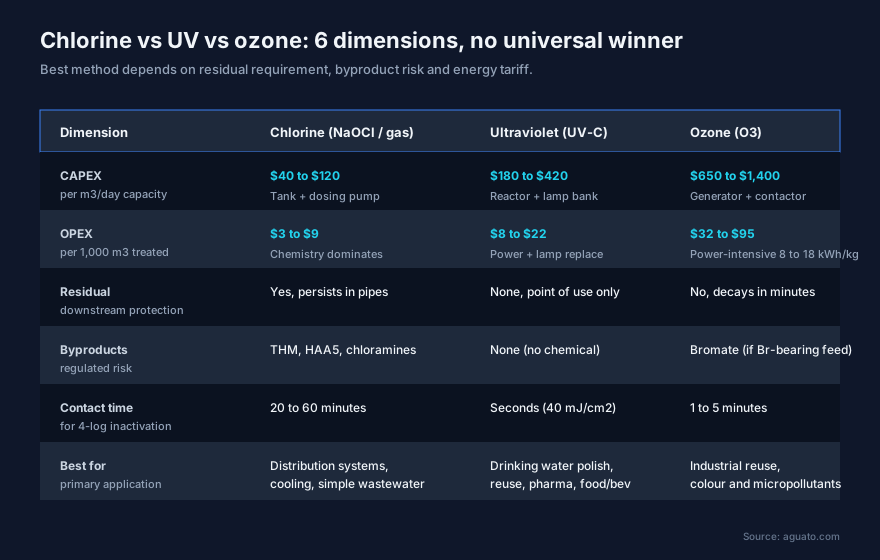
The three technologies are not interchangeable; each occupies a different operating envelope. The table below summarises the six dimensions that actually decide projects.
| Dimension | Chlorine (NaOCl) | UV (low/medium pressure) | Ozone (corona discharge) | |---|---|---|---| | CAPEX, USD per m3/day | $40 to $120 | $180 to $420 | $650 to $1,400 | | OPEX, USD per 1,000 m3 | $3 to $9 (chemistry) | $8 to $22 (power + lamps) | $32 to $95 (power-heavy) | | Distribution residual | Yes, 0.2 to 0.5 mg/L | None | None (decays in minutes) | | Regulated byproducts | THM, HAA5, chloramines | None in clean water | Bromate if bromide present | | Cryptosporidium / Giardia | Ineffective / partial | Excellent (40 mJ/cm2) | Effective at higher CT | | Oxidation of non-microbial targets | Limited | None alone (AOP needed) | Excellent (colour, pharma) |
A common compromise architecture combines two technologies. UV plus chlorine is the dominant drinking water configuration in any system with surface water input and a distribution residual requirement: UV inactivates Cryptosporidium, chlorine carries residual through the network at a lower dose that minimises DBP formation. Ozone plus chlorine or ozone plus UV plus chlorine appears in advanced municipal systems with both DBP and micropollutant constraints, accepting the CAPEX premium for full-spectrum risk coverage. Industrial wastewater reuse often runs ozone alone for combined oxidation and disinfection, because the absence of distribution requirement removes the chlorine driver.
## The four-step decision framework
Apply these four questions in order, with the water analysis in hand. Each question narrows the technology choice within a six-figure CAPEX band.
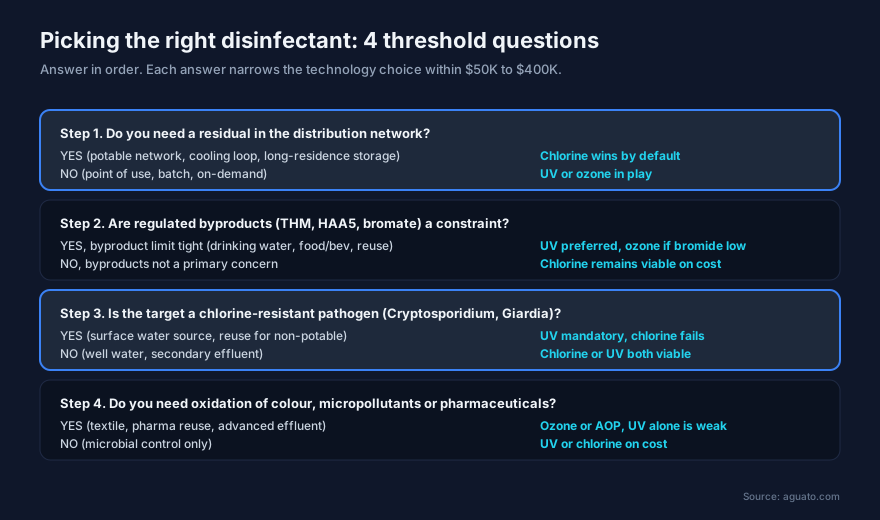
Step 1. Do you need a residual in the distribution network? If yes (potable network, long-residence storage, cooling loop with biofilm risk), chlorine wins by default; UV and ozone cannot deliver residual. If no (point-of-use polishing, batch processes, on-demand applications), UV and ozone come into play.
Step 2. Are regulated byproducts a tight constraint? US EPA THM/HAA5 limits, EU bromate/THM limits, or sector-specific reuse criteria. If yes and the matrix has TOC above 3 mg/L or bromide above 50 µg/L, UV is the safest default; ozone is in play if bromide is low and bromate control is engineered in.
Step 3. Is a chlorine-resistant pathogen (Cryptosporidium, Giardia) the design driver? If yes (surface water, secondary effluent reuse for non-potable applications), UV is mandatory; chlorine alone does not provide an adequate barrier. If no (groundwater, low-pathogen wastewater), chlorine and UV are both viable.
Step 4. Do you need oxidation of colour, micropollutants, or pharmaceuticals? If yes (textile reuse, pharma effluent polish, advanced municipal effluent), ozone or a UV-advanced-oxidation process is the only credible answer; chlorine alone will not touch refractory chromophores or pharmaceutical residues. If no (microbial control only), select on cost between chlorine and UV.
Applying these four questions in sequence usually collapses what looked like a three-way technology choice into a single best fit with one or two alternatives at significantly different price points. Where the matrix is unusual (high bromide and high TOC and surface water source with Cryptosporidium risk), modelling the combined cost of a multi-barrier train against the avoided liability is the right next step. [Nepti](/nepti) takes the water analysis, regulatory regime, and downstream profile and ranks single- and multi-stage disinfection trains against 15-year lifecycle cost, surfacing the risk-adjusted choice rather than the vendor-preferred one.
## Where disinfection decisions go wrong
Five patterns account for most of the post-commissioning regret in this category.
Specifying for nominal dose instead of validated dose. A UV reactor rated for 40 mJ/cm2 nominal output is not the same product as a unit validated to deliver 40 mJ/cm2 after fouling, ageing, and flow variability. Validated reactors cost 30 to 60% more upfront; unvalidated reactors deliver substantially less than nominal in real operation and generate no regulatory disinfection credit. Always specify validation per the EPA UVDGM or equivalent national standard.
Ignoring bromide before specifying ozone. A single bromide measurement on raw water (cost about $40 in commercial lab service) decides whether ozone is viable or guarantees a bromate retrofit. Plants on coastal or brackish source water that specified ozone without that test routinely face $400K to $1.4M of avoidable retrofit cost.
Picking chlorine without modelling NOM. Source water with TOC above 4 mg/L and seasonal NOM variation will generate THM and HAA5 in distribution systems at concentrations that violate consents. The right pre-step is either enhanced coagulation, GAC, or alternative disinfectant; not "dose more chlorine and hope".
Assuming UV is maintenance-free. Quartz sleeves foul, lamps age, intensity sensors drift. Plants without automated wipers and online intensity monitoring typically operate under-dosed for 20 to 40% of their service life. The capital uplift for proper monitoring is $25K to $80K, payback under 12 months.
Specifying single-barrier disinfection on multi-risk source water. Surface water with Cryptosporidium, NOM, and bromide all in play requires a multi-barrier train (typically UV plus chloramines, or ozone plus UV plus low-residual chlorine). Trying to solve all three risks with one technology is the most common single-source-of-failure error in this space.
For projects where the matrix is uncertain or the regulatory regime is tightening, scoped proposals from 3 to 5 disinfection specialists, each pricing against the same validated dose and same regulated byproduct envelope, keep the comparison apples-to-apples rather than vendor-narrative. The right shortlist for a drinking water polish on surface source is a very different shortlist from the right one for industrial reuse with colour removal, and the wrong shortlist means you spend two months evaluating proposals that were never going to fit.
Where the comparison still feels open after vendor responses come in, the deciding question is almost always the one not covered by a vendor brochure: what does the regulator measure, how often, and what happens to the operating budget if a single sample point fails. The five lifecycle costs below collapse that question into a single financial number the CFO can defend without further engineering input.
## FAQ
Which water disinfection method is cheapest overall?
Chlorine, by a wide margin, on direct CAPEX and OPEX. Chemistry runs $3 to $9 per 1,000 m3 treated and CAPEX is $40 to $120 per m3/day. The cost advantage disappears when DBP retrofits, taste-and-odour issues, or pathogen-resistance gaps force secondary investments to compensate for chlorine's limitations. Total cost of ownership requires modelling those downstream costs explicitly.
Is UV always better than chlorine for drinking water?
No. UV inactivates pathogens without producing chemical byproducts, but it provides zero distribution residual. Any drinking water system with a distribution network requires chlorine (or chloramine) for residual maintenance regardless of whether UV is in the primary disinfection step. The two technologies are complements more often than substitutes in potable applications.
When is ozone the right choice?
When the project requires combined disinfection plus oxidation of non-microbial targets (colour, taste, odour, pharmaceutical residues, manganese, iron), and when the source water has low bromide. Industrial reuse and advanced municipal drinking water are the two largest application categories. Ozone is rarely the right choice when microbial control is the only requirement.
What is the minimum UV dose for Cryptosporidium inactivation?
The US EPA validated dose for 4-log Cryptosporidium inactivation is 40 mJ/cm2. The Long Term 2 Enhanced Surface Water Treatment Rule is the regulatory anchor; the dose is the validated, not the nominal, value. Wastewater reuse applications typically require higher doses (60 to 100+ mJ/cm2) per [NWRI/AWWA reuse guidance](dofollow:https://watereuse.org/wp-content/uploads/2015/01/NWRI-AWWA-UV-Guidelines.pdf).
What does ozone do that UV alone cannot?
Ozone oxidises non-microbial targets: colour, taste-and-odour compounds, pharmaceutical residues, manganese, iron. UV alone produces almost no oxidation; pairing UV with hydrogen peroxide (UV/H2O2) creates an advanced oxidation process that approaches ozone's capability at typically lower CAPEX but higher chemistry cost.
Do disinfection byproducts affect industrial applications?
Yes, in any food and beverage, pharmaceutical, or microelectronics water system. THM and HAA5 limits in process water are typically more restrictive than drinking water limits, and product quality or pharma compliance can be affected by trace chlorinated species in process water. For these sectors, UV is the default disinfectant and chlorine is restricted to upstream biofilm control with downstream dechlorination.
Can multiple disinfectants be combined?
Yes, and multi-barrier disinfection is the standard for any source water with multiple risk factors. UV + chloramines, ozone + UV + low-residual chlorine, or chlorine + chloramines are common multi-stage configurations. The total CAPEX is 40 to 80% higher than single-barrier, but the regulatory protection and the operating margin against shock events are materially higher. See the [EPA Stage 2 DBPR guidance](dofollow:https://www.epa.gov/dwreginfo/stage-1-and-stage-2-disinfectants-and-disinfection-byproducts-rules) for the regulatory framing.