MBR vs activated sludge: MBR cuts footprint to 30 to 50% of CAS and hits sub-1 mg/L TSS, but costs 2x the CAPEX. Full lifecycle cost and decision framework.
The mbr vs activated sludge decision is not a technical preference: it is a 20 to 30 year cost commitment that compounds against your sustainability targets and water reuse ambitions. For a 5,000 m3/day industrial wastewater plant, the gap between a membrane bioreactor (MBR) and conventional activated sludge (CAS) translates to a CAPEX difference of roughly USD 3.5 to 5 million and an OPEX gap of USD 0.15 to 0.30 per cubic metre treated, meaning the process you specify today will cost or save your organisation between USD 1 and 2 million over the first decade before you factor in effluent reuse credits. With tightening discharge limits in the EU Industrial Emissions Directive (IED) revision and US EPA nutrient reduction requirements now reaching secondary treatment thresholds that CAS alone cannot reliably meet, the comparison between mbr vs activated sludge is no longer a purely technical question.
The conventional wisdom is that CAS wins on CAPEX and MBR wins on footprint and effluent quality. That is broadly true, but it is also the version of the story that causes engineers to under-specify at greenfield sites and over-specify at brownfield retrofits. The real decision hinges on three variables the vendor quotations rarely quantify for you: the value of the land the clarifier would have occupied, the cost of the tertiary polishing step CAS needs to hit your reuse standard, and the energy tariff trajectory over the asset life. Get those three numbers right and the MBR premium either justifies itself in under 8 years, or it does not.
This comparison covers both technologies in depth, from process fundamentals and MLSS operating windows to CAPEX, OPEX, failure modes, and the threshold-based decision framework that tells you which path to spec before you go to RFP. It is written for the plant manager dealing with an imminent compliance deadline, the capital projects lead building a 10-year infrastructure case, and the ESG director who needs to tie wastewater treatment to a water reuse commitment.
## The decision in brief
- Scope the MBR against the full system boundary. Switching from a CAS-plus-tertiary specification to a correctly scoped MBR at a 5,000 m3/day brownfield industrial site with a water reuse target yields a blended saving of USD 1.5 to 2.2 million in net present value over 15 years at a 5% discount rate. - Count what the blended saving includes. That blended saving includes avoided tertiary polishing CAPEX, land value, and a 60% water reuse credit at the same 5,000 m3/day brownfield site with its water reuse target. - Do not specify CAS without the full system boundary. The biggest cost-of-doing-nothing is specifying CAS without the full system boundary and then paying USD 1.2 to 2.0 million to retrofit tertiary polishing three to five years later.
That tertiary polishing retrofit arrives three to five years later, when the discharge consent tightens.
## What each process actually does
Both MBR and conventional activated sludge rely on the same biological engine: a mixed community of microorganisms suspended in aerated water breaking down organic contaminants. The difference is in how the biomass is separated from the treated water, and that single design choice cascades into every other dimension of cost, footprint, and effluent quality.
In conventional activated sludge, biomass separation is gravitational. The mixed liquor flows from the aeration basin into a secondary clarifier, where solids settle out, the clarified liquid moves forward to disinfection or optional tertiary polishing, and a return activated sludge (RAS) stream recycles settled biomass back to the aeration tank. The technology is mature, well-understood, and has been the backbone of municipal and industrial wastewater treatment since the 1910s. Its constraint is that gravity settling limits the mixed liquor suspended solids (MLSS) you can maintain in the aeration basin to roughly 2,000 to 4,000 mg/L. Go higher and the clarifier cannot handle the settling load.
In an MBR, the clarifier is replaced by a bank of submerged ultrafiltration or microfiltration membranes installed directly in the biological reactor or in a separate membrane tank. Because solids separation is mechanical rather than gravitational, MLSS can be run at 8,000 to 12,000 mg/L, roughly three times the CAS range. The higher biomass concentration means either a much smaller reactor footprint for the same load, or the ability to handle shock loads and load swings that would wash out a CAS clarifier.
## How MBR and CAS differ in operating parameters
The MLSS difference is the headline, but it is not the whole story. A pattern that recurs in industrial installations is that operators underestimate the impact of aeration energy on MBR OPEX until the first annual power bill arrives, because the higher MLSS and the membrane scouring air requirement together lift specific energy consumption to 0.8 to 1.5 kWh/m3 treated, compared to 0.3 to 0.6 kWh/m3 for CAS.
MBR membranes operate at a transmembrane pressure (TMP) of 0.1 to 0.5 bar, with flux rates of 15 to 30 LMH (litres per square metre per hour) in submerged configurations. Membrane fouling is the primary operational variable: a well-maintained MBR with a sound CIP (clean-in-place) protocol and adequate coarse bubble scouring aeration will sustain flux and TMP within design parameters. An MBR run at flux rates above design without adequate scouring will foul progressively, driving TMP to the alarm threshold and forcing an emergency chemical clean that costs USD 5,000 to 20,000 per event in lost production and chemical spend.
CAS operating parameters are more forgiving on a day-to-day basis, but the clarifier creates its own vulnerabilities. Sludge bulking, caused by filamentous bacterial overgrowth, is the canonical failure mode. A bulking episode elevates effluent TSS from the design range of 15 to 30 mg/L to 100 to 200 mg/L within 48 to 72 hours, a violation event with regulatory consequences and, in reuse applications, an immediate halt to downstream water recovery.
[According to the US EPA Technology Transfer Handbook for Municipal Wastewater Treatment](dofollow:https://www.epa.gov/wastewater-management/wastewater-technology-fact-sheets), CAS systems achieving secondary treatment standards typically produce effluent at BOD 20 to 30 mg/L and TSS 20 to 30 mg/L, while MBR achieves BOD below 5 mg/L and TSS below 1 mg/L as a routine operating condition.
## MBR vs activated sludge: process flow comparison
The architectural gap between the two technologies is most visible at the unit operations level.
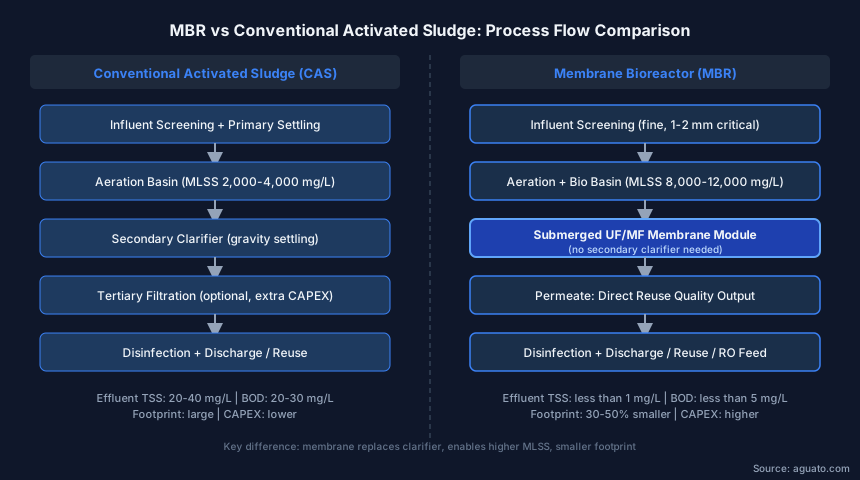
In CAS, the treatment train is: fine screening, primary settling (optional), aeration basin, secondary clarifier, and then, if reuse quality is the target, tertiary filtration (sand, disc, or membrane) plus disinfection. That tertiary step is the hidden cost that makes direct CAPEX comparisons misleading. A properly specified CAS system targeting industrial reuse quality must include tertiary filtration and, in most cases, advanced disinfection, adding USD 200 to 400 per m3/day to the installed cost before the CAS CAPEX advantage survives.
MBR eliminates the clarifier and replaces both the clarifier and the tertiary filtration step in a single membrane unit. The output is a permeate at TSS below 1 mg/L, BOD below 5 mg/L, and turbidity below 0.5 NTU, suitable as direct feed to reverse osmosis for high-purity reuse or as process-quality irrigation or cooling water after UV disinfection alone.
For constrained brownfield sites where the alternative is building a new clarifier plus tertiary plant on land worth USD 500 to 2,000 per square metre, MBR often costs less when the full system boundary is drawn correctly. The equipment cost is higher. The total site cost, including land, civil works, and tertiary treatment, is frequently lower.
The full-boundary analysis also needs to account for sludge production differences. CAS generates roughly 0.6 to 0.8 kg of dry sludge per kg of BOD removed. MBR, operating at higher MLSS and longer sludge retention times (SRT of 15 to 30 days versus 5 to 10 days in CAS), generates 20 to 30% less sludge per unit of BOD removed. At a sludge disposal cost of USD 80 to 200 per tonne dry solids, a 5,000 m3/day plant treating 500 mg/L BOD wastewater produces approximately 900 kg/day of dry sludge in CAS versus 630 to 720 kg/day in MBR. The reduction in sludge handling, dewatering, and disposal cost is worth USD 80,000 to 200,000 per year, a line item that rarely appears in vendor CAPEX comparisons but belongs in every lifecycle analysis.
Operators who have run both technologies in parallel at multi-site portfolios consistently report that MBR process stability under variable load is the harder-to-quantify benefit that tips the long-term case. The absence of clarifier upsets during peak events, combined with the consistently lower effluent variability, reduces the cost of compliance monitoring and eliminates the regulatory risk associated with settling failures.
[cta:nepti]
Understanding the cost case requires going beyond equipment pricing to model the full system boundary across a 15 to 20 year asset life. The sections below break down the CAPEX, OPEX, and lifecycle cost mechanics across both technologies with the numbers a capital projects lead needs to build an approval case. The analysis covers installed capital, energy, membrane replacement, sludge disposal, and the tertiary polishing step that CAS frequently requires but rarely shows up in the initial vendor quotation. Getting these numbers right before going to RFP is the single most valuable action a procurement team can take on a biological treatment project.
## Cost comparison: CAPEX, OPEX, and lifecycle math
The single most common mistake in MBR versus CAS procurement is comparing equipment-only CAPEX and concluding that CAS is cheaper without including the clarifier footprint, tertiary polishing, and land cost on both sides of the ledger.
For a 5,000 m3/day industrial wastewater plant at a mid-complexity site in Western Europe or North America:
CAS installed CAPEX (aeration basin, secondary clarifier, no tertiary): USD 2.0 to 4.0 million, or USD 400 to 800 per m3/day.
MBR installed CAPEX (aeration/membrane basin, membrane modules, CIP skid): USD 4.0 to 7.5 million, or USD 800 to 1,500 per m3/day.
That is a real premium of USD 2.0 to 3.5 million for the 5,000 m3/day case. Now add tertiary filtration to the CAS side for reuse: USD 1.0 to 2.0 million. Add land for the clarifier at a constrained urban-industrial site at USD 1,200/m2 for the 800 to 1,200 m2 a clarifier of that capacity requires: another USD 1.0 to 1.4 million. The gap has now compressed to USD 0.5 to 1.1 million in favour of CAS, and that is before the MBR water reuse credit is applied.
At OPEX, CAS has the operating cost advantage at scale. Specific energy for CAS runs 0.3 to 0.6 kWh/m3 against 0.8 to 1.5 kWh/m3 for MBR. At USD 0.10/kWh, this is a gap of USD 0.05 to 0.09 per m3, or USD 91,000 to 164,000 per year for a 5,000 m3/day plant. Over 20 years, that is USD 1.8 to 3.3 million in additional energy cost for MBR, partially offset by the lower membrane replacement cost after Year 10 as module prices continue to fall. Current hollow-fibre module replacement cost runs USD 20 to 40 per m2 membrane area, with a typical lifespan of 5 to 10 years.
The right answer depends on your site costs, energy tariff, reuse value, and land price. [Post your project on Aguato](/post-project) and membrane bioreactor and biological treatment specialists will scope the lifecycle cost against your actual numbers. A properly structured lifecycle model also needs to include the impact of rising water tariffs and tightening discharge fees, which in most OECD jurisdictions have increased 4 to 8% per year over the past decade. At that rate of increase, a USD 0.10/kWh energy cost advantage today becomes less decisive year by year as the reuse water credit compounds in the opposite direction.
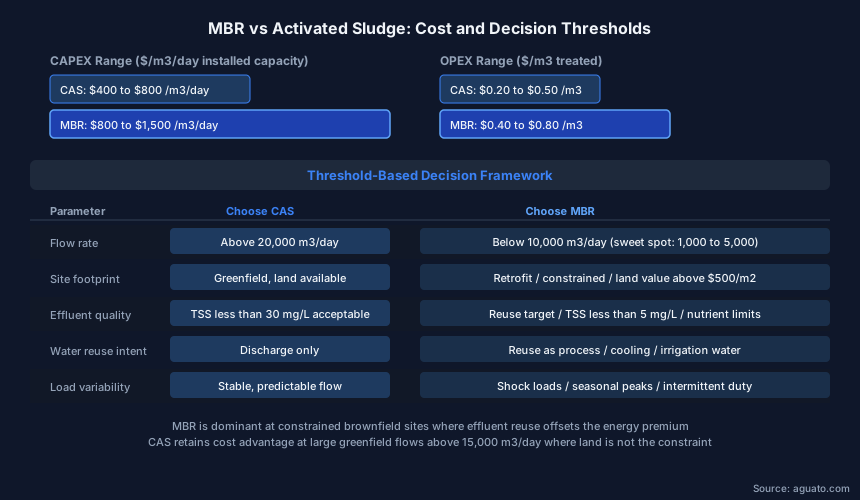
The framework above is a preliminary filter, not a final specification. Every site has local variables, including sewer ordinance requirements, available grid power, feed wastewater composition, and local civil construction costs, that shift the thresholds by 10 to 30%. A thorough feasibility study will apply site-specific numbers to each threshold before committing to detailed design. The most important input is the value of recovered water at your site, since that number changes the payback period more than any other single variable in the model. Sites in water-scarce regions with a municipal reuse tariff above USD 2 per m3 almost always favour MBR at flows below 15,000 m3/day when the full system boundary is correctly drawn.
## Effluent quality and reuse potential
MBR permeate is categorically different from CAS secondary effluent, and that difference has direct commercial value in water-stressed regions and industries where reuse is either mandated or commercially attractive.
The effluent quality gap is not incremental: MBR produces water that meets Class A+ reuse standards without tertiary polishing, while CAS secondary effluent requires at least one additional treatment step before any industrial reuse application. For a facility targeting zero liquid discharge or 80% water recovery, that step is not optional, and it costs.
CAS secondary effluent at TSS 20 to 30 mg/L and BOD 20 to 30 mg/L can be used as cooling tower blowdown replacement after sand filtration and chlorination, or as irrigation water after UV treatment, but it cannot feed RO membranes without tertiary polishing. MBR permeate at TSS below 1 mg/L and turbidity below 0.5 NTU is RO-ready, enabling direct recovery of industrial process water or production of high-purity water. At a water cost of USD 2 to 5 per m3 for treated industrial supply, a 5,000 m3/day plant recovering 60% of its treated wastewater offsets USD 1.1 to 2.7 million in water purchase costs per year.
For industrial sectors operating under ESG water targets, MBR offers a reporting-ready pathway to internal water reuse credits. A pharmaceutical plant in a water-scarce region that installs MBR and demonstrates 60 to 80% wastewater recovery can report a reduction in net water withdrawal intensity, which directly feeds Scope 3 water disclosures under GRI 303 and CDP. The CAS alternative does not offer this pathway without substantial additional investment in tertiary treatment.
The reuse value quantification should be built into the RFP specification from day one. A procurement team that models only the capital cost without a line for reuse water credit will consistently under-select MBR, then spend the next budget cycle on a tertiary polishing upgrade. The facilities that get this right build a full water balance model before issuing the tender, quantify the value of avoided freshwater at marginal supply cost, and run sensitivity scenarios against 5-year and 10-year energy tariff projections. That analysis takes four to six weeks and saves USD 1 to 3 million in specification regret. If your team lacks the internal resources to build it, qualified process engineers through [industrial water treatment providers](/industrial-wastewater-treatment) can scope the water balance and technology comparison as a standalone feasibility service.
Quantifying the reuse credit accurately requires site-specific water balance modelling, but even conservative estimates using the numbers in this section typically close the MBR business case at flow rates below 10,000 m3/day where land is constrained and reuse water has a local market value above USD 1.50 per m3. The comparison table in the next section is built to support that analysis.
## MBR vs activated sludge: head-to-head technology comparison
The comparison below is intended for procurement leads preparing RFP evaluation criteria. It covers the dimensions that determine total cost of ownership, not just headline CAPEX.
| Dimension | Conventional Activated Sludge | Membrane Bioreactor (MBR) | Best for | |---|---|---|---| | Installed CAPEX (USD/m3/day) | USD 400 to 800 | USD 800 to 1,500 | CAS: large greenfield, no reuse | | OPEX - energy (kWh/m3) | 0.3 to 0.6 | 0.8 to 1.5 | CAS: low energy cost, no reuse target | | Effluent TSS (mg/L) | 15 to 30 | Below 1 | MBR: discharge limits or reuse | | Effluent BOD (mg/L) | 20 to 30 | Below 5 | MBR: nutrient-sensitive discharge | | Footprint (relative) | 100% (baseline) | 30 to 50% of CAS | MBR: constrained brownfield | | MLSS operating range (mg/L) | 2,000 to 4,000 | 8,000 to 12,000 | MBR: shock loads, variable feed | | Membrane replacement OPEX | Not applicable | USD 20 to 40/m2 per 5 to 10 yr | CAS: low long-term maintenance budget | | Reuse pathway | Requires tertiary addition | RO-ready permeate direct | MBR: water reuse or ZLD target | | Scale sweet spot (m3/day) | 5,000 to 100,000+ | 500 to 15,000 | CAS: municipal scale, MBR: industrial | | Upset risk | Sludge bulking, clarifier hydraulics | Membrane fouling, TMP exceedance | Site-specific ops capability | | Regulatory compliance (strict N/P limits) | Requires tertiary polishing | Achieves without extra steps | MBR: tightening nutrient permits |
[Water Research journal publications on MBR performance benchmarking](dofollow:https://www.sciencedirect.com/journal/water-research) document consistent pathogen removal of 4 to 5 log reduction for bacteria and 3 to 4 log for viruses in MBR systems, removing the need for intensive disinfection steps required in CAS trains targeting indirect potable reuse.
## When to choose MBR and when to stay with CAS
The threshold-based framework below is designed to give a defensible preliminary selection before you commit to detailed design. It is not a substitute for site-specific hydraulic and mass balance modelling, but it will prevent the most common specification errors.
Choose MBR when any of the following thresholds are met:
Flow rate below 10,000 m3/day at a site where land cost exceeds USD 500/m2. Below this scale, the clarifier footprint cost and the avoided tertiary polishing step typically offset the membrane premium within 6 to 10 years.
Effluent reuse target requiring TSS below 5 mg/L, turbidity below 1 NTU, or direct RO pre-feed. CAS cannot meet these specifications without additional unit operations that cost more than the MBR premium in most cases.
Brownfield retrofit where no space exists for a secondary clarifier of adequate surface overflow rate. An MBR can often be installed in 30 to 50% of the footprint, enabling biological treatment upgrades at plants where CAS expansion is physically impossible.
Variable or shock loading from industrial batch processes (food and beverage, chemical, pharmaceutical). The higher MLSS in MBR provides buffering capacity that a CAS clarifier cannot match at the same basin volume.
Tightening discharge limits for nutrients (total nitrogen below 10 mg/L, total [phosphorus](/elements/phosphorus) below 1 mg/L) where the permit timeline is under 24 months. MBR with integrated denitrification zones achieves these limits without the clarifier-dependent tertiary nitrification steps that CAS upgrade paths require.
Choose CAS when these conditions apply:
Flow rate above 20,000 m3/day at a greenfield site with adequate land. At this scale, CAS CAPEX advantage is decisive and the land arbitrage does not overcome the energy OPEX premium.
Discharge-only operation with secondary treatment standards (BOD below 30 mg/L, TSS below 30 mg/L). CAS meets these specifications reliably and at lower 20-year lifecycle cost.
Operations team without membrane maintenance experience and no budget or timeline for training. An MBR operated by a team unfamiliar with TMP management, scouring aeration, and CIP protocols will underperform and over-cost relative to projections.
Budget-constrained CAPEX with no reuse revenue to amortise the premium. Where the capital expenditure ceiling is firm and reuse savings cannot be modelled into the approval case, CAS is the risk-appropriate choice.
## Failure modes and what they cost
Every technology looks good in a vendor presentation. The cost analysis that matters is what happens when it fails.
CAS failure mode 1: sludge bulking. Decision leading to failure: dissolved oxygen (DO) control in the aeration basin is inconsistent, filamentous organisms dominate. Operational outcome: secondary clarifier effluent TSS rises to 80 to 200 mg/L. Quantified cost: discharge consent violation at USD 10,000 to 50,000 per event (US EPA permit fees plus potential permit revision costs), plus loss of downstream reuse production at USD 2 to 5 per m3 for duration of the upset, typically 1 to 4 weeks. Correct decision: automated DO control with blower modulation and regular mixed liquor microscopy.
CAS failure mode 2: clarifier hydraulic overload during storm events. Decision leading to failure: combined wastewater system with inadequate equalization. Operational outcome: clarifier surface overflow rate exceeds design, solids carryover, downstream processes impacted. Quantified cost: USD 50,000 to 200,000 in clarifier rehabilitation and permit violation costs per major event. Correct decision: upstream equalization tank sized for 4 to 6 hours of peak wet-weather flow.
MBR failure mode 1: irreversible membrane fouling. Decision leading to failure: fine screening failed (rags and fibres reaching membrane modules), or SMP/EPS buildup from organic overload without CIP intensification. Operational outcome: TMP rises irreversibly, membrane module must be replaced ahead of design life. Quantified cost: USD 50,000 to 250,000 in premature module replacement plus lost production during shutdown. Correct decision: dual-stage fine screening at 1 to 2 mm, SMP monitoring, and accelerated CIP (maintenance clean weekly, recovery clean monthly).
MBR failure mode 2: membrane integrity breach. Decision leading to failure: physical damage to hollow-fibre membranes from abrasive solids or poor scouring aeration distribution. Operational outcome: permeate turbidity rises above 0.1 NTU, membrane integrity test fails. Quantified cost: USD 5,000 to 30,000 per incident in module repair plus compliance hold if permeate is used for reuse. Correct decision: inlet grit removal, pressure integrity testing monthly, scouring aeration uniformity verification at installation.
The cost of a single avoidable failure in either technology exceeds the annual budget for preventive maintenance in most industrial facilities. The specification decision should include, from day one, a 5-year O&M budget that accounts for the respective failure modes.
## Real-world application examples
Example 1: Food processing, mid-size dairy, Netherlands. Problem: existing CAS plant at 1,200 m3/day generating effluent at TSS 45 mg/L, BOD 28 mg/L, exceeding discharge consent under Dutch Water Framework Directive implementation. Site footprint constrained. Solution: MBR retrofit replacing clarifier with membrane bioreactor in existing basin, adding 180 m2 of hollow-fibre UF modules. Outcome: effluent TSS below 2 mg/L, BOD below 4 mg/L. Permeate reused as clean-in-place pre-rinse water, recovering 350 m3/day and saving EUR 420 per day (approximately USD 462) in water and discharge tariff. Full payback on the EUR 1.1 million (approximately USD 1.21 million) MBR upgrade in 7.1 years. Why it worked: the land arbitrage and reuse credit closed the business case where equipment CAPEX alone could not.
Example 2: Municipal industrial park, Southeast Asia, 8,000 m3/day. Problem: new industrial park required a shared wastewater treatment plant for mixed chemical and textile effluent with reuse target of 50% treated water for cooling tower makeup. Solution: MBR selected at detailed design stage over CAS after full lifecycle cost modelling. MBR CAPEX was USD 2.8 million higher, but avoided tertiary filtration and eliminated 1,400 m2 of clarifier footprint on land valued at USD 1,800/m2. Reuse revenue of USD 3.10 per m3 for 4,000 m3/day recovered water provided a reuse credit of USD 1.13 million per year. Why it worked: the combination of land arbitrage and reuse revenue made MBR the lower total cost option over a 15-year horizon despite the higher equipment cost.
Example 3: Pharmaceutical API plant, Germany, 400 m3/day. Problem: discharge consent required TN below 8 mg/L and TP below 0.5 mg/L. CAS upgrade path would have required clarifier expansion plus tertiary nitrification-denitrification plus chemical phosphorus removal, totalling EUR 1.8 million (approximately USD 1.98 million). Solution: MBR with integrated anoxic zone, single-stage biological nutrient removal. Installed cost EUR 1.35 million (approximately USD 1.49 million). Outcome: TN consistently below 6 mg/L, TP below 0.3 mg/L, permeate quality enabling partial reuse as laboratory-grade rinse feed after RO polishing. Why it worked: the complexity and cost of the CAS upgrade path made the MBR a cheaper solution even at small flow.
Qualifying your specific site requires modelling against your actual feed water quality, discharge consent, and site constraints. [Post your project](/post-project) to access MBR and biological treatment specialists who will scope both options against your numbers before you commit to RFP.
## Procurement and vendor selection
The MBR market is dominated by a handful of global membrane suppliers who account for roughly 70% of installed capacity, but the local system integrator who engineers the balance of plant often determines whether the technology performs at specification.
Key vendors in the MBR membrane module space include manufacturers of PVDF hollow-fibre and flat-sheet modules. Specification of the membrane module is necessary but not sufficient. The aeration grid design, fine screening stage, CIP skid sizing, and SCADA integration determine operating cost and failure rate as much as the membrane itself.
For CAS, the vendor landscape is broader, with established integrators in each region. The critical procurement parameter is the clarifier mechanism design and the blower specification, as both drive long-term maintenance cost.
For a defensible procurement process, specify both technologies to a common performance standard (effluent quality, uptime SLA, energy consumption guarantee) and evaluate bids on lifecycle cost over 20 years, not equipment price. A USD 300,000 CAPEX saving on a CAS bid that requires USD 80,000/year more in energy and USD 1.2 million in tertiary polishing is not a saving.
Use [membrane filtration companies on Aguato](/membrane-filtration-companies) to identify pre-vetted MBR system integrators in your region, and [industrial wastewater treatment specialists](/industrial-wastewater-treatment) for full biological treatment system procurement.
Platforms like [Nepti](/nepti) can model your water matrix and discharge targets against both technology pathways, producing a ranked comparison of MBR versus CAS with cost projections across CAPEX, OPEX, and lifecycle scenarios, so you arrive at RFP with a technically grounded baseline rather than relying on vendor-generated cost models.
Understanding the broader [industrial wastewater treatment process](/resources/industrial-wastewater-treatment-process) informs how the biological treatment stage fits within the full treatment train, which matters for selecting the right pre-treatment and tertiary polishing strategy. For facilities targeting closed-loop water recovery, integrating MBR output with downstream [membrane filtration systems](/resources/membrane-filtration-system) or [industrial water reuse programmes](/resources/industrial-water-reuse-recycling) delivers the effluent quality and system resilience that discharge-only CAS cannot match.
Aguato connects you with pre-vetted biological treatment and membrane system specialists who can scope the full lifecycle comparison against your actual site data, feed quality, and discharge targets. The typical scoping engagement takes 2 to 4 weeks and produces a technology comparison report with CAPEX estimates, OPEX projections, and a recommended technology pathway, providing the documented analysis an internal capital committee needs before approving detailed design expenditure. That deliverable replaces months of internal research and arrives with the credibility of an independent technical opinion, which is the standard most environmental compliance teams require for a permit-backed investment.
Turning this comparison into a defensible capital decision means putting both pathways out to scoped proposal. Browse vetted [wastewater treatment companies](/providers) on Aguato, filter by MBR and conventional activated sludge experience, and request like-for-like quotes so the OPEX gap modelled above is confirmed against your influent profile.
## FAQ
### What is the main difference between MBR and conventional activated sludge?
The core difference is biomass separation: MBR uses submerged ultrafiltration or microfiltration membranes to retain solids, while CAS relies on gravity settling in a secondary clarifier. This allows MBR to operate at MLSS concentrations of 8,000 to 12,000 mg/L compared to 2,000 to 4,000 mg/L in CAS, producing effluent at TSS below 1 mg/L and BOD below 5 mg/L without a separate tertiary polishing step. The trade-off is higher energy consumption (0.8 to 1.5 kWh/m3 vs 0.3 to 0.6 kWh/m3) and higher CAPEX (USD 800 to 1,500 vs USD 400 to 800 per m3/day installed capacity).
### How much more expensive is MBR than activated sludge?
MBR CAPEX runs USD 800 to 1,500 per m3/day installed capacity compared to USD 400 to 800 for CAS, a premium of roughly 50 to 100% on equipment cost alone. However, when the full system boundary includes avoided tertiary filtration (USD 200 to 400 per m3/day), land savings from the 30 to 50% smaller footprint, and water reuse credits of USD 1 to 3 per m3 recovered, the lifecycle cost advantage of CAS frequently disappears at sites below 10,000 m3/day with a reuse or strict discharge target. The energy OPEX gap of USD 0.05 to 0.09 per m3 favours CAS over the long run at large-scale, discharge-only applications.
### Can MBR meet reuse water quality standards directly?
Yes. MBR permeate typically achieves TSS below 1 mg/L, BOD below 5 mg/L, and turbidity below 0.5 NTU as a standard operating condition, meeting Class A recycled water criteria in most jurisdictions. This makes MBR permeate directly usable as cooling tower makeup, process rinse water, or landscape irrigation without tertiary polishing. For applications requiring higher purity (boiler feed, ultrapure process water), MBR permeate feeds RO with significantly lower fouling potential than CAS secondary effluent, extending RO membrane life and reducing cleaning frequency.
### What is the energy consumption of MBR compared to CAS?
MBR consumes 0.8 to 1.5 kWh/m3 treated, compared to 0.3 to 0.6 kWh/m3 for CAS, with the gap driven by membrane scouring aeration and higher MLSS requiring more mixing energy. At an electricity tariff of USD 0.10/kWh, this is an additional operating cost of USD 50,000 to 90,000 per year for a 1,000 m3/day plant. [The International Water Association's guidance on membrane bioreactor design](dofollow:https://iwa-network.org/iwa-specialist-group-membrane-bioreactors/) confirms that energy benchmarking across multiple MBR installations places well-operated submerged hollow-fibre systems at 0.8 to 1.2 kWh/m3. Optimised coarse-bubble scouring aeration design and careful membrane flux management can reduce MBR energy consumption to the lower end of its operating range.
### What size projects are best suited to MBR?
MBR performs best at flow rates of 500 to 15,000 m3/day, with the industrial sweet spot between 1,000 and 5,000 m3/day. Below 500 m3/day, the membrane CIP infrastructure cost per unit flow is disproportionate. Above 15,000 to 20,000 m3/day on a greenfield site with adequate land, CAS retains a compelling lifecycle cost advantage. Municipal-scale MBR installations above 50,000 m3/day exist but represent cases where space or effluent quality constraints override the economics.
### How often do MBR membranes need to be replaced?
Hollow-fibre PVDF MBR membranes have a design life of 7 to 10 years under normal operating conditions, with replacement cost ranging from USD 20 to 40 per m2 of membrane area. For a 2,000 m3/day MBR with approximately 1,500 m2 of installed membrane area, that is a replacement budget of USD 30,000 to 60,000 per replacement cycle. Premature replacement from fouling or mechanical damage reduces effective life to 3 to 5 years, doubling the annualised replacement cost. Membrane longevity is primarily governed by fine screening adequacy, CIP protocol discipline, and avoidance of operating flux above design rates.
### Is MBR better than activated sludge for nutrient removal?
MBR offers a structural advantage for biological nutrient removal (BNR) because the higher MLSS and decoupled SRT allow independent optimisation of nitrification and denitrification zones without the settling constraints that limit CAS BNR configurations. An MBR with an integrated anoxic pre-anoxic zone routinely achieves TN below 8 mg/L and TP below 1 mg/L (with chemical phosphorus precipitation) without the clarifier-dependent recycle limitations of CAS BNR. For facilities facing tightening nutrient limits under the EU Urban Wastewater Treatment Directive revisions or US EPA nutrient criteria, MBR is the lower-risk specification path.