The choice between in-house operations, outsourced O&M, and water-as-a-service is not primarily a cost decision. It is a decision about risk transfer, compliance liability, and whether water treatment is a core competency or a support function. The framework for getting it right.
The question of whether to operate a water treatment plant in-house, outsource it to a specialist contractor, or transfer it entirely to a water-as-a-service provider under a OPEX-only model is not primarily a technical question. Technical competence can be acquired in all three models. It is a question about where the risk sits, who has accountability for compliance outcomes, and whether water treatment is a core competency or a support function that competes for management attention with the organisation's actual business.
The wrong O&M model costs more than the wrong technology choice. A correctly specified RO system operated by undertrained in-house staff who do not understand membrane cleaning protocols will foul in 18 months and be operating at 40% of designed capacity within three years. The same system operated by a specialist under a performance-based contract will be maintained to specification for its full 15 to 20 year life. The technology is identical. The outcomes are not.
This guide covers the three primary O&M models (in-house, outsourced, WaaS), the hidden costs in each that are rarely included in upfront financial analysis, the threshold-based decision framework for selecting between them, contract structure for outsourced arrangements, and the failure modes that turn an outsourcing decision into a costly mistake.
## The decision in brief
- Buy cost certainty. In-house operation carries four unpredictable costs: staff turnover and replacement, unplanned equipment failure, compliance exceedance response and capital refresh events. An outsourced contract converts these into a fixed or capped monthly payment. - Price the risk transfer. A 48-hour shutdown attributable to a water treatment compliance event has an operational impact of approximately 480,000 euros for a facility producing at 10,000 euros per hour. The annual premium for outsourcing that risk is rarely more than 10 to 20% of that one event. - Test the argument against outsourcing honestly. The argument that you are paying a margin for something your own team could do is correct if your team is already fully competent, fully resourced and operating without gaps. The question is whether that describes the actual situation, not the intended one.
For a CFO managing a P&L with limited tolerance for operating cost volatility, the risk premium embedded in a contractor's fee can be less than the volatility risk of in-house operation.
[Use Aguato's Nepti tool](/nepti) to assess your plant's treatment complexity and benchmark against the specifications that determine whether in-house operation is viable. [Browse qualified O&M specialists on Aguato](/operations-and-maintenance) to compare what full outsourcing would cost against your fully-loaded in-house operating budget.
## The three O&M models
In-house operations means the organisation employs its own water treatment operators, maintains its own spare parts inventory, holds its own discharge consents, and is directly responsible for all operational decisions and compliance outcomes. The plant owner is the operator. Capital spending decisions, chemical procurement, and incident response all sit with the owner's team.
Outsourced O&M means the organisation contracts a specialist water treatment company to operate the plant on its behalf, typically under a multi-year service agreement with defined service levels (uptime, effluent quality, discharge compliance) and financial penalties for failure to meet them. The owner retains ownership of the asset and responsibility for the overall compliance position, but day-to-day operations are managed by the contractor. The contractor typically provides the operators, the chemicals, the consumables, and the technical oversight.
Water-as-a-Service (WaaS) goes further: the water treatment provider designs, builds, owns, and operates the treatment plant on the owner's premises, charging a unit fee per cubic metre of treated water (or per tonne of product water). The owner has no capital exposure to the water treatment plant. Risk of technical failure, regulatory compliance, technology obsolescence, and maintenance cost overruns sits entirely with the provider. The [water as a service guide](/resources/water-as-a-service-waas) covers WaaS in detail. From an O&M perspective, WaaS is the maximum form of operational outsourcing.
All three models exist on a spectrum of control, cost certainty, and risk transfer. None is universally superior. The right choice depends on the specific organisation, plant complexity, regulatory environment, and management capacity.
## In-house operations: the real cost structure
In-house O&M is presented to finance teams as the cheapest long-term model because the organisation avoids paying a contractor's margin. This framing systematically understates the real cost in ways that experienced water plant owners recognise.
Staffing is the dominant cost and the dominant risk. A water treatment plant requiring continuous operation needs at minimum 3 to 4 full-time equivalents to cover 24/7 operation with holiday, sickness, and training absences: one operator per shift at a 3-shift operation, plus a supervisor or lead. For a plant at a food or pharmaceutical manufacturer where water quality is a GMP-critical parameter, the specification for these operators is high. Annual cost including salary, employer contributions, training, and on-costs is typically 50,000 to 80,000 euros per FTE in Western Europe. A 4-FTE water treatment operation costs 200,000 to 320,000 euros per year in direct staff cost before any other operating cost.
Knowledge concentration risk is systematically undervalued. When the one operator who understands the RO CIP protocol, knows which membrane manufacturer the membranes are from, and knows the quirks of the pressure-relief sequence leaves the organisation, the accumulated operational knowledge leaves with them. Replacement operators need 6 to 12 months to reach full competency on a complex plant. During that period, the risk of operating errors and the frequency of out-of-specification events both increase.
Compliance cost is higher without specialist support. Environmental discharge consents require periodic review, renewal, and sometimes renegotiation as process loads or consent standards change. In-house operations teams at non-water businesses are rarely expert in environmental regulation, and the cost of specialist consultants to manage consent renewals, respond to regulatory inquiries, and prepare annual environmental reports adds 15,000 to 50,000 euros per year for a plant with a complex consent portfolio.
Unplanned capital expenditure is the cost that breaks in-house budgets. In-house operations have no contractual buffer against unexpected capital events. When a pump fails outside warranty, the repair cost hits the operating budget directly. When the RO membranes reach end of life 2 years earlier than expected due to a feed water change, the replacement cost of 80,000 to 200,000 euros is an unplanned CAPEX event in that budget year. Outsourced O&M contracts can include these risks within a fixed monthly fee, converting unpredictable capital events into predictable operating costs.
## Outsourced O&M: what vendors won't tell you
Outsourcing O&M transfers operational responsibility to a specialist but does not transfer legal compliance responsibility. The permit holder for the discharge consent, the regulated entity under industrial emissions legislation, and the responsible party in enforcement proceedings is the plant owner, not the contractor. This distinction matters enormously.
Performance-based contracts require rigorous KPI definition. A contract that specifies "compliant effluent" without defining which specific parameters, what concentration limits, what testing frequency, and what the consequences of non-compliance are will be interpreted in the contractor's favour at every ambiguous point. Contracts that specify effluent quality in terms of the actual discharge consent conditions, with financial penalties of sufficient size to incentivise compliance and not just absorb non-compliance as a cost, perform substantially better than contracts with vague quality requirements.
Contractor margin is not waste. The 15 to 25% overhead and profit that a water treatment contractor charges on top of direct costs pays for technical support from engineers who have seen the specific failure mode you are about to experience before you have encountered it, for a 24/7 response capability that your own organisation would need to staff at equivalent cost, and for the capital reserves needed to replace failed equipment within the SLA timeframe. Comparing a contractor's loaded day rate to an employee's salary is not an apples-to-apples comparison.
Scope definition determines everything. The contract scope must specify clearly: who provides consumables (membranes, filter media, resin, chemicals); who bears the cost of unplanned maintenance events above a defined threshold; who is responsible for the performance monitoring systems; who manages sub-contractors (analytical laboratory, specialist membrane cleaning contractor, electrical contractors); and what happens when the plant equipment reaches the end of its design life. Scope ambiguity resolves in practice to disputes, and disputes during an operational relationship are damaging.
According to [Water UK data on industrial water management practices](dofollow:https://www.water.org.uk), approximately 60% of UK industrial water treatment plants above 500 m3/day that are operated in-house report at least one significant compliance event per 5-year period, versus approximately 30% for professionally outsourced operations. The delta reflects both the specialist competence gap and the 24/7 monitoring and response capability that large specialist contractors maintain.
## Water-as-a-Service compared to traditional outsourcing
WaaS shifts the financial model from capital ownership with operating cost to pure operating cost. The practical differences from traditional outsourced O&M are:
Capital ownership: In traditional outsourcing, the owner owns the asset and bears the book value risk. In WaaS, the provider owns the plant. If the technology becomes obsolete after 7 years, the risk of the stranded asset is the provider's problem. For asset-light organisations or organisations in sectors with rapid process technology change, this matters.
Contract duration and exit: WaaS contracts typically run 15 to 20 years, which is the time needed for the provider to amortise the capital investment. This is a significantly longer lock-in than traditional O&M contracts (5 to 10 years). The exit provisions matter enormously: what happens if the organisation's water demand decreases significantly, if the business is sold or the site is closed, or if the WaaS provider performs poorly? These scenarios must be addressed in the contract before it is signed.
Unit cost vs fixed cost: WaaS is typically priced per m3 of treated water, which means cost scales with demand. For organisations with highly variable water demand, this can be advantageous. For organisations with stable high demand, it typically costs more per unit of output than a capital-owned plant properly operated. The [CAPEX vs OPEX analysis](/resources/water-treatment-capex-opex) covers the general framework for this comparison.
## O&M cost comparison
The cost comparison diagrams below illustrate the 10-year total cost structure for a 1,000 m3/day industrial water treatment plant operated under different models.
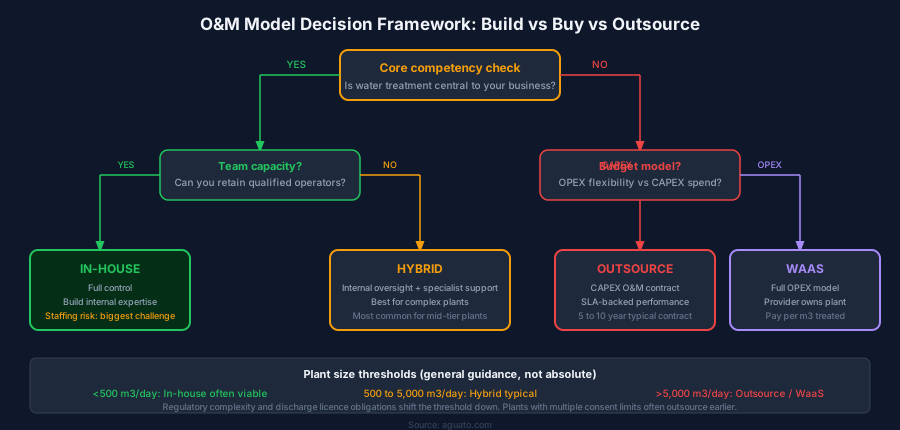
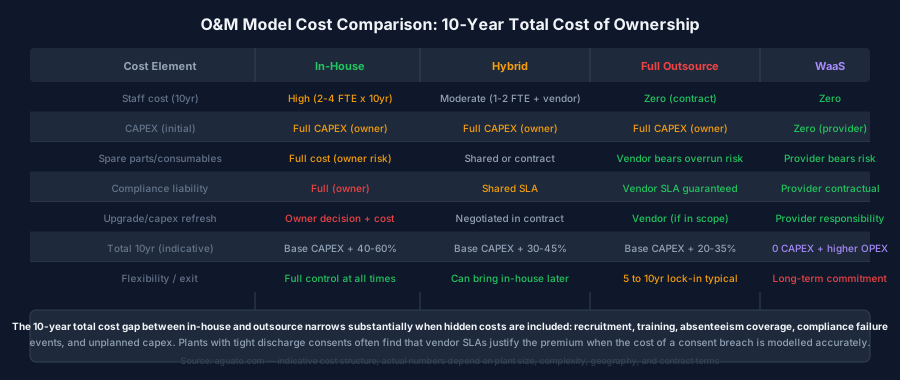
A useful rule of thumb: For plants below 200 m3/day with simple technology (softening, standard RO), in-house operation is viable if the organisation already has maintenance staff who can be trained. For plants between 200 and 2,000 m3/day with moderate complexity, hybrid arrangements (in-house operator with specialist contractor providing technical support and consumables) are common and generally cost-effective. For plants above 2,000 m3/day, complex technology (MBR, ZLD, advanced treatment), or tight regulatory constraints, outsourced or WaaS models are generally more cost-effective when full costs including risk are included.
## The decision framework: a threshold-based approach
The decision framework is not an algorithm; it is a set of threshold questions that should be answered in sequence.
Threshold 1: Is water treatment a core competency? If the organisation is a water utility, an engineering firm with process water expertise, or a sector where water quality is a direct revenue driver (semiconductor, pharmaceutical, food), the answer may be yes. For a steel mill, a hotel group, or a logistics operation, the answer is almost certainly no. If the answer is no, in-house operation has a structural disadvantage that staffing quality and budget cannot overcome.
Threshold 2: Can the organisation attract and retain qualified operators? The market for experienced water treatment operators is tight in most developed countries. In regions where water treatment expertise is concentrated in contractor organisations, an in-house operation that cannot offer specialist career development paths will consistently lose operators to contractors, creating a permanent competency deficit.
Threshold 3: What is the compliance exposure? Facilities with complex discharge consents, multiple environmental permits, or operations in sectors with active regulatory enforcement have a compliance exposure that makes in-house operation particularly risky. The question is not whether the in-house team is capable in principle, but whether the organisation can absorb the regulatory and financial consequences of an error that an experienced specialist contractor would likely avoid.
Threshold 4: What is the capital and OPEX budget flexibility? WaaS eliminates upfront CAPEX at the cost of higher 20-year OPEX. For organisations in capital-constrained sectors, or for projects in markets where access to capital is expensive, the OPEX model has balance sheet advantages that change the effective cost comparison.
[Browse water treatment O&M specialists on Aguato](/operations-and-maintenance) to compare the full range of outsourcing models. [Post your O&M requirements on Aguato](/post-project) to receive structured proposals from contractors who operate in your sector and geography.
## Contract negotiation: SLAs, KPIs, and exit clauses
The quality of an O&M contract determines whether outsourcing delivers its promised benefits. Four elements are non-negotiable in a well-structured agreement.
KPIs tied to actual regulatory requirements: Service level agreements should specify the effluent quality parameters from the site's discharge consent, the testing frequency from the consent conditions, and the action protocol when consent conditions are at risk. Generic "best endeavours" language for compliance is not adequate. Specific numeric limits, testing frequencies, and contractual consequences are.
Financial penalties scaled to risk: The penalty for missing an SLA should be proportionate to the consequence of the breach. A day's penalty equivalent to 1% of the monthly service fee for a compliance event that risks a 100,000 euro regulatory fine and production impact creates no real incentive. Penalty structures should be designed to make compliance economically dominant over non-compliance.
Asset condition obligations: The contract should specify the condition standards for the plant assets at contract end, preventing the contractor from under-maintaining the plant in the final years to reduce operating cost at the expense of the next operator.
Exit provisions: The contract should address plant handover in detail: what documentation must be provided, what training must be delivered, what spares inventory must be held, and what is the notice period that allows a new operator (in-house or a different contractor) to be trained and operational before the outgoing contractor leaves.
## Transition risk: switching O&M models
Switching from in-house to outsourced, from one contractor to another, or from outsourced back to in-house all carry transition risk that is frequently underestimated.
Knowledge transfer: An outgoing contractor or outgoing operator team holds detailed knowledge of the plant's quirks, failure history, and operational nuances. This knowledge is not fully captured in O&M manuals and is not transferred by document handover alone. Transition programmes should include a minimum 3-month parallel operation period where the outgoing operator mentors the incoming one, even when contractual relationships make this uncomfortable.
Regulatory continuity: If the site operates under a discharge consent held by a contractor, and the contractor changes, the consent may need to be transferred or reissued. In some jurisdictions this triggers a fresh permit review. The timing of contractor changes should account for regulatory lead times in the consent management.
Chemical and consumable inventory: The transition period between contractors typically involves a change in chemical supplier, consumable specification, and potentially resin or membrane brand. Changes to any of these without adequate commissioning and re-optimisation of dosing rates and operating parameters risk both water quality exceedances and accelerated consumable deterioration.
## Where O&M outsourcing fails
Scope assumptions diverge between owner and contractor: The most common O&M contract failure mode is not performance failure by the contractor; it is a disagreement about what was in scope. Equipment that the contractor assumed was the owner's responsibility and the owner assumed was the contractor's responsibility reaches end of life with no party having maintained it, leading to an emergency replacement with contested cost allocation.
Contractor substitution of lower-cost operating staff: Experienced water treatment operators are expensive. Some contractors bid contracts with experienced staff in the proposal and operate with less experienced staff once the contract is running. The owner only discovers this when performance deteriorates or a compliance event occurs. Contracts should specify minimum operator qualification levels, allow owner inspection of operator credentials, and require advance notification of key personnel changes.
Inadequate performance monitoring by the owner: Outsourcing operations does not mean outsourcing oversight. Owners who delegate completely to a contractor without maintaining their own visibility of daily and monthly operating data lose the ability to identify deteriorating performance trends before they become compliance events. Regular operational performance reviews between the owner's representative and the contractor's account manager are a contract requirement, not an optional extra.
Using Aguato for competitive tendering: Multi-provider competitive tendering for O&M contracts provides both cost benchmarking and quality signals that sole-source appointments cannot deliver. [Browse specialist O&M providers on Aguato](/operations-and-maintenance) to identify contractors with demonstrated experience in your plant type and sector. [Post your O&M brief on Aguato](/post-project) to receive structured proposals that allow direct comparison on scope, SLA structure, and cost.
## FAQ
### What is the difference between outsourced O&M and Water-as-a-Service?
In outsourced O&M, the plant owner owns the water treatment plant and pays a service contractor to operate it under a performance contract. The owner bears the capital asset risk and typically has capital obligations for major equipment replacement. In Water-as-a-Service, the service provider owns and operates the plant on the owner's site, charging a unit rate per cubic metre of treated water. The owner has no capital obligation but pays a higher unit OPEX over a longer contract term to fund the provider's capital investment.
### How long should an outsourced O&M contract run?
Traditional outsourced O&M contracts run 5 to 10 years. This duration allows the contractor to invest in staff training and plant optimisation with a reasonable payback horizon, while not creating excessive lock-in for the owner. WaaS contracts typically run 15 to 20 years due to the provider's capital investment. Contracts shorter than 3 years rarely produce the performance improvement they promise: contractors cannot recover the mobilisation cost and do not invest in plant improvements on short contract terms.
### Who is legally responsible for discharge consent compliance when O&M is outsourced?
The legal compliance obligation stays with the plant owner, not the contractor. The discharge consent is held by the owner or operator of the site. If the contractor's operation results in a consent breach, the regulator's enforcement action is directed at the consent holder, not the contractor. The owner may then have contractual recourse against the contractor under the SLA, but this does not protect the owner from regulatory action. This is why performance-based SLAs with meaningful financial consequences are essential: they align the contractor's financial interest with the owner's regulatory interest.
### What are the main hidden costs of in-house water treatment operation?
The main costs systematically omitted from in-house versus outsource comparisons are: recruitment and training costs when operators leave (industry average tenure for industrial operators is 3 to 5 years); knowledge loss during the transition period; the management time cost of dealing with compliance events and regulatory correspondence; the cost of unplanned capital events that hit the operational budget; and the cost of specialist consultants for consent renewals, environmental reporting, and technical investigations that an in-house generalist team cannot handle internally.
### What should be in a water treatment O&M contract KPI framework?
The minimum KPI framework should include: treated water quality parameters tied to the discharge consent numeric limits; plant availability (uptime) expressed as a minimum percentage; response time for operator callout outside normal hours; monthly and annual reporting obligations; chemical dosing accuracy against design targets; and energy consumption benchmarks. Each KPI should have a monitoring protocol, a reporting frequency, and a financial consequence for non-achievement that is proportionate to the impact of non-compliance on the owner's operations.
### How do you manage the transition from in-house to outsourced O&M?
The key elements of a successful transition are: a parallel operation period of at least 3 months where the incoming contractor works alongside the outgoing operator before taking full control; a comprehensive knowledge transfer including failure history, operating log review, and equipment documentation; a spares inventory count and transfer or reconciliation; a chemical stock and supplier transition plan; and regulatory notification if the consent holder or responsible person needs to be updated. Transitions that skip the parallel operation period and rely on documentation alone consistently result in a performance dip in months 3 to 12 of the new contract.