The gap between a well-designed ETP and a poorly designed one is $1.5M to $5M over 20 years, set almost entirely by the biological technology matched to your load. Here is how to specify, size, and procure one defensibly.
An effluent treatment plant is the asset that stands between an industrial site and a regulator's closure notice, and it is the one piece of infrastructure where a specification error compounds silently for two decades. Specify the wrong ETP for your effluent and the gap between a well-designed plant and a poorly designed one runs USD 1.5 million to 5 million over a 20-year service life, before you count the discharge fines, the production curtailments, and the inevitable retrofit that follows the first serious exceedance. The plant looks like a commodity on a procurement spreadsheet. It is, in reality, a process-engineering decision whose cost is set almost entirely by one choice: the biological technology matched to your contaminant load.
This guide is written for the people who carry the ETP decision: operations leads commissioning a new plant, procurement teams running an RFP against three or more vendors, sustainability directors trying to turn the effluent into a reuse stream, and project sponsors deciding between a packaged plant and a site-built one. It covers what an ETP actually does, the four process stages and where the cost concentrates, the technology choices that make or break the lifecycle case, the failure modes that produce six-figure write-offs, and what the numbers look like in real ranges across the common load bands.
## The decision in brief
- Characterise the effluent across the full production cycle. With the biological technology matched to the actual contaminant load and variability rather than the vendor's standard offering, you save USD 1.5 million to 5 million over the ETP's 20-year service life on a medium-strength plant. - Count the saving on four lines. It splits between capital avoidance from right-sizing, operating-cost reduction from the correct biology, reuse revenue from recovered water, and regulatory-enforcement avoidance. - Size the equalisation and sludge train defensibly. That is the third condition on the saving, alongside characterising the effluent and matching the biology. The treatment itself is a known cost, USD 0.40 to 6.50 per cubic metre depending on strength.
The cost of doing nothing is a vendor specifying a package ETP to the average load without a documented mass balance, the single decision behind three of the four six-figure failure modes in this article.
## What an effluent treatment plant actually does
An effluent treatment plant takes the contaminated wastewater an industrial process generates and turns it into a discharge the regulator will accept, or into water clean enough to reuse on site. That is the whole job, and the difficulty of it is set by the gap between what the process produces and what the discharge consent allows. An ETP treating a food processing effluent with 3,000 mg/L COD to a sewer limit of 1,000 mg/L is a fundamentally different machine from one treating the same effluent to a river limit of 125 mg/L, even though the influent is identical.
The defining feature of industrial effluent, and the reason an ETP is harder to design than a domestic sewage plant, is variability. The contaminant load swings with the production schedule, the product mix, and the season. A plant designed for the average load fails when the load peaks, and the load peaks precisely when production is highest, which is also when the regulator's automatic sampler is most likely to be running. The single most important design input is therefore not the average effluent quality but the variability around it, characterised across a full production cycle. An ETP designed from a single grab sample is an ETP designed to fail. The [US EPA effluent guidelines for industrial categories](dofollow:https://www.epa.gov/eg) set out the technology-based limits that anchor the design target for many of these effluents, and they are the reference an RFP should cite rather than a vendor's assumed influent.
An opinionated view that survives every project: the most common procurement failure on an ETP is treating it as an equipment purchase rather than a process design. Vendors who win on price usually win because their influent assumptions are optimistic, and the operator inherits the gap between the brochure and reality. The right way to evaluate an ETP proposal is on a documented mass balance, with a defensible peak-load factor and a sludge production estimate that matches the chosen biology, not on a quoted lump sum for a package plant. This is the same discipline that governs any rigorous [industrial wastewater treatment](/resources/industrial-wastewater-treatment) project.
[cta:nepti-dark]
A second confusion that costs real money is conflating the ETP with a sewage treatment plant or a common effluent treatment plant. The three solve different problems and follow different design rules, and getting the distinction right at the brief stage is the first risk-management step on any project. The next section draws the lines.
## ETP vs STP vs CETP: knowing which problem you have
The terms get used loosely, and the looseness is expensive, because each plant type is engineered for a different feed and the wrong one fails fast.
An effluent treatment plant (ETP) handles industrial effluent: high-strength, variable-composition wastewater from a manufacturing process, often carrying recalcitrant or toxic loads that demand specialised treatment. The design problem is the variability and the specific contaminant mix, and the unit cost per cubic metre is typically several times that of a domestic plant.
A sewage treatment plant (STP) handles domestic-style sewage: a predictable feed dominated by organic load with a relatively narrow contaminant envelope. The design challenge is hydraulic variability rather than chemical variability. The detailed sizing and configuration logic for these is covered in the [sewage treatment plant guide](/resources/sewage-treatment-plant-stp), and the cardinal error is using an STP to treat an industrial effluent it was never designed for.
A common effluent treatment plant (CETP) is a shared facility serving multiple industrial units, common in industrial estates and clusters (textile parks, tannery clusters, chemical zones). The CETP pools the effluent from many small generators, which spreads the capital cost but creates a hard governance problem: the plant's biology can be poisoned by any single member discharging a non-conforming load, so a CETP only works with enforced member discharge standards and upstream monitoring.
The rule that holds: if the contaminant load is dominated by a manufacturing process effluent with variable composition or toxic fractions, you have an ETP problem, and the design must be built around the specific contaminants and their variability. Treating an ETP problem with an STP-grade plant, on the basis that the flow numbers look generous, is one of the most expensive errors in the sector, because the biological stage collapses on the first significant production day.
## The four process stages of an ETP
A conventional ETP has four stages, each removing a specific class of contaminant, and the cost concentrates heavily in one of them. Understanding the distribution is what lets a procurement team focus its scrutiny where the money is.
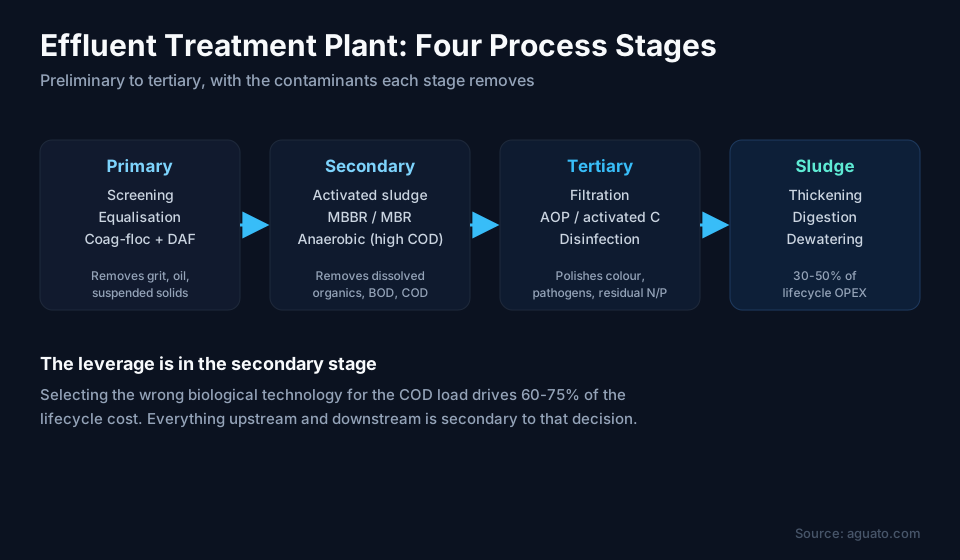
Preliminary and primary treatment conditions the raw effluent and removes the easy fraction. Screening removes solids that would damage downstream equipment. Equalisation, a buffer tank that dampens the flow and load variability, is the single most underrated unit operation in an ETP, because it protects the biology from the peaks that cause most failures. Coagulation, flocculation, and dissolved air flotation remove suspended solids, oil, and grease. The [coagulation and flocculation step](/resources/electrocoagulation-vs-chemical-coagulation) is where the choice between chemical and electrochemical approaches is made, and it matters more on variable feeds than vendors often acknowledge. Primary treatment is relatively cheap, but skipping equalisation to save capital is a false economy that shows up as biological-stage failures within the first year.
Secondary (biological) treatment is where the dissolved organic load is removed and where the cost concentrates. Aerobic processes (activated sludge, moving-bed biofilm reactors, membrane bioreactors) convert dissolved organics into settleable biomass. Anaerobic processes (UASB and similar) are used as a pre-treatment on very high-COD effluents because they remove a large fraction of the load with low energy and produce biogas. The choice between [aerobic and anaerobic treatment](/resources/aerobic-vs-anaerobic-wastewater-treatment), and within aerobic between activated sludge and membrane bioreactors, is the highest-leverage single decision in the plant.
Tertiary treatment handles whatever the biology cannot. Filtration polishes residual suspended solids. Advanced oxidation processes break down recalcitrant COD and colour that biology leaves behind. Nutrient removal targets residual nitrogen and phosphorus where the consent demands it. Disinfection destroys pathogens. The tertiary stage is where the binding discharge parameter, the one that requires the most aggressive treatment, often gets dealt with, and where colour-bearing or recalcitrant effluents need [advanced oxidation process suppliers](/advanced-oxidation-processes-companies) rather than a generic polishing filter.
Sludge handling is the silent cost centre. Both the primary chemical sludge and the waste biological sludge must be thickened, stabilised, dewatered, and disposed. Sludge handling routinely accounts for 30 to 50% of the lifecycle operating cost, and a plant whose sludge train was sized optimistically becomes an operating nightmare, forced to tanker raw sludge off site at significant cost. The [sludge dewatering and treatment](/resources/sludge-dewatering-treatment) decision deserves as much scrutiny as the main treatment train, because it carries a comparable share of the lifecycle cost.
The cost concentration is heavily back-weighted: preliminary and primary treatment rarely exceed 12 to 18% of the lifecycle spend, while the secondary biological stage plus the sludge train together account for 60 to 75%. That distribution is what makes the secondary-technology choice the single highest-leverage decision in the project.
## Choosing the biological technology: the decision that sets the cost
The biological technology choice determines the plant's footprint, its energy cost, its sludge production, its robustness to load variability, and its capital cost. Getting it right for the specific effluent is the difference between a plant that holds compliance cheaply for 20 years and one that fights its load every day.
Conventional activated sludge (ASP) is the mature workhorse. It is well understood, the failure modes are predictable, and operators are widely available. The trade-offs are footprint (it needs large aeration basins and clarifiers) and sensitivity to load shocks. ASP is the default for medium-strength effluents where land is available and the load is reasonably stable.
Moving-bed biofilm reactors (MBBR) grow the biomass on suspended carrier media, which makes the process more robust to load variability and more compact than ASP. MBBR suits effluents with variable load and sites with limited land, at a modest cost premium over ASP. The robustness to shock loads is the main reason MBBR has gained share on industrial effluents.
Membrane bioreactors (MBR) combine biological treatment with membrane separation, producing an exceptionally high-quality effluent in a compact footprint, which is what makes them the technology of choice where the discharge limit is tight or where the effluent is destined for reuse. The trade-off is cost: MBR carries the highest operating cost of the three, driven by membrane cleaning and replacement, and it is sensitive to fouling if the upstream treatment is inadequate. MBR wins where effluent quality or reuse drives the decision, and loses where a looser discharge limit makes its quality premium unnecessary.
Anaerobic pre-treatment is the right answer for very high-COD effluents (food, beverage, distillery, some chemical), where it removes a large fraction of the load with low energy and generates biogas that offsets plant power. Anaerobic is almost always a pre-treatment, followed by aerobic polishing, rather than a stand-alone solution. On the right high-strength effluent, anaerobic pre-treatment can cut the aerobic stage's energy cost by more than half, a saving the [European Commission Best Available Techniques reference for common waste water treatment](dofollow:https://eippcb.jrc.ec.europa.eu/reference/common-waste-water-and-waste-gas-treatmentmanagement-systems-chemical-sector) recognises as a core efficiency lever for industrial effluent plants.
The decision rule that holds: match the biology to the effluent's strength, variability, and discharge target, not to the vendor's standard offering. A documented evaluation of ASP, MBBR, MBR, and anaerobic pre-treatment against the characterised effluent, on a common 15-year lifecycle basis, is what separates a defensible decision from an expensive default. A [Nepti decision intelligence run](/resources/nepti-decision-intelligence-water-treatment) on the characterised effluent ranks these options on lifecycle cost before any vendor scope is written.
## Packaged vs site-built ETP: the real trade-offs
The packaged-versus-site-built decision changes the cost structure, the build schedule, the operational model, and the risk profile of the whole project, and treating it as binary is where projects go wrong.
Packaged ETPs are factory-built modular units that ship as pre-assembled skids. They win on footprint (typically half that of a site-built plant), build time (4 to 9 months versus 14 to 28 for a civil-engineered build), and factory quality control (the plant arrives pre-tested, reducing commissioning risk). They suit smaller flows, constrained sites, and projects where speed matters.
Site-built ETPs are concrete-and-civils plants built up from individual unit operations. They win on lifecycle cost per cubic metre at scale, on the ability to handle large flows economically, and on the maturity and serviceability of conventional technology. Above a certain flow, the unit economics of pouring concrete beat the economics of multiple parallel package skids.
The trap is treating the decision as a binary choice between two catalogue products. The right framing is which configuration minimises 15-year present value cost at your specific flow band, with your land cost, your load variability, and the operator capability you can realistically recruit, and the answer often involves a hybrid: packaged secondary biology on a site-built civils shell. Those hybrids are rarely offered unless the procurement team specifically asks, because they are harder for a single vendor to deliver turnkey.
## Sizing the plant: load, flow, and reserve
The most common cause of ETP underperformance is undersizing, and the second is oversizing. Both come from sizing on the wrong number, and a defensible mass balance is the antidote.
The mass balance starts with the characterised effluent: the average and peak flow, the average and peak concentration of each regulated parameter, and the variability between them. The load (concentration times flow) is what the biology has to process, and the design load is not the average, it is a defensible peak that the plant must handle without breaching the consent. The peak-load factor depends on the process: a continuous-process plant might need 1.3 to 1.6, while a batch-process plant with slug discharges might need 2.5 or more.
Equalisation is the lever that lets you size the biology economically. A well-sized equalisation tank dampens the peaks so the biological stage can be sized closer to the average load rather than the peak, which can cut the secondary-stage cost substantially. Under-sizing the equalisation to save capital, then having to over-size the biology to cope with the un-dampened peaks, is a classic false economy that costs more overall.
The reserve provision is the third lever. A modest over-sizing of the biological stage (10 to 15%) extends the plant's design life on a growing site without meaningful operating-cost penalty. Beyond about 25 to 30% over-sizing, the capital cost rises without proportionate benefit and the plant becomes harder to operate efficiently at part-load, because biomass control is harder when the plant runs well below its design point.
## Capital and operating cost ranges by load band
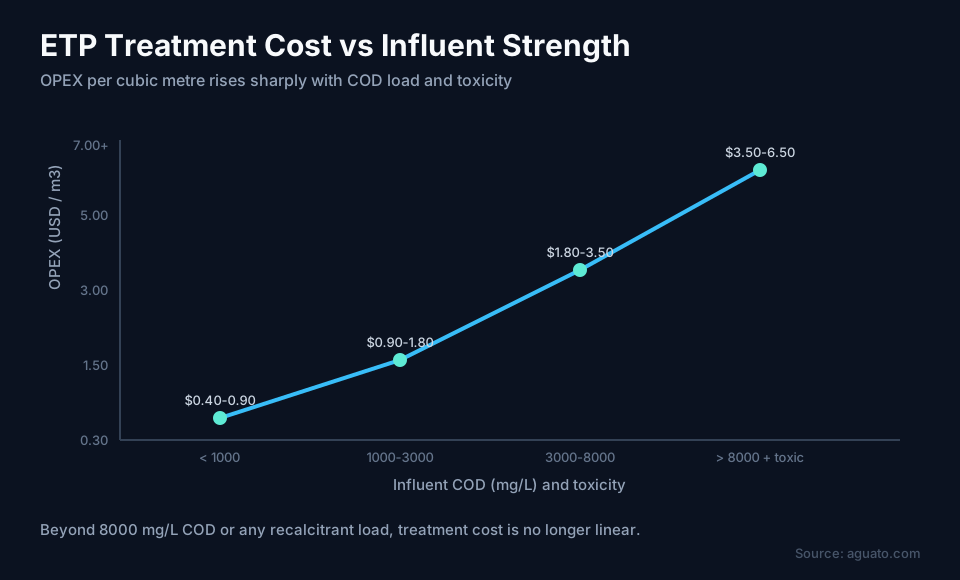
The table below gives realistic ranges across the load bands most ETP projects encounter, indexed to influent COD strength rather than flow alone, because strength drives the treatment intensity. Figures exclude land and off-site connections.
| Influent strength | Typical configuration | Capex per m3/day | OPEX per m3 | Main risk | |---|---|---|---|---| | Low (COD < 1,000) | Primary + ASP/MBBR | $400 to $900 | $0.40 to $0.90 | Peak hydraulic load | | Medium (1,000 to 3,000) | Equalisation + MBBR + tertiary | $700 to $1,500 | $0.90 to $1.80 | Load variability, sludge | | High (3,000 to 8,000) | Anaerobic + aerobic + tertiary | $1,200 to $2,800 | $1.80 to $3.50 | Sludge under-design, biology shock | | Very high (> 8,000 / toxic) | Anaerobic + MBR + AOP | $2,500 to $5,500 | $3.50 to $6.50 | Recalcitrant fraction, membrane fouling |
The OPEX numbers are dominated by energy (aeration is the single biggest power draw on an aerobic plant), chemicals (coagulants, nutrients, pH control), sludge disposal, and membrane or media replacement. The single biggest swing variable is sludge disposal cost, which ranges from under USD 50 per tonne where land application is permitted to over USD 400 per tonne where hazardous-waste incineration is mandated, a range the [US EPA biosolids and sewage sludge framework](dofollow:https://www.epa.gov/biosolids) governs and which is exactly the case for many [industrial wastewater treatment process](/resources/industrial-wastewater-treatment-process) streams carrying metals or recalcitrant organics. Sites carrying that disposal burden often turn to specialist [effluent treatment plant providers](/effluent-treatment-plants) who can integrate the sludge train into the main scope rather than treating it as an afterthought.
The capex numbers exclude land, site preparation, and off-site connections, which on a greenfield site can add 25 to 45% to the headline budget. Pricing an ETP on the equipment scope alone and discovering the connection costs later is a classic procurement failure.
## Failure scenarios and what they cost
The undersized biology. A plant is designed to the average COD load measured in a quiet week. During peak production the load doubles, the biological stage cannot keep up, and the discharge breaches the consent for weeks. The regulator issues an enforcement notice and mandates an upgrade. The total cost (fines, investigation, lost production, and a USD 200,000 to 600,000 capacity retrofit) runs into seven figures. The fix was to characterise across the full production cycle and design to the peak with equalisation.
The skipped equalisation tank. To save capital, a project omits or under-sizes the equalisation tank. The biological stage, now exposed to the full load variability, experiences repeated upsets, loses biomass on every slug load, and operates below capacity for days at a time while it recovers. The cumulative cost in lost capacity, emergency chemical dosing, and compliance excursions over the plant's life far exceeds the cost of the equalisation tank that was omitted. The fix is a retrofit equalisation tank that is far more disruptive to install on an operating plant.
The sludge train under-design. The secondary stage is correctly sized, but the sludge thickening and dewatering equipment was sized for optimistic solids reduction. Wet sludge accumulates faster than it can be processed, on-site storage fills, and the plant is forced to tanker raw sludge off site at USD 0.15 to 0.35 per cubic metre, an operating penalty of USD 20,000 to 80,000 per year for the asset life. The fix is a dewatering retrofit costing USD 150,000 to 500,000 with disruptive civils work.
The recalcitrant fraction nobody characterised. A plant treats a chemical effluent and meets its COD consent on the biodegradable fraction, but a recalcitrant COD component that the characterisation missed pushes the discharge over the limit during certain production runs. The biology cannot remove it, and a tertiary advanced oxidation stage has to be retrofitted at USD 300,000 to 800,000. The fix was a full effluent characterisation that distinguished biodegradable from recalcitrant COD before the plant was designed.
## Real-world examples across three sectors
Industry: food and beverage processing, Southeast Asia. A beverage plant installed an ETP sized to its average COD load. Within the first peak production season the biological stage was overwhelmed, the discharge breached the consent, and the local pollution control board issued a notice. The remediation added a 1,000 cubic metre equalisation tank and uprated the aeration capacity at a cost of USD 280,000. The lesson is that food and beverage effluents have high COD variability tied to production schedules, and equalisation plus a defensible peak factor is non-negotiable.
Industry: chemical manufacturing, Western Europe. A specialty chemical plant designed its ETP for the biodegradable COD measured in a characterisation campaign that did not adequately capture a recalcitrant intermediate produced on certain runs. The plant met its consent most of the time but breached it during those runs. The retrofit of an advanced oxidation tertiary stage cost USD 650,000. The lesson is that for chemical effluents, the characterisation must distinguish biodegradable from recalcitrant COD, because the recalcitrant fraction needs a fundamentally different treatment stage.
Industry: textile dyeing cluster, South Asia. A textile cluster relied on a common effluent treatment plant that suffered repeated biological upsets when individual member units discharged non-conforming dye loads. The CETP operator had to retrofit member-level pre-treatment standards into the cluster agreements, install upstream monitoring, and add a buffer capacity, at a total cost across the cluster of over USD 1 million. The lesson is that a CETP only works with enforced member discharge standards and upstream monitoring, because the shared biology is only as robust as its worst member's discharge.
## Where reuse turns the ETP into a revenue stream
The ETP is increasingly not just a compliance cost but a water-recovery asset, and on a water-stressed or high-tariff site the reuse case can transform the plant's economics. A site discharging 1,000 cubic metres per day of treated effluent at a water tariff of USD 2 per cubic metre is throwing away USD 730,000 per year in potential reuse value.
The reuse case turns on three factors: the quality the ETP effluent achieves, the on-site water demand, and the cost of the polishing step to bridge the gap to the reuse-grade specification. Cooling tower makeup is the easiest application, needing only moderate polishing (sand filtration and disinfection). Process water reuse is the most demanding, often needing reverse osmosis or nanofiltration to scrub residual organics and TDS, but it offsets the highest-value water. The [industrial water reuse and recycling](/resources/industrial-water-reuse-recycling) decision is a function of the site's water tariff and demand profile, and an MBR-based ETP, which already produces a high-quality effluent, has a shorter step to reuse-grade water than a conventional plant.
The strategic point is that designing the ETP with reuse in mind from the start, rather than retrofitting it later, costs a fraction of the bolt-on alternative. A plant designed only for discharge that later needs to be upgraded for reuse pays twice. The reuse decision belongs in the original brief, evaluated alongside the discharge route, so the [most efficient water treatment solution](/resources/most-efficient-water-solution) is designed in rather than added on.
## FAQ
### What is an effluent treatment plant (ETP)?
An effluent treatment plant treats the contaminated wastewater an industrial process generates, removing organic load, suspended solids, nutrients, and any sector-specific contaminants so the water meets the discharge consent or is clean enough to reuse on site. It differs from a sewage treatment plant because industrial effluent is high-strength and variable in composition, often carrying recalcitrant or toxic loads that demand specialised treatment stages.
### What is the difference between an ETP and an STP?
An ETP treats industrial effluent, which is high-strength, variable in composition, and often carries toxic or recalcitrant contaminants, so it needs specialised treatment matched to the specific load. An STP treats domestic-style sewage, which has a predictable composition dominated by organic load and a narrower contaminant envelope. Using an STP to treat an industrial effluent it was never designed for is a common and expensive error, because the biological stage collapses on the first significant production day.
### What are the main stages of an ETP?
A conventional ETP has four stages: preliminary and primary treatment (screening, equalisation, coagulation, flotation) to remove the easy fraction; secondary biological treatment (activated sludge, MBBR, MBR, or anaerobic) to remove dissolved organics; tertiary treatment (filtration, advanced oxidation, nutrient removal, disinfection) to polish to the discharge limit; and a parallel sludge handling train. The secondary biological stage and the sludge train together account for 60 to 75% of the lifecycle cost.
### How much does an effluent treatment plant cost?
Capital cost ranges from roughly $400 to $900 per cubic metre per day of capacity for low-strength effluent (COD below 1,000 mg/L), up to $2,500 to $5,500 per cubic metre per day for very high-strength or toxic effluent. Operating cost ranges from $0.40 to $6.50 per cubic metre treated, depending on influent strength, energy cost, and sludge disposal regime. Costs exclude land and off-site connections, which can add 25 to 45% on greenfield sites.
### How do I choose the biological technology for an ETP?
Match the biology to the effluent's strength, variability, and discharge target. Conventional activated sludge suits medium-strength stable loads where land is available. MBBR suits variable loads and constrained sites. MBR suits tight discharge limits or reuse applications, at a higher operating cost. Anaerobic pre-treatment suits very high-COD effluents (food, beverage, distillery), removing a large load fraction with low energy and generating biogas. The decision should be a documented evaluation against the characterised effluent on a common 15-year lifecycle basis.
### Can ETP effluent be reused?
Yes, and increasingly it should be on water-stressed or high-tariff sites. The reuse case depends on the effluent quality the ETP achieves, the on-site water demand, and the cost of the polishing step to reach the reuse specification. Cooling tower makeup needs only moderate polishing; process water reuse may need reverse osmosis or nanofiltration. Designing the ETP for reuse from the start costs a fraction of retrofitting it later, so the reuse decision belongs in the original project brief.