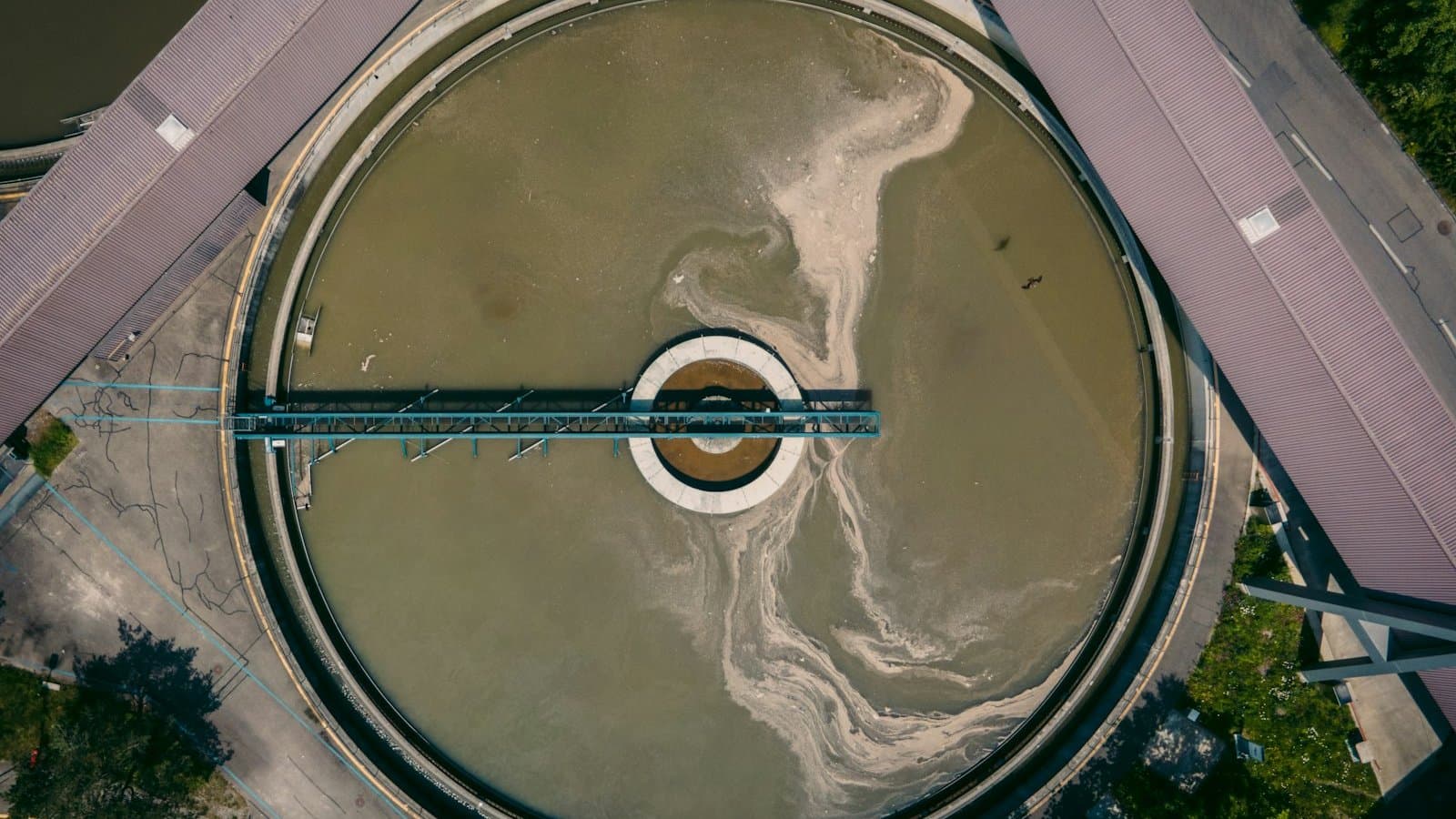
Specifying the wrong STP configuration costs $1.8M to $4.6M over a 25-year service life. Here is how to size, scope, and procure a sewage treatment plant defensibly.
When a developer breaks ground on a 400-unit hotel in a coastal town with no municipal sewer connection, the question is not whether the project needs a sewage treatment plant, it is which sewage treatment plant stp configuration will keep the development out of regulatory crosshairs for the next 25 years at a defensible operating cost. Get the answer wrong on a 3,000 m3/day flow and the spread between a well-specified package plant and a poorly specified one is $1.2 million to $3.8 million over the asset's life, before you count the discharge fines, reputation damage, and the inevitable retrofit that follows the second consent order.
A sewage treatment plant is not just a category of equipment. It is a discrete engineered unit that takes raw domestic or mixed-domestic sewage and produces an effluent compliant with whatever the local environmental regulator will tolerate, end-to-end, on a single site or campus. That definition matters because the term is often confused with industrial wastewater treatment, which deals with high-strength process effluents from manufacturing and follows very different design rules. STPs handle organic-load sewage with a relatively narrow contaminant envelope, and that constraint is what makes their economics, footprint, and technology choices so different from a generic industrial wastewater plant.
This guide is written for operations leads commissioning a new STP, procurement teams running RFPs against three or more vendors, sustainability directors trying to extract reuse value from the discharge stream, and project sponsors who need to decide whether a packaged STP, a hybrid MBBR or MBR build, or a conventional concrete-and-civils plant is the right call for their site. It covers what an STP actually does, the difference between package and conventional configurations, the five parameters that drive total cost of ownership, the failure modes that produce six-figure write-offs, and what the numbers look like in USD ranges for the most common flow bands.
## The decision in brief
- Specify for flow, peaking profile and reuse strategy from day one. The right configuration for your site, specified from day one, saves $1.8 million to $4.6 million over the asset's 25-year service life on a 2 MLD plant. - Do not over-size, and choose the secondary technology deliberately. Capital avoidance from not over-sizing is worth $400K to $1.2M, and operating cost reduction from the right secondary technology is worth $600K to $1.8M over the same 25-year life. - Count reuse revenue and enforcement avoidance. Reuse revenue from the cooling tower makeup or irrigation offset adds $300K to $1.0M, and regulatory enforcement avoidance adds $200K to $600K to the same lifecycle number.
The cost of doing nothing is a vendor-specified generic package STP with no documented mass balance and no defensible peaking factor, the upstream cause of three of the four six-figure failure modes here.
## What a sewage treatment plant actually does
A sewage treatment plant takes raw sewage, typically a slurry containing 99.9% water, 0.03 to 0.06% organic solids, and a long tail of pathogens, nutrients, surfactants, and trace synthetic compounds, and produces a clarified effluent the receiving environment can absorb without ecological collapse. The mechanism is sequential: physical screening removes large solids, primary sedimentation removes settleable matter, biological treatment converts dissolved organics into microbial biomass that can be separated, and tertiary polishing kills pathogens and trims residual nutrients to the discharge limit. The sludge that all of this generates is itself a separate treatment train, and on a conventional STP it typically represents 30 to 50% of the lifecycle operating cost.
What makes the design problem hard is that the incoming load is variable, contractually unbounded, and politically sensitive. Per capita sewage generation runs 120 to 250 litres per person per day in developed economies, and 60 to 150 litres in emerging markets, but the design flow is not the average, it is the peak. Diurnal peaks on a hotel, a stadium, or an industrial estate can run 2.5 to 4 times the daily average. Plants undersized to the average and not the peak experience hydraulic washout of the biological stage at exactly the moments the load is highest, which is when the regulator's automatic sampler also happens to be running.
An opinionated view: the most common procurement failure on an STP is treating it as a commodity package selection rather than a process engineering decision. The vendors who win on price typically win because their feed-water assumptions are aggressive. Operators inherit the gap between the brochure and the reality. The right way to evaluate an STP proposal is on the basis of a documented mass balance with a defensible peak factor and a sludge production estimate that matches the secondary technology, not on a quoted lump-sum price for "a package STP". [The US EPA Secondary Treatment Standards under 40 CFR 133](dofollow:https://www.epa.gov/npdes/secondary-treatment-standards) set out the design framework that every defensible mass balance follows, and is the document procurement teams should be referencing in the RFP rather than vendor-specific catalogue figures.
[Browse verified municipal and industrial water treatment providers](/providers) to compare scoped proposals from three or more specialists who can defend their assumptions in writing.
A second confusion that costs projects real money is the assumption that any "wastewater treatment plant" can handle any wastewater. The reality is that the upstream contaminant profile is the single biggest determinant of which technology train works, and the gap between sewage and industrial wastewater is one of the largest in the entire sector. Getting that distinction right at the brief stage is the first risk-management step on any project, and it is the one that vendors are least incentivised to surface unless asked.
## STP vs industrial wastewater treatment: not the same problem
Conflating an STP with an industrial wastewater treatment plant is one of the most expensive design errors in this sector. The two are different technologies because they solve different problems. A sewage treatment plant is engineered for a feed that is, in chemical terms, predictable: BOD typically 200 to 400 mg/L, COD 400 to 800 mg/L, suspended solids 200 to 400 mg/L, total nitrogen 30 to 70 mg/L, total phosphorus 5 to 15 mg/L. The variability is in flow and not so much in composition. An [industrial wastewater treatment plant](/resources/industrial-wastewater-treatment), by contrast, handles a feed whose composition swings on every batch, often with toxic loads that will kill the biological stage of an STP within hours.
The financial consequence is large. Installing a package STP to handle the wastewater from a craft brewery, a dairy, or a small food processing plant looks attractive at the quotation stage because the published flow numbers suggest the STP is generously sized. The reality is that brewery effluent runs BOD of 2,000 to 5,000 mg/L, dairy runs 1,500 to 4,000 mg/L, and high-strength food processing can exceed 8,000 mg/L. A standard 1,000 m3/day STP designed for 300 mg/L BOD sees its biological stage collapse at the first significant production day, the operator scrambles to feed [nitrogen](/elements/nitrogen) and [phosphorus](/elements/phosphorus) to revive the biomass, and the regulator issues a non-compliance notice that costs $15,000 to $80,000 in remediation, lab analysis, and consultant fees before the system stabilises.
The rule that survives every project: if the contaminant load is dominated by domestic-style sewage (toilets, showers, kitchens, laundry, basic hand-wash) and the high-strength industrial fraction is below 15 to 20% of the total flow, an STP is the right answer. If the industrial fraction is above 20%, or if any single load contains a recalcitrant compound (phenols, heavy metals, solvents, dyes), the design problem is industrial wastewater treatment and the unit costs are 2 to 5 times higher per cubic metre treated.
## The five stages of a conventional STP
A conventional STP has five stages, each with its own equipment train, its own footprint demand, and its own contribution to compliance and cost. Skipping any stage works only in a narrow set of cases that very few projects actually meet.
Preliminary treatment removes the inorganics that would otherwise destroy downstream equipment. Bar screens at 6 to 25 mm spacing intercept rags, plastics, and the contents of restaurant grease traps. Grit chambers remove sand and gravel that would otherwise abrade pumps and accumulate in aeration basins. Equipment costs are low, typically $15,000 to $80,000 per million litres per day (MLD) of design flow, but maintenance discipline is non-negotiable. A blocked screen on a sunday-night shift cascades into a hydraulic overflow that floods the primary settling tanks within 90 minutes.
Primary treatment is gravity sedimentation in rectangular or circular tanks, typically sized for a 1.5 to 2.5 hour hydraulic retention time. The tank removes 50 to 70% of the suspended solids and 25 to 40% of the BOD as primary sludge, which lightens the biological load by a factor that drives both the secondary tank size and the aeration energy. The trade-off is footprint: primary clarifiers are large, expensive, and emit odour unless covered. Many smaller modern plants skip primary treatment entirely and absorb the higher biological load in an extended-aeration secondary stage, which is a defensible choice up to roughly 2 MLD.
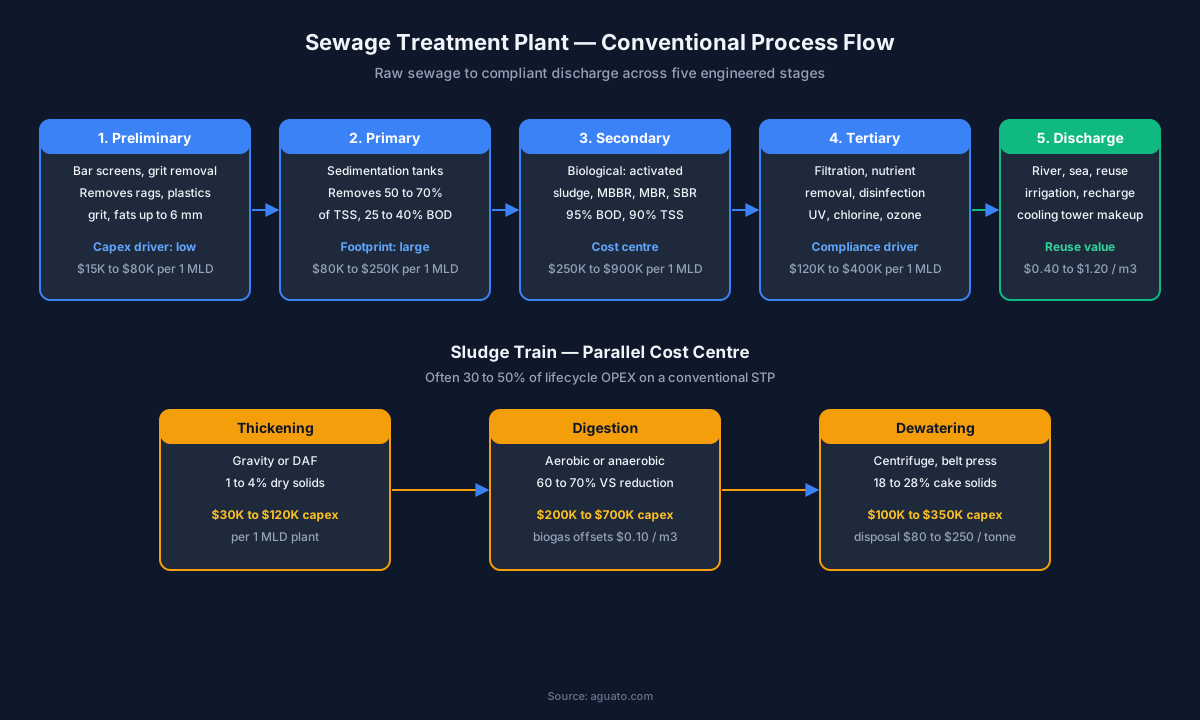
Secondary treatment is where the engineering choices and the cost lines diverge most sharply between projects. Conventional activated sludge (ASP) is the workhorse: aeration basins where dissolved oxygen is maintained at 1.5 to 3 mg/L, biomass is grown on the soluble BOD, and the resulting mixed liquor is settled in secondary clarifiers. ASP achieves 95% BOD removal and 90% TSS removal at scale and is the dominant technology above 8 to 12 MLD. Below that flow band, attached-growth systems such as moving-bed biofilm reactors (MBBR) or membrane bioreactors (MBR) start to compete on footprint, robustness, and effluent quality.
Tertiary treatment handles whatever the secondary stage cannot. Sand or disc filtration polishes residual TSS. Nutrient removal targets nitrogen (via nitrification and denitrification) and phosphorus (via chemical precipitation with alum or ferric, or biologically). Disinfection by UV, chlorine, or ozone destroys the pathogens that survive the biological stage. The capital cost of tertiary equipment runs $120,000 to $400,000 per MLD, and the disinfection technology choice alone can swing operating cost by $0.05 to $0.20 per cubic metre of effluent.
Sludge handling is the silent cost centre. Both primary sludge and waste secondary sludge must be thickened, stabilised (aerobically or anaerobically), dewatered, and disposed. Anaerobic digestion generates biogas that can offset 30 to 60% of plant power demand on plants above 5 MLD; below that scale, the capital cost of digestion rarely pencils. Disposal of the dewatered cake runs $80 to $250 per tonne depending on geography and the rules governing land application versus landfill versus incineration.
Looking across the five stages together, the cost concentration is heavily back-weighted. Preliminary and primary treatment together rarely exceed 12 to 18% of the lifecycle spend, while the secondary biological stage plus the sludge train together account for 60 to 75%. That distribution is what makes the secondary-technology choice (ASP vs MBBR vs MBR) the highest-leverage single decision in the project, more consequential than the disinfection technology, the layout, or even the headworks specification. A 15% saving on the secondary stage translates into a 9 to 11% reduction in the 25-year present value of the entire plant, which on a 5 MLD plant is $400,000 to $1.1 million of avoided lifecycle cost. A 15% saving on the preliminary stage, by contrast, moves the present value by less than 2%.
[cta:nepti-dark]
That cost-concentration logic is also why the package-versus-conventional debate is more consequential than it appears at first glance. The two architectures distribute the same total cost across the same five stages in very different proportions, and they expose the project to different failure modes at different points in the operating life. The next section walks through the trade-off with real ranges in USD per MLD, so the procurement team can pressure-test any vendor's quoted lifecycle cost.
## Package STP vs conventional STP: the real trade-offs
The package vs conventional decision is where most STP projects either win or lose their lifecycle cost case. A package STP is a factory-built, modular unit, typically using MBBR or MBR secondary biology, that ships as a set of pre-assembled tanks or as a single skid-mounted unit. A conventional STP is a site-built, concrete-and-civils plant using activated sludge biology and built up from individual unit operations. The difference is not just the form factor; it changes the cost structure, the build schedule, the operational model, and the risk profile.
Package STPs win on three axes. First, footprint: a package MBR plant occupies 150 to 400 square metres per MLD, versus 600 to 1,200 for a conventional ASP plant, which can be the difference between fitting the plant inside the property line and triggering a land purchase. Second, build time: 4 to 9 months from order to commissioning, versus 14 to 28 months for a conventional civil-engineered build. Third, factory quality control: the secondary stage arrives pre-tested, which dramatically reduces the commissioning risk that haunts conventional plants for the first 12 to 18 months of operation.
Conventional STPs win on three different axes. First, lifecycle cost per cubic metre: $0.25 to $0.55 per m3, versus $0.45 to $0.95 per m3 for package plants, with the gap driven by membrane CIP and replacement costs in MBR or media-loss costs in MBBR. Second, scale: above 8 to 12 MLD, the unit economics of pouring concrete and using gravity-flow ASP beat the unit economics of multiple parallel package skids. Third, operator skill availability: ASP is mature, the diagnostic protocols are widely understood, and the failure modes are predictable in a way that newer membrane technologies are not.
The trap most projects fall into is treating the decision as binary. The right framing is "which configuration minimises 25-year present value cost at my specific flow band, with my specific land cost, with my actual peaking factor, and with the operator capability I can realistically recruit and retain", and the answer often involves a hybrid: package secondary biology on a conventional civils shell, or package primary and secondary with a conventional tertiary and sludge train sized for plant expansion. Those hybrid configurations are rarely presented unless the procurement team specifically asks for them, because they are commercially harder for any single vendor to deliver as a turnkey scope.
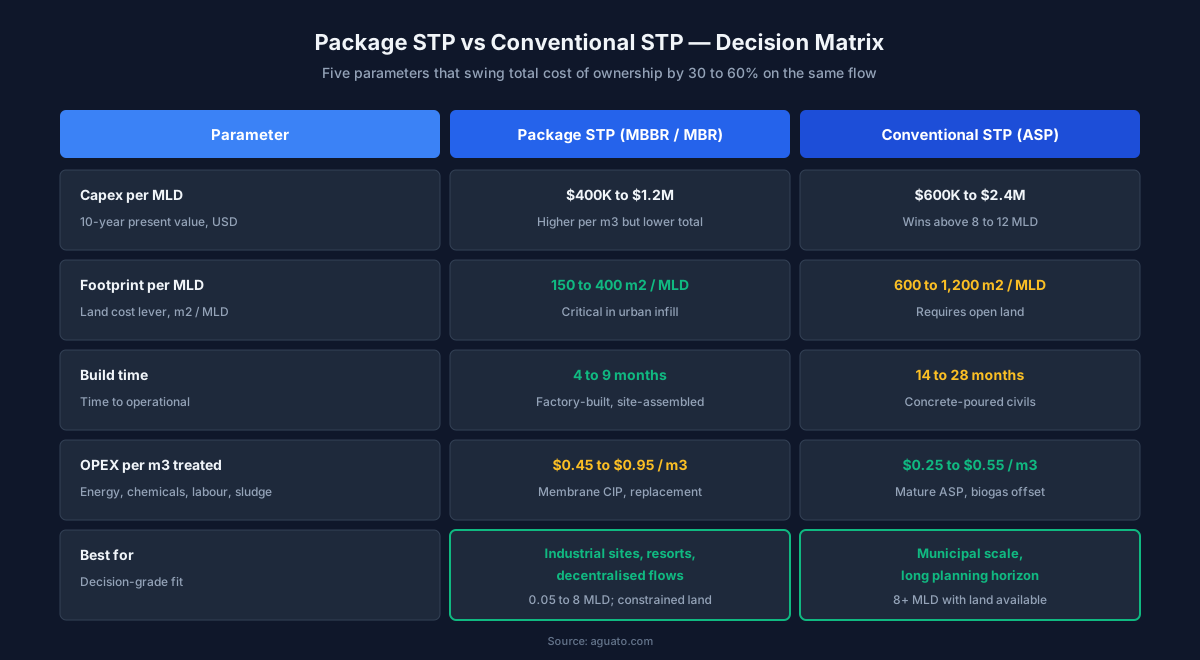
The procurement framing that gets to the right answer is to evaluate package and conventional in parallel, on the same flow, the same effluent quality target, the same land cost, and the same 15-year planning horizon, with both lifecycle cost and downside-case analysis. The vendors who only price one configuration are usually telling you something about their commercial preference, not the optimal answer for your site.
## Decentralised industrial sewage: when an on-site STP wins
Industrial sites with a domestic sewage stream that is separated from the process effluent face a different STP decision: whether to discharge to the municipal sewer, build an on-site STP, or use a hybrid approach. The municipal-sewer option looks simplest but carries trade waste tariffs that range from $1.20 to $4.50 per cubic metre in regulated jurisdictions, plus monthly sampling and reporting requirements that consume 0.2 to 0.5 of a full-time employee's time. The on-site STP option carries the capital investment but cuts the marginal cost per cubic metre to $0.30 to $0.85 and decouples the site from sewer-tariff inflation.
The crossover point is typically a flow of 200 to 500 cubic metres per day of domestic-equivalent sewage. Below that flow, trade waste discharge is almost always cheaper on a 10-year present value. Above 1,000 m3/day, an on-site package STP almost always wins, especially when the site already has the operational capacity to maintain water treatment equipment. Between those two thresholds, the answer turns on local sewer tariff structure, available land, and whether the treated effluent can be reused on site for cooling tower makeup, irrigation, or process water that would otherwise be drawn from a municipal supply.
A consideration that often tips the answer toward an on-site STP is the [HSE L8 guidance on Legionella risk in cooling systems](dofollow:https://www.hse.gov.uk/pubns/priced/l8.pdf), which requires that any reused water entering a cooling tower meet specific microbiological standards. A site-built tertiary stage with UV disinfection delivers that compliance baseline at a lower marginal cost than treating municipal supply with a separate disinfection step for the cooling tower alone.
Not sure whether discharge, on-site STP, or hybrid is right for your site? [Post your project](/post-project) and qualified providers will scope all three options against your actual flow, tariff, and reuse profile, with a 10-year NPV comparison you can take to the CFO.
## Sizing the plant: load, peaking, and reserve
The single most common cause of STP underperformance is undersizing, and the second most common is oversizing. Both come from sizing on the wrong number. A defensible mass balance starts with a population-equivalent (PE) load calculation, applies a peaking factor that matches the site usage profile, and adds a reserve for future development. Skipping any of those steps creates a plant that either fails compliance under peak load or operates inefficiently for 10 to 15 years against a load that never materialises.
For a residential development, the PE calculation is straightforward: 1.0 PE per resident at 60 grams of BOD per day and 200 litres of water per day. For mixed-use developments (hotels, conference centres, mixed industrial parks), the PE multipliers are nuanced. A hotel guest counts as 1.0 PE plus 0.2 to 0.4 PE per associated staff member. A conference centre attendee counts as 0.5 PE for daytime attendance. A retail store employee counts as 0.4 PE. A restaurant covers count as 0.3 to 0.5 PE per cover served. Get the multipliers from the local water authority's published guidance, not from the vendor's estimate.
The peaking factor is where most projects either save or lose 20 to 35% on lifecycle cost. A residential development with 24/7 occupancy needs a peak factor of 1.8 to 2.2. A hotel with check-in/check-out cycles needs 2.5 to 3.2. A stadium with event-driven flow needs 4.0 to 5.5 with attenuation storage. A continuous-process industrial site needs only 1.3 to 1.6. Apply a generic factor of 3.0 to everything and you build a plant that is too small for the stadium and too big for the residential development, with the operating cost penalty borne for the entire 25-year life.
The reserve provision is the third lever. A 15% over-sizing on the secondary stage typically extends the design life from 15 to 22 years on a growing site without adding meaningful operating cost. A 25% over-sizing on the hydraulic stage (preliminary and primary) protects against future combined-sewer overflow events. Anything beyond 30% over-sizing on either stage adds capital cost without proportionate benefit and degrades operational efficiency because biomass control becomes harder at part-load.
## Capital and operating cost ranges by flow band
The cost table below gives real ranges across the flow bands most projects encounter. All figures are USD per million litres per day (MLD) of design flow on an effluent quality target of BOD 20, TSS 30, ammonia 5, total nitrogen 15, total phosphorus 2 (typical EU urban wastewater directive compliance), and exclude land costs.
| Flow band | Configuration | Capex per MLD | OPEX per m3 | Build time | Main risk | |---|---|---|---|---|---| | 0.05 to 0.5 MLD | Package MBR | $600K to $1.1M | $0.70 to $1.20 | 4 to 6 months | Membrane fouling, single-skid redundancy gap | | 0.5 to 2 MLD | Package MBBR + clarifier | $400K to $750K | $0.45 to $0.85 | 5 to 8 months | Media loss, peak hydraulic events | | 2 to 8 MLD | Hybrid MBBR + tertiary | $350K to $700K | $0.35 to $0.65 | 9 to 14 months | Sludge handling under-design | | 8 to 25 MLD | Conventional ASP + AD | $300K to $600K | $0.25 to $0.50 | 14 to 22 months | Civils delay, commissioning curve | | 25+ MLD | Conventional ASP + AD + reuse | $250K to $500K | $0.20 to $0.45 | 22 to 32 months | Permit process, public engagement |
OPEX numbers assume 12 to 18% energy cost ($0.08 to $0.12 per kWh), 25 to 35% labour cost, 12 to 20% chemicals, 15 to 25% sludge disposal, and the balance in membrane or media replacement, lab analysis, and miscellaneous operating expenses. The single biggest swing variable is sludge disposal cost, which can be as low as $40 per tonne where agricultural land application is approved and as high as $400 per tonne where incineration is mandated.
The capex numbers exclude land, site preparation, and the off-site connections (pumping stations, force mains, outfall pipe) that are often a third of the total project cost on greenfield sites. Pricing an STP project on the equipment scope alone and discovering the connections cost later is a classic procurement failure that adds 25 to 45% to the headline budget.
## Failure scenarios and what they cost
The most common STP failure is biological-stage washout from a hydraulic peak the design did not anticipate. A storm event, a major sporting fixture, or a process upset at an industrial tenant doubles the influent flow over a 4-hour window. The biomass settles poorly under the higher upflow velocity, escapes the secondary clarifier, and discharges as a 200 to 400 mg/L TSS pulse against a 30 mg/L permit limit. The compliance violation triggers an enforcement letter ($5,000 to $25,000), mandatory consultant-led review ($15,000 to $50,000), and capital remediation that typically costs $100,000 to $400,000 to retrofit hydraulic balance or peak attenuation storage.
A second pattern is membrane fouling in MBR systems on plants that lack the chemical-cleaning regime the manufacturer specified. Membrane permeability drops from 250 LMH/bar at commissioning to below 80 LMH/bar within 12 to 18 months, at which point the plant either has to be CIP-cleaned monthly (chemistry cost $4,000 to $12,000 per cleaning, plus 24 to 48 hours of reduced capacity) or replaced (membrane cost $40,000 to $150,000 per replacement on a 1 MLD plant). Sites that budgeted for a 7-year membrane life and got 3 years see operating cost climb by 40 to 80% without warning.
A third pattern, particularly painful for industrial estates, is the slug-load failure when a tenant discharges a non-conforming load. A truck-wash facility releases 30 cubic metres of detergent-rich wastewater over 90 minutes. The surfactant disrupts floc formation in the secondary stage. Biomass is lost over the next 6 to 8 hours, and the plant operates at 30 to 50% of design capacity for 5 to 12 days while the biomass recovers. Lab fees, consultant fees, and tankering of partially treated effluent to an off-site facility typically cost $40,000 to $180,000 per slug-load event. The defensive design choice is tenant pre-treatment standards enforced contractually, plus a buffer tank with rapid pH and conductivity monitoring upstream of the biology.
A fourth pattern is sludge handling under-design. The plant's secondary stage is correctly sized for the design BOD load, but the sludge thickening, digestion, and dewatering equipment was sized for an optimistic VS reduction. Wet sludge accumulates faster than it can be processed. The on-site storage fills, the plant is forced to tanker raw sludge off site at $0.15 to $0.35 per cubic metre, and the operating cost penalty runs $20,000 to $80,000 per year for the life of the asset. The fix is a retrofit of additional dewatering capacity that costs $150,000 to $500,000 and requires civils work that is highly disruptive on an operating plant.
## Real-world examples across three sectors
Industry: coastal hotel resort. A 600-key hotel on the Mediterranean coast with no municipal sewer commissioned a 900 m3/day package MBR plant in 2021. The first 18 months of operation saw two compliance excursions during the peak summer season because the design peaking factor of 2.0 was inadequate against the actual 2.8 peak observed on Saturday check-in/check-out cycles. The retrofit added a 350 m3 hydraulic buffer tank and uprated the clarifier surface area at a cost of $180,000. Lifecycle cost over a 20-year horizon, including the retrofit, is now defensible. The lesson is the peaking factor: the original consulting engineer used a generic 2.0 from the regional design guide, when the site profile warranted 2.8 to 3.2.
Industry: industrial estate with mixed tenants. A 60-hectare industrial estate in central Europe with 24 tenants installed a 4 MLD MBBR plant in 2019 to serve the domestic and light industrial sewage streams. Within 30 months the plant experienced three slug-load failures from a textile tenant whose dyestuff discharges had not been adequately characterised at the design stage. The remediation involved retrofitting a tenant pre-treatment standard into the lease agreements, installing 24/7 conductivity and pH monitoring upstream of the secondary stage, and a 200 m3 emergency buffer tank. Total cost: $310,000. The lesson is contractual and design at once: industrial estate STPs need tenant discharge consents that match the plant's biological tolerance, and the buffer-tank infrastructure to survive the first violation.
Industry: pharmaceutical manufacturing campus. A pharmaceutical company in South Asia chose to combine its domestic sewage with a pre-treated process effluent stream in a single 6 MLD conventional ASP plant in 2020. The initial six months of operation were stable; the failure came in month nine when a process change in the API production wing released a slug of solvent-rich wastewater that the upstream activated carbon polishing did not fully scavenge. The biomass was lost over 48 hours. The plant operated at 25% of design for 14 days. Tankering, off-site treatment, lab fees, and a regulatory enforcement notice totalled $640,000. The lesson is that combining sewage and process effluent on a single plant requires a separate, validated industrial wastewater treatment train upstream of the STP, not just inline polishing.
The three real-world cases all illustrate the same upstream truth: the failure mode that lands the six-figure invoice is almost always traceable to an assumption made before the first concrete was poured. Peaking factor, tenant discharge consents, and the boundary between sewage and process effluent are not engineering details, they are commercial decisions whose dollar consequence is invisible until the operations team is already inside an enforcement notice. The next section flips the cost frame: the same plant that generates the failure-mode exposure also generates a discharge stream with measurable reuse value.
## Where reuse turns the STP from cost centre to revenue stream
The STP is one of the few plant assets where the discharge stream has independent commercial value. A site that discharges 1,000 m3/day of treated effluent at a municipal water tariff of $2.40 per cubic metre is throwing away $876,000 per year in potential reuse value. The economics of reuse turn on three factors: the quality the effluent achieves at discharge, the on-site water demand profile, and the cost of the polishing step needed to bridge the gap between secondary effluent quality and the reuse-grade water specification.
Cooling tower makeup is the easiest reuse application: target water quality is moderate (TDS below 600 mg/L, TOC below 8 mg/L), the volume profile matches industrial demand patterns, and the [closed-circuit cooling tower](/resources/closed-circuit-cooling-tower) configuration is particularly tolerant of recycled water. Adding a sand filter and UV polishing stage to a conventional STP costs $80,000 to $200,000 per MLD of reuse capacity, and the payback on cooling tower makeup is typically 3 to 6 years at industrial water tariffs of $1.80 per cubic metre or higher.
Irrigation reuse is slightly more demanding: the WHO and most regional regulators require treated wastewater to meet specific microbiological standards (typically <100 thermotolerant coliforms per 100 mL for unrestricted irrigation), which means an upgraded disinfection stage. A reuse-grade STP discharge with UV plus residual chlorine typically costs $40,000 to $120,000 per MLD extra over a standard secondary-only discharge configuration. On a site with 300 m3/day of landscape irrigation demand, the payback is 5 to 9 years against municipal supply costs of $1.80 to $2.40 per cubic metre.
Process water reuse, where the treated effluent feeds back into industrial process flows, requires the most aggressive polishing: reverse osmosis or nanofiltration to scrub residual organics, TDS, and any trace synthetic compounds. The polishing capex runs $300,000 to $800,000 per MLD, and the payback depends entirely on the site's process water tariff. A semiconductor or pharma site paying $4 to $9 per cubic metre for process-grade water can pay back the polishing investment in 2 to 4 years; a general manufacturing site paying $1.50 per cubic metre rarely does. The decision is a function of feed-water tariff and not of any general reuse principle.
## FAQ
What is the difference between an STP and a WWTP?
A sewage treatment plant (STP) handles domestic-style sewage with a relatively narrow contaminant envelope (BOD 200 to 400 mg/L, predictable composition, variable flow). A wastewater treatment plant (WWTP) is a broader category that includes industrial wastewater treatment with high-strength, variable-composition feeds that often require pre-treatment, specialised biology, and tighter discharge controls. Most municipal WWTPs are functionally STPs. Most industrial WWTPs are not.
How much does a sewage treatment plant cost?
Capital cost ranges from $600K to $1.1M per MLD for small package MBR plants (0.05 to 0.5 MLD), down to $250K to $500K per MLD for large conventional ASP plants above 25 MLD. Operating cost ranges from $0.20 to $1.20 per cubic metre treated, depending on configuration, energy cost, and sludge disposal regime. Costs exclude land, off-site connections, and any reuse polishing equipment.
Can a package STP handle industrial wastewater?
Only if the industrial fraction is below 15 to 20% of the total flow and contains no recalcitrant compounds (phenols, heavy metals, solvents, dyes). Above that fraction, the project is industrial wastewater treatment, not sewage treatment, and the unit costs are 2 to 5 times higher per cubic metre.
What is the design life of a sewage treatment plant?
Conventional concrete-and-civils STPs are typically designed for a 25 to 30-year service life, with mechanical equipment overhauled every 10 to 15 years. Package STPs (MBR, MBBR) typically have a 15 to 22-year asset life with membrane or media replacement every 5 to 10 years.
What discharge standards must an STP meet?
The minimum compliance baseline in most jurisdictions is BOD <25 mg/L, TSS <35 mg/L, ammonia <5 mg/L. Sites discharging to sensitive receiving waters (sensitive nutrient catchments, bathing waters, drinking water sources) face tighter limits: total nitrogen <10 to 15 mg/L, total phosphorus <1 to 2 mg/L, faecal coliforms <100 to 1,000 per 100 mL. Always confirm the site-specific discharge consent before specifying the plant.
How do I size an STP for a hotel or industrial estate?
Use a population-equivalent (PE) calculation: 1.0 PE per residential occupant, 0.5 PE per conference attendee, 0.4 PE per retail employee, 0.3 to 0.5 PE per restaurant cover. Apply a peaking factor that matches the site profile (hotels 2.5 to 3.2, stadiums 4.0 to 5.5 with attenuation, continuous-process industrial 1.3 to 1.6). Add 15 to 25% reserve provision. Always cross-check against the local water authority's published guidance.
Should I build my own STP or discharge to the municipal sewer?
Below 200 to 500 m3/day of domestic-equivalent flow, sewer discharge is almost always cheaper on a 10-year present value. Above 1,000 m3/day, an on-site package STP typically wins on lifecycle cost and adds reuse revenue potential. Between those thresholds, the answer turns on local trade waste tariffs, available land, and on-site reuse demand. According to [the World Health Organisation's 2017 guidelines on safe use of wastewater](dofollow:https://www.who.int/publications/i/item/9789241549950), on-site treatment with reuse is often the most resilient option for sites in water-stressed regions.