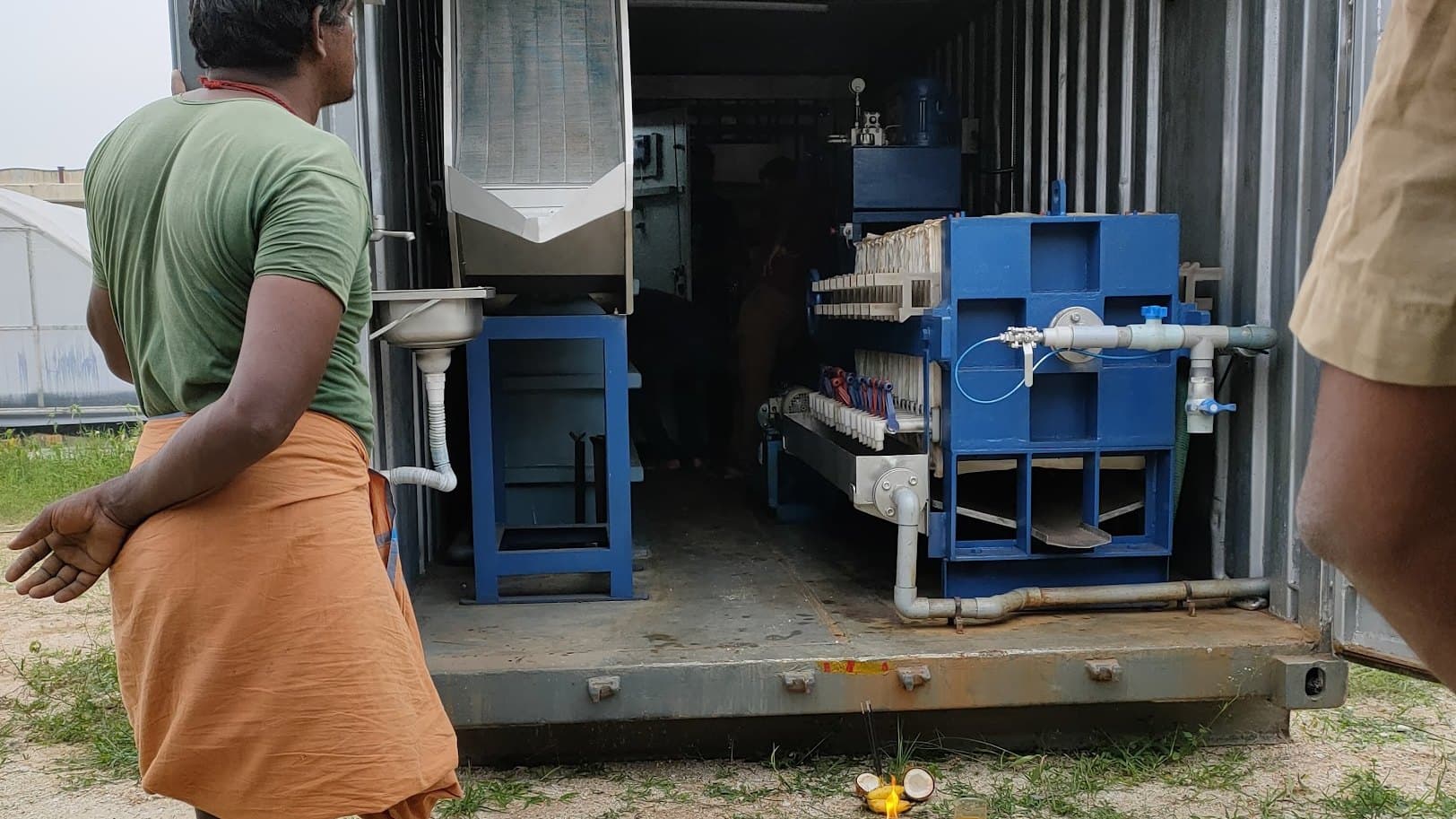
Decentralized water treatment costs 20 to 40% less in CAPEX than centralized infrastructure but carries 30 to 60% higher OPEX per cubic metre treated.
Decentralized water treatment moves the treatment facility from a single central plant to multiple smaller units distributed at the point of use, the point of discharge, or the neighbourhood cluster level. That architectural choice rewrites your CAPEX exposure, your O&M labour model, your regulatory compliance perimeter, and your failure-mode profile, and it is the difference between a USD 2 million to 8 million central-plant capital lock-in and a USD 200,000 to 800,000 modular staged deployment that scales with demand, but also the difference between a centralised skilled-operator model and a distributed monitoring challenge where 10 to 50 small units replace one large one.
Centralized treatment remains the default specification for municipal supply, large industrial campuses, and any scenario where economies of scale dominate the lifecycle math. But across remote mining sites, distributed manufacturing footprints, water-reuse projects where the demand centres are geographically scattered, disaster-response deployments, and rapidly growing peri-urban areas where central infrastructure cannot keep pace with development, decentralized architectures are increasingly winning the business case. The CAPEX advantage is real. So is the O&M complexity.
This guide covers what decentralized water treatment actually means in engineering terms, the five deployment models and their trade-offs, the cost mechanics over a 15-year horizon, the specific industries and geographies where it wins, the failure modes that turn a sound decentralized decision into a regretted one, and the decision framework that lets a procurement team determine whether centralized or decentralized is the right answer before the RFP goes out.
## The decision in brief
- Weigh the CAPEX saving against the O&M penalty. Decentralized water treatment costs 20 to 40% less in total installed CAPEX than centralized systems when trunk infrastructure must be built from scratch, but carries 30 to 60% higher O&M cost per cubic metre treated. - Run the greenfield case. For a 500 m³/day greenfield remote site, lifecycle cost over 15 years runs USD 520,000 to 1,205,000 for staged decentralized versus USD 500,000 to 1,305,000 for a single central plant. - Let demand certainty decide. The decentralized architecture wins when demand is uncertain or capital must be staged, and loses when demand is stable and full capital is available upfront, with distributed labour and multiplied regulatory reporting driving the O&M gap.
The cost of doing nothing is specifying decentralized without remote monitoring or realistic O&M labour assumptions, a decision that quietly compounds a USD 10,000 to 20,000 per year operations penalty for the full asset life.
## What decentralized water treatment actually means
Decentralized water treatment is any architecture where treatment capacity is distributed across 2 or more physically separated units rather than concentrated in a single facility. The decentralization spectrum runs from point-of-use filters on individual taps to neighbourhood-scale package plants serving 500 to 5,000 people to industrial-site clusters where each production building has its own pre-treatment or polishing step.
Centralized treatment does the opposite. All water passes through a single facility before distribution, or all wastewater converges at a single plant before discharge. Every contaminant that enters any part of the system must be removed at that one facility, and every user downstream of the facility receives the same treated-water quality.
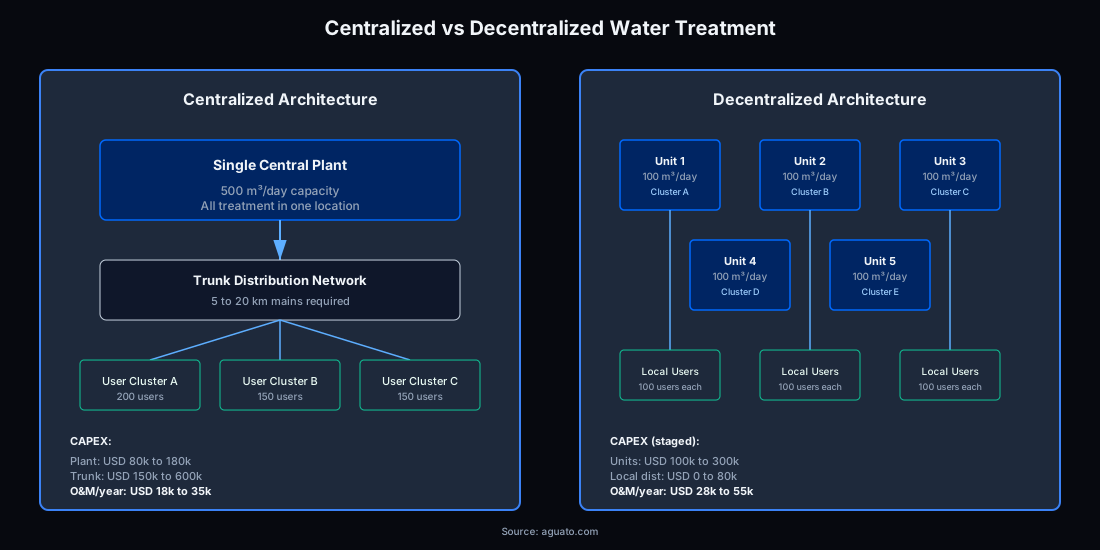
The architectural difference dictates almost everything about the project economics, the operations model, and the risk profile:
- Capital deployment pace, decentralized allows phased investment tied to demand growth. Centralized requires full-capacity capital upfront even if demand ramps slowly. - Single-point failure exposure, centralized puts the entire served population at risk if the plant fails. Decentralized spreads the exposure, a single-unit failure affects only the local cluster. - Operator skill requirements, centralized plants justify a full-time skilled operator or operator team. Decentralized often cannot, the business case depends on remote monitoring with periodic maintenance visits. - Regulatory reporting burden, centralized has one discharge permit, one sampling regime, one compliance file. Decentralized multiplies the permit count and the sampling-logistics complexity by the number of units. - Transport infrastructure dependency, centralized requires trunk mains or interceptor sewers. Decentralized eliminates or sharply reduces those infrastructure costs.
Per the [WHO guidelines on sanitation and health](dofollow:https://www.who.int/publications/i/item/9789241549950), decentralized systems are defined as those serving fewer than 10,000 people per unit or where treatment occurs within 1 kilometre of the point of use. That threshold captures the scale transition where centralised economies stop dominating and distributed flexibility starts mattering.
The five-model question follows next: once the centralised-versus-decentralized call is made, the decentralized family itself splits into five deployment patterns with very different scale profiles, CAPEX ranges, and best-fit applications.
## The five deployment models and their scale trade-offs
Decentralized water treatment spans five deployment models, and the procurement decision is rarely between centralised and decentralized as abstract concepts. It is among five decentralized configurations that differ by 100× in per-unit capacity, by 10× in per-cubic-metre capital cost, and by 5× in O&M intensity. The catalogue labels look subtle, point-of-use versus community-scale versus industrial-cluster, but the lifecycle-cost spread is large enough that specifying the wrong model produces a quietly compounding mismatch between installed capacity and actual demand that the operations budget absorbs for the asset's full service life.
| Deployment model | Typical capacity per unit | Best for | CAPEX per m³/day | O&M intensity | |---|---|---|---|---| | Point-of-use (POU) | 10 to 500 L/day | Individual households, remote buildings, disaster relief | USD 400 to 2,000 | Low (filter cartridge replacement every 3 to 12 months) | | Point-of-entry (POE) | 0.5 to 5 m³/day | Single-family homes, small facilities, off-grid cabins | USD 150 to 800 | Medium (annual service visit, chemistry top-up) | | Cluster / neighbourhood | 20 to 200 m³/day | Peri-urban developments, mining camps, industrial parks | USD 80 to 300 | Medium-high (weekly operator visit, monthly lab sampling) | | Community-scale package | 100 to 2,000 m³/day | Small municipalities, military bases, large resorts | USD 50 to 150 | High (daily operator rounds, full lab programme) | | Industrial on-site modular | 50 to 1,000 m³/day | Manufacturing sites, refineries, food plants | USD 60 to 200 | High (integrated into site operations, daily monitoring) |
The capacity-per-unit column is the architectural hinge. A 500 m³/day central plant might cost USD 40 to 80 per m³/day in CAPEX. Five 100 m³/day decentralized units treating the same aggregate flow cost USD 50 to 150 per m³/day, 20 to 90% higher on a per-cubic-metre basis, but they can be staged across 5 years instead of financed upfront, and the first unit can be operational 6 to 12 months faster than a greenfield central plant.
[Browse verified decentralized water treatment providers](/providers) and compare scoped proposals on capital cost, modular expandability, and remote-monitoring capability before specifying architecture.
The O&M intensity matters more than the per-unit capital cost in most real decisions. A cluster-scale unit needs a weekly operator visit. A central plant of the same aggregate capacity justifies a full-time operator. The decentralized model saves the full-time salary but multiplies the travel time and the spare-parts inventory. The break-even depends on local labour cost, site accessibility, and whether the operator can service 5 units in one day or needs 5 separate trips.
## Where decentralized wins, where centralized still rules
The lifecycle economics flip on six specific dimensions. When three or more apply, decentralized almost always wins. When fewer than two apply, centralized is the right answer.
| Decision dimension | Decentralized wins when... | Centralized wins when... | |---|---|---| | Demand uncertainty | Capacity needs are uncertain or expected to grow in unpredictable increments | Demand is stable or predictable over 15 to 20 years | | Geographic scatter | Users or discharge points are distributed across 2 to 50 kilometres | Users are dense within 1 to 2 kilometres of a single site | | Capital availability | Upfront capital is constrained; phased investment is required | Full capital is available upfront; financing cost is low | | Infrastructure cost | Building trunk mains or interceptors costs more than 30% of plant CAPEX | Existing mains or sewers are in place or very low cost | | Redundancy requirement | Single-point failure is unacceptable; N+1 redundancy is required | Single-point failure is manageable with bypass or storage | | Speed to first water | Project must deliver treated water in under 12 months | Timeline is flexible; 18 to 36 months is acceptable |
Industries and geographies where decentralized is now the default specification:
- Remote mining and oil and gas, workforce camps 50 to 500 kilometres from municipal infrastructure; demand scales with production ramp; redundancy is mandatory. - Disaster response and humanitarian relief, infrastructure is destroyed or absent; modular units can be airlifted and operational within days. - Peri-urban and informal settlements, populations growing faster than municipal utilities can extend trunk infrastructure; cluster systems serve 500 to 5,000 people per unit. - Agricultural and food processing, geographically distributed processing facilities where hauling wastewater to a central plant is uneconomic; on-site treatment and reuse closes the loop locally. - Military bases and forward operating locations, supply-chain vulnerability and transport cost make decentralized treatment and water reuse operationally necessary. - Ecotourism and resort developments, remote high-end facilities where treated-water quality must match urban standards but municipal connection is unavailable.
Industries and geographies where centralized still wins:
- Urban municipal supply, dense population within a compact service area; economies of scale are overwhelming. - Large industrial complexes, refineries, chemical plants, and integrated steel mills where production buildings are within 1 to 2 kilometres of a central utility block. - Mature municipal wastewater, established collection infrastructure already in place; retrofitting decentralized units onto existing sewers makes no sense.
The fit-for-duty filter above is the procurement gate, but it does not produce a number that survives a budget conversation. That requires running the lifecycle math at a specific reference capacity, with every cost line broken out across 15 years, because the decentralized case wins or loses on CAPEX staging flexibility and O&M labour multiplication, and those two variables sit on opposite sides of the capital-versus-operations budget split.
## CAPEX, OPEX, and the 15-year lifecycle math
The capital cost for decentralized is 20 to 40% lower than centralized on a project-total basis when trunk infrastructure is included, but 30 to 60% higher per cubic metre of installed capacity. The OPEX reverses: decentralized O&M per cubic metre treated is 30 to 60% higher than centralized. The lifecycle winner depends on discount rate, demand-growth trajectory, and whether the capital can be staged.
For a 500 m³/day duty split as 1 central unit versus 5 distributed 100 m³/day units:
| Cost element (15-year horizon, 500 m³/day aggregate) | Centralized (1 × 500 m³/day) | Decentralized (5 × 100 m³/day) | Delta | |---|---|---|---| | Treatment plant CAPEX | USD 80,000 to 180,000 | USD 100,000 to 300,000 | +USD 20,000 to 120,000 | | Trunk infrastructure (mains/sewers) | USD 150,000 to 600,000 | USD 0 to 80,000 (local distribution only) | USD 70,000 to 520,000 savings | | Total installed capital | USD 230,000 to 780,000 | USD 100,000 to 380,000 (staged over 3 to 5 years) | USD 130,000 to 400,000 savings | | Annual O&M (chemistry, energy, labour) | USD 18,000 to 35,000 | USD 28,000 to 55,000 | +USD 10,000 to 20,000/year | | 15-year O&M total | USD 270,000 to 525,000 | USD 420,000 to 825,000 | +USD 150,000 to 300,000 | | 15-year lifecycle cost (undiscounted) | USD 500,000 to 1,305,000 | USD 520,000 to 1,205,000 | USD 20,000 savings to USD 100,000 penalty |
For a greenfield remote site or a peri-urban area without existing trunk infrastructure, decentralized lifecycle cost is 10 to 30% lower than centralized. For a retrofit into an existing dense service area with mains already in place, decentralized lifecycle cost is 15 to 40% higher, and centralized is correct.
The right way to test the decision is demand-trajectory-specific. A mining site that ramps workforce from 200 to 800 over 4 years can stage decentralized units to match that ramp. A central plant sized for 800 sits 60 to 75% underutilised for the first 3 years, the capital is deployed but not earning a return. [Post your project challenge](/post-project) with the demand-growth profile and let qualified providers scope centralized versus staged-decentralized with actual numbers against your timeline.
The lifecycle math above depends on a remote-monitoring programme that keeps O&M labour predictable without requiring a full-time on-site operator at every distributed unit. Per the [US EPA guidelines for small public water systems](dofollow:https://www.epa.gov/dwreginfo/information-about-public-water-systems), systems serving fewer than 3,300 people (roughly 400 m³/day) can operate under a circuit-rider model where one certified operator services 5 to 15 small systems on a scheduled rotation. That model works when the monitoring layer catches deviations between visits. Without it, the O&M cost in the table above doubles.
## Regulatory compliance on a distributed perimeter
The regulatory burden multiplies with the number of discharge points or points of compliance. One central plant has one NPDES permit (US), one Environmental Permit (UK), one discharge consent, and one compliance file. Five decentralized units have five permits, five sampling regimes, five inspection schedules, and five opportunities for a single exceedance to trigger enforcement. According to [NPDES permit requirements](dofollow:https://www.epa.gov/npdes), EPA administers the National Pollutant Discharge Elimination System (NPDES) permit programme; this is the authoritative US source for understanding how discharge-permit count and reporting burden scale with decentralized wastewater systems.
Decentralized regulatory cost drivers:
- Permit count, each unit needs a separate discharge permit or point-of-compliance certification. Permit application and annual fees scale linearly with unit count. - Sampling logistics, grab samples must be collected from N distributed locations on the same day or within a tight window. Lab costs scale with sample count; field-labour time scales faster. - Reporting burden, monthly or quarterly discharge-monitoring reports (DMRs) multiply by unit count. A central plant files one DMR per month; five decentralized units file five. - Inspection cadence, regulatory inspections scale with permit count. A site with 5 units may see 5 inspections per year instead of 1.
The regulatory penalty for decentralized is partially offset by lower per-unit discharge volume. Many jurisdictions have simplified permitting for small discharges (under 50 to 100 m³/day) with less frequent sampling and streamlined reporting. In those jurisdictions, 5 small permits may be administratively simpler than 1 large one. But that relief is jurisdiction-specific and cannot be assumed.
Compliance management strategies for decentralized systems:
- Standardise equipment and treatment chemistry across all units so operator training, spare-parts inventory, and troubleshooting procedures are uniform. - Deploy online monitoring (pH, conductivity, turbidity, [chlorine](/elements/chlorine) residual) at every unit with cellular or satellite telemetry so deviations trigger alerts before they become permit exceedances. - Contract a single third-party O&M provider to service all units under one agreement so compliance reporting and operator certification are centralised even though the assets are distributed. - In jurisdictions that allow it, apply for a single general permit covering multiple small units under one compliance umbrella rather than N individual permits.
For small-community and industrial-cluster applications, the compliance burden is frequently the lifecycle-cost factor that tilts the decision back toward centralized, even when the CAPEX and O&M math favour decentralized. A procurement decision that ignores the regulatory-multiplier effect often discovers it 18 months after commissioning when the first round of annual reports is due.
[Try Nepti's water decision model](/nepti) to compare centralised versus decentralized architectures with regulatory-burden weighting included. Nepti models permit count, sampling frequency, and reporting cadence against your jurisdiction's rules and produces a compliance-adjusted lifecycle cost that accounts for the administrative load, not just the equipment and chemistry.
## Remote monitoring and the O&M labour model
The decentralized O&M model depends on remote monitoring reducing the required site-visit frequency to weekly or monthly intervals. Without reliable telemetry, every unit needs daily operator rounds, and the labour cost erases the CAPEX advantage.
Minimum viable monitoring package for unattended decentralized operation:
- Online sensors at a minimum: pH, conductivity, turbidity (for water treatment) or TSS (for wastewater). Chlorine residual for disinfected effluent. - Flow metering on feed, treated effluent, and waste streams. Totalised flow is required for discharge reporting; instantaneous flow detects upsets. - Chemical tank levels with low-level alarms. Running a treatment unit dry on scale inhibitor or coagulant for 12 hours can foul the membranes beyond chemical recovery. - Cellular or satellite telemetry with 15-minute to 1-hour data push to a cloud SCADA platform. SMS or email alerts on alarm conditions. - Remote start/stop and setpoint adjustment for pumps and dosing systems. An operator 200 kilometres away should be able to adjust chlorine dose or backwash frequency without a site visit.
Total installed cost for the monitoring package: USD 8,000 to 25,000 per unit depending on sensor count and telemetry type. Cellular works where cell coverage exists; satellite adds USD 3,000 to 8,000 per unit but works anywhere.
The labour model shifts from daily on-site rounds to weekly or monthly service visits with continuous remote oversight. One operator or technician can monitor 10 to 30 decentralized units remotely and schedule site visits based on actual alarm history and predictive maintenance indicators, not a fixed calendar. That model cuts labour cost per cubic metre by 40 to 60% compared to daily rounds, but it only works if the monitoring layer is reliable.
Failure mode: a decentralized unit with unreliable telemetry or no telemetry reverts to requiring daily site visits. If the site is 50 to 200 kilometres from the operator's base, the travel time and vehicle cost make that model uneconomic. A USD 15,000 remote-monitoring package that prevents 200 unnecessary site visits per year at USD 150 per visit pays for itself in the first 6 months.
## Where decentralized decisions go wrong
Three failure patterns recur, and each represents a recognised procurement-led mistake.
1. Specifying decentralized to save CAPEX without costing the O&M multiplier. A peri-urban water project specified 8 decentralized package plants to avoid building a 12-kilometre trunk main, saving USD 400,000 in upfront infrastructure cost. The O&M contract came in at 2.1× the budgeted rate because the operator needed to visit 8 sites instead of 1, and the spare-parts inventory had to cover 8 installations. Lifecycle cost was 18% higher than a central plant with the trunk main. The mistake was optimising capital cost in isolation. Correct decision: model 15-year lifecycle cost with realistic O&M labour and logistics assumptions before specifying architecture.
2. Under-sizing units to minimise per-unit CAPEX, then running them at continuous peak capacity. An industrial site deployed 6 small decentralized wastewater units sized at 80% of peak daily flow to keep each unit under the USD 50,000 capital threshold. The units ran at 95 to 105% of rated capacity 300 days per year. Membrane fouling accelerated, CIP frequency tripled, and membrane replacement came 4 years early across all units. The total membrane-replacement cost was USD 85,000. The correct sizing at 120% of peak flow would have added USD 18,000 to initial CAPEX and avoided the USD 85,000 penalty. The mistake was optimising per-unit capital budget without capacity margin.
3. Deploying decentralized without remote monitoring, then discovering the labour cost kills the model. A mining camp installed 4 package plants to treat potable water for a 400-person workforce. No remote monitoring was specified. The O&M contractor required daily site visits to all 4 units, 6 days per week, because process stability could not be confirmed remotely. Labour cost was USD 48,000 per year. A USD 60,000 remote-monitoring retrofit reduced required visits to weekly, cutting annual labour to USD 18,000. The payback on the monitoring package was 24 months, but the project ran 18 months at the higher cost before the retrofit was approved. The mistake was treating remote monitoring as optional.
In every case, the decision quality starts with modelling the full system, capital, O&M, regulatory burden, and failure-mode exposure, before issuing the RFP.
## Decision framework: centralized or decentralized?
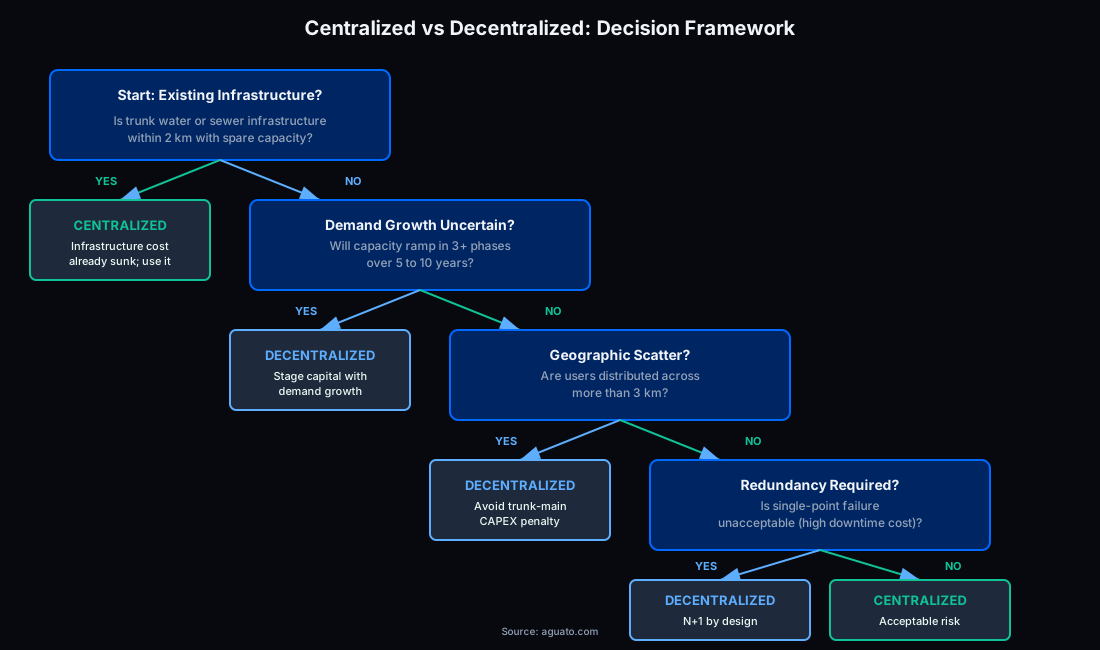
Run the project through this sequential check.
1. Existing trunk infrastructure: Is municipal water or sewer infrastructure already in place within 2 kilometres of all users or discharge points? Yes, and it has capacity → centralized. No or capacity-constrained → continue. 2. Demand growth trajectory: Is capacity demand uncertain or expected to grow in 3+ phases over 5 to 10 years? Yes → decentralized. No → continue. 3. Geographic scatter: Are users or discharge points distributed across more than 3 kilometres? Yes → decentralized. No → continue. 4. Capital availability: Is upfront capital for a full-capacity central plant constrained or unavailable? Yes → decentralized with staged deployment. No → continue. 5. Redundancy requirement: Is single-point failure exposure unacceptable (critical process, no backup, high downtime cost)? Yes → decentralized N+1. No → continue. 6. O&M labour availability: Can you deploy reliable remote monitoring and justify a circuit-rider O&M model? Yes → decentralized viable. No → centralized preferred.
If three or more answers favour decentralized, the lifecycle case is strong. If two or fewer, centralized is almost always the right specification. The lifecycle cost difference in the narrow zone (exactly two criteria met) is small enough that local factors, labour cost, telemetry reliability, regulatory complexity, dominate, and the answer requires site-specific modelling.
## FAQ
### What is the difference between decentralized and distributed water treatment?
The terms are used interchangeably in most industry contexts. Both refer to architectures where treatment capacity is spread across multiple smaller units rather than concentrated in one large facility. Some practitioners reserve distributed for industrial or commercial applications and decentralized for municipal or community systems, but no formal standard distinguishes them.
### How much does a decentralized water treatment system cost?
Per-unit CAPEX ranges from USD 400 to 2,000 per m³/day for point-of-use systems, USD 150 to 800 per m³/day for point-of-entry, USD 80 to 300 per m³/day for cluster-scale units (20 to 200 m³/day), and USD 50 to 150 per m³/day for community-scale package plants (100 to 2,000 m³/day). These figures are 30 to 90% higher per cubic metre than equivalent centralized capacity, but total project CAPEX can be 20 to 40% lower when trunk-infrastructure avoidance is included.
### Can decentralized systems meet the same water-quality standards as centralized plants?
Yes. Decentralized package plants use the same core treatment technologies (coagulation, filtration, membrane separation, disinfection) as large central plants. Treated-water quality depends on process design and operations, not on system scale. Many decentralized units produce water that exceeds municipal standards because they are designed for direct potable reuse or industrial process water where quality requirements are tighter than drinking-water regulations.
### What are the main disadvantages of decentralized water treatment?
Higher per-cubic-metre O&M cost (30 to 60% above centralized), multiplied regulatory-reporting burden (one permit per unit instead of one for the whole system), greater spare-parts inventory requirements, and dependency on reliable remote monitoring to keep labour cost manageable. For dense urban areas with existing infrastructure, these disadvantages typically outweigh the CAPEX savings.
### How does decentralized wastewater treatment differ from decentralized water treatment?
The deployment models and scale trade-offs are identical. The regulatory burden is typically higher for wastewater because discharge permits carry more stringent monitoring and reporting requirements than water-supply permits. Decentralized wastewater is more common in practice because it eliminates the need for long gravity sewers or pumped interceptors, whereas decentralized potable water still requires distribution piping to reach every user.
### Do decentralized systems require less maintenance than centralized plants?
No. Per cubic metre treated, decentralized systems require more maintenance because the same total capacity is spread across multiple units, each needing its own routine service, chemical dosing, filter replacement, and cleaning cycles. The advantage of decentralized is that maintenance can be scheduled flexibly (one unit at a time) without taking the entire system offline, not that total maintenance burden is lower.
### What is the typical payback period for switching from centralized to decentralized water treatment?
The question is backwards. Decentralized is not a retrofit onto existing centralized infrastructure; it is an alternative architecture decision made before the system is built. For greenfield projects where trunk infrastructure would otherwise be required, decentralized delivers positive ROI immediately through avoided infrastructure CAPEX. For retrofit scenarios where existing infrastructure is in place, decentralized almost never pays back because the infrastructure sunk cost cannot be recovered.