Untreated industrial wastewater exposes manufacturers to $580k or more per incident in fines, liability, and downtime. The hidden cost gap most site managers never quantify.
A mid-size chemical plant discharging 200 m3/day of untreated process water faces potential penalties of $37,500 per day under the US Clean Water Act, with total enforcement actions routinely reaching $500,000 to $2.5 million once EPA adds clean-up orders and third-party claims. That is the visible line on the risk register. The hidden costs of untreated industrial wastewater are larger and more insidious: they accumulate in equipment corrosion rates, municipal surcharge bills, product contamination events, supply chain audits failed, and ESG disclosure gaps that now carry real capital cost consequences. Most site managers are managing the tip of this iceberg.
The instinct is to treat wastewater compliance as a permit problem. Get a permit, stay within the numbers, close the file. That framing misses the operating economics entirely. The companies that have converted wastewater from a cost centre to a genuine profit lever are the ones that stopped asking "what is the minimum we must do?" and started asking "what does it cost us to discharge rather than recycle?" The answer, consistently, is that untreated or partially-treated discharge is more expensive than the treatment it avoids, once the full cost stack is assembled.
This guide builds that full cost stack. It covers the five hidden cost categories, the regulatory exposure by contaminant class, the business case for closed-loop reuse, the failure modes that turn a manageable compliance risk into a balance-sheet event, and the threshold-based framework for deciding which treatment tier to specify. It is written for plant and operations managers carrying OPEX accountability, procurement leads defending capital projects to the CFO, and ESG directors trying to close the gap between water targets and operational reality.
## The decision in brief
- Treat and recycle 70% of your discharge. If you treat and recycle 70% of your current wastewater discharge rather than discharging it, you save $400,000 to $900,000 per year in freshwater intake and discharge fees for a mid-size site at $3 to $5 per m3 water cost. - Expect payback in 12 to 20 months. The treatment capital that delivers the $400,000 to $900,000 annual saving has a typical payback of 12 to 20 months. - Size the system to eliminate permit drift. The production shutdown order is triggered by exactly the kind of incremental permit drift that a properly sized treatment system eliminates.
The biggest cost of doing nothing is the production shutdown order: a 48-hour regulatory halt at a manufacturing plant costs $100,000 to $2 million in lost output, cleanup, and legal response.
## Why the permit cost is the smallest number on the table
A discharge permit is a license to release treated or partially-treated water into a receiving body, conditional on staying within concentration limits for BOD, TSS, pH, and a growing list of priority pollutants. The permit itself costs $500 to $5,000 per year. That number is irrelevant to the real cost conversation.
The real cost conversation starts with the fact that permit limits are tightening. The [US EPA's effluent guidelines programme](dofollow:https://www.epa.gov/eg/effluent-guidelines-plan) has progressively added contaminants and tightened concentration thresholds across 59 industrial categories, with PFAS limits now entering the compliance horizon in multiple states. European facilities face analogous pressure under the Industrial Emissions Directive, which was revised in 2024 to sharpen permit conditions and increase penalty ceilings across the EU.
What this means in practice is that a site that was comfortably compliant three years ago may now be operating on borrowed time. And the cost of falling out of compliance is not just the fine: it is the emergency remediation contract, the potential shutdown order, the insurance premium revision, and the commercial relationship damage with customers who have added water compliance to their supplier audit scorecards. A pattern that recurs in industrial installations is that the gap between "we passed the last inspection" and "we are generating material liability" is frequently measured in months, not years, once effluent quality starts to drift.
## The five hidden cost categories: a full accounting
Most risk registers capture regulatory fines. They miss four additional cost categories that collectively dwarf the fine exposure in a serious non-compliance event.
Category 1: Regulatory fines and enforcement costs. US Clean Water Act civil penalties run $25,000 to $37,500 per day per violation. Consent decrees add monitoring obligations, third-party auditors, and mandatory capital expenditure, typically $200,000 to $1.5 million in the consent period. EU facilities face penalties scaled to turnover under the revised IED, with national enforcement agencies increasingly issuing injunctions rather than negotiating.
Category 2: Third-party liability and litigation. Downstream contamination of a municipal water source, irrigation water, or a neighboring facility's intake generates civil claims that are not covered by standard general liability policies without a specific environmental impairment liability endorsement. Settlement ranges for industrial discharge incidents affecting third-party property or health are $100,000 to $50 million, depending on scale and jurisdiction. The median settlement in documented US cases is around $800,000 once legal fees are included.
Category 3: Site remediation and soil/groundwater cleanup. When untreated or partially-treated wastewater infiltrates soil or reaches groundwater, the remediation obligation follows the property title. A contaminated site requiring pump-and-treat groundwater remediation costs $250,000 to $5 million depending on plume size, and the timeline runs 5 to 30 years. This is the cost category that kills asset sales and drives down property valuations at exit.
Category 4: Production downtime and shutdown orders. A regulatory shutdown order at a food and beverage plant typically costs $50,000 to $200,000 per day in lost production, spoilage, and fixed cost absorption. For a pharmaceutical plant, where batch traceability and contamination protocol add to the equation, a single unplanned shutdown event costs $500,000 to $2 million. For a power plant, the figure is $1.2 million to $3.8 million per 48-hour event. These are not hypothetical: enforcement agencies in the US and EU have the authority to issue immediate cease-and-desist orders for acute discharge violations.
Category 5: Insurance, financing, and capital cost uplift. Environmental impairment liability coverage has tightened since 2019. Facilities with incomplete treatment or unresolved compliance findings are paying 40 to 80% more in annual premiums than compliant counterparts, or finding that coverage is unavailable above a sub-economic limit. For facilities seeking project financing or running M&A processes, unresolved wastewater liability has become a deal-qualifier, appearing in Phase II environmental site assessments that now routinely include review of discharge records and permit status.
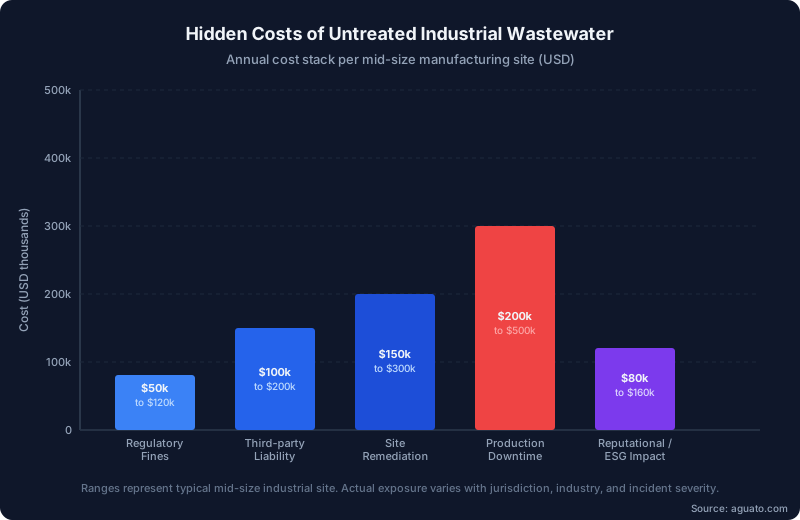
The aggregate exposure from these five categories for a mid-size manufacturing site during a serious non-compliance event routinely totals $580,000 to $3.5 million. The treatment system that would have prevented it costs $150,000 to $800,000 installed, with annual operating costs of $40,000 to $180,000. The math is not complicated. The problem is that the cost categories are owned by different functions (legal, insurance, operations, finance), and no one is totalling the exposure in a single document for the CFO.
## Regulatory exposure by contaminant class
Not all discharge violations carry the same risk profile. The gap between a pH exceedance and a heavy metals discharge is measured in orders of magnitude, both in regulatory consequence and in remediation cost.
Conventional pollutants (BOD, TSS, pH, oil and grease): These are the standard permit parameters for most industrial sites. Violations trigger notices of violation followed by compliance schedules if persistent. Civil penalties for single incidents are typically $5,000 to $50,000. Remediation cost is low if there is no accumulation. Treatment is well-established and comparatively cheap at $0.30 to $1.50 per m3 of wastewater treated.
Toxic pollutants (heavy metals, cyanide, phenols): Heavy metals in wastewater from electroplating, mining, and metal finishing operations carry heightened enforcement priority. Cadmium, mercury, lead, and hexavalent chromium trigger acute regulatory response. A single exceedance event can initiate a facility audit covering all discharge points. Remediation of metal-contaminated soil runs $500 to $3,000 per tonne of soil treated. See the dedicated guide on [removing heavy metals from industrial water](/resources/heavy-metals-removal-water) for the treatment decision tree.
Persistent organic pollutants and PFAS: PFAS compounds are now the fastest-growing compliance frontier. The EPA's April 2024 PFAS drinking water rule set maximum contaminant levels at 4 parts per trillion for PFOA and PFOS. Industrial dischargers upstream of drinking water intakes are facing zero-tolerance enforcement language in new permits. Treatment is not trivial: granular activated carbon and reverse osmosis are the primary removal technologies at $4 to $12 per m3, with spent media carrying its own disposal cost.
Temperature and thermal discharges: Power plant and manufacturing facility cooling water discharge can violate thermal limits even when chemical quality is acceptable. Thermal exceedances cause receiving body DO depletion, triggering both regulatory response and third-party ecological damage claims. Cooling tower upgrades to reduce discharge temperature cost $200,000 to $2 million for a mid-size plant.
For any facility uncertain about its current contaminant profile, independent [water quality testing and monitoring](/resources/industrial-water-quality-testing) is the first-priority spend before any treatment capital decision. Treating to the wrong specification is only marginally better than not treating at all.
## The business case for reuse: when discharge becomes a profit drain
The conventional framing is that wastewater treatment is a cost of compliance. The higher-return framing is that wastewater treatment is a water supply investment. For any facility paying more than $2.50 per m3 for freshwater intake, a reuse system treating and recycling 60 to 80% of process wastewater changes the OPEX equation entirely.
A food processing plant consuming 1,000 m3/day of municipal water at $3.50 per m3 spends $1.28 million per year on water supply alone. A secondary treatment and recycle system achieving 70% reuse costs $600,000 to $1.2 million installed and $120,000 to $250,000 per year to operate. The net water cost saving is $895,000 per year. Payback runs 8 to 16 months at those intake prices. In water-stressed regions, where industrial water tariffs run $5 to $12 per m3, the payback is 4 to 8 months.
[cta:nepti-dark]
The [industrial water reuse and recycling](/resources/industrial-water-reuse-recycling) landscape has matured significantly. Membrane bioreactors, dissolved air flotation combined with ultrafiltration, and reverse osmosis polish systems now achieve consistent treated water quality meeting most process reuse specifications. The barrier is not technology. It is the capital approval process, which is where the full cost stack argument above becomes essential. A treatment project that goes to the CFO as "compliance spend" fights a different approval battle than one that goes as "water supply cost reduction with a 14-month payback and a $3.5 million risk shield."
The right answer on whether reuse is economically attractive depends on your specific feed water quality, discharge volume, intake water cost, and process reuse specification. [Post your project on Aguato](/post-project) and qualified providers will scope the reuse feasibility against your actual site data before any capital is committed.
## Treatment technology options and the cost-risk trade-off
The treatment technology landscape spans four tiers of investment and performance. Matching the right tier to the site's actual effluent profile is where most capital projects either succeed or fail.
| Technology | CAPEX (per m3/day capacity) | OPEX (per m3 treated) | BOD/TSS removal | Regulated pollutant removal | Risk if undersized | Best for | |---|---|---|---|---|---|---| | Physico-chemical (coagulation/flocculation + clarification) | $800 to $1,800 | $0.30 to $0.80 | 60 to 85% | Low (metals partial) | High BOD in effluent | Light industrial, pre-treatment | | Activated sludge / SBR | $1,200 to $2,800 | $0.40 to $1.10 | 85 to 97% | Low (metals pass-through) | Sludge bulking, upset | Municipal-strength organics | | Membrane bioreactor (MBR) | $2,500 to $5,500 | $0.80 to $2.20 | 95 to 99% | Moderate | Membrane fouling | High-load food, pharma | | DAF + UF + RO | $4,000 to $9,000 | $1.50 to $4.50 | 98 to 99.9% | High (PFAS, heavy metals) | Scaling, concentrate disposal | Reuse, ZLD, high-value effluent | | Zero Liquid Discharge (ZLD) | $8,000 to $20,000 | $3.00 to $12.00 | 99.9%+ | Very high | Brine crystallizer fouling | Water-stressed, regulated metals |
The column that procurement leads most often skip is the risk column. A physico-chemical system sized for average load will fail during peak production cycles, generating exactly the exceedance events that trigger enforcement. Undersizing treatment relative to peak load is the single most common capital mistake in industrial wastewater projects, and it is almost always driven by a lowest-capital-cost mandate at the specification stage that ignores the risk exposure value of correct sizing.
For sites with [industrial wastewater treatment](/industrial-water-treatment-companies) capital decisions in progress, the specification framework must account for peak flow, not average flow, and must include a buffer for production ramp-up scenarios.
## Threshold-based decision framework: which tier fits your site
The treatment tier decision does not require a detailed engineering study to get to a first answer. A four-variable screening narrows the field.
Variable 1: Discharge volume. Below 50 m3/day, package physico-chemical or modular DAF units are cost-effective and require minimal civil works. 50 to 500 m3/day is the biological treatment zone where activated sludge or MBR systems deliver the best cost per unit of BOD removed. Above 500 m3/day, a centralised treatment plant with multiple unit operations is almost always justified. Above 2,000 m3/day, the economics of reuse loop closure become compelling in any geography.
Variable 2: Contaminant type. If the effluent contains only conventional pollutants (BOD, TSS, pH), biological treatment is sufficient. If it contains heavy metals, a physico-chemical pre-treatment stage (pH adjustment + precipitation + clarification) is non-negotiable before any biological stage. If it contains PFAS, activated carbon or RO is required, and the treatment cost jumps to $4 to $12 per m3. If it contains both organics and metals, a multi-stage train is required and the CAPEX rises 40 to 60% above single-contaminant systems.
Variable 3: Discharge destination. Discharge to a municipal sewer under a trade effluent consent carries lower treatment requirements than direct discharge to surface water. Both carry higher requirements than closed-loop reuse. The regulatory cost floor is set by the discharge destination, and reuse always has the lowest long-term regulatory exposure.
Variable 4: Site water stress. In regions where industrial water tariffs exceed $3 per m3 or where drought restrictions apply, the reuse economics dominate the treatment selection decision. The [water operational risk](/resources/water-operational-risk-fluid-management) framing applies here: water supply resilience is a business continuity variable, not just a utility cost line.
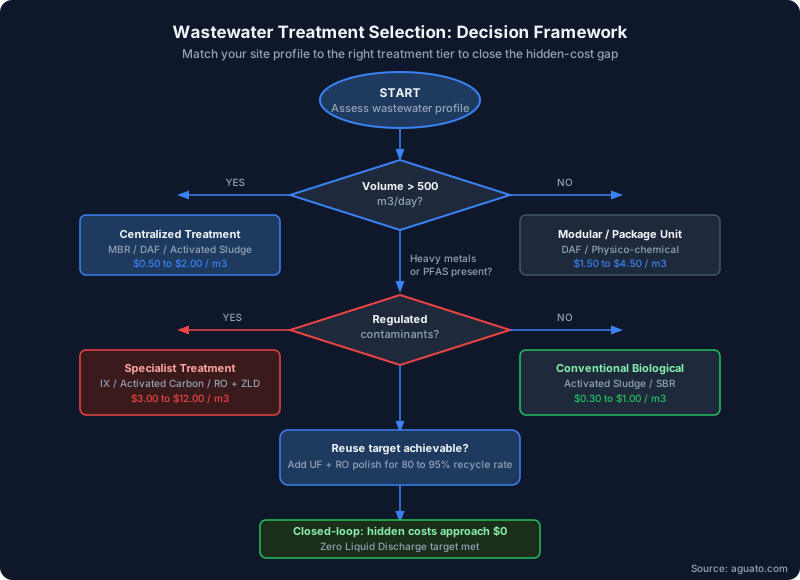
Where the four-variable screen points toward MBR, DAF+RO, or ZLD, the next step is a formal treatability study on actual effluent samples. Treatment systems sized from generic industry data rather than site-specific samples consistently underperform. The cost of a treatability study ($15,000 to $40,000) is the cheapest insurance available before committing to a $1 million to $10 million capital installation.
## Failure scenarios: the decisions that became six-figure events
These failure patterns are composites drawn from enforcement records and publicly documented consent decrees. Each illustrates a specific decision point that produced a foreseeable outcome.
Scenario 1: The undersized biological system. A specialty chemicals manufacturer in the US Midwest specified an activated sludge system for average organic load of 800 mg/L BOD. During a seasonal production surge, influent BOD reached 2,400 mg/L. The system went septic and discharged partially-treated effluent with BOD exceeding permit limits by 8x for 19 days before the plant manager identified the source. The EPA violation resulted in a $340,000 consent decree. The cost to retrofit the biological stage with an MBR conversion was $420,000. The total event cost exceeded $760,000. A peak-load-sized MBR at the original specification stage would have cost $180,000 more than the undersized activated sludge system. The $180,000 savings decision cost $760,000.
Scenario 2: The deferred maintenance shutdown. A food processing plant in the UK operated a DAF unit with a known air dissolving pump fault. The fault was deferred three times due to planned maintenance scheduling. On the fourth production cycle, the pump failed completely. The site discharged 48 hours of untreated oil-and-grease effluent to a river while awaiting an emergency contractor. The Environment Agency issued a formal caution and imposed a £180,000 (approximately $225,000) civil penalty. Production downtime during the cleanup and regulatory response cost an additional £95,000 ($119,000). A replacement pump at the first fault identification would have cost £3,200 ($4,000).
Scenario 3: The PFAS blind spot. A textile manufacturer in the US Northeast had operated under a wastewater discharge permit for 12 years without incident. A state agency monitoring survey identified PFAS compounds in the receiving water body upstream of a municipal intake. The source traced to the manufacturer's discharge. No PFAS limit existed in the permit at the time of the discharge. The manufacturer faced retroactive liability under state environmental law, a mandatory treatment upgrade requiring GAC polishing at $1.8 million capital cost, and civil claims from the municipal utility totalling $3.2 million. The PFAS had been present in the discharge for an estimated 4 to 7 years before detection.
Each of these scenarios shares a common decision pattern: a short-term cost avoidance decision (undersized system, deferred maintenance, incomplete characterisation) that transferred risk onto a future point in time when the cost was 10 to 50 times larger.
## ESG and supply chain: the emerging cost multiplier
For the first time in most industrial sectors, wastewater performance is a direct input to commercial relationships. Major consumer goods companies, automotive OEMs, and pharmaceutical buyers now require supplier water management disclosures that go beyond permit status to include discharge volumes, reuse rates, and watershed risk scores. [CDP Water Security questionnaire](dofollow:https://www.cdp.net/en/water) disclosure is now mandatory for suppliers to hundreds of large corporate buyers.
A facility that cannot demonstrate active wastewater management in a supplier audit faces contract loss or exclusion from approved vendor lists. For a $50 million supply contract with a 10-year horizon, the ESG qualification requirement is worth approximately $5 million per year in revenue exposure. This is a number that a sustainability director can put in front of a CFO alongside the treatment capital budget.
The second ESG lever is access to green finance instruments. Sustainability-linked loans and green bonds now offer 20 to 50 basis point interest rate reductions for facilities meeting water management KPIs. On a $20 million project finance facility, a 40 basis point reduction saves $80,000 per year in interest cost, or $800,000 over a 10-year term. This is a direct capital cost reduction that offsets treatment CAPEX.
For multi-site operations, the [industrial water pollution](/resources/industrial-water-pollution) risk aggregation at portfolio level is increasingly visible to institutional investors through ESG ratings services. A single site non-compliance event can lift the enterprise-level water risk score, affecting cost of capital across the entire portfolio. The site-level treatment investment decision is, for public companies and PE-backed operations, no longer a local OPEX call.
## How to build the business case for your CFO
The business case for wastewater treatment investment has three pillars, and all three must appear in the CFO presentation to win capital approval. A case built on only one pillar (typically "compliance cost avoidance") loses to competing capital priorities at least 60% of the time.
Pillar 1: Risk quantification (not risk description). Attach dollar ranges to the five hidden cost categories for your specific site profile. Use the enforcement penalty schedule for your jurisdiction, your industry's documented downtime cost per day, and your current insurance coverage gap. The number you are defending against is typically $500,000 to $3.5 million per event.
Pillar 2: Operational savings with a payback period. If your freshwater intake cost exceeds $2 per m3, model the reuse scenario. Include reduced discharge fees, reduced chemical input costs from cleaner recirculated water, and reduced sludge disposal costs. Present as year-1 saving, cumulative 5-year saving, and IRR.
Pillar 3: Revenue protection and ESG optionality. Document the specific customer audit requirements your site is being asked to meet. Attach the revenue exposure figure. Include the green finance interest rate saving if applicable.
For sites that have not yet assembled this case, [Nepti](/nepti) models your water matrix against treatment technology options and produces a ranked comparison with cost projections and payback scenarios. It does not sell a specific technology. It produces the numbers your CFO needs to see. For sites ready to move to market, [explore providers on Aguato](/providers) or [post your project](/post-project) to receive scoped proposals from qualified providers who will compete on your specification.
The [industrial water treatment companies](/industrial-water-treatment-companies) that win the best project outcomes are the ones briefed with a site-specific treatability dataset and a clearly stated performance specification, not a generic RFP. The business case process above produces exactly that brief.
The [science on the cost of delayed wastewater treatment](dofollow:https://www.sciencedirect.com/science/article/abs/pii/S0043135421001123) consistently shows that incremental compliance deferral accelerates both the technical complexity and the financial exposure of the eventual reckoning. The treatment system you install in year one costs 30 to 50% less than the system you are forced to install after an enforcement action, because the enforcement action typically mandates a higher-performance specification with shorter deployment timelines.
## FAQ
### What are the hidden costs of untreated industrial wastewater?
The five hidden cost categories are regulatory fines ($25,000 to $37,500 per day under the Clean Water Act), third-party liability ($100,000 to $50 million per incident), site remediation ($250,000 to $5 million depending on plume size), production downtime ($50,000 to $2 million per shutdown event), and insurance and financing cost uplift (40 to 80% premium increase for non-compliant facilities). Permit fees are the smallest number. The downtime and liability exposure are the numbers that close CFO conversations.
### How much does industrial wastewater treatment cost per cubic metre?
Treatment cost per m3 of wastewater ranges from $0.30 to $1.10 for conventional biological systems (activated sludge, SBR), $0.80 to $2.20 for membrane bioreactors, $1.50 to $4.50 for advanced treatment trains including DAF and reverse osmosis, and $3.00 to $12.00 for specialist PFAS or heavy metals removal. The right treatment cost depends on contaminant type, discharge volume, and reuse target. Sites treating above 500 m3/day at the biological tier typically achieve $0.50 to $0.90 per m3 at scale.
### When is zero liquid discharge (ZLD) economically justified for industrial wastewater?
ZLD is economically justified when freshwater intake cost exceeds $4 per m3, when regulatory pressure mandates zero discharge to surface water, or when the effluent contains high-value recoverable materials. CAPEX runs $8,000 to $20,000 per m3/day of capacity, making ZLD a significant capital commitment. The payback calculation depends almost entirely on avoided water intake cost plus avoided discharge and disposal fees. In water-stressed regions or facilities handling lithium, metals, or mineral recovery streams, ZLD frequently achieves a 3 to 6 year payback.
### What PFAS treatment methods work for industrial wastewater?
Granular activated carbon (GAC) and reverse osmosis are the two proven PFAS removal technologies for industrial wastewater, achieving 90 to 99% removal at treatment costs of $4 to $12 per m3. GAC is the lower-CAPEX option but generates spent carbon with a disposal obligation. RO achieves higher removal but produces a concentrated reject stream requiring further management. For high-PFAS load streams, a two-stage GAC-RO train is increasingly the specification default under state-level PFAS permit programmes.
### How does untreated wastewater affect ESG reporting and supplier audits?
CDP Water Security disclosure, ISO 14001 compliance, and major OEM supplier audit frameworks now all require documented wastewater volumes, discharge quality, and reuse rates. A facility that cannot meet these disclosure requirements faces exclusion from approved vendor lists at major corporate buyers. For a $50 million annual supply relationship, the revenue exposure from ESG qualification failure is typically $5 million per year per contract. Green finance instruments also require water KPI compliance, with non-qualifying facilities paying 20 to 50 basis points more on project debt.
### What is the payback period for an industrial wastewater treatment and reuse system?
For a site consuming more than 500 m3/day of freshwater at $2.50 to $5.00 per m3, a treatment and 70% reuse system typically pays back in 8 to 20 months on water cost savings alone, before accounting for reduced discharge fees or eliminated risk exposure. The payback shortens significantly in water-stressed regions or where municipal surcharge tariffs apply. Sites with heavy metals or PFAS removal requirements have longer paybacks (3 to 7 years) due to higher treatment CAPEX and operating cost.
### How should I specify a wastewater treatment system to avoid undersizing?
Specify the system for peak hydraulic and organic load, not average load. Use 90th-percentile flow and contaminant concentration data from at least 12 months of sampling, not the average of your permit monitoring reports. Build a 20 to 30% hydraulic headroom buffer for production ramp-up. Commission a treatability study on actual site effluent before finalising the specification. Undersized systems are the primary driver of treatment plant non-compliance events, and the retrofit cost to correct an undersized installation is typically 60 to 120% of the original capital cost.