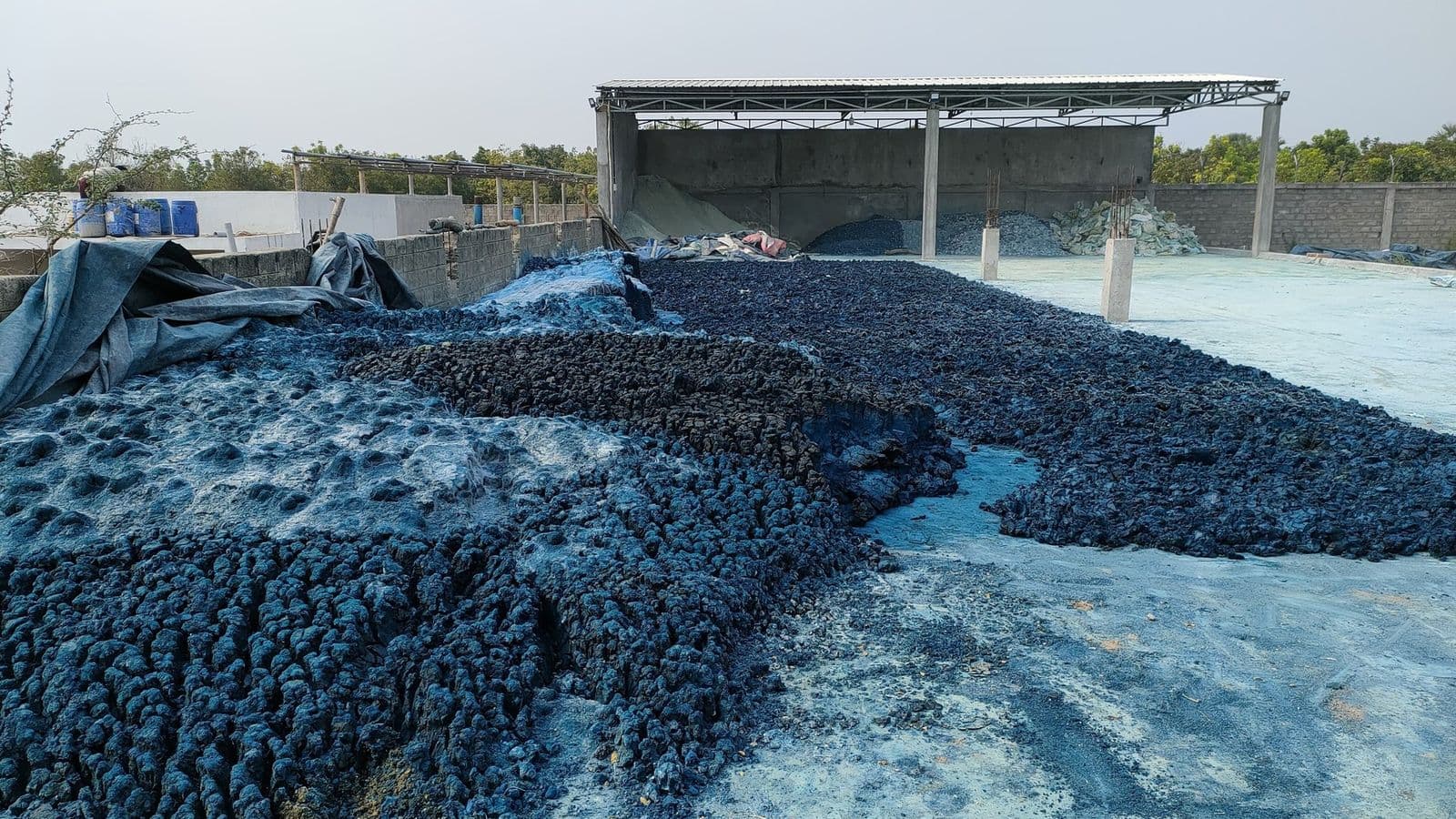
Industrial water pollution is a balance-sheet line item, not just an environmental story. Permit breaches cost USD 50,000 to 5M+ per incident; emerging-contaminant retrofits hit USD 2M, 50M. This guide covers contaminant classes, industry sources, compliance regimes, and the cost-of-failure exposure operators usually under-cost.
Industrial water pollution is a balance-sheet line item, not just an environmental story. A single Clean Water Act permit-limit exceedance triggers fines starting at USD 64,618 per day per violation under current US enforcement schedules; a tailings dam release or stormwater bypass routinely costs USD 5M, 500M+ in remediation, third-party damages, and brand exposure. Add the rising emerging-contaminant burden, PFAS limits at parts-per-trillion, mid-permit retrofits at USD 2M, 50M, and class-action exposure that has produced multi-billion-dollar settlements, and pollution becomes the single largest unmodelled liability on most industrial operators' books.
The compliance environment has shifted decisively in the last five years. Citizen-suit provisions in major water statutes are being used aggressively; ESG-driven investor scrutiny surfaces every consent breach in real time; and the cost of getting caught is now measured in market cap, not just fines. Understanding industrial water pollution as a financial decision, not just an engineering one, is what separates operators who price the risk correctly from those who carry it unmodelled.
This guide is for operations directors, environmental managers, and capital-projects leads who own industrial discharge compliance. It covers the five contaminant classes that drive every consent letter, the industries that generate each, the major compliance frameworks (Clean Water Act, EU Water Framework Directive, IFC Performance Standards), the cost-of-failure exposures that should sit on the operator's risk register, and the six recurring failure modes that produce the multi-million-dollar enforcement events.
## Why Pollution Is a Balance-Sheet Issue
For most of the 20th century, industrial water pollution was a regulatory issue with reputational tail risk. Today it is a CFO-level liability with three reinforcing pressure points: regulatory penalties have risen 5 to 10× in real terms since 2000; investor and customer ESG scrutiny captures every public enforcement record in real time; and emerging contaminants (PFAS, pharmaceuticals, microplastics) are creating retrofit obligations on already-compliant facilities. Operators that under-cost any of the three are sitting on a liability they have not modelled.
The [US EPA Clean Water Act enforcement schedule](dofollow:https://www.epa.gov/enforcement/water-enforcement) sets permit-violation civil penalties at up to USD 64,618 per day per violation under the 2024-adjusted Federal Civil Penalties Inflation Adjustment Act. A facility with 30 days of permit non-compliance accumulates USD 1.94M in civil exposure before considering the Supplemental Environmental Project demands, citizen-suit damages, or the consent decree that locks in compliance investments for 5 to 10 years. EU Water Framework Directive penalties scale similarly under member-state implementations; in the UK, the Environment Agency has imposed fines of £20M+ on single offenders in recent years.
The honest framing: a properly designed treatment programme costs USD 50,000 to 500,000 per year for most industrial facilities. A single permit breach can wipe out 10 to 100 years of that investment in one event. The economic case for over-investing in compliance is not environmental ethics, it is straightforward asymmetric risk pricing.
## Five Contaminant Classes
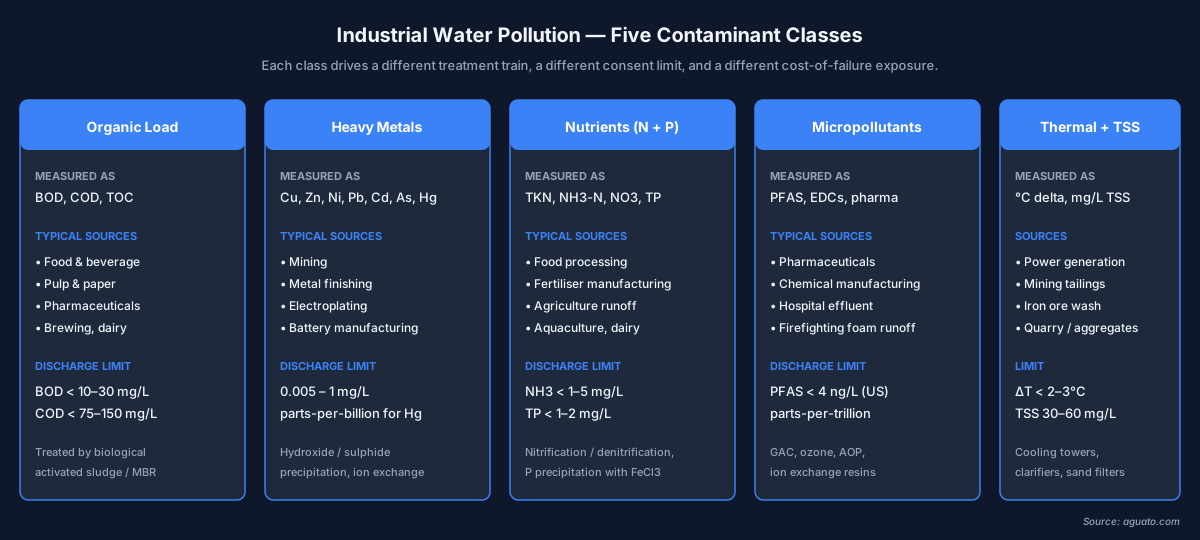
Every industrial discharge consent is built around the contaminants the receiving water body is sensitive to. Five classes account for over 95% of permit conditions:
| Class | Measured as | Typical sources | Discharge limit | Treatment focus | |---|---|---|---|---| | Organic load | BOD, COD, TOC | Food, pulp/paper, pharma, dairy | BOD < 10 to 30 mg/L | Biological (CAS, MBR, anaerobic) | | Heavy metals | Cu, Zn, Ni, Pb, Cd, As, Hg | Mining, metal finishing, electroplating | 0.005 to 1 mg/L | Hydroxide / sulphide ppt, IX | | Nutrients (N + P) | TKN, NH3-N, NO3, TP | Food, fertiliser, agriculture, dairy | NH3 < 1 to 5; TP < 1 to 2 mg/L | Nitrification / denitrification, P precipitation | | Micropollutants | PFAS, EDCs, pharma actives | Chemicals, pharma, hospital, AFFF | ng/L to µg/L | GAC, ozone, AOP, IX resins | | Thermal + TSS | °C delta, TSS mg/L | Power, mining, quarry | ∆T < 2 to 3°C; TSS 30 to 60 mg/L | Cooling towers, clarifiers, sand filters |
The trick most operators miss: most industrial effluents carry contaminants from at least three of the five classes simultaneously, and each class needs its own treatment unit. A food-processing plant's effluent is dominated by organic load + nutrients but also carries low-grade FOG (a TSS sub-class) and seasonal cleaning chemicals (low-grade chemical pollution). The treatment train must address all three; specifying for the dominant class only leaves the secondary classes as compliance gaps.
## Industry-to-Pollutant Source Matrix
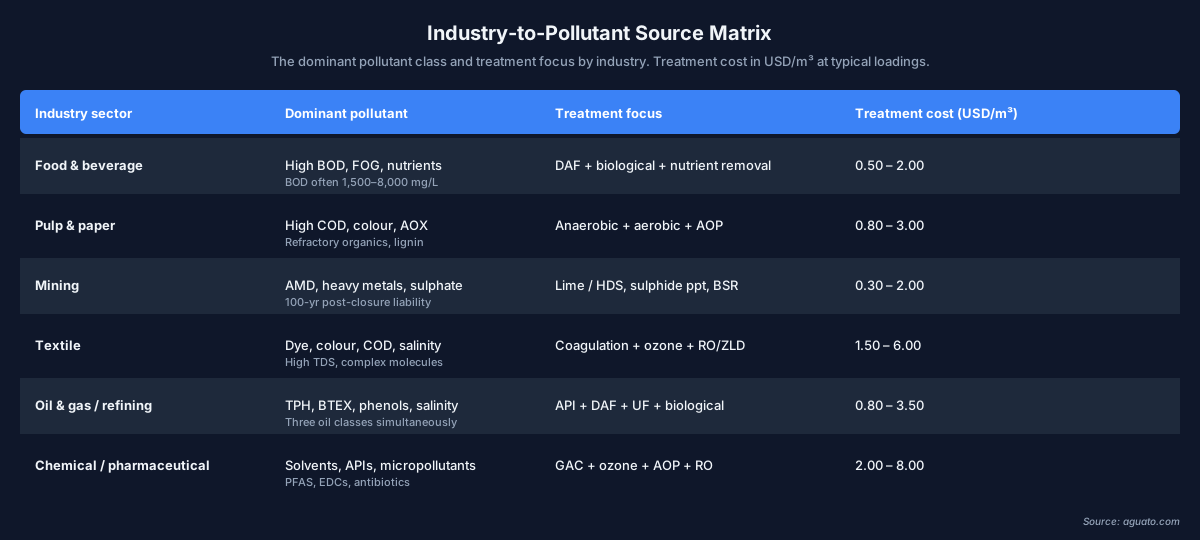
The pollutant profile varies sharply by sector. Treatment cost in USD per m³ at typical loadings:
| Industry sector | Dominant pollutant | Treatment focus | Cost (USD/m³) | |---|---|---|---| | Food & beverage | High BOD, FOG, nutrients | DAF + biological + nutrient removal | 0.50 to 2.00 | | Pulp & paper | High COD, colour, AOX | Anaerobic + aerobic + AOP | 0.80 to 3.00 | | [Mining](/resources/mining-wastewater-treatment) | AMD, heavy metals, sulphate | Lime / HDS + sulphide ppt + BSR | 0.30 to 2.00 | | Textile | Dye, colour, COD, salinity | Coagulation + ozone + RO/ZLD | 1.50 to 6.00 | | [Oil & gas / refining](/resources/oily-wastewater-treatment) | TPH, BTEX, phenols, salinity | API + DAF + UF + biological | 0.80 to 3.50 | | [Offshore oil & gas production](/resources/offshore-produced-water-treatment) | Dispersed oil, dissolved BTEX, NORM, scale ions | Hydrocyclone + IGF + nutshell + MPPE/ceramic UF | 0.50 to 4.50 | | Chemical / pharmaceutical | Solvents, APIs, micropollutants | GAC + ozone + AOP + RO | 2.00 to 8.00 |
Sector-specific intensity matters because consent regimes are sector-specific. The EU Industrial Emissions Directive sets sector-specific BAT (Best Available Techniques) Reference Documents for over 30 industrial sectors; US EPA Effluent Limitation Guidelines are similarly sector-specific. Operating without an explicit comparison of your treatment train to your sector's BAT or ELG benchmarks is operating blind on compliance.
[cta:nepti-dark]
## Compliance Frameworks That Bite
Three regulatory frameworks dominate the modern industrial water-pollution compliance environment:
US Clean Water Act (CWA). Permits issued through the National Pollutant Discharge Elimination System (NPDES). Civil penalties to USD 64,618 per day per violation; criminal exposure for knowing or negligent discharges; citizen-suit provisions allow third parties to bring enforcement actions independently of EPA. Recent record-setting CWA penalties include USD 5.5B (BP Deepwater Horizon, 2016), USD 20M (Chemours PFAS, 2024), USD 2M+ in routine industrial cases.
EU Water Framework Directive (WFD) + Industrial Emissions Directive (IED). WFD requires member states to achieve "good ecological status" of all water bodies by deadline cycles; IED imposes BAT obligations on covered installations. Member-state penalty regimes vary but are converging upward, the UK Environment Agency's [enforcement record](dofollow:https://www.gov.uk/government/publications/water-and-sewerage-companies-in-england-environmental-performance-report-2022) shows fines of GBP 90M (2023, water company sewage), regular GBP 1M+ on industrial sites, and unlimited individual director liability for environmental offences.
IFC Performance Standards (PS3, PS6). Triggered by international project finance, any operation borrowing from World Bank, IFC, or Equator Principles signatories must demonstrate compliance with PS3 (resource efficiency and pollution prevention) and PS6 (biodiversity). PS3/PS6 are stricter than most national consents in practice; non-compliance can trigger loan acceleration, not just fines.
ESG and voluntary frameworks. GRI 303 (Water and Effluents), CDP Water Security, SASB, TNFD. Not legally enforceable but increasingly tied to capital costs through investor screening; insurers are starting to price water-pollution risk separately in environmental impairment liability policies.
The compliance question is no longer whether you meet your single permit. It's whether you meet the most stringent of the layers that apply, in real time, with audit trails. The [International Water Association's water-quality benchmarks](dofollow:https://www.iwapublishing.com/) document how multi-framework compliance is structured at scale across borders, adopt them as the design baseline, not the regulatory minimum.
## The Cost of Pollution Events
Historical pollution events provide useful benchmarks. The typical permit-violation event costs USD 50,000 to 5M+ in fines, remediation, and corrective action. The typical catastrophic-release event (tailings dam, tank rupture, stormwater bypass) costs USD 5M, 500M+. Examples from the past decade:
- Mariana dam (Brazil, 2015): tailings spill, USD 7B+ in damages and ongoing claims - Brumadinho dam (Brazil, 2019): tailings spill, USD 7B+ in compensation, multiple criminal indictments - DuPont C8/PFAS class actions (US, 2017 to 2023): USD 670M+ in settlements; USD 12B+ AFFF water-utility class action settlements pending - BP Deepwater Horizon (2010, ongoing): USD 65B+ in cumulative cost - 3M PFAS settlement with US water utilities (2023): USD 10.3B - Norfolk Southern East Palestine derailment (2023): USD 600M+ EPA penalty + ongoing civil
The pattern: pollution events have a fat-tail cost distribution. Most consent breaches cost USD 50 to 500K. A small percentage cost USD 50 to 500M. Insurance does not fully cover any of these, environmental impairment liability policies cap at USD 50 to 250M typically and exclude knowing violations. The risk management answer is not insurance; it is investment in reliable treatment + monitoring + incident response.
## Treatment and Prevention Strategies
The cheapest treatment is the one you don't have to do. Source-control and process-substitution measures consistently deliver higher ROI than end-of-pipe treatment:
- Process water reuse within the plant (cooling tower blowdown to non-critical washdown, RO permeate reuse for irrigation) reduces both intake and discharge volume, multiplying the value of every dollar spent on treatment infrastructure - Solvent and reagent substitution (replacing AFFF with fluorine-free firefighting foam, swapping chrome-VI to chrome-III in plating) eliminates regulated discharge before it leaves the process unit - Closed-loop systems with [zero liquid discharge](/resources/zero-liquid-discharge) for high-value or high-toxicity streams - Real-time process control using AI / SCADA optimisation to reduce off-spec production and the associated cleaning effluent
End-of-pipe treatment is still required for the residual load. The right [water treatment plant design](/resources/water-treatment-plant-design) covers the FEED-to-commissioning workflow that produces a plant capable of meeting the consent. The right [membrane filtration system](/resources/membrane-filtration-system) handles the polishing requirement for stricter discharge or reuse targets. Specifying a treatment programme without a measured baseline of feed-water characteristics and a quantified compliance margin is engineering by hope. Browse verified industrial water treatment providers and request scoped proposals from 3 to 5 specialists with reference plants in your sector, the [Aguato marketplace](/providers) makes that comparison straightforward.
## Where Compliance Fails
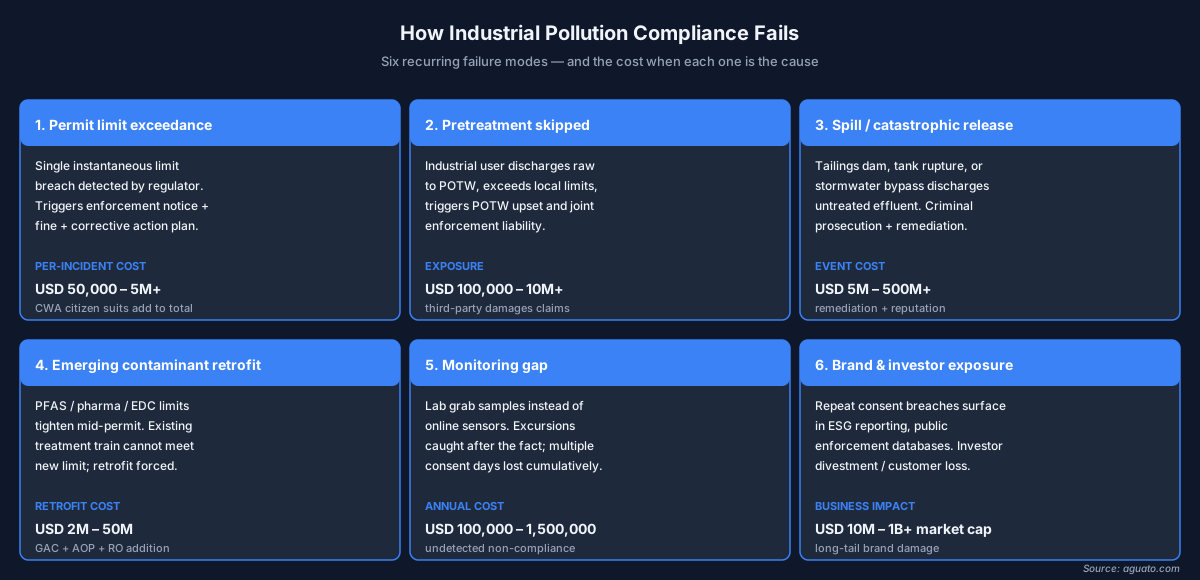
The six recurring failure modes:
Permit limit exceedance. Single instantaneous breach detected by regulator. Triggers enforcement notice + fine + corrective action plan. Cost: USD 50,000 to 5M+ per incident; CWA citizen-suit damages add to total.
Pretreatment skipped. Industrial user discharges raw to POTW (publicly-owned treatment works), exceeds local limits, triggers POTW upset and joint enforcement liability. Exposure: USD 100,000 to 10M+ including third-party damages claims.
Spill / catastrophic release. Tailings dam, tank rupture, or stormwater bypass discharges untreated effluent. Criminal prosecution + remediation. Event cost: USD 5M, 500M+.
Emerging contaminant retrofit. PFAS / pharma / EDC limits tighten mid-permit. Existing treatment train cannot meet new limit; retrofit forced. Cost: USD 2M, 50M for GAC + AOP + RO addition.
Monitoring gap. Lab grab samples instead of online sensors. Excursions caught after the fact; multiple consent days lost cumulatively. Cost: USD 100,000 to 1.5M per year in undetected non-compliance.
Brand & investor exposure. Repeat consent breaches surface in ESG reporting and public enforcement databases. Investor divestment / customer loss. Business impact: USD 10M, 1B+ in market cap from long-tail brand damage.
The pattern across all six is the same: each fails not because the engineering was wrong on day one, but because the operating discipline, feed monitoring, dosing programme, incident response, was treated as optional. Real industrial pollution control is a continuous-operations problem, not a one-off install. The plants that operate cleanly for 20 years all run real-time monitoring, defensive over-treatment for first-line failure modes, and integrated incident response. The plants that produce 7-figure enforcement events all skipped at least one of the three.
If you invest in a properly engineered treatment train + online monitoring + incident response programme that prevents one fat-tail catastrophic event over the asset's life, you save USD 5M, 500M+ in remediation, litigation, and brand exposure, and you avoid the regulatory consent decree that locks in 5 to 10 years of capital expenditure on terms set by the regulator, not by the operator. The biggest cost-of-doing-nothing is letting the EPC contractor specify the lowest-bid treatment package and the operations team run lab grab samples; that single combination is where every nine-figure pollution event begins.
## FAQ
### How is "industrial water pollution" formally defined?
In US federal law, industrial water pollution covers any introduction of pollutants into waters of the United States from a point source (40 CFR 122). EU law uses similar point-source definitions under the Water Framework Directive. Both frameworks distinguish "conventional" pollutants (BOD, TSS, pH, oil/grease, coliforms) from "toxic" pollutants (heavy metals, organic toxins) and "non-conventional" pollutants (nutrients, ammonia, micropollutants), with different permit and penalty regimes for each.
### What's the per-day fine for a CWA violation?
USD 64,618 per day per violation as of the 2024 Federal Civil Penalties Inflation Adjustment Act adjustment. This applies cumulatively, 30 days of non-compliance produces a baseline civil exposure of USD 1.94M before considering supplemental environmental projects, citizen-suit damages, or criminal exposure for knowing or negligent discharges. State-program penalties may stack on top of federal in delegated states.
### What about PFAS, how worried should I be?
Very. EPA finalised drinking-water MCLs at 4 ng/L for PFOA and PFOS in April 2024; industrial discharge limits and ELGs for chemical, plating, AFFF, and pulp industries are in active rulemaking. Existing treatment trains rarely remove PFAS; retrofits typically require GAC, IX resins, or destruction technologies (foam fractionation, supercritical water oxidation, plasma), with CAPEX of USD 2 to 50M depending on flow and sector. PFAS is the single highest-probability emerging-contaminant retrofit obligation in the next 5 years.
### How do I price pollution risk on my balance sheet?
Three lines: (1) expected-value annual permit-violation cost based on your facility's historical compliance rate × per-event cost; (2) catastrophic-event cost × probability based on your installed risk-mitigation infrastructure (single train vs N+1, online vs grab sampling, etc.); (3) emerging-contaminant retrofit reserve based on the highest-probability incoming regulation in your sector. Most operators carry only line 1 in their risk register; the asymmetric exposure is in lines 2 and 3.
### Can insurance cover the exposure?
Partly. Environmental impairment liability (EIL) policies typically cap at USD 50 to 250M and exclude known violations, gradual pollution, and sometimes specific contaminants like PFAS. Captive insurance and self-insured retentions handle the gap up to fat-tail events but cannot meaningfully cover the largest cases. Insurance is a complement to, not a substitute for, defensive operating practices.
### What's a 'consent decree' and should I worry about one?
Yes. A consent decree is a court-supervised settlement that locks the operator into specific compliance investments, monitoring requirements, and reporting obligations for a defined term, typically 5 to 10 years. Decrees are negotiated to settle major enforcement actions but can also be triggered by repeat consent violations. The economic cost of a consent decree typically exceeds the underlying fine by 3 to 10× because the regulator gets to dictate the remedial CAPEX programme.
### How does ESG reporting interact with pollution exposure?
GRI 303 (Water and Effluents) and SASB sector-specific standards require disclosure of every consent violation; CDP Water Security scoring penalises sites with non-compliance history; investor screening (MSCI ESG, Sustainalytics) flags pollution events in real time. Integrated ESG reporting is now the de-facto fastest route to disclose pollution events to capital markets, a single reportable consent breach can move a company's ESG rating, with knock-on effects on debt cost, equity multiple, and customer procurement scoring. For most operators, the brand and capital-cost impact of repeat pollution events now exceeds the direct regulatory penalty cost.