Heavy metals in industrial discharge carry fines up to $50K per day. A site-matched treatment train can cut compliance risk and reduce treatment OPEX by 30 to 60%.
A single discharge exceedance event for lead or hexavalent chromium can trigger penalties of $25,000 to $50,000 per day under US EPA enforcement, and a pattern of violations routinely results in consent orders requiring capital remediation programmes costing $2 million to $15 million. Heavy metals removal is not a wastewater-treatment afterthought. It is a compliance liability that sits on the balance sheet the moment a plant starts operating, and the cost of getting it wrong compounds over time in a way that routine process upsets do not. The leather industry faces this liability most acutely through chromium, and the segregation-and-recovery strategy that turns chrome from a hazardous-waste cost into a recovered raw material is covered in our [leather and tanning wastewater treatment guide](/resources/leather-tanning-wastewater-treatment).
The common mistake is specifying a single technology based on what the incumbent vendor supplies. Chemical precipitation is cheap to install, so precipitation gets specified. Ion exchange delivers low outlet concentrations, so IX gets bolted onto the end. Neither decision is wrong in isolation. Both decisions together, without a feed characterisation study, produce systems that fail permit limits during flow surges, generate sludge the site cannot legally dispose of, and cost 40 to 80% more to operate than a correctly sequenced train.
This guide covers the full decision arc for industrial operators: which metals drive the most regulatory risk, how each removal technology works and where it breaks down, a threshold-based framework for matching the right train to your feed water, what it costs (CAPEX and OPEX with real ranges), the failure modes that generate the largest unplanned bills, and a CFO-facing summary of the cost of inaction. The interlinkTargets at the end point to provider directories where you can issue scoped RFPs once you have your design parameters.
## The decision in brief
- Budget the train at the right scale. A correctly specified heavy metals removal train for a mid-sized industrial facility at 100 m3/h, treating a mixed metals stream to a 0.5 mg/L combined discharge limit, typically costs $600,000 to $1.4 million to install. - Expect a 3 to 6 year payback. Operating cost is $0.50 to $1.20 per m3. At 20 operating hours per day, that is $365,000 to $876,000 per year in OPEX and a 3 to 6 year payback against avoided penalty and remediation exposure. - Fear the consent order, not the first fine. The biggest cost of inaction is not the fine for the first exceedance but the consent order that follows a pattern of violations, which mandates a capital remediation programme at regulator-imposed scope and timeline.
That programme typically costs $2 million to $15 million without the benefit of competitive procurement.
## What heavy metals removal means for industrial operators
Heavy metals in industrial water are dissolved or suspended ionic forms of elements including lead (Pb), cadmium (Cd), [chromium](/elements/chromium) (Cr), [arsenic](/elements/arsenic) (As), mercury (Hg), copper (Cu), zinc (Zn), and nickel (Ni). They enter process water through ore processing, electroplating baths, surface finishing, circuit board manufacturing, coal combustion, tannery operations, and hydraulic fracturing flowback. Unlike organic contaminants that can biodegrade, metals do not break down. Every kilogram that enters a treatment system must leave it either in the treated effluent within permit limits, or captured in a solid residue that must be disposed of as hazardous waste.
The operating consequence is binary: either the treatment system removes metals to below the discharge threshold, every time, or the site is in violation. There is no partial credit. A system that achieves 98% removal of zinc against an inlet of 80 mg/L still discharges 1.6 mg/L -- a concentration that exceeds US EPA effluent guidelines for zinc in most industrial categories, which commonly sit at 0.5 to 1.0 mg/L total. That two-percentage-point gap between perceived and actual compliance is where consent orders originate.
For operations and procurement teams, the practical question is never "can we remove heavy metals" -- the technology exists to hit any permit limit. The question is which combination of technologies delivers reliable compliance at the lowest total lifecycle cost, with a residuals management plan the site can actually execute.
## Which metals cause the most compliance failures
Not all heavy metals are equal from a regulatory or operational standpoint. The metals most frequently cited in enforcement actions against [industrial wastewater treatment](/resources/industrial-wastewater-treatment) facilities are lead, hexavalent chromium, cadmium, arsenic, and mercury. Each has distinct chemistry that governs which treatment approach works and which fails.
Lead and cadmium respond well to alkaline precipitation at pH 9 to 11, where they form hydroxide or carbonate precipitates that settle readily. The risk is pH excursion: if the pH controller drifts below 8.5, solubility increases sharply and outlet concentrations spike. A one-unit pH error in a lead precipitation system can multiply the outlet lead concentration by a factor of 10 to 30 within hours.
Hexavalent chromium (Cr VI) requires a two-step process that most operators underestimate. It must first be chemically reduced to trivalent chromium (Cr III) using sodium metabisulfite or ferrous sulfate at acidic pH (2.5 to 3.0), then precipitated at pH 8 to 9 as chromium hydroxide. Skipping or short-cutting the reduction step leaves Cr VI in solution -- a known human carcinogen classified under Group 1 by the International Agency for Research on Cancer -- and an effluent that will fail any modern discharge limit. The [US EPA effluent guidelines](dofollow:https://www.epa.gov/eg/effluent-guidelines-table) for electroplating and metal finishing set total chromium limits of 0.33 to 2.77 mg/L depending on the category, with some state-level permits at 0.05 mg/L for Cr VI specifically.
Arsenic and mercury are in a different class. Removal to the sub-0.01 mg/L limits increasingly demanded by regulators is difficult with precipitation alone and typically requires adsorption polishing using iron-oxide media (for arsenic) or activated carbon impregnated with sulfur compounds (for mercury). These media have finite capacity and must be monitored continuously for breakthrough -- a point of failure that catches many operators off guard.
Zinc and copper are among the most common metals in industrial discharge and among the most treatable. Both precipitate reliably at pH 8.5 to 10, both respond to electrocoagulation, and both can be recovered as saleable concentrates in certain high-volume operations, partially offsetting treatment cost.
The practical takeaway is that a facility discharging a mixture of Cr VI, As, and Pb faces a fundamentally different and more expensive treatment problem than one discharging only Zn and Cu. Lumping all heavy metals under a single line item in the treatment budget is a procurement error that typically surfaces at commissioning, after the low-cost system has already been ordered.
## Chemical precipitation: the workhorse of bulk removal
Chemical precipitation is the most widely deployed heavy metals removal technology in industrial wastewater because it is simple, scalable, and works on high-concentration streams without pre-treatment. The process adds a chemical reagent -- typically sodium hydroxide, lime (calcium hydroxide), or sodium sulfide -- to the wastewater at a controlled pH, converting dissolved metal ions into insoluble metal hydroxides or sulfides that form a floc. The floc is then separated in a clarifier or a plate-separator and the resulting sludge is dewatered for disposal.
Hydroxide precipitation using lime or NaOH is the lowest-cost entry point. For a single metal like zinc in a 50 m3/h stream at 100 mg/L inlet concentration, a properly designed precipitation system can reduce outlet zinc to 0.5 to 2 mg/L with reagent costs of $0.20 to $0.60 per cubic metre. The total CAPEX for a lime-dosing, clarifier, and filter-press system at that scale sits in the $150,000 to $400,000 range.
The limitation is selectivity. Hydroxide precipitation does not work equally well on all metals at the same pH, and in a mixed stream optimising for one metal will undershoot another. Sulfide precipitation delivers lower residual concentrations -- typically 0.01 to 0.1 mg/L for Pb, Cd, and Hg -- but generates a sulfide sludge that carries higher hazardous-waste disposal costs ($150 to $400 per tonne, versus $80 to $200 per tonne for hydroxide sludge in most US and EU markets). The sludge disposal line item is consistently underestimated in feasibility studies. A 200 m3/h electroplating wastewater plant generating 4 to 8 tonnes of dewatered sludge per day at 20% solids incurs $220,000 to $580,000 per year in disposal costs alone. That number frequently exceeds the annual reagent cost.
A pattern that recurs across industrial installations is the system that performs perfectly during acceptance testing with clean, synthetic feed and then drifts into permit exceedances within six months of commissioning. The root cause is almost always feed water variability: production upsets, batch dumps, or seasonal chemistry changes that shift the inlet pH or metal speciation outside the precipitation window. The correct response is a robust pH control system with redundant probes, not a tighter SLA with the chemical vendor.
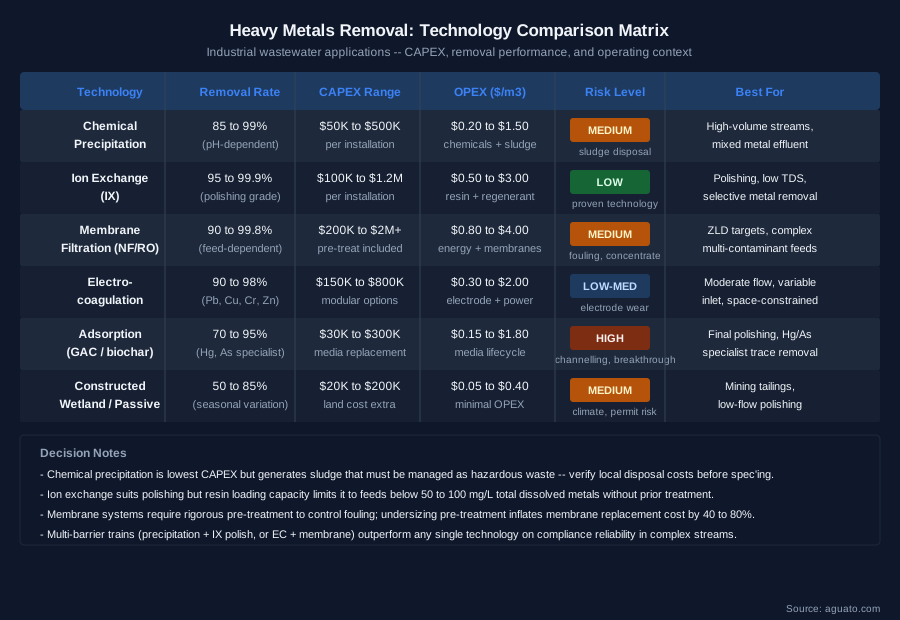
The comparison matrix above captures the six most common technologies across five decision dimensions. The key insight: no single row dominates. Every technology in the table has a context where it is the right answer, and a context where it is the wrong answer. The buyer's job is to define the context before selecting the box.
## Ion exchange: polishing to permit-grade limits
Ion exchange resins attract and hold metal ions from solution by swapping them for hydrogen or sodium ions on the resin surface. The process is exceptionally effective at polishing low-concentration streams to sub-0.1 mg/L levels, and it operates continuously without the chemistry variability of precipitation. For facilities subject to strict discharge limits -- semiconductor fabs, precision metal finishing shops, pharmaceutical manufacturers -- IX is often the only technology that consistently hits the limit.
The boundary condition is inlet concentration. Resin capacity is finite, measured in milliequivalents per litre, and a high-concentration inlet (above 50 to 100 mg/L total dissolved metals) exhausts a resin bed too quickly for economic operation. The rule of thumb used in most process designs is that IX is economical at inlet concentrations below 50 mg/L; above that threshold, a primary removal stage (precipitation or electrocoagulation) is required to reduce the load before IX polishing.
Selective resins have changed the calculus significantly in the last decade. Chelating resins designed to capture specific metals -- EDTA-functional resins for copper, iminodiacetic acid (IDA) resins for Pb and Cd, thiol-functional resins for Hg -- can achieve outlet concentrations below 0.001 mg/L for target metals while passing non-target ions. This selectivity matters when the permit has strict limits on one metal but not others, and when recovering the captured metal as a product stream has value. A copper refinery IX system regenerating with dilute sulfuric acid and returning copper sulfate to the process can recover 85 to 95% of dissolved copper, turning a waste treatment cost into a partial cost offset.
[Browse verified industrial water treatment providers](/industrial-water-treatment-companies) with ion exchange capability, filter by sector and country, and request scoped proposals for your specific metals and flow profile. A well-scoped IX enquiry -- inlet concentration, target outlet, regenerant disposal route, flow range -- takes 20 minutes to prepare and saves three months of vendor education.
Regeneration management is the operational risk most buyers underappreciate. The spent regenerant is a concentrated metal solution that must either be returned to the process, treated through a side-stream precipitation unit, or disposed of as hazardous liquid waste. The disposal cost is not trivial: at $2 to $5 per litre for concentrated heavy metals liquid waste in regulated markets, a 50-litre regeneration cycle on a system that regenerates twice per week generates $10,000 to $26,000 per year in disposal cost alone. Include that number in the lifecycle cost model before signing the vendor contract.
## Membrane filtration for complex heavy metals streams
Nanofiltration (NF) and reverse osmosis (RO) reject dissolved metal ions by physical exclusion through a semi-permeable membrane. NF membranes typically reject divalent metal ions (Pb2+, Cu2+, Cd2+, Zn2+) at 90 to 97% while partially passing monovalent ions, making them well-suited to divalent metal removal without the full energy burden of RO. RO achieves 95 to 99.8% rejection of virtually all dissolved metals, including arsenic and mercury at low concentration, but at higher energy cost (1.5 to 4 kWh/m3 depending on operating pressure and recovery) and requires rigorous pre-treatment to control fouling and scaling.
The business case for membrane filtration in heavy metals applications usually comes down to two factors: whether the operator needs to recover clean water for reuse (a strong driver in water-stressed locations), and whether the feed water contains multiple contaminants that a single membrane pass can address simultaneously. A mining site processing [mine drainage water](/resources/mining-wastewater-treatment) containing sulfates, arsenic, and a mixture of divalent metals is a strong membrane candidate because an RO train removes all three categories simultaneously, whereas precipitation would need to be sequenced differently for each.
The concentrate stream is the critical constraint in membrane heavy metals applications. An RO system operating at 75% recovery concentrates the metals by a factor of four in the reject stream. If the inlet contains 50 mg/L Zn, the reject will contain 200 mg/L Zn and must be treated as high-strength waste. Failure to model the concentrate disposal route before specifying a membrane system is one of the most common and expensive commissioning errors in the sector. The membrane works exactly as designed; the plant has nowhere to send the reject.
Pre-treatment requirements for membrane systems on industrial heavy metals streams are extensive. Iron fouling, silica scaling, biological growth, and suspended solids all shorten membrane life. A system with inadequate pre-treatment will replace membranes on a 12 to 24 month cycle instead of the 5 to 7 year design life, turning a $200,000 membrane asset into a $40,000-per-year recurring cost. Every $1 invested in pre-treatment engineering typically saves $3 to $5 in membrane replacement cost over a 10-year period.
[Browse nanofiltration and membrane filtration providers](/membrane-filtration-companies) who work on industrial heavy metals applications and can scope pre-treatment requirements against your actual feed chemistry before any capital commitment.
## Electrocoagulation: the emerging middle ground
Electrocoagulation (EC) passes an electrical current through the wastewater between sacrificial iron or aluminium electrodes. The current dissolves the electrode metal into the water as coagulant ions, which react with dissolved metals and form co-precipitates that are removed by flotation or settling. The result is a process that delivers precipitation-level removal without the chemical dosing infrastructure, in a more compact footprint, at a reagent cost close to zero (electrode wear replaces chemical cost).
EC has gained significant traction in electroplating, circuit board manufacturing, and metal finishing applications because it handles variable inlet concentrations gracefully: the current can be adjusted in seconds to match load changes that would overwhelm a chemical dosing system. Across projects covering small-to-medium metal finishing operations, EC has consistently reduced total dissolved metals from 100 to 300 mg/L inlet to 1 to 10 mg/L outlet in a single pass, with 90 to 98% removal efficiency for Pb, Cu, Cr III, and Zn.
The limitation is scale. EC capital costs scale steeply above 500 m3/h because electrode surface area must grow with flow, and the electrode replacement cost (aluminium electrodes: $800 to $2,500 per set; iron electrodes: $400 to $1,200 per set, with replacement cycles of 6 to 18 months) becomes significant at high volumes. EC is therefore best positioned as the primary treatment stage for streams in the 10 to 300 m3/h range, with IX or adsorption polishing to meet final permit limits.
## Adsorption media: activated carbon, biochar, and specialist resins
Adsorption is the technology of last resort for ultra-trace metals removal -- the stage that takes an already-treated stream from 0.05 mg/L down to 0.005 mg/L where a discharge permit demands it. Granular activated carbon (GAC), biochar, and iron-oxide coated media each have specific affinity for different metals, and choosing the wrong media is a common failure mode that leads to rapid breakthrough without meaningful removal.
Activated carbon (GAC) is effective for mercury in its organic forms (methylmercury, phenylmercuric compounds) but has low affinity for most inorganic metal ions in their ionic form. A GAC system purchased for "general heavy metals polishing" frequently delivers 30 to 50% removal at best for inorganic lead or cadmium -- well short of the 90 to 99% the procurement team expected. Impregnated GAC, loaded with sulfur compounds or thiol groups, performs significantly better for Hg and Pb, but costs 3 to 5 times more per tonne than standard GAC.
Iron-oxide and iron-hydroxide coated media are the standard for arsenic removal. Media such as granular ferric hydroxide (GFH) achieve As concentrations below 0.01 mg/L in batch adsorption, meeting WHO drinking water guidelines of 0.01 mg/L arsenic in the treated effluent and the [WHO Guidelines for Drinking-water Quality](dofollow:https://www.who.int/publications/i/item/9789240045064) threshold that increasingly anchors industrial discharge permits in developing markets. Capacity is finite -- typically 2 to 8 grams of As per kilogram of media -- and must be monitored by regular outlet testing. When breakthrough occurs it does so over days, not hours, giving operators a window to change media before the permit limit is breached, but only if the monitoring programme catches it.
Biochar and agricultural-waste-derived adsorbents have attracted considerable research attention as low-cost alternatives, particularly in emerging markets. Removal efficiencies of 60 to 90% for Pb, Cu, and Cd have been documented at laboratory scale, but field performance varies widely with feed pH, competing ions, and media uniformity. Until performance reliability at industrial scale is better established, biochar is most appropriate as a supplementary stage in low-criticality polishing applications, not as a primary compliance barrier.
The key operating discipline with adsorption systems is a documented breakthrough monitoring programme with pre-agreed change-out thresholds. Without it, the system becomes a silent failure risk. Across industrial sites with GAC or iron-oxide media beds, the most common compliance incident pattern is a media bed that exhausted six to eight weeks before the scheduled change, with no continuous monitoring to detect the drift. The result is permit exceedances over a multi-week period -- the regulatory equivalent of a persistent violation rather than a one-time event.
## How to select a treatment train: a threshold-based framework
Treatment selection is not a vendor-neutral exercise, which is why many buyers get it wrong. Vendors will recommend whatever they sell, and a vendor that only sells ion exchange will find a way to make ion exchange fit your feed profile even when precipitation-plus-IX would cost 40% less. The buyer's job is to characterise the feed before engaging vendors, establish the decision thresholds, and then invite proposals against a defined scope.
The framework below applies the four most important decision variables in sequence. Every variable has a numeric threshold that directs the technology choice.
Threshold 1: Total dissolved metals concentration. If the total dissolved metals load exceeds 50 mg/L, a primary bulk removal stage (chemical precipitation or electrocoagulation) is required before polishing. Below 50 mg/L, direct IX or NF can be cost-effective. Above 200 mg/L, precipitation is almost always the lowest-cost primary stage.
Threshold 2: Feed TDS. If total dissolved solids exceed 5,000 mg/L, membrane fouling risk rises sharply and chemical precipitation becomes the more reliable primary stage. Below 5,000 mg/L, NF or RO can treat the full stream. Above 10,000 mg/L, RO requires staged pre-concentration or brine management planning before it becomes economic.
Threshold 3: Specific metals requiring sub-0.1 mg/L discharge. If arsenic, mercury, or hexavalent chromium must reach below 0.1 mg/L in the final effluent, a dedicated polishing stage (adsorption media or selective IX) is non-negotiable. Precipitation alone will not reliably hit these limits across seasonal feed variability.
Threshold 4: Flow rate. Below 10 m3/h: batch precipitation or EC. 10 to 300 m3/h: continuous precipitation or EC, with IX or adsorption polish. Above 300 m3/h: continuous precipitation is typically the most cost-effective primary stage; IX polishing scales via parallel vessels; membrane only if water recovery for reuse is part of the brief.
Not sure which configuration fits your site? [Post your project on Aguato](/post-project) with your feed chemistry, flow rate, and discharge limits, and qualified treatment providers will scope the trade-off against your actual numbers.
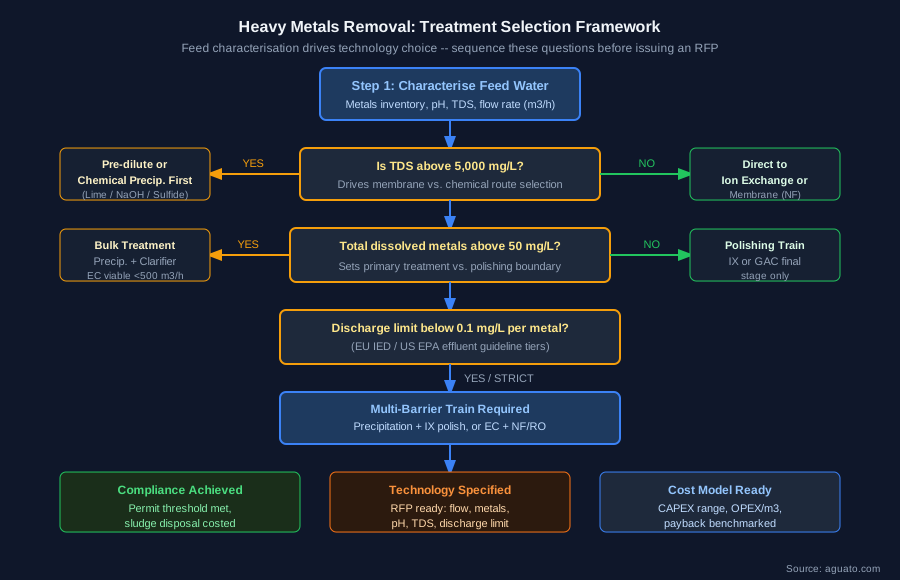
The framework above sequences these four decisions visually. The critical observation is that most facilities need a minimum of two stages: a primary removal stage and a polishing stage. The single-technology solution is an optimistic simplification that holds only for the most uniform, low-complexity streams. A [pfas removal water treatment](/resources/pfas-removal-water-treatment) parallel shows the same pattern: multi-barrier trains reliably outperform single-barrier solutions when permit limits are tight and feed variability is real.
The right question at the RFP stage is not "which technology removes heavy metals" but "which combination of technologies, operated in sequence, delivers permit compliance at the lowest 10-year lifecycle cost for this specific feed profile." That question eliminates most vendor-led single-technology proposals before they consume engineering time.
## CAPEX and OPEX: what heavy metals removal actually costs
Cost transparency is the single biggest gap in most heavy metals treatment procurement processes. Vendors quote equipment supply; buyers forget to cost installation, commissioning, civil works, reagents, sludge disposal, and membrane replacement. The lifecycle picture looks very different from the supply-chain picture.
| Cost Element | Chemical Precipitation | Ion Exchange | Membrane (NF/RO) | Electrocoagulation | |---|---|---|---|---| | CAPEX (small, 10 to 50 m3/h) | $50K to $250K | $100K to $400K | $200K to $600K | $100K to $350K | | CAPEX (medium, 50 to 300 m3/h) | $200K to $800K | $400K to $1.2M | $600K to $2.5M | $300K to $900K | | Reagent / consumable ($/m3) | $0.20 to $1.50 | $0.50 to $3.00 | $0.10 to $0.50 | $0.05 to $0.30 | | Energy ($/m3 at $0.10/kWh) | $0.01 to $0.05 | $0.02 to $0.10 | $0.15 to $0.40 | $0.05 to $0.20 | | Sludge / waste disposal ($/m3) | $0.10 to $0.80 | $0.05 to $0.30 | $0.10 to $0.50 | $0.08 to $0.40 | | Maintenance / labour ($/m3) | $0.05 to $0.20 | $0.10 to $0.30 | $0.10 to $0.30 | $0.05 to $0.20 | | Total OPEX range ($/m3) | $0.36 to $2.55 | $0.67 to $3.70 | $0.45 to $1.70 | $0.23 to $1.10 | | Typical payback vs. penalty avoidance | 1 to 3 years | 2 to 5 years | 3 to 7 years | 1 to 4 years |
A few observations the table cannot capture. First, the sludge disposal line item is the most volatile and the most frequently underestimated. Industrial sludge with cadmium or lead concentrations above 100 mg/kg is classified as hazardous waste (F006 or F019 under RCRA in the US; Annex III of the Basel Convention for cross-border disposal). Disposal costs vary from $80 per tonne in markets with established hazardous-waste infrastructure to $400 per tonne in markets without it. A site generating four tonnes per day of hazardous sludge in a high-cost disposal market pays $584,000 per year in disposal alone. Model this before finalising the technology choice.
Second, membrane costs are highly sensitive to pre-treatment quality. A well-pre-treated NF system on a metal finishing stream has a membrane replacement cycle of 5 to 7 years and a total lifecycle OPEX of $0.45 to $0.80 per m3. A poorly pre-treated system replaces membranes every 12 to 18 months, pushing OPEX above $1.50 per m3 and generating unplanned downtime that exposes the site to permit violations while the system is offline.
Third, [water treatment chemical companies](/water-treatment-chemical-companies) that supply precipitation reagents typically quote on spot or annual contracts. A fixed-price annual supply agreement locks in reagent cost and reduces OPEX variability -- worth negotiating upfront, particularly for sites where sodium sulfide or sodium metabisulfite (used in Cr VI reduction) constitutes more than 30% of total OPEX.
[cta:nepti]
## Where treatment systems fail and what it costs
The failure modes in heavy metals treatment follow identifiable patterns across sectors. Understanding them before specifying a system is the most direct way to avoid joining the statistics.
Failure 1: pH excursion in precipitation systems. Dissolved metal solubility is exponentially sensitive to pH in the precipitation window. A pH controller failure or reagent dosing interruption in a lime precipitation system targeting pH 9.5 can allow the pH to drift to 8.0, at which point zinc solubility increases from approximately 0.3 mg/L to 5 to 10 mg/L. If the failure persists for 12 hours before detection, a 100 m3/h system will have discharged an estimated 480 to 960 kg of zinc above the permit limit. The regulatory response to a discharge event of that scale typically involves a written notification requirement, a corrective action plan, and potential civil penalties of $10,000 to $50,000 per day of violation. Install redundant pH probes, automated reagent backup, and a high-pH alarm with automatic plant diversion as a first line of defence. The hardware cost is $5,000 to $15,000. The avoided penalty exposure is orders of magnitude higher.
Failure 2: IX resin fouling by iron or organic matter. Ion exchange resin lifetime is rated in regeneration cycles, not calendar years. A feed stream carrying dissolved iron above 0.5 mg/L will precipitate iron hydroxide within the resin bed, coating exchange sites and reducing capacity by 20 to 60% within 6 to 12 months. Organic matter at above 5 mg/L TOC fouls resin similarly. The symptom is an outlet concentration that slowly rises toward the permit limit despite normal regeneration cycles -- a pattern that operators often attribute to permit limit tightening rather than resin fouling. The correct diagnosis requires a resin capacity test. The correct fix is pre-treatment with iron removal (greensand filter or oxidation) and, where necessary, organic removal by GAC prior to the IX vessel.
Failure 3: Membrane concentrate with no disposal route. This failure mode is described above but deserves emphasis because it is so common and so expensive. A membrane system that works technically but generates a concentrate stream with no cost-effective disposal route eventually creates an operational crisis. Sites have been forced to install a second treatment train (typically precipitation) to treat the membrane concentrate at a cost of $150,000 to $600,000 -- an expenditure that could have been designed out with a 40-hour concentrate modelling exercise at the feasibility stage.
Failure 4: Adsorption media breakthrough without monitoring. An iron-oxide media bed for arsenic removal has a design capacity, and when that capacity is exhausted, arsenic passes through unimpeded. Without continuous or daily outlet monitoring, breakthrough can persist for weeks before a scheduled compliance sample detects it. In a mining wastewater application, arsenic breakthrough of 0.05 mg/L above a 0.01 mg/L permit limit over 30 days represents a reportable exceedance. The media change-out cost is $5,000 to $30,000. The regulatory and reputational cost of a 30-day violation is typically far higher.
Failure 5: Undersized clarifier during flow surges. Precipitation systems are designed for average flow. A production surge that doubles instantaneous flow through a clarifier halves the hydraulic retention time, increasing the turbidity of the overflow and carrying unsettled metal floc into the final effluent. This is predictable for batch-intensive operations (electroplating lines, batch reactors, rinse water systems) and should be modelled during design using maximum instantaneous flow, not average daily flow. A clarifier designed for average flow costs $40,000 to $120,000. A clarifier designed for peak flow costs $65,000 to $180,000. The incremental cost is $25,000 to $60,000. A single exceedance event requiring regulatory corrective action typically costs $50,000 to $200,000.
These failures share a root cause: technical specifications that meet average conditions rather than worst-case conditions, and monitoring programmes that detect problems after they have become compliance events rather than before. The [industrial wastewater treatment process](/resources/industrial-wastewater-treatment-process) literature is consistent on this point: the facilities with the best compliance records are those with the most conservative hydraulic designs and the most aggressive early-warning monitoring, not those with the most sophisticated technology.
The [EU Industrial Emissions Directive](dofollow:https://eur-lex.europa.eu/legal-content/EN/TXT/?uri=CELEX:32010L0075) (IED) and its associated Best Available Techniques Reference Documents (BREFs) require industrial operators to achieve associated emission levels (AELs) for heavy metals that increasingly reflect what the best-performing facilities in each sector have demonstrated is achievable, rather than what is merely average. This creates a ratchet effect: as frontier performance improves, the compliance floor rises, and facilities that specified to the old limit without headroom find themselves out of compliance on the next permit renewal.
## FAQ
### What is the most effective method for heavy metals removal from industrial wastewater?
No single method is universally most effective because performance depends on the metals present, their concentrations, feed TDS, flow rate, and discharge limits. For high-concentration mixed metal streams (above 50 mg/L total metals), chemical precipitation is the most cost-effective primary stage, removing 85 to 99% of dissolved metals at $0.20 to $1.50 per m3 OPEX. For polishing to sub-0.1 mg/L limits, ion exchange or adsorption media (iron-oxide for arsenic, selective chelating resins for Pb and Cd) are required as a second stage. Multi-barrier trains combining precipitation as a primary stage with IX or adsorption polishing deliver the most reliable compliance performance across variable inlet conditions.
### How much does heavy metals removal treatment cost to install?
CAPEX for a complete heavy metals removal system ranges from $50,000 to $600,000 for small installations (10 to 50 m3/h) up to $800,000 to $2.5 million for medium installations (50 to 300 m3/h), depending on technology choice, metals complexity, and pre-treatment requirements. Chemical precipitation systems occupy the lower end of the range; membrane systems (NF or RO) the upper end. These figures include equipment supply, civil works, electrical, and commissioning but not land, sludge disposal infrastructure, or operational training. Always include a 15 to 25% contingency for heavy metals projects because feed characterisation surprises during commissioning are common.
### What discharge limits apply to heavy metals in industrial wastewater?
Limits vary by jurisdiction, industrial sector, and receiving water body. US EPA effluent guidelines for metal finishing set total chromium at 0.33 to 2.77 mg/L and total zinc at 0.95 to 2.61 mg/L depending on flow category, with some state permits significantly stricter. The EU IED and associated BREFs set lead discharge levels of 0.01 to 0.05 mg/L for best-performing installations in sectors such as surface treatment and primary metals processing. For arsenic, the WHO drinking water guideline of 0.01 mg/L is increasingly used as the benchmark for industrial discharge into sensitive catchments. Any permit application should reference the most current sector-specific guideline, not a generic table, because AELs are being tightened on each renewal cycle.
### Can heavy metals be recovered and recycled from industrial wastewater?
Yes, and recovery is increasingly economically viable for copper, nickel, zinc, and precious metals at sufficiently high inlet concentrations. Ion exchange systems regenerated with acid eluent produce a concentrated metal salt solution that can be returned to a plating bath or sold to a metal reclaimer. Electrocoagulation sludge from copper-rich streams can be processed as secondary copper raw material if metal purity exceeds threshold levels. Recovery economics depend on metal price, concentration factor, and refinery acceptance specifications. At copper prices above $8,500 per tonne, a 50 m3/h electroplating IX system recovering 95% of dissolved copper from a 100 mg/L feed stream generates approximately $130,000 to $160,000 per year in recovered metal value, covering a significant portion of system OPEX.
### What is the difference between hexavalent and trivalent chromium treatment?
Hexavalent chromium (Cr VI) is a soluble oxyanion (chromate or dichromate) that carries high toxicity and is classified as a Group 1 carcinogen. It cannot be precipitated directly at the pH ranges used for other metals. It must first be chemically reduced to trivalent chromium (Cr III) using a reducing agent such as sodium metabisulfite or ferrous sulfate at pH 2.5 to 3.0. Trivalent chromium (Cr III) precipitates as chromium hydroxide at pH 8 to 9 and is orders of magnitude less toxic than Cr VI. Skipping the reduction step and relying on precipitation alone results in Cr VI passing through the treatment system in its fully soluble, fully toxic form. Any facility discharging chromium must verify the speciation of chromium in its feed water, not just the total chromium concentration.
### How do I know if my heavy metals treatment system is failing before it causes a permit exceedance?
Early warning requires a real-time monitoring programme at three points: the inlet (to detect load surges), the treatment system midpoint (pH and turbidity in a precipitation system, conductivity in an IX system), and the outlet (metal-specific sensors or daily grab samples, not just the quarterly compliance sampling schedule). The most common precursor to a compliance exceedance is a gradual drift in outlet concentration over days or weeks rather than a sudden spike. Continuous turbidity monitoring on clarifier overflow, pH trending on precipitation reactors, and resin capacity tracking on IX systems each catch the most frequent failure modes weeks before they become permit violations. Investing $15,000 to $40,000 in an online monitoring package avoids the $50,000 to $200,000 cost of a single corrective action event.
### Which industrial sectors have the highest risk from heavy metals in process water?
Metal finishing, electroplating, circuit board manufacturing (printed circuit boards use copper, tin, lead, gold, and nickel in process baths), primary metals smelting and refining, mining and mineral processing, battery manufacturing, pigment and coating production, and leather tanning are consistently the highest-risk sectors. Mining and mineral processing generate the largest volumes of heavy-metal-contaminated water, often as acid mine drainage carrying iron, zinc, copper, cadmium, and arsenic at concentrations of 10 to 10,000 mg/L. Electroplating and circuit board manufacture generate smaller volumes but often with more complex metal mixtures and stricter discharge limits because they typically discharge to municipal sewers with pretreatment requirements. Any operator in these sectors should have a current permit, a calibrated treatment system, and a documented monitoring programme as minimum operating standards.