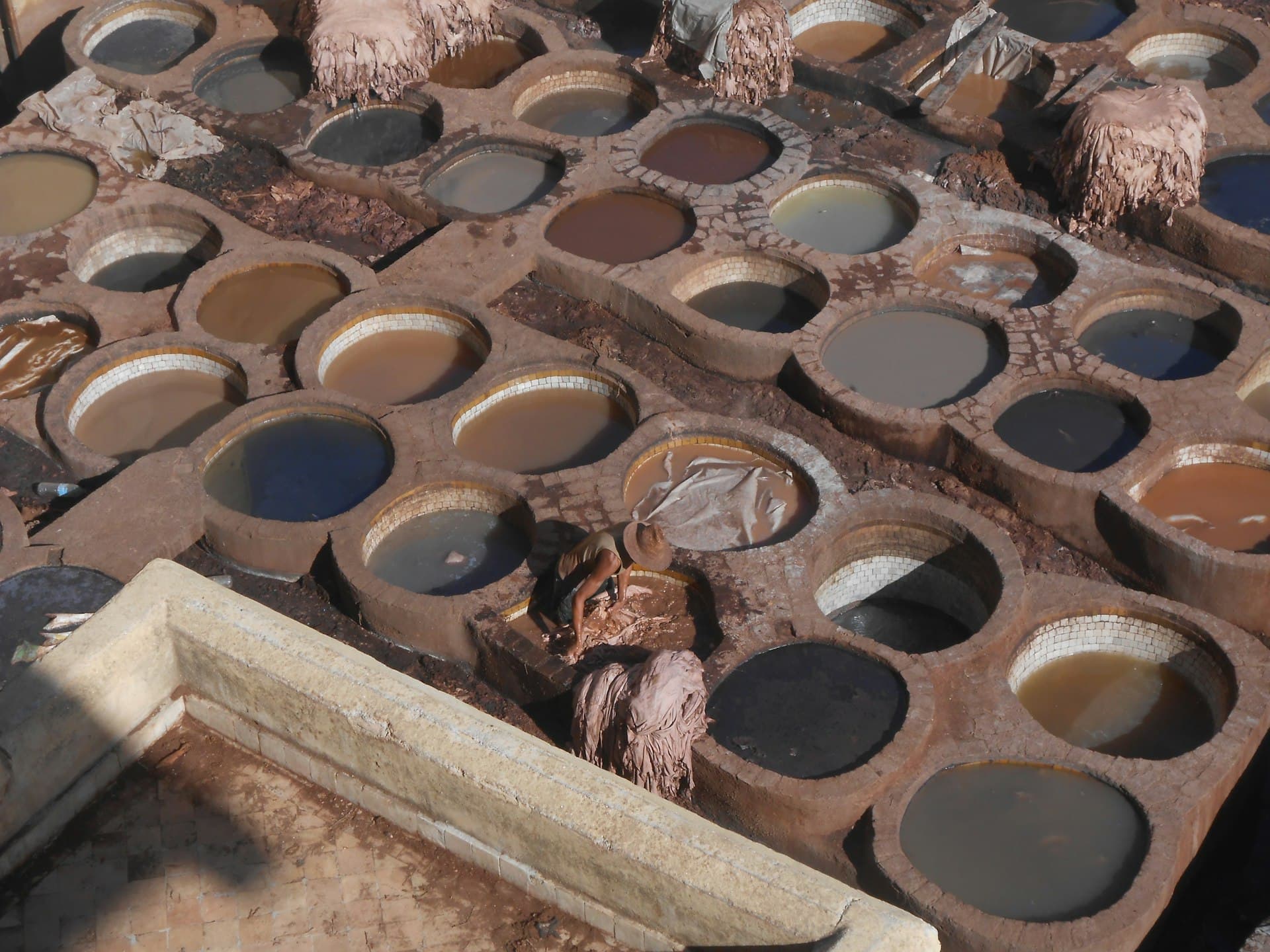
Mix your tannery streams instead of segregating them and you destroy chromium recovery, create a sulphide hazard, and push toward forced ZLD. Here is the segregation, recovery, and treatment strategy that keeps a tannery compliant, benchmarked against 17 published tannery treatment cases with real influent and effluent data.
Tannery wastewater is the hardest industrial effluent most engineers will ever design for, and the one where the cost of getting it wrong lands on the whole community downstream, not just the plant's P&L. A tannery that mixes its process streams instead of segregating them turns a manageable effluent into a toxic, high-salinity, [chromium](/elements/chromium)-bearing waste that costs USD 2 to 6 per cubic metre to treat and generates a hazardous sludge nobody wants, when a segregated approach would have cut both the treatment cost and the sludge volume by 30 to 50% and recovered the chromium as a reusable raw material. The leather industry is under regulatory pressure almost everywhere it operates, and the difference between a tannery that survives the next consent review and one that gets a closure notice is, more often than not, the wastewater specification chosen at the design stage.
This guide is written for the people who carry the tannery effluent decision: plant managers running a tannery under tightening discharge limits, procurement and technical teams scoping a treatment plant against vendor proposals, sustainability leads trying to reconcile the operation with ESG and brand-led chemical-management commitments, and cluster operators running a common effluent treatment plant for a tannery zone. It covers what makes tannery effluent uniquely difficult, why stream segregation is the whole game, the chromium recovery decision, the treatment train that actually works, the failure modes that produce closure notices, and what the numbers look like in real ranges.
## The decision in brief
- Segregate the chrome, sulphide and general streams at source. With chromium recovered rather than landfilled in the sludge and the salinity load tackled before it reaches the effluent, you avoid the two most expensive outcomes in tannery wastewater. - Price the retrofit and the forced ZLD march. The first is a USD 400K to 1.2M retrofit to fix a mixed-stream plant after the first serious exceedance, and the second is the multi-million-dollar forced march to zero liquid discharge that a high-salinity discharge plant invites from a tightening regulator. - Treat the treatment cost as known. It runs USD 1.50 to 7.00 per cubic metre depending on the configuration and whether ZLD is mandated, and a mixed-effluent plant is pushed toward the expensive end of that table for its entire life.
The cost of doing nothing is running a mixed-effluent plant because it was cheaper to build, a decision that foreclosed chromium recovery and created a sulphide safety hazard.
## What makes tannery wastewater uniquely difficult
Tannery wastewater is difficult because it combines almost every contaminant class that makes an effluent hard to treat, in a single waste stream, at high concentration. A typical tannery effluent carries high organic load (COD of 3,000 to 8,000 mg/L or more), extreme salinity (TDS often above 20,000 mg/L from the salt used to preserve raw hides), sulphide (from the liming and unhairing process, which generates toxic hydrogen sulphide gas if the stream goes acidic), chromium (from the dominant chrome-tanning process), ammonia and organic nitrogen, high and variable pH, and a heavy suspended-solids and grease load. No other common industrial effluent stacks this many problems at once. The [IFC environmental, health, and safety guidelines for tanning and leather finishing](dofollow:https://www.ifc.org/en/insights-reports/2000/tanning-and-leather-finishing) set out the contaminant profile and the pollution-prevention expectations that lenders and many regulators apply to the sector, and they are the reference a tannery project should design against rather than a vendor's generic effluent assumption.
The salinity alone disqualifies many standard treatment approaches. Biological treatment, the workhorse of most effluent plants, is inhibited at the salinity levels tannery effluent reaches, so the biology has to be either salt-adapted or protected by upstream desalination, and neither is cheap. The sulphide is a safety hazard before it is a treatment problem: mixing the alkaline sulphide-bearing liming stream with an acidic stream releases hydrogen sulphide, a gas that has killed tannery workers. And the chromium is both a treatment problem and a recoverable asset, which is what makes the segregation decision so consequential.
An opinionated view that holds across every tannery project: the single biggest determinant of a tannery effluent plant's cost and compliance is not the treatment technology, it is whether the process streams were segregated at source. A tannery that combines all its streams into a single mixed effluent has thrown away the chromium recovery value, created a sulphide safety hazard, and made the salinity and load harder to manage, all before the treatment plant sees a drop. Segregation is a process-engineering and plumbing decision made inside the tannery, and it determines whether the downstream plant has a manageable problem or an intractable one. This is a more specialised version of the discipline that governs any [industrial wastewater treatment](/resources/industrial-wastewater-treatment) project.
[cta:nepti-dark]
The corollary is that a tannery effluent plant cannot be specified from a single mixed-effluent sample. It must be specified from a characterisation of each segregated stream, because the streams are treated differently and the whole plant architecture follows from how they are separated and combined. The next section maps where the load comes from.
## The contaminant map: where the load comes from
Tannery processing is a sequence of distinct operations, and each one produces a characteristic waste stream. Understanding which operation produces which contaminant is the foundation of the segregation strategy, because you cannot segregate streams you have not mapped.
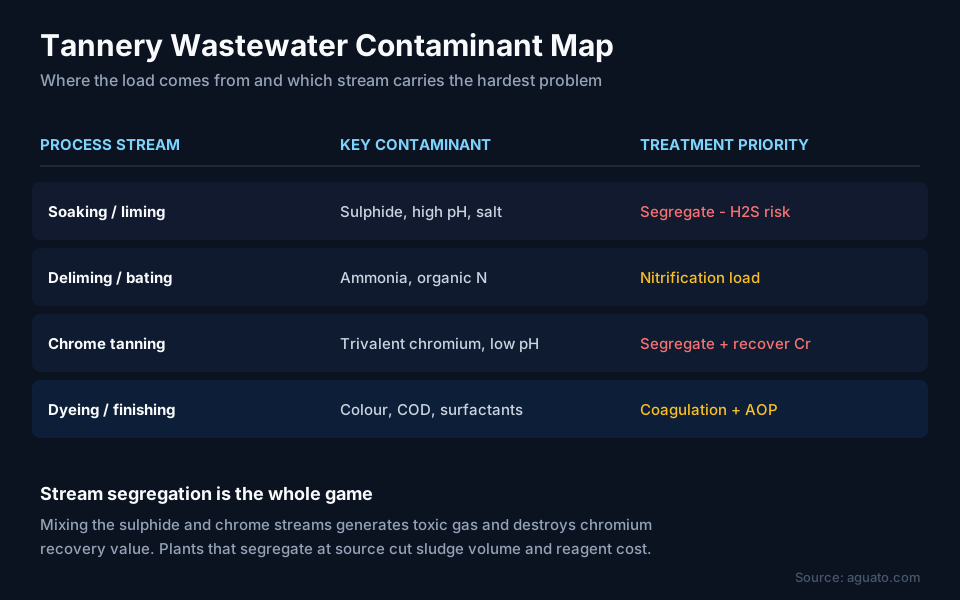
Soaking and liming produces the sulphide and salinity load. Soaking rehydrates the salted hides, releasing the preservation salt as a high-TDS stream. Liming and unhairing use lime and sodium sulphide to remove hair and open the hide structure, producing a strongly alkaline stream rich in sulphide, organic [nitrogen](/elements/nitrogen), and suspended solids. This is the stream that must never be allowed to go acidic in an uncontrolled way, because of the hydrogen sulphide risk, and it is the highest-priority stream for segregation and dedicated treatment.
Deliming and bating uses ammonium salts and enzymes to neutralise the limed hide and prepare it for tanning. This stream carries the ammonia and organic nitrogen load, which becomes a nitrification burden on the biological stage downstream.
Tanning (predominantly chrome tanning, using basic chromium sulphate) produces the chromium-bearing stream. This is an acidic stream containing trivalent chromium, and it is both the most regulated contaminant in the whole effluent and the most valuable recoverable material. Segregating this stream is what makes chromium recovery possible.
Dyeing and finishing produces the colour, residual COD, surfactant, and fatliquor load. This stream needs coagulation and often advanced oxidation to meet a colour limit, and it carries the synthetic chemicals that brand-led restricted-substance programmes increasingly scrutinise.
The map makes the strategy obvious: the sulphide stream and the chromium stream are the two that most need segregation, because mixing them with the rest creates a safety hazard and destroys recovery value respectively. The dyeing and bating streams can often be combined and treated together. A plant designed around this map is fundamentally cheaper and safer than one designed around a single mixed effluent.
## Benchmarks from 17 published tannery treatment cases
The guide promised real ranges, so here is what the data shows. These numbers come from a corpus of 17 published tannery treatment cases that Aguato has transcribed from peer-reviewed journals and delivered-project reports, each with paired influent and effluent measurements and the actual treatment train, spanning 10 countries. Roughly 60% sit at documented tier, meaning the full influent-to-effluent vector was read from the source table rather than a summary.
The parameters with enough data to report across the corpus are COD, BOD, suspended solids, total chromium, and total nitrogen (concentrations in mg/L):
| Parameter | Influent median | Influent p90 | Effluent median | Median removal | |---|---|---|---|---| | COD | 2,060 | 9,511 | 369 | 80.2% | | BOD | 943 | 4,377 | 309 | 80.3% | | TSS | 1,178 | 1,944 | 92 | 93.3% | | Total chromium | 27 | 106 | 1.0 | 95.1% | | Total nitrogen | 289 | 863 | 78 | 61.9% |
Chromium is the parameter treatment removes most reliably: a median 95.1% removal, taking a median 27 mg/L down to about 1 mg/L. That is the reassuring number. The uncomfortable ones are the organics and the nitrogen. COD and BOD median removal is only about 80%, and the median effluent COD of 369 mg/L still sits above many discharge consents, which is why a tertiary stage is common on a tannery rather than optional. Total nitrogen is the laggard at 62% median removal, because the ammonia and organic-nitrogen load from deliming and bating is heavy and biology struggles with it at tannery salinity.
Two honest caveats this corpus forces. First, the often-quoted "TDS above 20,000 mg/L" is the raw salted-soak stream, not the combined effluent: the combined and treated effluent in this corpus runs from a few hundred to about 5,900 mg/L TDS, which is why salinity is a segregation-and-source-reduction problem more than an end-of-pipe one. Second, this corpus measures chromium *removal*, not chromium *recovery*. Not one of these cases is a precipitate-and-redissolve recovery plant returning chrome to the tanning bath, which is the upstream process the next sections cover. End-of-pipe numbers show the chromium leaving the water; they do not show it coming back as a raw material. For the sector view, providers that build these trains are listed under [tannery and leather water treatment suppliers](/industries/leather-tanning).
### Real installations, with the numbers and the train
Every row is a real facility with a published source in the Sources section. Concentrations in mg/L; the train reads in treatment order. Pilots are labelled.
| Plant, country | Scope | Train | Headline result | |---|---|---|---| | Tannery WWTP, Addis Ababa, Ethiopia | full-scale | Equalisation, sulphide oxidation, aerobic, coagulation | COD 2,100 to 1,070; Cr 37 to 4.8; sulphide 191 to 58 | | Tannery WWTP, Barquisimeto, Venezuela | full-scale | Sequencing-batch reactor, nutrient removal, coagulation | COD 1,546 to 303; TN 200 to 35; ammonia 121 to 0.5 | | Tannery cluster CETP, Kanpur, India | 36,000 m3/day | Common-effluent anaerobic (UASB) plant | serves a whole tannery zone; sulphate and sulphide the standing concern | | Anaerobic, aerobic and wetland (pilot), Modjo, Ethiopia | pilot | Anaerobic, aerobic, constructed wetland | COD 12,548 to 395; Cr 27 to 0.95 | | Nanofiltration polishing (pilot), Italy | pilot | Physico-chemical, nanofiltration | COD 2,020 to 102; Cr 195 to 7.9 |
The Addis Ababa works is the segregation architecture the next section prescribes, built: a dedicated sulphide-oxidation stage ahead of the biology drops sulphide from 191 to 58 mg/L and takes chromium to 4.8 and ammonia to 1.4, but COD only reaches 1,070 mg/L, which is the honest signal that a tannery general stream needs a tertiary stage to clear a tight consent. The Kanpur CETP is the real version of the tannery-cluster common plant the failure section warns about, a 36,000 m3/day shared works whose performance is only ever as good as its worst member's discharge discipline. The two pilots bracket what is achievable: an anaerobic, aerobic and wetland train in Modjo took a very high-strength stream (COD 12,548) down to 395 mg/L and chromium to 0.95, and nanofiltration in Italy took chromium from 195 to 7.9, but both are pilots, and neither is chromium recovery.
Nepti benchmarks your own tannery numbers against this corpus. [Model your segregated streams and see where they sit against the real-plant distribution in Nepti](/nepti) before you accept a bidder's performance guarantee.
## Stream segregation: the decision that defines the whole plant
Stream segregation is the highest-leverage decision in tannery effluent treatment, and it is made inside the tannery, in the plumbing and process layout, not in the treatment plant. A tannery that segregates its streams at source can recover chromium, manage sulphide safely, and treat each stream with the right process. A tannery that combines everything into one mixed effluent has foreclosed all three options before the treatment plant is even designed.
The segregation strategy that works on most tanneries separates three streams. The chrome stream (from tanning) is collected separately so the chromium can be recovered. The sulphide stream (from liming and unhairing) is collected separately so the sulphide can be oxidised or recovered under controlled conditions, eliminating the hydrogen sulphide hazard. The general stream (soaking, deliming, bating, dyeing, finishing, and washes) is combined and treated together through the main biological and physico-chemical train.
The cost of segregation is modest: it is largely a matter of separate drainage, collection sumps, and discipline in the process operation. The cost of not segregating is large and compounds: lost chromium recovery (a recurring raw-material cost and a hazardous-sludge disposal cost), a permanent hydrogen sulphide safety risk, a harder-to-treat mixed effluent with worse salinity and load characteristics, and a larger, more expensive treatment plant. Segregation is the single best return on investment in the entire tannery effluent system.
The discipline that segregation demands is operational, not just engineering. The streams have to be kept separate in daily operation, which means the tannery floor has to be laid out and operated so that the chrome and sulphide streams actually go to their dedicated collection points rather than to the general drain. A segregation system that exists on the drawings but is bypassed in practice delivers none of the benefit, which is why segregation is as much a management and training question as a plumbing one. The same operational-discipline principle governs how a [common effluent treatment plant](/effluent-treatment-plants) survives the discharge behaviour of its member units.
## Chromium recovery vs disposal
The chromium decision is the one that most clearly separates a modern, defensible tannery from a liability waiting for a closure notice, and it follows directly from segregation.
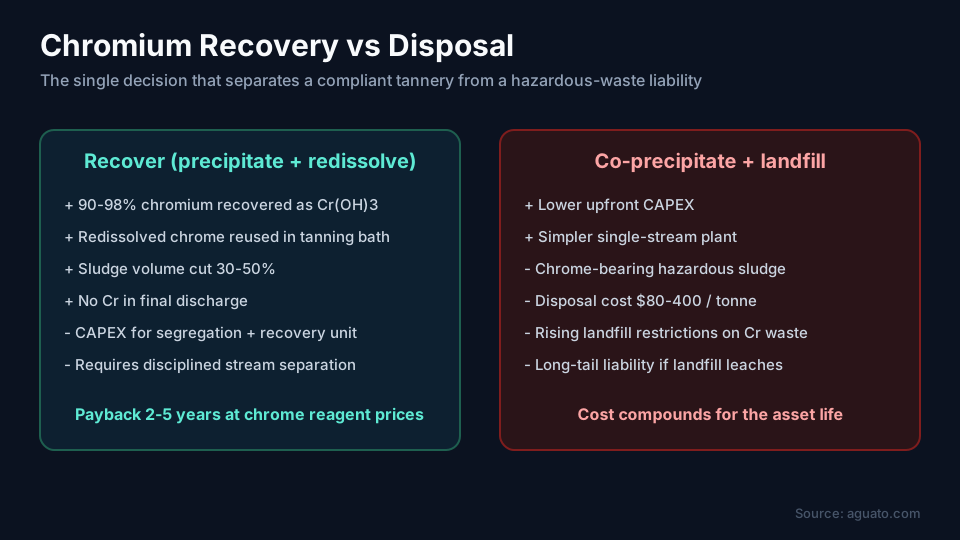
Chromium recovery takes the segregated chrome stream, precipitates the chromium as chromium hydroxide by raising the pH, then redissolves the precipitate in sulphuric acid to regenerate a basic chromium sulphate solution that can be reused in the tanning bath. The recovery efficiency is high, typically 90 to 98%, which cuts the chromium raw-material cost, eliminates chromium from the final discharge, and dramatically reduces the volume of hazardous chromium-bearing sludge. The trade-off is the capital cost of the recovery unit and the operational discipline to keep the chrome stream segregated.
Chromium co-precipitation and disposal is the alternative: the chromium is precipitated along with the rest of the suspended solids in the general treatment train and ends up in the sludge, which then has to be managed as a hazardous waste because of its chromium content. This is simpler and cheaper to build, but it carries chromium into the sludge at every step, producing a hazardous-waste stream that costs USD 80 to 400 per tonne to dispose of, attracts tightening landfill restrictions on chromium-bearing waste, and leaves a long-tail liability if the landfill ever leaches. The cost of this path compounds for the entire asset life.
The decision rule that holds: if the tannery operates at any meaningful scale and the chrome stream can be segregated, recovery almost always wins on lifecycle cost, typically paying back the recovery-unit capital in two to five years on chromium reagent savings alone, before counting the avoided hazardous-sludge disposal cost. The disposal path only makes sense for very small operations where the recovery-unit capital cannot be justified, and even there the rising regulatory pressure on chromium waste is closing that window. Recovering the chromium also removes the single contaminant that regulators pursue most aggressively, because [heavy metals removal](/resources/heavy-metals-removal-water) is enforced with the least tolerance of any discharge parameter. The [UN Industrial Development Organization guidance on chrome management in tanneries](dofollow:https://www.unido.org/our-focus-safeguarding-environment-resource-efficient-and-low-carbon-industrial-production/leather-and-leather-products-industry) documents the recovery techniques and the case for them, and it remains the most-cited technical reference for tanneries weighing recovery against disposal. Beyond the lifecycle cost, the recovery decision increasingly carries brand and supply-chain weight: footwear and apparel buyers running restricted-substance and chemical-management programmes are now asking their tannery suppliers to demonstrate chromium recovery and discharge compliance as a condition of the order, which turns what was a pure cost decision into a market-access one.
## The treatment train that actually works
With the streams segregated and the chromium recovered, the general stream still needs a complete treatment train to meet the discharge consent, and the train has to handle the salinity, sulphide residuals, COD, colour, and nutrients that remain.
Sulphide treatment comes first on the liming stream: catalytic oxidation (using manganese sulphate catalyst and aeration) converts the sulphide to sulphate, eliminating the hydrogen sulphide hazard before the stream joins the general treatment. This step is non-negotiable for worker safety as well as treatment.
Physico-chemical primary treatment on the general stream uses coagulation and flocculation followed by sedimentation or dissolved air flotation to remove suspended solids, a large fraction of the COD, and the grease and fatliquor load. The [coagulation and flocculation step](/resources/electrocoagulation-vs-chemical-coagulation) is particularly important on tannery effluent because the high suspended-solids and grease load would otherwise overwhelm the biology, and the choice between chemical and electrochemical coagulation matters on this variable feed.
Biological treatment removes the dissolved organic load and the ammonia. This is where the salinity bites: standard activated sludge is inhibited at high TDS, so the biology must be either salt-adapted (acclimatised to operate at elevated salinity) or the salinity must be reduced upstream. Extended-aeration activated sludge and salt-tolerant biological systems are the common choices, and the nitrification stage has to handle the ammonia load from the deliming and bating streams.
Tertiary polishing handles the residual colour and recalcitrant COD that the biology leaves behind. Advanced oxidation processes, activated carbon, or membrane polishing are used depending on the discharge limit, and the [advanced oxidation process](/advanced-oxidation-processes-companies) stage is often what gets a colour-bearing tannery effluent over the line on a tight consent. The [industrial wastewater treatment process](/resources/industrial-wastewater-treatment-process) sequence here mirrors a general effluent plant but with the salinity and sulphide complications layered on top.
## Salinity, TDS, and the zero liquid discharge question
Salinity is the contaminant that pushes many tanneries toward zero liquid discharge, whether they want it or not. The salt load from hide preservation produces a TDS that conventional biological and physico-chemical treatment does not remove, and in many jurisdictions, particularly in the major leather-producing regions of South Asia, regulators have responded by mandating zero liquid discharge for tannery clusters.
Zero liquid discharge on a tannery effluent means concentrating the salt-laden stream by reverse osmosis and then evaporation and crystallisation to a solid salt residue, recovering the water for reuse. This is expensive, often several times the cost of a discharge plant per cubic metre, and the recovered salt is usually a mixed, contaminated salt with little commodity value, which then becomes its own disposal problem. The [World Health Organisation and FAO guidance on safe wastewater reuse](dofollow:https://www.who.int/publications/i/item/9789241549950) frames the water-recovery side of the ZLD case, and it is the standard a reuse-grade tannery discharge has to meet before the recovered water can go back into any non-process application. The economics of tannery ZLD rarely close on the recovered-water value alone; they close because the regulatory alternative is no operating permit. The [zero liquid discharge versus minimal liquid discharge comparison](/resources/zld-vs-mld-cost-comparison) lays out where a minimal-liquid-discharge approach can be the defensible middle path that meets the regulatory intent at lower cost.
The strategic implication is that salinity reduction at source is worth pursuing aggressively, because every kilogram of salt that does not enter the effluent is a kilogram that does not have to be crystallised. Reducing the salt load on raw hides (through alternative preservation methods or desalting before processing) is the upstream lever that makes the whole salinity problem smaller, and it is consistently undervalued because it sits in the procurement and process domain rather than the effluent-treatment domain. The most effective tannery effluent strategies start before the hide is even wetted.
## Capital and operating cost ranges
The table below gives realistic ranges for tannery effluent treatment across the common configurations. Figures are indicative and exclude land, and they assume stream segregation, because a non-segregated plant's costs are both higher and less predictable.
| Configuration | Scope | Capex per m3/day | OPEX per m3 | Main risk | |---|---|---|---|---| | Basic discharge | Segregation + physico-chem + biology | $1,200 to $2,500 | $1.50 to $3.00 | Salinity inhibition, sulphide | | Discharge + Cr recovery | Above + chromium recovery unit | $1,500 to $3,200 | $1.20 to $2.80 | Segregation discipline | | Tight consent + colour | Above + advanced oxidation tertiary | $2,200 to $4,500 | $2.20 to $4.00 | Recalcitrant colour, COD | | Zero liquid discharge | Above + RO + evaporation + crystalliser | $4,000 to $9,000 | $3.50 to $7.00 | Salt disposal, energy cost |
The operating cost is dominated by chemicals (coagulants, the sulphide oxidation catalyst, pH control across the highly variable pH streams), energy (aeration and, on ZLD plants, evaporation), and sludge and salt disposal. The chromium recovery unit reduces operating cost despite adding capital, because the recovered chromium offsets a recurring raw-material purchase and the hazardous-sludge volume falls.
The single largest cost-avoidance lever is the one that does not appear in the table: stream segregation and salinity reduction at source. A tannery that gets these right can sit in the lower configurations; a tannery that does not is pushed toward the expensive end, often all the way to ZLD, by its own un-segregated, high-salinity mixed effluent.
## Failure scenarios and what they cost
The mixed-stream plant. A tannery combines all its process streams into a single mixed effluent and builds a treatment plant around it. The chromium ends up in the sludge, making it hazardous waste; the sulphide creates an ongoing safety hazard and odour problem; and the salinity inhibits the biology, so the plant struggles to meet its COD consent. The retrofit to segregate streams and add chromium recovery on an operating plant costs USD 400,000 to 1.2 million, far more than designing it in from the start. The fix was segregation at the design stage.
The hydrogen sulphide incident. A plant without proper sulphide stream management allows an acidic stream to contact the alkaline sulphide stream, releasing hydrogen sulphide. In the worst cases this has been fatal to workers; in the lesser cases it produces a regulatory and safety investigation, a shutdown, and a mandated redesign. The cost is measured in human terms first and in hundreds of thousands of dollars second. The fix is segregated collection and catalytic sulphide oxidation, which is standard practice but is skipped on under-engineered plants.
The closure notice from salinity. A tannery in a region moving toward mandatory ZLD designs a conventional discharge plant that meets COD and chromium limits but discharges high TDS. The regulator, as part of a cluster-wide policy, refuses to renew the discharge consent and mandates ZLD. The tannery has to retrofit reverse osmosis, evaporation, and crystallisation at a cost of several million dollars, on a compressed timeline, or shut down. The fix was to anticipate the regulatory direction of travel and design for salinity from the start.
The colour exceedance. A tannery meets its COD and chromium limits but breaches a colour limit because the dyeing-stream colour load was not adequately treated. Colour is increasingly a hard discharge limit, and the biology does not remove it. The retrofit of an advanced oxidation tertiary stage costs USD 300,000 to 700,000. The fix was to characterise the colour load and include tertiary treatment in the original design.
## Real-world examples across three contexts
Full-scale works with sulphide-first architecture: a tannery WWTP in Addis Ababa, Ethiopia. The plant runs the segregation architecture this guide prescribes: a dedicated sulphide-oxidation stage ahead of the biology, then aerobic treatment and coagulation. It drops sulphide from 191 to 58 mg/L, takes chromium from 37 to 4.8, and cuts ammonia from 32 to 1.4, but its COD reaches only 1,070 mg/L from a 2,100 mg/L influent. The lesson is that a well-built biological tannery works handles the sulphide hazard and the metals, but the tannery organic load needs a tertiary stage on top to clear a tight consent, and a plant specified without one will meet its chromium limit and miss its COD limit.
The cluster common-effluent plant: the Kanpur tannery zone, India. A 36,000 m3/day common effluent treatment plant serves a whole tannery cluster, and its documented standing problem is exactly the one the failure section warns about: sulphate and sulphide loads carried through the shared plant, driven by member tanneries whose discharge discipline the operator has to enforce. The lesson is that a shared tannery plant is only ever as robust as its worst member's stream, so member-level segregation and pre-treatment standards are not administrative niceties, they are the design basis of the shared works.
Metals removal is not the whole battle: an electrocoagulation and ozonation pilot in Lima, Peru. On a very high-strength stream, electrocoagulation followed by ozonation drove chromium from 108 down to 0.24 mg/L, essentially eliminating it, while COD fell only from 5,608 to 3,481 mg/L. The lesson, from a real pilot on real tannery effluent, is that metals removal and organics removal are separate battles: a process tuned to strip chromium to trace levels can still leave most of the COD behind, so the train has to be designed for the binding organic parameter as deliberately as for the metal.
## Sources
The plant benchmarks and case studies in this guide are drawn from Aguato's tannery reference corpus of published treatment studies. Featured facilities:
- Tannery WWTP, Addis Ababa, Ethiopia: [study (2021)](https://pmc.ncbi.nlm.nih.gov/articles/PMC8246915/) - Tannery cluster CETP, Kanpur, India: [IJRASET (2018)](https://doi.org/10.22214/ijraset.2018.5343) - Anaerobic, aerobic and wetland pilot, Modjo, Ethiopia: [study (2014)](https://pmc.ncbi.nlm.nih.gov/articles/PMC4277355/) - Electrocoagulation and ozonation pilot, Lima, Peru: [study (2025)](https://pmc.ncbi.nlm.nih.gov/articles/PMC12282864/) - Nanofiltration polishing pilot, Italy: [Membranes 3(3):126 (2013)](https://doi.org/10.3390/membranes3030126)
The Barquisimeto tannery WWTP (Venezuela) is drawn from a peer-reviewed journal in the same corpus.
## FAQ
### Why is tannery wastewater so difficult to treat?
Tannery effluent combines almost every contaminant class that makes a wastewater hard to treat in a single high-concentration stream: high organic load (COD of 3,000 to 8,000 mg/L or more), extreme salinity (TDS often above 20,000 mg/L from hide-preservation salt), toxic sulphide from liming, chromium from tanning, ammonia and organic nitrogen, high and variable pH, and a heavy suspended-solids and grease load. The salinity inhibits standard biological treatment, the sulphide is a worker safety hazard, and the chromium is both a regulated contaminant and a recoverable asset.
### What is stream segregation and why does it matter for tanneries?
Stream segregation means keeping the chrome-tanning stream, the sulphide-bearing liming stream, and the general process stream separate at source rather than combining them into one mixed effluent. Segregation makes chromium recovery possible, lets the sulphide be oxidised safely, and produces a more treatable general stream. It is the single highest-leverage decision in tannery effluent treatment because it is made inside the tannery and determines whether the downstream plant has a manageable problem or an intractable one.
### Should a tannery recover or dispose of chromium?
For any tannery at meaningful scale that can segregate its chrome stream, recovery almost always wins. Chromium recovery precipitates the chromium as hydroxide, redissolves it, and returns it to the tanning bath at 90 to 98% efficiency, cutting reagent cost, eliminating chromium from the discharge, and reducing hazardous-sludge volume. It typically pays back the recovery-unit capital in two to five years on reagent savings alone. Disposal (co-precipitating chromium into the sludge) is simpler to build but produces a hazardous waste costing $80 to $400 per tonne with a long-tail liability.
### How much does a tannery effluent treatment plant cost?
Capital cost ranges from roughly $1,200 to $2,500 per cubic metre per day of capacity for a basic segregated discharge plant, up to $4,000 to $9,000 per cubic metre per day for a full zero-liquid-discharge configuration. Operating cost ranges from $1.50 to $7.00 per cubic metre, dominated by chemicals, energy (aeration and, on ZLD plants, evaporation), and sludge and salt disposal. Stream segregation and salinity reduction at source are the largest cost-avoidance levers.
### Why are tanneries being pushed toward zero liquid discharge?
Tannery effluent carries a high salt load (TDS often above 20,000 mg/L) from hide preservation that conventional biological and physico-chemical treatment does not remove. In major leather-producing regions, particularly South Asia, regulators have responded to the resulting salinity pollution by mandating zero liquid discharge for tannery clusters. The economics of tannery ZLD rarely close on recovered-water value alone; they close because the regulatory alternative is loss of the operating permit. Reducing the salt load at source makes the ZLD burden smaller.
### Can vegetable-tanned leather avoid wastewater problems?
No. Vegetable tanning avoids chromium, which removes the heavy-metal contaminant and the associated recovery and disposal question, but it produces a high-COD, high-tannin effluent that is partly recalcitrant and difficult to treat biologically. Vegetable-tannery effluent typically needs anaerobic pre-treatment, aerobic polishing, and an advanced oxidation tertiary stage to meet colour and COD limits, often at a higher unit treatment cost than a chrome tannery's general stream. Avoiding chromium does not make tannery effluent easy.