WaaS converts a $400K capital asset into a predictable monthly fee of $8K to $22K, transferring compliance risk and tech lifecycle to the provider. Here is when it wins and when it does not.
Water treatment equipment sits on most industrial balance sheets as a depreciating asset, but the water it produces is rarely the core competency of the company that owns it. A $400,000 reverse osmosis system installed for a food processing plant in 2019 now faces $180,000 in mid-life membrane replacement, a new PFAS discharge permit condition the original design never anticipated, and a single specialist on staff who is three months from retirement. That combination of stranded capital, regulatory drift, and operational fragility is exactly the context in which water as a service waas was designed to compete.
WaaS inverts the traditional model. Instead of buying equipment and managing it yourself, you pay a monthly or volumetric fee for treated water delivered to a guaranteed quality specification. The provider owns the asset, handles chemistry, maintains compliance, and absorbs the upgrade cycle. The business case looks compelling on paper. The reality is more conditional than the sales pitch suggests, and the contracts are longer and stickier than most procurement teams appreciate before signing.
This article covers what WaaS actually is, how the financial structure compares to capital ownership across a 15-year horizon, the operational scenarios where it genuinely wins, the contractual traps that erode the promised savings, and a decision framework for choosing the right model for your site. It is written for plant managers evaluating OPEX alternatives, procurement leads building the case for the CFO, and sustainability directors who need water performance guarantees at scale.
## The decision in brief
- Switch if you fit the tenure and CAPEX band. If your site falls in the 5 to 10 year tenure band and your water treatment CAPEX exceeds $350,000, switching to a WaaS model eliminates the upfront capital outlay entirely. - Convert the obligation to a predictable monthly expense. For a site in that band, the WaaS model converts the treatment obligation to a predictable monthly expense of $9,000 to $18,000 in place of the upfront capital outlay. - Insist on a performance remedy clause. A well-structured WaaS contract with a performance remedy clause is the most direct financial hedge against both exposures: the Clean Water Act penalty and the production shutdown tied to out-of-spec water.
The biggest cost of doing nothing is a compliance event: up to $37,500 per day for a Clean Water Act violation, and routinely $50,000 to $250,000 per out-of-spec shutdown at pharmaceutical or food processing facilities.
## What Water-as-a-Service Actually Is
Water-as-a-Service is a contractual model in which a provider installs, owns, operates, and maintains a water treatment system on a customer's premises in exchange for a recurring fee tied to volume delivered, quality achieved, or both. The customer pays for the output, not the asset. Regulatory responsibility, chemistry management, and equipment lifecycle risk transfer from the buyer to the provider under a service-level agreement.
The model is not new. Industrial outsourcing of utilities goes back decades in compressed air, steam, and nitrogen supply. What has changed is that WaaS has moved from niche desalination contracts at remote mining and offshore sites into mainstream pharmaceutical, food and beverage, semiconductor, and municipal reuse projects. The driving force is a convergence of tighter discharge regulations, rising CAPEX approval thresholds (many industrial companies now require board-level sign-off on anything above $500,000), and the growing complexity of treatment trains that combine membrane filtration, electrodeionization, and advanced oxidation in sequences that few in-house teams can manage without expensive specialist hires.
The providers range from global water majors (Veolia, SUEZ, Xylem) to specialist membrane finance houses and regional equipment OEMs that have pivoted toward managed-service contracts. Pricing structures vary: the most common are (a) a fixed monthly availability fee plus a variable volumetric rate per cubic meter treated, (b) a pure volumetric rate with a minimum take-or-pay floor, and (c) a performance-bond structure where the fee steps up or down depending on whether the output hits quality targets.
## How the Financial Structure Works
Under capital ownership, the entire treatment system hits the balance sheet as a fixed asset, depreciated over 10 to 20 years depending on the jurisdiction and asset class. Maintenance, chemicals, energy, and labor sit in OPEX but are unpredictable, spiking in years where membranes foul heavily or a control system requires emergency replacement. Total cost of ownership for a mid-size industrial RO system typically runs $85,000 to $140,000 per year once chemicals, labor, and reactive maintenance are included alongside depreciation.
Under WaaS, the customer converts all of that into a single predictable monthly line item. A typical mid-size industrial WaaS contract for 50 to 200 m3/day capacity runs $8,000 to $22,000 per month ($96,000 to $264,000 per year), inclusive of chemicals, maintenance, and performance guarantee. The unit rate commonly lands at $1.80 to $4.50/m3 for treated water meeting pharmaceutical or food-grade quality, and $0.90 to $2.20/m3 for industrial-grade output. Those ranges are wider than most providers quote upfront. The final rate depends heavily on feed water TDS, required output quality, and site remoteness.
The balance-sheet effect matters to CFOs. Under IFRS 16 and ASC 842, a WaaS contract with a term above 12 months and identifying a specific asset is likely a right-of-use lease, meaning it will still appear on the balance sheet as a liability. Procurement teams that pitch WaaS as purely off-balance-sheet need to run this past their finance team before committing. The accounting treatment does not eliminate the financial logic, but it does change the narrative.
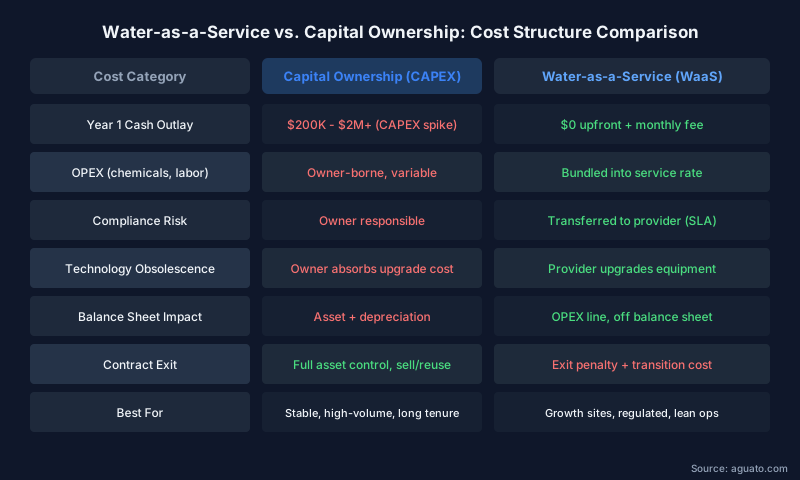
A pattern that recurs in industrial installations is the mismatch between the quoted WaaS rate and the all-in cost once take-or-pay minimums, mobilization fees, demobilization clauses, and chemistry exclusions are accounted for. The $1.80/m3 headline rate for a pharmaceutical ultrapure water contract consistently lands at $2.80 to $3.60/m3 once the contract is fully modeled. That is still competitive against ownership on a short to mid-duration site, but the gap between headline and all-in is wide enough that procurement teams need to model the full contract, not just the per-unit rate.
## When WaaS Wins: The Five Scenarios Where It Outperforms Ownership
Not every site benefits from WaaS. The model earns its premium in a narrow but well-defined set of conditions, and conflating those conditions with a general preference for OPEX over CAPEX is the most common strategic error in this market.
Short to medium site tenure (under 7 years). If the expected site life is below the depreciation horizon of the water treatment asset, ownership ties up capital that cannot be recovered at exit. A $600,000 treatment train on a 5-year lease site may recover $180,000 in residual asset value at exit. The same duty under a 5-year WaaS contract at $14,000 per month costs $840,000 total but carries zero exit risk and zero salvage uncertainty. For pharmaceutical contract manufacturers that move between facilities every 5 to 8 years, this arithmetic almost always favors WaaS.
Regulatory complexity and compliance exposure. Water discharge regulations in Europe and North America are tightening on PFAS, nitrates, and microplastics at a pace that makes it difficult to design a fixed-capital system with confidence in a 15-year forward compliance posture. When the [industrial wastewater treatment](/resources/industrial-wastewater-treatment) challenge includes compounds that may be regulated within the next 3 years, offloading that regulatory currency risk to a provider with a performance guarantee is worth a meaningful premium. A single non-compliance event at a food processing plant carries typical EPA penalty exposure of $37,500 per day per violation under the Clean Water Act.
Lean operations teams. A WaaS contract replaces the equivalent of 0.5 to 1.5 FTE in specialized water chemistry staff. At a fully-loaded cost of $90,000 to $130,000 per FTE in the US industrial sector, the labor arbitrage alone can offset a material portion of the WaaS premium, particularly at sites with high turnover in technical roles.
Multi-site ESG water targets. Sustainability directors managing portfolio-level water reduction commitments find WaaS useful because providers can bundle metering, reporting, and third-party verification into the contract. That eliminates the data-collection overhead that makes [industrial water reuse and recycling](/resources/industrial-water-reuse-recycling) programs difficult to manage across 15 or 20 facilities. Several Tier 1 food and beverage manufacturers have used WaaS contracts to compress the time between setting a water-intensity reduction target and reporting verified progress from 24 months to under 6 months.
Technology uncertainty. Where the optimal treatment technology is unclear because feed water quality is variable or the regulatory target is moving, a WaaS provider absorbs the technology selection risk. Instead of committing $800,000 to a fixed RO-plus-UV train that may need augmentation with activated carbon or advanced oxidation in year 3, the customer buys an output specification and lets the provider manage the technology stack. This is the WaaS argument that most often resonates with capital projects leads who have been burned by a system that hit its design spec but missed its performance target.
## When WaaS Loses: Four Situations to Avoid the Model
The WaaS model is not universally superior, and the scenarios where it underperforms ownership are just as well-defined as the ones where it wins.
High-volume, stable, long-tenure sites. A 10,000 m3/day desalination plant at a site with a 25-year concession has the scale, the volume predictability, and the time horizon to capture the lifecycle savings of ownership. At that scale, the blended capital and operating cost of ownership often runs 30 to 45% below what a WaaS provider needs to charge to cover their margin, financing cost, and mobilization. [Desalination energy consumption](/resources/desalination-energy-consumption) optimization is a core ownership lever that WaaS structures tend to dilute through contract conservatism.
Strategic water assets. Some industrial processes depend on water quality so specific to the process chemistry that the treatment system becomes a competitive asset. Semiconductor fabs producing ultrapure water to SEMI F57 or ASTM D5127 standards, or pharmaceutical manufacturers with USP Purified Water and Water for Injection systems validated to their own batch records, generally retain ownership because the system is entangled with the process validation. Handing that over to a third party introduces regulatory interface complexity that outweighs the financial benefit.
Very small duty (under 20 m3/day). Below a certain volume threshold, WaaS providers cannot construct a financially viable contract. Mobilization, monitoring, and chemistry management have fixed costs that make sub-20 m3/day contracts uneconomic without a very high unit rate. At that scale, a packaged [reverse osmosis system](/resources/reverse-osmosis-systems) or softener purchased outright and maintained under a simple service contract is almost always cheaper.
Weak negotiating position. WaaS contracts written entirely by the provider tend to include take-or-pay floors at 70 to 80% of design capacity, termination fees equivalent to 12 to 24 months of contract value, and chemistry exclusions that allow the provider to pass through chemical cost increases above a defined index. If the procurement team lacks the water treatment expertise to negotiate these terms, the promised cost certainty evaporates. This is the most common failure mode in the market, and it is avoidable.
## The Cost Comparison: WaaS vs. Capital Ownership Over 15 Years
The table below structures the trade-off for a representative 100 m3/day industrial water treatment system (softening plus RO, targeting 100 mg/L TDS permeate, mid-tier industrial site, US Gulf Coast location).
| Cost Category | Capital Ownership (15yr) | WaaS Contract (15yr) | Risk Owner | |---|---|---|---| | Initial CAPEX | $380,000 | $0 | CAPEX released vs. tied up | | Membrane replacement (2x over 15yr) | $90,000 | Bundled into rate | Surprise capital under ownership | | Chemicals (cumulative) | $195,000 | Bundled into rate | Variable, index-linked under WaaS | | Labor (0.5 FTE x 15yr) | $675,000 | $0 | Ownership bears full labor risk | | Monthly service fee (15yr at $12K/mo) | $0 | $2,160,000 | WaaS premium for risk transfer | | Compliance events (probability-weighted) | $85,000 | $0 (SLA-covered) | Compliance risk shifts to provider | | Salvage credit at exit | -$40,000 | $0 | Ownership captures residual value | | 15-year TCO | $1,385,000 | $2,160,000 | Ownership wins on long stable duty |
The same model on a 7-year horizon inverts: ownership TCO reaches approximately $820,000 (including mid-life membrane replacement) versus WaaS at $1,008,000, a smaller gap that closes further when compliance event probability is higher or when a second specialist hire is needed. At 5 years, the models converge in most scenarios, and WaaS wins when the site is in a regulated discharge category or when CAPEX approval would require a 6 to 12 month internal cycle.
The right answer depends on your specific feed water chemistry, discharge obligations, and site tenure. [Post your project](/post-project) and qualified providers will model the 15-year TCO against your actual numbers, not industry averages.
## Contract Anatomy: What the SLA Must Say
A WaaS contract that does not specify the following terms is a risk document, not a service document. This is the checklist procurement leads should use before entering any negotiation.
Output specification. The water quality deliverable must be written in measurable parameters: TDS (mg/L), conductivity (microsiemens/cm), TOC (mg/L), hardness (mg/L as CaCO3), microbial count (CFU/mL), and any process-specific parameters. Vague language like "potable quality" or "suitable for process use" is not enforceable. The specification should reference [water quality testing standards](/resources/industrial-water-quality-testing) by method (ISO 11885 for metals, EPA Method 415.3 for TOC).
Performance remedy. What happens when the provider misses the spec? Best-in-class contracts include: a credit mechanism for out-of-spec hours, a remediation timeline (typically 4 to 24 hours depending on process criticality), and a termination right if non-performance exceeds a defined threshold (5 to 10% of operating hours per quarter is a common benchmark). Contracts that only require the provider to "use best efforts to rectify" give the customer no practical recourse.
Feed water variability tolerance. Most WaaS providers design to a feed water specification. If the municipal supply or site groundwater changes, the provider may claim the changed feed water is outside contract scope and seek a rate uplift. The contract should define a feed water envelope (TDS, hardness, pH, temperature ranges) and state clearly which party bears the cost of design modification if the municipal feed drifts outside that envelope.
Chemistry and consumables pass-through. Providers frequently include a chemical index escalation clause allowing them to pass through chemical cost increases above a defined inflation index (typically CPI or the CEPCI chemical plant cost index). If chemicals represent 30 to 40% of the provider's cost structure, an uncapped escalation clause can add $0.30 to $0.80/m3 to the unit rate over a 10-year contract during a period of chemical market volatility. Cap the pass-through or negotiate a shared-savings structure.
Demobilization and exit. The contract must state who owns the skid, who pays for removal, and what happens to the foundation and electrical tie-ins at exit. A 100 m3/day WaaS system occupies a footprint of roughly 15 to 30 m2 of plant floor. Reinstatement costs for that space after demobilization can run $15,000 to $50,000 and are almost never included in the headline contract modeling.
[cta:nepti]
## Failure Scenarios: What Goes Wrong and What It Costs
The [operational risk of fluid management contracts](/resources/water-operational-risk-fluid-management) is consistently underestimated at the procurement stage. Three failure patterns recur across WaaS deployments with enough frequency to treat them as near-certainties without proper contract protection.
Scenario 1: Provider financial distress. A mid-size food and beverage manufacturer in the US Midwest signed a 10-year WaaS contract with a specialist provider in 2018. The provider was acquired in 2021, the acquiring company deprioritized the inherited contract portfolio, and service levels degraded. The customer had no termination right until the provider missed spec for 8% of operating hours in a rolling quarter. By then, the customer had already absorbed $240,000 in lost production from out-of-spec water and spent $180,000 on emergency mobilization of an alternative supply. The decision to sign with a smaller provider without financial health clauses in the contract cost $420,000 net. The correct decision would have been to include a change-of-control clause giving the customer a 90-day exit right on any acquisition.
Scenario 2: Feed water change with no contract protection. A pharmaceutical contract manufacturer on a municipal supply signed a WaaS contract for purified water production in 2020. In 2023, the municipality switched disinfection from chlorine to chloramines. Chloramines are significantly more damaging to polyamide RO membranes, causing accelerated flux decline. The provider invoked the feed water variability clause, sought a $0.90/m3 rate uplift, and slowed maintenance response times. The customer ultimately settled at a $0.60/m3 uplift ($130,000 per year in additional cost) because the contract did not include a municipal supply change risk-sharing provision. Protecting against this outcome costs nothing at contract drafting. It is purely a negotiation oversight.
Scenario 3: ESG data gaps. A specialty chemical company included WaaS in its water reduction reporting under CDP. The provider's metering system used a volumetric estimate rather than calibrated flow measurement, and the reported volumes diverged from the company's own internal meter by 12% over 18 months. The discrepancy created a significant gap in the CDP submission, requiring a restatement that delayed the company's B-score qualification by one reporting cycle. CDP data quality requirements for water reporting specify third-party verified measurement. The WaaS contract did not require the provider to use ISO 4064-compliant meters.
## Decision Framework: Which Model Fits Your Site
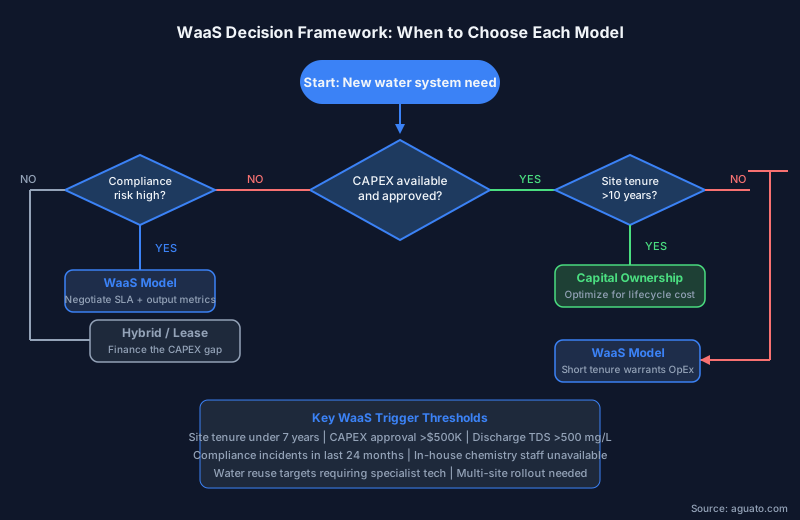
Use this threshold framework to set the direction before engaging providers. It is not a substitute for a full financial model, but it prevents the most common mistake: selecting the model based on a headline rate rather than a full total cost of ownership.
If your site tenure is under 7 years, start with WaaS unless strategic process integration rules it out.
If your CAPEX approval threshold requires board sign-off above $500,000 and the treatment system costs $400,000 to $800,000, WaaS removes the approval barrier entirely.
If your feed water TDS is above 1,500 mg/L (requiring two-pass RO or electrodialysis), the technology complexity favors a provider who manages the membrane stacking rather than an in-house team.
If your discharge permit includes a parameter regulated under a standard that has changed in the last 5 years (PFAS, nitrate, microplastics), the forward regulatory risk argument for WaaS is strong.
If you have experienced a compliance event in the last 24 months, the cost-of-doing-nothing argument for WaaS is quantifiable: take the penalty amount plus production loss, discount it at 80% probability of recurrence, and compare it to the WaaS premium.
If your volume exceeds 500 m3/day and your site tenure is above 12 years, run the full 15-year ownership model. WaaS almost never wins at that scale and tenure unless the technology complexity is extraordinary.
For sites that do not fit cleanly into either column, [how to choose the right industrial water treatment approach](/resources/how-to-choose-industrial-water-treatment) provides a structured methodology for evaluating the full option set, including hybrid lease-to-own structures that several equipment manufacturers now offer.
The most efficient outcome is usually to bring 2 to 3 WaaS providers and one capital-ownership scenario to the table simultaneously, using the [most efficient water solution framework](/resources/most-efficient-water-solution) to compare them on a levelized cost basis. That competitive tension almost always produces a better rate than a sole-source negotiation and gives the procurement team a defensible audit trail showing market comparison.
## How Technology Stacks Are Evolving Under WaaS
The WaaS model is changing the technology mix deployed in industrial water treatment, and the direction of that change matters for buyers who want to understand what they are getting.
Because providers own the assets and bear the lifecycle risk, they have a strong incentive to deploy technology with lower operating cost and higher reliability, even where that technology carries a higher upfront cost. The most visible shift is toward ceramic membranes for high-fouling feed water applications. A ceramic UF membrane costs 3 to 5x more per unit area than a polymeric equivalent, but its 15 to 20-year service life and resistance to aggressive CIP protocols make it the preferred choice for WaaS providers managing long-term contracts on challenging feed streams. Under capital ownership, the higher upfront cost creates a CAPEX barrier. Under WaaS, the provider absorbs that barrier and captures the long-run OPEX savings.
According to the [US EPA guidelines for water reuse](dofollow:https://www.epa.gov/waterreuse/guidelines-water-reuse), advanced treatment for direct or indirect potable reuse now incorporates reverse osmosis, UV-advanced oxidation, and biological filtration as a standard multi-barrier train. WaaS providers deploying these systems under long-term contracts are effectively positioning themselves as the delivery mechanism for municipal-scale water reuse targets at the industrial site level.
Remote monitoring and digital control are also becoming contractual requirements rather than optional add-ons. WaaS providers that operate 50 or more sites typically deploy cloud-connected SCADA with predictive dosing algorithms, which reduces chemical spend by 12 to 18% compared to manual dosing protocols, according to benchmarks published by the [Water Research Foundation](dofollow:https://www.waterrf.org).
When the treatment challenge combines membrane selection, chemical dosing optimization, and discharge compliance into a single decision, the technology stack question is not one most procurement teams should answer alone. [Nepti](/nepti) models your water matrix and produces a ranked comparison of technology options with cost projections across both WaaS and ownership scenarios, so you can enter provider negotiations with a defensible specification rather than a performance hope.
The [industrial water reuse and recycling](/resources/industrial-water-reuse-recycling) case is particularly strong under WaaS. Recycling trains that include brine concentration, UV-AOP, and biological polishing require specialist operational knowledge that WaaS providers accumulate across portfolios. A single-site operator building that capability in-house faces a steep learning curve and high knowledge-loss risk when staff turn over.
The standard the output specification should target for industrial process water reuse is [ISO 16075-2](dofollow:https://www.iso.org/standard/69460.html), which covers treated wastewater use in agriculture and process reuse and provides quality thresholds by use category. Anchoring the WaaS SLA to a specific ISO class rather than a generic description prevents quality specification drift over the contract term.
## FAQ
### What is Water-as-a-Service (WaaS) in industrial water treatment?
Water-as-a-Service is a contractual model where a provider installs, owns, and operates a water treatment system on your premises in exchange for a recurring fee based on volume delivered or quality achieved. The customer pays for treated water output rather than owning or managing the underlying equipment. The provider assumes responsibility for compliance, maintenance, and technology lifecycle, governed by a service-level agreement specifying measurable output water quality parameters.
### How much does a WaaS contract typically cost per cubic meter?
WaaS unit rates for industrial applications typically run $1.80 to $4.50 per cubic meter for pharmaceutical or food-grade quality, and $0.90 to $2.20 per cubic meter for standard industrial-grade output in the US and Western Europe. Monthly fixed fees for mid-size systems (50 to 200 m3/day) commonly run $8,000 to $22,000. Always model the all-in cost including minimum take-or-pay floors, mobilization fees, and chemical escalation clauses before comparing to capital ownership. The gap between headline rate and all-in rate is routinely 40 to 60%.
### Is WaaS better than buying a water treatment system outright?
WaaS outperforms capital ownership for sites with tenure under 7 years, CAPEX approval barriers above $500,000, complex discharge compliance obligations, or lean technical operations teams. Capital ownership wins on a full lifecycle basis for high-volume, long-tenure, stable-process sites where treatment technology is well-understood. The crossover point where WaaS becomes more expensive than ownership on a levelized cost basis typically occurs at 8 to 12 years for mid-size industrial systems.
### What should a WaaS service-level agreement include?
A well-structured WaaS SLA must specify measurable output water quality parameters (TDS, conductivity, TOC, microbial count), a performance remedy mechanism with credit and termination rights, a defined feed water variability envelope, a chemical cost escalation cap, and demobilization terms including equipment ownership at exit. Without each of these elements, the cost certainty and compliance protection that justify the WaaS premium are not contractually enforceable. Change-of-control clauses protecting against provider acquisition are also recommended given recent consolidation in the sector.
### Can WaaS help meet corporate ESG water targets?
Yes, but only if the contract requires calibrated metering to a recognized standard such as ISO 4064 and obliges the provider to supply data in a format compatible with CDP or GRI water reporting frameworks. WaaS providers that bundle metering, third-party verification, and reporting into the service fee are increasingly common in the pharmaceutical and food and beverage sectors. Several Tier 1 manufacturers have used WaaS contracts to compress the time between setting a portfolio-level water-intensity target and reporting verified progress from 24 months to under 6 months.
### What are the biggest risks in a WaaS contract?
The three most common failure modes are: provider financial distress or acquisition without a change-of-control exit right (cost impact $200,000 to $500,000 in emergency alternative supply); uncapped chemical escalation clauses that inflate the unit rate by $0.30 to $0.80 per cubic meter over a 10-year contract; and feed water variability clauses without risk-sharing provisions, which providers invoke when municipal supply chemistry changes. Each risk is avoidable at contract negotiation stage but is costly to address retroactively.
### How do I evaluate and select WaaS providers for an industrial site?
Evaluate WaaS providers on four dimensions: financial stability and existing contract portfolio tenure (request reference sites with contracts over 5 years old), technology stack and remote monitoring capability (cloud SCADA reduces diagnostic response lag by 60 to 80% versus reactive service), SLA structure and remedy rigor, and mobilization and demobilization terms. Getting 2 to 3 competitive bids using a consistent performance specification is the single most effective tactic for improving contract economics. For the full 15-year NPV model comparing WaaS and outright ownership, including the four cost categories most internal investment cases miss, see [Water-as-a-Service vs Ownership: Total Cost of Water Analysis](/resources/water-ownership-vs-waas-tco). [Post your project on Aguato](/post-project) to receive structured proposals from qualified WaaS providers benchmarked against your actual site parameters.