Modular stormwater detention cuts excavation 68% vs gravel at 95% void ratio, $8.50 to $13.00 per cubic foot installed, with a four-year payback over surface basins.
Stormwater is the billing line most civil engineers forget to price accurately until a planning rejection letter arrives. In the United States, post-construction stormwater controls are now mandatory under the EPA's MS4 (Municipal Separate Storm Sewer System) permit programme on virtually every commercial development exceeding one acre of disturbed land, and in England and Wales, Schedule 3 of the Flood and Water Management Act 2010 has already triggered mandatory SuDS (Sustainable Drainage Systems) approval in Wales since 2019, with England following. The financial sting is real: a mid-sized commercial site that fails to attenuate peak runoff to greenfield equivalent rates can face planning refusal worth far more than the cost of the drainage system itself. Getting the storage strategy right from the outset is not optional engineering, it is commercial necessity.
Modular geocellular crate systems have emerged as the dominant underground attenuation technology for constrained urban and suburban sites, and the economics explain why. Where a traditional gravel-filled trench needs 445 cubic feet of excavation to store 1,000 gallons of stormwater, a modular crate array needs just 141 cubic feet to store the same volume, a 68 percent reduction in spoil removal and backfill. On commercial sites where excavation costs run $25 to $55 per cubic yard depending on region, that difference on a 75,000 cubic-foot scheme can save over $130,000 in earthworks alone, before the surface is even reinstated. The modules themselves cost more per unit than gravel, but the total installed price, at $8.50 to $13.00 per cubic foot, consistently undercuts concrete tank alternatives and comes close to gravel when land value and programme speed are factored in.
This article provides a decision-grade guide for engineers, developers, and facilities managers choosing between modular crate systems, concrete tanks, oversized pipes, and open detention basins. It covers void ratios, load classification, compliance requirements under CIRIA C753 and BS 7533, failure modes, real-world trade-offs, and a threshold-based decision framework grounded in site-specific numbers. By the end, you will be equipped to scope a system that satisfies both the planning authority and the project balance sheet.
## The decision in brief
- Cut the earthworks. A correctly specified modular geocellular attenuation system on a 75,000 cubic foot commercial scheme saves over $130,000 in earthworks versus a gravel equivalent. - Lower the whole-life cost. The same correctly specified system delivers a 20-year total cost of ownership 65 percent lower than a surface detention pond. - Recover the premium quickly. The modular geocellular system recovers its incremental capital premium in approximately four years on that 75,000 cubic foot commercial scheme.
That makes it one of the highest-return mandatory compliance investments in civil infrastructure.
## What Is Modular Stormwater Detention?
Modular stormwater detention, sometimes called geocellular attenuation storage, is an underground system of interlocking plastic crate units that create a void space beneath the surface where stormwater runoff is temporarily held during and after a rainfall event, then released at a restricted rate to avoid overwhelming downstream drainage infrastructure. The term "attenuation" refers specifically to this peak-flow reduction function: the system accepts inflow at a high rate during the storm peak and meters outflow through a flow control device at the greenfield equivalent rate, typically 2 to 5 litres per second per hectare in UK planning practice, or at a site-specific discharge rate set by the local MS4 permit in the US.
The "modular" descriptor is critical. Unlike a monolithic concrete vault or a section of large-diameter culvert, a geocellular system is built from repeating plastic units, often resembling large rectangular milk crates, that are stacked and interlocked on site in any footprint and height configuration the site geometry allows. Individual units typically weigh 8 to 20 kilograms, so they can be handled by two workers without plant, and the entire excavation volume is occupied by structural plastic with approximately 95 percent of the gross volume available as live water storage. By contrast, a gravel-filled trench uses stone as its structural medium and achieves only 30 to 40 percent void ratio, meaning more than double the excavation is needed for the same storage volume.
Expert opinion has solidified around geocellular systems for constrained sites. The 95 percent void ratio is the single figure that changes the economics on tight urban plots. Once excavation prices top $30 per cubic yard, crates beat gravel on total installed cost almost every time, even accounting for the unit cost premium.
Modular systems are not a single product but a category. The key differentiators buyers should assess include: the load classification of the unit (ranging from light pedestrian to D400 highway to E600 aircraft apron), whether the unit is third-party certified for structural performance under sustained load, the void ratio as manufactured versus the net effective ratio after applying a silt allowance, and whether the manufacturer provides a geotextile-wrapping specification aligned to CIRIA C753 guidance. The [Susdrain guidance on geocellular attenuation storage systems](dofollow:https://www.susdrain.org/delivering-suds/using-suds/suds-components/retention_and_detention/Attenuation_storage_tanks.html) sets out the design and inspection principles that distinguish an adopted-standard system from a value-engineered one.
That total-cost discipline is what the rest of this guide operationalises. The cost breakdown below shows exactly which component dominates the installed price, and therefore where a buyer should concentrate value-engineering effort without compromising the silt management and load class that protect the asset over its design life.
## How the System Works: From Inflow to Restricted Outflow
Understanding the flow path through a modular detention system is essential for specifying the correct pre-treatment, selecting an appropriate flow control device, and designing a maintenance schedule that keeps the system performing to its design life.
Stormwater enters the system from the catchment surface via gullies, kerb drains, or surface-water sewers and first passes through a pre-treatment chamber. This silt trap, also called a gross pollutant trap or silt separator depending on jurisdiction, removes suspended solids, hydrocarbons, and debris before they reach the crate array. Skipping or under-sizing the silt trap is the most common installation error and leads to irreversible siltation of the storage volume within five to ten years. CIRIA C753 requires a 10 percent silt allowance on top of the design storage volume precisely because some accumulation is inevitable even with good pre-treatment, reducing the net effective void ratio from 95 percent to 82 to 87 percent over time.
From the silt trap, pre-treated runoff enters the geocellular array through a perforated inlet pipe or inlet manifold running along the base of the storage zone. The array is wrapped in a non-woven geotextile fabric that admits water while preventing fines migration from the surrounding soil into the crate voids. The crate units are oriented and stacked to create the target storage volume, which is calculated from the required attenuation for the 1-in-100-year critical storm duration at the discharge-limited rate. In the UK, designers work from the Design Cloud rainfall data and the rational method or more commonly a hydrograph-routing model to derive the required volume. In the US, the relevant methodology is typically the Rational Method or TR-55 curve number approach, producing a required volume in cubic feet or acre-feet.
The geometry of the array is more consequential than it first appears. A long, shallow single-layer array maximises infiltration contact area and keeps the excavation depth within the reach of standard plant, but it consumes footprint. A deep, compact two or three-layer array recovers footprint at the cost of deeper excavation, greater dewatering risk where the water table is high, and a heavier structural load case on the lower crate columns. The right configuration is the one that satisfies the required storage volume while staying within the site's depth, footprint, and load constraints simultaneously, which is why the volume calculation and the site survey must be read together rather than in sequence.
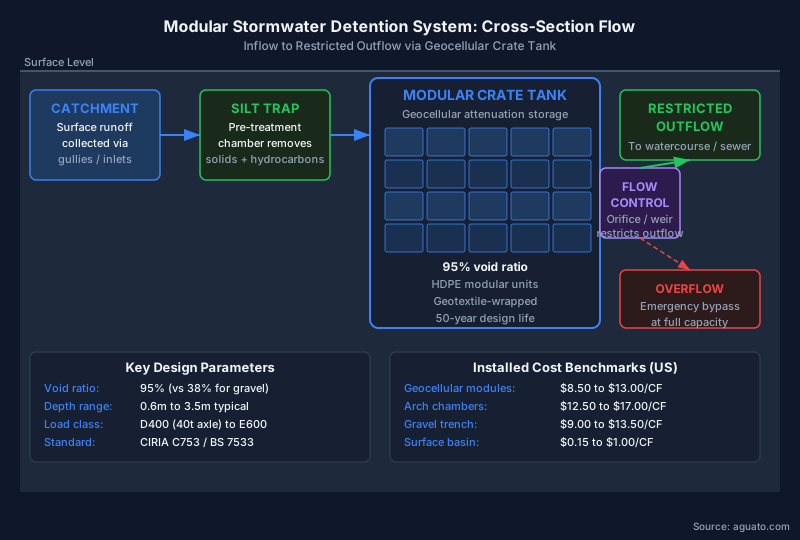
At the downstream end of the storage zone, an outlet structure houses the flow control device. This is commonly an orifice plate, a vortex flow control, or a penstock weir. The orifice size is calculated to discharge at the permitted rate, holding back the stored volume until the downstream system has capacity to accept it. Above the orifice, an emergency overflow weir or bypass pipe activates when the storage volume is full, discharging at an uncontrolled rate to prevent the upstream drainage network from flooding. This overflow pathway must be sized for the extreme event that exceeds the design storm, typically the 1-in-1,000-year event in critical drainage areas.
The entire assembly sits beneath a compacted granular surround, itself below the sub-base and surface course. Access risers rising to the surface allow camera inspection and jetting of the silt trap and, where the system design permits, the crate array itself. Annual inspection of the pre-treatment chamber and five-yearly camera survey of the array interior are the maintenance minima for most adopted systems. These surface SuDS components and the underground array together form the management train described in detail in the guide to [SuDS and green infrastructure for stormwater management](/resources/suds-green-infrastructure-stormwater).
## Storage Technology Comparison: Crates, Concrete, Pipes, and Basins
Choosing the right storage technology requires matching site constraints to system characteristics across four dimensions: installed cost per unit volume, void ratio and hence excavation requirement, risk profile, and the site conditions that suit each option best.
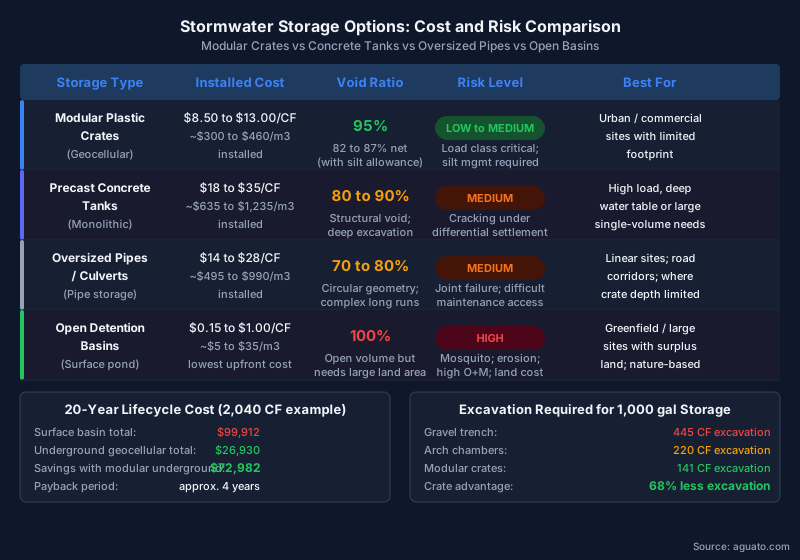
Modular plastic crates (geocellular) deliver the lowest excavation requirement at 95 percent void ratio, which translates to installed costs of $8.50 to $13.00 per cubic foot on US commercial sites. Their primary risks are load class specification errors under trafficked areas and silt management failure over the system life. They suit sites with limited footprint, high urban land values, and where programme speed is critical because modular units can be installed in days rather than the weeks required for precast concrete.
Precast concrete tanks achieve 80 to 90 percent structural void but require deeper, wider excavations because each unit must be placed by crane and the joints between tank sections represent potential leak points under differential settlement. Installed costs run $18 to $35 per cubic foot, which is 35 to 170 percent more than geocellular systems for the same storage volume. Concrete is the right choice where a single large volume is needed in a confined location, where depth-to-water-table prevents long shallow arrays, or where the client has specific structural concerns about plastic under very heavy dynamic loading.
Oversized pipes and culverts provide 70 to 80 percent void ratio and suit linear site geometries, such as car parks with a long narrow footprint or road corridors. Installed costs of $14 to $28 per cubic foot reflect the relatively high unit cost of large-diameter HDPE or concrete pipe and the complex jointing required for watertight detention. Maintenance access is limited to the pipe ends, which makes inspection of long runs difficult.
Open detention basins have the lowest upfront capital cost at $0.15 to $1.00 per cubic foot, but the comparison is misleading. Annual maintenance costs of $2,500 to $7,350 per acre compound over the asset life, and land cost is not captured in the construction figure. A 20-year lifecycle analysis for a 2,040 cubic foot equivalent scheme shows surface basin total costs of $99,912 against $26,930 for underground geocellular, a saving of $72,982 with a payback on the incremental geocellular capital in approximately four years. Open basins are the right choice on greenfield or semi-rural sites where surplus land is available, where ecology and biodiversity net gain targets require a nature-based solution, or where the development programme has no time pressure.
The comparison should always be made on total installed cost including excavation, not module unit price. Developers routinely reject crates on the basis of unit cost per module and then watch the concrete alternative consume their contingency on crane hire and extended programme. The error is structural in how cost plans are assembled: the module line item is visible and easy to compare on a spreadsheet, while the excavation, muck-away, and programme costs that dominate the real total sit in separate trades and rarely get attributed back to the storage decision. A buyer who insists on a single total-installed-cost figure per cubic metre, inclusive of earthworks and reinstatement, sees the true ranking immediately, and that ranking almost always favours the high void-ratio option on constrained sites. The cost breakdown below shows exactly which component dominates the installed price, and therefore where a buyer should concentrate value-engineering effort without compromising the silt management and load class that protect the asset over its design life.
## Cost and CAPEX Breakdown
The cost structure of a modular detention system divides into four components: module supply, geotextile and ancillaries, excavation and muck-away, and labour and connections. Understanding which component dominates on your site determines which system wins the comparison.
Module supply typically accounts for 45 to 55 percent of the total installed cost and is relatively stable across regions. Geocellular units cost $4.50 to $6.50 per cubic foot of gross volume at supply, comparable to arch chamber systems at $6.00 to $8.00 per cubic foot but cheaper than precast concrete solutions on a per-unit-volume basis. This is the figure most commonly quoted in early-stage cost plans, but it represents less than half the real cost.
Excavation and muck-away is the variable that makes or breaks the comparison. Regional benchmarks for commercial excavation in the United States range from $18 to $28 per cubic yard in rural Southwest markets up to $38 to $55 per cubic yard in the Northeast and California. Because the geocellular system requires only 141 cubic feet of excavation per 1,000 gallons of storage versus 445 cubic feet for a gravel system, the excavation differential grows as regional earthworks costs rise. In Northeast markets, a 75,000 cubic foot scheme saves over $131,600 in excavation alone by choosing crates over gravel, even before accounting for module cost differences.
Geotextile wrapping, inlet manifolds, outlet structures, and flow control devices add $0.50 to $1.50 per cubic foot of storage. Labour and connections, including installation of pre-treatment chambers, access risers, and reinstatement, add a further $1.50 to $2.50 per cubic foot.
[cta:nepti-dark]
Because excavation and programme dominate the real total, the cost comparison between technologies is highly sensitive to site context: the same modular system that is marginally more expensive than gravel on a cheap-earthworks greenfield site becomes decisively cheaper on a constrained urban plot with high muck-away rates. Modelling the full installed cost against the specific site is the only way to know which technology wins before committing to a drainage strategy.
A typical CAPEX range for a complete modular attenuation system, designed and installed on a commercial greenfield site in the US, runs from $300,000 to $900,000 for schemes between 25,000 and 100,000 cubic feet of storage. In the UK, equivalent schemes fall in the range of GBP 150,000 to GBP 500,000 at 2024 prices, with significantly higher costs in London and Southeast England where labour and excavation rates are elevated.
Lifecycle perspective matters. Underground detention systems consistently outperform surface alternatives on 20-year total cost of ownership when land values exceed $200,000 per acre, a threshold met by virtually every urban commercial development site. The [EPA stormwater best management practice design guidance](dofollow:https://www.epa.gov/npdes/national-menu-best-management-practices-bmps-stormwater) sets out the design principles, and modular geocellular systems with manufacturer-stated 50-year design lives and maintenance costs of $800 to $1,200 per inspection on a five-yearly cycle produce total 20-year ownership costs that are 65 to 75 percent lower than comparable surface detention pond configurations.
The finance team usually only sees the capital number. When the 20-year net present value comparison is laid alongside it, the conversation changes immediately, and the geocellular option wins on both payback and total cost in almost every urban scenario.
For developers specifically seeking to compare providers across this technology, the Aguato marketplace lists [modular detention and retention companies](/modular-detention-companies) with verified project experience and specification capability, allowing direct comparison of system approaches and commercial terms.
## Compliance Landscape: CIRIA C753, BS 7533, and EPA MS4
Compliance requirements differ significantly between the UK and US markets but converge on the same design principle: attenuate peak runoff to the pre-development greenfield rate for the critical storm event, provide treatment before discharge, and design for inspectability and maintainability over a minimum 50-year asset life.
In the United Kingdom, CIRIA C753, the SuDS Manual, is the authoritative technical reference. It does not have the force of law but local lead flood authorities (LLFAs) and water companies treat it as the de facto standard. CIRIA C753 sets out the volume calculation methodology, required silt allowances, geotextile specification guidance, access requirements for adopted systems, and the four SuDS pillars of water quantity, water quality, amenity, and biodiversity. BS 7533 governs the structural design of the paving systems that may overlie a geocellular installation, particularly relevant where the surface is a trafficked car park or light-duty road.
In Wales, compliance with Schedule 3 of the Flood and Water Management Act 2010 is mandatory. Developers must submit drainage designs to the SAB (SuDS Approval Body), typically the local authority drainage team, for approval before construction. The SAB adopts the drainage system on completion, meaning it becomes a publicly maintained asset, which in turn drives stringent maintainability requirements that favour systems with clear inspection access and low long-term O+M cost. This adoption regime has materially increased specification of modular geocellular systems in Wales because their inspection access credentials and predictable maintenance costs align with what LLFAs will agree to adopt.
In England, Schedule 3 implementation has tightened through planning conditions and pre-application advice from the LLFA. The planning system increasingly requires compliance with CIRIA C753 SuDS principles as a planning condition on major developments. [UK government guidance on Sustainable Drainage Systems](dofollow:https://www.gov.uk/guidance/sustainable-drainage-systems) confirms that planning policy expects SuDS on all new major developments in England.
In the United States, the EPA's NPDES (National Pollutant Discharge Elimination System) MS4 programme requires post-construction stormwater controls on regulated developments. The specific volume and discharge standards are set at state level, creating a patchwork of requirements. Ohio EPA requires 24-hour drawdown with less than 50 percent of stored volume released in the first eight hours. New Jersey DEP specifies 12 to 72-hour drawdown for TSS credit. Caltrans mandates 3:1 side slopes and two-foot freeboard for surface facilities. All jurisdictions accept underground modular detention systems as a compliant post-construction BMP (Best Management Practice), provided pre-treatment is included and the system is inspectable.
SuDS and green infrastructure approaches that complement modular attenuation storage are covered extensively by the range of [SuDS and green infrastructure companies](/suds-green-infrastructure-companies) on the Aguato platform, including specialists in green roofs, permeable paving, bioretention, and swales that can be combined with underground attenuation to create a treatment train meeting CIRIA C753 quality requirements.
## Threshold-Based Decision Framework
The choice between modular crate, concrete tank, oversized pipe, and surface basin depends on five numeric thresholds. Evaluating each in sequence points to the appropriate primary technology.
Threshold 1: Required attenuation volume above or below 500 m3. Below 500 m3, modular crates on a standard site will almost always deliver the lowest total installed cost. Above 500 m3, the comparison becomes more sensitive to site-specific factors including excavation cost and depth constraints.
Threshold 2: Depth to water table less than 1.2 m. If the groundwater table sits within 1.2 m of the proposed invert level of the storage, infiltration-based solutions are likely excluded and the geocellular array must be made watertight. This is achievable with impermeable geomembrane liners but adds cost. Below 0.8 m depth-to-water-table, concrete tanks merit closer evaluation because their monolithic construction is inherently watertight without additional liner specification.
Threshold 3: Traffic loading class D400 or above. Standard geocellular units rated for pedestrian and light vehicle areas (SLW 60 equivalent) are not suitable under roads or car parks carrying heavy goods vehicles or large passenger vehicles. Specify D400-rated units (40-tonne axle load per the UK axle class) where vehicles will overrun the storage footprint, and E600-rated units under heavy logistics areas or airport aprons. Failure to verify load class is the primary cause of structural failure in geocellular installations and can trigger full system excavation and replacement at costs exceeding $200,000 on mid-sized schemes.
Threshold 4: Available footprint less than 15 m2 per 100 m3 of required storage. Very tight footprints favour deep concrete tanks or, where depth is constrained, a combination of geocellular and large-diameter pipe. If footprint exceeds this threshold, a modular crate system in a standard single-layer or two-layer configuration is usually achievable.
Threshold 5: Surface land value above $500,000 per acre. On high-value urban land, any system that converts surface area to green or amenity space by going underground recovers land value that exceeds the cost differential between underground and surface options. At this land value threshold, underground modular systems are almost always the economically rational choice, even at the upper end of the $8.50 to $13.00 per cubic foot installed range.
For comprehensive cost benchmarking across technology options, the analysis in our [water treatment CAPEX and OPEX guide](/resources/water-treatment-capex-opex) provides the financial modelling framework applicable to stormwater infrastructure decisions as well as water and wastewater treatment plant investment.
## Failure Scenarios: What Goes Wrong and What It Costs
Three failure modes account for the majority of modular detention system problems encountered in practice. Understanding each, including the decision that caused it, the outcome, and the remediation cost, allows specifiers to build in the safeguards that prevent them.
Failure mode 1: Undersized attenuation volume. The decision: a developer pressures the drainage engineer to reduce the storage volume to save excavation costs, accepting a discharge rate higher than the permitted greenfield equivalent on the basis that the authority "probably won't notice." The outcome: at the first major rainfall event post-construction, the downstream sewer surcharges and a neighbouring property floods. The authority issues a Flood Risk Activity permit enforcement notice and requires the developer to demonstrate compliance within 60 days. The cost: emergency reworking of the outlet orifice plate to slow the discharge (if the storage volume is sufficient at a lower rate, this is achievable at $5,000 to $15,000) or, more commonly, additional off-site storage in the form of a supplementary tank at costs of $80,000 to $250,000 plus legal liability for flood damage claims. Prevention: design to the CIRIA C753 volume requirement with no negotiated reduction, and document the design rationale explicitly in the drainage strategy.
Failure mode 2: Inadequate silt management. The decision: the silt trap is specified at the minimum size to save capital cost, and the maintenance schedule includes inspection "as required" rather than at a fixed annual interval. The outcome: after three to five years of operation without cleaning, the silt trap overflows into the crate array. Fine sediments coat the geotextile and begin to fill the lower crate cells. System storage capacity degrades from the design 95 percent void ratio to 60 to 70 percent effective storage. A major storm event causes surface flooding. The cost: CCTV survey ($3,000 to $8,000), jet-washing of accessible areas ($5,000 to $20,000), and in the worst case, partial excavation and replacement of silt-filled lower layers ($50,000 to $150,000 depending on system size and access). Prevention: specify a silt trap with generous settlement volume, implement annual visual inspection and cleaning as a contractual O+M obligation, and apply the CIRIA C753 10 percent silt volume allowance in the design calculations from the outset.
Failure mode 3: Load class failure under traffic. The decision: standard pedestrian-rated crate units are installed beneath a car park surface that is subsequently designated for delivery vehicle access. The outcome: under the sustained loading of HGV tyres, the crate columns deflect and eventually collapse, causing surface depression and cracking. The cost: full excavation and replacement of the collapsed zone ($120,000 to $350,000 on a typical commercial car park bay), loss of car park use during works (revenue impact), and reputational damage. Prevention: specify load class before procurement, confirm the surface use in writing with the client, and inspect the as-built installation to verify the specified units were actually installed.
The specification stage is where these failures are determined, not the construction stage. If the load class, silt trap volume, and maintenance obligations are locked in at tender, none of these outcomes is preventable by the installer alone.
## Real-World Examples
Example 1: Urban mixed-use regeneration, UK (city centre brownfield site). A 2.4-hectare brownfield redevelopment in the UK Midlands required 1,200 m3 of attenuation storage to meet the LLFA's discharge rate of 2.5 l/s/ha. The site had no surface area available for open detention, as the entire footprint was occupied by residential buildings and communal space. The drainage engineer specified a two-layer geocellular array beneath the communal car park using D400-rated units across the trafficked zone and standard pedestrian-rated units under the landscaped amenity area. The installation was completed in nine days, significantly ahead of the original programme for a precast concrete alternative that was rejected on access and programme grounds. Total installed cost: GBP 215,000 versus a concrete tank quotation of GBP 390,000. Trade-off: the geocellular system required a more complex geotextile specification and a dedicated maintenance protocol, whereas the concrete tank would have needed less intensive long-term management.
Example 2: Logistics park, US Southeast. A 45-acre logistics and warehousing development in Georgia was required by the state authority to attenuate peak runoff for the 25-year storm to pre-development rates. Required storage volume: approximately 85,000 cubic feet. The site had ample land for an open detention basin but the developer wanted to maximise the warehouse footprint by using that area for additional trailer parking. The modular geocellular system beneath the trailer parking area was specified with E600-rated units capable of supporting the static loading of parked trailers. Installed cost: $980,000 for the underground system versus $260,000 for a surface basin. The developer recovered the cost differential ($720,000) through additional annual revenue from the 40 additional trailer parking spaces made available. Trade-off: the underground system required an ongoing maintenance contract at $12,000 per year versus approximately $6,000 per year for a surface basin. Full payback on the capital differential was achieved in approximately 15 years.
Example 3: Highway service area expansion, UK. A motorway services operator expanding a petrol forecourt needed 350 m3 of attenuation beneath a new fuelling apron area. The presence of fuel creates a pollution risk, requiring an impermeable geomembrane liner to prevent any hydrocarbon-contaminated runoff from infiltrating the underlying aquifer. The geocellular array was installed within a sealed HDPE liner welded on site, with a full-containment design that met Environment Agency (EA) requirements for pollution prevention at fuelling stations. The solution avoided the footprint of a concrete interceptor vault that would have consumed 40 percent of the apron area. Trade-off: the sealed liner added GBP 28,000 to the base crate cost and required specialist welding contractors, extending the installation programme by four days.
## Selecting and Working with Providers
The modular stormwater detention market is served by a combination of product manufacturers who supply units directly, specialist drainage contractors who design-and-build, and multi-technology civil engineering consultancies who specify systems independently of product. Understanding this supply chain determines where leverage sits in procurement.
Product manufacturers, including major HDPE geocellular suppliers, provide technical support for volume and load-class calculations, and offer drainage design software tools aligned to CIRIA C753 methodology. Their interest is in product specification, so their design tools will typically recommend their own units. This is not a conflict if the specifier runs an independent check using the methodology in the SuDS Manual.
Specialist drainage contractors, who may hold preferred-contractor arrangements with one or two manufacturers, can often deliver the lowest total installed cost because they combine supply and installation margins. The risk is that design decisions may be influenced by product availability rather than purely by site requirements.
For organisations with multiple sites or recurring stormwater compliance requirements, working through the [Nepti](/nepti) platform to assess system options and connect with vetted providers offers a structured procurement pathway. Nepti's decision intelligence layer allows direct comparison of system performance specifications and supplier commercial terms without requiring a full tender process for each site.
Independent of supply chain structure, the following minimum specification requirements should be confirmed with any provider before contract:
Structural certification: third-party structural test certification (not only manufacturer self-declaration) for the specific load class specified, with test reports available on request.
Design life documentation: a written statement from the manufacturer confirming the design life of the unit under the specified loading conditions, backed by accelerated creep test data.
Maintenance protocol: a maintenance schedule aligned to CIRIA C753 recommended inspection intervals, with confirmation of what access is provided for inspection and what constitutes a system failure requiring intervention.
For [water-as-a-service and asset financing models](/resources/water-as-a-service-waas) that cover stormwater infrastructure, including arrangements where a specialist contractor installs and maintains the system in exchange for a service fee rather than a capital payment, the Aguato marketplace lists providers offering structured financing alternatives to conventional CAPEX procurement.
The companion guide to [SuDS and green infrastructure stormwater management](/resources/suds-green-infrastructure-stormwater) covers how modular attenuation systems fit within a broader treatment train that includes surface SuDS components such as green roofs, permeable paving, and bioretention cells, and how the combined approach meets both water quantity and water quality targets simultaneously. For organisations comparing multiple provider approaches, the Aguato directory of [SuDS and green infrastructure companies](/suds-green-infrastructure-companies) offers a vetted starting point. Specialist providers operating across both underground attenuation and surface SuDS can deliver integrated drainage strategies that perform better and cost less than systems procured through two separate supply chains.
Specifying the system correctly and selecting the right provider together determine whether the scheme performs to its design life. The financial summary below distils why getting both right is one of the highest-return decisions in mandatory drainage compliance.
## FAQ
What is the difference between detention and retention in stormwater management? Detention systems temporarily hold stormwater and release it at a restricted rate after the storm passes; the storage volume empties between events. Retention systems, also called retention ponds, hold water permanently, with the stored volume topped up by rainfall and reduced by evaporation and infiltration. Modular geocellular systems can be configured as either detention or retention depending on whether the outlet includes a permanent water seal.
What void ratio should I specify for a geocellular crate system? The manufacturer's quoted gross void ratio is typically 95 percent for modern geocellular units. Apply a 10 percent silt allowance as recommended by CIRIA C753, giving a net effective design void ratio of 82 to 87 percent. Never use the gross void ratio for volume calculations because the silt allowance is mandatory for adopted systems and strongly recommended for private systems.
Which load class do I need under a car park? Standard car parking areas with passenger vehicles require a minimum of SLW 60 equivalent rating. Areas accessible to HGV delivery vehicles require D400 (40-tonne axle load). Bus and coach areas require E600. Confirm the intended surface use in writing with the property owner and specify the corresponding load class explicitly in the contract documents.
How often does a modular detention system need to be maintained? The pre-treatment silt trap requires annual visual inspection and cleaning when sediment accumulation exceeds 25 percent of the chamber volume. The geocellular array should be inspected by CCTV camera every five years. Cleaning costs typically run $800 to $1,200 per inspection and cleaning cycle. Budget $2,000 to $3,000 per year for a commercial scheme in the 50,000 to 100,000 cubic foot range.
Can geocellular crates be installed in high groundwater areas? Yes, but the design must account for buoyancy. A geocellular array filled with air in a high-groundwater environment will experience uplift. The design must demonstrate that the weight of overlying materials plus any water ballast exceeds the buoyancy force. An impermeable liner is also required to prevent groundwater from entering and consuming storage volume. Consult the CIRIA C753 guidance on buoyancy design for the specific methodology.
What happens if the attenuation volume is undersized? If the storage volume is insufficient for the design storm, the outlet structure fills before the storm peak passes, and excess runoff bypasses through the emergency overflow, which discharges at an uncontrolled rate. This may cause flooding of downstream properties and trigger enforcement action by the planning authority or environment regulator. Remediation typically costs $80,000 to $250,000 for additional off-site storage, plus potential legal liability for flood damage.
How do I convert between cubic feet and cubic metres for volume calculations? 1 cubic metre equals 35.31 cubic feet. 1,000 m3 of storage therefore equates to approximately 35,310 cubic feet. US cost benchmarks quoted in this article in dollars per cubic foot can be converted to a per-cubic-metre equivalent by multiplying by 35.31: a $10 per cubic foot figure equates to approximately $353 per cubic metre.