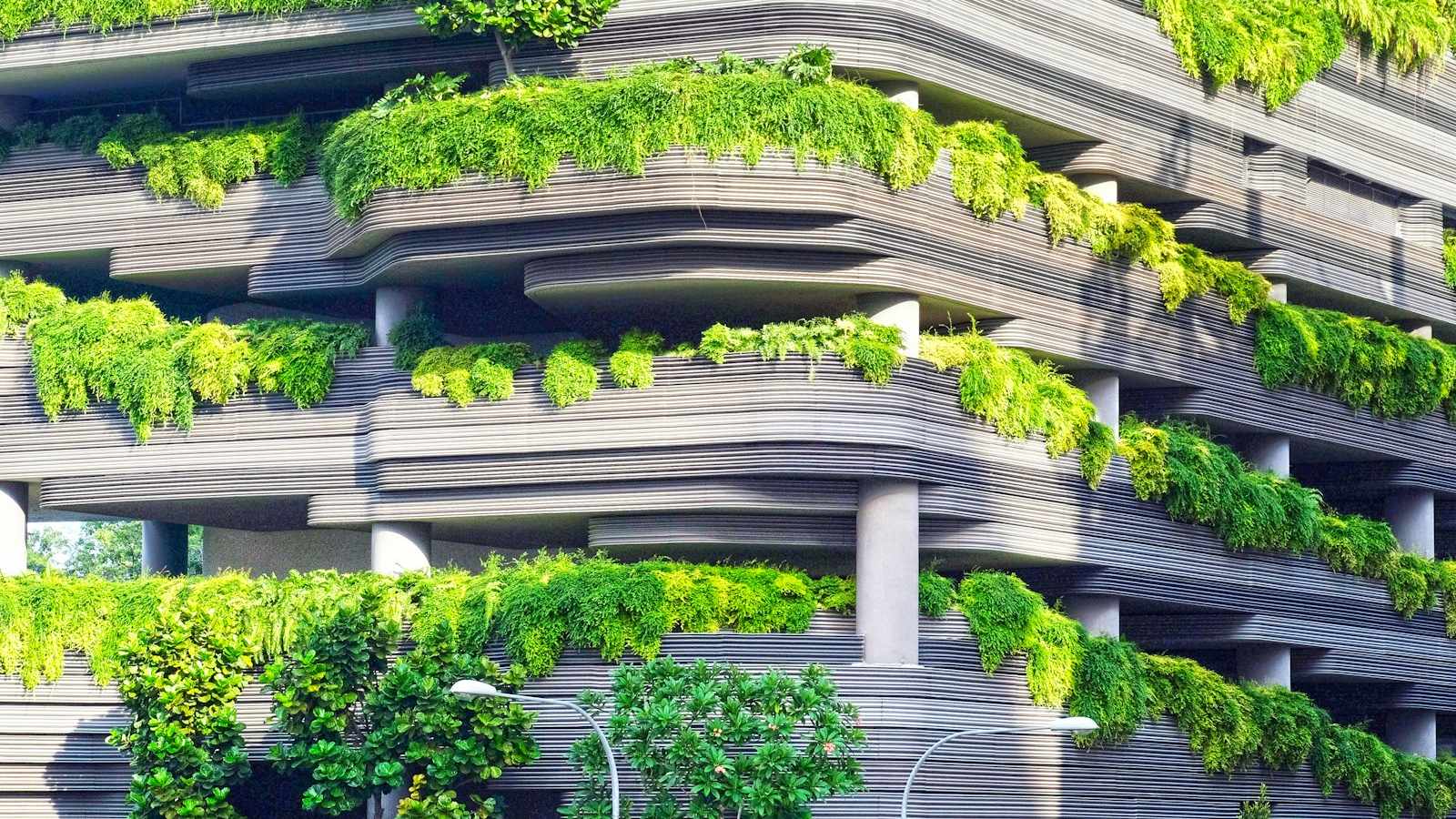
Urban stormwater flooding costs US cities over $9 billion a year. SuDS and green infrastructure cut peak flows up to 80% at a fraction of conventional drainage cost.
Urban stormwater flooding cost American cities and businesses an estimated $9 billion in direct damage during 2023 alone, a figure that climbs every year as impervious surfaces multiply and storm intensities grow under shifting climate patterns. The traditional response, bigger pipes, deeper tanks, more concrete, has reached its economic and physical limits in most built-up areas: the capital expenditure to upsize a city-centre combined sewer can exceed $12 million per kilometre, and the excavation disrupts commerce for months. Something fundamentally different is needed, and Sustainable Drainage Systems (SuDS = Sustainable Drainage Systems) and the broader discipline of green infrastructure stormwater management are delivering it at a fraction of the cost.
SuDS replicate the pre-development hydrological cycle by slowing, spreading, storing, and cleaning runoff at or near its source rather than rushing it downstream through buried pipes. The approach is codified in the CIRIA SuDS Manual C753 (2015, updated guidance 2022) and BS 8582:2013 (Code of Practice for Surface Water Management for Development Sites in the UK), and has been absorbed into US practice through the EPA's Green Infrastructure programme and local MS4 (Municipal Separate Storm Sewer System) permit frameworks. The principle is consistent: treat rainfall as a resource, not a waste. A correctly designed management train of source-control, site-control, and regional-control measures can attenuate peak flows by 50 to 80 percent compared with a fully piped alternative, while simultaneously improving water quality, creating public green space, and increasing biodiversity, what CIRIA C753 terms the four pillars: quantity, quality, amenity, and biodiversity.
For engineers, planners, and the asset owners who commission them, the financial case is now unambiguous. In a 2022 benchmarking exercise across 14 UK new-build schemes, SuDS whole-life costs over 60 years ran 28 to 45 percent below equivalent conventional drainage. Similar findings are documented in US EPA case studies across cities from Portland, Oregon to Philadelphia, Pennsylvania. This article unpacks the technology stack, the cost architecture, the decision thresholds, and the failure modes, everything a technical buyer needs to assess whether SuDS green infrastructure stormwater management is the right solution for their next project.
## The decision in brief
- Avoid the pipe upsizing. A commercial property developer or municipality investing $1 million in a SuDS management train for a 5-hectare site can typically avoid $2.4 to $4.1 million in conventional pipe upsizing costs. - Reduce the flood liability. Over 25 years that investment can typically avoid $600,000 to $1.8 million in downstream flood-damage liability exposure on the 5-hectare site. - Offset biodiversity net-gain procurement. The same $1 million SuDS investment can also typically avoid $80,000 to $200,000 in biodiversity net-gain unit procurement under post-2024 English planning rules.
Together that delivers a discounted whole-life return of 2.8 to 5.1x on the SuDS investment at a 5 percent discount rate, before amenity uplift on land values is included.
## What SuDS and Green Infrastructure Actually Do
The business stakes of getting stormwater drainage wrong are measurable and serious. A site that generates post-development runoff above its consented greenfield rate, typically 1.4 litres per second per hectare (l/s/ha) under UK Environment Agency guidance, or pre-development rate equivalents under US MS4 permits, faces planning rejection, retrospective enforcement, and potential liability for downstream flooding. Beyond the regulatory floor, untreated stormwater carries sediment, nutrients, heavy metals, hydrocarbons, and microplastics into receiving waterbodies, triggering Water Framework Directive and Clean Water Act obligations that attach financial penalties reaching $50,000 per day in the US.
Green infrastructure stormwater management encompasses any system that uses natural or semi-natural processes to manage the quantity and quality of runoff. This includes green roofs, rain gardens, bioswales, filter strips, permeable paving, retention ponds, constructed wetlands, and floodplain restoration. The [EPA Green Infrastructure programme](dofollow:https://www.epa.gov/green-infrastructure) has documented runoff volume reductions of 30 to 95 percent across individual techniques, depending on soil permeability, catchment impervious fraction, and storm return period.
SuDS differ from purely aesthetic green space in one critical way: they are engineered systems with defined hydraulic performance targets, soil specifications, overflow routes, and maintenance schedules codified in BS 8582 and CIRIA C753. A rain garden with no overflow protection is a landscape feature; a rain garden with a designed bypass weir, a geotextile-lined substrate to BS EN 13252, and a maintenance access point every 30 metres is a SuDS component. The distinction matters enormously when local authorities audit post-construction performance or when insurance underwriters assess flood risk.
A pattern that recurs across redevelopment schemes is striking. On a 4.2-hectare mixed-use site where post-construction monitoring data is available, a management train of permeable paving (source), bioswales (site), and a detention basin with a constructed wetland polishing cell (regional) achieved a peak flow reduction of 73 percent compared with the pre-SuDS fully piped concept, cutting the downstream pipe upsizing requirement from DN800 to DN450, a capital saving of approximately $620,000 before landscaping co-benefits are counted.
[cta:nepti-dark]
The management train is the organising principle behind every decision that follows in this article. Understanding how source, site, and regional controls stack to deliver redundant attenuation is the prerequisite for reading the cost comparison, the decision thresholds, and the failure modes correctly.
## The SuDS Management Train Explained
The management train is the architectural concept at the heart of CIRIA C753: deploy SuDS components at source first, then at site scale, then regionally, with each layer doing part of the hydraulic and water-quality work. The goal is redundancy. If a source-control element fails in a severe storm, the site-control layer absorbs the overspill, and the regional layer provides a final buffer before discharge to the receiving watercourse.
Source control operates at the building or plot level. Green roofs (extensive: 80 to 150 mm growing medium substrate; intensive: 200 to 500 mm) intercept between 40 and 90 percent of annual rainfall depending on substrate depth and regional climate. Rainwater harvesting tanks hold the first flush for reuse in toilet flushing, cooling tower makeup, or irrigation, reducing both mains water demand and peak discharge. Permeable paving, whether resin-bound aggregate, concrete block with open joints, or porous asphalt, allows infiltration directly through the surface into a sub-base reservoir, typically achieving 50 to 90 percent runoff reduction on a per-event basis.
Site control manages runoff that passes through or around source-control features. Bioswales, shallow vegetated channels with a longitudinal gradient of 1 to 5 percent and a freeboard of at least 150 mm, convey flow at reduced velocity while filtering suspended solids and attenuating the hydrograph. Filter strips perform a similar function through sheet flow over a grassed margin of 3 to 6 metres width. Below-ground modular attenuation tanks (geocellular units assembled from polypropylene or HDPE cells) provide controlled storage under driveways, car parks, or hard-standing areas where above-ground features are impractical.
Regional control captures what the upper layers cannot hold during extreme events. Detention basins, dry or wet, provide temporary storage with a throttled outlet designed to restrict discharge to the consented rate regardless of inflow magnitude. Retention ponds provide permanent water storage with an aerobic zone for biological nutrient removal. Constructed wetlands using emergent macrophytes (common reed, reedmace, yellow iris) provide tertiary polishing of soluble pollutants with reported total suspended solids (TSS) removal rates of 70 to 90 percent and biochemical oxygen demand (BOD) reduction of 60 to 80 percent.
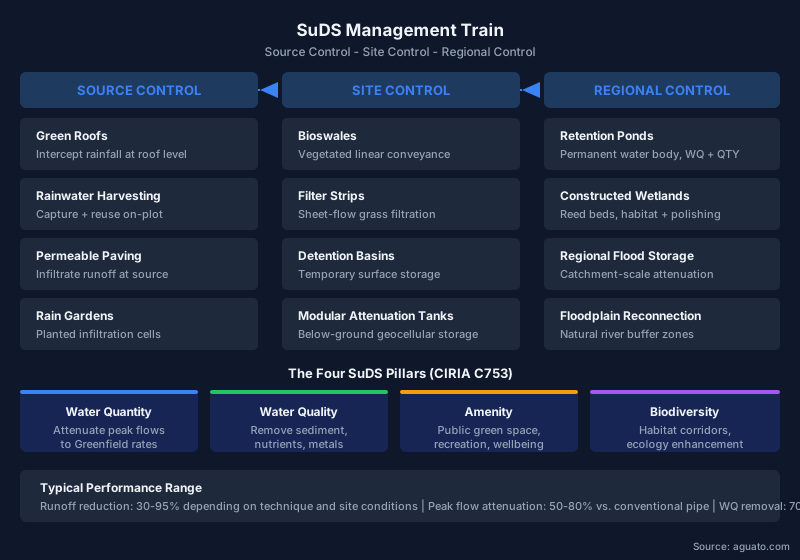
The power of the train lies in its cumulative effect. A site that achieves 60 percent volume reduction at source, then a further 40 percent attenuation of residual flow at site, and finally restricts discharge through a regional throttle, can meet greenfield discharge rates even for a 1 in 100-year storm event with 40 percent climate-change allowance, the design standard now expected under UK National Planning Policy Framework (NPPF) and increasingly referenced in US coastal resilience programmes. This redundancy is why modular below-ground storage and surface SuDS are best specified together rather than as competing alternatives, a point developed further in the dedicated guide to [modular stormwater detention and attenuation systems](/resources/modular-stormwater-detention-attenuation).
## SuDS Techniques: A Cost and Performance Comparison
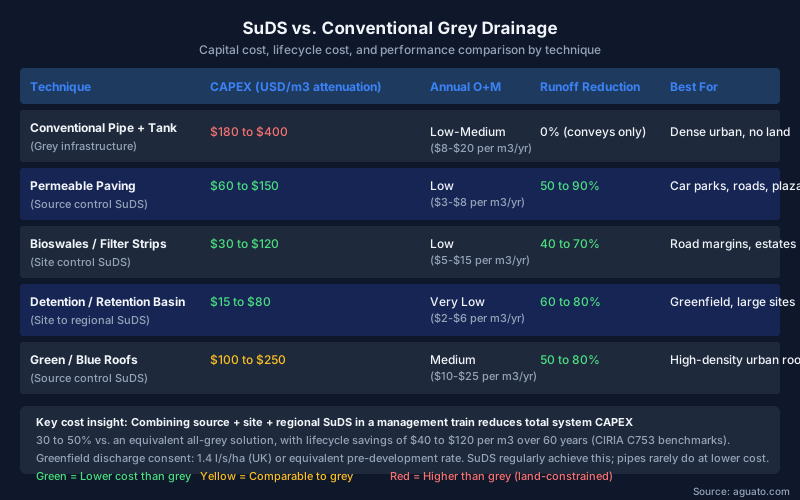
Understanding the cost architecture of SuDS requires separating capital expenditure (CAPEX) from lifecycle operational expenditure (OPEX) and from the risk cost that each approach transfers to downstream owners and insurers. The table and diagram below compare the most commonly specified techniques against conventional grey drainage.
| Technique | CAPEX (USD per m3 attenuation) | Annual O+M | Peak flow reduction | Best fit scenario | |---|---|---|---|---| | Conventional pipe and tank (grey) | $180 to $400 | Low to medium | 0% (conveys only) | Dense urban, minimal land | | Permeable paving | $60 to $150 | Low | 50 to 90% | Car parks, plazas, roads | | Bioswales and filter strips | $30 to $120 | Low | 40 to 70% | Road margins, housing estates | | Detention and retention basin | $15 to $80 | Very low | 60 to 80% | Greenfield, large commercial | | Green and blue roofs | $100 to $250 | Medium | 50 to 80% | High-density urban rooftops | | Constructed wetlands | $20 to $90 | Very low | 50 to 75% | Regional polishing, ecology |
The most important takeaway: the lowest-CAPEX SuDS techniques (bioswales, detention basins, constructed wetlands) cost two to ten times less per cubic metre of attenuation than conventional grey infrastructure. Even the mid-range SuDS options, permeable paving and green roofs, are broadly competitive once avoided pipe-upsizing costs, landscaping co-benefits, and biodiversity net-gain credits are factored in.
A vegetated SuDS scheme requires annual inspection (typically $1,500 to $5,000 per site), sediment removal from pre-treatment forebays every three to five years ($3,000 to $12,000), and periodic replanting of macrophytes. Bioswales may need mowing four to eight times per year. These costs are real and must be included in whole-life cost models, typically $2 to $15 per m3 of attenuation capacity per year, but they remain significantly below the annual inspection and CCTV survey costs for equivalent buried pipe networks.
For a detailed breakdown of how CAPEX and OPEX interplay across water infrastructure projects, the [water treatment CAPEX and OPEX analysis on Aguato Insider](/resources/water-treatment-capex-opex) applies the same lifecycle thinking used by SuDS designers to broader water infrastructure investment.
Expert view 1: the industry consistently underestimates the cost of doing nothing. A blocked bioswale costs $2,000 to fix. A flood event caused by undersized conventional drainage costs $200,000 to $2 million in insurance claims, remediation, and business interruption, often borne by the developer under latent defect liability for ten to twelve years post-completion.
Expert view 2: flood damage avoidance is the metric that converts SuDS from a cost line to a profit centre. Actuarial data from FEMA's National Flood Insurance Programme shows that $1 invested in pre-event mitigation returns $6 in avoided damage, a ratio that SuDS consistently exceed because they address multiple flood pathways simultaneously.
## Integrating SuDS with Conventional Grey Drainage
The binary framing of "green vs. grey" misrepresents how SuDS are actually deployed. Most successful schemes use a hybrid approach: SuDS components handle the frequent, low-intensity storms (the 1 in 2 and 1 in 30-year events that cause most chronic flooding and pollution) while a residual conventional pipe network handles the catastrophic events that exceed any surface storage capacity. This is sometimes called the "twin-track" or "dual drainage" approach in UK practice.
The design principle is to size SuDS for the minor system, up to the 1 in 30-year storm, and provide a safe overland flow route for flows exceeding that threshold. The overland route (streets, open channels, detention areas) forms the major system. This is consistent with guidance in CIRIA C753 Chapter 7 and the UK Environment Agency's [surface water management guidance](dofollow:https://www.gov.uk/guidance/sustainable-drainage-systems).
Hybrid integration pitfalls: - Incorrect invert levels: If a SuDS feature discharges into a grey pipe network at an invert level that allows back-flooding into the SuDS during surcharge events, the entire treatment train is bypassed. Always design a minimum 300 mm freeboard above the hydraulic grade line in the receiving sewer. - Mixing treatment zones: Contaminated runoff from fuel forecourts or industrial yards must pass through an oil interceptor (Class 1, BS EN 858-1) before entering a SuDS polishing component. Never route first-flush contaminated runoff directly to an infiltration feature. - Partial maintenance contracts: Grey and green drainage components managed by different contractors often leads to maintenance gaps at interfaces. Appoint a single drainage asset manager or include clear interface protocols in the long-term maintenance plan (LTMP) required under Schedule 3 of the Flood and Water Management Act 2010 (England and Wales).
For context on how water-as-a-service models can finance both grey and green water infrastructure through a single operational contract, the [Water-as-a-Service guide on Aguato Insider](/resources/water-as-a-service-waas) is directly relevant to developers and municipalities considering whole-asset outsourcing.
## Threshold-Based Decision Framework
Not every site is suited to every SuDS technique. The decision depends on six measurable parameters with numeric thresholds that can be evaluated at feasibility stage:
1. Impervious area fraction - Less than 30% impervious: permeable paving alone can typically meet greenfield discharge rates. Full SuDS management train optional. - 30 to 60% impervious: source plus site control combination required. Modular detention tanks likely needed below ground. - Greater than 60% impervious: full management train mandatory plus consideration of blue-roof attenuation on buildings. Regional detention essential.
2. Discharge consent rate - Less than 2 l/s/ha: extremely restrictive. Only achievable with multiple SuDS layers plus throttled outfall. Grey-only solutions uneconomic. - 2 to 5 l/s/ha: standard greenfield rate for UK sites. Achievable with well-designed SuDS at lower cost than grey. - Greater than 5 l/s/ha: more relaxed, giving greater design flexibility. Hybrid approaches viable.
3. Infiltration suitability - Ground permeability greater than 1 x 10⁻⁶ m/s (tested to BRE Digest 365): infiltration SuDS (soakaways, infiltration trenches) viable. Highest performance, lowest cost. - Permeability 1 x 10⁻⁸ to 1 x 10⁻⁶ m/s: slow infiltration suitable for bioswales and filter strips with attenuation storage. Detention required for peak events. - Permeability less than 1 x 10⁻⁸ m/s or Groundwater Source Protection Zone 1: no infiltration. Attenuate and discharge to watercourse or sewer at consented rate.
4. Available land - Greater than 2% of total site area available for SuDS: sufficient for full management train including detention basin. Standard SuDS design feasible. - 0.5 to 2% available: constrained; rely on permeable paving, green roofs, and modular below-ground tanks. - Less than 0.5% available: severely constrained. Blue-roof attenuation and proprietary vortex throttle chambers in grey network likely required.
5. Water quality risk - Clean roofscape or landscaped runoff: direct to SuDS polishing components acceptable after simple silt trap. - Mixed commercial or highway runoff: pre-treatment with gross solids removal and oil interceptor mandatory before SuDS bioretention. - High-risk industrial or fuel-contaminated: SuDS not appropriate for pollutant removal alone; conventional treatment plant required with SuDS for quantity management only.
6. Capital budget per m3 of attenuation - Greater than $150 per m3: full options open including green roofs and hybrid grey-green. - $80 to $150 per m3: favour bioswales, permeable paving, detention basins. Avoid green roofs except where amenity premium justifies cost. - Less than $80 per m3: value-engineer to detention basins and constructed wetlands on greenfield. Modular tanks only where no above-ground alternative exists.
## Real-World Project Examples
Example 1: Philadelphia Green City Clean Waters Programme. Philadelphia manages a combined sewer overflow (CSO) system that historically discharged 11 billion gallons of untreated sewage per year into the Delaware and Schuylkill rivers. Rather than building $8 billion in underground tunnels (the grey-only solution), the city committed $2.4 billion over 25 years to a green infrastructure programme covering 9,800 acres of impervious surface. By 2024, 3,200 acres had been retrofitted with tree trenches, bioswales, stormwater bump-outs, and green roofs. The result: a documented 30 percent reduction in CSO volume, water quality improvements achieving partial Clean Water Act compliance a decade ahead of the tunnel-only schedule, and $3.4 billion in projected whole-life savings versus the conventional alternative. Trade-off: the programme requires 25-year sustained municipal commitment and annual operations expenditure of approximately $18 million that a one-time grey infrastructure project would not.
Example 2: Sheffield Urban Drainage Retrofit. The Sheffield Advanced Manufacturing Research Centre (AMRC) campus retrofit (2019 to 2022) replaced approximately 1.8 hectares of conventional hard-standing with permeable concrete block paving over a geocellular sub-base and added bioswale margins along two access roads. Peak runoff from the parking zones was reduced from 48 l/s to 12 l/s, meeting the local planning authority's 2 l/s/ha discharge consent. CAPEX for the SuDS elements totalled $1.1 million versus an estimated $2.7 million for equivalent conventional attenuation tanks, a 59 percent saving. The downside: the permeable paving required resin joint infill after two years due to weed colonisation, adding an unbudgeted $28,000 maintenance call.
Example 3: Singapore's ABC Waters Programme. Singapore's Active, Beautiful, Clean Waters (ABC Waters) programme is the most extensive national-scale green infrastructure stormwater programme in Asia, with over 100 canal and reservoir projects integrating bioretention swales, naturalised waterway edges, and public parks on what were formerly concrete drainage channels. The Bishan-Ang Mo Kio Park project (2012) converted 2.7 km of concrete canal into a naturalised river system with surrounding bioretention areas, reducing peak runoff to the Kallang River by 40 percent and creating 62 hectares of public amenity space valued at $38 million. The programme demonstrates that SuDS green infrastructure can be retrofitted into existing dense urban fabric where legacy grey infrastructure previously prevented any natural drainage function. Trade-off: the engineered river requires ongoing geotechnical monitoring and quarterly vegetation management at a cost of approximately $420,000 per year, roughly double the maintenance cost of the original concrete canal.
These examples confirm the pattern: SuDS save capital at project level, but they require consistent long-term maintenance commitments and multi-stakeholder coordination that purely mechanical systems do not. The risk transfer is genuine, but so is the operational responsibility. For large or complex schemes, [SuDS and green infrastructure companies](/suds-green-infrastructure-companies) with specialist design and O+M capabilities are better positioned than generalist civil contractors to deliver whole-life performance.
Procurement and provider selection matter, but they are downstream of getting the design right. The most expensive SuDS outcomes are not procurement failures, they are specification failures that no contractor can correct on site, which is why the failure modes below deserve as much scrutiny as the supplier shortlist.
## Failure Scenarios and How to Avoid Them
Failure 1: Bioswale siltation leading to surcharge. Decision: A developer builds a standard bioswale to CIRIA C753 specification but omits the pre-treatment forebay recommended for catchments greater than 0.5 hectares. Outcome: Within 18 months, fine sediment from a 600-metre highway catchment blocks the bioswale substrate to approximately 5 mm/hr permeability (down from 100 mm/hr design). The swale surcharges in events greater than 1 in 5-year, flooding the adjacent service road. Cost: Emergency sediment removal $18,000, road repair $6,000, retrospective forebay installation $45,000, planning compliance report $12,000. Total: $81,000, avoidable with a $9,000 forebay at design stage. Fix: Always spec a 200 to 400 mm depth pre-treatment forebay with a check dam for catchments greater than 0.2 ha. Size it to trap sediment at 0.05 m/s horizontal velocity. Include it in the LTMP.
Failure 2: Permeable paving void collapse under HGV loading. Decision: A logistics facility specifies permeable concrete block paving on a standard 200 mm Type 3 sub-base without checking for HGV axle loads of 11.5 tonnes. Outcome: Within 12 months, sub-base fines migrate upward through the geotextile (specified at 150 micron instead of 250 micron), causing differential settlement of up to 40 mm in wheel-track zones. Cost: Paving relift and sub-base replacement $95,000, business interruption $35,000, structural investigation $15,000. Total: $145,000. Fix: For HGV areas, specify minimum 350 mm unbound Type 1 sub-base with 100 mm concrete flag carriers (BS 7533 Part 12) or a proprietary structural grid cell system rated for 40 tonne loads. Geotextile to G3 category under BS EN 13252.
Failure 3: Green roof drainage layer failure causing ponding and structural loading. Decision: A specifier selects an extensive green roof with a 25 mm plastic dimple drainage mat to save cost over the specified 60 mm mineral drainage layer. Outcome: In a single 1 in 10-year event (67 mm in 1 hour), the drainage mat cannot convey flow fast enough. The roof ponds to 120 mm depth, exceeding the structural engineer's 50 mm allowance. Roof membrane blisters under standing water. Cost: Emergency drainage upgrade $62,000, membrane replacement $145,000, temporary waterproofing $22,000. Total: $229,000. Insurance dispute over specification non-compliance added 18 months of delays. Fix: Never reduce below the CIRIA C753 minimum drainage layer specification. Confirm roof structural live load allowance (typically 100 to 200 kg/m2 for extensive, 300 to 500 kg/m2 for intensive) before specifying substrate depth.
Failure 4: Constructed wetland short-circuiting. Decision: A constructed wetland is designed with inlet and outlet on opposite sides of a rectangular cell with no internal baffling, to save $28,000 in berm construction. Outcome: Hydraulic tracer tests reveal a mean hydraulic retention time (HRT) of 3.2 hours against a design HRT of 18 hours. Pollutant removal rates are 35 percent of design values. The downstream watercourse fails its annual water quality assessment. Cost: Remedial baffling and internal berm $44,000, regulatory fine $28,000, water quality consultancy $19,000. Total: $91,000. Plus reputational damage with the Environment Agency. Fix: Use computational fluid dynamics (CFD) or at minimum a physical model (1:20 scale) to confirm HRT before committing to construction. Include at least two longitudinal baffles with 0.6 to 0.8 aspect ratio (length to width). Reference [Susdrain technical guidance on wetland design](dofollow:https://www.susdrain.org/delivering-suds/using-suds/suds-components/wetlands.html) for design principles.
## Procurement and Provider Selection
Procuring SuDS and green infrastructure is not the same as procuring conventional civil drainage. The skill set required spans civil hydraulic engineering, landscape architecture, ecology, and long-term maintenance management. Very few contractors hold all four capabilities in-house, which is why the procurement model matters as much as the technical specification.
Model A: Design-build with LTMP handover. The contractor designs and builds to an employer's requirement specification, then hands a 25-year LTMP to the local authority or maintenance company. Risk stays with the client from handover. This is the most common model for new housing developments in the UK under Schedule 3 FWMA 2010 arrangements.
Model B: Design-build-maintain. The contractor holds both construction and operational risk for a defined period (typically 10 to 25 years). This aligns incentives for quality design and construction, as the contractor bears the cost of maintenance failures. It is increasingly common for large commercial or infrastructure schemes and is directly analogous to the [Water-as-a-Service model in water treatment](/resources/water-as-a-service-waas), where whole-life risk is transferred to a specialist operator.
Model C: Framework or panel arrangement. For local authorities or estate managers with multiple SuDS assets across a geographical area, a framework agreement with a specialist SuDS asset management firm provides consistent standards, economies of scale in inspection and maintenance, and a single point of accountability.
When evaluating providers, prioritise: demonstrated hydraulic modelling capability (MIKE FLOOD, TUFLOW, or InfoWorks ICM), experience with the specific SuDS technique types required, a named ecologist for biodiversity net-gain calculations (post-2023 mandatory for most English developments), and a track record of post-construction monitoring reports showing the SuDS performing at design specification in real storms.
Specialist [modular detention and retention companies](/modular-detention-companies) can also supply proprietary geocellular and modular tank systems that reduce excavation volume and installation time compared with bespoke concrete tanks, often with full design support and performance guarantees.
For broader context on how to structure a water infrastructure procurement and assess providers on total cost of ownership, the [zero liquid discharge and industrial water reuse frameworks](/resources/zero-liquid-discharge-zld-industrial) offer a useful analytical template that transfers directly to SuDS procurement.
Avoiding those failures is partly a design discipline and partly a regulatory one. The compliance landscape now actively rewards well-designed SuDS and penalises conventional drainage, and understanding the direction of regulatory travel is what turns a defensive compliance exercise into a proactive commercial advantage.
## Regulatory Drivers and Compliance Considerations
Regulatory pressure on stormwater management is tightening globally, and the direction is unambiguously toward SuDS-style solutions. Understanding the regulatory landscape helps procurement teams make the case internally and avoid compliance exposure.
United Kingdom. Schedule 3 of the Flood and Water Management Act 2010 (FWMA 2010), mandatory in Wales since 2018 and mandatory in England since April 2024, requires SuDS to be approved by the relevant Sustainable Drainage Approval Body (SAB) before construction of any new drainage system for sites of 1 or more dwellings or commercial developments greater than 100 m2. Design standards are set by Schedule 3 National Standards (England) and the SuDS Standards (Wales), both of which draw directly from CIRIA C753. Failure to obtain SuDS approval before construction is a criminal offence under Section 34 FWMA 2010.
United States. MS4 (Municipal Separate Storm Sewer System) permits under the Clean Water Act Phase II rules require regulated municipalities to implement six minimum control measures, including construction site runoff control and post-construction stormwater management. Many Phase II permits now require that post-construction drainage maintains pre-development hydrology, effectively mandating SuDS-equivalent approaches. State permits frequently exceed federal minima.
European Union. The EU Floods Directive (2007/60/EC) and the Urban Wastewater Treatment Directive (recast 2024) both include provisions favouring nature-based solutions and SuDS in urban flood risk management plans. The EU Taxonomy Regulation's climate adaptation and water criteria incentivise SuDS investment as a qualifying green activity for sustainable finance instruments.
Insurance and ESG. Beyond regulatory compliance, insurers are now explicitly pricing stormwater flood risk at asset level. Green infrastructure that demonstrably reduces runoff from a site is increasingly accepted as evidence in flood risk assessments that supports lower insurance premiums. ESG reporting frameworks including the Task Force on Climate-related Financial Disclosures (TCFD) and the CDP water security questionnaire treat SuDS and green infrastructure investment as a quantifiable physical risk mitigation measure, relevant to any corporate with significant impervious land holdings.
Expert view 3: the UK's Schedule 3 mandatory SuDS regime is the most important stormwater policy development in a generation. The sector is finally internalising the external costs of conventional drainage, costs that have been paid for decades by downstream homeowners, insurers, and the public purse.
Expert view 4: the MS4 permit renewal cycle is the single biggest regulatory driver of SuDS adoption in the US. When a city's permit comes up for renewal, green infrastructure requirements typically tighten by 10 to 20 percent compared with the previous cycle. Developers who pre-empt this by designing to the next generation of standards avoid expensive retrofit projects.
Expert view 5: biodiversity net-gain requirements in England (mandatory from February 2024 under the Environment Act 2021) and equivalent frameworks emerging across Europe create an incentive alignment that did not exist before. SuDS with habitat value now deliver planning credits worth $20,000 to $120,000 per hectare in avoided biodiversity unit procurement costs.
## FAQ
What does SuDS stand for and what is the difference between SuDS and conventional drainage? SuDS stands for Sustainable Drainage Systems. Conventional drainage relies on buried pipes and concrete tanks to collect and convey stormwater as fast as possible to a receiving watercourse or sewer. SuDS instead slow, store, infiltrate, and clean runoff using natural or semi-natural components, permeable surfaces, vegetation, soil, and open water, mimicking the pre-development hydrological cycle. The practical difference: conventional drainage increases peak flows and reduces water quality downstream; SuDS attenuate peak flows by 50 to 80 percent and achieve 70 to 90 percent removal of suspended solids before discharge.
How much does a SuDS scheme cost compared with conventional drainage? Costs depend heavily on technique and site constraints, but as a broad benchmark: bioswales and detention basins typically cost $15 to $120 per cubic metre of attenuation capacity, compared with $180 to $400 per cubic metre for equivalent concrete tanks or underground pipe storage. Permeable paving runs $60 to $150 per cubic metre. Green roofs are more expensive at $100 to $250 per cubic metre but deliver co-benefits (thermal insulation, amenity, biodiversity) that justify the premium in many urban contexts. Whole-life cost modelling over 60 years typically shows SuDS saving 28 to 45 percent versus conventional alternatives.
What maintenance do SuDS require? SuDS require more frequent visual inspection than buried grey infrastructure but significantly less structural maintenance. A typical annual maintenance programme for a medium residential SuDS scheme (2 to 5 hectares) includes four to eight grass cuts per year, one to two sediment inspections, desludging of forebays every three to five years, and replanting of macrophytes every five to ten years. Total annual O+M cost: approximately $2,000 to $15,000 per site, compared with $3,000 to $20,000 per year for CCTV survey, jetting, and repair of equivalent buried conventional drainage. The long-term maintenance plan (LTMP) required under Schedule 3 FWMA 2010 must specify the funding mechanism, typically a service charge, local authority adoption, or management company.
Are SuDS suitable for industrial or heavily contaminated sites? SuDS are suitable for managing the quantity of runoff from industrial sites in all circumstances. However, SuDS vegetated components (bioswales, filter strips, constructed wetlands) are not suitable as the sole treatment mechanism for high-risk contaminated runoff, for example from fuel forecourts, chemical handling areas, or sites with a history of ground contamination. In these cases, conventional pre-treatment (oil interceptors to Class 1 BS EN 858-1, settlement tanks, or chemical dosing) must be provided upstream of any SuDS component. Low-risk industrial runoff (clean roofscapes, landscaped areas away from process zones) can generally be routed directly to SuDS components after a gross solids screen.
What is the difference between a detention basin and a retention pond? A detention basin (sometimes called an attenuation basin) is normally dry or nearly dry between storm events. It fills temporarily during rainfall, then drains through a throttled outlet over 24 to 72 hours. A retention pond maintains a permanent pool of water. Detention basins are primarily quantity-management features; retention ponds provide both quantity management and water-quality treatment through sedimentation and biological processes. Retention ponds with a constructed wetland polishing cell downstream represent the highest-performing regional SuDS combination for both quantity attenuation and water-quality improvement, and are increasingly specified as the final stage of a full management train.
How does the Schedule 3 mandatory SuDS approval process work in England? Under Schedule 3 FWMA 2010 as applied in England from April 2024, developers of most new buildings must submit drainage designs to the local lead flood authority (LLFA) for approval before planning permission is granted. The design must demonstrate compliance with the Schedule 3 National Standards for Sustainable Drainage Systems, which require that surface water drainage mimics pre-development hydrology, achieves greenfield discharge rates, incorporates the four pillars of SuDS (quantity, quality, amenity, biodiversity), and includes a fully funded long-term maintenance plan. The LLFA has 7 weeks to determine an application. Approval is a condition of planning consent; construction without approval is a criminal offence.
Can SuDS be retrofitted into existing urban areas? Yes, retrofit SuDS is one of the fastest-growing segments of the green infrastructure sector. Common retrofit interventions include: tree pit enhancements with Silva Cells or structural soil to intercept kerb runoff; road-edge bioswales in parking bays (sometimes called "rain gardens" or "stormwater bump-outs"); green roof retrofits on flat-roofed commercial or residential buildings; and replacement of conventional paving with permeable surfaces in car parks and pedestrian areas. The Philadelphia Green City programme (referenced above) is the largest-scale example of urban SuDS retrofit globally. Retrofit is typically 20 to 40 percent more expensive than equivalent new-build SuDS due to existing service conflicts, traffic management, and phased construction constraints.