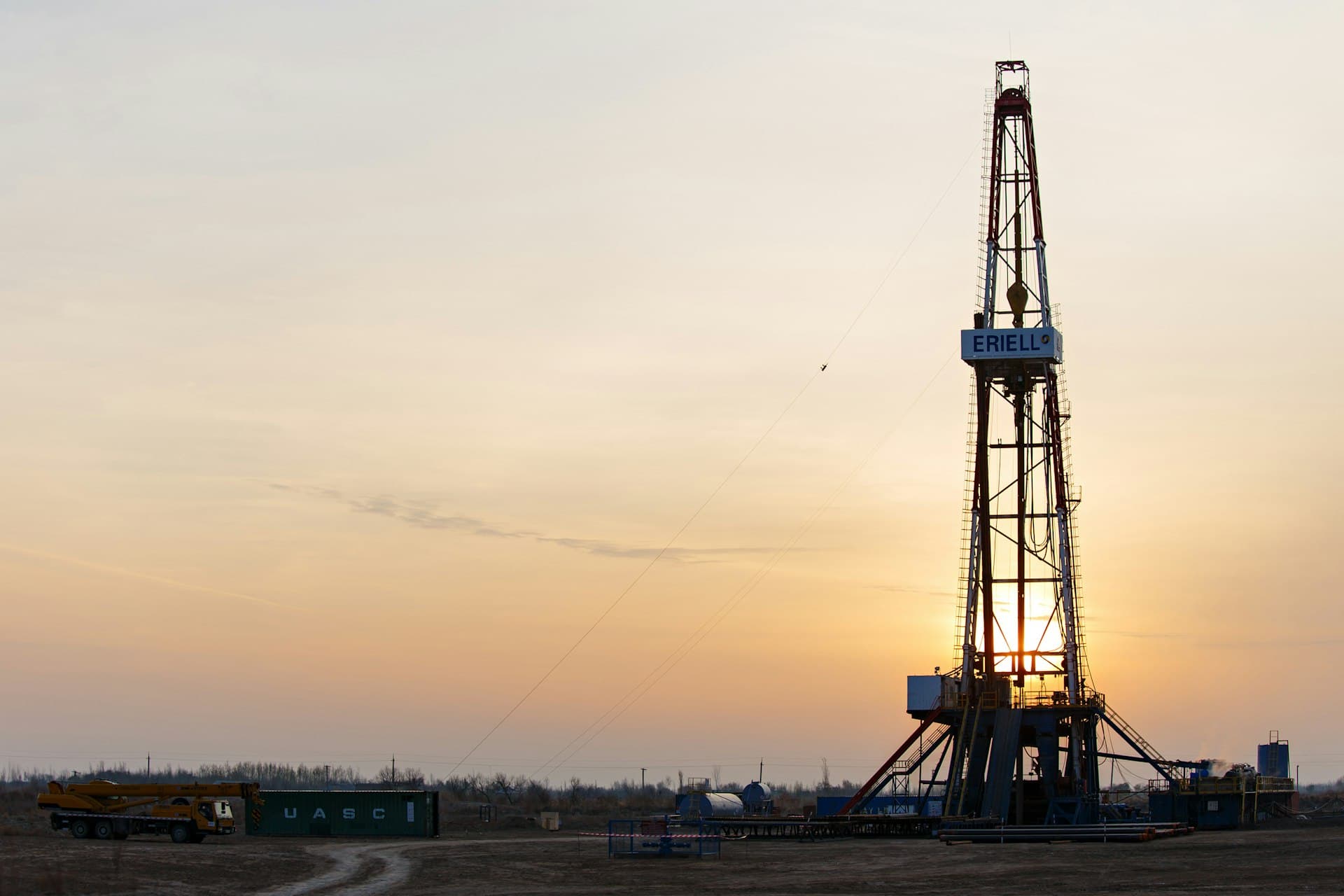
Shale flowback water can reach 300,000 mg/L TDS in tight formations, far beyond conventional treatment. The technology options, cost structures, and regulatory framework for operators choosing between treatment, reuse, and disposal.
Shale flowback water is among the most difficult water treatment challenges in any industry, not because the technologies to handle it do not exist, but because the composition changes dramatically over time, the volumes are large, the logistics are complex, and the regulatory framework varies by state or country in ways that fundamentally change the available options. An operator who approaches flowback management as a fixed-specification water treatment problem will find that the specification they designed for in week 1 is unrecognisable by week 12, and the treatment system that was working is now overwhelmed or undersized for the new water chemistry.
Shale flowback water can reach total dissolved solids concentrations of 300,000 mg/L in tight oil formations, ten times the salinity of seawater. At those concentrations, reverse osmosis does not work, conventional biological treatment does not work, and even evaporation ponds face regulatory opposition. The practical choices narrow to injection disposal, advanced thermal treatment, or on-site reuse for the next fracturing job, and the right answer changes depending on the basin, the regulatory regime, the water volumes, and the available infrastructure.
This guide covers what shale flowback water is, how its composition evolves from early flowback through to long-term produced water, the treatment options at each stage, the economics of each option, and the regulatory context that determines what is actually available to operators in major shale basins.
## The decision in brief
- Recycle and reuse 70% of flowback and produced water on site. A mid-size Permian operator producing 20,000 barrels per day pays approximately $1 to $2.50 per barrel for SWD disposal, or $20,000 to $50,000 per day. - Reuse cuts disposal cost by $14,000 to $35,000 per day. Recycling 70% of that volume reduces disposal costs by $14,000 to $35,000 per day, and a facility handling 14,000 barrels per day with solids removal, iron treatment and biocide costs $3 to $8 million. - Payback is 3 to 7 months. At $14,000 to $35,000 per day in disposal savings, the $3 to $8 million facility pays back in 3 to 7 months, which is why the calculation belongs in every annual review.
Operators not running this calculation annually are leaving between $5 million and $12 million per year on the table per production facility.
## What makes shale flowback water different
Shale formations require hydraulic fracturing, pumping millions of gallons of water mixed with proppant and chemical additives at high pressure to crack the rock and release hydrocarbons. The fluid that returns to the surface when pressure is released is called flowback water. It is a mixture of the original fracturing fluid, which comes back in the first days, and progressively larger proportions of the deep formation water, which comes back over weeks and months and is much more saline.
The characteristics that distinguish flowback water from other industrial wastewater are the extraordinary salinity range (from near-fresh in the earliest flowback to hypersaline later), the presence of naturally occurring radioactive material (NORM) from formation [radium](/elements/radium) and [barium](/elements/barium), high concentrations of barium and strontium that form scale-generating sulphate precipitates when mixed with sulphate-containing waters, high concentrations of dissolved organics including BTEX (benzene, toluene, ethylbenzene, xylene), and the presence of fracturing fluid additives including friction reducers, biocides, and scale inhibitors.
The combination of very high TDS with scale-forming ions, radioactivity, and volatile organics means that conventional wastewater treatment, biological treatment, conventional clarification, or standard RO, is not applicable in most cases. The treatment approach must be specifically designed for hypersaline, radioactive, scale-prone water.
The [produced water treatment options for oil and gas](/resources/produced-water-treatment-oil-gas) guide covers the longer-term produced water management challenge. Flowback is the initial phase of that challenge, with more rapidly changing composition and typically higher volumes relative to production in the first 30 to 90 days.
## The flowback composition profile over time
Understanding how flowback water composition changes over time is the key to designing a treatment and management programme that works at every stage of the well's life.
In the first 1 to 7 days after fracturing, the returned fluid is predominantly fracturing fluid with TDS typically in the range of 1,000 to 30,000 mg/L. The main concerns in this early flowback are the fracturing fluid additives, which include biocides, scale inhibitors, and friction reducers, and residual hydrocarbons. This water is often suitable for reuse in the next fracturing operation with minimal treatment if the additive profile is compatible.
From day 7 to approximately day 90, the flowback transitions progressively from fracturing fluid chemistry to formation water chemistry. TDS rises from 30,000 to 100,000 mg/L. Barium and strontium concentrations increase sharply (barium from less than 100 mg/L to more than 5,000 mg/L in Marcellus and Permian formations), calcium and magnesium increase, and NORM levels rise. This transitional phase is the most difficult for treatment design because the water chemistry changes faster than a fixed treatment system can adapt.
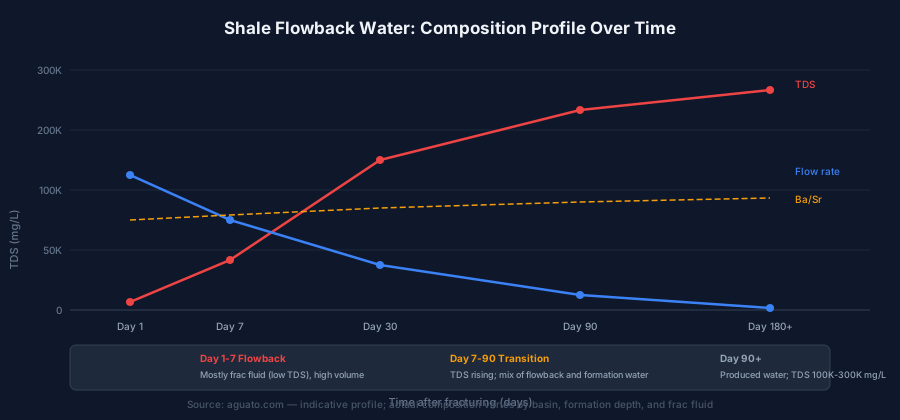
After 90 days, the returned water is predominantly formation water and is properly called produced water. TDS may be 100,000 to 300,000 mg/L in deep tight formations. Barium and strontium reach their peak concentrations. NORM activity is at its highest. This is the long-term produced water management challenge that extends for the life of the well.
According to [USEPA research on hydraulic fracturing water cycle impacts](dofollow:https://www.epa.gov/hfstudy), flowback water from shale gas wells in the Marcellus formation had median TDS of approximately 89,000 mg/L and median chloride concentrations above 40,000 mg/L, with significant formation-to-formation variation. These concentrations are the starting point for any treatment system specification.
## Treatment option overview
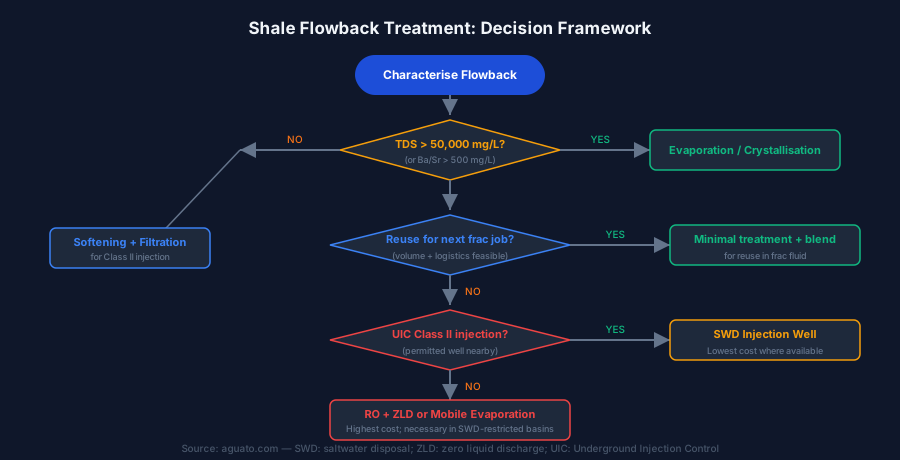
The treatment options for shale flowback and produced water span a wide range of cost and complexity. The fundamental division is between minimise-and-dispose approaches (injection wells, evaporation ponds where permitted) and treat-for-reuse approaches (filtration and conditioning for frac reuse, thermal treatment for beneficial reuse or ZLD).
Reuse for fracturing: Direct reuse of flowback water in subsequent fracturing operations is the lowest-cost option and the fastest-growing management approach in the Permian and Marcellus basins, driven by water scarcity, disposal well constraints, and improved frac fluid formulations that can tolerate higher TDS feed. Treatment requirements are minimal: solids removal, biocide addition, and iron removal to prevent pipe and formation damage. This approach can handle TDS up to 200,000 mg/L in some frac designs.
Saltwater disposal (SWD) wells: Class II underground injection well disposal is the most common management approach in basins with adequate injection well capacity. The water requires minimal treatment (solids removal to prevent well plugging) and the cost is $0.50 to $2.50 per barrel. The constraint is injection well availability and capacity, which is under pressure in mature basins, and the regulatory limitation that volume-induced seismicity is associated with high-volume SWD in some geological settings.
RO treatment: Reverse osmosis can treat flowback water up to approximately 50,000 mg/L TDS. Above that level, osmotic pressure exceeds economically practical operating pressure for conventional RO membranes. High-pressure RO (HPRO) extends the range to approximately 70,000 mg/L TDS. For early-stage flowback (first 7 to 30 days), RO is technically feasible if the water is properly pre-treated for scale and solids.
Thermal evaporation and crystallisation: For high-TDS flowback and produced water above the RO range, thermal technologies are the only route to zero liquid discharge or beneficial reuse of the concentrated brine. Mechanical vapour recompression (MVR) evaporators and crystallisers can handle TDS from 50,000 to saturation, producing a distillate of near-fresh quality and a salt or mineral product. Cost is $3 to $15 per barrel treated, which is prohibitive unless there is a beneficial reuse pathway for the distillate that offsets treatment cost.
Mobile treatment units: For operators without infrastructure for permanent treatment systems, mobile and modular treatment units can be deployed at the wellpad and moved between sites. Mobile evaporators, RO skids, and clarification systems are commercially available, typically on a service contract basis at $2 to $8 per barrel.
[cta:nepti-dark]
## Reuse in subsequent fracturing operations
Direct reuse is now the preferred management approach in water-stressed basins where SWD well capacity is constrained. The Permian Basin in Texas treats and reuses a significant proportion of produced water in new fracturing operations, avoiding both the cost of freshwater purchases and SWD disposal fees.
The water quality requirements for reuse in fracturing depend on the frac design. Traditional slick-water fracs using guar or friction reducers work best with low TDS water below 20,000 mg/L, but crosslinked gel fracs are more salt-tolerant and some are formulated specifically for high-TDS produced water reuse. The key quality targets for reuse are: TSS below 50 mg/L (to prevent formation damage), iron below 20 mg/L (to prevent iron fouling of frac fluid), barium and strontium management to avoid sulphate-barium precipitation when blended with make-up freshwater, H2S below detectable levels if iron-containing frac additives are used, and biocide residual to prevent microbiological fouling.
The [zero liquid discharge technology guide](/resources/zero-liquid-discharge) is relevant when reuse reaches its limit and disposal is also restricted, as some operators in the Marcellus and Appalachian basins have faced.
## Saltwater disposal (SWD) injection wells
Class II injection wells under the EPA's Underground Injection Control (UIC) programme are the safety valve of the US flowback management system. The vast majority of produced and flowback water in the US goes to permitted Class II SWD wells. The process requirements are minimal (solids filtration to prevent plugging the injection zone) and the cost is low.
The constraint on SWD is capacity and induced seismicity. The USGS has documented elevated seismic activity in areas with high-volume SWD operations in Oklahoma, Texas, and Ohio, and several states have imposed volume limits on SWD wells near identified fault systems. As the most accessible SWD wells fill up and new ones face regulatory scrutiny, operators are increasingly looking at reuse and treatment options that were not economically competitive when disposal cost $0.50 per barrel.
According to [EPA's Underground Injection Control programme](dofollow:https://www.epa.gov/uic), Class II wells are specifically permitted for injection of brines associated with oil and gas production. The UIC permit sets injection pressure limits, injection rate limits, and monitoring requirements that operators must comply with. A SWD well that exceeds its permitted injection pressure or triggers a seismicity protocol can be shut down by the state authority, leaving the operator without a disposal route.
For [brine management and disposal](/resources/brine-management-disposal) beyond what SWD accommodates, the options escalate rapidly in cost and regulatory complexity.
## Advanced treatment for beneficial reuse or discharge
Beneficial reuse and surface discharge of treated flowback water are both technically feasible and economically challenging. The treatment train required to reach municipal effluent quality from Marcellus produced water with 80,000 mg/L TDS is: solids removal, NORM removal (usually by precipitation or ion exchange), heavy metal removal, organics treatment, RO or thermal evaporation for TDS reduction, and final polishing. The capital cost of such a system for a 5,000 barrel per day facility is $5 to $20 million, and the OPEX is $5 to $15 per barrel treated, making it economically viable only where freshwater has a high market value or where disposal alternatives are expensive and restricted.
Several states including Pennsylvania, West Virginia, and Ohio have enacted NORM-specific regulations that add a radiological treatment and disposal requirement to any treatment system handling Marcellus produced water. The radium precipitate generated in conventional lime softening is classified as Technologically Enhanced Naturally Occurring Radioactive Material (TENORM) and requires disposal at licensed radiological waste facilities, adding $2 to $8 per barrel to the treatment cost.
## NORM management: the regulatory complication most operators underestimate
Naturally occurring radioactive material is present in the formation waters of most shale plays at concentrations that, while much lower than industrial radioactive sources, require specific management once they are concentrated by the treatment process. Radium-226 and radium-228 are the primary NORM constituents. They are naturally present in deep formation brines and do not pose a significant health risk in produced water at the concentrations typically encountered. The management challenge arises when NORM accumulates in scale deposits on the inside of pipes and treatment vessels, in the sludge from water treatment processes, and in the filter media used for solids removal.
The threshold that triggers TENORM regulatory requirements varies by state. In Pennsylvania, the threshold is 5 picocuries per gram (pCi/g) for radium-226 plus radium-228. In Texas, the threshold is 15 pCi/g. Scale deposits in Marcellus produced water treatment systems have been measured at several thousand pCi/g in some installations. These are classified as TENORM and cannot be disposed of in conventional industrial waste streams.
The practical implications for flowback water treatment project planning are: radium characterisation must be included in the initial water quality analysis, treatment system materials in contact with the water must be selected for ease of decontamination, sludge disposal contracts must specify TENORM acceptance and include the appropriate licensed disposal facility, and regulators in the relevant state must be consulted about NORM notification and disposal requirements before the treatment system is commissioned.
NORM management adds $1.50 to $5.00 per barrel to the treatment cost in high-NORM basins, primarily from the elevated disposal cost for TENORM waste. Operators who do not account for this in the project economics will face an unexpected cost when the first sludge sample comes back above threshold. The [industrial water risk assessment](/resources/industrial-water-risk-assessment) approach should always include a radiological screening as part of the initial water characterisation in any basin where produced water is known to carry NORM.
For treatment systems handling NORM-bearing water, activated carbon media and filter sand that accumulates radium must be replaced more frequently than in non-NORM applications, and the spent media must be managed as TENORM. The frequency of media replacement and the associated cost is a significant OPEX item that the project economics must incorporate.
## Technology and cost comparison
| Treatment approach | TDS range handled | Typical cost (USD/bbl) | Best application | |---|---|---|---| | Reuse (minimal treatment) | Up to 200,000+ mg/L | 0.10 to 0.50 | Water-stressed basins, pad drilling | | SWD injection (Class II) | No limit | 0.50 to 2.50 | US basins with available wells | | RO treatment | Up to 50,000 mg/L | 2.00 to 5.00 | Lower-TDS early flowback for reuse/discharge | | Mobile evaporation | No practical limit | 3.00 to 8.00 | Remote sites, temporary operations | | ZLD (evaporation + crystallisation) | No practical limit | 6.00 to 15.00 | Restricted basins, beneficial reuse goals |
## Mobile treatment units and shared infrastructure
Mobile treatment units have become a significant part of the flowback water management toolkit, particularly for operators drilling multiple wells on a pad who need treatment capacity at the wellsite but cannot justify permanent infrastructure for a well's limited life. Mobile evaporators, clarification skids, and RO trailer units are available from specialty service companies on a contract basis, typically priced by volume treated rather than as capital equipment purchases.
The business model for mobile treatment is that the service company owns and operates the equipment, providing a fully staffed turnkey water treatment service. This converts the treatment cost from capital expenditure with operational complexity into a service fee, which matches the cash flow profile of a drilling programme better than owned infrastructure. The trade-off is the per-barrel cost, which at $2 to $8 per barrel is higher than owned infrastructure for operators with stable, long-term production.
For wildcat exploration wells or appraisal wells where the production profile is uncertain, mobile treatment allows an operator to manage flowback water without committing to infrastructure that may not be needed if the well is not developed. This is an application of the CAPEX vs OPEX framework from [water treatment economics](/resources/water-treatment-capex-opex): when the operational need is uncertain and the duration is short, the higher-OPEX mobile service beats the lower-OPEX owned infrastructure on net present value.
Shared water treatment infrastructure, where multiple operators in the same basin share a central treatment facility, is an emerging model in mature, high-density shale plays. The Permian Basin has several commercial produced water treatment and recycling networks that accept produced water from multiple operators, treat it to frac-quality standards, and sell it back as frac water at below the cost of freshwater. This creates a market for produced water that incentivises treatment and reuse rather than disposal, and it reduces the treatment cost for individual operators who lack the scale to justify owned infrastructure.
## Regulatory landscape by basin
The regulatory framework for flowback water management varies significantly by state and basin.
Permian Basin (Texas/New Mexico): Texas Railroad Commission (RRC) regulates SWD wells. No surface discharge of produced water is permitted in Texas. Reuse is actively encouraged. SWD well capacity is under pressure in some parts of the Delaware Basin.
Marcellus/Utica (Pennsylvania/Ohio/West Virginia): Pennsylvania DEP has restricted SWD well injection in many parts of the state due to geological concerns, making reuse the primary management strategy. Pennsylvania also has specific NORM management requirements for Marcellus water. Ohio allows SWD but monitors for induced seismicity.
Bakken (North Dakota/Montana): Large SWD capacity exists. North Dakota allows a more permissive disposal regime than eastern US basins. NORM management requirements are less stringent than Marcellus equivalents.
EU and UK: There is limited hydraulic fracturing activity in the EU (France and Germany have bans; UK has a moratorium). Where it does occur, [EU industrial discharge regulations](/resources/industrial-wastewater-discharge-regulations) apply, and surface discharge of produced water faces very stringent standards under the Water Framework Directive.
## Pilot testing and characterisation before committing to a treatment approach
The capital investment in a flowback water treatment facility, whether owned infrastructure or a long-term mobile service contract, requires a characterisation programme that goes beyond the basic water chemistry analysis. A proper pre-design characterisation programme for a new shale play or a new producing zone within an existing play includes: full water chemistry analysis from multiple wells at multiple points in time during flowback (days 1, 7, 30, and 90 minimum), bench-scale treatability testing for the proposed treatment technologies, evaluation of the interaction between the flowback water and the specific treatment chemicals proposed, and a NORM characterisation as discussed above.
Treatability testing for reuse scenarios should specifically test: whether the flowback water is compatible with the proposed frac fluid design when blended with freshwater at the intended blend ratio, whether scale forms at the blending ratio due to sulphate-barium or calcium-carbonate reactions, and whether the residual fracturing fluid additives in the flowback interfere with the performance of the new frac fluid. These tests are inexpensive relative to the cost of discovering compatibility problems after the treatment system is in operation.
For disposal scenarios, the permitted injection zone must be characterised for compatibility with the treated water chemistry. Barium sulphate precipitation can plug an injection well as effectively as it plugs surface pipework, and a water chemistry that is acceptable for surface handling may be incompatible with a specific injection formation. The injection zone compatibility test should be part of the UIC Class II permit application, not an afterthought.
The most effective risk mitigation in flowback water treatment is characterisation before design, not re-engineering after commissioning. The cost of a comprehensive characterisation programme, typically $50,000 to $200,000, is a fraction of the cost of redesigning or retrofitting a treatment system that was specified without adequate characterisation.
## Where flowback treatment programmes fail
Treating to a static specification. A treatment system designed for week-1 flowback chemistry is overwhelmed or ineffective by week-12, when TDS has risen by a factor of 10. The treatment programme must be designed as a dynamic system that adapts to the evolving water chemistry, not a fixed plant tuned to one set of parameters.
Underestimating NORM. Operators who characterise their flowback water for the obvious parameters (TDS, chloride, barium) and do not test for radium-226 and radium-228 discover the NORM issue when their treatment sludge is classified as TENORM and they have no approved disposal route. NORM characterisation must be part of the initial water analysis programme.
Assuming SWD availability. A project plan built around SWD disposal with no contingency for disposal well capacity constraints is a risk. Operators who have had disposal wells shut down for seismicity reasons, injection pressure exceedances, or permit issues mid-project face treatment and logistics crises at exactly the point when production is ramping up.
Barium-sulphate scaling. When flowback water with high barium concentration is blended with freshwater or surface water that contains sulphate, barium sulphate precipitates almost instantaneously. This precipitation occurs in flowlines, tanks, and treatment equipment, causing blockages that shut down operations. Scale inhibitor selection and dosing for barium-sulphate management is a critical, non-optional part of any treatment programme handling Permian or Marcellus produced water.
[Explore produced water treatment solutions and find providers specialising in flowback management on the Aguato marketplace](/providers).
## FAQ
### What is the difference between flowback water and produced water?
Flowback water is the fluid that returns to the surface in the days to weeks immediately after hydraulic fracturing, primarily consisting of the fracturing fluid mixed with formation water. Produced water is the long-term brine that comes up with hydrocarbons throughout the life of the well. The distinction matters for treatment because flowback water changes composition rapidly, while produced water reaches a relatively stable, high-TDS composition after 90 to 180 days.
### Can shale flowback water be treated to drinking water standards?
Technically yes, using thermal treatment (MVR evaporation plus polishing), but the cost is $6 to $15 per barrel, which makes it economically viable only in acute water-scarcity contexts or where regulatory pressure eliminates lower-cost options. In practice, the recovered distillate is more commonly used for agricultural irrigation or industrial reuse rather than potable water production.
### Why is barium important in flowback water treatment?
Barium at high concentrations (typically above 500 mg/L) in flowback water creates a severe scaling risk when the water is blended with any sulphate-containing water, because barium sulphate (barite) precipitates almost instantaneously and is very difficult to remove once it forms. Scale inhibitor selection for barium sulphate is one of the most critical design decisions in flowback water management.
### What is NORM in the context of flowback water?
NORM stands for naturally occurring radioactive material. Formation waters in many shale plays, particularly the Marcellus in Pennsylvania and some Permian zones, contain elevated concentrations of radium-226 and radium-228 that co-precipitate with barium sulphate scale. When this scale accumulates in treatment equipment, it is classified as TENORM (technologically enhanced NORM) and requires licensed radiological waste disposal.
### What is the cheapest way to manage shale flowback water?
In basins with available SWD well capacity, Class II injection disposal at $0.50 to $2.50 per barrel is typically the cheapest option. Where SWD is constrained, direct reuse in subsequent fracturing operations with minimal treatment is the next most cost-effective approach. The economics of reuse improve significantly in pad-drilling programmes where multiple wells are being fractured in sequence at the same location.
### Is hydraulic fracturing water management regulated at the federal level in the US?
Yes and no. The EPA's Underground Injection Control programme under the Safe Drinking Water Act regulates Class II disposal wells at the federal level. But the management of flowback water on the surface, including storage, treatment, and transportation, is primarily regulated at the state level under each state's oil and gas programme. This creates significant variation in what is permitted and required across different shale plays.