The discharge permit, not the process, drives your treatment plant. Miss a consent limit and the exposure runs $100K to several million per event. Here is how EU, US, China, and emerging-market rules shape plant design.
Industrial wastewater discharge is the one operational decision where the regulator, not the market, sets the price of getting it wrong. Miss a discharge consent limit at a manufacturing site and the exposure runs USD 100,000 to several million per event in fines, mandated production curtailment, consultant-led remediation, and the slow-burn cost of a regulator who now inspects you more often than your competitors. The permit limits look like a compliance footnote at the design stage. They are, in reality, the single biggest determinant of your treatment plant's size, technology, and 15-year operating cost, and they differ enough across the EU, the United States, China, and the emerging markets that a plant designed for one jurisdiction can be illegal in another.
This guide is written for the people who have to live with the consequences of the discharge decision: environmental compliance managers who sign the self-monitoring returns, plant managers who absorb the cost of an exceedance, procurement leads scoping a treatment plant against a consent they may not fully understand, and sustainability directors who have to reconcile the discharge permit with the corporate ESG commitments. It maps the major regulatory frameworks, explains how a permit limit actually translates into a treatment specification, walks through the discharge-route decision that drives the whole project, and quantifies what non-compliance costs when it happens.
## The decision in brief
- Read the binding discharge consent before you design the plant. With effluent characterised across the full production cycle rather than a quiet day, and the discharge route locked at the brief stage, you avoid the two most expensive outcomes in industrial wastewater. - Price the exceedance and the overrun. The first is a USD 100K to several-million exceedance event that curtails production and brings the regulator in, and the second is an 80%-plus capital overrun from a discharge-route or design decision made too late to be cheap. - Design to the regulatory worst case, not the average. The treatment itself is a known cost, USD 0.40 to several dollars per cubic metre depending on the route, and an exceedance costs an order of magnitude more than the margin you saved by not building it in.
The cost of doing nothing is designing to the average instead of the regulatory worst case, because that single shortcut is the upstream cause of most exceedances.
## Why the discharge permit, not the process, drives the plant design
The most expensive misconception in industrial wastewater is that the treatment plant is designed around the manufacturing process. It is not. It is designed around the gap between what the process produces and what the regulator will allow to leave the site. That gap is the entire job of the plant, and the regulator defines one end of it. A process producing 3,000 mg/L COD effluent needs a radically different plant depending on whether the discharge consent is 1,000 mg/L (to sewer) or 125 mg/L (to a river), and the cost difference between those two plants can be a factor of three.
This is why reading the permit is the first engineering task on any wastewater project, before any technology is selected. The permit specifies not just the concentration limits but the load limits (kg/day, which interact with your flow), the monitoring frequency, the sampling method (grab versus composite), and the consequences of an exceedance. Two sites with identical processes and identical effluent can need completely different plants because their permits differ, and a plant designed without reading the binding consent carefully is a plant designed to the wrong target.
An opinionated view that holds across markets: most industrial wastewater plants are designed to the wrong number because the design brief used the average effluent quality, not the regulatory worst case. The regulator does not sample your average. The regulator samples whenever it wants, including on your worst production day, and the consent applies to that sample. A plant sized for average load and average concentration will fail compliance during the peaks, which is precisely when the automatic sampler is most likely to be running. The defensible design is built to the regulatory worst case, with a documented margin, not to the comfortable average. This is the same discipline that governs any well-run [industrial wastewater treatment](/resources/industrial-wastewater-treatment) project.
[cta:nepti-dark]
The corollary is that the discharge route, the choice between treating to a river limit, treating to a sewer limit, or eliminating discharge entirely, is a strategic decision that should be made at the brief stage, because it determines everything downstream. Make it late, after the plant is half-designed, and the project doubles. The frameworks that govern that choice differ by jurisdiction, and the next section lays them out.
## The major regulatory frameworks: EU, US, China, and emerging markets
Industrial wastewater is regulated through four broadly distinct frameworks, and a company operating across regions has to design to whichever is tightest, or maintain different plant specifications per site. Understanding the structure of each framework is the foundation of a defensible multi-site compliance strategy.
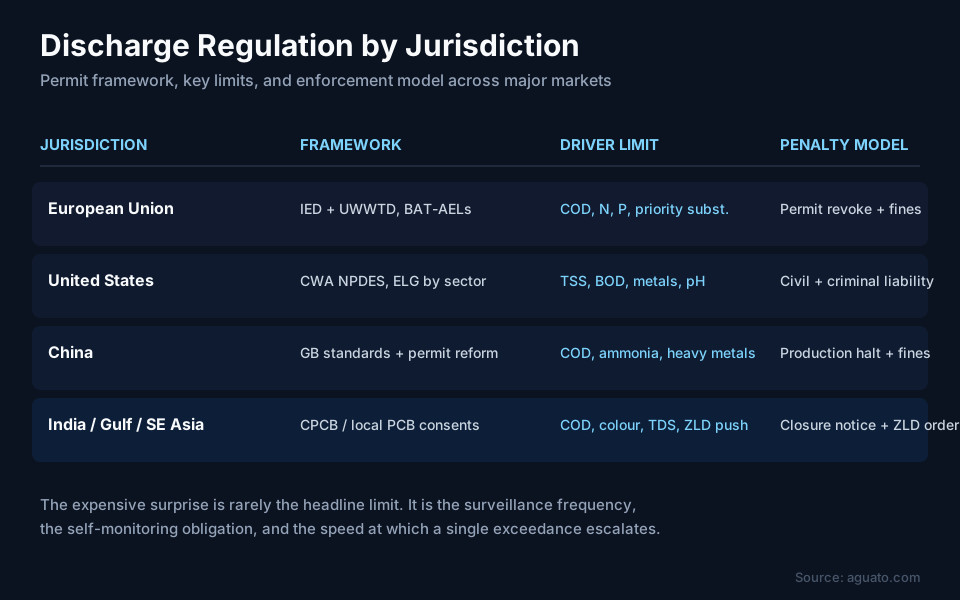
The European Union regulates industrial discharges primarily through the Industrial Emissions Directive (IED) and, for discharges to municipal systems, the Urban Waste Water Treatment Directive. The defining feature of the EU approach is Best Available Techniques (BAT): for each industrial sector, the EU publishes BAT Reference Documents that set BAT-Associated Emission Levels (BAT-AELs), and a site's permit limits are derived from these. The practical consequence is that the EU limits track the best demonstrated technology in your sector, and they tighten over time as the BAT documents are revised. The [European Commission's Industrial Emissions Directive framework](dofollow:https://environment.ec.europa.eu/topics/industrial-emissions-and-safety/industrial-emissions-directive_en) is the document that ultimately governs a permit limit, and it is the reference compliance teams should be working from rather than a vendor's catalogue figures.
The United States regulates discharges through the Clean Water Act, primarily via the National Pollutant Discharge Elimination System (NPDES) permit programme. For direct dischargers, the EPA and delegated states issue NPDES permits with technology-based Effluent Limitation Guidelines (ELGs) specific to each industrial category, overlaid with water-quality-based limits where the receiving water is impaired. The US system is notable for its enforcement teeth: the Clean Water Act carries both civil and criminal liability, and the per-day, per-violation penalty structure can compound an exceedance into a very large number quickly. The [US EPA NPDES permit programme](dofollow:https://www.epa.gov/npdes) sets out the permitting and enforcement structure that every US direct discharger operates under.
China has moved from a relatively loose enforcement regime to one of the strictest in practice over the past decade. Discharges are governed by national GB standards (general and sector-specific), implemented through a discharge permit system that has been progressively tightened. Chinese enforcement increasingly includes production halts for non-compliant facilities, real-time online monitoring connected to the regulator, and an aggressive push toward zero liquid discharge in water-stressed regions and sensitive catchments. For multinational operators, China is now often the binding constraint on plant design.
Emerging markets (India, Southeast Asia, the Gulf, parts of Latin America and Africa) vary widely, but a common pattern is a national framework implemented through local or state pollution control boards with significant discretion. India's Central Pollution Control Board and state boards, for example, can issue closure notices and increasingly mandate zero liquid discharge for specific water-intensive sectors such as textiles. The enforcement intensity in these markets has risen sharply, and the assumption that emerging-market discharge rules are loosely enforced is dangerously outdated. The [World Bank guidance on industrial effluent and pollution prevention](dofollow:https://www.ifc.org/en/insights-reports/2000/general-ehs-guidelines) sets the baseline that many of these national frameworks and international lenders reference when they assess a site's discharge controls.
## How a permit limit becomes a treatment specification
A permit limit is a number. Turning it into a plant is a chain of engineering decisions, each of which can be done well or expensively, and understanding that chain is what lets a procurement team pressure-test a vendor's proposal rather than accept it on trust.
The chain starts with characterisation. You cannot design to a limit until you know your effluent: the full panel of regulated parameters (COD, BOD, suspended solids, [nitrogen](/elements/nitrogen) species, [phosphorus](/elements/phosphorus), metals, priority substances, pH, temperature, colour, and any sector-specific contaminants), the flow profile (average, peak, and the duration of peaks), and the variability across production cycles. Characterisation done badly, a single grab sample on a quiet day, is the root cause of most undersized plants. Characterisation done well, a composite sampling campaign across the full production cycle, is the foundation of a plant that holds compliance.
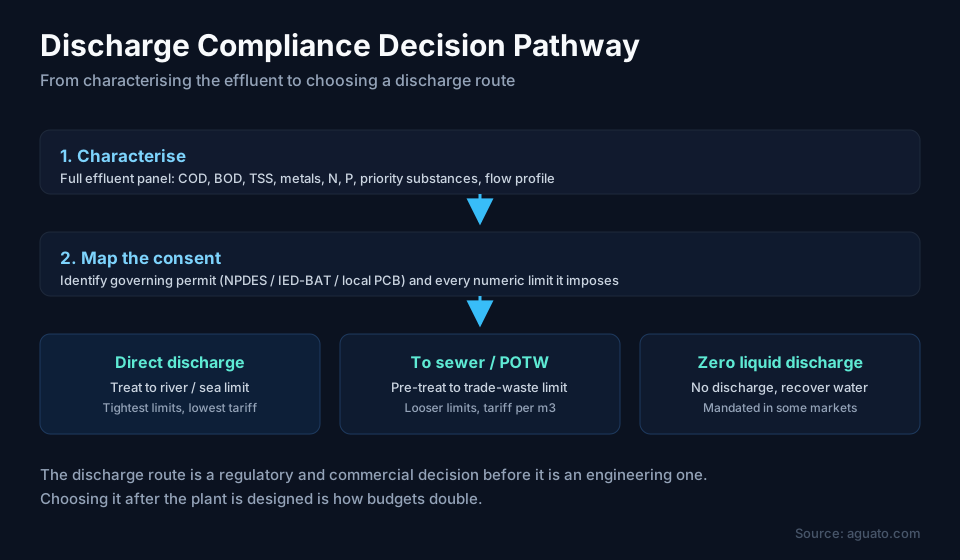
From the characterisation and the consent, the design derives the required removal for each parameter, and that determines the treatment train. A modest COD reduction to a sewer limit might need only primary treatment and dissolved air flotation. A deep COD and nitrogen reduction to a sensitive-river limit needs biological treatment with nitrification and denitrification, tertiary polishing, and often [advanced oxidation processes](/advanced-oxidation-processes-companies) for the recalcitrant fraction. Each parameter that has to be driven low adds a unit operation, and the binding parameter, the one that requires the most aggressive treatment, sets the plant's cost.
The discipline that separates a good design from an expensive one is to identify the binding constraint early and design the whole train around it, rather than over-treating every parameter to be safe. A plant that drives COD to 50 mg/L when the consent is 125 mg/L is spending capital and energy to achieve a margin nobody asked for. The right margin is documented, risk-based, and applied to the binding parameter, not gold-plated across the board. Running a [Nepti decision intelligence model](/resources/nepti-decision-intelligence-water-treatment) on the characterised effluent against the consent limits surfaces the binding constraint before any vendor scope is written.
## Direct discharge vs sewer vs zero liquid discharge
The discharge-route decision is the highest-leverage choice in the entire project, because the three routes impose completely different treatment targets and completely different cost structures. Getting this decision right at the brief stage can halve the project cost; getting it wrong, or making it late, routinely doubles it.
Direct discharge to surface water (a river, lake, or the sea) carries the tightest limits, because the receiving environment has the least capacity to dilute and assimilate. A direct-discharge consent will specify low COD, low BOD, tight nitrogen and phosphorus limits in sensitive catchments, and often colour and ecotoxicity limits. The plant has to do the entire job. The compensating advantage is that there is no ongoing trade-waste tariff: once the capital is sunk, the marginal cost of discharge is just the operating cost of the plant. Many sites discharging to surface water build toward an [effluent treatment plant](/effluent-treatment-plants) sized for the full removal duty.
Discharge to sewer (to a municipal Publicly Owned Treatment Works or its equivalent) carries looser limits, because the downstream municipal plant does the polishing. The site pre-treats to a trade-waste consent (typically a higher COD limit, controlled pH, no toxic loads that would upset the municipal biology) and pays a volumetric tariff plus often a load-based surcharge. The trade-off is the ongoing tariff, which can run USD 1 to 5 per cubic metre and which is exposed to municipal price increases over the plant's life. For low-strength, low-volume effluents, sewer discharge is almost always the cheaper lifecycle answer; for high-strength or high-volume effluents, the tariff compounds into a number that justifies on-site treatment.
Zero liquid discharge (ZLD) eliminates the liquid discharge entirely, recovering the water and concentrating the contaminants to a solid or near-solid residue. ZLD is the most expensive route by a wide margin, with treatment costs often several times the direct-discharge cost per cubic metre, but it is increasingly mandated rather than chosen, particularly in water-stressed regions and for specific sectors in China and India. The economics of ZLD only close when the recovered water has high value or when the alternative is no permit at all. The [zero liquid discharge vs minimal liquid discharge cost comparison](/resources/zld-vs-mld-cost-comparison) lays out where the crossover sits and where minimal liquid discharge is the defensible middle path.
The decision between these three is a regulatory and commercial decision before it is an engineering one, and it should be made with all three options costed on the same flow, the same characterised effluent, and the same 15-year horizon. The vendors who only price one route are usually telling you about their commercial preference, not the optimal answer for your site.
## The parameters regulators actually enforce
Not every parameter in a permit carries the same enforcement weight, and understanding which ones the regulator actually pursues is the difference between a plant that holds compliance and one that holds a documentation burden.
Organic load (COD and BOD) is the parameter most consents are built around, because it is the proxy for the oxygen-depleting potential of the discharge. COD is the faster, more reliable measurement and is increasingly the primary regulated parameter. A plant's biological stage is sized around the COD removal duty, and a COD exceedance is the most common compliance failure because it is the most sensitive to load variability.
Suspended solids (TSS) is enforced because it carries both a direct ecological impact and a load of adsorbed contaminants. TSS limits are usually straightforward to meet with adequate clarification and filtration, but TSS exceedances during peak hydraulic events (when biomass escapes the clarifier) are a common failure mode.
Nutrients (nitrogen and phosphorus) are tightly regulated in sensitive catchments because they drive eutrophication. Total nitrogen and total phosphorus limits in sensitive areas can be very tight, and meeting them requires dedicated nitrification, denitrification, and phosphorus removal stages that add significant cost. Nutrient limits are often the binding constraint that determines whether a plant needs a tertiary stage.
Metals and priority substances are enforced with the least tolerance, because they are persistent, bioaccumulative, and often toxic. A metals exceedance is treated far more seriously than a COD exceedance by most regulators, and sectors with metal-bearing effluents (metal finishing, mining, tanning) face the tightest scrutiny. Specialised removal such as [heavy metals removal](/resources/heavy-metals-removal-water) and, increasingly, [PFAS removal](/resources/pfas-removal-water-treatment) are where the regulatory frontier is moving fastest.
pH, temperature, and colour round out the commonly enforced set. pH is a continuous-monitoring parameter on most consents. Temperature limits protect receiving-water ecology. Colour, once a cosmetic concern, is now a hard limit in many textile and chemical sectors. Each of these can be the parameter that fails an otherwise-compliant discharge.
## Self-monitoring, reporting, and the surveillance burden
The compliance cost is not only the treatment plant. It is also the ongoing surveillance obligation, and on many modern permits the surveillance burden is a significant operating cost in its own right that projects routinely underestimate.
Most industrial discharge consents now require self-monitoring: the operator measures the regulated parameters at a specified frequency, records the results in a defensible data system, and submits periodic returns to the regulator. The frequency ranges from monthly grab samples on a low-risk discharge to continuous online monitoring of COD, pH, flow, and other parameters with the data streamed directly to the regulator in real time, which is now standard in China and increasingly common elsewhere. The capital cost of an online monitoring installation runs USD 8,000 to 35,000 per parameter, and the calibration and maintenance burden is continuous.
The data integrity dimension is where this gets expensive. A self-monitoring regime is only as good as its data, and regulators increasingly audit the data system itself, not just the results. A gap in the monitoring record, a calibration that lapsed, or a data point that cannot be defended is treated as a compliance failure in its own right in many jurisdictions. Building a robust [industrial water quality monitoring](/resources/water-quality-monitoring-online-vs-lab) regime, with the right balance of online and laboratory analysis, is part of the project scope, not an afterthought, and it should be designed and budgeted alongside the treatment plant.
The surveillance burden also shapes the relationship with the regulator. A site with a clean self-monitoring record and a well-documented data system is inspected less and trusted more. A site with a history of gaps, late returns, or exceedances moves up the regulator's priority list and is inspected more often, sampled more aggressively, and given less benefit of the doubt when something goes wrong. The surveillance record is, over time, a commercial asset or a liability.
## The cost of non-compliance by jurisdiction
The cost of a discharge exceedance is wildly different across jurisdictions, and understanding the local cost structure is essential to sizing the compliance margin correctly. The table below gives indicative ranges for the consequence of a significant, sustained exceedance, not a single minor blip.
| Jurisdiction | Direct penalty | Operational consequence | Escalation risk | |---|---|---|---| | European Union | $50K to $500K+ per case | Permit conditions tightened, BAT review | Permit revocation, prosecution | | United States | $10K to $50K+ per day, per violation | Consent decree, mandated upgrades | Civil and criminal liability | | China | $30K to $300K+ per case | Production halt until compliant | Forced ZLD retrofit, blacklisting | | India / SE Asia | Closure notice + fines | Plant shutdown until remediated | Mandated ZLD, loss of operating consent | | Gulf states | $25K to $250K+ per case | Permit suspension | Loss of environmental clearance |
The numbers in the table are the visible cost. The invisible cost is usually larger: the production curtailment while the plant is brought back into compliance, the consultant and laboratory fees of the investigation, the capital cost of the retrofit the regulator now demands, and the reputational damage that follows a company onto its next permit application and into its ESG reporting. A single significant exceedance can easily generate a total cost ten times the headline fine once all of these are counted, which is the calculus that should drive the compliance-margin decision at the design stage.
## Failure scenarios and what they cost
The undersized biological stage. A food processing plant designs its treatment plant to the average COD load measured in a quiet production week. During the peak season, the COD load doubles, the biological stage cannot keep up, and the discharge exceeds the consent COD limit for several weeks before it is brought under control. The regulator issues an enforcement notice, mandates a consultant-led review, and requires a capacity upgrade. The total cost (fines, investigation, lost production during the partial shutdown, and the USD 200,000 to 600,000 retrofit) runs well into seven figures. The correct decision was to characterise the effluent across the full production cycle and design to the peak.
The late discharge-route decision. A chemical manufacturer designs a treatment plant for sewer discharge, then discovers late in the project that the local municipal works will not accept the load and the only available route is direct discharge to a sensitive river. The plant has to be redesigned for far tighter limits, adding a tertiary stage and advanced oxidation, and the capital cost rises by 80%. The schedule slips by a year. The correct decision was to confirm the discharge route with the municipal authority and the environmental regulator at the brief stage, before any plant design began.
The metals exceedance. A metal-finishing shop's effluent treatment relies on chemical precipitation that is not robust to a process change. A new product line shifts the metal speciation, the precipitation no longer captures it fully, and a routine sample shows a metals exceedance. Because metals are enforced with near-zero tolerance, the regulator responds far more aggressively than it would to a COD blip, suspending the discharge consent until the plant is upgraded. The plant is effectively shut for the duration. The fix (a more robust [industrial wastewater treatment process](/resources/industrial-wastewater-treatment-process) with polishing for the metal fraction) costs USD 300,000 to 800,000, and the lost production during the suspension dwarfs it.
## Real-world examples across three sectors
Industry: textile manufacturing, India. A textile dyeing unit operating under a state pollution control board consent faced a closure notice when its discharge exceeded the colour and COD limits during a production ramp. The state board, as part of a sector-wide push, mandated a move to zero liquid discharge rather than allowing a return to discharge. The unit had to install evaporation and crystallisation to eliminate the liquid discharge, at a capital cost of several million dollars, far more than a compliant discharge plant would have cost if specified correctly from the start. The lesson is that in sectors and regions where ZLD is the regulatory direction of travel, designing a discharge plant that the regulator will later reject is a false economy.
Industry: automotive components, European Union. A components manufacturer operating under an IED permit found its BAT-AEL-derived limits tightened when the sector BAT reference document was revised. The existing plant, compliant under the old limits, no longer met the new ones. The manufacturer had to retrofit a tertiary polishing stage at a cost of USD 1.2 million within the compliance transition period. The lesson is that EU BAT-based limits tighten over time, and a plant designed only to the current limits, with no headroom, is a plant that will need an expensive retrofit at the next BAT revision.
Industry: pharmaceutical manufacturing, United States. A pharmaceutical site discharging under an NPDES permit experienced a process upset that released a slug of high-COD wastewater, producing a single-day exceedance. Because the Clean Water Act penalty structure is per-day and per-violation, and because the site had two earlier minor exceedances on record, the regulator pursued a consent decree requiring a capital upgrade and a multi-year enhanced monitoring programme. The total cost ran past USD 2 million. The lesson is that in the US, a clean compliance record is a financial asset, because the enforcement response to an exceedance scales with the site's history.
## FAQ
### What regulations govern industrial wastewater discharge?
The framework depends on the jurisdiction. The EU uses the Industrial Emissions Directive with Best Available Techniques-derived limits and the Urban Waste Water Treatment Directive for discharges to municipal systems. The United States uses the Clean Water Act through the NPDES permit programme with sector-specific Effluent Limitation Guidelines. China uses national GB standards through a discharge permit system. Emerging markets typically use national frameworks implemented through local or state pollution control boards. A site must comply with whichever framework governs its location.
### What is the difference between direct discharge and discharge to sewer?
Direct discharge to surface water carries the tightest limits because the receiving environment has the least dilution capacity, so the plant must do the entire treatment job, but there is no ongoing trade-waste tariff. Discharge to sewer carries looser pre-treatment limits because the downstream municipal plant does the polishing, but the site pays a volumetric tariff (often $1 to $5 per cubic metre) exposed to future price increases. The choice is a lifecycle-cost decision driven by effluent strength and volume.
### What parameters do regulators enforce most strictly?
Metals and priority substances are enforced with the least tolerance because they are persistent and toxic, so an exceedance triggers a far more aggressive response than an organic-load blip. COD (organic load) is the parameter most consents are built around and the most common exceedance because it is sensitive to load variability. Nutrients (nitrogen and phosphorus) are tightly regulated in sensitive catchments. TSS, pH, temperature, and colour are also commonly enforced, and any one can fail an otherwise-compliant discharge.
### How much does non-compliance with discharge regulations cost?
The direct penalty for a significant exceedance ranges from tens of thousands to several million depending on jurisdiction: the US carries per-day, per-violation penalties with civil and criminal liability; China and India increasingly impose production halts and mandated zero liquid discharge retrofits. The invisible costs (lost production, investigation fees, mandated upgrades, reputational damage) usually exceed the headline fine, so a single significant exceedance can generate a total cost ten times the fine.
### What is zero liquid discharge and when is it required?
Zero liquid discharge (ZLD) eliminates the liquid discharge entirely by recovering the water and concentrating the contaminants to a solid or near-solid residue. It is the most expensive discharge route, but it is increasingly mandated rather than chosen, particularly in water-stressed regions and for specific water-intensive sectors in China and India. The economics only close when the recovered water has high value or when the regulatory alternative is no operating permit at all.
### How do I make sure my treatment plant stays compliant over time?
Design to the regulatory worst case with a documented margin on the binding parameter, not to the average effluent quality, because the regulator samples whenever it wants. Build a robust self-monitoring regime with the right balance of online and laboratory analysis and a defensible data system, because regulators now audit the data, not just the results. In jurisdictions where limits tighten over time (such as the EU under BAT revisions), design with headroom so the next regulatory revision does not force an expensive retrofit.