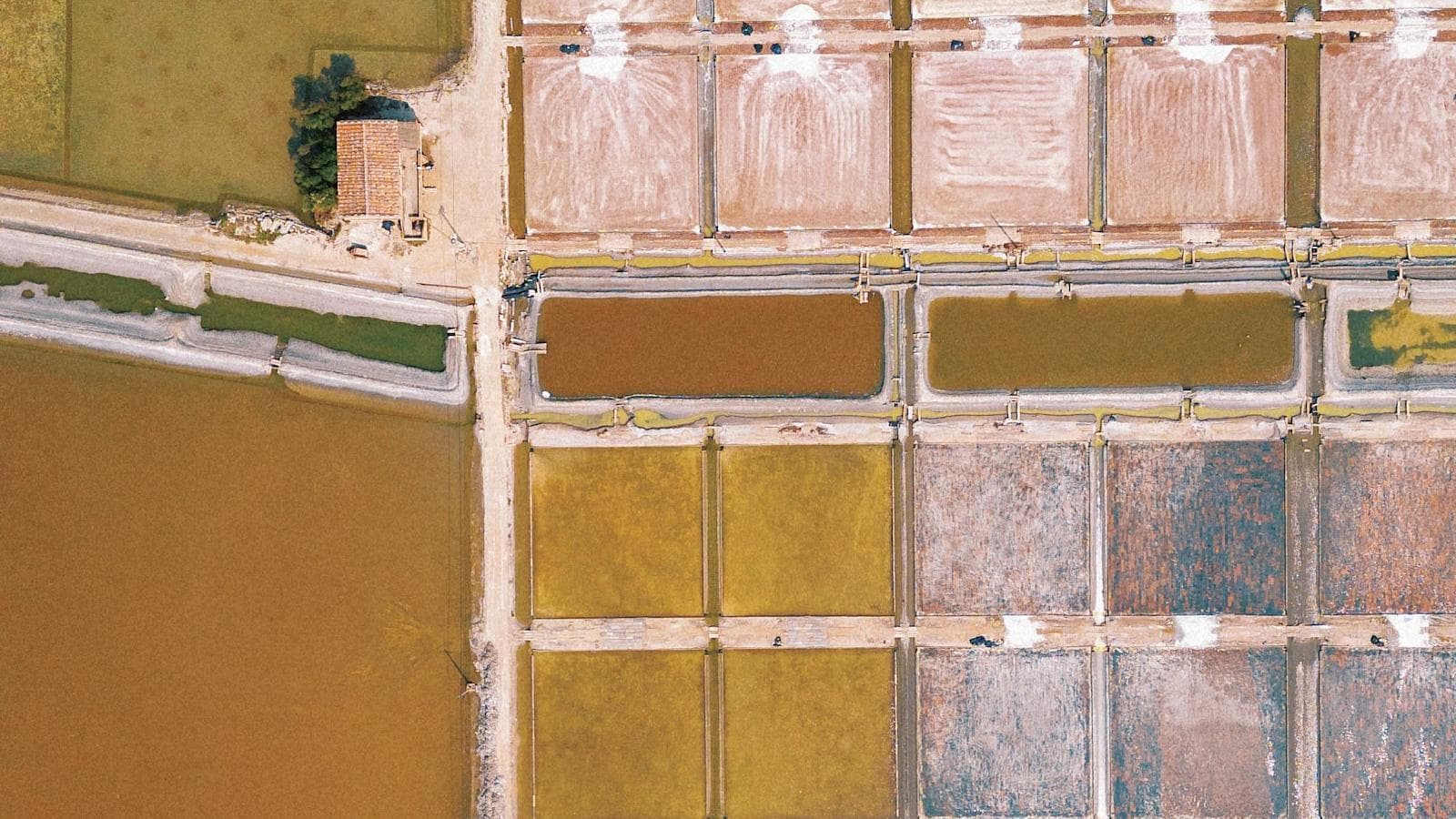
Brine disposal adds $0.50 to $8 per m3 to water treatment cost and is the route most projects underestimate. Six methods, full CAPEX and OPEX ranges, and a permit-first decision framework.
Brine management is the operational problem that desalination, water treatment, and industrial process plants consistently underestimate until it is too late. For every cubic metre of product water a reverse-osmosis plant delivers, it generates between 0.3 and 1.5 m3 of concentrated reject stream. That stream carries dissolved solids, heavy metals, scaling compounds, and in some sectors industrial chemicals. Disposing of it legally and economically can add $0.50 to $8 per m3 of product water to the plant's lifetime cost, sometimes exceeding the cost of the treatment process itself.
The industry has a habit of optimising the front end of a water treatment train and treating the back end as an afterthought. That sequencing is backwards. A plant that achieves 75% recovery and routes the remaining 25% to a surface discharge that fails a permit inspection is not a working plant. It is a compliance liability generating $1,000 to $100,000 per day in potential regulatory fines while the operations team scrambles for a fix that should have been engineered from day one. Vendors will recommend whatever they sell. The buyer's job is to model the lifecycle cost of all disposal options across a 20-year horizon, including the probability-weighted cost of a permit enforcement action.
This guide covers every mainstream brine disposal and management route, the costs and compliance obligations of each, where the methods fail, and how to build a decision framework that holds up in an RFP, a permit application, and a board-level ESG review. It addresses plant managers dealing with operational continuity, procurement teams spec-ing the disposal train, and sustainability directors trying to hit zero-liquid-discharge commitments against a real CAPEX envelope.
## The decision in brief
- Do not pick the disposal route on a vendor recommendation. A mid-scale inland RO plant generating 1,000 m3/day of brine that selects surface discharge on a vendor recommendation, without a site-specific permit feasibility assessment, faces an expected retrofit cost of $1.5 to $4.5 million. - Add the delay and the enforcement exposure. The same plant faces regulatory delays of 12 to 36 months, and enforcement exposure of $500,000 to $3 million in fines if it operates without a valid permit during the retrofit period. - Decide the route before construction. Getting the disposal route right at the design stage, including a $50,000 to $150,000 feasibility study and the correct capital for the compliant system, is the cheapest brine management decision a capital projects team will ever make.
The biggest cost of doing nothing is discovering, post-construction, that the disposal route is not permittable, and paying the retrofit and enforcement bill while the plant stands idle.
## What brine is and why it is a regulated waste stream
Brine in an industrial water treatment context is any reject stream with total dissolved solids significantly higher than the incoming feed water. In a seawater RO plant operating at 45% recovery, the brine leaves at roughly 55,000 to 65,000 mg/L TDS, approximately twice the salinity of seawater. In a brackish groundwater RO system at 80% recovery, the reject can reach 12,000 to 20,000 mg/L. In a mining or industrial process plant treating process water, the reject may contain heavy metals, scaling inhibitors, antiscalants, and trace organics that trigger hazardous-waste classification.
The volume is the first shock. A 10,000 m3/day SWRO plant at 45% recovery generates roughly 12,000 m3/day of brine. That is 4.4 million m3 per year of a stream that cannot be pumped to a drain, dropped in a holding tank, or evaporated to atmosphere without a permit, an engineered system, or both. Getting the disposal route wrong does not just create a fine risk. It stops the plant.
[Industrial wastewater treatment](/industrial-wastewater-treatment) regulations treat brine as a point-source discharge subject to the same permitting requirements as process effluent, and in most jurisdictions the burden of proof lies with the discharger to demonstrate that the release is safe. The US EPA, the EU's Industrial Emissions Directive, and national analogues all require site-specific modelling, mixing zone calculations, and in some cases continuous water quality monitoring downstream of the discharge point.
## Regulatory framework: what governs brine disposal
Regulatory frameworks for brine disposal vary by jurisdiction, but the underlying logic is consistent: the method must prevent harm to receiving environments, groundwater, or soil, and the permit holder carries the financial liability if it does not.
In the United States, surface discharges from desalination or industrial facilities require a National Pollutant Discharge Elimination System (NPDES) permit issued under the Clean Water Act. The [US EPA NPDES program](dofollow:https://www.epa.gov/npdes) sets effluent limits based on technology performance standards and receiving-water quality criteria. Brine-specific limits for TDS, salinity, and specific ions apply in most states. Violations carry civil penalties of up to $25,000 per day per violation under Clean Water Act Section 309, with criminal liability for wilful violations.
Deep-well injection falls under the Underground Injection Control (UIC) Program, also EPA-administered. Class I wells for industrial waste require a permit, groundwater baseline sampling, pressure-front modelling, and financial assurance (bonding). In the European Union, the Industrial Emissions Directive and the Water Framework Directive together govern brine discharges. The IED requires best available techniques to be applied, and the relevant BAT Reference Document for water treatment specifies technology performance benchmarks that permit conditions must reflect.
Beyond discharge regulation, the EU REACH regulation may classify certain brine constituents ([boron](/elements/boron), heavy metals, antiscalant residues) as substances of very high concern, triggering additional handling and reporting obligations. A pattern that recurs across projects is operators who secured a permit for the original plant design, then expanded capacity or changed feed chemistry, and failed to update the permit to reflect the increased brine volume or changed constituent profile. The existing permit is no longer valid, and the operator is technically in violation on the day the expansion goes live.
## Brine disposal methods compared
Six disposal routes cover the vast majority of industrial and desalination applications. Each has a fundamentally different cost structure, regulatory risk profile, and site requirement. The comparison below maps the trade-offs that a procurement team needs to see before committing to a plant configuration, and the columns that matter most are compliance risk and best-fit criteria, not just unit cost.
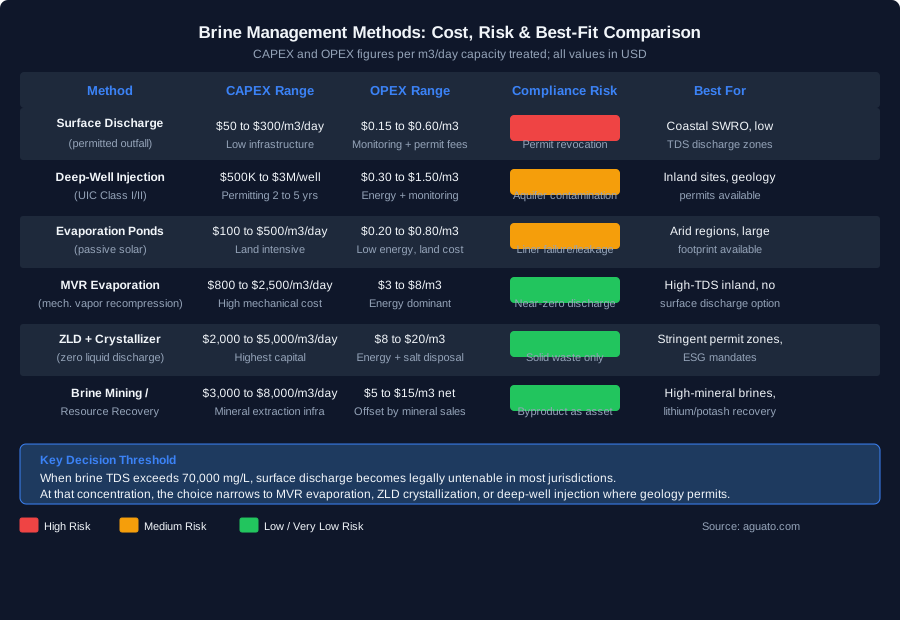
The pattern visible in that comparison is not coincidental. The lower the upfront capital cost, the higher the regulatory risk. Surface discharge and evaporation ponds look cheap on a capex-per-m3-per-day basis. They are cheap because they defer cost to the permit system and to the liability exposure if something goes wrong. ZLD and MVR evaporation look expensive because they internalise the risk at the CAPEX stage, converting a variable compliance liability into a known capital commitment. Most project budgets optimise the upstream treatment train and treat disposal as a residual line item. That sequence is the wrong direction.
A disposal route that is two-thirds cheaper on capital but carries a 40% probability of permit failure over a 20-year operating life is not cheaper. It is more expensive on any risk-adjusted basis, and the engineering consultants who earn their fee are the ones who model this explicitly in the feasibility stage. The [consulting-services](/consulting-services) category on Aguato lists engineers who specialise in brine management feasibility and can produce a risk-adjusted lifecycle cost comparison for your site before you commit to any configuration.
## Surface discharge: when it works and when it does not
Surface discharge is the lowest-cost disposal route when the permit conditions are achievable. At a coastal SWRO plant with a well-designed diffuser system and a receiving environment with sufficient dilution capacity, discharge costs run $0.15 to $0.60 per m3 of brine, almost entirely monitoring and permit compliance labour. For a 12,000 m3/day brine stream from a 10,000 m3/day SWRO plant, that translates to $660,000 to $2.6 million per year in ongoing disposal cost, versus $5 to $10 million per year for the same stream through a ZLD system.
The conditions that make it work are specific: a large, well-flushed receiving water body (ocean or tidal estuary), brine TDS below roughly 60,000 to 65,000 mg/L (seawater salinity range), no significant co-contaminants (antiscalant residues, heavy metals, boron above regulatory threshold), and a regulatory environment that accepts the discharge with a mixing zone analysis. Coastal SWRO in Australia, Chile, Israel, and the UAE operates under surface discharge permits as standard practice.
The conditions that make it fail: any one of the following breaks the model. Inland location with no tidal dilution. Brine TDS above the salinity tolerance of the receiving ecosystem. Industrial co-contaminants that push the brine into a hazardous category. A jurisdiction that has tightened discharge limits since the original permit was issued. A receiving water body already at or near its assimilative capacity from other discharges.
When surface discharge fails a permit review, the remediation cost is severe. Engineering an alternative disposal system after the plant is operational typically costs 30 to 60% more than integrating it into the original design, because the site layout was not planned around the alternative system's footprint and utilities. A case pattern seen repeatedly in inland RO projects: the plant was designed with surface discharge as the assumed route, the permit was denied post-construction, and the operator ended up spending $2 to $5 million retrofitting a deep-well or evaporation-pond system that should have been the design basis from day one.
A permit feasibility study costs $20,000 to $80,000 and confirms in eight to twelve weeks whether surface discharge is viable for a given site and receiving environment. It is the cheapest line item in a brine management strategy.
## Deep-well injection: geology, cost, and permit lead-time
Deep-well injection sequesters brine in a porous geological formation (aquifer or depleted reservoir) below any potable groundwater zone, sealed by an impermeable confining layer. It is the dominant inland disposal route in the US for high-TDS brines from power plants, mining operations, and inland desalination, where no surface water discharge option exists and the geology is suitable.
The [US EPA Class I Underground Injection Control wells program](dofollow:https://www.epa.gov/uic/class-i-industrial-and-municipal-waste-disposal-wells) requires a permit, groundwater baseline sampling, pressure-front modelling, and financial assurance in the form of a closure bond. Permit timelines of two to five years are typical in contested jurisdictions. A plant that needs to be operational in 18 months cannot count on deep-well injection unless a permitted well already exists on site or the project is in a jurisdiction with a streamlined regulatory track.
Geological requirements are non-negotiable: the site must have a deep porous formation capable of accepting the injection volume and pressure, overlain by a competent confining layer. In crystalline rock terrain (much of the eastern US, Scandinavia, South Africa), suitable injection zones simply do not exist. Geological assessment, including seismic survey, stratigraphic correlation, and formation testing, costs $100,000 to $500,000 before any well is drilled.
CAPEX for the well system runs $500,000 to $3 million per well, and a facility may need one to three injection wells depending on volume and formation permeability. Add the cost of the wellhead, injection pumps, brine conditioning (softening to prevent formation scaling), and surface piping. Total system CAPEX for a facility injecting 500 m3/day is typically $1.5 to $4 million. OPEX is $0.30 to $1.50 per m3, dominated by injection pressure energy and mandatory quarterly mechanical integrity testing.
For [reverse-osmosis companies](/reverse-osmosis-companies) operating inland brackish or process water systems, deep-well injection is often the most cost-effective 20-year disposal route once the permit lead-time is planned into the project schedule. The mistake is treating it as a last resort rather than evaluating it in parallel with other routes at the feasibility stage. A well that takes four years to permit is still the right answer if the alternative is a ZLD system at five times the operating cost.
## Evaporation ponds: land, climate, and liner risk
Evaporation ponds dispose of brine by concentrating it through solar evaporation until the remaining solids can be removed as a semi-solid or solid waste. They are passive, low-energy, and relatively low-cost when the conditions are right.
Climate requirement: net evaporation must exceed net precipitation by a meaningful margin. In arid and semi-arid regions (the US Southwest, the Middle East, northern Chile, parts of Australia), annual evaporation of 2,000 to 3,500 mm versus annual precipitation of 50 to 300 mm creates the driving force. In humid continental climates, the math simply does not work. A pond designed for an evaporation rate of 1,500 mm/year filling at a rate that requires 1,800 mm/year of evaporation will overflow in the first wet season.
Land requirement: a rough rule of thumb is 0.3 to 0.8 hectares per 100 m3/day of brine, depending on evaporation rate, brine TDS, and target concentration factor. A 1,000 m3/day brine stream requires 3 to 8 hectares of pond surface, plus berms, freeboard, and access roads. Land scarcity in industrial zones makes this a practical constraint as often as climate does.
Liner integrity is the critical failure point. Regulatory requirements in most jurisdictions mandate engineered liners, typically double-lined systems with a leak-detection layer between the two liner sheets, for any pond receiving a regulated waste. Liner installation costs $5 to $15 per square metre, and a double-liner system for a 5-hectare pond runs $600,000 to $1.5 million before earthworks. A liner failure releases brine to groundwater, triggering a cleanup liability that can exceed the original construction cost of the pond by a factor of five or more.
The [zero liquid discharge](/resources/zero-liquid-discharge) pathway begins where evaporation ponds end: when the salt concentration reaches the point where crystalline precipitation begins, operators face a choice between harvesting the solids as a saleable product or removing them as solid hazardous waste.
## Mechanical evaporation and ZLD: the high-cost floor
When surface discharge is not permitted, deep-well geology is absent, and the climate or land constraints rule out evaporation ponds, the choice narrows to mechanical evaporation. This is the route that eliminates or near-eliminates liquid discharge by concentrating brine to a slurry or dry solid.
The two main technologies are mechanical vapor recompression (MVR) evaporators and crystallizers, often operated in series in a zero liquid discharge (ZLD) train. An MVR evaporator compresses the vapor produced by boiling brine and reuses its latent heat to drive further evaporation, achieving specific energy consumption of 20 to 50 kWh per m3 of water evaporated. A crystallizer takes the concentrate from the evaporator to the point of salt crystallization, producing a mother liquor and wet salt cake. The [desalination-energy-consumption](/resources/desalination-energy-consumption) article covers energy benchmarking for the upstream RO train; ZLD energy economics require a separate optimisation exercise because the specific energy is an order of magnitude higher than membrane separation.
CAPEX for an MVR-plus-crystallizer ZLD train runs $2,000 to $5,000 per m3/day of brine treated. A plant generating 500 m3/day of brine (typical of a 1,500 to 2,000 m3/day brackish RO plant) faces $1 to $2.5 million in ZLD CAPEX on top of the upstream treatment system. OPEX ranges from $8 to $20 per m3 of brine, with energy typically accounting for 60 to 70% of that figure. At an industrial electricity rate of $0.09 per kWh and specific energy of 35 kWh/m3, energy alone costs $3.15 per m3. Add chemical conditioning, maintenance on rotating equipment, and brine concentrate disposal, and total OPEX approaches $10 to $15 per m3 for a mid-scale installation.
These are not numbers that a plant optimised for $0.50 per m3 product cost can absorb without revisiting its business case. ZLD is the right answer when regulatory constraints leave no alternative, or when mineral recovery from the crystallizer product creates a revenue stream that offsets part of the operating cost. The ZLD supply market has matured significantly over the past decade, with multiple vendors now offering standardised skid-mounted MVR systems for flows under 200 m3/day that reduce both CAPEX and commissioning risk compared to custom-engineered systems.
## Brine mining and resource recovery
Brine is not pure waste. Depending on its origin, it carries concentrated mineral value: sodium chloride, magnesium, potassium, calcium, sulfate, [lithium](/elements/lithium) (in certain geological brines), and in some desalination reject streams, significant boron concentrations. Brine mining recovers these minerals through controlled crystallization, ion exchange, or selective precipitation, converting a disposal cost into a partial revenue offset.
The economics work when the mineral concentration is high enough and the market is accessible. A solar evaporation brine from a potash-rich geological formation in Chile can crystallise potassium chloride worth $400 to $600 per tonne. Industrial sodium chloride commands $40 to $120 per tonne depending on purity and location. Lithium carbonate at $15,000 to $70,000 per tonne (highly variable with the battery market) justifies capital-intensive recovery systems where the brine contains lithium at concentrations above roughly 100 to 200 mg/L, limiting the opportunity to specific geological settings in the South American Lithium Triangle and certain geothermal fields.
Purity requirements are stringent. Salt sold for food or chemical use must meet pharmacopoeia or industrial specifications that most mixed-composition brines cannot reach without additional purification stages. The capital cost of selective crystallization or ion exchange needed to achieve saleable purity can easily exceed the mineral revenue it generates unless volumes are large, typically above 50 tonnes per day of product. For most industrial brine management applications, resource recovery is a secondary benefit of ZLD rather than a primary economic driver.
The [industrial wastewater treatment process](/resources/industrial-wastewater-treatment-process) discipline covers the sequencing of treatment trains where brine valorisation is a project objective. An operator expecting mineral revenue to offset ZLD cost should commission an independent market study for the likely product grade before including any credit in the project business case. The market for industrial salt is regional and often saturated within 200 km of production; assume zero revenue unless a specific offtaker is contracted.
## CAPEX, OPEX, and what disposal actually costs
Brine disposal cost is almost never a single line item in a project budget. It spreads across five categories: capital infrastructure, permitting and legal, energy, chemistry and consumables, and compliance monitoring. Most project budgets capture the first two and underestimate the last three over the project lifetime.
### Capital infrastructure
The infrastructure cost ranges from near-zero for a simple surface discharge outfall (perhaps $50,000 to $300,000 for a diffuser system and associated piping) to $5,000 per m3/day for a full ZLD crystallizer train. At typical industrial brine volumes, the infrastructure cost for a 1,000 m3/day brine stream looks roughly like this: surface discharge outfall, $100,000 to $500,000 total; deep-well injection system, $2 to $5 million; evaporation ponds on a greenfield site with liner, $800,000 to $3 million; MVR evaporator, $2 to $4 million; ZLD crystallizer added to MVR, additional $1 to $2.5 million. The normalisation metric for cross-project comparison is cost per m3/day of brine treated, not total system cost, because brine volume scales with plant size.
### Permitting and compliance
Permitting costs are chronically underestimated. An NPDES permit application for a new discharge point requires environmental baseline sampling (often 12 months of data), mixing zone modelling, a biological assessment, public comment response, and attorney's fees, totalling $150,000 to $500,000. A UIC Class I well permit adds geological assessment, well construction oversight, and a closure bond of $300,000 to $2 million. Annual monitoring and compliance reporting runs $50,000 to $200,000 per year across all methods, every year for the life of the permit.
### Energy and chemistry
For MVR and ZLD, energy dominates. At 35 kWh/m3 and $0.09 per kWh, energy costs $3.15 per m3 of brine. Scale and corrosion inhibitors for high-temperature evaporation systems add $0.50 to $2.00 per m3. Over 20 years at 365 operating days, a 500 m3/day MVR system accumulates $10 to $20 million in energy and chemistry costs alone. For surface discharge and evaporation pond systems, chemistry costs are lower but monitoring costs persist. A permitted discharge point typically requires automated effluent monitoring instrumentation running $30,000 to $100,000 per year.
The [industrial water treatment companies](/industrial-water-treatment-companies) category on Aguato includes specialists who provide brine disposal infrastructure with lifecycle cost modelling rather than capital-only pricing. Insist on a 20-year total cost of ownership comparison before approving any configuration. A vendor who declines to provide lifecycle cost modelling is a vendor whose system performs poorly on that metric.
## Where brine management decisions go wrong
Every significant brine management failure follows one of four patterns. Understanding them is cheaper than learning them operationally.
Pattern 1: Assuming the cheapest permitted route will remain permitted. A plant built in 2005 with an NPDES surface discharge permit has often operated under progressively tightening conditions as the regulator ratchets permit limits downward at each renewal cycle. An operator who did not model what 2025 or 2030 permit limits might look like is now facing a retrofit to a more expensive disposal route on a site that was not designed for it. Across projects reviewed over the past decade, the average cost of a post-construction disposal route retrofit is $2 to $6 million, compared to $400,000 to $1.2 million for designing the correct route from the start.
Pattern 2: Recovery rate optimised without brine volume modelled. A water treatment train designer increases the RO recovery rate from 75% to 85% to reduce the volume of product water needed and improve energy cost per m3 product. The brine volume drops from 25% of feed to 15%, but the brine TDS rises from approximately 45,000 to 85,000 mg/L. The existing surface discharge permit was issued on the basis of 45,000 mg/L brine TDS. The plant is now generating a stream that violates its own permit conditions. This is not a hypothetical. It is a recurring design oversight documented across multiple industrial RO installations.
Pattern 3: Evaporation pond capacity modelled on average evaporation, not minimum. A pond sized for the average annual evaporation rate will overflow in a year with below-average evaporation. In a drought-breaking year with 30% above-average rainfall, the same pond overflows its berms. The design needs to account for the 1-in-10-year minimum evaporation event, not the long-run average. An overflow from a lined brine pond is a reportable release in virtually every jurisdiction, triggering investigation, potential permit suspension, and cleanup costs of $500,000 to $5 million depending on the receiving environment.
Pattern 4: ZLD crystallizer under-specified for impurity loading. A crystallizer designed for a relatively clean softened brine will scale, foul, and fail on the actual feed water if scale inhibitor carryover from the upstream RO system is higher than specified, or if feed chemistry shifts seasonally. Across projects we have reviewed, crystallizer availability drops from a design target of 90 to 95% to actual operating performance of 70 to 80% in the first two years when the brine chemistry was not fully characterised during design. At $5,000 to $20,000 per hour of plant downtime for a mid-scale industrial facility, the cumulative cost of under-specification can exceed $2 million per year.
Not sure whether your proposed brine management train is correctly specified? [Post your project](/post-project) and qualified brine management specialists will scope the options against your actual feed water analysis, site constraints, and regulatory environment before you commit CAPEX.
## Decision framework: matching method to site
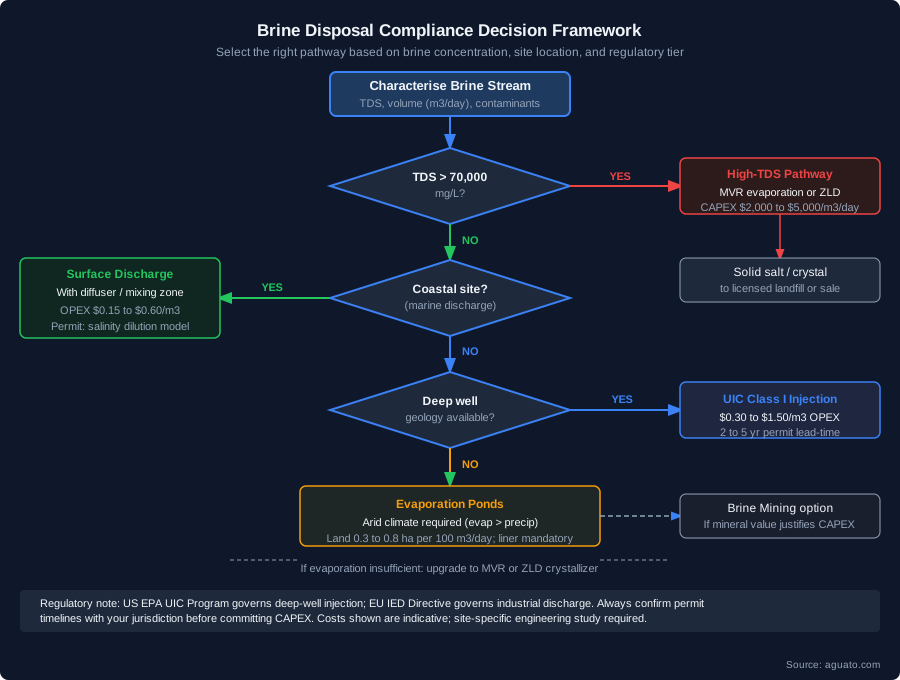
The brine management method selection is not primarily a technology question. It is a site and regulatory question. The technology choice follows from the constraints. Apply this decision sequence in order.
Step 1: Characterise the brine stream fully. TDS, volume (m3/day), constituent profile (major ions, trace metals, antiscalant residue, biological oxygen demand), and seasonal variation. Every step after this depends on accurate input data. A water quality testing programme costs $5,000 to $30,000. Skipping it costs ten times that in redesign.
Step 2: Map the regulatory permitting landscape. Is a surface discharge permit achievable in your jurisdiction and receiving water body? What is the expected permit timeline? What limits will be applied? Get a preliminary consultation from a permit attorney or environmental engineer before spending money on system design. This step costs $5,000 to $20,000 and has a direct bearing on every subsequent capital decision.
Step 3: Apply the TDS threshold cut. If brine TDS exceeds roughly 70,000 mg/L, surface discharge to freshwater or estuarine environments is almost universally prohibited. The choice narrows to deep-well injection (if geology permits), evaporation ponds (if climate and land permit), or mechanical evaporation and ZLD. If brine TDS is below 70,000 mg/L and you have coastal access, surface discharge is the first route to evaluate.
Step 4: Apply the geography and geology cuts. Coastal sites: evaluate surface discharge with diffuser and a detailed mixing zone study. Inland sites with suitable deep geology: evaluate UIC Class I well injection. Inland sites in arid climates with land available: evaluate evaporation ponds. Any inland site that fails both the geology and the climate cuts: mechanical evaporation and ZLD are the residual options, not optional upgrades.
Step 5: Run a 20-year lifecycle cost comparison across the remaining options. Include capital, permitting, energy, chemistry, monitoring, and a probability-weighted cost of permit enforcement action. The cheapest capital option is often not the cheapest 20-year option. The [EU Water Framework Directive](dofollow:https://environment.ec.europa.eu/topics/water/water-framework-directive_en) and equivalent national statutes continue to tighten ambient water quality standards, meaning that the regulatory risk assigned to surface discharge should be modelled as increasing over the project lifetime, not as static.
Across the [industrial wastewater treatment](/resources/industrial-wastewater-treatment) sector, the lifecycle cost advantage of correctly selecting the disposal route at design stage versus retrofitting after a permit problem is $1 to $5 million for a mid-scale plant. That gap funds the feasibility study, the permit pre-application consultation, and the correct disposal infrastructure with money to spare.
[cta:nepti-dark]
## FAQ
### What is brine management in water treatment?
Brine management encompasses all processes used to handle, treat, and dispose of the concentrated reject stream produced by desalination, reverse osmosis, and other membrane-based water treatment systems. The brine stream contains two to ten times the dissolved solids of the feed water and cannot be discharged without treatment or a specific regulatory permit. Effective brine management selects the disposal or treatment route that meets permit requirements at the lowest 20-year lifecycle cost, accounting for capital, energy, monitoring, and compliance liability.
### What are the main methods of brine disposal?
The six main methods are: surface discharge to a receiving water body via a permitted outfall or diffuser; deep-well injection under a UIC Class I permit; solar evaporation ponds; mechanical vapor recompression (MVR) evaporation; zero liquid discharge (ZLD) with crystallization; and brine mining or mineral recovery. Each method has distinct cost, land, climate, geology, and regulatory requirements. The optimal choice depends on brine volume, TDS, constituent profile, site location, and local regulatory constraints rather than on any single technology preference.
### How much does brine disposal cost per cubic metre?
Brine disposal costs range from $0.15 to $0.60 per m3 for a permitted surface discharge (monitoring and compliance costs only) up to $8 to $20 per m3 for a full ZLD crystallizer system including energy, chemistry, and maintenance. Deep-well injection falls in the range of $0.30 to $1.50 per m3 for ongoing OPEX, with upfront well permitting and drilling adding $0.5 to $3 million in capital. Evaporation pond OPEX is $0.20 to $0.80 per m3 with significant capital for lining and earthworks. The cheapest option on an OPEX basis is not always the cheapest over a 20-year lifecycle when permitting risk and potential enforcement costs are included.
### What TDS level makes surface discharge legally problematic?
Above roughly 70,000 mg/L (approximately twice seawater salinity), surface discharge to most receiving environments is not permittable under standard mixing-zone models. Coastal marine discharge of SWRO brine at 55,000 to 65,000 mg/L is typically permittable with a properly designed diffuser and dilution zone. Inland discharge to rivers or lakes faces much stricter limits, often below 1,000 to 2,000 mg/L TDS in freshwater-protected jurisdictions, which effectively rules out surface discharge for any significant RO reject stream.
### What is zero liquid discharge and when is it required?
Zero liquid discharge (ZLD) is a treatment configuration that converts the entire brine stream to solid waste, leaving no liquid effluent requiring disposal. It typically combines MVR evaporation with a crystallizer and produces a wet salt cake alongside recovered water that is recycled to the process. ZLD is required when regulatory constraints prohibit any liquid discharge to surface water, groundwater, or land. It carries the highest CAPEX ($2,000 to $5,000 per m3/day treated) and OPEX ($8 to $20 per m3) of any disposal route and is economically justified only when the cost of complying with alternative routes exceeds the cost of ZLD over the project lifetime.
### What permits are required for deep-well injection of brine?
In the United States, deep-well injection of industrial brine requires a UIC Class I permit from the US EPA or from a state with primacy. The application requires geological characterisation, a groundwater baseline study, formation testing, injection pressure and volume limits, mechanical integrity testing of the well, and financial assurance covering the cost of well plugging and abandonment. Permit timelines of two to five years are typical in contested jurisdictions. Outside the US, analogous permits under national groundwater protection regulations apply, with varying timelines and cost structures depending on the jurisdiction.
### Can brine from reverse osmosis be reused or valorised?
In specific conditions, yes. If the brine contains high concentrations of a recoverable mineral (sodium chloride, potassium, magnesium, or in geological brines, lithium), selective crystallization or ion exchange can produce a saleable byproduct. Industrial-grade sodium chloride commands $40 to $120 per tonne; lithium carbonate recovered from high-lithium geological brines can command $15,000 to $70,000 per tonne depending on market conditions. For most municipal and industrial RO systems, the brine mineral concentration and composition do not justify the capital cost of selective recovery. The most practical form of valorisation is full ZLD where the recovered water (90 to 95% of the brine volume) is recycled to the plant feed, reducing make-up water demand by 8 to 15% at the plant level.