As a mill cuts fresh-water intake from 50 to under 10 m3 per tonne, contaminants concentrate and a plant that worked at high dilution fails. Here is how to treat COD, AOX, and colour through water closure without an exceedance, benchmarked against 12 published pulp and paper treatment cases with real influent and effluent data.
Pulp and paper is one of the most water-intensive industries on the planet, and its wastewater is where the sector's environmental licence to operate is won or lost. Water closure is the great efficiency win of the modern mill and its great treatment challenge at the same time: as fresh-water intake falls, the contaminants that dilution used to hide concentrate in the effluent, and a plant that met its consent comfortably starts to breach it.
This guide is for the people who carry the mill's wastewater decision: operations and environmental managers, engineering and procurement teams scoping an upgrade against vendor proposals, sustainability directors, and the sponsors deciding how far to push water closure.
## The decision in brief
- Design for the closed-loop mill, not for today's dilution. Water closure from 50 towards 10 cubic metres per tonne concentrates COD, colour and AOX, and a plant sized for the open mill breaches its consent the moment intake falls. That retrofit runs to USD 1 million or more. - Treat colour and AOX as tertiary problems from day one. Biology does not remove dissolved lignin or chlorinated organics. A mill that discovers this after commissioning retrofits an ozone or advanced oxidation stage at USD 500,000 to 1.5 million. - Capture the high-strength streams for anaerobic energy recovery. Pulping condensates and evaporator streams give up most of their load as biogas, which is why the anaerobic configuration can run at a lower operating cost than a basic discharge plant despite a stronger feed.
Treatment itself is a known cost, USD 0.25 to 2.00 per cubic metre depending on the configuration, and this guide benchmarks it against 12 published cases with real influent and effluent data.
## What makes pulp and paper effluent distinctive
Pulp and paper effluent is distinctive in three ways: its sheer volume, its high and variable organic load, and the presence of specific contaminants (AOX, colour, and resin acids) that biology alone does not fully remove. A large integrated mill can produce tens of thousands of cubic metres of effluent per day, which makes even a modest concentration of contaminant a large mass load to treat, and the load swings with the furnish (the fibre mix), the product grade, and the degree of water recycling within the mill.
The organic load comes in two forms that matter for treatment. The readily biodegradable fraction (sugars, organic acids, low-molecular-weight compounds) is removed efficiently by biological treatment. The recalcitrant fraction (lignin and its derivatives, which give the effluent its brown colour, plus chlorinated organics from bleaching measured as AOX) resists biology and requires dedicated tertiary treatment to meet a tight consent. The ratio between these two fractions, which depends heavily on the pulping and bleaching processes, determines how much tertiary treatment the mill needs, and characterising it correctly is the foundation of a defensible design.
The most common treatment mistake in pulp and paper is sizing the plant for the effluent the mill produces today and ignoring the effluent it will produce after the next water-closure upgrade. Water closure is the direction of travel for the entire industry, driven by water cost, scarcity and regulatory pressure, so the defensible plant is designed for the concentrated effluent of the closed-loop mill. This is a sector-specific case of the discipline that governs any [industrial wastewater treatment](/resources/industrial-wastewater-treatment) project.
The second distinctive feature is that the mill's water system and its effluent system are not separable: every cubic metre of water recycled inside the mill is a cubic metre that does not reach the effluent plant, but it also concentrates the contaminants in the water that does. Optimising the two together, rather than treating effluent as a downstream afterthought, is what separates an efficient mill from one that fights its water balance. The next section maps where the load originates.
## Where the load comes from: mill section by section
A pulp and paper mill is a sequence of processes, each producing a characteristic effluent, and understanding the section-by-section load profile is what lets a treatment design target the right contaminant at the right point.
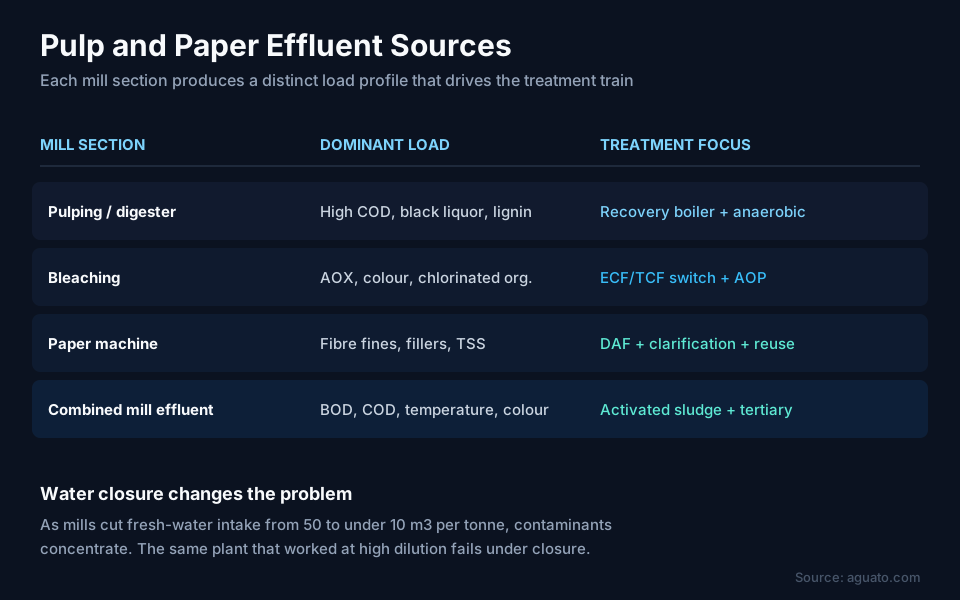
Pulping and the digester produce the highest-strength effluent, rich in dissolved lignin and organic load (black liquor in a kraft mill). In a chemical pulp mill, most of this is captured in the recovery boiler and chemical recovery cycle rather than going to effluent, but the fraction that escapes (spills, washing losses, condensates) carries a very high COD. The pulping condensates in particular are a concentrated, high-COD stream well suited to anaerobic pre-treatment.
Bleaching produces the AOX, colour, and chlorinated-organics load. The shift from elemental chlorine to elemental-chlorine-free (ECF) and totally-chlorine-free (TCF) bleaching has dramatically cut the AOX load over the past decades, and the bleaching technology choice is the single biggest lever on a mill's AOX discharge. A mill still using older bleaching chemistry carries a far heavier AOX treatment burden than one that has switched to ECF or TCF. The [European Commission Best Available Techniques reference document for pulp, paper, and board production](dofollow:https://eippcb.jrc.ec.europa.eu/reference/pulp-and-paper) sets the AOX and COD benchmarks the sector is expected to meet, and it is the document a mill's environmental team should be designing against rather than a vendor's catalogue figure.
The paper machine produces a high-volume, lower-strength effluent dominated by fibre fines, fillers, and suspended solids, with a moderate dissolved organic load. This stream is the prime candidate for in-mill recycling, because removing the solids by dissolved air flotation and clarification produces water clean enough to reuse in the machine, cutting both fresh-water intake and effluent volume.
The combined mill effluent is what reaches the central treatment plant: a blend of all the above plus general washes and cooling-water bleed, carrying BOD, COD, suspended solids, colour, AOX, temperature, and nutrient-deficiency challenges (pulp and paper effluent is often [nitrogen](/elements/nitrogen) and phosphorus deficient for biological treatment, requiring nutrient dosing). Designing the central plant around this blended stream, while capturing the high-strength streams for targeted pre-treatment, is the architecture that works.
## The discharge drivers: COD, BOD, AOX, colour, and solids
Each discharge parameter is removed by a different treatment stage, and matching the stage to the binding parameter is what determines the plant's cost. No single stage covers every driver.
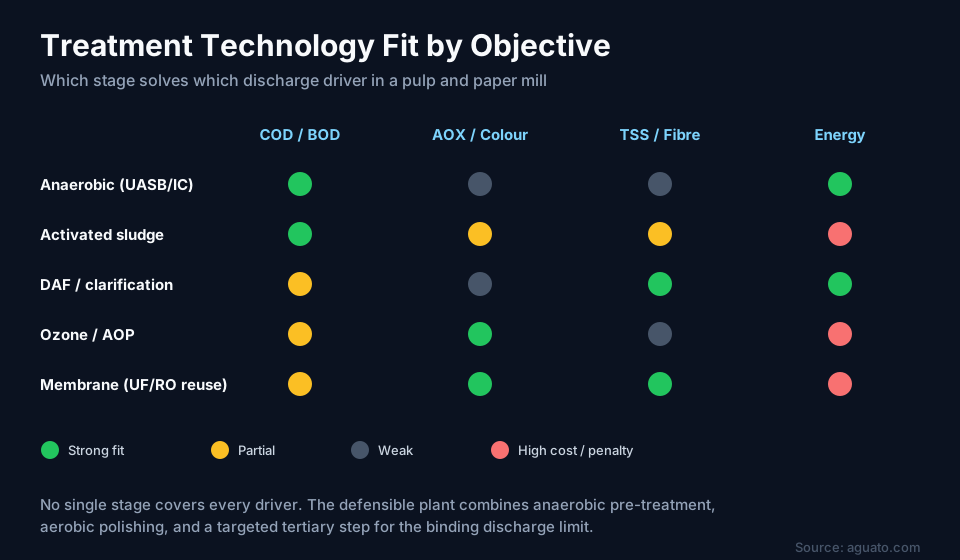
COD and BOD are the primary organic-load parameters, removed mainly by biological treatment (anaerobic for the high-strength fraction, aerobic for the polishing). BOD, the readily biodegradable load, is removed efficiently by aerobic biology. COD includes the recalcitrant fraction, so meeting a tight COD consent often needs tertiary treatment beyond the biology.
AOX (adsorbable organic halides) is the measure of chlorinated organics from bleaching, and it is tightly regulated because these compounds are persistent and some are toxic. The primary lever on AOX is the bleaching process itself (ECF and TCF cut it at source), and the secondary lever is tertiary treatment (ozone and advanced oxidation) for the residual.
Colour comes from dissolved lignin and is increasingly a hard discharge limit. Biology removes little of it, so colour is a tertiary-treatment problem, addressed by ozone, [advanced oxidation](/resources/advanced-oxidation-processes-industrial), coagulation, or membrane treatment. A mill facing a colour limit needs [advanced oxidation process suppliers](/advanced-oxidation-processes-companies) or an equivalent tertiary stage, because the biological plant will not get colour over the line on its own.
Suspended solids (fibre fines and fillers) are removed by dissolved air flotation and clarification, which also recovers fibre that can be returned to the process. This is the most reuse-friendly part of the treatment train, because the clarified water is often clean enough to recycle into the paper machine.
The decision rule that holds: identify the binding discharge parameter, the one requiring the most aggressive treatment, and design the train around it, rather than over-treating every parameter to be safe. For most modern mills the binding parameter is either colour or AOX (the recalcitrant fractions biology cannot touch) or COD under water closure, and the tertiary stage chosen to address it is the highest-cost single decision after the biology. A [Nepti decision intelligence run](/resources/nepti-decision-intelligence-water-treatment) on the characterised effluent ranks the tertiary options on lifecycle cost before any vendor scope is written.
## Benchmarks from 12 published pulp and paper treatment cases
These numbers come from a corpus of 12 published pulp and paper treatment cases that Aguato has transcribed from peer-reviewed journals and delivered-project reports, each with paired influent and effluent measurements and the actual treatment train. The corpus spans 7 countries, and three quarters of the cases sit at documented tier, meaning the full influent-to-effluent vector was read from the source table rather than a summary.
The three parameters with enough data to report across the corpus are COD, BOD, and suspended solids (concentrations in mg/L):
| Parameter | Influent median | Influent p90 | Effluent median | Median removal | |---|---|---|---|---| | COD | 1,465 | 9,507 | 115 | 82.8% | | BOD | 653 | 2,793 | 27 | 90.7% | | TSS | 784 | 4,115 | 32 | 94.6% |
The median mill removes 82.8% of COD, taking a median influent near 1,465 mg/L down to 115 mg/L, and the influent range is enormous: the 90th percentile influent COD is 9,507 mg/L, which is where recycled-fibre and integrated mills sit. The honest caveat this corpus forces is about the two parameters the article rightly stresses: colour and AOX are not in the benchmark. The dataset records neither as a distribution, because the underlying studies report them inconsistently, so the colour and AOX figures in this guide come from individual plants, described in the examples below, not from a corpus median. Treat COD, BOD, and TSS as benchmarked; treat colour and AOX as plant-specific.
One structural fact confirms the article's architecture: aerobic biological steps appear in 58% of the cases and anaerobic steps in 25%, while membranes appear in only 8%, and every membrane case is a reuse project. Biology does the load removal; membranes are the reuse decision. For the sector view, providers that build these trains are listed under [pulp and paper water treatment suppliers](/industries/pulp-paper).
### Real installations, with the numbers and the train
Every row is a real facility with a published source in the Sources section. Concentrations in mg/L; the train reads in treatment order.
| Plant, country | Flow (m3/day) | Train | COD, in to out | |---|---|---|---| | Integrated pulp and paper mill, China | 6,300 | Coagulation, anaerobic, aerobic, filtration | 17,388 to 33 | | Recycled packaging-paper mill, Saudi Arabia | 2,500 | Equalisation, clariflocculation, activated sludge, filtration | 9,507 to 750 | | Writing-paper mill, Saharanpur, India | 8,320 | Equalisation, activated sludge | 1,465 to 252 | | Tissue mill, Governador Valadares, Brazil | 6,033 | Aerated lagoon, settling lagoon | 446 to 77 |
Two of these carry the lesson. The integrated mill in China reaches 33 mg/L COD from a 17,388 mg/L influent (99.8%) because it runs the full sequence, coagulation then anaerobic then aerobic then filtration, on a very high-strength stream. The recycled packaging mill in Saudi Arabia, by contrast, still carries a high residual after a full activated-sludge train. Recycled-fibre mills carry the highest COD in the corpus and need the most treatment, which is exactly where a colour or AOX limit turns a biology-only plant into a compliance problem; the examples section shows why.
Nepti benchmarks your own mill numbers against this corpus before you accept a bidder's performance guarantee.
[cta:nepti-dark]
## Anaerobic pre-treatment: the energy and load lever
Anaerobic pre-treatment is the most powerful lever in modern pulp and paper effluent treatment, because it removes a large fraction of the high-strength organic load with very low energy and generates biogas that offsets the mill's energy cost. On the right high-strength streams, it transforms the economics of the whole plant.
The mechanism is that anaerobic bacteria, in the absence of oxygen, convert the dissolved organic load into biogas (methane and carbon dioxide) rather than into biomass requiring aeration. This means anaerobic treatment uses a fraction of the energy of aerobic treatment (no aeration blowers running continuously), produces far less sludge, and generates a biogas stream that can offset 30 to 60% or more of the treatment plant's energy demand, or feed the mill's energy system. For the high-strength condensate and evaporator streams in a pulp mill, anaerobic pre-treatment is often the difference between an economic plant and an uneconomic one. The broader case for [anaerobic over aerobic treatment](/resources/aerobic-vs-anaerobic-wastewater-treatment) on high-strength effluents applies with particular force here.
The trade-off is that anaerobic treatment is a pre-treatment, not a complete solution. It removes the bulk of the biodegradable COD but leaves a residual organic load, the recalcitrant fraction, the colour, and the AOX, all of which need aerobic and tertiary treatment downstream. Anaerobic also requires a reasonably consistent, high-strength feed to work well, so it is applied to the captured high-strength streams rather than the dilute combined effluent. The architecture that works is anaerobic pre-treatment on the high-strength streams, feeding into an aerobic stage that polishes the combined effluent.
The strategic point is that anaerobic pre-treatment turns the high-strength effluent from a pure treatment cost into a partial energy source, which is exactly the kind of circularity that water-intensive industries increasingly need to demonstrate. A mill that captures its high-strength streams for anaerobic treatment is both cheaper to operate and better positioned on its sustainability reporting than one that sends everything to a single aerobic plant.
## Aerobic treatment and tertiary polishing
After anaerobic pre-treatment (where used), the combined effluent goes through aerobic biological treatment to remove the residual biodegradable load, followed by tertiary polishing for the parameters biology cannot reach.
Aerobic biological treatment (activated sludge, or increasingly membrane bioreactors where effluent quality or reuse drives the decision) removes the residual BOD and a large fraction of the COD. The pulp and paper context adds two complications: the effluent is often nutrient-deficient, requiring nitrogen and phosphorus dosing to keep the biology healthy, and the temperature can be high, sometimes requiring cooling before the biology. The aerobic stage is the workhorse, but it leaves the recalcitrant COD, the colour, and the AOX largely untouched.
Tertiary polishing is where the binding parameter is dealt with. Ozone and advanced oxidation break down colour and recalcitrant COD and reduce AOX. Coagulation and flotation remove residual colour-bearing colloids. Membrane treatment (ultrafiltration and reverse osmosis) produces a high-quality effluent suitable for reuse, and is increasingly used where water closure drives the mill toward recovering its effluent. The [membrane filtration](/membrane-filtration-companies) stage is the bridge between a discharge plant and a water-recovery plant, and the choice of tertiary technology depends entirely on which parameter is binding and whether reuse is a goal.
The discipline that keeps this stage economic is to size it to the binding parameter, not to gold-plate every contaminant. A mill that drives colour and AOX to well below the consent is spending tertiary capital and energy to achieve a margin nobody asked for, while a mill that under-sizes the tertiary stage breaches the very limit that biology could never have met. The right margin is documented and applied to the binding parameter, and the [industrial wastewater treatment process](/resources/industrial-wastewater-treatment-process) sequence here is the same logic as any effluent plant, with the colour and AOX challenges layered on top.
## Water closure: the efficiency win that creates the treatment problem
Water closure, progressively recycling water within the mill to cut fresh-water intake, is the defining trend in modern pulp and paper, and it is both an efficiency win and a treatment challenge that cannot be separated.
The efficiency win is real: cutting fresh-water intake from 50 cubic metres per tonne of product to 10 or less cuts the water-supply cost, the effluent volume, the energy spent heating water, and the mill's environmental footprint. For mills in water-stressed regions, water closure is increasingly a licence-to-operate requirement, not an optimisation. The [US EPA effluent guidelines for the pulp, paper, and paperboard category](dofollow:https://www.epa.gov/eg/pulp-paper-and-paperboard-effluent-guidelines) set the technology-based discharge limits that frame how far a US mill can push closure before the concentrated residual stream becomes a compliance problem. The [industrial water reuse and recycling](/resources/industrial-water-reuse-recycling) strategies that enable closure are now central to mill competitiveness.
The treatment challenge is that closure concentrates the contaminants. As the dilution falls, the concentration of COD, colour, AOX, salts, and dissolved solids in the circulating water and the residual effluent rises, and problems that high dilution masked (scaling, biological growth, corrosion, and the buildup of dissolved non-process elements) emerge. A treatment plant designed for the dilute effluent of an open mill cannot handle the concentrated effluent of a closed one, and the mill that pushes closure without upgrading its treatment finds itself breaching its consent on the concentrated residual stream.
The strategic implication is that water closure and effluent treatment must be designed together, as a single water-balance optimisation, not as separate projects. The right degree of closure is the one where the marginal saving from recycling another cubic metre is still larger than the marginal cost of treating the resulting more-concentrated effluent, and that crossover point is specific to each mill's water cost, effluent characteristics, and discharge consent. Pushing closure past that point, or stopping short of it, both leave value on the table, which is why the [most efficient water treatment solution](/resources/most-efficient-water-solution) for a mill is a joint water-and-effluent optimisation rather than a treatment plant specified in isolation.
## Capital and operating cost ranges
The table below gives realistic ranges for pulp and paper effluent treatment across common configurations. Figures are indicative, scale with mill size, and exclude land and in-mill water-system modifications.
| Configuration | Scope | Relative capex | OPEX per m3 | Main risk | |---|---|---|---|---| | Basic discharge | Primary (DAF) + activated sludge | Lower | $0.30 to $0.70 | Colour/AOX exceedance | | High-strength + energy | Anaerobic + aerobic + DAF | Medium | $0.25 to $0.60 | Anaerobic feed consistency | | Tight consent | Above + ozone/AOP tertiary | Higher | $0.50 to $1.20 | Recalcitrant COD, colour | | Closed-loop / reuse | Above + membrane (UF/RO) | Highest | $0.80 to $2.00 | Concentration, fouling, brine |
The operating cost is dominated by energy (aeration is the biggest power draw, partly offset by anaerobic biogas), chemicals (nutrient dosing, coagulants, ozone generation), and sludge disposal. The anaerobic biogas credit is a genuine offset that can materially reduce net operating cost on a high-strength mill, which is why the high-strength-plus-energy configuration can have a lower OPEX than the basic-discharge configuration despite treating a stronger load.
The capex scales strongly with mill size and with the tertiary requirement. The single biggest swing variable is whether the mill faces a colour or AOX limit that forces a tertiary stage, and whether water closure pushes the plant toward membrane treatment and reuse. A mill with a loose discharge consent and abundant water can sit in the basic configuration; a mill with a tight consent in a water-stressed region is pushed toward the closed-loop configuration.
## Failure scenarios and what they cost
The plant sized for today's dilution. A mill designs its effluent plant for its current open-loop effluent, then pushes a water-closure project that cuts fresh-water intake by half. The residual effluent is now twice as concentrated, the existing plant cannot meet its COD and colour consent on the concentrated stream, and the mill breaches its discharge limit. The retrofit (upgraded biology and a tertiary stage sized for the concentrated effluent) costs USD 1 million or more, and the mill faces enforcement in the meantime. The fix was to design the plant for the closed-loop effluent from the start.
The missing tertiary stage. A mill meets its COD and BOD consent with biological treatment alone but breaches a colour or AOX limit that biology cannot remove. Because colour and AOX are increasingly hard limits, the regulator pursues the exceedance, and the mill has to retrofit an ozone or advanced oxidation tertiary stage at a cost of USD 500,000 to 1.5 million. The fix was to recognise at the design stage that colour and AOX are tertiary-treatment problems, not biological ones.
The nutrient-starved biology. A mill's biological stage underperforms because the effluent is nitrogen and phosphorus deficient and the nutrient dosing was inadequate. The biomass is unhealthy, the COD removal falls short, and the discharge drifts toward the consent limit. The cost is in lost treatment capacity, emergency intervention, and compliance risk, and the fix (proper nutrient dosing and control) is cheap but is routinely overlooked because pulp and paper engineers do not always anticipate the nutrient deficiency. The lesson is that pulp and paper effluent needs nutrient management that domestic-sewage biology never requires.
## Real-world examples across three contexts
Anaerobic energy recovery: a paper mill in southern Vietnam. The mill routed its high-strength stream through an internal-circulation anaerobic reactor as pre-treatment, cutting COD from 2,000 to 450 mg/L in that stage alone before aerobic and physico-chemical polishing, and generating biogas that offsets treatment energy. The lesson is that anaerobic pre-treatment removes the bulk of the biodegradable load at very low energy and turns a cost into a partial energy source, but it is a pre-treatment, not a complete plant: the residual COD, colour, and AOX still need the aerobic and tertiary stages downstream.
The recycled-fibre residual: a packaging-paper mill in Saudi Arabia. Running heavily on recycled fibre, the mill's combined effluent carried an extreme organic load (COD 9,507 mg/L) and was severely nutrient-deficient, so nitrogen and phosphorus had to be dosed to keep the biology alive. Even a full equalisation, clariflocculation, activated-sludge, and filtration train left the effluent at 750 mg/L COD. The lesson is that recycled-fibre mills carry the highest COD in the sector and a biological train alone will not clear a tight consent: a tertiary stage is not optional for these mills, it is the design basis.
Colour as a tertiary problem: a board mill in Peshawar, Pakistan. Facing a strong colour load, the mill took its effluent through coagulation and a granular activated-carbon column, bringing colour from 6,660 to 25 Pt-Co and COD from 2,820 to 22 mg/L. The lesson is the one the discharge-drivers section makes in the abstract, now concrete: colour is dissolved lignin that biology barely touches, and it takes a dedicated tertiary stage, coagulation plus adsorption here, ozone or advanced oxidation elsewhere, to clear it.
## Sources
The plant benchmarks and case studies in this guide are drawn from Aguato's pulp and paper reference corpus of published treatment studies. Featured facilities:
- Writing-paper mill, Saharanpur, India: [Frontiers in Environmental Science (2022)](https://www.frontiersin.org/journals/environmental-science/articles/10.3389/fenvs.2022.960639/full) - Tissue mill, Governador Valadares, Brazil: [UFV repository (2014)](https://locus.ufv.br/handle/123456789/3836) - Paper mill anaerobic reactor, southern Vietnam: [Architecture Civil Engineering Environment (2019)](https://doi.org/10.21307/acee-2019-045) - Board mill, Peshawar, Pakistan: [Water 11(11):2393 (2019)](https://www.mdpi.com/2073-4441/11/11/2393)
The integrated pulp and paper mill (China) and the recycled packaging-paper mill (Saudi Arabia) are drawn from peer-reviewed journals and delivered-project reports in the same corpus.
## FAQ
### What makes pulp and paper wastewater difficult to treat?
Pulp and paper effluent combines very high volume, a high and variable organic load, and specific contaminants (AOX from bleaching, colour from dissolved lignin, and resin acids) that biological treatment does not fully remove. It is also often nutrient-deficient for biology and can be hot, requiring nutrient dosing and sometimes cooling. The recalcitrant fraction (lignin derivatives and chlorinated organics) is what drives the need for tertiary treatment beyond the biological stage.
### What is AOX and why does it matter for paper mills?
AOX (adsorbable organic halides) measures the chlorinated organic compounds produced by [chlorine](/elements/chlorine)-based bleaching. These compounds are persistent and some are toxic, so AOX is a tightly regulated discharge parameter for pulp and paper mills. The primary way to reduce AOX is at source, by switching from elemental chlorine bleaching to elemental-chlorine-free (ECF) or totally-chlorine-free (TCF) bleaching; the residual AOX is then addressed by tertiary treatment such as ozone or advanced oxidation.
### Why is anaerobic treatment used in pulp and paper effluent?
Anaerobic pre-treatment removes a large fraction of the high-strength biodegradable organic load with very low energy (no continuous aeration), produces far less sludge than aerobic treatment, and generates biogas that can offset 30 to 60% or more of the plant's energy demand. It is applied to the captured high-strength streams (such as pulping condensates) and feeds into an aerobic stage that polishes the combined effluent. It transforms the energy economics of treating high-strength mill effluent, and the biogas it generates contributes directly to the renewable-energy and emissions targets that the [International Energy Agency analysis of the pulp and paper sector](dofollow:https://www.iea.org/energy-system/industry/paper) identifies as central to the industry's decarbonisation.
### How does water closure affect effluent treatment?
Water closure recycles water within the mill to cut fresh-water intake, which reduces effluent volume and water cost, but it concentrates the contaminants in the residual effluent. A treatment plant designed for the dilute effluent of an open mill cannot handle the concentrated effluent of a closed one. Water closure and effluent treatment must therefore be designed together, and the right degree of closure is where the marginal saving from recycling still exceeds the marginal cost of treating the more-concentrated effluent.
### How much does pulp and paper effluent treatment cost?
Operating cost ranges from roughly $0.25 to $2.00 per cubic metre depending on the configuration: a basic discharge plant (DAF plus activated sludge) runs $0.30 to $0.70 per cubic metre, a high-strength plant with anaerobic energy recovery can be lower net of the biogas credit, a tight-consent plant with ozone tertiary runs $0.50 to $1.20, and a closed-loop reuse plant with membranes runs $0.80 to $2.00. Capital cost scales with mill size and with whether colour, AOX, and water closure force tertiary and membrane stages.
### Can pulp and paper mill effluent be reused?
Yes, and water closure is pushing the industry strongly in that direction. The paper-machine effluent (high-volume, solids-dominated) is the easiest to recycle after dissolved air flotation and clarification, and the clarified water is often clean enough to return to the machine. Deeper reuse of the combined effluent needs membrane treatment (ultrafiltration and reverse osmosis) to reach a quality suitable for higher-grade process use. The reuse case depends on the mill's water cost and discharge consent, and it is best designed in from the start rather than retrofitted.