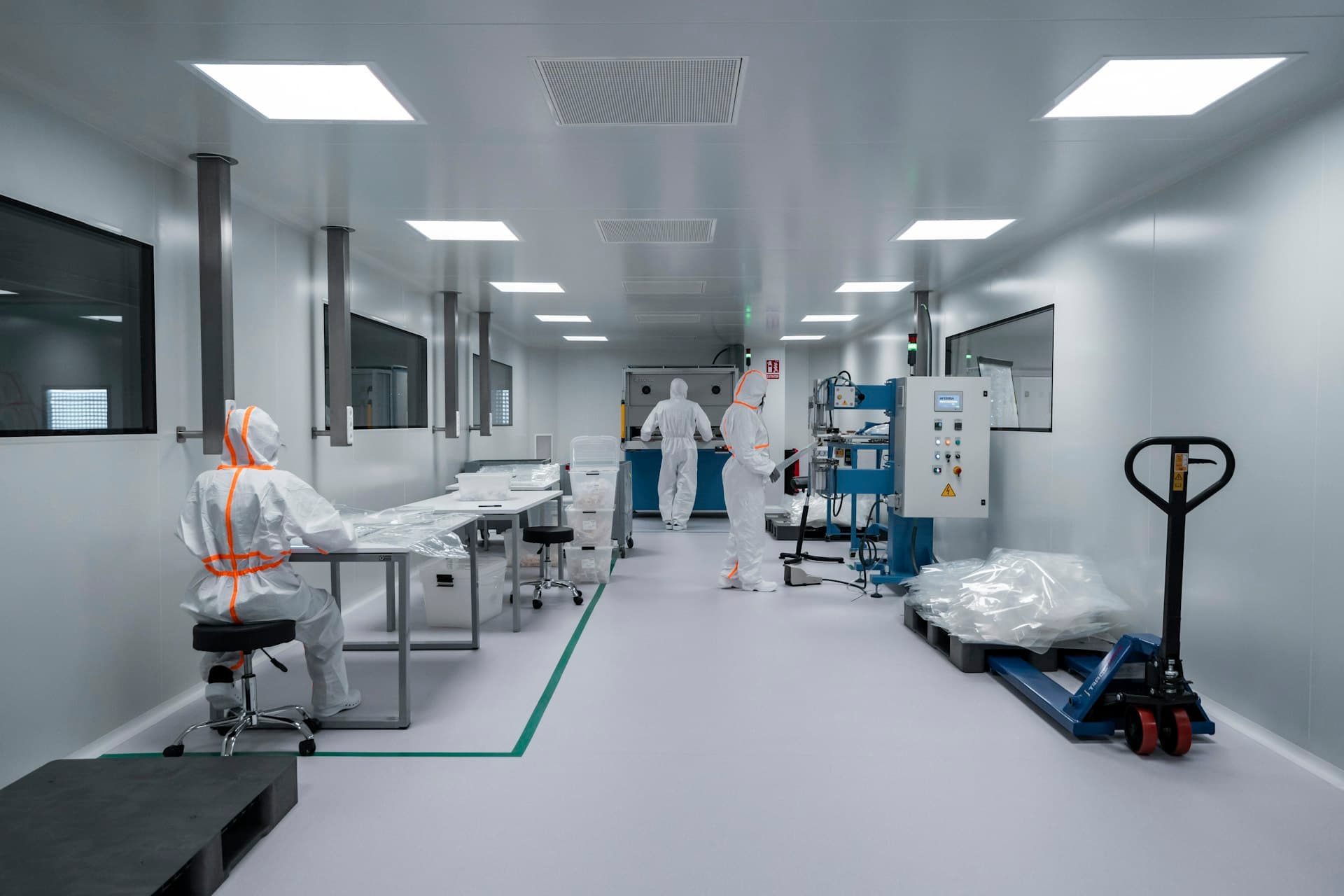
Ultrapure water production costs $0.50 to $4.50 per cubic metre but a single contaminant spike shuts down a semiconductor fab for 12 to 48 hours at $2M to $8M in lost wafer output.
Ultrapure water production for semiconductor fabs, pharmaceutical clean utilities, and thermal power generation delivers water at resistivity levels between 1 and 18.2 megohm-cm, silica concentrations below 1 part per billion, and total [organic carbon](/elements/carbon) under 10 parts per billion. That purity level costs $0.50 to $4.50 per cubic metre to produce, depending on feed water quality and the treatment train selected, and a single contaminant spike that escapes the polishing loop shuts down a semiconductor fab line for 12 to 48 hours at $2 million to $8 million in lost wafer output. The difference between a correctly engineered ultrapure water system and one that meets specification on paper but fails in service is measured in unplanned shutdowns, off-spec product batches, and the cost of re-engineering the polishing loop mid-project.
The three industries that anchor ultrapure water demand operate at fundamentally different purity targets and failure tolerances. Semiconductor manufacturing targets 18.2 megohm-cm resistivity with sub-PPB particle counts because a single 0.1 micron particle on a 5-nanometre process node scraps the wafer. Pharmaceutical USP Purified Water and Water for Injection require bacterial endotoxin levels below 0.25 EU per millilitre and total organic carbon below 500 PPB, enforced through FDA inspection. Thermal power high-pressure boiler feedwater runs at 1 to 5 megohm-cm with silica below 20 PPB to prevent turbine blade scaling that costs $500,000 to $2 million per cleaning cycle. The same two-pass reverse osmosis plus electrodeionisation treatment train serves all three, but the monitoring cadence, the polishing-loop design, and the capital-versus-operating-cost trade-off are completely different.
This guide walks through what ultrapure water production actually delivers, the four standard treatment train configurations and their cost structures, the specific standards that define purity for each industry, the capital and operating cost ranges across duty scales, the failure modes that produce contamination spikes, and the decision framework for selecting the right train against your feed water and target specification.
## The decision in brief
- Characterise feed water and target specification before selecting the configuration. Ultrapure water production costs $0.50 to $4.50 per cubic metre depending on feed quality, target specification, and the treatment train selected, but the system's value is measured in avoided contamination events. - Price a semiconductor excursion. A single TOC breakthrough or particle spike in a semiconductor fab costs $200,000 to $2 million in wafer scrap and 12 to 48 hours of tool downtime. - Price a pharmaceutical excursion. A WFI endotoxin excursion in a pharmaceutical plant triggers an FDA deviation investigation and a potential batch hold at $200,000 to $1.5 million per day in lost production.
The cost of doing nothing is specifying on price or generic catalogue data, where 60 to 80% of lifecycle regret begins, preventable with a 2-week feed-water analysis and a lifecycle-cost model before the RFP.
## What ultrapure water production delivers and where the specification comes from
Ultrapure water is defined by what it does NOT contain. The target specification measures resistivity (the inverse of conductivity), which correlates to dissolved ionic contamination, total organic carbon, which measures carbon-based molecules from bacterial biofilm to solvent residues, silica, which scales on hot surfaces, particles, counted by size distribution, and bacterial endotoxins, measured in endotoxin units per millilitre. A typical municipal feed water at 300 to 600 microsiemens per centimetre conductivity and 2 to 8 milligrams per litre TOC sits five orders of magnitude away from the ultrapure target.
The three dominant industry standards are [SEMI F63 for semiconductor manufacturing](dofollow:https://www.semi.org/en/products-services/standards), which specifies 18.2 megohm-cm resistivity, total organic carbon below 1 PPB, silica below 1 PPB, and particle counts below 0.05 particles per millilitre at 0.05 micron size, USP Purified Water and Water for Injection for pharmaceutical applications, which target conductivity under 1.3 microsiemens per centimetre at 25 degrees Celsius, TOC below 500 PPB, and endotoxin below 0.25 EU per millilitre, and the ASME BPVC, which specifies conductivity under 0.2 microsiemens per centimetre for high-pressure drum boilers with silica below 20 PPB. Each standard exists because the consequence of missing it is expensive: semiconductor wafer scrap, pharmaceutical batch rejection under FDA audit, or turbine blade fouling that forces an unscheduled outage.
The resistivity target is the first-order filter. Water at 18.2 megohm-cm contains fewer than 0.056 PPB of dissolved ions in perfect stoichiometric balance. Any deviation from that, a sodium ion, a chloride ion, a carbonate fragment, drops resistivity immediately. Measuring resistivity is continuous and real-time; measuring TOC, silica, and particles requires periodic sampling or online analysers with lag times between 2 and 15 minutes. Operators managing ultrapure loops watch the resistivity trace; spikes precede contamination events by minutes to hours, which is the window where intervention prevents product loss.
The semiconductor specification is the tightest and the most expensive to meet continuously. Pharmaceutical purified water tolerates higher conductivity and TOC, the USP limit is 500 PPB TOC versus 1 PPB for SEMI F63, but adds the endotoxin requirement, which means the storage and distribution loop must run hot (65 to 80 degrees Celsius continuous circulation) or with periodic sanitisation cycles that an EDI-based production train cannot always support without auxiliary equipment. Power generation feedwater sits between the two on ionic purity but is the least sensitive to organics, which burn off in the boiler anyway. Matching the treatment train to the target avoids over-specifying, which is the most common capital waste in ultrapure water projects, and under-specifying, which produces a system that meets nameplate but fails operationally.
## The four treatment train configurations and their cost structures
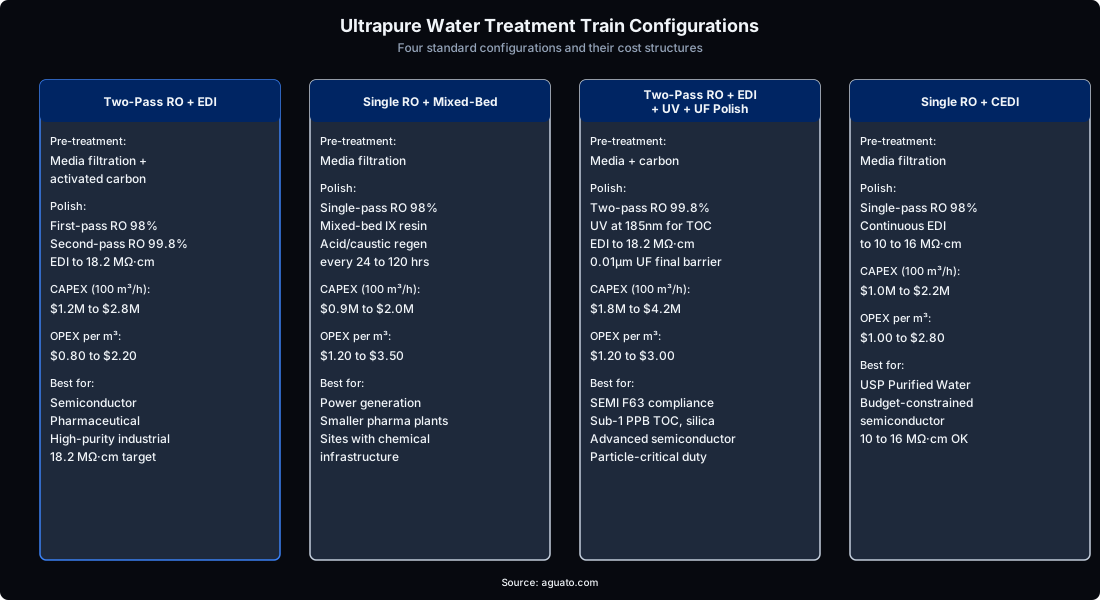
Ultrapure water systems are built in stages. Each stage removes a category of contamination that the previous stage could not economically remove or that would foul the next stage if left in. The four standard configurations differ in how they handle the final polishing step, where dissolved ions are removed to achieve the target resistivity, and that difference drives 40 to 60% of the capital cost gap and 60 to 80% of the operating cost gap between configurations.
Configuration 1: Two-pass RO plus electrodeionisation (EDI)
The workhorse configuration for semiconductor and pharmaceutical duty. First-pass RO at 50 to 70% recovery removes 98 to 99.5% of dissolved solids. Second-pass RO takes permeate from the first pass and pushes it to 99.8 to 99.9% rejection, delivering water at 0.1 to 1.0 microsiemens per centimetre. EDI modules downstream remove the residual ions without chemical regeneration, producing 16 to 18.2 megohm-cm water continuously. Capital cost for a 100 cubic metre per hour system: $1.2 million to $2.8 million. Operating cost: $0.80 to $2.20 per cubic metre, dominated by membrane replacement every 3 to 7 years and electricity for the RO high-pressure pumps.
Configuration 2: Single-pass RO plus mixed-bed deionisation
The legacy configuration, still common in power generation and smaller pharmaceutical plants. Single-pass RO removes 95 to 99% of dissolved solids. Mixed-bed ion exchange tanks packed with cation and anion resins remove the rest. Capital cost is 20 to 35% lower than EDI-based systems, but the mixed beds require chemical regeneration every 24 to 120 hours depending on feed quality, consuming caustic and acid, generating a regeneration waste stream that needs neutralisation, and adding 8 to 15 hours per month of downtime for regeneration cycles. Operating cost: $1.20 to $3.50 per cubic metre, higher than EDI when the regeneration chemical cost and waste disposal are included.
Configuration 3: Two-pass RO plus EDI with UV and ultrafiltration polishing
Semiconductor-grade configuration with additional organic and bacterial control. Adds a 185 or 254 nanometre UV lamp downstream of the second RO pass to oxidise residual organics, reducing TOC from 10 to 50 PPB down to 1 to 5 PPB, and a 0.01 to 0.05 micron ultrafiltration membrane as final particle and bacteria barrier before the point of use. Capital cost: $1.8 million to $4.2 million for a 100 cubic metre per hour system. Operating cost: $1.20 to $3.00 per cubic metre. This is the configuration that meets SEMI F63 reliably; anything cheaper under-specifies the organic removal or particle control and produces intermittent contamination events.
Configuration 4: Single-pass RO plus continuous electrodeionisation (CEDI)
Pharmaceutical and smaller semiconductor installations where capital cost is constrained. Skips the second RO pass and feeds single-pass permeate directly into a larger CEDI stack. Capital cost is 15 to 25% lower than two-pass RO plus EDI, but the CEDI modules work harder, increasing replacement frequency from 7 to 10 years down to 4 to 6 years, and the final water quality sits at 10 to 16 megohm-cm instead of 17 to 18.2. Operating cost: $1.00 to $2.80 per cubic metre. Suitable for USP Purified Water, marginal for SEMI F63, and a poor fit for anything requiring sub-1 PPB silica.
The configuration choice is feed-water-dependent. High-TDS feed water (above 500 milligrams per litre) almost always justifies two-pass RO because the second pass cuts the EDI workload enough to recover its capital cost through longer EDI module life. Low-TDS feed water (below 200 milligrams per litre) can skip the second pass if the target specification tolerates 12 to 15 megohm-cm instead of 18.2. The break-even is site-specific; characterising the feed water and the target spec before selecting the train prevents the single largest avoidable capital error in ultrapure water projects.
[Browse ultrapure water system providers](/providers) to compare configurations and request site-specific proposals from specialists who can model your feed water against the target specification.
## Semiconductor ultrapure water: 18.2 megohm-cm and the particle problem
Semiconductor fabs consume ultrapure water at 2 to 4 cubic metres per hour per fabrication tool, with total plant demand ranging from 50 to 500 cubic metres per hour depending on wafer output. The water rinses wafers between photolithography, etching, and deposition steps, any residual particle or ionic contamination left on the wafer surface during these rinses creates a defect that propagates through subsequent layers, scrapping the die. A single 0.1 micron particle on a wafer at a 5-nanometre process node costs $500 to $3,000 in scrap value; a contamination event that affects an entire batch costs $200,000 to $2 million, and an undetected system-level fault that runs for 6 to 12 hours before alarms trigger can cost $5 million to $15 million in wafer scrap and tool downtime.
The SEMI F63 specification exists to prevent these events. It defines allowable limits not just for resistivity and TOC but for particle counts at four size ranges: 0.05, 0.1, 0.2, and 0.5 micron. Most municipal and even deionised feed water contains 10,000 to 1 million particles per millilitre at the 0.5 micron range. The target is below 0.05 particles per millilitre at 0.05 micron, a six-order-of-magnitude reduction. Achieving that requires ultrafiltration membranes with absolute ratings at 0.01 to 0.02 micron, continuous recirculation loops that prevent biofilm formation, and real-time particle counters at critical use points.
The failure mode that recurs is TOC breakthrough. Reverse osmosis membranes reject 95 to 99% of organics, but low-molecular-weight alcohols, aldehydes, and isopropanol, common in semiconductor cleaning processes, pass through RO at 20 to 60% and concentrate in the recirculation loop if not oxidised. UV lamps at 185 nanometre wavelength oxidise these to carbon dioxide, which is then removed by degassing or ion exchange, but the UV intensity must be maintained above 30 milliwatts per square centimetre, and the lamps age at 8 to 12% per 1,000 operating hours. A TOC spike from an under-powered or aged UV lamp produces 50 to 200 PPB TOC at the rinse tool, scrapping the batch. Replacing UV lamps on a time-based schedule, not a failure-based one, costs $8,000 to $25,000 per year on a 100 cubic metre per hour system and prevents $500,000 to $3 million in annual scrap exposure.
## Pharmaceutical purified water and WFI: endotoxin and TOC limits
Pharmaceutical plants produce two grades of ultrapure water under USP monographs: Purified Water for formulation, cleaning, and non-sterile manufacturing, and Water for Injection for parenteral drug products and any application where the water contacts a sterile surface. Both are produced from the same base treatment train, typically two-pass RO plus EDI or single-pass RO plus distillation, but WFI has an additional thermal or membrane distillation step that achieves sterility and reduces endotoxin to below 0.25 EU per millilitre. According to [EMA water-for-pharmaceutical-use guidelines](dofollow:https://www.ema.europa.eu/en/quality-water-pharmaceutical-use-scientific-guideline), European Medicines Agency scientific guideline on water quality for pharmaceutical manufacturing , authoritative regulatory reference for WFI and Purified Water standards.
The endotoxin limit is what distinguishes pharmaceutical ultrapure water from semiconductor-grade water. Endotoxins are lipopolysaccharide fragments from Gram-negative bacterial cell walls; they survive standard water treatment, pass through 0.2 micron filters, and trigger pyrogenic reactions in patients at concentrations as low as 5 EU per kilogram of body weight. A WFI system that produces water at 0.30 EU per millilitre, just above the USP limit, fails FDA inspection, triggering a manufacturing hold that costs $200,000 to $1.5 million per day in lost production depending on the product line affected. The only reliable way to remove endotoxins is thermal treatment above 121 degrees Celsius for 15 minutes, which is why pharmaceutical water-quality standards traditionally used multi-effect or vapour-compression distillation as the final polishing step.
Modern WFI systems increasingly use hot ultrafiltration membranes rated for continuous operation at 65 to 80 degrees Celsius in place of distillation. The hot loop denatures endotoxins and prevents bacterial regrowth in the distribution piping, eliminating the sanitisation cycles that distillation-fed systems require every 7 to 30 days. Capital cost for a 5 cubic metre per hour hot UF-based WFI system: $400,000 to $900,000, versus $600,000 to $1.4 million for an equivalent-capacity distillation system. Operating cost is 25 to 40% lower because hot UF avoids the steam demand of distillation, but membrane replacement every 3 to 5 years adds $40,000 to $120,000 per replacement cycle.
[Post your pharmaceutical water project](/post-project) to receive scoped proposals from providers experienced with FDA-compliant purified water and WFI systems.
## Power generation boiler feedwater: silica and conductivity targets
High-pressure boilers in thermal power plants, whether coal, gas, nuclear, or concentrated solar, require feedwater at conductivity below 0.2 microsiemens per centimetre and silica below 20 PPB to prevent scaling on turbine blades and heat-exchanger tubes. The consequence of missing the silica target is silica varnish deposition on the high-pressure turbine first-stage blades, which reduces efficiency by 0.5 to 2.0% and requires a turbine outage and chemical or mechanical cleaning at $500,000 to $2 million per event, plus 48 to 120 hours of lost generation. According to [ASME Boiler and Pressure Vessel Code](dofollow:https://www.asme.org/codes-standards), ASME codes-and-standards index covering the Boiler and Pressure Vessel Code (BPVC), the authoritative reference for power-generation boiler design and feedwater specifications.
Boiler feedwater differs from semiconductor and pharmaceutical ultrapure water in two ways. First, the organic carbon tolerance is higher, 50 to 200 PPB TOC is acceptable because organics decompose in the boiler and exit through blowdown. Second, the dissolved [oxygen](/elements/oxygen) specification is much tighter, below 7 PPB, because oxygen accelerates pitting corrosion on boiler tubes at high temperature and pressure. Ultrapure water production for boilers therefore skips the UV oxidation step but adds a degassing membrane or vacuum deaerator to strip dissolved oxygen and carbon dioxide.
The treatment train for a 500 megawatt thermal plant producing 1,200 to 1,800 cubic metres per hour of boiler feedwater is typically single-pass or two-pass RO feeding mixed-bed deionisation, not EDI, because the regeneration waste from mixed beds can be discharged to the plant's existing wastewater system and the capital cost is 20 to 30% lower. The trade-off is higher operating cost from regeneration chemicals and more frequent resin replacement every 3 to 5 years versus 7 to 10 years for EDI modules, but on a plant with existing chemical storage and waste neutralisation infrastructure, the operating cost delta is small enough that mixed-bed remains the standard.
## Capital and operating cost across duty scales
Ultrapure water system costs scale non-linearly with capacity. Doubling the flow rate increases capital cost by 1.4 to 1.6×, not 2×, because the pre-treatment and control infrastructure is shared across parallel RO trains. The table below normalises capital and operating cost per cubic metre of capacity to show how economies of scale compound.
| System capacity | Capital cost (total) | Capital cost per m³/h | Annual operating cost (total) | Operating cost per m³ produced | |---|---|---|---|---| | 10 m³/h (small pharma) | $350,000 to $700,000 | $35,000 to $70,000 | $140,000 to $280,000 | $2.20 to $4.50 | | 50 m³/h (mid-size semiconductor) | $1.2M to $2.5M | $24,000 to $50,000 | $480,000 to $950,000 | $1.50 to $3.00 | | 100 m³/h (large fab or power plant) | $1.8M to $4.0M | $18,000 to $40,000 | $800,000 to $1.6M | $1.20 to $2.40 | | 500 m³/h (major power station) | $6.0M to $12M | $12,000 to $24,000 | $3.2M to $6.5M | $0.90 to $2.00 |
The operating cost range reflects feed water quality, energy cost, and the configuration chosen. A two-pass RO plus EDI system running on low-TDS groundwater (below 200 milligrams per litre TDS) in a low-electricity-cost region sits at the bottom of the range. The same system running on brackish surface water (800 to 1,500 milligrams per litre TDS) with high electricity cost sits at the top. The difference is driven by RO pump energy, which scales with feed TDS, and membrane replacement frequency, which accelerates with fouling.
## Electrodeionisation versus mixed-bed ion exchange: the 10-year cost comparison
The final polishing step, where resistivity is pushed from 1 to 5 microsiemens per centimetre up to 16 to 18.2 megohm-cm, accounts for 35 to 50% of the capital cost and 50 to 70% of the operating cost of an ultrapure water system. The two competing technologies are electrodeionisation, which removes ions continuously using an applied electric field and ion-exchange membranes, and mixed-bed deionisation, which removes ions by passing water through a tank packed with cation and anion exchange resins that are regenerated periodically with acid and caustic.
EDI has higher capital cost, $180,000 to $450,000 for a 100 cubic metre per hour module train, versus $80,000 to $200,000 for an equivalent mixed-bed system, but lower operating cost because it requires no regeneration chemicals, generates no waste, and runs continuously without downtime. Mixed-bed systems require regeneration every 24 to 120 hours depending on feed quality, consuming 40 to 120 kilograms of caustic and 50 to 140 kilograms of acid per regeneration cycle, generating 2 to 6 cubic metres of waste that needs neutralisation before discharge, and taking the system offline for 6 to 12 hours per cycle.
The 10-year lifecycle cost comparison at a 100 cubic metre per hour duty:
- EDI: $1.8M to $3.2M capital plus $8.0M to $16M operating (electricity, membrane replacement, module replacement at year 7 to 10) equals $9.8M to $19.2M total. - Mixed-bed: $1.4M to $2.4M capital plus $10.5M to $24M operating (regeneration chemicals, resin replacement every 3 to 5 years, waste disposal, downtime cost) equals $11.9M to $26.4M total.
EDI wins on lifecycle cost when the system runs above 50 cubic metres per hour, feed water is pre-treated to below 1 microsiemens per centimetre by RO, and downtime for regeneration has a cost above $2,000 per hour. Mixed-bed wins when the system is smaller than 20 cubic metres per hour, feed quality is variable, or the site already has chemical storage and waste infrastructure that makes the regeneration cost incremental.
[Try Nepti](/nepti) to model your feed water, target specification, and duty profile against both technologies, Nepti produces a ranked lifecycle-cost comparison with sensitivity to electricity cost, chemical cost, and downtime exposure.
## Where ultrapure water systems fail and what those failures cost
The recurring failure modes in ultrapure water production are TOC breakthrough, particle contamination from biofilm sloughing, silica slip through the RO membranes, and resistivity drift from EDI membrane fouling. Each produces a different contamination signature, a different cost-of-failure profile, and a different corrective action.
TOC breakthrough happens when the UV lamp intensity drops below the oxidation threshold or when a low-molecular-weight organic that the UV cannot fully oxidise accumulates in the recirculation loop. The contamination event is detected by online TOC analysers with a 5 to 15 minute lag, during which 10 to 50 cubic metres of off-spec water may have reached the process. In a semiconductor fab, that volume represents 5 to 20 wafer batches at $200,000 to $1.5 million in scrap. In a pharmaceutical plant, it triggers an investigation under 21 CFR Part 211 and potential batch rejection. Preventing TOC breakthrough costs $15,000 to $40,000 per year in UV lamp replacement and TOC analyser calibration; allowing it costs $500,000 to $3 million per event.
Particle contamination from biofilm occurs when bacteria colonise the storage tank or distribution piping, form a biofilm, and then slough under shear stress during flow-rate changes. The particle spike is immediate and visible on inline particle counters, but the contaminated water has already passed downstream. Semiconductor fabs respond by flushing the tool and scrapping any wafers in process. Pharmaceutical plants initiate a deviation investigation and may quarantine product. Preventing biofilm formation requires continuous recirculation at velocities above 1 metre per second, periodic hot-water or chemical sanitisation, and maintaining residual chlorine dioxide or ozone in the loop at 0.05 to 0.2 milligrams per litre, which adds $8,000 to $25,000 per year to operating cost but eliminates the $1 million to $5 million biofilm event.
Silica slip through RO membranes occurs when feed-water silica exceeds 30 milligrams per litre and the RO system is not designed with sufficient rejection or anti-scalant dosing. Silica polymerises on hot surfaces, forming a glassy scale that is nearly impossible to remove chemically. In power generation, silica deposition on turbine blades forces an outage and mechanical cleaning at $500,000 to $2 million. In semiconductor fabs, silica contamination at 5 to 20 PPB scraps wafers intermittently and is difficult to trace because the effect is cumulative. The corrective action is adding a second RO pass or switching to a high-silica-rejection membrane, which costs $200,000 to $600,000 as a retrofit but prevents the $2 million to $8 million turbine-cleaning or fab-downtime exposure.
## Decision framework: selecting the right treatment train
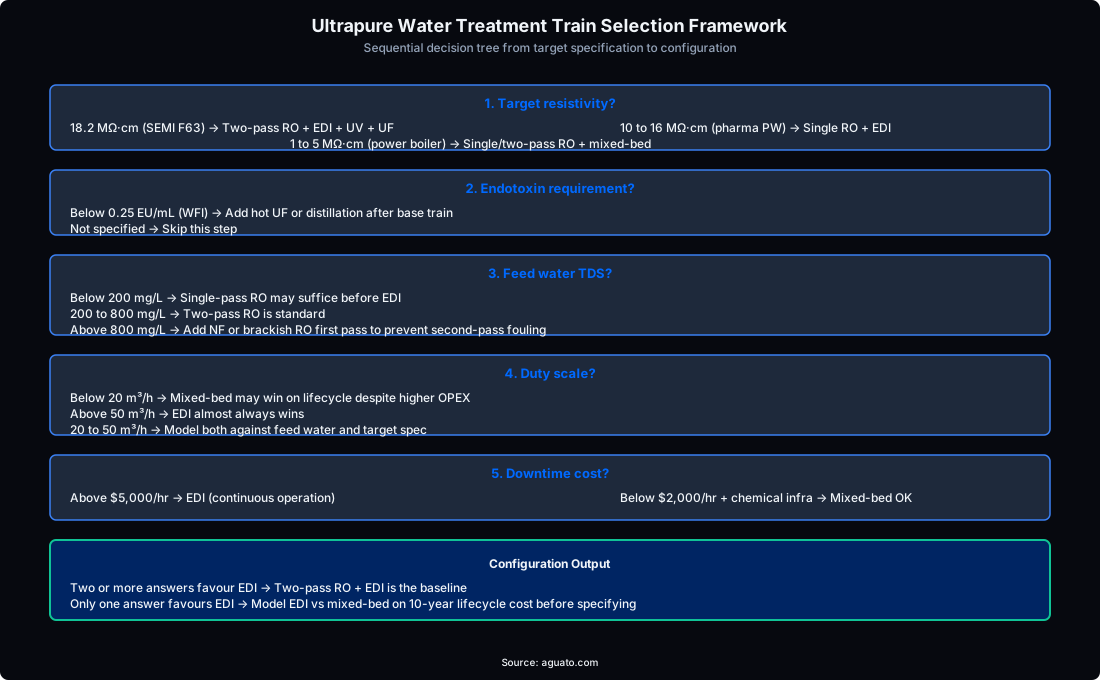
Run your duty through this sequential decision tree.
1. What is the target resistivity? If 18.2 megohm-cm (SEMI F63 or equivalent), proceed to two-pass RO plus EDI plus UV plus UF. If 10 to 16 megohm-cm (pharmaceutical purified water, lower-grade semiconductor), consider single-pass RO plus EDI. If 1 to 5 megohm-cm (power generation boiler feedwater), single-pass or two-pass RO plus mixed-bed is correct.
2. What is the endotoxin requirement? If below 0.25 EU per millilitre (WFI), add hot ultrafiltration or distillation after the base train. If endotoxin is not specified, skip this step.
3. What is the feed water TDS? If below 200 milligrams per litre, single-pass RO may suffice before EDI. If 200 to 800 milligrams per litre, two-pass RO is standard. If above 800 milligrams per litre, add a nanofiltration or brackish-RO first pass before the two-pass train to prevent fouling the second pass.
4. What is the duty scale? If below 20 cubic metres per hour, mixed-bed may win on lifecycle cost despite higher operating cost. If above 50 cubic metres per hour, EDI almost always wins. Between 20 and 50 cubic metres per hour, model both against your feed water and target spec.
5. What is the cost of downtime? If above $5,000 per hour, EDI wins because it runs continuously. If below $2,000 per hour and the site has chemical infrastructure, mixed-bed regeneration downtime is tolerable.
6. Is the system for new-build or retrofit? New-build projects should default to EDI. Retrofit projects into existing pharmaceutical or power plants with chemical systems already in place may retain mixed-bed to avoid duplicating infrastructure.
## FAQ
### What is the difference between ultrapure water and deionised water?
Deionised water removes dissolved ions to achieve resistivity between 0.1 and 10 megohm-cm, typically through ion exchange. Ultrapure water goes further, removing ions to 16 to 18.2 megohm-cm, plus organics to below 1 to 10 PPB, particles to below 0.05 particles per millilitre, and in some cases bacteria and endotoxins. Ultrapure water is a subset of deionised water, defined by tighter specifications on every contaminant class.
### Can I produce ultrapure water from brackish or seawater feed?
Yes, but the capital and operating cost increases significantly. Seawater at 35,000 milligrams per litre TDS requires a seawater RO first pass before the two-pass freshwater RO train, adding 30 to 50% to capital cost and increasing energy cost by 40 to 80% due to the higher operating pressure. Brackish water at 2,000 to 8,000 milligrams per litre is more common as ultrapure feed and adds one nanofiltration or brackish RO pass before the standard train.
### How often do EDI modules need replacement?
EDI modules typically last 7 to 10 years when fed with water at conductivity below 1 microsiemens per centimetre from a two-pass RO train. Service life drops to 4 to 6 years if fed with single-pass RO permeate at 5 to 15 microsiemens per centimetre, or if the feed contains above-specification hardness or organics that foul the ion-exchange membranes. Replacement cost for a 100 cubic metre per hour EDI train: $150,000 to $400,000.
### What is the energy cost to produce one cubic metre of ultrapure water?
Energy cost depends on feed water TDS and the number of RO passes. For municipal feed at 300 milligrams per litre TDS through a two-pass RO plus EDI train: 0.8 to 1.5 kilowatt-hours per cubic metre, or $0.08 to $0.25 per cubic metre at $0.10 to $0.16 per kilowatt-hour electricity cost. For brackish water at 2,000 milligrams per litre: 1.8 to 3.0 kilowatt-hours per cubic metre, or $0.18 to $0.48 per cubic metre.
### Do pharmaceutical WFI systems still require distillation?
No. The 2017 revision to the European Pharmacopoeia and subsequent USP revisions allow membrane-based WFI systems using hot ultrafiltration as an alternative to distillation, provided the system maintains continuous recirculation at 65 to 80 degrees Celsius and achieves endotoxin below 0.25 EU per millilitre. Many new pharmaceutical plants now specify hot UF-based WFI because capital and operating costs are 25 to 40% lower than distillation systems.
### How do I prevent biofilm in ultrapure water distribution loops?
Biofilm prevention requires three controls: continuous recirculation at flow velocity above 1 metre per second to prevent stagnant zones, maintaining distribution loop temperature above 60 degrees Celsius (pharmaceutical hot loops) or residual sanitiser at 0.05 to 0.2 milligrams per litre chlorine dioxide or ozone (semiconductor loops), and periodic sanitisation every 30 to 90 days with hot water, caustic, or hydrogen peroxide. Letting biofilm establish and then attempting remediation costs 10 to 50 times more than preventive measures.
### What is the silica limit for semiconductor ultrapure water and why does it matter?
SEMI F63 specifies silica below 1 PPB for ultrapure water feeding photolithography and etching tools. Silica at 5 to 20 PPB does not cause immediate defects but deposits on wafer surfaces during drying steps, creating haze and reducing yield on sub-10 nanometre process nodes. Silica removal to below 1 PPB requires two-pass RO with high-rejection membranes plus EDI, single-pass RO alone delivers 5 to 15 PPB silica, which is acceptable for power generation but fails semiconductor specification.