A batch rejected for endotoxin costs $500K to $3M. The contamination rarely starts in formulation. It starts in the water system. Full WFI, PW, and UPW technology and cost guide.
Pharmaceutical water systems are among the most tightly regulated utilities in industrial manufacturing. A batch of injectable drugs rejected for endotoxin contamination costs a mid-size manufacturer $500,000 to $3 million in scrapped product, regulatory response costs, and delayed revenue. The contamination almost never originates in the formulation suite. It originates in the water system that nobody audited properly after commissioning, or in the distribution loop that was designed without adequate turbulent flow to prevent biofilm.
The water grade decision is where most facilities make their most consequential and irreversible investment. Specifying Water for Injection (WFI) where Purified Water (PW) would satisfy the regulatory requirement adds $120,000 to $400,000 in CAPEX and roughly doubles OPEX per cubic metre. For a deep-dive on the grade standards, system architectures, and validation requirements by grade, see [High Purity Water for Pharmaceuticals: USP Standards Explained](/resources/high-purity-water-pharmaceutical-usp). Specifying PW where the product is parenteral exposes the facility to FDA Form 483 observations, consent decrees, and import alerts. And vendors will recommend whatever their equipment portfolio happens to cover.
This guide covers how the USP and European Pharmacopoeia (Ph.Eur.) water grades work, what each production technology costs across the CAPEX-to-OPEX arc, the distribution system decisions that determine whether a compliant system stays compliant over time, and how to structure the vendor evaluation so the decision is defensible to a regulatory auditor. The guide addresses the engineering, procurement, and quality-assurance perspectives; it assumes a pharmaceutical or biotech manufacturing context, not a hospital or compounding pharmacy.
## The decision in brief
- Right-size the water grade to the product. If you specify PW where PW is sufficient and WFI only where the product mandates it, the typical greenfield pharmaceutical site saves $200,000 to $600,000 in CAPEX and $80,000 to $200,000 per year in OPEX compared to a WFI-everywhere approach. - Count it over the asset life. Over a 10-year asset life, right-sizing the pharmaceutical water grade to your actual product requirements is $1 million to $2.6 million in recoverable capital and operating cost. - A WFI loop biofilm event is the biggest cost. The biggest cost of doing nothing is a biofilm event in a WFI loop that forces a 4 to 8 week production shutdown, destroying $1 million to $5 million in in-process product.
That event also triggers a regulatory inspection that diverts quality and management resource for 3 to 6 months.
## The three pharmaceutical water grades and what distinguishes them
Water quality in pharmaceutical manufacturing is not a matter of preference. Each grade has legally binding pharmacopoeial limits for conductivity, total [organic carbon](/elements/carbon) (TOC), bioburden, and in the case of WFI, bacterial endotoxins. The grade required for a given application is determined by the route of administration of the drug product and the manufacturing step involved, not by what the facility can produce cheaply.
Purified Water (PW) under [USP General Chapter 1231 on water for pharmaceutical purposes](dofollow:https://www.usp.org/frequently-asked-questions/water-pharmaceutical-and-analytical-purposes) must not exceed 1.3 microsiemens per centimetre (uS/cm) conductivity at 25 degrees C, 500 parts per billion TOC, and a bioburden alert limit of 100 colony-forming units per millilitre (CFU/mL). It is the minimum acceptable grade for rinsing equipment used in non-parenteral manufacturing, for preparation of oral and topical dosage forms, and as feed water for WFI systems.
Water for Injection (WFI) carries the same conductivity and TOC limits as PW but adds a bacterial endotoxin limit of 0.25 endotoxin units per millilitre (EU/mL). Endotoxins are lipopolysaccharide fragments from gram-negative bacteria that survive standard sterilisation at 121 degrees C and cause fever responses in patients receiving injectable products. The endotoxin limit is why distillation has historically been the default: it physically separates water vapour from endotoxin-contaminated liquid. Since the 2017 Ph.Eur. revision, non-thermal membrane processes have been formally permitted for WFI production, opening a significant cost-reduction path. The grade-by-grade specifications and the full treatment, distribution, and validation train are covered in our [pharmaceutical water treatment USP standards guide](/resources/pharmaceutical-water-treatment-usp).
Highly Purified Water (HPW) exists only in the European Pharmacopoeia, sits between PW and WFI with an endotoxin limit of 0.25 EU/mL but without the requirement that the production method ensures pyrogen removal by design. It is largely absent from new facility designs since WFI prices have fallen with non-thermal routes.
The grade that matters most commercially is the one your product demands. Every other decision flows from that.
## Purified Water: production technology and compliance requirements
Purified Water is the workhorse of pharmaceutical water systems, and its production is well understood. The standard production route is Reverse Osmosis followed by Electrodeionisation (RO+EDI), which delivers continuous, chemically stable output with conductivity reliably below 0.1 uS/cm, well within the 1.3 uS/cm USP limit. The combination has displaced the older RO plus mixed-bed ion exchange (RO+MBIX) configuration in most new builds because EDI operates continuously without the batch regeneration cycles that create out-of-specification (OOS) windows and consume significant quantities of acid and caustic.
The case for EDI over mixed-bed is straightforward arithmetic. A mixed-bed polisher on a 5 cubic metre per hour (m3/h) PW system requires regeneration with hydrochloric acid and sodium hydroxide every 4 to 8 weeks, consuming $800 to $2,000 per regeneration cycle in chemicals alone, plus 8 to 24 hours of reduced or zero production. EDI eliminates the regeneration chemicals and the associated OOS risk entirely. The CAPEX premium for EDI over MBIX is $30,000 to $80,000 on a mid-scale system; the OPEX saving pays that back in 2 to 4 years, and the reduced regulatory risk never appears on a payback spreadsheet but is the actual driver of the decision in most quality-aware facilities.
Pre-treatment for a PW system is not optional and is frequently underspecified. Feed water entering a pharmaceutical RO must be free of chlorine (which destroys polyamide RO membranes within weeks), suspended solids above 5 microns, and excessive hardness. The standard pre-treatment train is multimedia filtration, activated carbon dechlorination, and either softening or antiscalant dosing. Specifying the pre-treatment to match the actual feed water quality analysis is what determines whether the RO membranes last 3 to 5 years (adequate) or 12 to 18 months (a project failure). [Working with specialist water treatment consultants](/water-treatment-consulting) during the pre-treatment design phase is the highest-leverage investment in a PW system's long-term compliance cost.
### Key PW quality thresholds
- Conductivity: maximum 1.3 uS/cm at 25 degrees C (USP 645) - TOC: maximum 500 ppb (USP 643) - Bioburden: alert limit 100 CFU/mL, action limit typically 50 CFU/mL - Heavy metals: per USP 231 unless exempted by specific monograph - No endotoxin limit (this is the PW-vs-WFI dividing line)
A facility producing oral solid dosage forms only, with no parenteral products on the site, can operate its entire water system at PW grade. The moment a parenteral product is introduced, the water strategy changes fundamentally, and the capital plan needs to reflect that before design is frozen.
## Water for Injection: technology selection and the 2017 Ph.Eur. change
WFI production is the decision with the largest financial and regulatory consequence in pharmaceutical water system design. Before 2017, both USP and Ph.Eur. required WFI to be produced by distillation, which meant every WFI facility needed a still, steam infrastructure, and the associated energy costs. The USP has permitted membrane-based WFI production since 1997. The European Pharmacopoeia's acceptance of non-thermal processes in its 2017 revision brought EU-regulated facilities into alignment and opened the entire European market to alternative WFI production technologies.
The timing matters for investment decisions. A facility built or retrofitted after 2017 for an EU or US market can specify non-thermal WFI and receive full regulatory acceptance. A facility manufacturing for a market that has not adopted the Ph.Eur. 2017 amendment, or where the national regulatory authority has not recognised the revision in its guidance, must still use distillation. Before specifying a non-thermal WFI system, confirm with your regulatory affairs team which pharmacopoeial edition governs each target market.
### Multiple Effect Distillation (MED)
Multiple Effect Distillation (MED) remains the benchmark WFI production technology. It operates by boiling purified water feed under pressure through a series of heat-exchanging effects (typically 4 to 8), condensing the pure vapour to produce WFI, and recovering heat energy across effects to reduce steam consumption. A well-designed 4-effect still reduces steam consumption to approximately 1.1 to 1.4 kilograms of steam per kilogram of WFI produced.
The commercial case for MED is its regulatory predictability and its long service life. A pharmaceutical-grade still from a major supplier carries a validated design with decades of inspection history. CAPEX for a 5 m3/h MED still is $300,000 to $700,000 fully installed with controls, plus steam boiler costs if dedicated steam generation is required. OPEX is dominated by steam energy and typically runs $2.50 to $5.00 per cubic metre of WFI produced at European industrial energy prices.
### Non-thermal WFI: UF plus UV plus final polishing
Non-thermal WFI takes purified water feed and passes it through an ultrafiltration membrane (typically 5 to 20 kDa molecular weight cut-off) to remove endotoxins and bioburden, followed by UV treatment at 185nm and 254nm for TOC reduction and bioburden kill, then final membrane polishing. The endotoxin removal mechanism is retention rather than thermal destruction, which is why the 2017 Ph.Eur. revision required demonstration of validated endotoxin removal performance, not just end-product testing.
CAPEX for a non-thermal WFI system at 5 m3/h is $180,000 to $600,000, lower than MED where steam infrastructure is absent, with OPEX at $1.00 to $2.20 per cubic metre. For greenfield facilities without existing steam generation, the total project cost including steam infrastructure can make MED substantially more expensive than the still price alone suggests. A 500 kW steam boiler to support a WFI still adds $150,000 to $400,000 to the project, an item that frequently appears only after budget approval.
A pattern that recurs in pharmaceutical capital projects is the underestimation of steam infrastructure costs for WFI production. The still price is highly visible in the vendor quotation; the boiler, steam distribution pipework, condensate return, and water treatment for the boiler feed are often captured only in the civil and mechanical contingency, where they quietly consume $200,000 to $600,000 that was never formally allocated.
For a facility with no existing steam infrastructure manufacturing oral solids but planning to enter parenteral manufacturing, non-thermal WFI is almost always the lower total project cost option. [Browse verified ultrapure water production specialists](/ultrapure-water-production) who can model this total-cost comparison for your specific steam and energy configuration.
## Ultrapure Water: when standard WFI is not enough
Standard WFI satisfies the endotoxin specification for injectable drug products, but some applications demand water purity beyond the pharmacopoeial minimums. Cell therapy and gene therapy manufacturing, high-performance analytical instrumentation, and biological API synthesis processes may specify water at ASTM Type I resistivity of 18.2 megaohm-centimetre (MOhm-cm) and TOC below 5 ppb. This is what the semiconductor industry calls ultrapure water (UPW), and achieving it in a pharmaceutical setting requires adding polishing steps beyond the standard WFI train.
The UPW production sequence for pharmaceutical applications typically runs: RO, then EDI, then a polishing mixed-bed, then UV at both wavelengths for TOC destruction, then a 0.2-micron final filter or tight ultrafiltration membrane. Each step adds capital cost and introduces a potential failure point that must be validated. CAPEX for a pharmaceutical-grade UPW system at 1 to 5 m3/h is $400,000 to $2 million, depending on loop redundancy and instrumentation requirements. OPEX runs $1.50 to $3.50 per cubic metre, reflecting the multi-barrier energy load and frequent membrane replacements.
The key question is whether the process genuinely requires UPW or whether compliant WFI is sufficient. Forcing UPW specification on a process that needs only WFI adds CAPEX without regulatory value and creates additional failure modes that require ongoing qualification effort. The specification should be driven by process analytical technology data from development-scale studies, not by a conservative assumption that higher purity is always safer.
[Browse verified water purification specialists](/water-purification-companies) who have experience specifying and qualifying pharmaceutical-grade UPW systems for biologics and cell therapy applications. The technology selection depends heavily on the specific TOC and bioburden targets for your process.
## The treatment train: from feed water to grade-compliant output
The production chain from feed water to pharmaceutical-grade output requires thinking in stages, with each stage sized to protect the one downstream of it. The most expensive mistake in pharmaceutical water system design is treating the treatment train as a series of independent units rather than an integrated system where fouling, breakthrough, or biofilm at any stage propagates to every downstream stage.
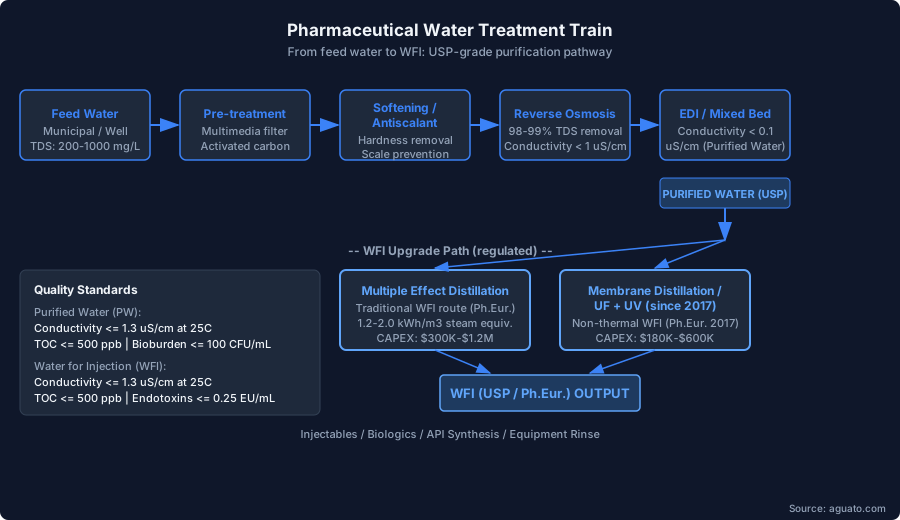
The starting point is always a detailed feed water analysis covering at minimum: TDS, pH, hardness, alkalinity, silica, iron, manganese, [chlorine](/elements/chlorine), total bacteria count, and turbidity. Designing without a feed water analysis is the equivalent of designing a building structure without a soil survey. The analysis determines pre-treatment configuration and RO membrane selection. Feed water TDS above 500 mg/L typically requires two-pass RO to achieve PW-grade conductivity with adequate margin. Feed water with high silica (above 25 mg/L as SiO2) requires antiscalant selection specific to silica scaling, which behaves differently from calcium carbonate and calcium sulphate.
The pre-treatment train for pharmaceutical water is more demanding than for industrial RO because the consequence of an upset is not just fouling cost, it is OOS product and a potential regulatory event. Activated carbon beds in pharmaceutical pre-treatment must be validated for dechlorination performance and managed to prevent their becoming a biofilm reservoir, which they naturally become if poorly designed. Carbon beds should operate at superficial velocities of 10 to 15 metres per hour (m/h) and undergo periodic hot-water or steam sanitisation depending on the system design.
Between the pre-treatment and the RO sits what is often called the break tank or feed water storage, which itself requires sanitary design, continuous circulation, and UV treatment to prevent bioburden accumulation. The break tank is among the most commonly cited deficiencies in FDA 483 observations for pharmaceutical water systems, precisely because it is perceived as passive infrastructure and receives inadequate attention in the initial design.
The connection between the [demineralised water production](/resources/demineralized-water-production) process used for industrial applications and the pharmaceutical PW train is the RO+EDI core. The difference is everything else: pharmaceutical systems require sanitary piping (316L stainless steel electropolished to Ra below 0.5 micrometre surface roughness, or high-grade PVDF for heat-sanitisable loops), validated cleaning and sanitisation procedures, continuous online monitoring with alarm integration, and a qualification package that demonstrates the system meets specification across its entire validated operating range.
The [dialysis water treatment](/resources/dialysis-water-treatment) sector provides a useful parallel. Both pharmaceutical WFI and dialysate-grade water require continuous recirculation loops, online conductivity and endotoxin monitoring, and validated sanitisation cycles. The key difference is that dialysis water standards are set by AAMI rather than pharmacopoeias, and the endotoxin limit for dialysate-grade water (0.1 EU/mL for standard dialysis, 0.03 EU/mL for ultrapure dialysate) is more stringent than WFI in some configurations. The engineering discipline is directly transferable.
## CAPEX and OPEX: what pharmaceutical water systems cost
The cost of a pharmaceutical water system cannot be quoted from a vendor catalogue because the installed and qualified cost includes engineering, procurement, construction, commissioning, and three-stage validation (Installation Qualification, Operational Qualification, Performance Qualification) that typically adds 20 to 40% to equipment cost. A $400,000 WFI still becomes a $550,000 to $650,000 installed and commissioned system before validation. With a full IQ/OQ/PQ validation package from a specialist validation contractor, the total project cost is $700,000 to $900,000 for that same still on a mid-size manufacturing site.
The table below provides indicative CAPEX and OPEX ranges for a 5 m3/h pharmaceutical water production system by grade and technology. Treat these as order-of-magnitude guidance for feasibility modelling; detailed site-specific engineering is required for capital budget purposes.
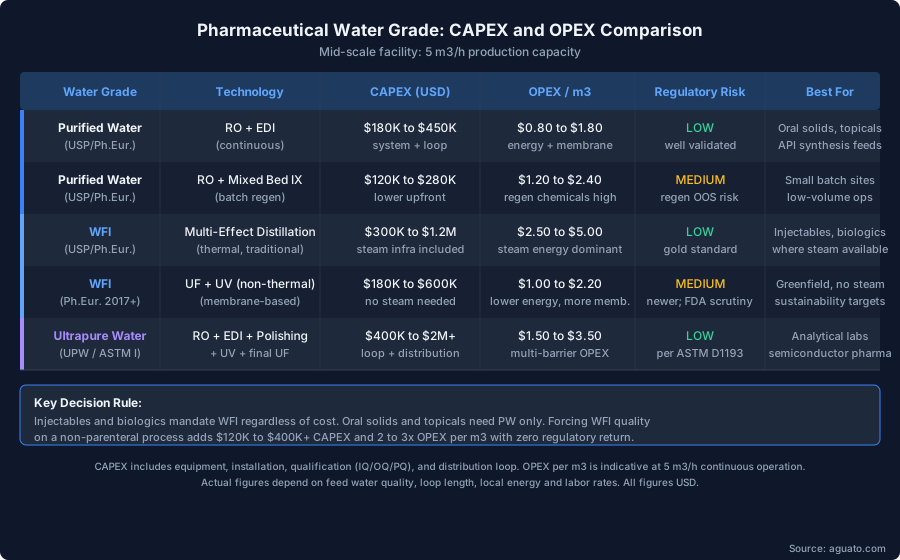
The OPEX breakdown for a compliant pharmaceutical water system includes five cost lines that industrial water system models routinely undercount:
- Energy: RO pumping at 0.3 to 0.8 kWh/m3, EDI at 0.05 to 0.15 kWh/m3, UV at 0.02 to 0.05 kWh/m3, distillation steam at $1.50 to $4.00/m3 equivalent depending on energy price - Membrane and consumables replacement: RO membranes at 3 to 5 year intervals ($8,000 to $25,000 per replacement event for a 5 m3/h system), EDI stacks at 5 to 8 year intervals, UF cartridges at 1 to 2 year intervals - Sanitisation chemicals: For heat-sanitisable loops, this cost is near zero; for chemical sanitisation (ozone, peracetic acid, hydrogen peroxide), expect $2,000 to $8,000 per year in consumables - Analytical testing: Ongoing pharmacopoeial testing (TOC, conductivity, bioburden, endotoxins for WFI loops) runs $15,000 to $60,000 per year depending on sample point count and frequency - Maintenance and validation support: Annual validation reviews, periodic requalification after system changes, and preventive maintenance on instrumentation and controls add $20,000 to $80,000 per year on a medium-complexity system
Across projects we have seen, the analytical testing and validation-support line items are consistently the most surprised-at items in year 2 operational reviews. They were present in the original cost model but invariably at the low end of the range, reflecting optimism about sampling frequency that the quality system will not actually permit.
Not sure which water grade and technology combination minimises your total lifecycle cost? [Post your project requirements](/post-project) and qualified pharmaceutical water system specialists will scope the trade-off against your actual feed water, production volumes, and target markets.
[cta:nepti]
## Distribution loop design: the compliance risk most systems underestimate
The production system can be perfectly designed and the distribution loop can still be a serial 483 generator. Pharmaceutical water distribution loops fail for five recurring reasons: inadequate flow velocity that permits biofilm formation, dead legs that cannot be sanitised, improper slope that creates standing water pools, sampling points installed in configurations that introduce contamination, and temperature management failures in hot water sanitisation loops.
The [FDA Inspection Technical Guide on Water for Pharmaceutical Use](dofollow:https://www.fda.gov/inspections-compliance-enforcement-and-criminal-investigations/inspection-technical-guides/water-pharmaceutical-use) is explicit that distribution loops must be designed to prevent microbial proliferation. For ambient-temperature PW loops, this means continuous recirculation at sufficient velocity to maintain turbulent flow (Reynolds number above 10,000), combined with a UV disinfection unit on the return line. For WFI loops, the standard is either continuous hot circulation at 70 to 80 degrees C (hot-loop WFI) or a validated ozone or UV-based cold-loop design. Hot-loop WFI is the regulatory default: the continuous heat load prevents biofilm formation without chemical intervention.
The dead-leg rule is specific and quantified. USP guidance requires that branch connections to use points not exceed a dead-leg ratio of 6 diameters (L/D ratio below 6), meaning a 1-inch branch can extend no more than 6 inches from the main loop before presenting a sanitisation-resistant biofilm risk. In practice, most facilities that have not reviewed their distribution drawings find multiple dead legs exceeding this ratio at points-of-use added after commissioning.
Loop piping material selection is driven by temperature requirement. High-density polyethylene (HDPE) and polypropylene (PP) are acceptable for ambient PW loops at competitive cost. Electropolished 316L stainless steel is required for HWS WFI loops, where the sustained 75 degrees C temperature rules out most plastics. PVDF (polyvinylidene fluoride) handles both temperature and chemical sanitisation and is increasingly used for HWS PW loops on sites that want plastic cleanability with thermal performance.
The [dialysis water treatment sector](/resources/dialysis-water-treatment) offers the most directly transferable loop-design lessons to pharmaceutical manufacturing. Both fields operate continuous-recirculation loops at defined quality specifications with zero tolerance for biofilm, both use similar online monitoring approaches, and both have extensive real-world experience with the failure modes that regulatory agencies look for in inspections.
## Failure modes and what they cost
The five most expensive failure modes in pharmaceutical water systems, with their commercial consequences:
Biofilm in the distribution loop. This is the most common and most costly. Biofilm forms at low-velocity zones, dead legs, gaskets, and improperly designed sample valves. Once established, biofilm cannot be eliminated by standard flush-and-sanitise procedures; it requires system shutdown, mechanical cleaning, and full requalification. Downtime for biofilm remediation on a WFI loop runs 3 to 8 weeks, with production losses typically $1 million to $5 million for a mid-size injectable manufacturing line. The correct decision is to design the loop to prevent biofilm from forming rather than relying on post-formation remediation.
RO membrane failure from chlorine breakthrough. Polyamide RO membranes are irreversibly damaged by free chlorine above 0.1 mg/L. A single event of chlorine breakthrough, caused by carbon bed exhaustion or bypass, can destroy an entire RO skid's membrane inventory in hours. Replacement cost is $15,000 to $50,000 in membranes plus 1 to 3 weeks of reduced production while replacement membranes are ordered and system requalification is completed. The mitigation is continuous online chlorine monitoring upstream of the RO, with automated feed shutdown on positive signal.
OOS conductivity from EDI or mixed-bed exhaustion. When the polishing unit reaches capacity, conductivity rises, and any water produced during the OOS period must be quarantined and destroyed. The cost is the product lost (potentially $50,000 to $500,000 per batch depending on product value) plus the investigation and CAPA documentation burden. Real-time conductivity monitoring with automated product diversion to drain is the required safeguard.
Endotoxin exceedance in a WFI loop. Endotoxin in a WFI system almost always originates from gram-negative bacteria that proliferated in the distribution loop. A single endotoxin OOS result in a WFI system triggers product batch quarantine, regulatory notification in some jurisdictions, a root cause investigation, a CAPA, and potentially a regulatory inspection. The direct cost of endotoxin remediation on a WFI loop can exceed $500,000 when product recall costs, recall logistics, and regulatory response costs are included.
Validation failure on initial Performance Qualification. A PQ that fails because the system does not consistently produce water within specification delays the start of commercial production. For a facility in the launch phase of a new product, each week of delay has a quantifiable revenue cost. For a product with a $100 million per year revenue expectation, a 4-week PQ failure delay costs approximately $8 million in delayed revenue, plus $200,000 to $500,000 in additional validation and engineering work to resolve the deficiency. The root cause is almost always insufficient attention to system design during engineering, not to the validation execution itself.
A typical pattern across biologics and cell therapy manufacturing sites is that the water system validation becomes the critical path for facility start-up at the last possible moment, when the engineering team has moved on to other projects and the quality team has just inherited a system they did not design. Building the validation strategy into the engineering specification from day one, rather than treating it as a post-construction task, is the most reliable way to prevent this scenario.
## Technology selection: a decision framework with numeric thresholds
Pharmaceutical water system technology selection should be made from the product requirements down, not from the available equipment up. The following framework provides decision rules with numeric thresholds for the key decision points.
Step 1: Determine the water grade required by product and process. - Parenteral product (injectable, ophthalmic, inhalation): WFI required for final rinse and product-contact water - Oral or topical product only, no parenterals on site: PW is sufficient - Cell therapy, gene therapy, or analytical support: evaluate UPW specification against process requirements
Step 2: Assess feed water quality. - Feed water TDS below 300 mg/L: single-pass RO likely achievable for PW specification - Feed water TDS 300 to 1,000 mg/L: two-pass RO recommended to achieve PW-grade conductivity with margin - Feed water TDS above 1,000 mg/L: two-pass RO required; evaluate feed water pre-softening - Free chlorine present: activated carbon pre-treatment mandatory; size for 10 to 15 m/h superficial velocity - Silica above 25 mg/L: specify silica-specific antiscalant; discuss with membrane supplier before finalising design
Step 3: Select WFI production technology (if required). - Site has existing steam infrastructure rated above 3 bar-g: MED is straightforward; evaluate on total OPEX over 15 years - Site has no steam infrastructure: model total project cost including boiler, pipework, and condensate return before comparing to non-thermal WFI - Target markets include EU and US: both thermal and non-thermal WFI accepted (verify with regulatory affairs) - Target markets include regions not having adopted Ph.Eur. 2017: distillation may still be required
Step 4: Design the distribution loop for the grade. - WFI loop: specify hot-loop at 70 to 80 degrees C unless you have validated cold-loop alternative; 316L EP stainless steel throughout - PW loop: continuous recirculation with UV on return; ambient temperature loops acceptable with bioburden monitoring - All loops: dead-leg L/D ratio below 6; slope to drain at points of use; sanitary design throughout
Step 5: Confirm monitoring and control strategy. - Minimum online monitoring: conductivity, TOC (continuous or periodic per pharmacopoeia), UV transmission - WFI loops: add online endotoxin monitoring if budget allows; if not, increase bioburden sampling frequency - Integrate all alarms with production system to enable automatic product diversion on OOS event
The [European Medicines Agency Guideline on the Quality of Water for Pharmaceutical Use](dofollow:https://www.ema.europa.eu/en/documents/scientific-guideline/guideline-quality-water-pharmaceutical-use_en.pdf) provides the regulatory reference for EU-licensed facilities and is a useful cross-reference even for US-primarily regulated sites when evaluating non-thermal WFI.
Not sure which route fits your site's steam infrastructure, target markets, and validation timeline? [Browse verified water purification companies](/water-purification-companies) who specialise in pharmaceutical applications, filter by technology and country, and request scoped proposals from 3 to 5 specialists.
## Validation and qualification: IQ, OQ, PQ in water systems
Validation is not a post-commissioning task in pharmaceutical water systems. The validation strategy must be defined at the point of design specification and drive engineering decisions that would otherwise be purely performance-based. A distribution loop designed for process flow without regard to validation sampling requirements will require expensive rework before PQ can commence.
The three-phase qualification protocol is required by all major pharmacopoeias and regulatory authorities:
Installation Qualification (IQ) verifies that the system as installed matches the approved design documentation, that materials of construction are verified, that instruments are calibrated, and that all documentation (P&IDs, equipment manuals, calibration records) is complete. IQ typically takes 2 to 4 weeks for a medium-complexity system.
Operational Qualification (OQ) demonstrates that the system operates within its design parameters across its operational range: that the RO produces the specified rejection rate at design flow, that the EDI consistently delivers target conductivity, that sanitisation cycles achieve the time-temperature profile required, and that alarms and interlocks function as designed. OQ typically takes 4 to 8 weeks.
Performance Qualification (PQ) for pharmaceutical water systems has a specific structure defined by USP: a minimum 2 to 4 week intensive sampling phase (Phase 1), followed by a 4-week reduced-frequency phase (Phase 2), followed by routine monitoring (Phase 3). The entire PQ period runs 2 to 4 months for a WFI system. During PQ, the system must consistently produce water within specification at all sample points, in all seasons, and under all normal operating conditions.
The most common PQ failure mode is seasonal variation in feed water quality that was not accounted for in the design. A facility that completes OQ in summer may find that winter feed water, with different temperature and microbiological character, exceeds bioburden alert limits on certain sampling days. The solution is a water risk assessment as part of the design phase that characterises feed water quality across a full seasonal cycle before the system is designed.
Across pharmaceutical water projects, the difference between a 3-month PQ and a 6-month PQ is almost always an engineering decision made 18 months earlier, not a validation execution failure. Sites that invest in thorough design review and commissioning testing before initiating formal validation consistently complete PQ on schedule. Sites that treat commissioning as a shorter version of IQ consistently find the same deficiencies in PQ that a proper commissioning would have caught.
The [water treatment plant design](/resources/water-treatment-plant-design) discipline that governs industrial water infrastructure overlaps substantially with pharmaceutical system engineering for the pre-treatment stages. The divergence point is qualification, sanitary design, and the ongoing documentation burden, all of which are unique to the pharmaceutical and healthcare sectors. [Exploring verified water treatment consulting specialists](/water-treatment-consulting) who have dual competence in industrial and pharmaceutical systems is the most efficient path to a design that satisfies both engineering and regulatory requirements.
## FAQ
### What is the difference between Purified Water and Water for Injection in pharmaceutical manufacturing?
Purified Water (PW) and Water for Injection (WFI) share the same conductivity limit (1.3 uS/cm at 25 degrees C) and TOC limit (500 ppb) under USP monographs, but WFI adds a bacterial endotoxin limit of 0.25 EU/mL. Endotoxins are lipopolysaccharide fragments from gram-negative bacteria that survive standard heat sterilisation and cause fever reactions in patients receiving injectable drugs. Because endotoxins cannot be removed by simple filtration or UV treatment in a pharmacopoeially validated manner, WFI production has historically required distillation, which physically separates endotoxin-contaminated liquid from pure vapour. Since 2017, the European Pharmacopoeia also permits membrane-based non-thermal processes for WFI production. The practical implication is that PW is acceptable for oral and topical drug products, while WFI is required for injectables, ophthalmics, and any product-contact water in parenteral manufacturing.
### Can non-thermal membrane processes be used to produce WFI under FDA regulations?
Yes. The United States Pharmacopeia has permitted non-thermal WFI production since 1997, significantly earlier than the European Pharmacopoeia. Under USP, the requirement is that the WFI production method reliably produces water meeting the USP WFI monograph specification, including the 0.25 EU/mL endotoxin limit, and that the process is validated to demonstrate consistent endotoxin removal. The European Pharmacopoeia adopted non-thermal WFI in its 2017 revision. Facilities manufacturing for markets governed by other pharmacopoeias should verify regulatory acceptance in those jurisdictions with their regulatory affairs team before specifying a non-thermal WFI system.
### How much does a pharmaceutical WFI system cost to install and qualify?
For a 5 cubic metre per hour WFI system, equipment costs range from $300,000 to $700,000 for Multiple Effect Distillation and $180,000 to $600,000 for non-thermal membrane WFI. Installed and commissioned costs are typically 30 to 50% higher than equipment cost, reflecting pipework, instrumentation, controls, and the sanitary distribution loop. Full IQ/OQ/PQ validation adds a further $100,000 to $300,000 in validation engineering and testing costs. Sites without existing steam infrastructure must also budget for boiler and steam distribution, adding $150,000 to $400,000 for a WFI still configuration. Total installed and validated project costs for a mid-scale WFI system typically run $700,000 to $1.5 million depending on site conditions, loop length, and validation complexity.
### What is the minimum distribution loop velocity for a pharmaceutical water system?
The distribution loop must maintain turbulent flow to prevent biofilm formation. Turbulent flow is defined by a Reynolds number above 10,000. For a 1-inch nominal pharmaceutical loop pipe at ambient temperature, this requires a minimum velocity of approximately 1.0 to 1.5 metres per second (m/s). For a 2-inch nominal pipe, the minimum velocity for turbulence is approximately 0.7 to 1.0 m/s. Hot-loop WFI systems operating at 70 to 80 degrees C achieve additional biofilm suppression from the continuous thermal load, but minimum velocity requirements still apply. Dead legs, low-velocity zones, and stagnant water at sample points are the most frequently cited distribution deficiencies in FDA water system inspections.
### How often should pharmaceutical water system validation be repeated?
Initial validation consists of IQ, OQ, and a three-phase PQ covering a minimum of 2 to 4 months of data collection under USP guidance. After initial validation, ongoing monitoring under Phase 3 protocols constitutes continuous process verification. Formal revalidation is required after any change to the system that could affect water quality: new use points, changes to sanitisation procedures, replacement of major components (RO skid, still, EDI module), changes to the building environment, or changes in feed water source. Periodic system review, typically annually, should assess trend data to identify whether the system is operating within its validated range and whether any emerging trend requires corrective action before an OOS event occurs.
### What causes biofilm in WFI distribution loops and how is it prevented?
Biofilm in WFI loops originates from gram-negative bacteria entering the system through the feed water, through the production equipment on an upset, or through poor hygienic practice at sample points. Once gram-negative bacteria establish in a low-velocity zone, they form a structured community protected by an extracellular polysaccharide matrix that resists standard sanitisation. Hot-loop WFI at 70 to 80 degrees C is the most reliable prevention: the continuous thermal exposure prevents establishment. Cold-loop WFI systems rely on ozone or UV plus validated recirculation protocols. The design precautions that matter most are eliminating dead legs with L/D ratios above 6, using sanitary-design sample valves that drain completely after sampling, ensuring adequate slope to drain at all use points, and maintaining continuous recirculation flow even at zero demand.
### How does pharmaceutical water system design differ from standard industrial water purification?
Standard industrial [water purification systems](/industrial-water-purification) are designed primarily for process performance: they deliver water within a conductivity or hardness specification at the required flow rate. Pharmaceutical water systems are designed for regulatory defensibility as much as for performance. Every material of construction must be documented and verified, every weld must be inspected, every instrument must be calibrated with traceability to national standards, every change must be documented through change control, and the entire system must be requalifiable after any significant modification. The piping is sanitary design (no crevices, no internal threads, no dead legs) rather than industrial design. The monitoring is continuous with automated alarm integration rather than periodic spot testing. The documentation burden is typically 3 to 5 times that of a comparable industrial system in engineering hours, and it does not reduce after commissioning.