A patient meets 120 litres of treated water per session. Inside AAMI/ISO limits, the RO train, monitoring, and the failures that kill.
A haemodialysis patient is exposed to roughly 120 litres of treated water per session, three sessions a week, across the membrane that separates their blood from the dialysate. That is more than 18,000 litres a year crossing a barrier that a healthy person's gut and kidneys would normally police. The patient has no such defence. Whatever is in the water goes almost directly into the bloodstream, which is why dialysis water treatment is not a utility decision, it is a patient-safety system that happens to involve pumps and membranes.
Get the chemistry wrong and people die. Chloramine breakthrough triggers acute haemolytic anaemia within a single shift. An endotoxin spike from a fouled distribution loop produces fever, hypotension, and a unit-wide pyrogenic reaction that ends up on an incident report and, eventually, in front of a regulator. Aluminium carryover accumulates silently over months and shows up as dialysis dementia and bone disease. These are not hypothetical failure modes. Every one of them has a documented body count behind the standard that now exists to prevent it.
This article is written for the people who specify, validate, and defend that system: biomedical engineers, hospital facilities managers, and renal-unit procurement teams. It covers the standards that govern dialysis water and why they are non-negotiable, the standard reverse osmosis treatment train stage by stage, the water quality parameters and their numeric limits, the monitoring and validation protocols that keep a system inside those limits, the failure modes that recur across real units, and how to evaluate a supplier so you do not inherit someone else's mistake for the next fifteen years.
## The decision in brief
- Engineer the system to your actual feed water. A dialysis water system engineered to your actual feed water and validated against ISO 13959, with the monitoring cadence resourced to run to internal action levels rather than legal ceilings, costs 8,000 to 28,000 dollars per station per year in treatment OPEX. - Avoid the one number that matters. A single serious water-quality event, a pyrogenic reaction cluster, a chloramine breakthrough, or a premature membrane failure, costs 100,000 to 500,000 dollars in litigation, regulatory penalty, transferred patients, and reputational damage. - Do not accept a value-engineered train. The biggest cost of doing nothing is letting a vendor specify a value-engineered train trimmed to win the bid, with undersized carbon, a timer-regenerated softener, and a loop without sanitisation capability.
Every six-figure failure in this article begins with a stage that was cut to make the capital number look better.
## Why The Standards Are Not Optional
Dialysis water sits under one of the most prescriptive regulatory frameworks in all of water treatment. The governing documents are AAMI/ANSI ISO 23500 (the umbrella suite for preparation and quality management of dialysis fluids), ISO 13959 (water for haemodialysis and related therapies), and the historical AAMI TIR34 guidance that informs how a unit selects and validates its system. Most national regulators adopt these by reference, which means the limits in them are not best-practice suggestions. They are the line a coroner's inquiry measures you against.
The reason the framework is this aggressive is that dialysis defeats every natural protection the body has. A person drinking municipal water absorbs maybe two litres a day through a digestive tract that filters, dilutes, and rejects. A dialysis patient meets a far larger volume across a semipermeable membrane with no biological gatekeeper behind it. A contaminant present at a level that is legally safe in drinking water can be acutely toxic in dialysate, because the exposure route and volume are completely different. Chloramine at the 4 mg/L the EPA permits in tap water will destroy red blood cells if it reaches the dialysate.
This is also where the commercial stakes become unavoidable. A single pyrogenic-reaction cluster, multiple patients spiking fevers in the same session, triggers mandatory incident reporting, an immediate halt to treatment on the affected loop, a root-cause investigation, and often a regulator site visit. The direct cost of a unit shutdown runs into tens of thousands of dollars per day in transferred patients, locum nursing, and emergency engineering. The indirect cost, loss of accreditation, litigation exposure, and reputational damage, dwarfs it. Across renal services, the recurring pattern is that the cost of compliance is always an order of magnitude smaller than the cost of one serious water-quality event.
For procurement teams, the standards are also a defensibility tool. When a system is specified, built, and validated explicitly against ISO 13959, every downstream decision has an audit trail. When it is specified against a vendor's marketing sheet, the team owns whatever gap exists between the brochure and the standard. The full text of the haemodialysis water standard is worth reading before any specification is locked, available through the [ISO 13959 standard listing](dofollow:https://www.iso.org/standard/79388.html).
## The Standard RO Treatment Train
The canonical dialysis water system is a reverse osmosis train with carefully sequenced pretreatment in front of it and a continuously recirculating distribution loop behind it. Each stage protects the stage after it. Skip one, or undersize one, and the failure surfaces downstream where it is harder and more expensive to diagnose.
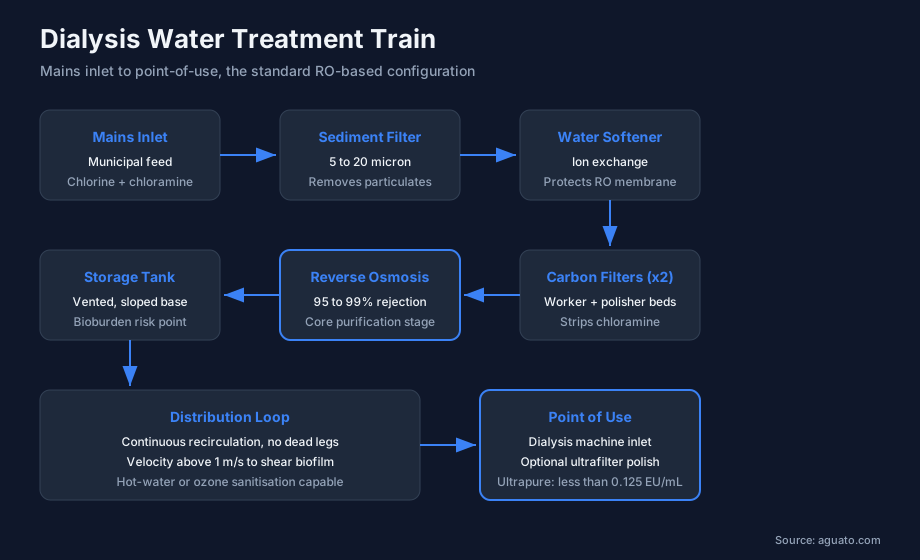
The train begins at the mains inlet, where municipal feed water arrives carrying chlorine or chloramine disinfectant, hardness, particulates, and whatever seasonal variation the local supply throws at it. The first job is mechanical: a sediment filter at 5 to 20 microns strips suspended solids that would otherwise blind the membranes and abrade the pumps. This is cheap insurance, and it is the stage most often neglected on undersized retrofits.
Next comes the water softener, an ion-exchange stage that removes [calcium](/elements/calcium) and magnesium hardness. Its purpose is not patient safety directly, it is membrane protection. Hardness scales an RO membrane fast, collapsing rejection and shortening membrane life from years to months. A softener that regenerates on a fixed timer rather than on measured throughput is a common silent failure: it exhausts mid-week and lets hardness through to the membrane without anyone noticing until rejection drops.
The most safety-critical pretreatment stage is carbon filtration, almost always configured as two beds in series, a worker tank followed by a polisher. Activated carbon is the only practical barrier against chloramine, and chloramine is the single most acutely dangerous contaminant in the feed. The two-bed configuration exists so that the unit can test between the beds: if the worker bed is exhausting, the polisher still protects the patient while the worker is rebedded. Empty bed contact time is the design variable that matters here, and undersizing it to save floor space is how chloramine breakthrough events begin. A carbon stage needs enough bed volume that the water dwells long enough for adsorption to complete at the worst-case feed concentration and flow rate the system will ever see, not the average. Municipal chloramine dosing is not constant: utilities raise it seasonally and during main-flushing campaigns, and a carbon stage sized for the annual mean will fail at the seasonal peak, which is exactly when the patient load is unchanged and the margin for error is gone.
The reverse osmosis unit is the core purification stage, rejecting 95 to 99% of dissolved ions, organics, endotoxins, and microorganisms in a single pass. Many units run a double-pass configuration for margin. RO is what takes the water from drinkable to dialysis-grade. After the membranes, treated product flows to a vented storage tank sized to buffer demand, then into the distribution loop, a continuously recirculating ring that delivers water to every machine with no dead legs and enough velocity to physically shear biofilm off the pipe walls.
The architectural choices in this train are not interchangeable, and the cost of getting the sequence or the sizing wrong compounds over the system's fifteen-year life. A softener undersized by 20% does not announce itself; it quietly halves membrane life, turning a planned five-year membrane replacement into a reactive eighteen-month one and adding 15,000 to 40,000 dollars in unscheduled CAPEX across the asset life. A carbon stage sized for floor-plan convenience rather than empty bed contact time shifts the dominant risk from inconvenience to patient harm. The train reads as a simple left-to-right diagram, but each box is a budget line and a risk line at the same time, and the place where most six-figure mistakes originate is the decision to trim one of them during value engineering. The right way to read the diagram is therefore back to front: start from the patient at the point of use, define the water quality the therapy demands, and let that specification dictate the size and redundancy of every stage upstream, rather than starting from a capital budget and trimming stages until the number fits.
## Water Quality Parameters And Their Limits
A dialysis water system is judged against a short list of numeric limits, and every one of them maps to a specific patient-harm mechanism. The limits below are the AAMI/ISO standard maximums for water used to prepare dialysate. They are not targets to drift toward, they are ceilings, and most units set internal action levels at half the standard limit so that a rising trend triggers intervention before the ceiling is breached.
The parameters fall into two groups by the speed at which their breach harms a patient, and that speed dictates the testing frequency. The acute group, chloramine and conductivity, can move a system out of spec within a single session, so they are watched in real time or tested before every shift. The chronic group, bacteria, endotoxins, [organic carbon](/elements/carbon), and heavy metals, accumulates over weeks to months, so it is sampled on a monthly or annual cadence and judged on its trend rather than a single reading. Understanding which group a parameter belongs to is what tells an engineer whether a rising number is an emergency or a maintenance signal, and it is the mental model that should sit behind every line in the table below.
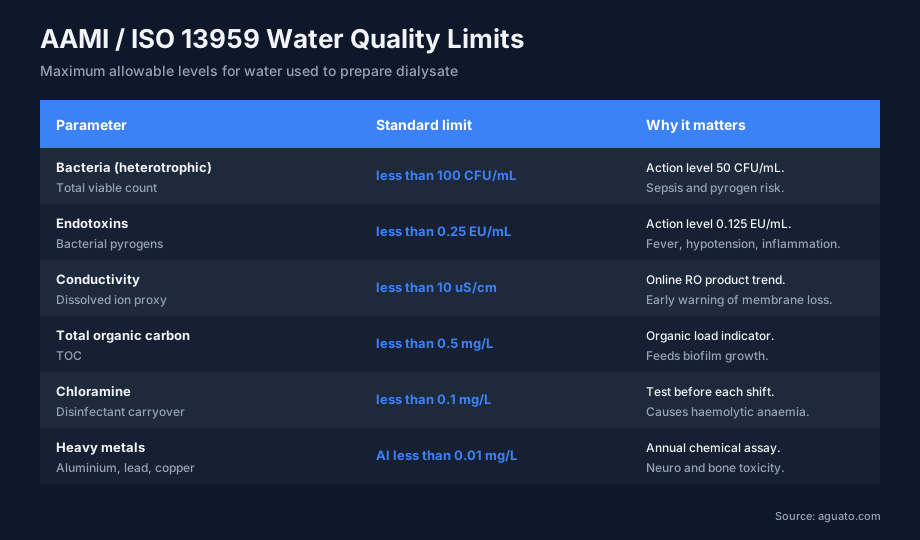
Conductivity must stay below 10 microsiemens per centimetre, and it is the parameter you watch in real time because it is the cheapest early-warning signal of RO failure. Conductivity is a proxy for total dissolved ions: when membrane rejection degrades, conductivity rises before any patient-facing harm occurs, giving the unit time to react. A continuous online conductivity monitor on the RO product line, alarmed and trended, is the single highest-value instrument in the plant room.
Bacteria are capped at less than 100 CFU/mL, with an action level at 50 CFU/mL. The count matters less than the trend: a system that holds steady at 20 CFU/mL is healthy, while one climbing from 10 to 60 over three weeks is telling you a biofilm is establishing somewhere in the loop. Endotoxins, the pyrogenic fragments shed by gram-negative bacteria, are limited to less than 0.25 EU/mL for standard dialysis water, with an action level at 0.125 EU/mL. Endotoxins are the parameter that produces the dramatic acute reactions, fever, rigors, and hypotension across multiple patients in the same shift, and they are why the distribution loop design obsesses over biofilm.
Total organic carbon below 0.5 mg/L matters because organic carbon is the food source that lets a biofilm grow in the first place; controlling TOC starves the bacteria the endotoxin limit is trying to suppress. Chloramine must be below 0.1 mg/L tested at the point downstream of the carbon beds, before every patient shift, because chloramine breakthrough causes haemolytic anaemia fast enough that a shift-start test is the only adequate frequency. Heavy metals, particularly aluminium below 0.01 mg/L, are assayed annually by an external chemistry lab; their harm, neurotoxicity and renal bone disease, accumulates over months rather than minutes, which is why the testing cadence is annual rather than per-shift.
The discipline that separates a well-run unit from a compliant-on-paper one is the gap between the standard limit and the internal action level. A unit that only reacts when it hits the legal ceiling is always reacting to a problem that has already reached the patient envelope, whereas a unit that acts at half the limit is managing a trend. The numbers above are the floor that any specification must meet; the operating philosophy on top of them is what actually keeps patients safe.
[cta:nepti-dark]
The reason this parameter set is worth internalising before a procurement conversation is that vendors quote against the standard limits, not against the operating action levels a safe unit actually runs to. Two systems can both claim compliance with ISO 13959 while one is engineered with the instrumentation, redundancy, and sanitisation capability to hold comfortably below the action levels and the other is engineered to scrape the ceiling on a good day. The difference does not show up in the headline spec; it shows up in the third year, in the bacteria trend line and the frequency of pyrogenic incidents, and by then the capital decision is locked. Characterising your feed water and your duty profile against these limits before you talk to suppliers is what lets you tell the two systems apart on paper.
## Monitoring And Validation Protocols
A dialysis water system is only as good as the evidence that it is performing, and that evidence is generated on a fixed cadence that runs from per-shift to annual. The monitoring programme is itself a regulated artefact: inspectors read the logs, and a gap in the log is treated as a gap in the water.
The per-shift checks are the ones that catch acute hazards. Chloramine is tested at the point between or after the carbon beds before patients are connected, because chloramine is the contaminant that can harm within a single session. Online conductivity is observed and recorded continuously, with the RO product conductivity logged at the start of each shift. Daily checks add RO percent rejection and the pressure differentials across the pretreatment filters, which together reveal whether the membranes and the filters are degrading.
Monthly sampling is microbiological: bacteria counts and endotoxin assays are pulled from defined sample points, typically the post-RO product, the storage tank, and the far end of the distribution loop, the point most likely to harbour biofilm. The samples go to a lab and the results are trended, not just compared to the limit, because the trend is the early signal. Annually, a full chemical assay covering heavy metals and the complete ISO contaminant list is performed by an accredited external laboratory, and the system undergoes a documented revalidation.
Validation is distinct from monitoring. Monitoring confirms the system is performing today; validation confirms the system is capable of performing and is performed at commissioning, after any significant modification, and on the annual cycle. A proper validation includes a documented installation qualification, an operational qualification proving the system meets spec across its operating range, and a performance qualification demonstrating sustained compliance over a defined period. The FDA's guidance on the infection-control and water-quality requirements for haemodialysis sets out the expectations that underpin this validation discipline, summarised in the [FDA guidance on reuse and water for dialysis](dofollow:https://www.fda.gov/medical-devices/reprocessing-reusable-medical-devices/dialyzer-reprocessing).
The recurring lesson from real units is that the monitoring programme fails not because the instruments are wrong but because the cadence slips. A chloramine test skipped on a busy Monday, a monthly microbiology sample pulled from the wrong port, an annual chemical assay deferred to save a few hundred dollars, these are the gaps that an incident investigation later identifies as the root cause. Robust sampling protocols, validated against your specific system layout and your actual feed water, are what turn a paper programme into a defensible one. For units characterising their feed and designing a sampling regime that will survive an audit, [post your project](/post-project) and qualified water-treatment specialists will scope the monitoring programme against your actual numbers rather than a generic template.
## Standard Versus Ultrapure Water
Not all dialysis water is held to the same specification. The standard distinguishes between conventional dialysis water and ultrapure dialysis water, and the difference is not cosmetic, it changes the treatment train, the cost, and the clinical outcome.
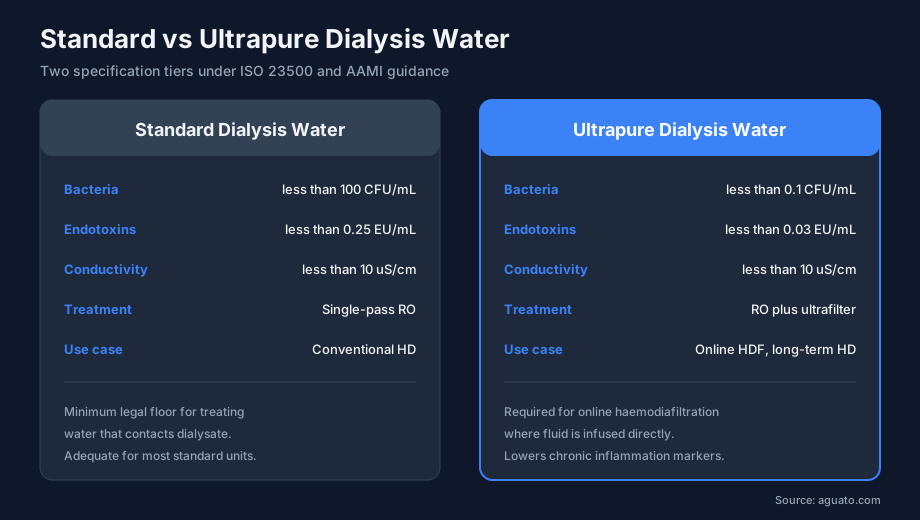
The two tiers diverge most sharply on the microbiological limits, as the comparison below makes clear.
| Aspect | Standard dialysis water | Ultrapure dialysis water | |---|---|---| | Bacteria limit | less than 100 CFU/mL | less than 0.1 CFU/mL | | Endotoxin limit | less than 0.25 EU/mL | less than 0.03 EU/mL | | Treatment train | Single-pass RO | RO plus point-of-use ultrafilter | | Annual treatment OPEX | 8,000 to 18,000 dollars per station | 12,000 to 28,000 dollars per station | | Best for | Conventional intermittent HD | Online haemodiafiltration, long-term HD | | Main risk | Chronic low-grade inflammation | Higher CAPEX, ultrafilter replacement cycle |
Ultrapure water is mandatory for online haemodiafiltration, where dialysate is infused directly into the patient's blood and any microbiological burden goes straight into circulation. It is achieved by adding a point-of-use ultrafilter downstream of the standard RO train, a final endotoxin and bacteria barrier immediately before the machine. The clinical case for ultrapure water extends beyond HDF, though: sustained exposure to even standard-grade water at the bacteria ceiling drives a chronic low-grade inflammatory state in long-term dialysis patients, and units that have moved to ultrapure water report measurable reductions in inflammatory markers and erythropoietin requirement.
The trade-off is capital and consumables. Ultrapure adds 30 to 55% to per-station treatment OPEX through ultrafilter replacement and the additional validation burden, and it raises commissioning CAPEX. The decision is therefore a clinical-economic one: for a unit running online HDF it is not optional, for a conventional HD unit it is an investment in long-term patient outcomes that competes with other capital priorities. The role of ultrafiltration as a final endotoxin barrier is covered in depth in our guide to [ultrafiltration membrane technology](/resources/ultrafiltration), and the upstream RO stage that makes it possible is detailed in our [reverse osmosis systems guide](/resources/reverse-osmosis-systems).
## Common Failure Modes And Their Consequences
Dialysis water systems fail in a small number of recurring ways, and every one of them maps to a decision made or skipped during design, commissioning, or operation. The three scenarios below are the patterns that recur across renal services.
Scenario one: chloramine breakthrough. A unit configured its carbon beds with insufficient empty bed contact time to save plant-room floor space, and ran the worker bed past its exhaustion point because the change-out schedule was set on a calendar rather than on measured chloramine throughput. During a period of elevated municipal chloramine dosing, the carbon stage stopped removing chloramine, and the per-shift chloramine test, the one safeguard that should have caught it, had been skipped on a busy morning. Multiple patients presented with acute haemolytic anaemia within the same session. The operational consequence is patient harm and a mandatory incident investigation; the financial consequence runs to hundreds of thousands of dollars in litigation, regulatory penalty, and unit downtime. The correct decision was to size empty bed contact time to the standard, change carbon on measured throughput, and never skip the shift-start chloramine test regardless of workload.
Scenario two: biofilm in the distribution loop. A loop was designed with a dead leg, a capped branch left in place for a future machine that never arrived, and the loop velocity was below the threshold needed to shear biofilm from the pipe walls. Over months, a biofilm established in the stagnant branch, shedding endotoxin into the recirculating water. The monthly endotoxin trend crept from 0.05 to 0.20 EU/mL, but because the unit only reacted at the 0.25 limit rather than at the 0.125 action level, no intervention was triggered until patients began spiking fevers across a single shift, a classic pyrogenic reaction cluster. The cost was a full loop shutdown, chemical and heat sanitisation, re-validation, and transferred patients, totalling tens of thousands of dollars plus the reputational damage of a reportable event. The correct decisions were no dead legs, loop velocity above 1 m/s, hot-water or ozone sanitisation capability designed in from day one, and acting on the trend at the action level.
Scenario three: inadequate RO reject rate. A retrofit reused an existing softener that was undersized for the feed hardness, and the resulting scale on the RO membrane collapsed rejection from 98% to 91% over eighteen months. Conductivity in the product water climbed, but the online monitor's alarm setpoint had been relaxed during a previous nuisance-alarm complaint, so the degradation ran unflagged. Total dissolved solids in the dialysate rose, and the membranes had to be replaced two and a half years early. The financial consequence was 15,000 to 40,000 dollars in premature membrane CAPEX plus the validation cost of the replacement, and the clinical risk of out-of-spec dialysate delivered before the problem was caught. The correct decision was to size the softener to the actual feed hardness, never relax a safety alarm to silence a nuisance, and treat a rising conductivity trend as the early warning it is.
The common thread across all three is that the failure was always upstream of the symptom, and the monitoring that should have caught it was either undersized at design or relaxed in operation. Peer-reviewed work on RO performance and membrane integrity in healthcare water systems reinforces that membrane degradation is gradual and detectable long before it becomes clinically significant, provided the monitoring is intact, as documented in research published in [Water Research on membrane performance monitoring](dofollow:https://www.sciencedirect.com/journal/water-research).
## How To Choose And Evaluate A Supplier
Selecting a dialysis water supplier is a fifteen-year decision, because the system you commission is the system you operate, validate, and defend for its entire service life. The vendor's incentive is to sell a system; your incentive is to operate one safely and cost-effectively for a decade and a half. These interests are not automatically aligned, and the evaluation framework below is designed to surface the gap before the contract is signed.
Work through these decision points in sequence against your actual site data, not against generic ranges:
- If your feed water carries chloramine (most municipal supplies now do), then dual carbon beds sized to standard empty bed contact time with inter-bed sampling are mandatory, not optional. Reject any proposal that single-stages the carbon. - If you run or plan to run online haemodiafiltration, then ultrapure water with point-of-use ultrafilters is a hard requirement, and the supplier must validate to the ultrapure microbiological limits, less than 0.1 CFU/mL and less than 0.03 EU/mL. - If your feed hardness exceeds 150 mg/L as calcium carbonate, then softener sizing dominates membrane life, and the proposal must size the softener on measured throughput with metered regeneration, not a fixed timer. - If your distribution loop will serve more than a handful of stations, then loop velocity above 1 m/s, zero dead legs, and designed-in hot-water or ozone sanitisation are non-negotiable, because retrofitting sanitisation capability into a loop later costs more than designing it in. - If the supplier cannot provide a documented installation, operational, and performance qualification package, then you are buying equipment, not a validated system, and the validation gap becomes your liability.
Each branch above resolves cleanly only when it is tested against your actual feed water analysis, your station count, and your therapy mix, which is precisely the data a single vendor has no incentive to interrogate before quoting. The way to convert this framework into competing, comparable proposals is to put your real numbers in front of several qualified specialists at once and let them scope the train against your constraints rather than their catalogue.
Beyond the technical screen, evaluate the supplier on the things that matter over fifteen years: the responsiveness of their service contract, the availability of consumables and membranes, the quality and clarity of their validation documentation, and whether their proposal reads as engineered to your feed water or templated from their catalogue. A supplier that asks for your feed water analysis and your duty profile before quoting is engineering a system; one that quotes from a model number is selling a box. The defensible procurement decision is the one with an audit trail back to your actual numbers and the ISO standard, which is exactly the comparison Aguato's marketplace is built to support: filter verified reverse osmosis and water-purification specialists, request scoped proposals from several at once, and compare them apples-to-apples. Our coverage of medical and pharmaceutical-grade water in the [industrial water purification guide](/resources/industrial-water-purification) and the validation testing in our [industrial water quality testing guide](/resources/industrial-water-quality-testing) both expand on the points above. Browse verified specialists through [reverse osmosis providers](/reverse-osmosis-companies), [ultrafiltration systems providers](/ultrafiltration-systems-companies), [water purification providers](/water-purification-companies), [water quality testing providers](/water-quality-testing), and [water treatment consulting providers](/water-treatment-consulting).
Pulling the validated-system trade-offs above into a single procurement decision is easier when the field is scoped. Compare vetted [water treatment equipment manufacturers](/providers) on Aguato, filter by medical and ultrapure water experience, and request proposals built against your station count and water quality targets.
## FAQ
What standards govern dialysis water quality? Dialysis water is governed by AAMI/ANSI ISO 23500 (the umbrella suite for dialysis fluid preparation and quality management) and ISO 13959 (water for haemodialysis), with the historical AAMI TIR34 informing system selection and validation. Most national regulators adopt these by reference, so the numeric limits in them are mandatory rather than advisory.
Why is reverse osmosis the core of a dialysis water system? Reverse osmosis rejects 95 to 99% of dissolved ions, organics, endotoxins, and microorganisms in a single pass, taking water from drinkable to dialysis-grade. No single competing technology removes that breadth of contaminants at once, which is why RO is the central stage with carbon and softening pretreatment in front of it and a recirculating loop behind it.
What is the difference between standard and ultrapure dialysis water? Standard dialysis water must hold below 100 CFU/mL bacteria and 0.25 EU/mL endotoxins; ultrapure water must hold below 0.1 CFU/mL and 0.03 EU/mL, achieved by adding a point-of-use ultrafilter. Ultrapure is mandatory for online haemodiafiltration and is increasingly used in conventional units to reduce chronic inflammation in long-term patients.
How often should dialysis water be tested? Chloramine is tested before every patient shift, conductivity and RO rejection daily, bacteria and endotoxins monthly from defined sample points including the far end of the distribution loop, and a full chemical assay including heavy metals annually by an accredited external lab. The cadence is itself a regulated artefact that inspectors review.
What causes the most serious dialysis water failures? The recurring causes are chloramine breakthrough from undersized or unmonitored carbon beds, biofilm and endotoxin shedding from dead legs and low-velocity distribution loops, and collapsed RO rejection from inadequate softening. In every case the failure is upstream of the symptom and the monitoring that should have caught it was undersized at design or relaxed in operation.
Why are dialysis water limits stricter than drinking water limits? A dialysis patient meets roughly 120 litres of treated water per session across a membrane with no biological gatekeeper, so contaminants enter the bloodstream almost directly. A level that is safe in drinking water, where the gut filters and dilutes a much smaller volume, can be acutely toxic in dialysate. Chloramine at the EPA-permitted drinking-water level destroys red blood cells if it reaches the dialysate.
How should a renal unit evaluate a dialysis water supplier? Require dual carbon beds with inter-bed sampling if the feed carries chloramine, ultrapure capability if you run HDF, softener sizing on measured throughput, a distribution loop above 1 m/s with no dead legs and designed-in sanitisation, and a complete installation, operational, and performance qualification package. A supplier that asks for your feed water analysis before quoting is engineering a system; one that quotes from a model number is selling a box.