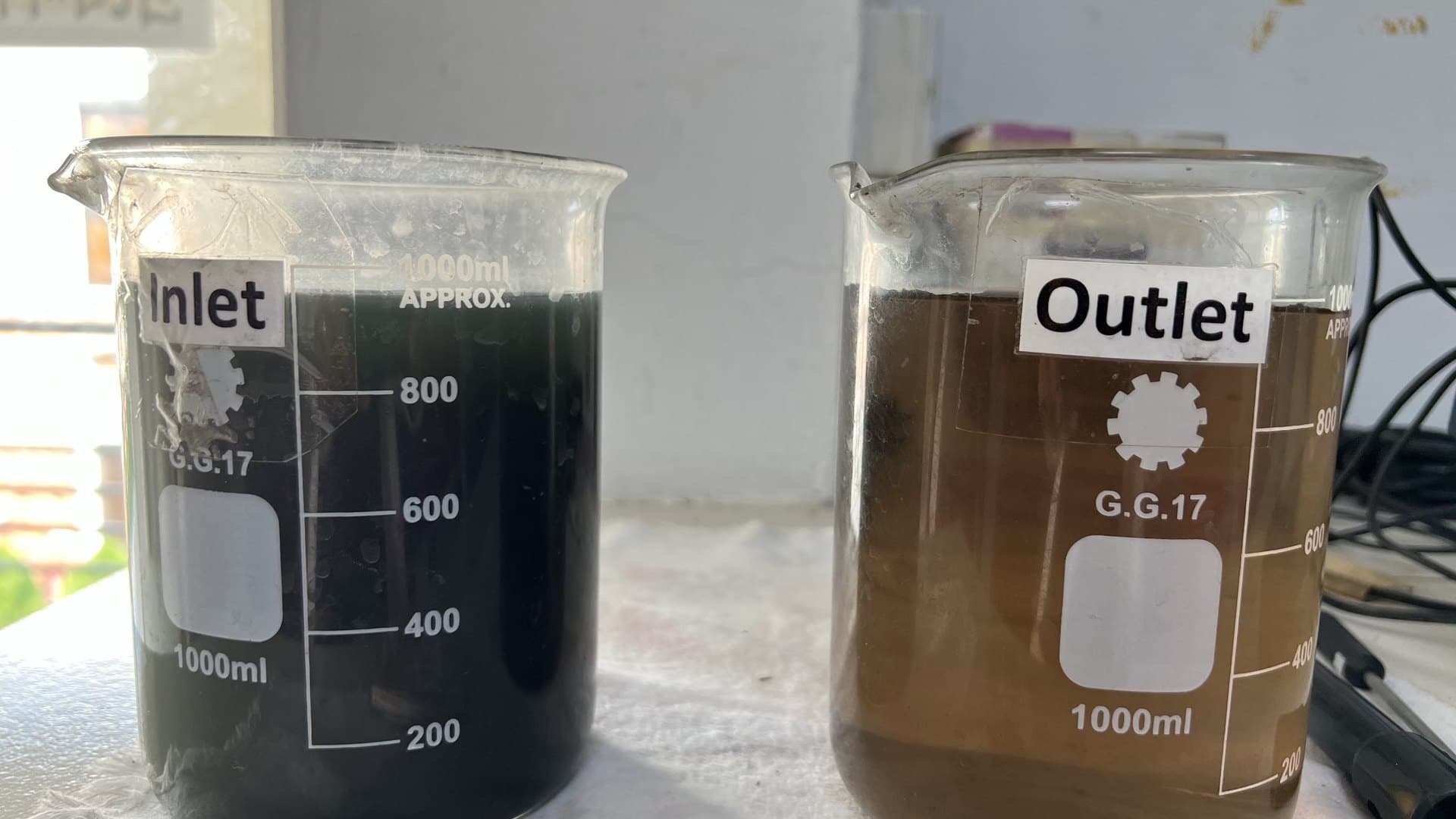
Textile dye effluent runs USD 0.40 to 1.80 per m3 to treat for discharge and USD 1.20 to 4.20 per m3 to recover for reuse, and the wrong technology choice locks a dye house into a USD 200,000 to 1.5M lifecycle penalty. This guide benchmarks the decision against 22 published textile treatment cases with real influent and effluent data, from a 100,000 m3/day district works to delivered reuse retrofits.
Textile dye effluent is the most visible water-pollution problem in industrial wastewater, and the most asymmetric. A single 50 m3/day reactive-dye line can stain a 2 km river reach a permanent indigo blue at concentrations the human eye sees before any monitoring instrument registers a violation. The wrong treatment specification locks a dye house into a USD 200,000 to 1.5M lifecycle penalty across two routes that look almost identical on a procurement spreadsheet: USD 0.40 to 1.80 per m3 to treat for discharge, and USD 1.20 to 4.20 per m3 to recover for reuse.
For Plant Managers, Procurement Leads, and Sustainability Directors at vertically integrated apparel, denim, knit, and home-textile producers, this is the decision that determines whether the site clears a brand-customer Higg FEM audit, whether the discharge permit survives the next Zero Discharge of Hazardous Chemicals (ZDHC) wastewater test cycle, and whether the wash-room recovers 70 to 90% of its incoming water or buys every cubic metre fresh. Get the technology stack wrong and the colour-removal failure does not arrive as a sudden permit breach. It arrives as a slow erosion of compliance margin, a missed brand-audit threshold, and a USD 50,000 to 300,000 per year recurring penalty on chemistry, sludge, and lost water that nobody put in the capital model.
This guide gives the procurement and operations teams a costed comparison of the five core colour-removal technologies, the dye-class decision matrix that determines which combination wins for a given fabric mix, the discharge-versus-reuse architecture trade-off, the failure modes that destroy the cost case, and the regulatory perimeter that is actively tightening in every textile-producing geography that buyer brands audit. It also benchmarks the whole decision against 22 published textile treatment cases with real influent and effluent numbers and technology trains, so the performance figures here are what real plants deliver, not vendor ranges.
## The decision in brief
- Price both architectures net, not gross. Discharge-only colour removal runs USD 0.40 to 1.80 per m3. Reuse plus ZLD runs USD 1.20 to 4.20 per m3 gross, falling to USD 0.01 to 0.85 per m3 net after water and discharge-tariff offsets. - Design against the strictest of the three perimeters, not the loosest in force today. The right decision turns on three variables that do not appear on the procurement bid: the brand-customer audit calendar, Higg FEM and ZDHC Progressive, the 5-year regulatory consent trajectory in the operating geography, and the dye-class mix envelope across the next 10-year production plan. - Run the mill case. A 1,500 m3/day knit mill on reactive dyes with Higg Level 2+ customers and water above USD 1.20/m3 pays a USD 1.2M to 2.7M reuse premium, recovered against USD 380,000 to 1,180,000/year in avoided fresh water and USD 2M to 8M/year in retained tier-1 revenue.
The lifecycle penalty for the wrong architecture is USD 200,000 to 1,500,000 across 15 years on chemistry, lost reuse and tanker brine haulage, recurring, and almost always invisible until 24 months after commissioning.
## What textile wastewater colour actually is
Textile dye effluent is a high-chroma, high-COD, high-salt stream that loads a treatment plant on three dimensions simultaneously. The visible colour is the customer-facing problem and the regulator-facing problem; the dissolved COD and salt are the engineering problem. A single saturated reactive-dye bath dumped to drain carries colour at 1,500 to 4,000 ADMI units, COD at 800 to 3,500 mg/L, conductivity at 8,000 to 25,000 microsiemens per cm, and pH swings between 4 and 12 depending on which stage of the dye cycle just discharged. Each of those numbers sits 5 to 20× above the consent limit at a typical European or US dye house.
The dye chemistry itself splits into six classes that behave completely differently in a treatment train:
- Reactive dyes bond covalently to cellulose. Unfixed dye (15 to 50% of the bath, depending on shade depth) goes straight to drain in hydrolysed, anionic form. Salt-heavy, low-biodegradability, and the single hardest class to decolourise. - Disperse dyes are non-ionic, low-solubility, used on polyester. Removed reasonably well by coagulation and adsorption, but generate persistent sludge with hazardous-classification triggers. - Acid dyes are anionic, used on wool, silk, polyamide. Moderate-to-high biodegradability; coagulation + biological works. - Direct dyes are large-molecule anionic, used on cellulose. Coagulation removes most colour but salt remains. - Basic (cationic) dyes are cationic, low usage globally. Adsorb easily on activated carbon; moderate biological response. - Vat and sulphur dyes (indigo, sulphur black) are reduced-soluble, oxidised on the fibre. Sediment-heavy, well removed by coagulation but generate visible-tint risk on discharge polish.
The procurement-relevant point: a denim mill running 90% indigo and a knit mill running 80% reactive dyes face the same regulatory consent, with completely different treatment economics. The denim mill will recover 75 to 90% water with a coagulation + biological + sand-filter train at USD 0.45 to 0.95 per m3. The knit mill needs membrane separation and oxidation at USD 1.40 to 3.80 per m3 to reach the same colour endpoint. Specifying the wrong train for the dye-class mix is the single most expensive procurement mistake in this category.
[cta:nepti-dark]
A second engineering point that determines the design: the textile colour challenge is time-averaged shock load, not steady state. A reactive-dye-batch discharge is a 4 to 8 hour pulse of 3 to 8× the daily-average colour load, and the receiving treatment plant has to absorb that pulse without breaching consent at the end-of-pipe sampling point. Equalisation tank sizing is the procurement decision most plants under-engineer: an under-sized equalisation buys the entire downstream train another 30 to 50% of capacity to handle the shock, and that capital lives on the OPEX line for the asset's full life.
## Benchmarks from 22 published textile treatment cases
Most textile treatment guides quote vendor ranges. The numbers in this section come instead from a corpus of 22 published textile wastewater treatment cases that Aguato has transcribed from peer-reviewed journals and delivered-project reports, each with paired influent and effluent measurements and the actual technology train. The corpus spans 10 countries and runs from a 100,000 m3/day textile-district works down to bench and single-stage trials. Half the cases sit at documented tier, meaning the full influent-to-effluent vector was read from the source table rather than a summary paragraph.
One caveat up front, because it changes how the distribution reads. The bottom of the range is single-stage and bench-scale trials, not failed plants. So the high effluent numbers at the 90th percentile are what a partial or lab-scale process leaves behind, not what a well-run full-scale plant discharges. A properly engineered whole-train plant sits in the left half of the distribution.
A note on colour units. This dataset records colour in Pt-Co (Hazen), the scale most of the underlying studies use. ZDHC and most textile discharge consents specify colour in ADMI. The two scales do not convert cleanly, so colour figures from the dataset are given in Pt-Co and the regulatory limits stay in ADMI. Do not compare the two directly.
Across the three parameters with enough data to report, this is what the corpus achieves (mg/L, all 22 cases):
| Parameter | Influent median | Influent p90 | Effluent median | Effluent p90 | Median removal | |---|---|---|---|---|---| | COD | 1,025 | 2,136 | 78 | 725 | 92.7% | | BOD | 352 | 773 | 34 | 228 | 89.0% | | TSS | 368 | 1,410 | 31 | 789 | 89.3% |
The median case removes 92.7% of COD, taking a median influent near 1,025 mg/L down to 78 mg/L. That 92.7% figure is the number to hold a bidder to on a conventional discharge duty. The spread matters more than the midpoint: the middle half of the corpus lands between 46 and 160 mg/L on effluent COD, while the 90th percentile sits at 725 mg/L, which is where the coagulation-only and bench trials fall. A full-train plant should be quoted against the median, not the tail.
Two structural facts from the corpus shape the technology decision. First, biological treatment is nearly universal: aerobic biological steps appear in 73% of the cases and anaerobic or hydrolytic-acidification steps in 41%, because textile COD is not something coagulation reaches on its own. Second, membranes are still the minority: only 18% of the cases run a nanofiltration or reverse osmosis stage, and every one of those is a reuse or high-recovery project. Membranes are the reuse decision, not the colour decision.
### Real installations, with the numbers and the train
Every row below is a real, named, full-scale facility with a published source, listed in the Sources section. COD is in mg/L and the train reads in treatment order.
| Plant, country | Flow (m3/day) | Train | COD, in to out | |---|---|---|---| | Prato textile district works, Italy | 100,000 | Equalisation, aerobic (oxidation ditch, nitrification), coagulation, ozonation | 301 influent (source reports no effluent COD) | | Zhejiang cluster park CETP, China | 30,000 | Equalisation, coagulation, anaerobic, aerobic | 1,370 to 88 | | Daegu dyeing complex, South Korea | 15,000 | Equalisation, aerobic, nutrient removal | 584 to 21 | | Jiangxi textile mill, China | 8,000 | Hydrolytic acidification, CASS, coagulation, filtration | 2,000 to 54 | | Santa Clara textile mill, Cuba | 3,600 | Extended-aeration activated sludge | 424 to 101 | | Disperse-dye mill, China | 960 | Hydrolysis, contact oxidation, flotation, coagulation, biological activated carbon | 992 to 72 | | Bahir Dar textile factory, Ethiopia | not reported | Equalisation, electrocoagulation, coagulation, activated sludge | 483 to 144 | | Denizli dyeing and finishing works, Turkey | not reported | Equalisation, aerobic biological | 550 to 155 (colour 330 to 210 Pt-Co) |
Prato is the intake benchmark for a large textile-district works: its published study reports a mean influent COD of 301 mg/L across a 100,000 m3/day plant that is roughly 70% textile-industrial, treated through oxidation ditches, coagulation, and a final ozonation polish. The Chinese cluster and mill cases show a biological plus coagulation train with no membranes reaching 54 to 88 mg/L COD, clearing indirect-discharge limits without the cost of RO. The Cuban and Ethiopian cases sit higher, at 101 and 144 mg/L, and the reason at Bahir Dar is instructive rather than a data artefact: the designed media filter and polishing pond were built but never commissioned, so the plant discharges at secondary-clarifier quality. That failure mode gets its own case below.
### The reuse cases: what closing the loop actually delivers
Three delivered reuse projects in the corpus show the recovery architecture working, each built around the ultrafiltration and reverse osmosis trains that [membrane filtration suppliers](/membrane-filtration-companies) deliver, and they are the real-world version of the cost-stack in the next section:
- Ergene denim mill, Turkey. A washing and finishing combined effluent (low-COD, 336 mg/L) taken through activated sludge, ultrafiltration, and reverse osmosis to reuse grade: COD 336 to 4 mg/L and colour 262 to 4 Pt-Co. That endpoint is what only a membrane tail delivers. - Zhongshan reuse plant, China. Reverse osmosis polishing of membrane-bioreactor effluent at a 70% water-recovery ratio: COD 72 to 1.5 mg/L, iron 6 to 0.02 mg/L. The bioreactor does the biology, the RO does the reuse. - Jiaxing reuse retrofit, China (1,500 m3/day). Hydrolytic acidification, anoxic-oxic, ultrafiltration, and reverse osmosis took influent COD from 450 to 15 mg/L at a stable reuse ratio near 53%, saving about 240,000 tonnes of freshwater a year. Its delivered economics anchor the cost stack in the next section.
Nepti benchmarks your own dye-house numbers against this corpus. [Characterise your effluent and see where it sits against the real-plant distribution in Nepti](/nepti) before you accept a bidder's performance guarantee, then compare [textile colour-removal system suppliers](/color-removal-wastewater) on the marketplace when you move to procurement.
## The five colour-removal technologies and where each wins
Across all textile dye houses, five technology families do the work of colour removal. None is universally correct; most well-engineered installations run two or three in series. The selection logic depends on the dye-class mix, the discharge-versus-reuse architecture, and the regulatory consent the plant is filing against.
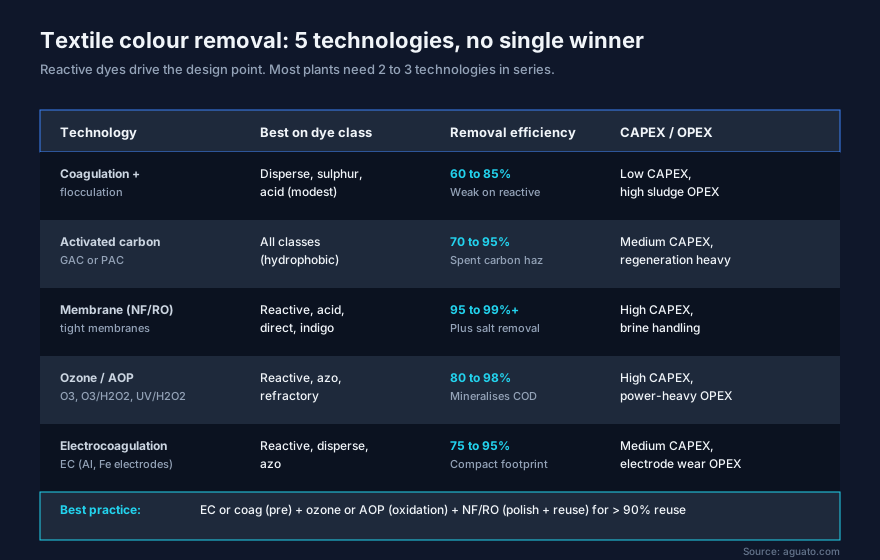
1. Coagulation + flocculation. The default first-stage workhorse. Aluminium sulphate, ferric chloride, or PAC (polyaluminium chloride) at 100 to 600 mg/L drops 60 to 85% of colour as floc, depending on dye class. Strong on disperse, sulphur, and direct dyes; weak on hydrolysed reactive dyes that stay in solution. Low CAPEX (USD 80 to 220 per m3/day installed capacity) but heavy on sludge production (1.5 to 4.5 kg dry solids per kg dye removed), and the sludge classification triggers hazardous waste handling in most jurisdictions. Best used as a pre-treatment stage feeding a polishing technology, not a stand-alone solution.
2. Activated carbon adsorption. Granular (GAC) or powdered (PAC) carbon adsorbs 70 to 95% of residual colour across all dye classes. The carbon does its job; the lifecycle penalty is the regeneration cycle. Spent GAC carries the adsorbed dye load and triggers hazardous-waste classification; off-site thermal regeneration runs USD 1,800 to 3,500 per tonne and has a 6 to 12 week turnaround. Plants that specify GAC without a regeneration contract end up with a USD 80,000 to 250,000 annual carbon-replacement bill they did not model. Medium CAPEX (USD 180 to 450 per m3/day) but the regeneration OPEX is the dominant lifecycle cost.
3. Membrane separation (NF and RO). Tight membranes (nanofiltration and reverse osmosis) reject 95 to 99%+ of colour and salt simultaneously, producing reuse-grade permeate. This is the only technology family that delivers a reuse-grade output stream, which is why every architecture above 60% water recovery has NF or RO at its core. The price for that capability is high CAPEX (USD 450 to 1,200 per m3/day installed), accelerated fouling on textile feeds (CIP frequency 3 to 8× higher than RO on cooling-tower blowdown), and a concentrated brine stream that needs evaporation or zero liquid discharge to close the mass balance. The membrane-fouling pattern in textile use is documented: see our [guide on membrane fouling prevention](/resources/membrane-fouling-prevention) for the operational programme that determines whether membranes last 5 years or 18 months in dye-house service.
4. Advanced oxidation processes (AOP). Ozone (O3), ozone + hydrogen peroxide (O3/H2O2), and UV/H2O2 generate hydroxyl radicals that mineralise dye molecules to colourless intermediates and ultimately to CO2 and water. Removal efficiency 80 to 98%; AOP is the only family that destroys dye chromophores rather than concentrating them into a brine or sludge stream. The price is power: ozone generation runs 8 to 16 kWh per kg O3 produced, and a textile colour load needs 3 to 12 kg O3 per kg dye removed. Power-heavy OPEX (USD 0.18 to 0.55 per m3 treated on power alone), but no concentrated waste stream to handle. The economic case strengthens in geographies with cheap renewable power and tight brine-discharge regulation. See our [advanced oxidation processes for industrial wastewater](/resources/advanced-oxidation-processes-industrial) deep-dive for the AOP selection logic that determines whether ozone, UV/peroxide, or Fenton is the right choice for a given dye-class mix.
5. Electrocoagulation (EC). Aluminium or iron sacrificial electrodes generate coagulant in situ, removing 75 to 95% of colour with a footprint 30 to 60% smaller than chemical coagulation. EC produces less sludge per kg dye removed and uses no purchased coagulant, which makes it attractive for sites where coagulant logistics or sludge disposal cost is the binding constraint. Medium CAPEX (USD 250 to 600 per m3/day) and electrode wear OPEX (USD 0.08 to 0.22 per m3 treated). The decision between EC and chemical coagulation usually turns on local power cost versus local coagulant logistics: high power cost, expensive coagulant logistics favours EC; cheap power, on-site coagulant storage favours chemical. The mechanism difference is detailed in our [electrocoagulation vs chemical coagulation guide](/resources/electrocoagulation-vs-chemical-coagulation).
The pattern that recurs in successful installations: EC or chemical coagulation as a pre-stage, biological (MBR or SBR) for COD reduction, ozone or AOP for refractory colour and COD polishing, and NF or RO as the reuse-architecture polish step. A single technology rarely wins. The combination wins.
## Cost stack: discharge-only versus reuse + ZLD
The most consequential architecture decision is whether the treated effluent goes to discharge under consent, or recirculates back into the dye house. The CAPEX delta is large; the OPEX delta is larger; the strategic outcome is completely different.
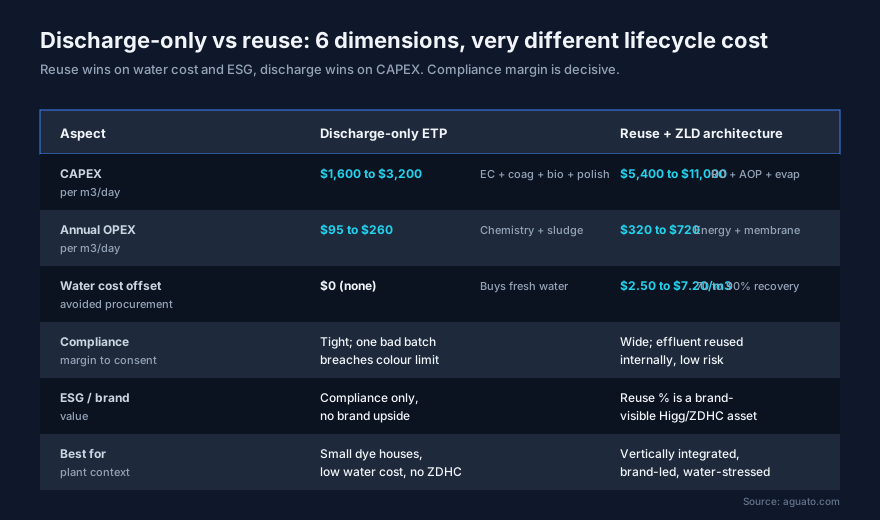
For a 1,500 m3/day textile wastewater duty (mid-size knit mill, 70% reactive dye load):
| Cost element (15-year horizon) | Discharge-only ETP | Reuse + ZLD architecture | Delta | |---|---|---|---| | Equalisation + EC/coag CAPEX | USD 280,000 to 480,000 | USD 280,000 to 480,000 | 0 | | Biological (MBR) CAPEX | USD 220,000 to 380,000 | USD 220,000 to 380,000 | 0 | | AOP / ozone polish CAPEX | USD 150,000 to 280,000 | USD 220,000 to 420,000 | +USD 70,000 to 140,000 | | NF / RO polish CAPEX | 0 | USD 650,000 to 1,200,000 | +USD 650,000 to 1,200,000 | | Evaporator / crystalliser CAPEX | 0 | USD 480,000 to 1,400,000 | +USD 480,000 to 1,400,000 | | Total installed capital | USD 650,000 to 1,140,000 | USD 1,850,000 to 3,880,000 | +USD 1,200,000 to 2,740,000 | | Annual OPEX (chemistry, energy, labour) | USD 220,000 to 460,000 | USD 480,000 to 1,080,000 | +USD 260,000 to 620,000 | | Avoided fresh-water procurement (annual) | 0 | USD 380,000 to 1,180,000 | −USD 380,000 to 1,180,000 | | Avoided sewer / discharge tariff (annual) | 0 | USD 95,000 to 320,000 | −USD 95,000 to 320,000 | | Net annual OPEX after offsets | USD 220,000 to 460,000 | USD 5,000 to 420,000 | −USD 40,000 to 455,000/yr | | Per m3 treated (loaded cost) | USD 0.40 to 1.80 | USD 1.20 to 4.20 (gross) / USD 0.01 to 0.85 (net) | Reuse wins when water cost exceeds USD 1.20/m3 |
This 1,500 m3/day duty is not hypothetical. A delivered reuse retrofit at a dyeing plant in Jiaxing, China took influent COD from 450 to 15 mg/L through a hydrolytic-acidification, anoxic-oxic, ultrafiltration, and reverse osmosis train, at a stable reuse ratio near 53% that saves about 240,000 tonnes of freshwater a year. The published project reported total investment of 4.90 million CNY and an operating cost of 3.53 CNY per m3, roughly USD 0.72 million in capital and USD 0.52 per m3 at 2017 exchange rates. That is the real-world version of the reuse column above.
The crossover point is local water cost. In Bangladesh, Cambodia, and most of Pakistan textile clusters, fresh water at USD 0.35 to 0.85/m3 makes discharge-only the right answer on cost. In Italy, Portugal, Turkey, India (Tirupur, Tamil Nadu after the zero-discharge mandate), China (most coastal zones), Mexico, and increasingly the US South-East drought-zone, water cost above USD 1.20/m3 plus the ZDHC discharge perimeter swings the math to reuse + ZLD. The geography of the decision is shifting fast: as of 2026, every major textile cluster outside South Asia is either under an active zero-discharge mandate or has one in regulatory preparation.
The brand-customer dimension multiplies the cost case. Higg FEM Level 3 (Sustainable Apparel Coalition) and ZDHC Progressive (the highest ZDHC tier) both reward water reuse percentages, and major buyer brands (H&M, Inditex, PVH, VF, Nike, Adidas) increasingly require Level 3 or Progressive for tier-1 supplier status. A 75% water-reuse certification on the Higg dashboard is worth USD 2M to 8M per year in retained customer revenue at a mid-size mill, and that number does not appear on the wastewater CAPEX calculation but does appear in the sales forecast that funds the wastewater CAPEX. The right wastewater architecture is the one that retains the brand-customer relationship over 10 years, not the one with the lowest tendered capital cost.
The full ZLD architecture and the underlying evaporator + crystalliser economics are covered in our [evaporation crystallization ZLD guide](/resources/evaporation-crystallization-zld) and the [ZLD vs MLD cost comparison](/resources/zld-vs-mld-cost-comparison) for the intermediate-architecture decision. The colour-removal stack determines what feeds the ZLD; the ZLD determines whether the architecture is closed-loop.
## Dye-class decision matrix
The technology mix that wins depends on the dye-class fingerprint of the dye house's actual production. The following matrix is the procurement-grade starting point; site-specific characterisation is the FEED-stage step that locks the configuration.
| Dye-class mix | Pre-treatment | Biological | Colour polish | Reuse-grade polish | Typical CAPEX (per m3/day) | |---|---|---|---|---|---| | 70%+ reactive | EC or coag (FeCl3) | MBR | Ozone or O3/H2O2 | NF + RO | USD 1,400 to 2,800 | | 70%+ indigo / vat | Coag (alum) | SBR or MBBR | Sand filter | Optional NF | USD 600 to 1,400 | | 70%+ disperse | Coag (PAC) | MBR | GAC | NF + RO | USD 1,200 to 2,400 | | Mixed (no class >40%) | EC + coag | MBR | Ozone | NF + RO | USD 1,600 to 3,200 | | Acid / direct dominant | Coag (FeCl3) | MBR | GAC | NF | USD 900 to 1,800 |
A pattern that recurs in plants that retrofit existing ETPs to reach reuse-grade output: the bottleneck is almost always the colour-polish stage, not the biological. A mid-1990s coag + biological ETP that runs colour at 200 to 400 ADMI on a good day can be upgraded to discharge-compliant (<75 ADMI) for USD 180,000 to 450,000 by adding ozone or UV/H2O2 polish. The same plant brought to reuse-grade colour and conductivity needs a full NF + RO train at USD 600,000 to 1,400,000. The retrofit cost gap between "compliant" and "reusable" is 3 to 5×, and that gap is what the procurement decision should resolve before the FEED contract is signed, not during commissioning.
The full mechanical wastewater-stack design pattern that links these stages is covered in our [industrial wastewater treatment process guide](/resources/industrial-wastewater-treatment-process), the textile colour-removal stack is a specialised version of that general architecture with two additional decision axes (dye-class fingerprint, reuse architecture).
## Regulatory perimeter: ZDHC, Higg FEM, and discharge consents
The regulatory perimeter on textile wastewater is tighter than on most industrial discharge categories and is tightening faster. Three frameworks dominate the practical operations agenda for any dye house selling to global apparel and home-textile brands.
1. ZDHC Wastewater Guidelines. The Zero Discharge of Hazardous Chemicals (ZDHC) framework defines the most-watched parameter list in textile wastewater: 50+ regulated parameters across colour (ADMI), conventional chemistry (COD, BOD, TSS, pH), heavy metals, persistent organic pollutants, and the ZDHC MRSL (Manufacturing Restricted Substances List), 200+ chemical-by-name limits. A failed ZDHC test is published on the ZDHC Gateway, which is visible to every major buyer brand, and triggers customer-side procurement reviews within 72 hours. The full text of the wastewater requirements is at [the ZDHC Wastewater Guidelines](dofollow:https://www.roadmaptozero.com/process). The Aspirational (Progressive) tier requires colour below 7 ADMI and conductivity below 1,200 microsiemens, both of which require NF or RO membrane polish to achieve.
2. Higg FEM (Facility Environmental Module). The Higg FEM, administered by the Sustainable Apparel Coalition, scores every audited facility on water use intensity, water reuse percentage, and discharge compliance. A score below Level 2 on the Higg FEM water module triggers customer-side delisting at most tier-1 brands, and a Level 3 score unlocks preferred-supplier pricing of 3 to 8% on tier-1 contracts. Water reuse percentage is the single largest scoring lever in the Higg water module: every 10% of recovered water above 50% reuse moves the facility 0.4 to 0.6 score points on the relevant axis. See [the Sustainable Apparel Coalition's Higg FEM resource page](dofollow:https://apparelcoalition.org/the-higg-index/) for the audit framework.
3. Local discharge consents. Beyond the brand-customer perimeter, every dye house operates under a national or regional discharge consent. The colour limit varies wildly: India (CPCB) sets colour at 150 to 400 ADMI depending on receiving water class; the EU Industrial Emissions Directive defers to member states with typical consents at 25 to 75 ADMI; China sets some textile-cluster discharge at 50 ADMI under the GB 4287-2012 standard. The trend is monotonic and predictable: every five-year permit cycle tightens the colour and salt limits by 20 to 40%, and the chemistry that worked at year 0 of a 15-year facility design will not work at year 10.
The defensive design pattern: specify the wastewater architecture to clear the strictest of the three frameworks the facility will face within its 15-year service life, not the loosest one in force today. That usually means specifying NF-grade colour polish even when the current consent does not require it; the marginal CAPEX delta at FEED-stage is 15 to 25%, against a retrofit cost of 80 to 150% at year 8.
## Where textile colour-removal projects go wrong
Three procurement patterns recur across textile wastewater installations, and each represents a recognised, expensive mistake.
1. Specifying the technology stack from a single dye-class assumption. Reactive-dye knit mills that specify a coag plus biological plus GAC train against a single "reactive dye" design point run into trouble when the production mix migrates toward disperse dyes for polyester blends. GAC consumption can run 2 to 3 times above the design assumption and the regeneration contract cost with it, a recurring penalty on the order of USD 95,000 a year against the design case. The mistake is designing against a single dye-class fingerprint instead of the actual production-mix envelope. Correct decision: characterise the full dye-class portfolio across the next 10-year production plan and design against the envelope, not the centre case.
2. Under-engineering equalisation to save tank CAPEX. Denim mills that specify 4 hours of equalisation where 12 is needed find the reactive-rinse pulse during indigo programme transitions overwhelms the biological stage every 18 to 24 hours, derating the downstream membrane train by 40 to 60% and forcing a third of the design-rated reuse to be aborted daily. The lost reuse and extra chemistry runs to the order of USD 220,000 a year. The mistake is treating equalisation as a buffer tank instead of a flow-and-chemistry stabiliser. Correct decision: size equalisation against the full daily shock-load amplitude, not the daily-average flow.
3. Specifying reuse architecture without modelling the salt mass balance. Vertically integrated mills that specify NF plus RO for reuse without a paired evaporator or crystalliser for the brine stream discover after commissioning that the reject brine (8 to 12% of feed volume at 4 to 7% TDS) has no compliant disposal route. Defaulting to tanker haulage at USD 28 to 65 per m3 can erase the entire water-cost saving, a penalty on the order of USD 480,000 a year. The mistake is specifying a recovery architecture without closing the mass balance on the concentrated waste stream. Correct decision: every reuse architecture above 60% recovery needs a paired ZLD or MLD plan, costed at the same FEED stage as the membrane train.
### The same mistakes, in three published plants
The patterns above are not theoretical. Three plants in the reference corpus show exactly where a train falls short of its consent.
Single-stage coagulation cannot clear a textile consent. A garment laundry ETE in Caruaru, Brazil runs equalisation and alum coagulation-flocculation only. The published characterisation shows COD falling just 46% (1,152 to 623 mg/L) and BOD not moving at all, because alum strips colloidal and particulate load while leaving the soluble biodegradable fraction untouched. That misses the state regulator's 80% COD-reduction requirement for textile plants outright. The lesson: coagulation is a pre-stage, not a discharge solution, and a one-stage train will not clear a textile consent.
A polish stage that exists on the drawing but not in operation. The Bahir Dar textile factory in Ethiopia was built with a multigrade media filter and a guard pond after its activated-sludge stage, but the published assessment records both as not functional, so the plant discharges at secondary-clarifier quality of 144 mg/L COD. The lesson: compliance is set by the stages the plant actually operates, not the ones on the P&ID. Specify for the train you will run and commission, and budget the O&M to keep the polish stage alive.
Biology alone does not clear metals. A knit-composite textile effluent run through a moving-bed and membrane bioreactor pilot in Tongi, Bangladesh reached strong COD and colour removal, but effluent iron (10 mg/L) and lead (0.14 mg/L) stayed above the national discharge limits of 2 and 0.1 mg/L, because a biological train carries no dedicated metals-removal mechanism. The lesson: where the dye-class mix or the auxiliary chemistry carries metals, the train needs a coagulation, precipitation, or electrocoagulation step. Biology will not do it on its own.
In every case, pattern or published plant, the decision quality starts with characterising the production envelope, closing the mass balance, and specifying for the stages the plant will actually operate before issuing the RFP.
## Decision framework: which architecture wins for your dye house
Run the dye-house production profile through this sequential check.
1. Brand-customer perimeter: Does any tier-1 customer require Higg FEM Level 2+ or ZDHC Aspirational/Progressive? Yes → reuse + ZLD architecture is the right specification, regardless of local water cost. No → continue. 2. Local water cost: Does fresh-water cost (procurement + treatment to dye-house quality) exceed USD 1.20/m3? Yes → reuse architecture wins on lifecycle cost. No → continue. 3. Discharge consent trajectory: Is the regional consent expected to tighten colour or conductivity limits within the next 5 years? Yes → over-specify polish stage to absorb the consent trajectory. No → continue. 4. Dye-class mix: Is reactive dye load more than 50% of production? Yes → membrane polish (NF or RO) is necessary regardless of architecture; specify reuse-capable train. No → continue. 5. Water-stress geography: Is the site in a basin classified as high or extremely high water stress by the WRI Aqueduct framework? Yes → reuse architecture wins on operational continuity, even if cost case is marginal. No → continue. 6. All five answers no: A well-engineered discharge-only ETP is the right architecture. Specify against the brand-customer audit calendar, not the local consent floor.
If two or more answers favour reuse + ZLD, the architecture case is strong enough to absorb the 2 to 3× CAPEX premium. If only one is yes, model the 15-year lifecycle at the local water and energy cost, the architecture decision is genuinely close in that zone, and the answer requires site-specific modelling against the brand-customer scoring lever.
[Test the configuration against your dye-class mix and local cost stack in Nepti](/nepti), which models the production envelope, the local water and energy cost, the brand-customer audit calendar, and the regulatory consent trajectory, and produces a ranked configuration comparison with 15-year lifecycle cost projections.
## Sources
The plant benchmarks and case studies in this guide are drawn from Aguato's textile reference corpus of published treatment studies. Featured facilities:
- Prato (Baciacavallo) textile-district works, Italy: [Tuci et al., Water 16:3164 (2024)](https://doi.org/10.3390/w16223164) - Daegu dyeing complex, South Korea: [full-scale metagenomic treatment study, PLoS ONE (2021)](https://pmc.ncbi.nlm.nih.gov/articles/PMC8306160/) - Bahir Dar textile factory, Ethiopia: [Wondim et al., Environmental Monitoring and Assessment 195:1360 (2023)](https://pmc.ncbi.nlm.nih.gov/articles/PMC10593618/) - Santa Clara textile mill, Cuba: [Cabrera Estrada et al., Centro Azucar 42(4) (2015)](http://centroazucar.uclv.edu.cu/index.php/centro_azucar/article/view/237) - Caruaru garment-laundry ETE, Brazil: [Cavalcanti, MSc dissertation, UFPE (2020)](https://repositorio.ufpe.br/handle/123456789/37738) - Zhongshan RO reuse plant, China: [RO reclamation of MBR-treated dyeing effluent (2023)](https://pmc.ncbi.nlm.nih.gov/articles/PMC10142955/) - Tongi knit-composite MBBR-MBR pilot, Bangladesh: [combined MBBR-MBR study, Heliyon (2024)](https://pmc.ncbi.nlm.nih.gov/articles/PMC11133930/)
Additional cases (the Denizli dyeing works and Ergene denim reuse mill in Turkey, and the Zhejiang cluster, Jiangxi mill, Jiaxing retrofit, and disperse-dye plant in China) are drawn from peer-reviewed journals and published delivered-project reports in the same corpus.
## FAQ
### What is textile wastewater colour removal?
Textile wastewater colour removal is the treatment-train decision and engineering programme that takes high-chroma dye effluent (typically 800 to 4,000 ADMI units) down to the level required by either a discharge consent or a reuse architecture. The colour comes from unfixed dye (15 to 50% of the bath at the dye stage), which arrives in solution and resists conventional biological treatment. Removal requires a combination of pre-treatment (coagulation or electrocoagulation), biological COD reduction, chemical oxidation (ozone, UV/peroxide), and membrane separation (NF or RO) for reuse-grade output.
### How much does it cost to treat textile dye wastewater?
Discharge-only treatment runs USD 0.40 to 1.80 per m3 loaded cost, including chemistry, energy, labour, and sludge disposal. Reuse + ZLD architecture runs USD 1.20 to 4.20 per m3 gross, falling to USD 0.01 to 0.85 per m3 net after the avoided fresh-water procurement and discharge-tariff offsets. The crossover point where reuse beats discharge on net cost is local water cost above USD 1.20 per m3, plus a brand-customer audit perimeter that rewards reuse percentage in Higg FEM scoring.
### What is the best technology for removing colour from textile wastewater?
No single technology wins across all dye-class mixes. The best-practice stack combines (1) coagulation or electrocoagulation as a pre-treatment, (2) biological (MBR or SBR) for COD reduction, (3) ozone or advanced oxidation for refractory colour polish, and (4) nanofiltration or reverse osmosis for reuse-grade polish where reuse architecture is chosen. The specific stack depends on the dye-class fingerprint of the dye-house production: reactive-dye-dominant mills need membrane polish, indigo-dominant mills can usually clear consent with coagulation + biological + sand filter.
### Does activated carbon work for textile wastewater colour?
Yes, for 70 to 95% colour removal across all dye classes, especially as a polishing stage downstream of coagulation or biological. The lifecycle cost depends entirely on the regeneration model: dye-loaded carbon classifies as hazardous waste in most jurisdictions, off-site thermal regeneration runs USD 1,800 to 3,500 per tonne with a 6 to 12 week turnaround. Plants that specify GAC without a regeneration contract end up with USD 80,000 to 250,000 in annual carbon-replacement cost they did not model. Activated carbon usually wins on a polish-stage basis after coagulation reduces the upstream load, not as a primary colour-removal technology.
### What is ZDHC and does it apply to my dye house?
ZDHC (Zero Discharge of Hazardous Chemicals) is the framework adopted by the major global apparel and home-textile buyer brands (H&M, Inditex, PVH, VF, Nike, Adidas, IKEA, and 70+ others) that defines wastewater discharge limits for textile suppliers. ZDHC applies to any dye house in the supply chain of any signatory brand. A failed ZDHC wastewater test is published on the ZDHC Gateway, which is visible to every major buyer brand, and triggers customer-side procurement reviews within 72 hours. The Aspirational (Progressive) tier requires colour below 7 ADMI and conductivity below 1,200 microsiemens, both of which require NF or RO membrane polish to achieve.
### Can textile wastewater be reused?
Yes, with the right architecture. A well-engineered reuse + ZLD train can recover 70 to 90% of dye-house wastewater to reuse quality (low colour, low conductivity, suitable for dye-bath make-up or rinse stages). The recovery percentage depends on the membrane train (NF + RO), the brine-handling tail (evaporator + crystalliser for the highest recovery), and the dye-class mix (reactive dyes carry high salt loads that constrain recovery). Reuse is the dominant architecture in water-stressed textile clusters (Tirupur, Tamil Nadu, Bursa, Guangdong) and in any facility selling to brands that score water reuse in their supplier audits.
### How long does a textile wastewater treatment plant last?
Mechanical and biological infrastructure typically operates for 20 to 30 years with appropriate refurbishment. Membrane elements (NF and RO) need replacement every 3 to 7 years in dye-house service, faster than the 5 to 10 year benchmark for cooling-tower or municipal feed because the textile feed accelerates organic and biological fouling. The colour-polish technology (ozone generators, UV reactors, activated carbon contactors) has a 12 to 20 year service life. The economic question is rarely whether the asset will last, it is whether the original specification will still meet the discharge consent or brand-customer perimeter at the year-10 audit, which is why over-specification of the polish stage at FEED-stage is the defensive procurement strategy.
### Does textile colour removal generate hazardous waste?
Yes, in most jurisdictions. Coagulation sludge contains the adsorbed dye load and triggers hazardous-waste classification under EU Directive 2008/98/EC, US RCRA Subtitle C, and most equivalent national frameworks. Disposal cost runs USD 180 to 450 per tonne depending on jurisdiction. Spent activated carbon, ion-exchange resin, and concentrated brine from membrane separation also classify as hazardous in most cases. The total hazardous-waste OPEX is typically 12 to 28% of total ETP OPEX in textile colour-removal installations and is one of the under-modelled cost lines in early-stage procurement bids.