A food plant paying $200,000 per year in FOG surcharges can recover DAF capital in 24 months. How dissolved air flotation works, what it costs, and when to choose it.
Dissolved air flotation is one of the most effective primary treatment technologies in industrial wastewater. A food and beverage plant generating 500 cubic metres per day of high-FOG effluent can face municipal surcharge penalties of $150,000 to $400,000 per year if it discharges above consent limits. A correctly sized DAF unit, removing 90 to 98% of fats, oils, and grease before discharge, typically eliminates that surcharge within 12 to 24 months. That payback window is the real reason DAF has become the default primary treatment unit across food processing, paper manufacturing, oily water handling, and produced-water treatment.
The technology looks deceptively simple on paper: dissolve air under pressure, release it into a tank, and the resulting microbubbles float contaminants to the surface for skimming. In practice, getting a DAF to perform consistently across variable feed compositions, seasonal temperature swings, and changing production schedules is where projects succeed or fail. Vendors will recommend whatever they sell. The buyer's job is to model the lifecycle cost of all separation options before committing to a tank size, saturator pressure, or chemical programme.
This guide covers how [dissolved air flotation](/resources/industrial-wastewater-treatment) works mechanically, which wastewater streams it handles best, how to compare it against gravity clarifiers and membrane alternatives, what CAPEX and OPEX to budget, which failure modes drive the largest unplanned costs, and how to structure a vendor RFP that forces apples-to-apples comparison. The guide is written for the plant managers who own compliance and uptime, and the procurement leads who have to defend the capital line item in an engineering review.
## The decision in brief
- Specify the DAF correctly. If a 300 gallon-per-minute food-processing plant installs a correctly specified DAF system for $600,000 to $900,000 installed, it eliminates a $200,000 to $350,000 per year municipal surcharge and avoids the sludge-volume costs of an undersized clarifier. - Expect the capital back in 2 to 3 years. That plant recovers the capital in 2 to 3 years and generates $150,000 to $280,000 per year in net avoided cost over a 20-year asset life. - The cascade is the biggest cost. The biggest cost-of-doing-nothing is the cascade: a single consent exceedance triggers regulatory enforcement, which triggers a permit review, which triggers a compliance programme with third-party oversight at $50,000 to $150,000 per year until the root cause is resolved.
That compliance programme is exactly the remediation a correct DAF specification would have prevented.
## How dissolved air flotation works
Dissolved air flotation removes suspended solids, fats, oils, and grease from water by generating a dense cloud of microscopic air bubbles, typically 30 to 80 micrometres in diameter, that attach to contaminant particles and carry them to the water surface as a floating sludge layer called float. The process is fundamentally different from gravity settling, which relies on particle density exceeding the surrounding water. DAF works on buoyancy, making it effective on any contaminant that can be made less dense than water, including emulsified oils that gravity clarifiers cannot separate.
The mechanical sequence runs as follows. A portion of the clarified effluent, typically 15 to 30% of the forward flow, is recycled to a pressurised saturator vessel operating at 60 to 90 psi. At that pressure, approximately 9% air by weight dissolves into the water at 70 degrees Fahrenheit. The saturated stream is then injected into the inlet of the DAF contact zone, where the sudden pressure drop to atmospheric causes dissolved air to nucleate as microbubbles. Those bubbles rise at 4 to 12 gallons per minute per square foot through the clarification zone. Contaminant-bubble agglomerates float to the surface and are continuously skimmed by a mechanical skimmer into a float hopper. Clarified water exits from the bottom.
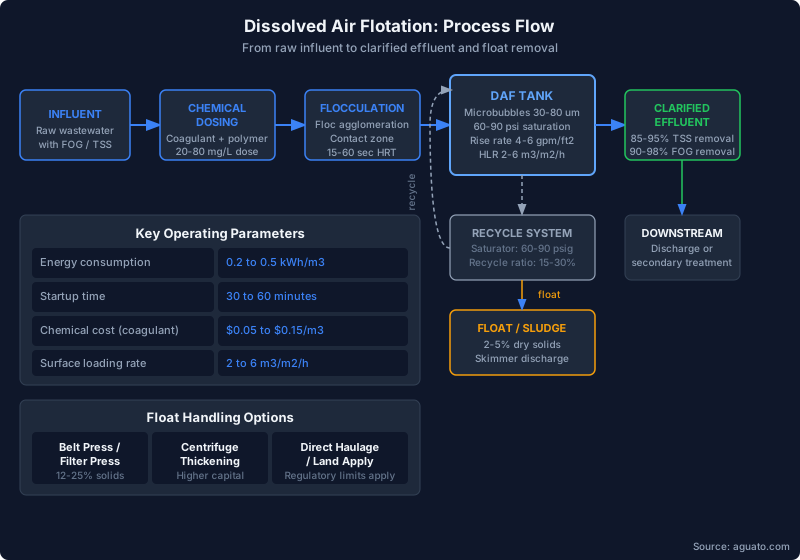
Chemical pretreatment almost always precedes the DAF contact zone. A coagulant (typically alum, ferric chloride, or a proprietary polyaluminium chloride at 20 to 80 mg/L) destabilises the surface charge on emulsified particles, allowing them to aggregate. A polymer flocculant at 0.3 to 3 mg/L then bridges those aggregates into floc large enough to capture bubbles reliably. Without that chemistry, DAF performance on emulsified oils drops from 90 to 98% FOG removal to below 60%. This is a critical specification point that many vendor proposals bury in footnotes.
The float produced is wet sludge at 2 to 5% dry solids, which is 3 to 4 times drier than the settled sludge from a conventional clarifier. That concentrated float significantly reduces downstream sludge dewatering costs. A plant handling 1,000 gallons per minute of wastewater generating 0.5% solids that thickens to 4% with DAF reduces its digester or filter-press feed volume by a factor of eight. That volume reduction compounds across the entire sludge handling train, cutting hauling, dewatering energy, and disposal costs.
Contact zone residence time is the parameter most frequently undersized in budget DAF proposals. The hydraulic retention time in the contact zone should be 15 to 60 seconds, with 30 seconds as the defensible minimum for mixed industrial streams. Vendors who shorten the contact zone to reduce tank steel and fabrication cost are compromising flotation efficiency in a way that only becomes visible during performance testing, not during vendor selection. Specify minimum contact zone HRT in your RFP as a binding design parameter, not a typical value.
## When DAF outperforms gravity separation
The single most important selection criterion is particle density relative to water. Gravity clarifiers work by sedimentation: particles denser than water sink, are raked to a sludge hopper, and pumped away. They fail on anything that floats or remains neutrally buoyant. DAF works by flotation: it does not require the contaminant to be denser than water. This makes DAF the only practical primary treatment for emulsified oils, biological solids from activated sludge systems, algae, fibres, and colloidal suspensions.
A useful rule of thumb from [industrial wastewater treatment process](/resources/industrial-wastewater-treatment-process) practice: if your wastewater fails a simple jar test with a clarifier (particles float or stay dispersed after settling) and passes a jar test with a DAF float simulation (bubbles form and carry solids to the surface), DAF is the right primary technology. That determination should happen in the lab before any capital commitment.
The operational advantage of DAF over gravity clarifiers is startup time. DAF reaches steady-state clarification in 30 to 60 minutes. A conventional clarifier can take hours or, in primary municipal applications, days to stabilise. For food processing plants that start and stop production seasonally or by shift, that rapid startup matters operationally. A plant that runs two 12-hour shifts and shuts down for 4 hours daily will accumulate thousands of startup-shutdown cycles over a 20-year asset life. Each cycle that requires a 6-hour clarifier stabilisation period is a 6-hour window of sub-compliant discharge.
Surface loading rate is where DAF earns its footprint advantage. A standard DAF unit operates at 2 to 6 cubic metres per square metre per hour surface hydraulic loading, compared to 0.5 to 2.5 cubic metres per square metre per hour for gravity clarifiers on comparable feed streams. A DAF that fits on a 4 metre by 10 metre footprint can process the same volume as a gravity clarifier needing three to four times that area. In brownfield retrofits where concrete is scarce and installation space is limited, that footprint difference determines feasibility.
Sludge quality is the third operational advantage that is almost never mentioned in marketing materials. DAF float at 2 to 5% dry solids is significantly easier and cheaper to dewater than conventional clarifier underflow sludge at 0.5 to 1.5% dry solids. The difference in sludge volume for equivalent dry-solids output is a factor of 3 to 4. For any plant paying for sludge hauling or operating a sludge dewatering system, that difference is a direct OPEX saving that should appear in the lifecycle cost model alongside CAPEX and energy.
## Industries and wastewater streams where DAF dominates
Dissolved air flotation is not a universal solution, but in the right application it is genuinely hard to beat. The industries that rely on it most are those with high FOG loads, variable feed quality, or both.
Food and beverage processing is the largest single market. Meat, poultry, and fish processing generate wastewater with FOG concentrations of 500 to 3,000 mg/L and TSS of 400 to 2,000 mg/L. Dairy plants produce milk fats, casein, and lactose in concentrations that overwhelm gravity systems. Breweries and beverage plants discharge carbohydrates and organic solids. In all these streams, DAF with appropriate coagulation achieves 85 to 95% TSS removal and 90 to 98% FOG removal in a single pass, reducing BOD load sufficiently to meet municipal consent limits or to condition the stream for downstream biological treatment.
Pulp and paper manufacturing uses DAF to recover fibre from white-water streams. The value of recovered fibre in a large paper mill can reach $200,000 to $600,000 per year, making DAF a revenue recovery tool, not just a compliance cost. The recovered fibre is returned to the process, and the clarified white water is recycled, reducing both raw-material consumption and freshwater intake.
Oil and gas produced water and refinery wastewater present a different challenge. Produced water from conventional onshore wells typically contains free and emulsified oil at 50 to 500 mg/L, and regulatory limits in many jurisdictions require discharge concentrations below 10 to 15 mg/L oil-in-water. DAF with coagulation achieves those limits where API gravity separators alone cannot, because API separators only remove free oil, not emulsified fractions. See [oily wastewater treatment](/resources/oily-wastewater-treatment) for a full breakdown of the separation sequence for refinery and produced-water streams.
Mining and mineral processing generates high-suspended-solids streams with fine particles that do not settle reliably. Industrial wastewater treatment in mining using DAF is common for tailings pond overflow, mineral processing water, and acid mine drainage pre-treatment stages where turbidity and TSS must be controlled before pH adjustment and metals removal.
Textile and tannery operations produce complex mixed wastewater with dyes, surfactants, and fibres that respond well to DAF flotation when paired with coagulation. The colour removal from DAF on textile wastewater is not complete but typically achieves 40 to 70% colour reduction alongside 80 to 90% TSS removal, which is often sufficient to meet consent conditions or to provide a workable feed to downstream biological treatment.
## DAF vs. competing separation technologies
Not every wastewater stream needs a DAF. The decision depends on particle characteristics, flow rate, discharge target, and available footprint. Vendors selling DAF will not volunteer that a gravity clarifier might be cheaper and adequate for your application. The comparison table below provides the decision data that a procurement team needs without reading through competing vendor brochures.
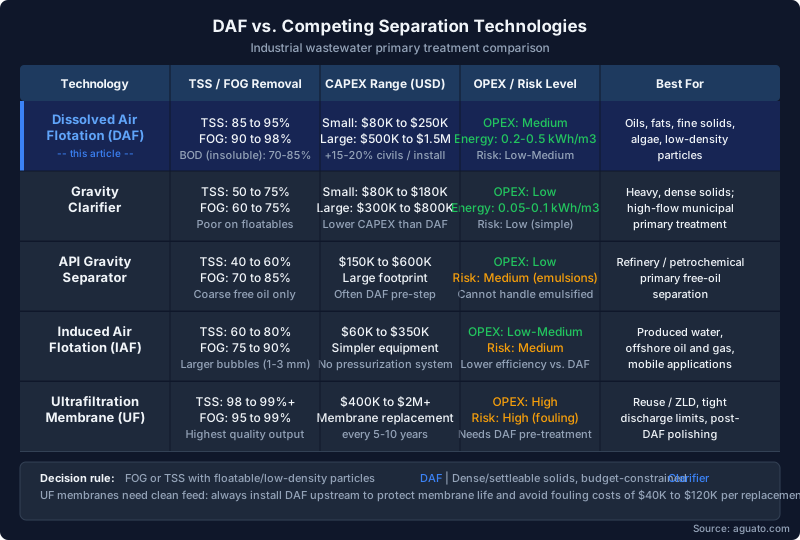
The table above summarises the five most common primary separation options for industrial wastewater. The key takeaway for a procurement team: if your contaminants are heavy and settleable, a gravity clarifier costs 30 to 50% less in CAPEX and has lower OPEX. If your contaminants are oily, fibrous, or biologically derived, DAF outperforms at a justifiable premium. Ultrafiltration membranes deliver the highest effluent quality but need a clean feed; installing DAF upstream of a [membrane filtration system](/resources/membrane-filtration-system) is standard practice in advanced reuse systems because it protects membrane life and avoids fouling replacement costs of $40,000 to $120,000 per event.
[cta:nepti-dark]
Induced air flotation (IAF) deserves a separate note. IAF generates bubbles mechanically by injecting air through a rotor rather than by pressure dissolution, producing larger bubbles (1 to 3 millimetres versus 30 to 80 micrometres for DAF). Larger bubbles have lower surface area and attach less efficiently to fine particles. IAF achieves 60 to 80% TSS removal and 75 to 90% FOG removal, versus DAF's 85 to 95% and 90 to 98%. The gap matters when consent limits are tight. IAF is cheaper and simpler, making it appropriate for offshore platforms and mobile applications where DAF pressure systems are impractical. For a shore-based industrial plant with stable infrastructure, DAF's higher performance usually justifies the premium.
The most common mistake across projects we have seen is selecting technology based on capital cost alone, then discovering that the cheaper clarifier or IAF unit cannot consistently meet consent limits, triggering permit violations at $10,000 to $50,000 per day in regulatory fines and the capital cost of an emergency DAF retrofit that runs 40 to 60% above the original DAF quote. Buy the performance the discharge permit demands, not the cheapest unit that passes a bench test.
A comparison table is necessary, but it is not sufficient. The correct selection also requires site-specific jar testing on representative feed samples. No tabulated benchmark can substitute for a test on your actual wastewater, because FOG concentration, emulsification state, temperature, and pH interact in ways that shift performance by 10 to 25 percentage points across otherwise similar applications.
## CAPEX and OPEX: what dissolved air flotation actually costs
The capital cost of a DAF system scales with flow rate, materials specification, and the extent of civil works required. Package DAF units for small industrial applications, processing 20 to 150 gallons per minute, typically range from $80,000 to $250,000 for the mechanical package. Mid-size units for food processing and paper applications at 150 to 600 gallons per minute range from $250,000 to $700,000. Large-scale systems at 600 to 2,000 or more gallons per minute, common in municipal-scale food processing or refinery applications, run $700,000 to $1.5 million for the DAF equipment alone.
Civil and installation costs add 15 to 25% to those equipment figures in a greenfield application and 20 to 40% in a brownfield retrofit where existing concrete may need cutting, pits may need deepening, and utilities may need rerouting. A full installed cost for a mid-size food-processing DAF at 300 gallons per minute, including civils, pipework, electrical, and commissioning, typically lands at $500,000 to $1 million. Chemical pretreatment dosing skids, sludge handling (filter press or belt press), and instrumentation add a further $100,000 to $300,000.
The OPEX breakdown by line item for a 300 gallon-per-minute DAF system running continuously at an electricity price of $0.12 per kWh:
- Energy: The recycle pump, air compressor, and skimmer drive typically consume 0.2 to 0.5 kWh per cubic metre of treated water. At 300 gallons per minute (1,636 m3 per day), energy cost runs $14,000 to $36,000 per year. - Coagulant and polymer: A coagulant dose of 40 mg/L at $0.35 per kilogram and a polymer dose of 1 mg/L at $2.50 per kilogram costs approximately $0.018 per cubic metre for chemistry, or $10,700 per year at this flow rate. Variable feed concentrations can push chemistry costs 30 to 50% higher if dose is not optimised with online turbidity monitoring. - Sludge disposal: Float at 3% solids from 1,636 m3 per day at 1,000 mg/L TSS yields roughly 1.6 tonnes of dry solids per day. Dewatering and disposal at $50 to $120 per tonne of wet cake adds $30,000 to $70,000 per year depending on local disposal routes. - Maintenance: Skimmer chains, saturator media, recycle pump seals, and chemical dosing pump diaphragms. Budget $15,000 to $30,000 per year for a well-maintained system. - Labour: Routine operations for a DAF system integrated into an existing wastewater plant typically require 0.5 to 1.0 full-time-equivalent operator hours per shift, or 1,000 to 2,000 operator hours per year.
Total OPEX for the example system lands at $70,000 to $155,000 per year, dominated by sludge handling. Optimising sludge dewatering is consistently the highest-leverage OPEX lever in a DAF programme. A plant that moves from hauling wet float at 3% solids to running a belt press to 18% solids and then composting or land-applying the cake can reduce disposal costs by 60 to 70%.
Browse [operations and maintenance providers](/operations-and-maintenance) who specialise in wastewater primary treatment if your team needs supplemental capacity for commissioning or ongoing optimisation. The difference between a well-commissioned and a poorly commissioned DAF, in terms of first-year chemistry costs and effluent compliance rate, typically ranges from $30,000 to $80,000, more than covering the cost of a specialist commissioning engagement.
## Chemical programme: coagulants, polymers, and dose control
Chemical pretreatment is where most DAF underperformance originates. A DAF tank that is correctly sized and pressurised will still fail to meet effluent targets if coagulation is insufficient, overdosed, or mistimed relative to the flocculation contact time. Across industrial installations, the most common root cause of chronic DAF underperformance is not the equipment itself but the chemical dosing strategy.
The coagulant step neutralises the negative surface charge on emulsified particles, allowing them to approach each other and aggregate. Alum (aluminium sulphate) is the lowest-cost option and effective across the pH range of 6.0 to 7.5. Ferric chloride performs better at lower pH (5.0 to 6.5) and produces a denser floc. Polyaluminium chloride (PAC) offers better performance at low temperatures and across a broader pH range but costs 20 to 40% more than alum per unit dose. The correct choice depends on your feed pH, temperature range, and the nature of the suspended material, not on what the DAF vendor's distribution partner happens to stock.
Polymer flocculant selection requires bench testing specific to your wastewater. A cationic polymer at 1 to 2 mg/L is the standard starting point for food processing streams, but anionic or non-ionic polymers sometimes outperform cationic in paper or textile applications. The difference in flotation efficiency between the right polymer and a generic default can be 10 to 20 percentage points on FOG removal, which is the difference between meeting and missing a 50 mg/L discharge limit. Insist on jar-test data from at least three polymer candidates before specifying your dosing contract.
The [Water Research Foundation](dofollow:https://www.waterrf.org/) publishes guidance on coagulant and polymer selection for flotation applications across a range of industrial wastewater matrices. Referencing that guidance in your RFP sets a defensible technical baseline for vendor responses and prevents the generic deflection that masks inadequate bench testing.
Online turbidity or TSS monitoring on the DAF effluent line with feedback to the coagulant dosing pump is the single most effective process control investment for a DAF system. The cost of a turbidity sensor and a variable-speed dosing pump is $5,000 to $15,000. The savings from eliminating overdose, which wastes chemistry and can actually inhibit flotation by reversing particle charge, typically recover that cost within six months. Not sure which chemical suppliers specialise in flotation pretreatment in your region? [Browse verified water treatment chemical providers](/water-treatment-chemical-companies) and filter by industrial wastewater application.
Flocculation contact time is the second most frequently undersized parameter after contact zone HRT. The flocculation chamber should provide 3 to 10 minutes of gentle mixing (G value of 20 to 70 per second) to allow adequate floc growth before the stream enters the DAF contact zone. Skipping the flocculation stage or undersizing it to save tank length produces smaller, weaker floc that generates fewer bubble attachment points, lowering TSS and FOG removal by 15 to 30 percentage points regardless of how well the saturator performs.
## Failure modes and what they cost
Most DAF failures are slow and predictable. The equipment rarely breaks catastrophically. Instead, performance degrades gradually as saturator efficiency drops, chemical doses drift, or the float skimmer falls behind during peak production hours. By the time the effluent fails a compliance test, the root cause has often been building for weeks.
Saturator fouling. The saturator vessel dissolves air into the recycle stream under pressure. If the recycle stream contains residual suspended solids, those solids accumulate in the saturator packing or on the vessel walls, reducing the effective dissolving surface area and lowering bubble generation efficiency. The symptom is a gradual decline in float rate and an increase in effluent turbidity over 4 to 12 weeks. The cost is chemical overuse (trying to compensate with higher polymer doses), reduced throughput, and eventual compliance failure. A saturator inspection and clean costs $2,000 to $8,000. A compliance violation triggered by months of degraded performance costs far more. A systematic protocol of monthly saturator inspections and quarterly cleans is the correct response; most plants do it annually, which is too infrequent.
Recycle pump cavitation. The recycle pump operates at elevated pressure and is sensitive to suction-side conditions. Cavitation, from entrained air in the recycle line, dissolved gas pockets, or suction-line restrictions, erodes impeller and casing material, reduces pump efficiency, and eventually causes premature bearing failure. Recycle pump replacement runs $15,000 to $60,000 depending on size and material specification. The operational consequence is a drop in saturator pressure that cuts bubble generation by 30 to 50%, reducing TSS removal from 90% to below 70% within hours. A pressure transducer on the suction side with an alarm set point is a $500 investment that prevents a $50,000 repair.
Chemical dose upset. A polymer drum runs empty on a night shift, or a coagulant pump diaphragm fails silently. Without online effluent monitoring, neither event is detected until the morning BOD/COD grab sample shows a violation. A single exceedance of a discharge consent limit, depending on jurisdiction and prior compliance history, can trigger regulatory notices, third-party inspections, and fines from $10,000 to $100,000, plus the cost of an emergency consultant engagement. Automated level switches on all chemical tanks and current-monitoring relays on all dosing pumps are not optional on a compliant installation; they are risk mitigation at a cost of under $3,000 per chemical feed point.
Float carry-over. If the hydraulic loading rate exceeds design, or if the skimmer speed is set too low, float accumulates at the water surface faster than it is removed, and a wave of float is pulled under the baffle and exits with the clarified effluent. This is visible as a sharp spike in effluent FOG. The fix is usually a skimmer speed adjustment and a review of peak-flow events. The damage is a consent exceedance that can trigger regulatory escalation. A flow-proportional skimmer speed control, linked to the influent flow meter, prevents carry-over during production surges and costs $2,000 to $5,000 to install. The [US EPA biosolids technology fact sheet on dissolved air flotation thickening](dofollow:https://www.epa.gov/biosolids/biosolids-technology-fact-sheet-dissolved-air-flotation-thickening) includes thickening design parameters and operational guidance that set the technical baseline for compliant installations.
Understanding these failure modes is the starting point for a defensible [industrial water pollution](/resources/industrial-water-pollution) compliance programme. A site that has documented its DAF failure modes, quantified their cost, and implemented the corresponding monitoring controls is in a fundamentally stronger position with a regulator than one that responds to exceedances reactively.
## Threshold-based decision framework
Use these numeric cut points to determine the appropriate primary treatment technology for an industrial wastewater stream before engaging vendors. These are decision triggers, not design specifications.
If FOG > 100 mg/L in the feed: Gravity clarification alone will not meet a typical discharge limit of 30 to 50 mg/L for FOG. DAF with coagulation is required. API separators can reduce free oil to 50 to 80 mg/L but cannot address emulsified fractions.
If TSS > 500 mg/L with significant fines fraction (particles below 50 micrometres): Gravity settling of fine particles requires hydraulic retention times of 4 to 8 hours and very large tank footprints. DAF handles the same load with an HRT of 20 to 45 minutes. If available footprint is constrained, DAF is the practical choice above this TSS threshold.
If feed temperature is below 10 degrees Celsius: Cold water increases viscosity, which slows both bubble rise rate and particle settling. DAF is more tolerant of cold-water performance degradation than gravity clarifiers because it does not rely on particle settling velocity. Specify a saturator rated for low-temperature operation and select a polymer that performs at your minimum feed temperature.
If flow rate > 1,000 gallons per minute and FOG < 50 mg/L and TSS is predominantly settleable: A gravity clarifier will likely meet discharge targets at 30 to 50% lower CAPEX. Bring DAF in as a tertiary polisher or omit it entirely if the effluent passes jar test settling without flotation.
If you are protecting a downstream membrane system (UF or RO): Always install DAF upstream regardless of raw TSS or FOG concentration. Colloidal material that passes a jar test still causes membrane fouling. DAF with coagulation removes colloids that are invisible in conventional turbidity measurements. See [industrial water filtration](/resources/industrial-water-filtration) for the recommended pre-treatment specification for each membrane tier.
If your wastewater contains algae at any concentration: Gravity clarifiers cannot remove algae reliably because algal cells are buoyant. DAF is the standard treatment for algae-loaded streams regardless of the TSS value, and it is the pre-treatment of choice for potable water treatment plants drawing from eutrophic surface sources.
The right answer depends on your site-specific feed water characterisation and duty profile. [Post your project](/post-project) and qualified DAF and wastewater treatment providers will scope the technology decision against your actual numbers, including site-specific jar testing before any capital commitment.
## Real-world sector examples
Food and beverage processing, large dairy application. A pattern that recurs across large dairy processing sites: the plant operates two production shifts, generating 800 to 1,200 cubic metres per day of whey and wash-down water with FOG at 600 to 1,800 mg/L and TSS at 500 to 1,400 mg/L. A single gravity clarifier, specified at commissioning when production was half the current volume, no longer meets the local authority discharge limit of 60 mg/L FOG and 100 mg/L TSS. The plant is paying a surcharge of $180,000 to $280,000 per year. A DAF retrofit, sized for peak flow with 20% headroom, costing $450,000 to $700,000 installed, eliminates the surcharge and pays back in 2.0 to 3.5 years on surcharge savings alone, before accounting for any reduction in sludge dewatering costs. The project is routinely prioritised over competing capital requests because the financial case is unambiguous. The common failure mode in these retrofits is underestimating the civils cost for integrating a DAF into an existing compact wastewater building, which typically adds $80,000 to $150,000 not included in the first equipment quote.
Oily water handling, oil terminal or tank farm application. A typical pattern at inland oil storage terminals: stormwater and wash-down water contains free and emulsified oil at 50 to 200 mg/L, with seasonal variation driven by rainfall events causing flow peaks 3 to 5 times the normal design flow. An API separator handles free oil adequately during normal conditions but fails compliance during storm events when emulsified oil fractions surge. An IAF unit was tried first because of lower capital cost; it achieved 70 to 80% FOG removal but could not reliably meet the 10 mg/L oil-in-water discharge limit. A DAF system with a proportionally sized recycle pump and a flow-splitting arrangement for storm events achieved consistent sub-5 mg/L oil-in-water performance. The trade-off was a CAPEX premium of $120,000 to $200,000 over the IAF option, offset against avoided regulatory enforcement costs and the liability associated with repeated consent breaches in a water-source protection zone. For context on the regulatory stakes see [industrial water pollution](/resources/industrial-water-pollution).
## How to evaluate vendors and proposals
A DAF proposal that contains only equipment capital cost is incomplete and potentially misleading. A compliant proposal should include: hydraulic and solids loading calculations at peak and average flow, jar-test results on representative feed samples, proposed chemical dose and annual cost estimate, effluent quality guarantee (not a typical performance range), sludge volume and solids content projection, energy consumption at design flow, and a list of reference installations in the same industry segment.
The single biggest differentiator between DAF vendors is their willingness to conduct site-specific jar testing before proposing a system. Vendors who size from a flow rate and a generic industry assumption, without testing your specific wastewater, are transferring the performance risk to you. Insist on jar testing as a condition of receiving a formal proposal.
Ask for the bubble size distribution that the saturator produces at your specified recycle ratio and pressure. Some vendors run saturators at the minimum bubble specification to reduce energy consumption; bubbles at the coarser end of the 30 to 80 micrometre range are less effective on fine particles and emulsified oils. A bubble size distribution test, measured by laser diffraction, is a reasonable specification requirement for any system above $200,000.
For projects above $500,000 in system value, consider commissioning an independent design review before issuing a purchase order. A qualified process engineer from an [industrial water treatment specialist](/industrial-water-treatment-companies) can identify undersizing in the saturator, insufficient contact zone HRT, or missing monitoring instruments that will cause performance problems post-commissioning. That review typically costs $5,000 to $15,000 and can prevent a $100,000 to $500,000 remediation programme.
The [AWWA Water Quality and Technology Division](dofollow:https://www.awwa.org/Resources-Tools/Resource-Topics/Water-Treatment) publishes peer-reviewed guidance on flotation system evaluation criteria that provides a defensible technical baseline for procurement. Not sure which configuration suits your site? [Browse verified wastewater treatment providers](/industrial-water-treatment-companies), filter by DAF technology and your industry sector, and request scoped proposals from 3 to 5 specialists before issuing an RFP.
To convert the sizing and chemistry trade-offs above into firm pricing, compare vetted [wastewater treatment companies](/providers) on Aguato, filter by DAF technology and your industry sector, and request scoped proposals from three to five specialists before issuing an RFP.
## FAQ
### What is dissolved air flotation used for?
Dissolved air flotation is used to remove suspended solids, fats, oils, and grease from industrial and municipal wastewater by attaching microscopic air bubbles to contaminant particles and floating them to the water surface for skimming. It is the primary treatment technology of choice in food processing, dairy, paper and pulp, oil refining, and produced-water applications where contaminant densities are too low for gravity clarification. A well-specified DAF with coagulation typically achieves 85 to 95% TSS removal and 90 to 98% FOG removal in a single pass, meeting most municipal consent limits as a standalone primary treatment step.
### How much does a dissolved air flotation system cost?
A packaged DAF unit for small industrial applications processing 20 to 150 gallons per minute costs $80,000 to $250,000 for the mechanical package. Mid-size systems at 150 to 600 gallons per minute range from $250,000 to $700,000, and large systems at 600 to 2,000 or more gallons per minute reach $700,000 to $1.5 million for equipment. Add 15 to 25% for civils and installation in a greenfield application and 20 to 40% in a brownfield retrofit. Full OPEX including energy, chemicals, sludge disposal, and maintenance typically runs $70,000 to $155,000 per year for a 300 gallon-per-minute system operating continuously at $0.12 per kWh electricity.
### What is the difference between DAF and a gravity clarifier?
A gravity clarifier relies on particles being denser than water so they sink to the bottom of a tank. A DAF system uses pressurised microbubbles to float particles to the surface regardless of their density. This makes DAF effective on emulsified oils, fibres, and biological solids that gravity clarifiers cannot handle. DAF is faster (30 to 60 minutes to steady state versus hours for clarifiers), more compact (2 to 5 times smaller footprint for equivalent volume), and achieves higher FOG removal, but costs more in both CAPEX and OPEX. Gravity clarifiers are better suited to dense, settleable solids at high flow rates where capital budget is the primary constraint.
### What energy does a dissolved air flotation system consume?
A dissolved air flotation system typically consumes 0.2 to 0.5 kWh per cubic metre of treated water, driven primarily by the recycle pump and air compressor. At an electricity price of $0.12 per kWh and a flow rate of 300 gallons per minute (1,636 m3 per day), annual energy cost runs $14,000 to $36,000. This is higher than gravity clarification at approximately 0.05 to 0.1 kWh per cubic metre, but lower than ultrafiltration membranes at 0.3 to 0.8 kWh per cubic metre for the membrane stage alone. Modern variable-speed recycle pumps can reduce DAF energy consumption by 15 to 25% compared to fixed-speed configurations by matching pump output to actual flow demand.
### How do you control chemical dosing in a DAF system?
Effective chemical dosing in a dissolved air flotation system requires bench-tested coagulant and polymer selection specific to your wastewater matrix, followed by online effluent monitoring to enable feedback control. Start with jar testing using at least three coagulant and three polymer candidates on actual feed samples. Install a turbidity or TSS sensor on the DAF effluent line and link it to variable-speed dosing pumps for automatic dose adjustment. Automated level switches on all chemical tanks with pump current alarms prevent silent dosing failures. Overdosing is as damaging as underdosing: excess coagulant can reverse particle charge and inhibit flotation, dropping removal efficiency by 20 to 30 percentage points.
### What industries use dissolved air flotation most?
The largest industrial users of dissolved air flotation are food and beverage processing (meat, dairy, poultry, brewing), pulp and paper manufacturing, oil and gas produced-water and refinery wastewater treatment, mining and mineral processing, textile and tannery operations, and pharmaceutical manufacturing. Food processing and dairy dominate the installed base because FOG loads in those wastewater streams are consistently too high for gravity separation to meet discharge consent limits. The dairy sector in particular finds DAF attractive for its ability to produce a concentrated float at 2 to 5% dry solids that reduces sludge hauling and disposal costs by 60 to 70% compared to gravity clarifier underflow.
### How long does a DAF system last and what maintenance does it need?
A well-maintained dissolved air flotation system has a mechanical life of 20 to 30 years for the tank, skimmer structure, and saturator vessel. Wear components including skimmer chains, recycle pump impellers, and chemical dosing pump diaphragms require periodic replacement on 2 to 5 year cycles depending on duty and water chemistry. The most important preventive maintenance tasks are monthly saturator inspections and cleans to prevent fouling-driven bubble efficiency loss, quarterly recycle pump condition monitoring (vibration, bearing temperature), and annual chemical system audits to confirm dose optimisation against current feed conditions. A well-executed maintenance programme keeps DAF performance within 5 to 10% of design specification over the full asset life.