Industrial water tariffs rose 5.5% a year for a decade. This buyer's guide covers system cost, sizing, compliance, and payback for rainwater harvesting at scale.
Water bills are no longer a predictable line item. Industrial water tariffs in the United States rose an average of 5.5% per year between 2012 and 2022, and several drought-stressed municipalities have imposed surcharges that doubled effective rates overnight. For a mid-size manufacturer drawing 10 million gallons per year from the mains, that trajectory adds $150,000 or more to annual operating costs over a decade, before a single process improvement is made. Industrial rainwater harvesting systems convert a site's footprint from a liability that sheds stormwater into a supply asset that offsets purchased water, and the economic case has strengthened in direct proportion to the tariff escalation that now keeps facilities managers awake.
The physics work in industry's favour. A standard 100,000-square-foot roof catchment area yields roughly 62,000 gallons from each inch of rainfall, applying the commonly used 0.623 gallons-per-square-foot-per-inch coefficient. Across typical mid-continental rainfall patterns of 30 to 50 inches annually, that single roof can supply 1.9 to 3.1 million gallons per year, enough to cover the entire cooling tower make-up demand for many light-manufacturing sites. The core insight driving buyer interest is that this yield is essentially free once the capital system is in place, and that every gallon harvested is a gallon not purchased at a tariff that will be higher next year than it is today.
Buying decisions, however, are more complex than the rainfall arithmetic suggests. Storage sizing, pre-treatment specification, end-use qualification, and regulatory compliance under frameworks such as BS EN 16941-1:2024 all carry cost and risk implications that vary significantly across site types and geographies. This guide walks procurement and engineering teams through every stage of the decision, from initial yield estimation through vendor selection, common failure modes, and the financial modelling that separates a well-structured project from a capital write-off.
## The decision in brief
- Budget the capital. Industrial rainwater harvesting systems require upfront capital of $80,000 to $400,000 for mid-size sites, but the financial case is structurally strong for any facility meeting the five-gate thresholds. - Count the direct saving first. At a mains tariff of $6.00 per 1,000 gallons, a system displacing 2 million gallons annually saves $12,000 per year directly, plus avoids the wastewater treatment charge on equivalent volumes discharged. - Add the indirect benefits to reach the net figure. Including stormwater management savings, regulatory compliance benefits and utility rebate programmes, net annual financial benefit for a well-specified mid-size system typically lands between $18,000 and $35,000.
That capital cost delivers a 6-to-9-year payback and a 20-year NPV in the range of $150,000 to $280,000 at a 7% discount rate.
## What Industrial Rainwater Harvesting Systems Actually Do
An industrial rainwater harvesting system is an engineered infrastructure that intercepts precipitation falling on impermeable surfaces, conveys it through a treatment train, stores it in purpose-built tanks or cisterns, and delivers it under pressure to designated non-potable end uses within the facility. The term "non-potable" is not a limitation; it is a feature. Cooling tower make-up, equipment washdown, vehicle washing, toilet flushing, landscape irrigation, and many process water applications all operate comfortably on water that does not meet drinking-water standards, and treating mains water to that standard for these uses is pure cost overhead.
The treatment train a system requires depends on the intended end use. A washdown application might need only screening and sedimentation. A cooling system requires chemical dosing and biocide control to prevent Legionella proliferation. A food-grade rinse application demands full microbial inactivation. The buyer's first engineering decision is mapping the intended end uses against the quality parameters each requires, because that mapping determines between 30% and 60% of the installed system cost.
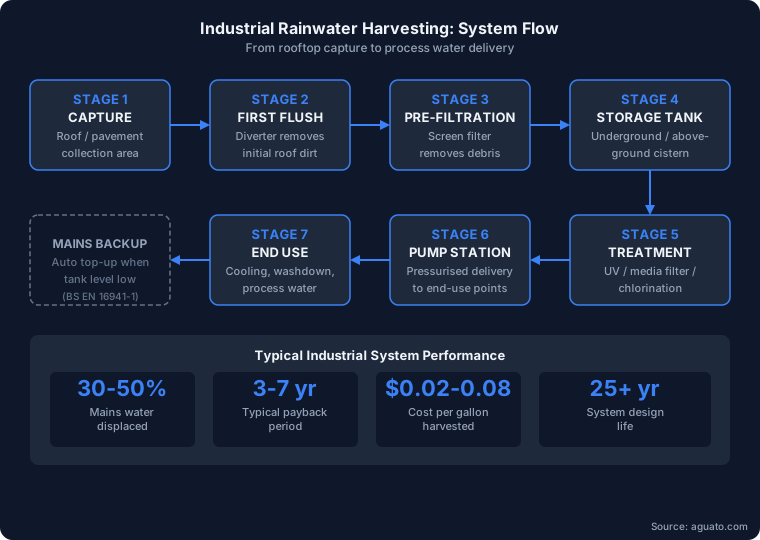
Most industrial systems share seven functional stages: a collection surface (roof, pavement, or purpose-built catchment), a first-flush diverter that routes the initial, most-contaminated runoff to drain, a coarse screen filter, a primary storage tank, secondary treatment (UV disinfection, media filtration, or dosing), a pressurised pump station, and a dedicated non-potable distribution network clearly labelled to prevent cross-connection with potable supplies. Each stage carries capital and maintenance cost, and each is a potential failure point if undersized or incorrectly specified. The UK code of practice [BS EN 16941-1 for non-potable rainwater systems](dofollow:https://rainharvesting.co.uk/british-code-of-practice-for-rainwater-harvesting-systems/) sets out the design requirements for each of these stages.
The mains backup is often misunderstood. It is not an admission that the system fails. It is a code-required automatic top-up connection that engages when tank levels fall below a set threshold, ensuring process continuity during dry spells. The backup connection must include an air gap or approved backflow preventer to prevent non-potable water from contaminating the potable supply. Omitting this protection has caused regulatory shutdowns at sites that otherwise had functional, well-specified systems.
## System Components and Their Cost Drivers
Understanding what drives cost at each stage is essential for producing realistic business cases. The following breakdown reflects installed costs across typical US industrial sites as of 2025, using USD throughout.
Catchment surface and guttering: Often the lowest marginal cost element if the building already has guttering. Upgrading from domestic-grade to industrial-flow channels typically costs $2,000 to $15,000 for a 50,000-to-150,000-square-foot roof.
First-flush diverter: A mechanical device that routes the first 0.03 to 0.1 inches of runoff (which carries the highest pollutant load) to a drainage sump rather than to the storage tank. Units sized for industrial catchments cost $500 to $5,000 installed. Omitting a first-flush diverter is the single most common specification shortcut that inflates long-term maintenance costs.
Pre-filtration: Self-cleaning vortex or screen filters rated at 200 to 1,000 microns. Industrial-grade units capable of handling high flow rates: $3,000 to $20,000. Maintenance intervals of 3 to 6 months, or automatic with a backwash motor.
Storage tanks: The largest single capital line item. Above-ground polyethylene tanks in the 5,000-to-50,000-gallon range: $8,000 to $80,000 installed. Below-ground concrete or glass-reinforced plastic (GRP) cisterns in the 50,000-to-500,000-gallon range: $60,000 to $350,000 installed, depending on excavation complexity and groundwater conditions. Tank material matters: concrete absorbs alkalinity, which can require pH correction before some process uses; polyethylene is inert but UV-sensitive above ground and requires shading or pigmentation.
Secondary treatment: UV disinfection systems for flows up to 100 gallons per minute: $4,000 to $25,000. Media filtration adding a secondary polishing step: $6,000 to $40,000. Chemical dosing skids for sites where Legionella risk requires maintained residual chlorine: $8,000 to $30,000.
Pump station and controls: Variable-speed pumps with duty and standby configuration, pressure vessels, and a programmable logic controller (PLC) that manages tank levels, mains backup engagement, and system alarms: $10,000 to $60,000.
Distribution network: Dedicated pipework from pump station to end uses, including labelling, colour-coding (typically green or blue for non-potable in most jurisdictions), and isolation valves: $5,000 to $80,000, highly site-specific.
Installed system totals for mid-size industrial projects typically land between $80,000 and $400,000. Very large systems serving multi-building campuses or integrating with stormwater management infrastructure can reach $1,000,000 or more. At the other end, modular packaged systems for single-end-use applications (one cooling tower, one washdown station) can be specified and installed for $25,000 to $60,000 and represent a useful proof-of-concept investment before committing to a site-wide scheme.
The cost spread across these components explains why two systems of identical storage volume can differ in price by a factor of three. A buyer who understands which stage dominates the budget on their specific site can direct value-engineering effort where it actually moves the number, rather than trimming the first-flush diverter or pre-filtration that protect the asset over its life. The most common costing error is to benchmark on the headline storage-tank price alone, because the tank is the visible line item, when in practice the secondary treatment, distribution network, and controls often add as much again to the installed total. A like-for-like comparison has to price the whole train, not just the vessel, or the cheapest-looking proposal wins on a number that excludes half the real cost.
## How Rainwater Harvesting Compares to Alternatives
The decision to install a rainwater harvesting system should always be benchmarked against the principal alternatives: continuing on mains water, installing a greywater reuse system, or a hybrid approach that combines both. Each alternative carries a different capital profile, a different operating cost per gallon, and a different exposure to tariff and drought risk, and the right answer is rarely the same across two sites with different rainfall, demand, and water chemistry.
Mains water is the lowest-CAPEX option and the highest long-run cost option for sites in water-stressed regions. The trend is clear: [EPA research on water efficiency in commercial and industrial buildings](dofollow:https://www.epa.gov/watersense) confirms that non-potable reuse systems reduce facility water draw by 20% to 40% on average, translating to cost savings that typically outpace treatment OPEX within 4 to 6 years for high-volume consumers.
Greywater reuse captures water that has already been used once in a low-contamination process and recirculates it for secondary applications. It has a more consistent feed supply than rainwater (not weather-dependent) but requires a heavier treatment burden because the source water carries organic load, surfactants, and sometimes pathogens. Capital costs for equivalent throughput are typically 20% to 40% higher than for a rainwater system, and the OPEX for chemical dosing and membrane cleaning adds $6,000 to $20,000 annually per million gallons of capacity. Greywater reuse makes most sense where the facility generates large volumes of lightly-contaminated process effluent that can be polished and reused without reaching a discharge point.
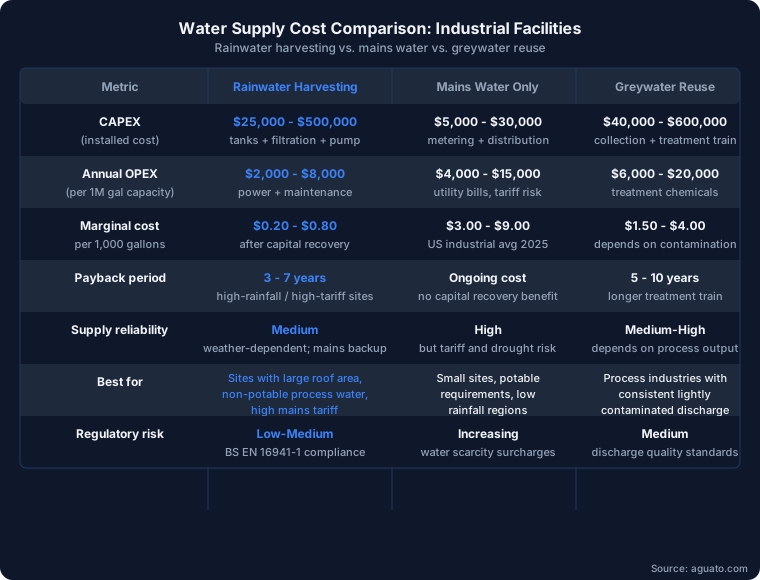
The table below quantifies the comparison across the metrics that determine which option wins for a given site.
| Metric | Rainwater Harvesting | Mains Water Only | Greywater Reuse | |---|---|---|---| | Typical CAPEX | $25,000 to $500,000 | $5,000 to $30,000 | $40,000 to $600,000 | | Annual OPEX per 1M gal capacity | $2,000 to $8,000 | $4,000 to $15,000 | $6,000 to $20,000 | | Marginal cost per 1,000 gal | $0.20 to $0.80 | $3.00 to $9.00 | $1.50 to $4.00 | | Payback period | 3 to 7 years | Ongoing cost | 5 to 10 years | | Supply reliability | Medium (weather-dependent) | High (tariff/drought risk) | Medium-high | | Regulatory risk | Low-Medium (BS EN 16941-1) | Increasing | Medium | | Best for | Large roof, high tariff, non-potable uses | Small sites, potable needs | Consistent process effluent |
A hybrid approach, harvesting rainwater for cooling tower make-up and recycling treated process effluent for washdown, often achieves the highest overall water self-sufficiency, commonly 50% to 70% of total site demand. The capital investment is proportionally higher, but the unit economics typically justify the approach at sites drawing more than 5 million gallons per year from the mains.
You can find vetted suppliers for all of these system types through [rainwater harvesting equipment companies](/rainwater-harvesting-equipment-companies) listed on Aguato's marketplace, where each provider's technology scope and geographic coverage are pre-verified.
Selecting the right alternative is only half the decision. Once rainwater harvesting is chosen, the system has to be sized correctly, and sizing is where the largest avoidable losses occur. Oversize the storage and capital is wasted on volume that never turns over; undersize it and the catchment yield overflows to drain before it can offset a single gallon of purchased water.
## Sizing the System: The Numbers That Matter
Correct system sizing is where most buyer mistakes occur. Oversizing storage is expensive and creates water age problems that drive Legionella risk. Undersizing storage wastes catchment yield because tanks fill and overflow before water can be used. The goal is to match storage volume to the inflection point where marginal tank cost equals marginal water savings over the payback horizon.
The standard sizing inputs are: mean annual rainfall for the site (available from national meteorological databases), monthly rainfall distribution (critical, because a system sized for annual averages may overflow in winter and run dry in summer), the effective catchment area (roof area multiplied by a runoff coefficient of 0.75 to 0.90 for smooth metal or membrane roofs, 0.65 to 0.80 for rough concrete or tile), the daily demand of the end uses being served, and the required reserve days of supply.
For a practical example: a logistics facility with 200,000 square feet of roof in a region averaging 40 inches of annual rainfall generates approximately 1.0 inch of rain per month in the driest month. Monthly yield from the roof during that dry month is 200,000 x 1.0 x 0.80 (runoff coefficient) x 0.623 = approximately 99,680 gallons. If the facility's cooling tower requires 150,000 gallons per month in summer, the system will need mains backup during the dry period regardless of storage volume. Storage should be sized to capture the peak wet-month surplus (the difference between wet-month yield and that month's demand) for use during the dry-month shortfall.
Rule-of-thumb storage sizing: 3 to 5 percent of annual catchment volume for sites with relatively even seasonal demand, 8 to 12 percent for sites with strongly seasonal demand or multi-week dry periods. In absolute terms, a 200,000-square-foot roof in a 40-inch annual rainfall region yields approximately 4 million gallons annually; target storage of 120,000 to 400,000 gallons.
[cta:nepti-dark]
Translating these inputs into a defensible storage volume by hand is laborious and error-prone, because the answer depends on the interaction of monthly rainfall distribution, demand profile, and reserve-day requirement rather than any single figure. Modelling the full year month by month is what separates a system that pays back on schedule from one that overflows in winter and runs dry in summer.
A frequently overlooked sizing factor is the first-flush diversion volume. Each millimetre of rainfall per square metre of roof generates approximately one litre of runoff, so a 20,000-square-metre roof sheds 20,000 litres (5,280 gallons) per millimetre of rain. The first 2 millimetres of each storm event should be diverted; for this roof, that means a first-flush sump capacity of 40,000 litres (10,560 gallons). Under-specifying the first-flush diversion forces more contamination into the main tank and shortens filter service intervals.
The water-treatment configuration for [water treatment CAPEX and OPEX](/resources/water-treatment-capex-opex) planning should include rainwater harvesting as a separate asset class from conventional treatment, because its amortisation profile (high initial capital, low marginal cost per gallon over a 25-year asset life) differs fundamentally from chemical-intensive mains treatment.
## Regulatory and Standards Landscape
Compliance obligations for industrial rainwater harvesting systems vary by jurisdiction but converge on a common set of principles: prevent cross-contamination with potable supplies, control Legionella risk in stored water, and meet applicable discharge standards for overflow or blowdown.
In the United Kingdom, the governing standard is BS EN 16941-1:2024, which superseded BS 8515:2009 and the earlier transitional standard BS EN 16941-1:2018. The 2024 edition formalises requirements for system design, tank material, overflow management, mains backup connection (including mandatory air gap or Type AB air gap as defined in BS EN 1717), water quality monitoring intervals, and labelling of non-potable pipework. System designers in the UK must demonstrate compliance with BS EN 16941-1 to satisfy planning conditions at most local authorities, and BREEAM certification credits for water efficiency now reference this standard explicitly.
In the United States, regulation is primarily at the state level, with no federal mandate for industrial rainwater harvesting. Approximately 31 states have enacted legislation permitting or actively incentivising rainwater collection, with Texas, Colorado, and Washington having the most developed frameworks. Industrial sites in regulated states typically need a permit specifying maximum collection volume, permitted end uses, and water quality testing intervals. Where industrial stormwater permits under the National Pollutant Discharge Elimination System (NPDES) are in place, a rainwater harvesting system can often reduce permitted discharge volumes and associated compliance costs, an additional financial benefit that is frequently omitted from CAPEX/OPEX models.
A pattern that recurs across industrial sites, particularly in food manufacturing, is the discovery mid-project that the intended end use (ingredient water, equipment rinse) is classified as potable by the site's food safety plan, invalidating the non-potable system that has already been specified. Aligning the water quality classification in the food safety plan with the system design before procurement avoids this costly rework.
The [water-as-a-service model](/resources/water-as-a-service-waas) is worth considering alongside outright ownership for compliance-intensive sites. Under a WaaS structure, the provider assumes responsibility for BS EN 16941-1 compliance, water quality monitoring, and system maintenance, removing both the capital burden and the regulatory management overhead from the site operator.
## Real-World Application Patterns
Automotive manufacturing, Midwest US: A plant with 350,000 square feet of roof area in a 38-inch annual rainfall region installed a 400,000-gallon below-ground concrete cistern with UV disinfection and chemical dosing. The system serves two cooling towers and a vehicle body washdown line, displacing approximately 3.2 million gallons of mains water annually. At a blended mains tariff of $6.50 per 1,000 gallons, annual savings are approximately $20,800. With installed cost of $320,000, the simple payback period was 15 years. However, a tax deduction for stormwater management infrastructure and a local utility rebate of $0.50 per 1,000 gallons for the first three years brought the effective payback to 9 years. The trade-off: a dry summer caused tank levels to fall below the operational threshold for 22 days; the mains backup engaged and diluted the cost-saving argument in that year's water audit. Lesson: the cooling tower demand profile should have been modelled month by month rather than against annual averages.
Pharmaceutical site expansion, UK: A greenfield expansion of a UK pharmaceutical manufacturing campus integrated a 250,000-litre (66,000-gallon) GRP rainwater harvesting tank into the utility infrastructure design from the outset. The system serves only non-process applications: toilet flushing, irrigation, and fire suppression reserve. Meeting BS EN 16941-1 from day one meant no retrospective compliance work. The system reduced potable water consumption by 28% versus the original demand model, qualifying the site for a BREEAM Outstanding water credit. The trade-off: the GRP tank required a specialist calmed-inlet fitting to prevent sediment resuspension that was not in the original spec, adding $8,000 to the installation cost and a two-week schedule delay.
Food and beverage, Southeast Asia: A brewery in a high-rainfall tropical region (80 to 100 inches annually) installed a 1,000,000-litre stainless steel tank system to collect roof and hardstand runoff for cooling and cleaning. The system was specified to [zero-liquid-discharge principles](/resources/zero-liquid-discharge-zld-industrial) for all process water discharges, reducing the net freshwater draw by 42% and cutting the municipal wastewater discharge permit fee by approximately $35,000 per year. The trade-off: tropical rainfall is highly episodic rather than evenly distributed; the first-flush volume per storm event was underestimated in design, and the pre-filtration system required significantly more frequent service than modelled.
## Failure Scenarios and How They Happen
Scenario 1: Storage oversized, water age exceeds 72 hours. Decision: A facility manager specified a 500,000-gallon tank based on peak capacity without modelling daily throughput. Actual daily draw was 3,000 gallons. Outcome: stored water exceeded 72 hours' residence time in summer, creating conditions for bacterial growth including Legionella. Cost: $45,000 for a full tank clean, superchlorination, and system recommission. Regulatory notice issued. Fix: right-size storage based on daily demand multiplied by reserve days (typically 5 to 10 days), not catchment capacity. Introduce tank recirculation or bleed-off if turnover is low.
Scenario 2: First-flush diverter omitted to reduce cost. Decision: A design-build contractor removed the first-flush diverter from a $90,000 system to hit a budget target. Outcome: high particulate load from the first 2mm of each rain event entered the main storage tank, clogging the UV sleeve within four months. UV output dropped below the minimum effective dose, and a subsequent microbial test failed the end-use water. Cost: $18,000 for emergency UV replacement plus $6,000 for tank drain and clean. System was offline for 30 days. Fix: treat first-flush diversion as a non-negotiable capital item. Its cost is typically $1,000 to $5,000; the maintenance cost it avoids over a 10-year period is 10 to 20 times that.
Scenario 3: Cross-connection between non-potable harvested water and potable supply. Decision: A retrofit installation used existing pipework in a food facility without full cross-connection control audit. Outcome: a valve misalignment allowed non-potable water to enter the potable drinking circuit. Discovery was triggered by a discoloration complaint. Cost: full facility potable pipe replacement ($120,000), three-day plant shutdown ($280,000 lost production), HSE investigation. Fix: non-potable distribution networks must use dedicated pipework from day one, colour-coded and labelled to the requirements of BS EN 16941-1 (UK) or equivalent local plumbing code, with an absolute air gap between the mains backup and the tank.
Scenario 4: Insufficient demand to justify storage scale. Decision: A warehouse operator installed a 200,000-gallon system based on roof area without verifying demand. The building's non-potable demand was only 1,200 gallons per day (landscape irrigation). Outcome: tank filled in the first significant rain event and overflowed for 9 months. No cost savings materialised. System essentially functioned as a stormwater detention basin. Cost: $95,000 CAPEX with zero financial return. Fix: always model annual water demand before sizing storage. If demand is below 5,000 gallons per day, question whether a large storage investment can be justified versus a modular 10,000-to-30,000-gallon system targeting a single high-value end use.
## Decision Framework: When Rainwater Harvesting Makes Financial Sense
Use this framework to determine which tier of system investment is justified before committing to detailed engineering.
Gate 1: Rainfall adequacy. - Annual rainfall above 25 inches (635mm): Proceed. - Annual rainfall 15 to 25 inches: Proceed only if high-value end uses are identified and storage is conservatively sized. - Annual rainfall below 15 inches: Rainwater harvesting is unlikely to deliver sufficient yield for industrial-scale systems. Consider greywater reuse or ZLD instead.
Gate 2: Catchment area. - Available roof or hardstand area above 50,000 square feet: Strong potential; proceed to detailed modelling. - 20,000 to 50,000 square feet: Viable for targeted single-use systems (one cooling tower, one washdown station). - Below 20,000 square feet: Marginal; modular packaged systems only.
Gate 3: Non-potable demand volume. - Annual non-potable demand above 1 million gallons: Strong candidate. - 250,000 to 1,000,000 gallons: Viable, target a focused application. - Below 250,000 gallons: Payback will likely exceed 10 years at typical US tariffs.
Gate 4: Effective mains water tariff. - Above $5.00 per 1,000 gallons (including wastewater charges): Strong economics. - $3.00 to $5.00 per 1,000 gallons: Viable with favourable rainfall and low system complexity. - Below $3.00 per 1,000 gallons: Challenging; consider only if regulatory drivers or ESG reporting requirements apply.
Gate 5: Site tenure and capital horizon. - Owned site with 15+ year horizon: Invest in full below-ground system. - Leased site with 5 to 10 year horizon: Modular above-ground only; ensure lease permits installation. - Leased site with fewer than 5 years remaining: Payback will not be achieved; do not proceed.
Sites that clear all five gates with the upper-tier thresholds typically achieve payback in 3 to 6 years and generate net present value positive returns over a 20-year asset life at any realistic discount rate. Procurement teams ready to compare qualified suppliers should review the [water recycling and reuse companies](/water-recycling-and-reuse-companies) category alongside the rainwater-specific directory.
Clearing the decision gates tells you that a system is worth building. It does not tell you who should build it, and that choice carries its own cost and risk profile. The vendor model you select, bespoke design-build, packaged modular, or fully managed service, determines who absorbs design risk, who carries the compliance burden, and whether the system lands on your balance sheet as capital or appears on your P&L as an operating cost.
## Selecting and Qualifying Vendors
The vendor landscape for industrial rainwater harvesting systems ranges from specialist civil engineering firms that design and build bespoke cistern installations, to manufacturers of packaged modular systems, to water-as-a-service providers that finance, install, and operate the system under a long-term offtake agreement. Each model carries different risk allocation and financial treatment.
A bespoke design-build contract gives the site owner the most control and, if specified correctly, the lowest lifetime cost. The risk is that design errors, site surprises (groundwater, rock, contaminated fill), and interface management between civil, mechanical, and electrical trades can push costs 20% to 40% above budget. Engage a vendor with at least five completed industrial rainwater projects of comparable scale, and insist on references from clients with similar water quality requirements and end-use applications.
Packaged modular systems from manufacturers reduce design risk and installation time but come with constraints on storage volume and flow rate. They are best suited to sites where a single end use (one cooling tower, one washdown bay) is being targeted as a pilot before a site-wide scheme is developed.
Water-as-a-service (WaaS) providers structure rainwater harvesting as an operational cost rather than a capital investment. The provider finances, installs, and maintains the system in exchange for a guaranteed offtake volume at an agreed price per 1,000 gallons, typically 30% to 50% below the prevailing mains tariff. This model is financially compelling for sites whose capital budget is constrained, but requires a 10-to-15-year contract that should be scrutinised carefully for volume-take-or-pay obligations, service level guarantees, and exit provisions. Review the [water ownership versus WaaS TCO analysis](/resources/water-as-a-service-waas) before entering contract negotiations to understand the long-run cost implications of each structure.
Key qualification criteria for any vendor: demonstrated BS EN 16941-1 design competency (UK) or equivalent state-level compliance record (US), in-house water quality testing and commissioning capability, a maintenance service agreement with defined response times, and experience with the specific end-use water quality requirements your applications demand. Require commissioning water quality data from at least two comparable prior installations.
Connecting with pre-qualified [rainwater harvesting equipment companies](/rainwater-harvesting-equipment-companies) through Aguato's marketplace shortens the vendor discovery process and surfaces providers who have already been validated against these criteria. For broader procurement support, [Nepti](/nepti) provides a decision-intelligence layer that maps your facility's specifications against the verified vendor pool and surfaces the best-fit options based on system type, water quality need, and geographic coverage.
[According to a peer-reviewed assessment of rainwater harvesting at the watershed scale](dofollow:https://pmc.ncbi.nlm.nih.gov/articles/PMC6638562/), systems that integrate water quality monitoring from the outset consistently achieve better long-run performance, because they generate the operational data needed to optimise dosing intervals and storage turnover before problems become costly.
## FAQ
What is the typical cost of an industrial rainwater harvesting system? Installed costs for industrial systems typically range from $25,000 for a modular single-use packaged system to $400,000 or more for a bespoke multi-use scheme serving an entire manufacturing campus. The primary cost drivers are storage volume (tank excavation and material), secondary treatment requirements (UV, dosing, or membrane), and the extent of the dedicated non-potable distribution network. Very large systems on multi-building sites can exceed $1,000,000.
How much water can an industrial site harvest from its roof? The standard calculation uses the formula: annual yield (gallons) = catchment area (sq ft) x annual rainfall (inches) x runoff coefficient x 0.623. A 100,000-square-foot metal roof in a 40-inch rainfall region with a 0.85 runoff coefficient yields approximately 2.1 million gallons per year. Actual harvested volume will be lower due to first-flush diversion losses and overflow during peak storm events.
Which end uses are suitable for harvested rainwater in an industrial facility? Cooling tower make-up water, equipment and vehicle washdown, toilet and urinal flushing, landscape irrigation, fire suppression reserve storage, and certain process water applications that do not require potable quality are all commonly served by industrial rainwater harvesting systems. Potable water applications (drinking, food ingredient water, pharmaceutical process water) require dedicated mains supply unless the harvested water is treated to drinking water standards.
What standard governs industrial rainwater harvesting system design? In the UK, BS EN 16941-1:2024 (which superseded BS 8515:2009) is the primary design standard, covering system design, tank material, water quality, cross-connection prevention, and labelling requirements. In the United States, regulation is state-level with no single federal standard. The EPA's green infrastructure guidance provides design principles, and applicable state permits define water quality and maximum collection volume requirements.
How long is the payback period for an industrial rainwater harvesting system? Payback periods for well-specified industrial systems typically range from 3 to 7 years on sites with annual rainfall above 30 inches, mains tariffs above $5.00 per 1,000 gallons, and daily non-potable demand exceeding 5,000 gallons. Sites with lower rainfall, lower tariffs, or smaller demand profiles may see payback periods of 8 to 15 years. Utility rebates, tax incentives, and stormwater permit savings can reduce effective payback by 20% to 40%.
What maintenance does an industrial rainwater harvesting system require? Core maintenance tasks include: first-flush diverter cleaning (quarterly), pre-filter inspection and backwash (monthly to quarterly), tank inspection for sedimentation and biofilm (annually), UV lamp replacement (typically every 9,000 operating hours or annually), chemical dosing system calibration (monthly), and water quality testing at intervals specified by BS EN 16941-1 or the applicable state permit. Annual maintenance cost for a mid-size industrial system typically runs $3,000 to $8,000.
Can a rainwater harvesting system be retrofitted to an existing industrial building? Yes, retrofit is the most common deployment context. The primary constraints are: roof condition and load-bearing capacity for additional guttering, available ground space or below-grade volume for storage tanks, the practicality of routing a dedicated non-potable distribution network to the target end uses, and the ability to install a compliant mains backup connection with air gap. Many facilities start with a modular above-ground tank system targeting a single end use before committing to a full below-grade installation. Engage a specialist from the [rainwater harvesting equipment companies](/rainwater-harvesting-equipment-companies) directory early in the retrofit scoping process to identify site-specific constraints before finalising the business case.