Most cooling towers run at 3 to 5 cycles of concentration. The right setpoint, often 6 to 8, would cut make-up water and sewer cost by 25 to 45% on a 5 MW duty. The wrong setpoint, too low or too high, costs USD 8,000 to 240,000 per year. Here is the engineering and chemistry decision framework.
Cycles of concentration (COC) is the single most consequential operating-cost setpoint in an industrial cooling-tower programme, and the single most-misunderstood. A cooling tower running 3 cycles uses 33% more make-up water than the same tower running 6 cycles, discharges 50% more blowdown to sewer, and pays 25 to 45% more per year in combined water and chemistry cost across an unaltered heat-rejection duty. On a 5 MW industrial cooling duty in US or EU pricing, the gap between a poorly-tuned 3-cycle setpoint and a correctly-engineered 7-cycle setpoint is USD 18,000 to 65,000 per year, every year, on the same physical equipment. Multiply that across a 15-year cooling-tower service life and the COC decision is a USD 270,000 to 975,000 lifecycle line item that almost never appears in a procurement bid.
For Plant Managers running cooling-tower duty, Operations Leads tuning chemistry programmes, and Procurement Teams writing the water-treatment chemicals contract, the cycles-of-concentration setpoint is the most asymmetric optimisation lever available. Too low, and the plant is paying for make-up water it does not need, sewer-discharge cost it could avoid, and chemistry programme cost that scales with blowdown volume. Too high, and the tower is risking [calcium](/elements/calcium)-[carbonate](/elements/carbon) scale on the heat-exchanger surfaces (USD 50,000 to 250,000 per fouling-driven cleaning campaign), silica scale on the fill (USD 80,000 to 300,000 per fill-replacement event), and biological fouling driven by elevated cycle conductivity (USD 20,000 to 90,000 per chiller-side biofilm event). The right setpoint depends on feed-water chemistry, on the local cost of make-up water, on the local cost of sewer discharge, and on the chemistry programme that is dosed to support the chosen cycle, and these four variables move independently across geography, season, and supplier.
This guide gives the operations and procurement teams the engineering framework to land the right cycles-of-concentration setpoint, the U-shaped cost curve that explains why both ends are expensive, the feed-water chemistry matrix that determines the physical ceiling, the chemistry programme adjustments that come with the COC decision, the failure modes that turn a sound setpoint into a costly mistake, and the regulatory perimeter that increasingly constrains the answer.
## The decision in brief
- Cycles of concentration is the highest-leverage operating-cost lever. A 5 MW duty cooling tower moved from 3 cycles to 7 cycles saves USD 50,000 to 90,000 per year in make-up water and sewer cost, against a USD 8,000 to 18,000 per year increase in chemistry programme cost. - The saving needs no capital. The net is USD 35,000 to 75,000 per year recurring on the same physical equipment, for USD 8,000 to 25,000 in engineering and chemistry-supplier review, paying back in 30 to 90 days. - Run the saturation calculation and the discharge check before the setpoint moves. Pushing cycles past the silica or hardness saturation ceiling guarantees scale formation at USD 50,000 to 250,000 per cleaning event, and pushing past the discharge consent ceiling triggers permit violations, so move in 0.5 to 1.0 cycle increments with 30 to 60 day validation.
This is the single most asymmetric water-treatment optimisation available to most industrial plants.
## What cycles of concentration actually means and why it matters
Cycles of concentration is a mass-balance ratio: it is the dissolved solids concentration in the recirculating cooling water divided by the dissolved solids concentration in the make-up water. A tower running at 4 cycles has cooling water that is 4x more concentrated than the make-up that feeds it. In practice the field measurement is almost always done by conductivity ratio (recirculating loop conductivity divided by make-up conductivity), because conductivity is cheap to measure online and tracks dissolved-solids concentration closely enough for control.
Cycles arise from the fundamental physics of evaporative cooling. The tower rejects heat by evaporating a fraction of the recirculating water; the evaporated water is pure (it leaves the dissolved solids behind), so the dissolved-solids concentration in the loop rises with every pass. Blowdown is the engineering response that removes a fraction of the concentrated water and replaces it with fresh make-up, which sets the steady-state cycles of concentration. Higher cycles = less blowdown = less make-up. Lower cycles = more blowdown = more make-up.
The water mass balance for a tower running at any cycle:
- Make-up (MU) = Evaporation (E) + Blowdown (BD) + Drift (D) - Cycles (C) = MU / (BD + D), approximately, where drift is typically negligible (below 0.005% of recirculating flow on modern drift eliminators)
Restating: Blowdown = Evaporation / (Cycles minus 1). At 2 cycles, blowdown equals evaporation. At 5 cycles, blowdown is one-quarter of evaporation. At 10 cycles, blowdown is one-ninth of evaporation. The relationship is hyperbolic and the steepest improvements happen between 2 and 5 cycles; beyond 7 to 8 cycles, the marginal water saving per added cycle is small.
For a reference 5 MW heat-rejection duty (typical mid-size industrial chiller plant), the numbers:
| Cycles | Evaporation (m3/day) | Blowdown (m3/day) | Make-up (m3/day) | Make-up cost per year (USD 3.20/m3) | Sewer cost per year (USD 2.10/m3) | |---|---|---|---|---|---| | 2 | 144 | 144 | 288 | 336,000 | 110,000 | | 3 | 144 | 72 | 216 | 252,000 | 55,000 | | 4 | 144 | 48 | 192 | 224,000 | 37,000 | | 5 | 144 | 36 | 180 | 210,000 | 28,000 | | 6 | 144 | 29 | 173 | 202,000 | 22,000 | | 7 | 144 | 24 | 168 | 196,000 | 18,000 | | 8 | 144 | 21 | 165 | 192,000 | 16,000 | | 10 | 144 | 16 | 160 | 187,000 | 12,000 |
Moving from 3 to 6 cycles cuts make-up cost by USD 50,000 per year and sewer cost by USD 33,000 per year on the same physical cooling duty. The chemistry programme cost rises in parallel, see the next section, but the net savings are still USD 35,000 to 65,000 per year in the typical industrial case. That is the asymmetric optimisation lever, and the one most plants leave on the table because their COC is locked at the value the chemistry vendor recommended in the early 2000s.
[cta:nepti-dark]
## The U-shaped cost curve: why both ends are expensive
Total annual operating cost on the tower is the sum of two cost lines that move in opposite directions as cycles increase, and a third cost line that is largely flat.
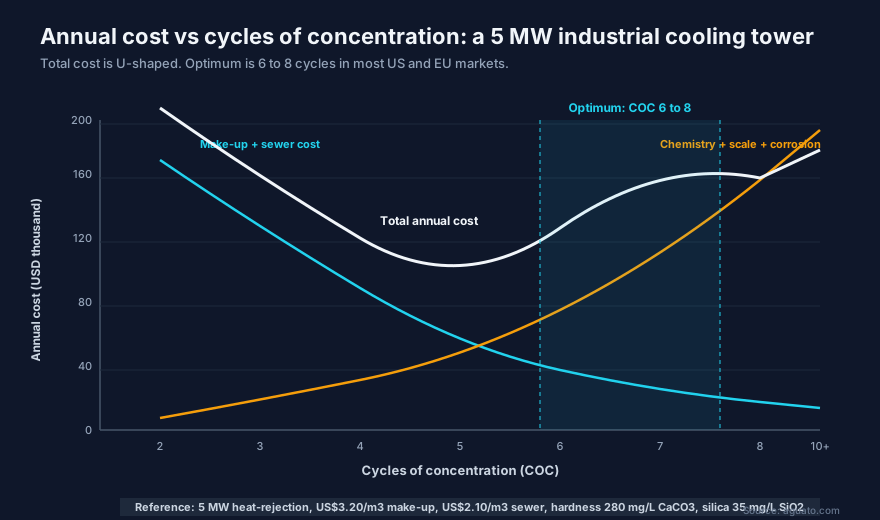
Decreasing curve: make-up water + sewer discharge. As cycles rise, blowdown volume drops hyperbolically and make-up water demand drops with it. Sewer-discharge cost (or zero-discharge treatment cost where blowdown cannot be discharged to sewer) drops at the same rate. This curve has the steepest gradient between 2 and 5 cycles, then flattens out above 6 cycles.
Increasing curve: chemistry programme + scale risk + corrosion risk. As cycles rise, the dissolved-solids and ionic-strength concentration in the loop rises proportionally. Scale-inhibitor dosing, dispersant dosing, and oxidising-biocide dosing all increase to maintain control of the more concentrated water. The marginal cost of scale-inhibitor and corrosion-inhibitor chemistry is small per added cycle below 6, but rises steeply above 7 to 8 as the chemistry must work against ion concentrations approaching the saturation thresholds. Above the saturation thresholds for calcium carbonate (the most common limit), silica, or calcium phosphate, the chemistry programme cannot prevent scale and the cost crosses a step change: an unplanned cleaning campaign at USD 50,000 to 250,000 per event.
Flat curve: fan energy + pumping energy. The fan energy to evaporate a given heat load is set by the heat-rejection duty and the wet-bulb temperature, not by cycles. The pumping energy on the loop is set by the loop flow rate (which is set by the heat-exchanger duty), not by cycles. Both costs are essentially constant across the COC range from 3 to 10.
The total-cost curve is U-shaped, with the optimum typically in the 6 to 8 cycle band for moderate municipal feed water in the US and EU, and shifted lower (4 to 5 cycles) for hard or arid-region feed water and higher (8 to 10 cycles) for soft or RO-treated make-up. The optimum point is rarely where the plant is operating, because the COC setpoint was usually locked at 3 to 4 cycles on the day the tower was commissioned and has never been re-engineered against current water and sewer prices, current chemistry costs, or current feed-water chemistry.
A pattern that recurs in industrial installations: the COC setpoint is the highest-leverage operating-cost optimisation lever a plant has access to, and the one most underutilised. A single afternoon of chemistry-programme analysis with the treatment-chemicals supplier and a Langelier or Stiff and Davis saturation calculation on the actual current make-up water can move the setpoint by 2 to 4 cycles and unlock USD 25,000 to 80,000 per year in net savings. The work is engineering, not procurement, and it almost always pays back inside 30 days.
## Feed-water chemistry sets the physical ceiling
The economic optimum is not always reachable. The feed-water chemistry sets a physical ceiling on the maximum safe cycles of concentration, and pushing past that ceiling guarantees scale formation, no matter what chemistry programme is dosed.
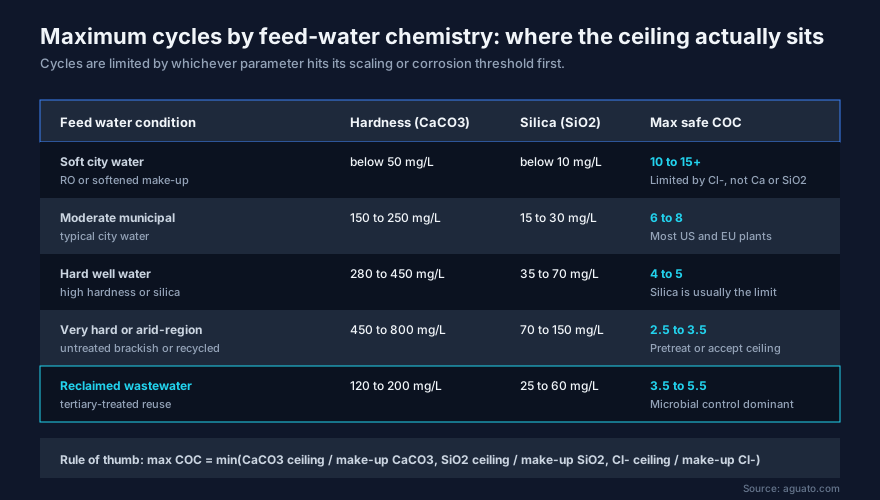
The three parameters that govern the ceiling, in order of how often they are the binding constraint:
1. Calcium hardness (as CaCO3). Calcium carbonate is the most common scale on heat-exchanger surfaces in industrial cooling. The Langelier Saturation Index (LSI) and the Stiff and Davis Saturation Index are the field-standard calculations for predicting CaCO3 scaling tendency at a given combination of calcium, alkalinity, pH, and temperature in the loop. As cycles rise, calcium and alkalinity rise proportionally, the LSI rises, and the CaCO3 scaling tendency increases. Most well-dosed chemistry programmes can maintain control up to LSI = +2.0 to +2.5 on a moderate-temperature loop with scale-inhibitor dosing; above LSI = +2.5, scale forms regardless of dosing. Working backward from the saturation calculation gives the maximum cycles.
2. Dissolved silica (as SiO2). Silica scale (amorphous SiO2) deposits on the cooling-tower fill and on cool heat-exchanger surfaces, and is much harder to remove than CaCO3 (requires hot caustic or hydrofluoric acid). The dissolved-silica saturation limit is approximately 150 to 180 mg/L at typical tower temperatures, regardless of chemistry programme. Working backward: if make-up water silica is 35 mg/L, the maximum cycles before saturation is reached is approximately 4.5 to 5; if make-up silica is 50 mg/L, the ceiling drops to 3.0 to 3.5. Silica is the binding constraint in most US Southwest, Spanish, Italian, and Australian inland installations.
3. Chloride (as Cl). Elevated chloride concentration drives stress-corrosion cracking risk on stainless-steel heat-exchanger tubes (typical limit 250 to 500 mg/L for 304SS, 1,000 to 1,500 mg/L for 316SS, 5,000+ mg/L for duplex stainless steels). The chloride ceiling is rarely the binding constraint on cooling water (it usually becomes binding at higher cycles than silica or hardness), but on very-soft or RO-treated make-up where hardness and silica are not limiting, chloride can become the ceiling at 10 to 15+ cycles.
The procurement-relevant point: the make-up water chemistry determines the maximum cycles, and changing the make-up chemistry (by softening, dealkalisation, RO treatment, or sidestream filtration) is the only way to raise the ceiling. Pretreating make-up water with a softener typically raises the COC ceiling from 4 to 6 cycles up to 7 to 9 cycles at a make-up softening CAPEX of USD 40,000 to 180,000 (5 MW duty); RO pretreatment can push the ceiling to 12+ cycles at a make-up RO CAPEX of USD 120,000 to 400,000. The economic case for pretreatment is the net make-up water saving across 15 years at the higher achievable cycles, minus the pretreatment OPEX, and that case turns positive at make-up-water cost above USD 4.50 to 6.50 per m3 in most plants.
The full programme structure for cooling-tower chemistry, including the relationship between cycles and scale-inhibitor dosing, is in our [cooling tower water treatment guide](/resources/cooling-tower-water-treatment). The blowdown setpoint engineering and the discharge-permit perimeter that constrains the COC decision are in our [cooling tower blowdown deep-dive](/resources/cooling-tower-blowdown).
Per [the US EPA WaterSense at Work cooling tower programme guide](dofollow:https://www.epa.gov/watersense/types-facilities), facilities that optimise cycles of concentration from the typical 2 to 4 cycle baseline up to 6+ cycles routinely reduce cooling-tower make-up water consumption by 20 to 30%, which is the authoritative federal benchmark for the magnitude of the optimisation opportunity at most US industrial sites.
## The chemistry programme that supports the chosen cycle
The cycles-of-concentration setpoint is not a procurement decision in isolation, it is paired with a chemistry programme that must keep the loop within control limits at the chosen concentration. The chemistry programme cost rises with cycles, but rises non-linearly: small cycle increases above 6 are cheap; large cycle increases above 8 are expensive.
The chemistry programme has five components, and each scales differently with COC:
- Scale inhibitor (phosphonate, polymer, or blended). Dosed at 2 to 8 mg/L active in the recirculating loop, with the higher dosage as cycles rise above 6. Cost runs USD 0.30 to 0.95 per m3 of make-up water at 5 cycles; USD 0.45 to 1.45 per m3 at 8 cycles. - Corrosion inhibitor (azoles for yellow metals, zinc and phosphate for steel). Dosed at 1 to 4 mg/L active. Cost runs USD 0.18 to 0.55 per m3 of make-up, largely independent of cycles below 8, then rising slightly as ionic strength approaches the chemistry's effective range limit. - Oxidising biocide (chlorine, bromine, chlorine dioxide). Dosed to maintain 0.2 to 1.0 mg/L free residual in the loop. Cost runs USD 0.08 to 0.28 per m3 of make-up, largely independent of cycles. - Non-oxidising biocide (DBNPA, isothiazolinone, glutaraldehyde, rotated to prevent resistance). Dosed periodically (1 to 4x per week) at 50 to 200 mg/L per addition. Cost runs USD 0.06 to 0.18 per m3 of make-up. - Dispersant or sludge conditioner (polymer). Dosed at 1 to 6 mg/L active to keep colloidal scale precursors suspended. Cost runs USD 0.04 to 0.15 per m3 of make-up.
Total chemistry cost at 5 cycles in moderate municipal feed: USD 0.66 to 2.11 per m3 of make-up. At 8 cycles: USD 0.83 to 2.61 per m3 of make-up. Chemistry cost rises 25 to 30% from 5 to 8 cycles, but make-up volume drops 8 to 10% over the same range, so total chemistry cost per year rises by only 15 to 18% while make-up cost drops 30 to 40%. The chemistry programme cost is the smaller of the two opposing curves, which is why higher cycles win on net cost in the typical operating envelope.
The chemistry-side architecture for advanced cooling-water programmes (especially the question of whether to use phosphonate, polymer, or all-organic chemistry) is covered in our broader [water treatment chemicals guide](/resources/water-treatment-chemicals). For Legionella control and the related biocide-rotation programme, see our [legionella risk assessment guide](/resources/legionella-risk-assessment).
## Control methods: conductivity, make-up flow, or hybrid
The COC setpoint is enforced by an automatic blowdown control system that monitors loop conductivity and opens a blowdown valve when conductivity exceeds the setpoint. Three control architectures are in common use:
1. Loop conductivity control (standard). A conductivity probe in the recirculating loop continuously measures loop conductivity. When conductivity exceeds a setpoint (set at make-up conductivity x target COC), a solenoid valve on the blowdown line opens until conductivity drops to setpoint. Simple, inexpensive, and the default architecture for new towers. The failure mode is conductivity probe drift, which sees the setpoint drift by 10 to 25% over 6 to 12 months between calibrations and changes the actual operating cycles without anyone noticing.
2. Make-up flow proportional control. A flow meter on the make-up line provides a feed-forward signal that triggers blowdown proportionally to make-up flow. More expensive (requires both make-up and blowdown metering) but more stable, because it does not depend on the conductivity probe. Used in plants with sensitive heat-exchanger surfaces or with strict discharge-permit limits.
3. Hybrid (conductivity + flow). Both signals are integrated; the conductivity probe is the primary control and the flow meter is the failsafe. Standard for advanced industrial installations and the only architecture that catches both probe drift (caught by the flow signal) and unexpected feed-water TDS spikes (caught by the conductivity signal).
The control architecture decision is small CAPEX relative to the COC setpoint optimisation; for plants running at suboptimal cycles, the binding constraint is almost always the human decision about the setpoint, not the control hardware. Upgrading the control hardware on a tower already running at 4 cycles when 7 is the right answer does not generate the savings; moving the setpoint to 7 does. The control upgrade matters when the setpoint is already at the optimum and the next failure mode is probe drift.
The broader continuous-monitoring architecture for cooling-water programmes is covered in our [water quality monitoring online vs lab guide](/resources/water-quality-monitoring-online-vs-lab), which determines the right cadence and instrumentation for the chemistry-residual programme that the COC setpoint depends on.
## Where COC decisions go wrong
Three failure patterns recur across cooling-tower installations, and each represents a recognised engineering-led mistake.
1. Setting cycles by tradition, not by current make-up chemistry. A pharma plant in the US Midwest ran a 5 MW cooling tower at 3 cycles for 12 years, because the original commissioning manual specified 3 cycles based on the 2002 make-up water chemistry. The municipal water supply was switched to a soft RO-blended source in 2018, which dropped feed hardness from 280 to 120 mg/L CaCO3 and feed silica from 35 to 18 mg/L. The plant could have safely run at 8 cycles after the source switch but continued at 3 for another 4 years until an external audit caught it. Cumulative excess cost: USD 285,000 over 4 years. Correct decision: re-engineer the COC setpoint whenever the make-up source changes, or at minimum annually against current feed-water chemistry.
2. Pushing cycles past the silica ceiling to chase make-up water savings. A data-centre cooling installation in Arizona pushed cycles from 4 to 7 to cut make-up water cost. The make-up water silica was 65 mg/L, and at 7 cycles the loop silica reached 455 mg/L, well above the 150 to 180 mg/L saturation limit. Silica scale formed on the fill within 60 days; fill replacement cost USD 220,000; loss of cooling capacity during fill replacement cost USD 380,000 in additional grid-supplied cooling. The mistake was treating the COC decision as purely economic without modelling the chemistry ceiling. Correct decision: run the Langelier or Stiff and Davis saturation calculation, plus silica saturation, before changing the setpoint. If the economic optimum is above the chemistry ceiling, the right answer is make-up pretreatment, not pushing cycles past the ceiling.
3. Ignoring blowdown-discharge regulatory limits when raising cycles. A food-processing plant in the EU raised cycles from 4 to 7 to cut make-up cost, which raised the chloride and total dissolved solids in the blowdown above the discharge consent. The plant absorbed three permit-violation notices over 8 months before reverting to 4 cycles. The mistake was optimising the input side of the mass balance without modelling the output side. Correct decision: model the blowdown chemistry at the proposed cycles against the discharge consent before committing to the setpoint change.
In every case, the decision quality starts with characterising the make-up chemistry, modelling the chemistry envelope at the proposed cycles, and checking the discharge-perimeter constraint.
## Decision framework: landing the right cycles-of-concentration setpoint
Run the cooling tower through this sequential check.
1. Current make-up chemistry: Get the most recent water analysis from the supplier or run a fresh one. Document hardness (as CaCO3), alkalinity (as CaCO3), silica (as SiO2), chloride, conductivity, and pH. No COC decision is valid without current chemistry. 2. Saturation calculation: Run the Langelier Saturation Index or Stiff and Davis Saturation Index at the proposed COC for the actual loop temperature. The LSI must stay below +2.0 to +2.5 with chemistry programme support. Silica concentration in the loop must stay below 150 to 180 mg/L. These two calculations set the chemistry ceiling. 3. Discharge-permit constraint: Calculate the blowdown chemistry at the proposed COC and compare to the discharge consent (chloride, TDS, sulphate, phosphate). Discharge limits often constrain the COC ceiling below the chemistry ceiling. 4. Make-up cost vs chemistry cost gradient: Calculate the savings from a higher COC (make-up + sewer cost reduction) versus the cost (chemistry programme increase). At the economic optimum, the marginal saving equals the marginal cost. 5. Control hardware adequacy: Confirm the conductivity control system can hold the setpoint within +/-3% over 6 to 12 months between calibrations. Upgrade to make-up flow or hybrid control if the conductivity-only system is the binding constraint. 6. Implement, monitor, validate: Move the setpoint in steps of 0.5 to 1.0 cycle, monitor heat-exchanger fouling, fill condition, and chemistry residuals for 30 to 60 days at each step. Lock in the setpoint that achieves the economic optimum without violating the chemistry or regulatory ceiling.
For most US and EU plants on moderate municipal feed water, the right answer falls in the 6 to 8 cycle band. For arid-region or hard-water plants, the answer is more often 4 to 5 cycles or 6 to 8 cycles with make-up pretreatment. For RO-blended or soft-water plants, the answer is often 8 to 10+ cycles with chloride as the binding constraint.
[Test the cycles-of-concentration setpoint against your make-up chemistry, local water and sewer cost, and discharge consent in Nepti](/nepti), which models the LSI saturation envelope, the chemistry programme cost curve, and the discharge-permit perimeter, and produces a ranked COC recommendation with annual cost projections.
## FAQ
### What does cycles of concentration mean in a cooling tower?
Cycles of concentration is the ratio of dissolved solids concentration in the recirculating cooling water to the dissolved solids concentration in the make-up water that feeds the tower. A tower running at 4 cycles has loop water that is 4x more concentrated than the make-up that supplies it. The cycles are set by the blowdown rate: more blowdown gives lower cycles, less blowdown gives higher cycles. Cycles are typically measured by conductivity ratio because conductivity tracks total dissolved solids closely and is cheap to measure online.
### What is the optimal cycles of concentration for a cooling tower?
For most US and EU plants on moderate municipal feed water (hardness 150 to 250 mg/L as CaCO3, silica 15 to 30 mg/L), the economic optimum sits in the 6 to 8 cycle band. For arid-region or hard-water plants (hardness 280 to 450 mg/L, silica 35 to 70 mg/L), the optimum is lower, typically 4 to 5 cycles, unless make-up pretreatment is added. For soft or RO-blended make-up (hardness below 50 mg/L, silica below 10 mg/L), the optimum can be 10 to 15+ cycles, limited by chloride content rather than scaling chemistry.
### What is the maximum cycles of concentration safe to run a cooling tower at?
The maximum safe cycles is set by feed-water chemistry, not by a universal rule. The binding constraint is whichever parameter (calcium carbonate, silica, or chloride) hits its saturation or corrosion threshold first as cycles rise. Calculate the Langelier Saturation Index for CaCO3, the silica saturation level, and the chloride concentration at the proposed cycles, and the safe maximum is the lowest of the three. Most chemistry programmes can support LSI = +2.0 to +2.5, silica below 150 to 180 mg/L, and chloride below the corrosion limit for the loop materials.
### How do you calculate cycles of concentration?
The field calculation is COC = Conductivity (recirculating loop) / Conductivity (make-up water). For example, if make-up conductivity is 600 microsiemens per cm and loop conductivity is 3,000 microsiemens per cm, COC = 5. The mass balance calculation is COC = Make-up water / (Blowdown + Drift), but conductivity ratio is the field standard because the measurements are continuous and inexpensive.
### How much can you save by increasing cycles of concentration?
For a typical 5 MW industrial cooling tower on moderate municipal feed water, moving from 3 cycles to 7 cycles saves approximately USD 50,000 to 90,000 per year in make-up water and sewer cost, against a USD 8,000 to 18,000 per year increase in chemistry programme cost. Net savings: USD 35,000 to 75,000 per year. The optimisation requires no capital and pays back in 30 to 60 days. Larger duties (10 to 50 MW) scale the savings proportionally, with net savings of USD 100,000 to 400,000 per year on a 25 MW duty.
### What controls cycles of concentration in a cooling tower?
An automatic blowdown control system monitors loop conductivity and opens a blowdown valve when conductivity exceeds a setpoint (set at make-up conductivity x target cycles). Three architectures are in common use: loop conductivity control (standard, simple, cheap), make-up flow proportional control (more stable, more expensive), and hybrid control (both signals, used in advanced installations). The control hardware decision is small CAPEX relative to the COC setpoint optimisation; the binding constraint is almost always the human decision about the setpoint.
### Does softening or RO pretreatment of make-up water raise the cycles of concentration?
Yes. Pretreating make-up water with a softener removes calcium and magnesium hardness and can raise the COC ceiling from 4 to 6 cycles up to 7 to 9 cycles at a make-up softening CAPEX of USD 40,000 to 180,000 for a 5 MW duty. RO pretreatment removes hardness, silica, and dissolved solids and can push the ceiling to 12+ cycles at a make-up RO CAPEX of USD 120,000 to 400,000. The economic case turns positive at make-up water cost above USD 4.50 to 6.50 per m3 in most plants, where the net make-up saving across 15 years pays back the pretreatment CAPEX plus the pretreatment OPEX.
### Can you run a cooling tower at very high cycles of concentration (10+)?
Yes, if the feed-water chemistry supports it. Plants running on soft city water or RO-blended make-up routinely operate at 10 to 15+ cycles, limited by chloride content rather than scaling chemistry. The chemistry programme cost rises non-linearly above 8 cycles, but the make-up water saving still wins on net cost where the make-up chemistry is favourable. Most plants with hard or arid-region feed water cannot reach 10+ cycles without make-up pretreatment because the silica or hardness ceiling is hit first.