A 50,000 wafer-starts-per-month fab consumes 5 to 10 million gallons of ultrapure water per day at 18-megohm-cm purity. The water-treatment train runs USD 60M to 180M of fab CAPEX and USD 12M to 35M per year in OPEX. Specifications below par cost 0.5 to 3% yield, USD 50M to 400M per fab per year.
Semiconductor manufacturing is the most water-intensive precision industry on earth. A 50,000 wafer-starts-per-month logic fab consumes 5 to 10 million gallons of ultrapure water (UPW) per day at 18-megohm-cm resistivity, and every cubic metre that enters the cleanroom has passed through a treatment train that costs USD 60M to 180M of upfront fab CAPEX and runs USD 12M to 35M per year in OPEX. The water-treatment system is not a utility line item, it is one of the top three engineering systems that determine whether the fab achieves design yield, and a specification gap of 1 to 2 ppb on TOC or 5 to 10 particles per mL on 50 nm count costs 0.5 to 3% wafer yield, or USD 50M to 400M per fab per year at current logic-wafer ASPs.
For Plant Managers running fab utilities, Procurement Leads writing the UPW package, and Sustainability Directors filing the next ESG water-use report, this is the most asymmetric water-treatment decision in industry. The water specification is fixed by the process node, not chosen, and missing the spec is not a compliance violation, it is a yield catastrophe that the head of fab operations sees on the same dashboard as defect density. At the same time, the wastewater side carries 18 to 32 distinct chemistries (HF, fluoride, ammonia, [copper](/elements/copper), isopropyl alcohol, slurry CMP solids, organic solvents) and a regulatory perimeter that is tightening fast in every fab geography that customer brands audit, with PFAS the new top-priority concern across US EPA, EU, and Asian fab clusters in the last 18 months.
This guide gives the engineering and procurement teams a costed walkthrough of the UPW train, the wastewater segregation architecture that determines whether the fab clears its discharge consent or fails it, the quality-tier decision matrix that links process node to treatment specification, the regulatory perimeter (SEMI F63, ITRS, regional fab-discharge frameworks, the new PFAS rules), and the failure modes that destroy fab yield and capital recovery in equal measure.
## The decision in brief
- Treat UPW as reliability engineering, not procurement optimisation. Semiconductor water-treatment runs USD 139M to 312M of fab CAPEX and USD 12M to 35M per year in OPEX on a 50,000 wpm logic fab, or 1.0 to 2.2% of total fab CAPEX and 0.4 to 1.0% of total fab OPEX. - Price the excursion, not the water. A single UPW excursion event runs USD 8M to 30M in scrapped wafers and rework, with 1 to 3 such events per year at fabs running at the design floor of acceptable specification. - Accept the 20 to 35% CAPEX premium as insurance. Specify UPW against the most advanced process node the fab will run in the asset's life, oversize capacity by 35 to 50%, and build redundancy at every stage, against USD 200M to 800M of lost production in the brownfield retrofit failure mode.
The defensive specification absorbs the 2024 to 2027 PFAS phase-in, the largest discharge-perimeter shift in 20 years, for USD 1.5M to 6M of design-stage polish CAPEX against USD 8M to 35M of mid-life retrofit.
## Why semiconductor water is the most asymmetric water decision in industry
The asymmetry has three components, and each compounds against the next.
First, the cost-of-failure function is convex. A 1 ppb TOC excursion in distribution loop UPW for 4 hours on a logic line in production deposits a measurable organic film on the wafer surface during clean-and-etch steps, and that film translates directly into defect density that the lithography inspection picks up two days later. At sub-7 nm nodes, a single 4-hour UPW excursion event costs USD 8M to 30M in scrapped wafers and rework, and the larger fabs see one to three such events per year in plants where the treatment train is at the design floor of acceptable specification.
Second, the regulatory perimeter on the wastewater side is moving faster than the equipment-replacement cycle. A UPW train installed in 2020 to 2022 was designed against TOC and conductivity limits that are now 30 to 60% looser than the 2025 to 2026 ZDHC-equivalent semiconductor frameworks emerging across the EU Industrial Emissions Directive (revised 2024) and the US EPA Effluent Guidelines Programme covering Electrical and Electronic Components (planned revision 2027). On the wastewater side, the PFAS perimeter is the biggest single regulatory shift in 20 years. PFAS are used as wetting agents and process surfactants in photolithography, and most fabs have measurable PFAS in their effluent. The EPA's 2024 NPDES guidance proposes 4 ppt PFOS and PFOA discharge limits, against typical fab effluent baselines of 50 to 800 ppt, requiring retrofit of granular activated carbon, ion exchange, or foam fractionation at USD 8M to 35M per fab.
Third, the architectural decisions are 15 to 20 year commitments. UPW distribution loops are welded PVDF or PFA piping installed during fab build, and the entire piping geometry is sized at design stage against the wafer-output forecast. A fab that outgrows its UPW capacity at year 8 cannot retrofit the distribution loop without taking the entire production line offline for 6 to 12 weeks, which destroys USD 200M to 800M in foregone production. The defensive specification is to oversize the UPW train and distribution by 35 to 50% against the wafer-output design point, accepting the upfront CAPEX premium as insurance against the catastrophic mid-life retrofit.
[cta:nepti-dark]
The combination, convex yield function, fast-moving regulation, and 15-year locked architecture, makes semiconductor water specification more like nuclear safety system specification than like industrial wastewater specification. The right framework is reliability engineering, not procurement optimisation.
## Ultrapure water quality tiers by process node
The 18-megohm-cm resistivity number is the most-cited UPW specification and the most misleading. Three different fabs at the same nominal "18-megohm" UPW spec run treatment trains that differ by 3 to 5x in capital cost and 4 to 7x in operating cost, because the supporting specifications (TOC, particle count, silica, bacteria, dissolved gases) span a 50x range across process nodes.
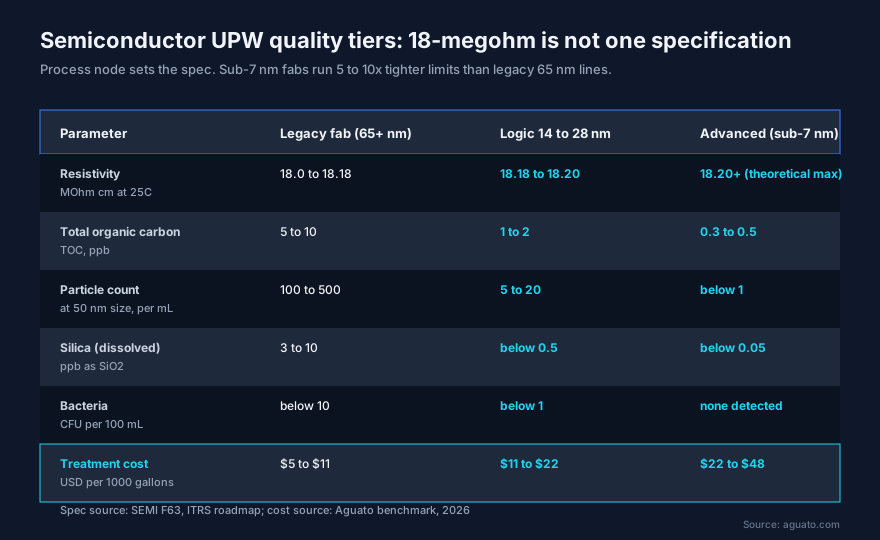
The driver across all four parameters is the wafer feature size. At 65 nm, a 50 nm particle on the wafer surface is smaller than a single feature and does not destroy a transistor; the spec is correspondingly relaxed. At sub-7 nm, that same particle covers 7+ features and definitively scraps the die. The same logic applies to TOC (organic films at the molecular scale matter only at sub-10 nm), dissolved silica (silica deposition during high-K dielectric deposition matters only at advanced nodes), and bacteria (biofilm shed deposits [organic carbon](/elements/carbon) onto wafers, which manifests as defects on advanced lithography).
The procurement-relevant implication: any fab considering technology-node migration (legacy 65 nm fab adding 28 nm logic capacity, or a 14 nm fab tooling for 7 nm) must specify the UPW train against the most advanced node it will run within the asset's service life, not against the average. The UPW system installed for the average will be the limiting factor at the leading-edge node, and the retrofit cost during the upgrade campaign is the kind of CAPEX surprise that delays node-migration projects by 12 to 36 months.
The full set of UPW specifications is governed by SEMI Standard F63, the international semiconductor industry specification for UPW quality. The full text is at [the SEMI Standards programme catalog page](dofollow:https://www.semi.org/en/products-services/standards). Procurement teams should treat SEMI F63 as the floor specification, and the fab's process integration team should set internal specifications 20 to 40% tighter than the SEMI F63 floor to absorb operational drift across the asset's life.
## The four-stage UPW treatment train
A complete UPW treatment train runs in four stages: pretreatment, primary loop, polish loop, and distribution loop. Each stage has a different role and a different failure mode.
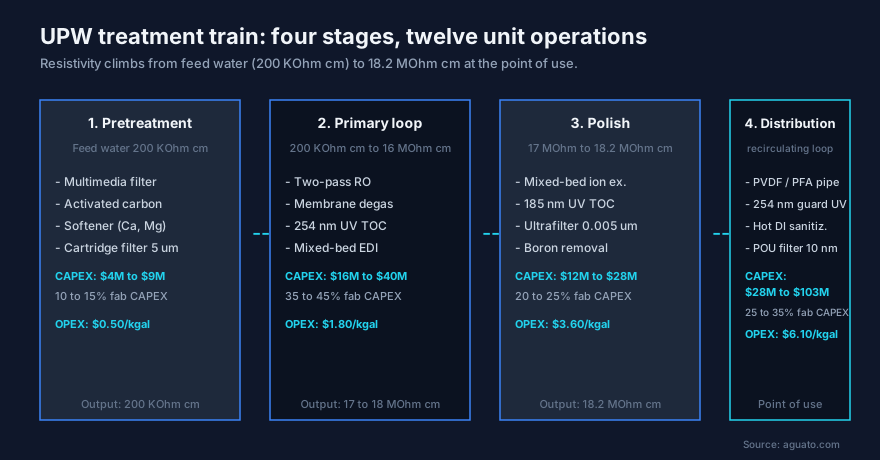
Stage 1: Pretreatment. Multimedia filter, activated carbon, softening, and 5-micron cartridge filtration on the incoming city or process feed water. The mission is to remove suspended solids, chlorine, hardness, and gross organic load before the membrane stages. CAPEX share is 10 to 15% of total train; OPEX is dominated by media replacement (carbon every 12 to 18 months at USD 8,000 to 25,000 per regeneration) and softener salt. The failure mode is upstream feed-water excursions during regional drought, when city-water TDS spikes and chlorine residual rises above the carbon's removal capacity.
Stage 2: Primary loop. Two-pass reverse osmosis, membrane degasification (CO2 removal), 254 nm UV for TOC reduction, and mixed-bed electrodeionisation (EDI) to reach 17 to 18 megohm-cm resistivity. CAPEX share is 35 to 45%; OPEX is dominated by RO membrane replacement (every 3 to 7 years at USD 150,000 to 400,000 per change-out per fab) and EDI module replacement (every 5 to 10 years at USD 80,000 to 250,000). The dominant failure mode is membrane fouling driven by upstream pretreatment failure, see our [membrane fouling prevention guide](/resources/membrane-fouling-prevention) for the operations programme that keeps RO membranes at design performance through their full service life.
Stage 3: Polish loop. Mixed-bed ion exchange (final cation and anion polish), 185 nm UV (TOC reduction to 0.3 to 0.5 ppb at sub-7 nm spec), ultrafiltration at 0.005 micron (particle removal to sub-1 per mL at 50 nm size), and boron-specific resin polish for the most advanced nodes (where boron contamination affects high-K dielectric deposition). CAPEX share is 20 to 25%; OPEX is dominated by mixed-bed resin regeneration (every 6 to 18 months at USD 80,000 to 220,000) and UF cartridge replacement (every 18 to 36 months at USD 35,000 to 95,000). The dominant failure mode is mixed-bed channeling, which causes ion breakthrough that is not detected by the loop conductivity sensor until 4 to 12 hours after onset, see our [ion exchange water treatment guide](/resources/ion-exchange-water-treatment) for the chemistry and operations programme that prevents this.
Stage 4: Distribution loop. Welded PVDF or PFA piping, 254 nm guard UV at multiple points around the recirculation loop, hot-DI sanitization capability (typically 80 to 90 deg C cycle once per quarter), and point-of-use (POU) cartridge filters at every tool drop (typically 5 to 10 nm cut-off). CAPEX share is 25 to 35%; OPEX is dominated by POU cartridge replacement (every 3 to 9 months at USD 4,000 to 22,000 per cartridge, with 50 to 200 cartridges per fab). The dominant failure mode is biofilm formation in dead legs and infrequently used drops, which seeds the loop with sloughed organic material when production resumes after maintenance shutdowns.
The architectural principle: each stage exists to absorb the failure of the stage upstream. If the polish loop is sized to compensate for primary-loop excursions, the fab survives a primary-loop event without a UPW shutdown. If the distribution loop is designed with guard UV at multiple recirculation points, a polish-loop bacteria breakthrough is caught before it reaches the wafer. The defensive design is layered redundancy at every stage, with the cost of redundancy traded against the cost of a single UPW excursion event. At sub-7 nm yield economics, redundancy almost always wins.
The full ultrapure-water production architecture decision (including the question of whether to build, buy, or contract UPW as a service) is covered in our [ultrapure water production guide](/resources/ultrapure-water-production), which extends to non-semiconductor UPW applications (pharma, power, lab).
## Wastewater: segregation, treatment, and the new PFAS perimeter
Semiconductor wastewater is the engineering opposite of UPW, an extremely complex mixed waste stream that must be segregated before treatment because the chemistries do not coexist. A typical 50,000 wpm logic fab generates 18 to 32 distinct waste streams across the process areas, and the segregation architecture is the single most consequential wastewater decision a fab makes at design stage.
The principal waste streams and their dominant chemistries:
- HF / fluoride waste (3 to 12% of total fab effluent volume). Hydrofluoric acid from oxide etch and post-etch cleans. Treated by calcium-fluoride precipitation (lime addition) and clarification; the resulting CaF2 sludge is hazardous-classified and disposed at USD 200 to 600 per tonne. Fluoride discharge limit at most US fabs is 8 to 20 mg/L. - Ammonia waste (5 to 15% of volume). NH4OH from SC1 RCA cleans and post-CMP cleans. Treated by air stripping, biological nitrification-denitrification, or breakpoint chlorination. The biological route is preferred for plants with the footprint and operations capability, see our [nitrification denitrification design considerations](/resources/aerobic-vs-anaerobic-wastewater-treatment) for the aerobic-vs-anaerobic decision logic that applies. - Copper waste (1 to 4% of volume, sub-7 nm fabs only). From dual-damascene Cu plating in BEOL. Treated by ion exchange or electrowinning to recover Cu metal for resale at USD 7,000 to 9,000 per tonne; recovered Cu can offset 8 to 25% of the wastewater OPEX. - CMP slurry (10 to 18% of volume). Silica, ceria, or alumina particle slurry from chemical-mechanical planarization. Treated by coagulation + clarification, see our [electrocoagulation vs chemical coagulation comparison](/resources/electrocoagulation-vs-chemical-coagulation) for the coagulant-selection logic for CMP slurries. - Organic solvent waste (3 to 9% of volume). IPA (isopropyl alcohol) from wafer drying and photoresist solvents from lithography. Treated by air stripping, activated carbon, or advanced oxidation, see our [advanced oxidation processes for industrial wastewater](/resources/advanced-oxidation-processes-industrial) for the AOP selection logic. - General acid waste (15 to 25% of volume). Mixed HCl, H2SO4, HNO3 from various cleans. Treated by lime or caustic neutralisation to pH 6 to 9 before discharge or further polishing. - General organic waste (25 to 45% of volume). Process water with dissolved organics below hazardous thresholds. Treated by biological MBR or activated sludge, see our [MBR vs activated sludge comparison](/resources/mbr-vs-activated-sludge) for the membrane-bioreactor decision logic. - PFAS-containing streams (1 to 3% of volume, but the regulatory keystone). Fluorinated photoresists, wetting agents, and surfactants. Treated by GAC, ion exchange, or foam fractionation; the regenerated GAC is a hazardous waste with USD 800 to 2,400 per tonne disposal cost.
The wastewater segregation decision is the most consequential cost lever in fab design. A fab that segregates aggressively at design stage spends USD 12M to 35M on dedicated piping, sampling stations, and segregated treatment trains. A fab that mixes waste streams to "simplify" the wastewater plant saves USD 8M to 18M at design stage but spends USD 28M to 95M over 15 years on:
- Higher disposal cost (mixed waste classifies hazardous more often). - Lost copper recovery revenue. - PFAS contamination of streams that would have been below detection if segregated. - Inability to apply the right treatment to the right chemistry (e.g. biological treatment fails if HF or copper mixes in).
The PFAS perimeter is the new keystone. The EPA's revised NPDES guidance, effective 2024 to 2027 phase-in, proposes 4 ppt PFOS and PFOA discharge limits and a sum-of-PFAS cap that captures GenX, ADONA, and 35+ other fluorinated compounds. Per [the EPA's PFAS Strategic Roadmap](dofollow:https://www.epa.gov/pfas/pfas-strategic-roadmap-epas-commitments-action-2021-2024), the regulatory expectation is that all major industrial dischargers will have detection and treatment capability within the phase-in period. Fabs that did not design for PFAS segregation are retrofitting GAC or ion-exchange polish stages at USD 8M to 35M, with 12 to 24 month installation programmes. Fabs that segregated at design stage absorbed the PFAS perimeter for USD 1.5M to 6M of incremental polish-stage CAPEX. See our deeper [PFAS removal from water treatment guide](/resources/pfas-removal-water-treatment) for the technology selection logic.
## CAPEX and OPEX: what UPW and wastewater actually cost a fab
The numbers below are for a reference 50,000 wpm logic fab on the 14 nm to 7 nm node range, at greenfield design. Brownfield retrofits run 1.4 to 2.2x these numbers because of stranded piping and the cost of working around live production.
| Cost element (15-year horizon) | UPW system | Wastewater system | Combined | |---|---|---|---| | Equipment CAPEX | USD 60M to 120M | USD 35M to 85M | USD 95M to 205M | | Distribution / piping CAPEX | USD 18M to 42M | USD 12M to 28M | USD 30M to 70M | | Engineering, commissioning, qualification | USD 8M to 22M | USD 6M to 15M | USD 14M to 37M | | Total installed capital | USD 86M to 184M | USD 53M to 128M | USD 139M to 312M | | Annual OPEX (energy, chemistry, labour, consumables) | USD 8M to 24M | USD 4M to 11M | USD 12M to 35M | | 15-year OPEX total | USD 120M to 360M | USD 60M to 165M | USD 180M to 525M | | Cost of a single UPW excursion event | USD 8M to 30M per event | n/a | USD 8M to 30M per event | | 15-year total cost of ownership | USD 206M to 544M | USD 113M to 293M | USD 319M to 837M |
For comparison, the equipment fit-out CAPEX of the same 50,000 wpm fab is USD 8B to 15B at 14 nm and USD 15B to 25B at 7 nm. Water-treatment CAPEX runs 1.0 to 2.2% of total fab CAPEX, and OPEX runs 0.4 to 1.0% of total fab OPEX. Wafer yield impact of a UPW excursion runs 1 to 5% of fab revenue per event. The asymmetry between investment share and yield-impact share is the engineering case for over-specification, and the financial case for the redundancy that procurement-led decision-making routinely tries to cut.
The right framework for the water-treatment package within a fab capital programme is reliability-engineered specification with redundancy at every stage, not cost-optimised procurement. The water-treatment vendor that proposes the cheapest capital cost almost always has a single-train architecture without N+1 redundancy on the polish loop, and that architecture has a 3 to 8x higher probability of generating a UPW excursion event in any given year compared to a 2x100% or N+1 architecture.
[Test your fab's water-treatment specification against the process-node roadmap and the regulatory perimeter in Nepti](/nepti), which models the UPW spec at SEMI F63 versus internal-spec floor, the wastewater segregation against the local discharge consent and the PFAS phase-in, and produces a costed comparison of single-train versus N+1 versus 2x100% architectures.
## Where semiconductor water-treatment projects go wrong
Three failure patterns recur across semiconductor fab water installations, and each is a recognised engineering-led mistake.
1. Sizing the UPW train against the average wafer-output, not the design point plus margin. A 28 nm logic fab in Texas sized its UPW train at exactly the wafer-output design point with no headroom. Within 18 months of ramp, the fab outsold its capacity forecast by 15%, the UPW train hit 100% utilisation at 23 hours per day, and the polish loop resin regeneration cycles compressed to weekly from monthly. Two excursion events in the first 30 months cost USD 42M in scrapped wafers. The mistake was treating UPW capacity as a cost line to minimise, not as a reliability buffer to oversize. Correct decision: specify UPW capacity at 1.35 to 1.50x the wafer-output design point.
2. Mixing wastewater streams to "simplify" the plant. A 14 nm logic fab in Asia consolidated its acid, ammonia, and CMP waste streams into a single 6,000 m3/day mixed treatment plant to save USD 14M at design stage. Within 4 years, the mixed plant could not meet the discharge consent on copper (post-Cu BEOL introduction), and a USD 38M retrofit campaign installed segregated copper and CMP trains during 8 months of partial production shutdown. The mistake was optimising for design CAPEX without modelling the chemistry-evolution risk over the asset's life. Correct decision: design wastewater architecture for the full set of waste streams the fab will generate at the most advanced process node it will ever run.
3. Specifying treatment trains without redundancy on the polish loop. A pure-play foundry in Europe specified a single-train polish loop (single mixed-bed, single UV, single UF) to save USD 12M at design stage. The polish loop has been off-spec 14 days in aggregate over its first 4 years of operation, against an industry benchmark of fewer than 1 day per year for N+1 architectures. The cumulative yield cost is USD 64M, against the USD 12M CAPEX saving. The mistake was treating redundancy as a procurement variable to optimise, not as a reliability variable to specify. Correct decision: every UPW polish loop should be N+1 minimum, and the primary loop should be 2x100% for any fab on a process node below 14 nm.
In every case, the decision quality starts with reliability-engineering the specification before issuing the RFP.
## Decision framework for fab water-treatment specification
Run the fab water-treatment package through this sequential check.
1. Process-node ceiling within asset life: What is the most advanced node the fab will produce within the 15-year UPW asset life? Specify UPW against SEMI F63 at that node, plus an internal-spec floor 20 to 40% tighter. 2. Wafer-output design point: What is the design point for wafer-starts-per-month? Specify UPW capacity at 1.35 to 1.50x the design point, accepting the CAPEX premium as production-growth insurance. 3. Process-chemistry evolution: Will Cu BEOL, advanced photolithography, advanced cleans (cryogenic, supercritical CO2) be introduced within the asset life? If yes, design wastewater segregation for the full chemistry set, not just the current-node set. 4. PFAS regulatory exposure: Is the fab in a US, EU, Korean, or Taiwanese cluster subject to the 2024 to 2027 PFAS regulatory phase-in? Segregate PFAS-containing streams (lithography, fluorinated photoresists) at design stage; provision GAC or ion-exchange polish capacity. 5. UPW redundancy architecture: Single-train, N+1, or 2x100% on primary loop? For sub-7 nm fabs: 2x100% primary, N+1 polish. For 14 to 28 nm fabs: N+1 primary, N+1 polish. For 65+ nm fabs: single-train acceptable with full sparing. 6. Wastewater discharge perimeter trajectory: Is the local discharge consent expected to tighten within 5 years? If yes, oversize the polish stages of the wastewater train by 25 to 40% on flow capacity to absorb the future spec tightening.
For sub-7 nm fabs, the answer to almost every question is "specify against the upper end of the range." For legacy 65 nm fabs, the answer to most questions is "specify at the design point with standard sparing." The middle node range (14 to 28 nm) is the zone where the decision is genuinely close and where the architectural choice is most sensitive to the fab's actual process-mix.
For the middle-node fabs where the architecture decision is genuinely close, the answer comes from scoped proposals, not first principles. Compare vetted [water treatment suppliers](/providers) on Aguato, filter by ultrapure water and semiconductor experience, and request like-for-like quotes scoped to your actual process-mix and resistivity targets.
## FAQ
### What is ultrapure water (UPW) in semiconductor manufacturing?
Ultrapure water is the highest-purity water specification used in industry. For semiconductor manufacturing, UPW must reach 18-megohm-cm resistivity (the theoretical maximum for pure water at 25 deg C is 18.2 megohm-cm), with simultaneous limits on total organic carbon (0.3 to 10 ppb depending on process node), particle count (sub-1 to 500 per mL at 50 nm size), dissolved silica (0.05 to 10 ppb), bacteria (0 to 10 CFU per 100 mL), and dissolved gases. The full specification is governed by SEMI Standard F63 and tightens with every process-node generation.
### How much water does a semiconductor fab use?
A typical 50,000 wafer-starts-per-month logic fab consumes 5 to 10 million gallons (19,000 to 38,000 m3) of water per day. Of that, 60 to 75% is ultrapure water consumed in wafer cleans, etch, lithography, and CMP; 25 to 40% supports utilities (cooling, scrubbers, exhaust treatment). Advanced sub-7 nm fabs typically consume 30 to 60% more water per wafer than legacy nodes due to the increased number of clean-and-etch steps in advanced lithography.
### How much does a semiconductor water treatment plant cost?
The complete water-treatment package for a 50,000 wpm logic fab runs USD 139M to 312M of installed CAPEX, plus USD 12M to 35M per year in OPEX. UPW alone runs USD 86M to 184M of CAPEX and USD 8M to 24M of OPEX; wastewater runs USD 53M to 128M of CAPEX and USD 4M to 11M of OPEX. Costs scale linearly with wafer-output capacity above and below this reference point.
### What is the difference between UPW and ultrapure water?
The terms are used interchangeably in the semiconductor industry. SEMI Standard F63 defines UPW as ultrapure water meeting specific tier limits across resistivity, TOC, particles, silica, bacteria, and dissolved gases. Practitioners use UPW as a specific defined specification, and ultrapure water as the generic name for water at that purity tier.
### Why is PFAS a problem for semiconductor fabs?
PFAS (perfluoroalkyl and polyfluoroalkyl substances) are used in semiconductor manufacturing as photoresist surfactants, wetting agents, and process additives. They reach fab wastewater in the photolithography and clean streams. The 2024 EPA NPDES guidance proposes 4 ppt PFOS and PFOA discharge limits, against typical fab effluent baselines of 50 to 800 ppt, requiring dedicated treatment (granular activated carbon, ion exchange, or foam fractionation) to comply. The retrofit cost at fabs that did not design for PFAS segregation runs USD 8M to 35M and 12 to 24 month installation programmes.
### Can semiconductor fabs reuse water?
Yes, increasingly. Modern fabs achieve 60 to 90% water reuse by recovering rinse-water and cooling-tower blowdown back into the treatment train through dedicated reclaim loops. The economics depend on local water cost and on the process-node tolerance for reuse water; sub-7 nm fabs typically reuse process-side rinse water back to the cooling-tower loop rather than back to UPW, while legacy nodes can reuse high-quality rinses back into the UPW pretreatment stage. Water reuse is now standard at fabs in water-stressed clusters (Arizona, Taiwan, Korea, Israel).
### How long does a semiconductor UPW treatment plant last?
The mechanical infrastructure (vessels, piping, instrumentation) typically operates for 20 to 30 years with appropriate refurbishment. RO membranes need replacement every 3 to 7 years; EDI modules every 5 to 10 years; mixed-bed resin regeneration every 6 to 18 months; UF cartridges every 18 to 36 months; POU cartridges every 3 to 9 months. The economic question is rarely whether the asset will last, it is whether the original specification will still meet the SEMI F63 limits at the process node the fab is running at year 8 to 10, which is why over-specification at FEED-stage against the most advanced future node is the defensive procurement strategy.
### What is the difference between UPW for semiconductors and UPW for pharma?
Semiconductor UPW prioritises particle count, dissolved silica, dissolved metals, and TOC at the part-per-trillion level. Pharma UPW (Water for Injection per USP and EP standards) prioritises bacterial endotoxin, viable organisms, and conductivity at slightly looser specs, with explicit microbiological control that semiconductor UPW does not require. The two specifications overlap on resistivity (both target above 18 megohm-cm) but diverge on the supporting limits, and a UPW system designed for one application is rarely directly usable for the other without modifications to the polish and distribution stages.