GAC pre-treatment costs $0.05 to $0.18/m3. Skipping it risks $50,000 to $200,000 in membrane damage within three years. Full carbon type comparison, CAPEX, OPEX, and PFAS guide.
Activated carbon water filtration removes dissolved organics, [chlorine](/elements/chlorine), taste, odor, and emerging contaminants like PFAS from industrial water streams at a cost of $0.05 to $0.30 per cubic metre treated, depending on media type and contaminant load. A single uncontrolled chlorine breakthrough into a reverse osmosis system can destroy a membrane array worth $50,000 to $200,000 in under 48 hours. Carbon filtration is what prevents that, and it does it without chemical addition to the treated water.
The industrial water treatment market sells activated carbon as a commodity product and then charges premium rates to fix the problems that come from misapplying it. Undersized contactors, wrong carbon grades for the target contaminant, and ignored breakthrough curves are the most common failure patterns. Vendors optimise for the sale, not the lifecycle. The buyer's job is to understand what carbon actually does, where its limits are, and what it costs when specified correctly versus when it is not.
This guide covers the three main activated carbon filter configurations used in industrial settings, how to match carbon type to your contamination profile, the CAPEX and OPEX ranges needed to build a defensible business case, the failure modes that generate the largest unplanned costs, and a decision framework for determining when carbon is the right technology and when it is not. The guide is written for the operations and engineering teams that own water quality programmes and for procurement and capital projects leads building the cost model for a treatment upgrade.
## The decision in brief
- Budget GAC pre-treatment ahead of the RO. If you specify a GAC pre-treatment system for a reverse osmosis plant processing 500 cubic metres per day, you will typically spend $60,000 to $120,000 in CAPEX and $25,000 to $90,000 per year in OPEX. - Price the accelerated membrane replacement. The same plant without carbon pre-treatment will typically spend $50,000 to $200,000 in accelerated membrane replacement within the first three years of operation. - Add the compressed cleaning cycles. On top of that, the plant without carbon pre-treatment will typically spend $30,000 to $80,000 per year in compressed cleaning cycles within the same first three years of operation.
The cost-of-doing-nothing in activated carbon applications is not gradual degradation: it is a discrete and avoidable capital event with a well-documented failure mechanism and a well-understood price tag.
## What activated carbon filtration does and how it works
Activated carbon removes contaminants from water through adsorption, a surface-chemistry process in which dissolved molecules attach to the vast internal pore structure of carbon particles. A single gram of activated carbon has an internal surface area of 500 to 1,500 square metres, which is why even a modest GAC vessel can process thousands of cubic metres of water before exhaustion.
The process sounds simple, and mechanically it is. Water passes through a bed of carbon particles (or a block of compressed carbon) at a controlled flow rate, and organic molecules, chlorine, and certain synthetic chemicals bond to the carbon surface. What makes it technically demanding is the interaction between empty bed contact time (EBCT), the target contaminant, the carbon pore size distribution, and the feed water chemistry. Get any of those parameters wrong and you get either premature exhaustion, poor removal, or both.
Activated carbon works best on organic compounds with molecular weights between 45 and 1,000 daltons. It is highly effective on chlorine, trihalomethanes (THMs), volatile organic compounds (VOCs), taste-and-odor compounds like geosmin and 2-methylisoborneol, many pesticides and herbicides, and long-chain PFAS compounds. It does not remove dissolved salts, nitrates, hardness, or most heavy metals without chemical impregnation. Understanding this boundary prevents the common and expensive mistake of specifying carbon for problems it cannot solve.
The [U.S. EPA's guidance on granular activated carbon for drinking water treatment](dofollow:https://www.epa.gov/ground-water-and-drinking-water/national-primary-drinking-water-regulations) confirms GAC as a best available technology for THMs, VOCs, and certain synthetic organics. For industrial buyers, that designation matters beyond municipal compliance: it sets the technology's place in a treatment train relative to alternative approaches. For a broader view of [industrial water filtration](/industrial-water-filtration) options and how carbon sits within the wider technology stack, Aguato's category overview maps the full set of choices.
## The three main carbon filter configurations
The format of activated carbon determines what it can treat, at what flow rate, at what cost, and whether the media can be recovered and reused. Most vendors present a single format as the default. That is rarely the right call.
Granular activated carbon (GAC) is the workhorse of industrial and municipal water treatment. Carbon is crushed and sieved to particles between 0.5 and 4 mm (8 to 30 US mesh). Water flows down through a fixed bed in a pressure vessel or open basin, and the carbon is backwashed periodically to remove particulates. GAC is reactivatable: when exhausted, it can be thermally regenerated at specialist facilities for $0.40 to $1.00 per kilogram, extending its lifecycle and significantly reducing long-run media cost. For continuous large-volume applications above 50 cubic metres per hour, GAC is almost always the cost-optimal format.
Powdered activated carbon (PAC) is ground to sub-100-micron particles and dosed as a slurry directly into water. It is not used in standalone filter vessels; it is added upstream of clarifiers or filters and removed with settled solids. PAC works well for handling episodic contamination events, taste-and-odor peaks, or seasonal algal blooms where a permanent GAC system would be oversized for the duration of the problem. The trade-off is that PAC is a single-use product: it cannot be regenerated and must be disposed of as solid waste, often at hazardous-waste rates when the adsorbed contamination warrants it. OPEX for PAC at typical doses of 5 to 20 mg/L runs $0.10 to $0.30 per cubic metre, roughly double the cost of a well-designed GAC system at steady-state.
Carbon block and cartridge filters compress fine carbon powder into a rigid matrix with controlled pore size, typically 0.5 to 50 microns. The result is simultaneous filtration and adsorption: particulates are mechanically excluded while dissolved organics and certain synthetic compounds are adsorbed. Carbon blocks deliver tighter organic removal than loose-media GAC for challenging compounds like short-chain PFAS, and they work at low flow rates where a GAC column would be overengineered. The downside is capital cost ($80 to $200 per cubic metre per day of capacity) and the absence of reactivation, making them cost-prohibitive at scale. Carbon block is well-positioned for point-of-entry or point-of-use applications, pharmaceutical process water, and PFAS polishing as a final treatment step.
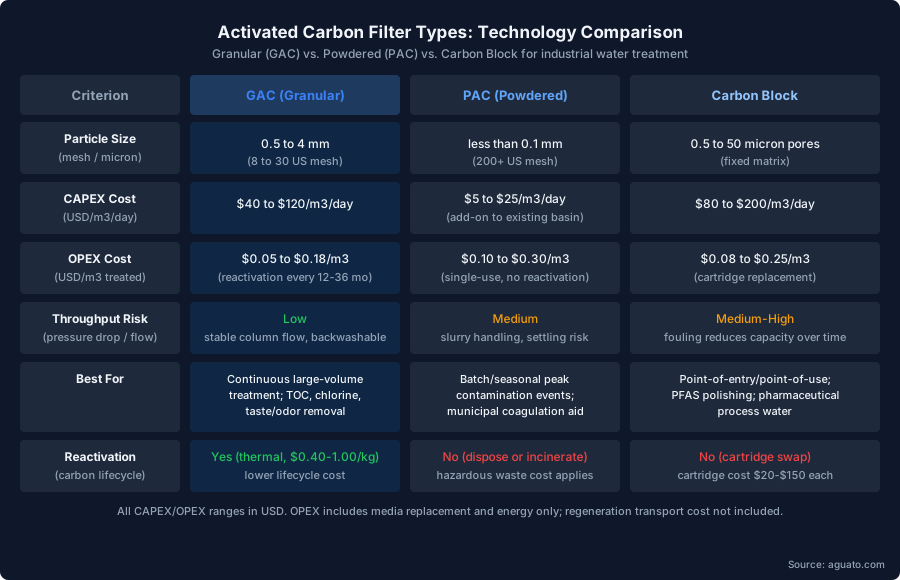
These three formats are not interchangeable. A project that opens with "we need activated carbon" and gets quoted on the first format a vendor stocks has already made a $50,000 to $500,000 decision without the information to defend it. The right format follows from the contamination profile, flow rate, and lifecycle cost model, in that order.
## Matching carbon type to your contamination profile
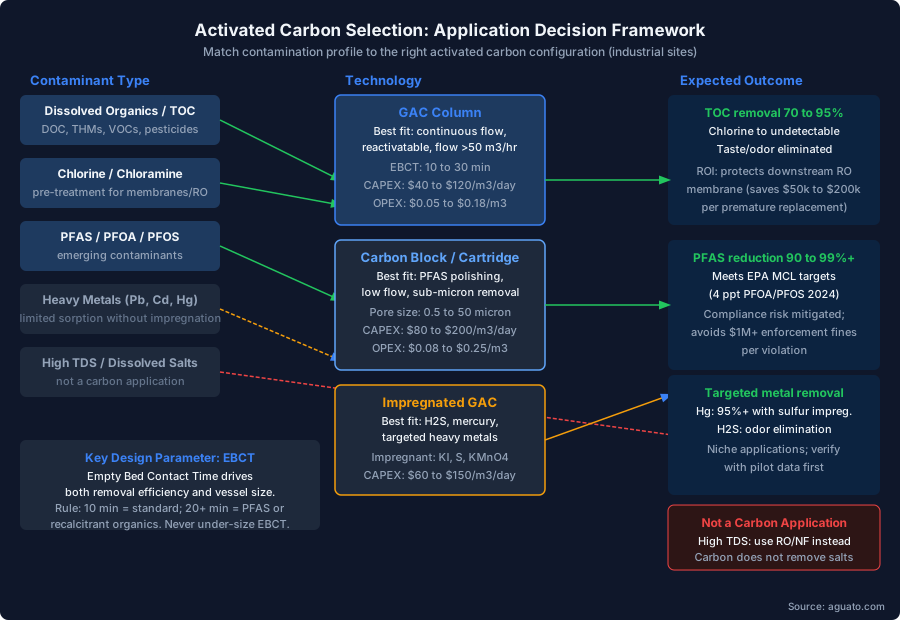
The contamination profile drives everything: which format to use, which carbon raw material (coal, coconut shell, wood, peat) is most effective, what EBCT is required, and whether supplementary treatment is needed upstream or downstream. Across projects in industrial water treatment, the most common failure is specifying a format based on what is available rather than what the water chemistry demands.
TOC and dissolved organics are the broadest application for GAC. Coal-based carbons with a mixed macro-mesopore structure perform well across a wide range of molecular weights. Target EBCT of 10 to 15 minutes for most organics at the concentrations found in industrial pre-treatment. If the TOC is above 10 mg/L, consider upstream coagulation-flocculation to protect the carbon bed from premature loading.
Chlorine and chloramine removal is the most reliable carbon application and the least likely to cause performance surprises. Both compounds react chemically with carbon in addition to adsorbing onto it, so removal is fast and essentially complete at an EBCT of 5 to 10 minutes. Coconut-shell carbon, with its high proportion of micropores, is often preferred for chloramine because the molecule is smaller than most organics. Chloramine removal matters specifically as [pre-treatment before reverse osmosis systems](/resources/reverse-osmosis-systems), where free chlorine will oxidise and degrade polyamide membranes irreversibly.
Taste and odor compounds, particularly geosmin and 2-methylisoborneol (MIB) from algal blooms, require a carbon with a high proportion of micropores and an EBCT of at least 15 minutes at the concentrations found during bloom events. Many operations undersize the bed for baseline conditions and are then caught short during peak events. A pattern that recurs in industrial installations with surface water intake is sizing for average conditions and discovering during a bloom event that effective removal requires double the EBCT the system was built for.
PFAS compounds (per- and polyfluoroalkyl substances) are the most technically demanding application and the one with the most regulatory momentum. GAC removes long-chain PFAS (PFOA, PFOS) well at EBCT of 15 to 30 minutes. Short-chain PFAS are harder to remove and require either longer EBCT, carbon block, or ion exchange resin as a polishing step. This is covered in more depth in the PFAS section below.
Heavy metals are not a natural activated carbon application. Standard GAC removes lead, cadmium, and mercury poorly in dissolved ionic form. Impregnated activated carbon, treated with potassium iodide, sulfur, or permanganate, can achieve selective removal of specific metals, but at a cost premium of $60 to $150 per cubic metre per day of capacity, and without reactivation economics in most cases. For significant heavy metal loads, [industrial water purification](/resources/industrial-water-purification) technologies including ion exchange and precipitation are usually the better primary treatment.
For a comprehensive view of how activated carbon fits within membrane-based treatment trains, the [membrane filtration system](/resources/membrane-filtration-system) overview details the upstream/downstream interactions that determine total system performance.
## CAPEX and OPEX: what activated carbon filtration actually costs
The cost of activated carbon filtration is not the cost of the carbon. The carbon is often a small fraction of the total system cost. The real cost drivers are vessel engineering, backwash infrastructure, reactivation logistics, and the opportunity cost of getting the sizing wrong.
GAC system CAPEX for industrial pressure-vessel configurations runs $40 to $120 per cubic metre per day of throughput capacity. A 500 cubic metres per day plant needs between $20,000 and $60,000 in carbon equipment, before civil works, piping, instrumentation, and commissioning. Full installed cost including site integration typically lands at 2x to 3x the bare equipment price. Open-basin GAC in a municipal configuration is cheaper per unit capacity but is rarely applicable in industrial settings where space and backwash handling are constrained.
Media cost for virgin GAC runs $1.50 to $3.50 per kilogram for coal-based carbon and $3.00 to $6.00 per kilogram for coconut-shell carbon. A 500 cubic metres per day system with an EBCT of 15 minutes holds roughly 2,500 to 4,000 kg of carbon, so initial media fill is $4,000 to $24,000 depending on grade. When that bed exhausts, reactivation at a specialist facility costs $0.40 to $1.00 per kilogram, compared with $1.50 to $3.50 for virgin replacement, making reactivation the economically correct choice for beds exhausted by organics (as opposed to contamination that renders the carbon hazardous waste).
OPEX breakdown for a well-operated GAC system: - Energy (pumping through bed): $0.005 to $0.015 per cubic metre - Carbon reactivation or replacement: $0.03 to $0.12 per cubic metre - Backwash water (typically 2 to 5% of throughput): $0.005 to $0.02 per cubic metre - Monitoring and sampling: $0.005 to $0.015 per cubic metre - Labour (maintenance, media handling): $0.005 to $0.02 per cubic metre
Total OPEX: $0.05 to $0.18 per cubic metre at steady state, rising toward the upper end when contaminant loads are high and bed life is short.
PAC OPEX is higher on a per-volume-treated basis at typical industrial doses, and it carries an additional disposal cost. At $1.00 to $3.00 per kilogram for PAC and doses of 5 to 20 mg/L, chemical cost alone runs $0.005 to $0.06 per cubic metre, but disposal of the spent PAC-sludge adds $0.05 to $0.20 per cubic metre in facilities handling regulated contaminants. For episodic use, PAC can be cheaper than building dedicated GAC capacity. As a permanent solution, it is almost never cost-optimal.
| Cost Component | GAC System | PAC Addition | Carbon Block | |---|---|---|---| | CAPEX ($/m3/day) | $40 to $120 | $5 to $25 | $80 to $200 | | Media cost ($/kg) | $1.50 to $6.00 | $1.00 to $3.00 | $20 to $150/cartridge | | Energy OPEX ($/m3) | $0.005 to $0.015 | Negligible | $0.002 to $0.010 | | Media OPEX ($/m3) | $0.03 to $0.12 | $0.01 to $0.06 | $0.05 to $0.20 | | Disposal cost ($/m3) | Minimal | $0.05 to $0.20 | Minimal | | Reactivation | Yes, $0.40 to $1.00/kg | No | No | | Total OPEX ($/m3) | $0.05 to $0.18 | $0.10 to $0.30 | $0.08 to $0.25 | | Typical payback vs. damage avoided | 2 to 5 years | N/A (variable use) | 1 to 3 years |
Vendors will quote the carbon and the vessel. They will not volunteer the reactivation logistics, the backwash handling cost, or the cost of breakthrough monitoring instrumentation. All three need to be in the cost model before a purchase order is issued.
## Activated carbon for PFAS removal: what the data shows
PFAS removal is the fastest-growing application for activated carbon in industrial water treatment, driven by regulatory pressure that is accelerating in both the United States and Europe. The U.S. EPA set the Maximum Contaminant Level for PFOA and PFOS at 4 parts per trillion in 2024, triggering compliance obligations across industrial water dischargers and drinking water suppliers that previously had no PFAS-specific treatment requirement.
Activated carbon removes PFAS primarily through hydrophobic and electrostatic interactions between the fluorinated carbon chain and the carbon surface. Long-chain PFAS (eight carbons or more) are strongly adsorbed and can be removed to below 4 ppt at EBCT of 15 to 20 minutes. Short-chain PFAS (fewer than six carbons), which regulators are progressively adding to monitoring lists, are harder: they require EBCT of 25 to 40 minutes for comparable removal, making the vessel significantly larger and more capital-intensive.
For sites with PFAS as the primary contaminant, the capital choice between GAC and ion exchange resin is not straightforward. Ion exchange (specifically, single-use ion exchange resins designed for PFAS) offers faster kinetics, smaller footprints, and comparable removal, but at a higher per-cycle media cost with no reactivation option. GAC is reactivatable but with a critical caveat: PFAS concentrations on spent carbon typically require high-temperature thermal reactivation (above 850 degrees Celsius) to destroy the PFAS rather than simply transfer it. Not all commercial reactivation facilities are equipped for this. Buyers need to confirm reactivation capability before committing to a GAC solution for PFAS.
For more detail on the regulatory landscape and treatment options for PFAS in industrial discharge streams, the [PFAS removal in water treatment](/resources/pfas-removal-water-treatment) guide covers the regulatory timeline and technology trade-offs in depth. Understanding the compliance obligation is the prerequisite to sizing the system correctly.
Carbon block filters achieve PFAS removal comparable to GAC at low flow rates but are not scalable to industrial volumes without a large number of parallel units. Their highest-value role in a PFAS programme is as a final polishing step downstream of a GAC primary bed, particularly for short-chain compounds the GAC bed is passing.
The [AWWA guidance on PFAS treatment](dofollow:https://www.awwa.org/Portals/0/AWWA/Government/AWWAPFASResourcesandInformation.pdf) provides utility-facing benchmarks on removal efficiency and bed life that, while written for municipal systems, translate directly to industrial design parameters.
## Carbon filtration as pre-treatment for membranes and RO
The most commercially important role activated carbon plays in an industrial water treatment plant is not standalone contaminant removal. It is protecting the membrane assets downstream. A reverse osmosis system represents $100,000 to $2,000,000 in capital investment depending on capacity, and the membranes themselves account for 30 to 50% of replacement cost when a train needs to be re-membraned.
Chlorine is the primary threat. Standard polyamide RO membranes begin to degrade at chlorine exposures as low as 0.1 mg/L, and degradation is cumulative and irreversible. The industry standard for dechlorination before RO is a GAC bed sized at a minimum EBCT of 5 minutes, though 10 minutes is the conservative design point when feed chlorine levels exceed 2 mg/L. The alternative, sodium metabisulphite dosing, is faster and cheaper to install, but it introduces [sodium](/elements/sodium) to the feed water, requires precise control to avoid underdosing, and creates a chemical handling and storage obligation. A well-sized GAC bed has no such failure mode: it operates reliably across the variable chlorine concentrations that come with municipal supply changes.
Organic fouling is the second threat. TOC above 2 to 3 mg/L in the RO feed accelerates biofouling on the membrane surface, compresses cleaning intervals from 3 to 6 months to as little as 4 to 6 weeks, and shortens membrane life. A GAC bed achieving 70 to 90% TOC reduction in the feed reduces this fouling rate proportionally, extending membrane replacement cycles by 18 to 36 months in practice. At $50,000 to $200,000 for a full membrane replacement on a medium-scale train, that extension is worth $25,000 to $100,000 per avoided replacement event.
This is the justification a CFO or operations director can work with. The carbon system is not overhead; it is an insurance policy with a calculable premium and a calculable payout. Teams that avoid carbon pre-treatment to save $40,000 to $120,000 in upfront CAPEX routinely find themselves spending $150,000 to $300,000 in accelerated membrane replacement costs within three years.
For operations teams evaluating the full pre-treatment train before RO, the [industrial water purification](/resources/industrial-water-purification) guide covers the full treatment sequence and how each step conditions the feed water for membrane performance.
[cta:nepti-dark]
## Failure modes and what they cost
The four failure modes that generate the largest unplanned costs in activated carbon filtration are all preventable, and all of them follow from one of three root causes: undersizing the bed, skipping breakthrough monitoring, or applying the wrong carbon format.
Premature carbon breakthrough occurs when the adsorption front reaches the bottom of the bed before the design bed life is exhausted. The result is contaminant pass-through at concentrations that can be higher than the feed, because low-affinity compounds desorb as higher-affinity ones compete for adsorption sites (a phenomenon called displacement). In a pre-RO application, a breakthrough event lasting 24 to 48 hours can deposit enough organic material on the membrane to accelerate fouling by six months. Cost: $5,000 to $50,000 in accelerated cleaning and shortened membrane life, per event. The correct response is continuous online TOC monitoring at the bed effluent, with an automated alarm at the breakthrough threshold.
Media channelling happens when GAC beds are not backwashed correctly, allowing preferential flow paths to develop through the bed. Water passes through the channel without contacting the carbon, dramatically reducing effective EBCT and removal efficiency. A channelled bed can show 30 to 50% lower removal performance than a correctly maintained equivalent. Across projects, channelling is most common in facilities that inherited a carbon system from a previous operator and never re-established the backwash protocol. Cost: ongoing product quality exceedances, potential compliance violations worth $10,000 to $100,000 in regulatory penalties depending on the regulated stream.
Wrong carbon specification for the target contaminant is the most expensive long-run error because it is usually not identified until after the system is commissioned. A wood-based carbon specified for chloramine removal, for example, can exhaust in a quarter of the expected bed life because wood carbon's macropore structure is suboptimal for small molecules. The same happens with coconut-shell carbon on large organic molecules. Cost: 3x to 4x higher media replacement frequency, translating to $30,000 to $150,000 in excess annual OPEX on a medium-scale system.
Ignored reactivation timing is where GAC economics most often fall apart. The design typically specifies a bed life of 12 to 36 months before reactivation. In practice, procurement cycles and operational disruption cause reactivation to be deferred by 6 to 18 months beyond the design point. The carbon continues to operate, but at degraded removal efficiency. In a regulated discharge application, operating past breakthrough is a compliance event. In a process water application, it is a product quality event. Either way, the avoided cost of a timely reactivation cycle ($20,000 to $60,000) is typically less than 20% of the cost of the problem it prevents.
For sites managing multiple treatment steps where carbon sits within a broader purification train, the [industrial water purification](/resources/industrial-water-purification) guide and the [industrial water disinfection](/resources/industrial-water-disinfection) guide cover how carbon interacts with downstream disinfection and polishing steps.
Upstream of the carbon, [industrial water filtration](/industrial-water-filtration) providers listed on Aguato's directory include the specialists who design and commission carbon systems as part of integrated pre-treatment trains. Browsing verified providers by technology and geography lets you compare scoped proposals before committing to a vendor recommendation.
## Real-world sector examples
Food and beverage: chloramine removal for product water
A medium-sized food and beverage manufacturer with a 2,000 cubic metres per day process water demand faced a product quality issue after the municipal supplier switched from free chlorine to chloramine disinfection. The existing sodium metabisulphite dechlorination system could not reliably control chloramine at the variable concentrations delivered from the distribution network. Chloramine was passing into the product stream at 0.2 to 0.5 mg/L, triggering off-flavour complaints in taste testing and a potential food safety review.
The solution was a paired GAC system: two vessels in lead-lag configuration, each sized at an EBCT of 12 minutes using coconut-shell carbon. Lead-lag configuration allows the lead vessel to reach breakthrough while the lag vessel maintains product quality, and allows the lead vessel to be removed for reactivation without process interruption. System CAPEX was $320,000 fully installed. The alternative, replacing the metabisulphite system with a more sophisticated chemical dosing package capable of handling chloramine, was quoted at $280,000 for less reliable performance. The GAC system was chosen. Payback from avoided product quality events and reactivation economics: 2.8 years.
Electronics manufacturing: ultra-low TOC for ultrapure water pre-treatment
A semiconductor-adjacent electronics manufacturer running ultrapure water production for component washing required RO feed water with TOC below 0.5 mg/L. Municipal feed water TOC averaged 3.5 to 5 mg/L seasonally. A single GAC bed sized at 20 minutes EBCT using a premium coal-based carbon achieved 85 to 92% TOC reduction, bringing the RO feed to 0.35 to 0.75 mg/L, with the higher end during peak TOC events. The GAC system protected the downstream RO train's membrane lifetime and the subsequent UV-TOC destruction system, which had a capacity limit of 2 mg/L incoming TOC. CAPEX for the GAC system was $180,000; the cost of a failed UV-TOC unit due to overloading was $120,000 to $200,000 in downtime and replacement, making the carbon system a straightforward capital allocation. The connection between carbon pre-treatment and [ultrapure water production](/resources/ultrapure-water-production) is direct: carbon defines the ceiling on what the polishing steps can deliver.
## When activated carbon is not the answer
Knowing where activated carbon does not work is as commercially important as knowing where it does.
High TDS and dissolved salts: activated carbon has no mechanism to remove sodium, chloride, sulphate, calcium, magnesium, or other dissolved ionic species. Total dissolved solids above 500 mg/L are a reverse osmosis or nanofiltration problem, not a carbon problem. Sites that install carbon for taste and odor where the actual problem is high mineral content will see no improvement in finished water quality. [Industrial water filtration companies](/industrial-water-filtration-companies) offering multi-technology assessments will identify this early; single-technology vendors may not.
Pathogens: activated carbon does not inactivate bacteria, viruses, or protozoa. In fact, GAC beds can become a colonisation point for biofilm if not maintained and chlorinated periodically. Carbon filtration removes the chlorine residual that controls biogrowth downstream, so any application where pathogen control is required must pair carbon with a downstream disinfection step, UV irradiation, or ozone, after the carbon bed, not before. For operations with disinfection as a primary requirement, [industrial water disinfection](/resources/industrial-water-disinfection) should be scoped as part of the system design alongside carbon pre-treatment.
Heavy metals at significant concentrations: as noted, standard carbon does not remove dissolved heavy metals effectively. For lead, arsenic, chromium, or mercury in concentrations that matter to compliance or process quality, the correct primary treatment is ion exchange, coagulation-precipitation, or media filtration with specialized sorptive media. Carbon can serve as a polishing step in some configurations but should not be the primary removal mechanism. For industrial sites managing complex mixed contamination including heavy metals, the [industrial wastewater treatment](/resources/industrial-wastewater-treatment) guide covers the multi-step treatment train design approach.
Nitrates and phosphorus: these compounds are not adsorbed by activated carbon and require biological treatment, ion exchange, or chemical precipitation. Specifying carbon for nutrient removal is a common error in preliminary engineering, and it typically surfaces during piloting or commissioning rather than in the proposal stage.
Not sure which technology fits your site's contamination profile? [Browse verified water filtration companies](/water-filtration-companies) on Aguato, filter by treatment technology and location, and request scoped proposals from 3 to 5 specialists who work with your contaminant class.
## How to evaluate carbon filtration vendors and proposals
The proposal stage is where industrial carbon projects most commonly go wrong, and the failures are almost always the same: EBCT is not specified, the carbon grade is not identified, reactivation logistics are omitted, and breakthrough monitoring is treated as optional. A proposal that does not address all four of these is not a complete proposal.
What a well-specified carbon system proposal must include:
- Contaminant targets and design removal efficiency (e.g., TOC from 5 mg/L to below 1 mg/L) - Feed water analysis, including TOC, chlorine, pH, temperature, and any regulated compounds - Carbon format specified (GAC, PAC, carbon block) with justification - Carbon raw material and supplier (coal, coconut, wood) with rationale for the contaminant - EBCT at design flow rate - Vessel sizing (diameter, bed depth) and hydraulic loading rate in metres per hour - Design bed life (months) and projected reactivation or replacement schedule - CAPEX itemised: vessels, carbon fill, instrumentation, backwash system, civil - OPEX itemised: energy, media replacement/reactivation, monitoring, labour - Breakthrough monitoring specification: online TOC meter, grab sampling frequency - Pilot test results or reference case data for comparable applications
Proposals that hedge on carbon grade ("a suitable activated carbon will be specified") or omit EBCT from the summary table are signaling that the engineering has not been done. These are red flags, not details to sort out during commissioning.
The right answer depends on your feed water and duty profile. [Post your project on Aguato](/post-project) and qualified activated carbon and water filtration providers will scope the trade-off against your actual water chemistry, flow rate, and compliance targets, without you having to evaluate 15 generic sales decks.
For projects that involve multiple treatment steps or where carbon is one component of a larger system, the [WHO guidelines on drinking water quality](dofollow:https://www.who.int/publications/i/item/9789240045064) provide a rigorous framework for risk-based treatment selection that industrial engineers can adapt directly to process water and reuse applications.
Across the Aguato provider network, the [industrial water filtration companies](/industrial-water-filtration-companies) category and the broader [water filtration companies](/water-filtration-companies) directory are the fastest paths to comparing providers with demonstrated activated carbon experience. Filter by technology, geography, and project scale to narrow to 3 to 5 relevant specialists before requesting proposals.
## FAQ
### What does activated carbon water filtration remove?
Activated carbon water filtration removes dissolved organic compounds, chlorine, chloramines, trihalomethanes (THMs), volatile organic compounds (VOCs), taste and odor compounds, and long-chain PFAS such as PFOA and PFOS. It is highly effective on organic molecules in the 45 to 1,000 dalton molecular weight range. It does not remove dissolved salts, nitrates, hardness, pathogens, or most heavy metals without chemical impregnation. Understanding this boundary prevents the common and expensive mistake of applying carbon to problems it cannot solve.
### What is the difference between GAC and PAC in water treatment?
Granular activated carbon (GAC) is used in fixed-bed pressure vessels for continuous flow treatment and can be thermally reactivated and reused, making it cost-optimal for steady-state industrial applications above 50 cubic metres per hour. Powdered activated carbon (PAC) is dosed as a slurry into a water stream ahead of a clarifier or filter and is a single-use product with no reactivation option. PAC suits episodic or seasonal contamination events where permanent GAC capacity would be oversized. For baseline continuous operation, GAC delivers lower lifecycle cost in most industrial configurations.
### How long does an activated carbon filter last before it needs replacement or reactivation?
GAC bed life depends on contaminant loading, EBCT, and carbon grade, but typically ranges from 12 to 36 months before the bed needs reactivation or replacement. High-TOC or high-PFAS feed water exhausts beds faster, sometimes in 6 to 12 months. The correct practice is to monitor effluent quality continuously with an online TOC meter and track breakthrough curves rather than operating on a fixed calendar schedule, which often results in either premature replacement (wasted cost) or operation past breakthrough (compliance and quality risk).
### What is EBCT and why does it matter for carbon filter performance?
EBCT stands for Empty Bed Contact Time, the theoretical time water spends in contact with carbon if the bed were empty of carbon particles. It is calculated as bed volume divided by flow rate. EBCT drives both removal efficiency and vessel size: longer EBCT means better removal of difficult compounds (short-chain PFAS, slow-adsorbing organics) but requires larger vessels and higher CAPEX. Standard organic and chlorine removal typically requires 10 to 15 minutes EBCT. PFAS removal to regulatory limits typically requires 15 to 30 minutes. Undersizing EBCT is the most common design error in industrial carbon systems and the one that generates the highest ongoing operational cost.
### Can activated carbon remove PFAS from industrial water?
Yes, GAC removes long-chain PFAS (PFOA, PFOS, eight-carbon chain) effectively at EBCT of 15 to 20 minutes, achieving greater than 90% removal to meet the U.S. EPA 4 ppt MCL established in 2024. Short-chain PFAS require longer EBCT (25 to 40 minutes) or ion exchange as a polishing step. Carbon block filters also achieve high PFAS removal at low flow rates and are used as a final polishing stage downstream of GAC primary beds. Buyers should confirm that their reactivation facility is equipped for high-temperature PFAS destruction before committing to a reactivatable GAC solution.
### How much does an industrial activated carbon filtration system cost?
GAC systems for industrial applications cost $40 to $120 per cubic metre per day of capacity in bare equipment terms, with full installed cost typically 2x to 3x that figure including civil works, piping, and instrumentation. OPEX runs $0.05 to $0.18 per cubic metre treated at steady state, covering energy, carbon reactivation or replacement, backwash, monitoring, and labour. Carbon block systems cost $80 to $200 per cubic metre per day in CAPEX but are not scalable to large industrial volumes. PAC addition costs $0.10 to $0.30 per cubic metre in chemical and disposal costs. Payback compared with the equipment damage avoided typically runs 2 to 5 years for pre-RO carbon systems.
### When should I use activated carbon versus a membrane filtration system?
Activated carbon and membrane filtration are complementary rather than competitive. Carbon excels at removing dissolved organics, chlorine, and trace synthetic compounds that membranes cannot address or that would foul or damage membrane surfaces. Membranes (reverse osmosis, nanofiltration, ultrafiltration) remove dissolved salts, suspended solids, pathogens, and particles that carbon cannot. In most industrial water treatment trains, carbon pre-treatment protects the membrane investment by removing the chlorine and organics that would otherwise degrade membrane performance. The choice of carbon versus membrane as a standalone technology applies only when the contamination problem is entirely within the carbon range (organics, chlorine, PFAS) and no dissolved salt removal is required.