Water chemistry failures cause over 40% of forced outages in steam-cycle generation. A 48-hour outage costs $1.2M to $3.8M. Full cycle guide from makeup to blowdown.
Power plant water treatment is not a single system. It is a chain of six to eight interdependent treatment stages, each one protecting a different piece of capital equipment worth tens to hundreds of millions of dollars. A 500 MW combined-cycle gas turbine plant carries roughly $400 million to $600 million in installed asset value. Water chemistry failures are responsible for more than 40% of forced outages in steam-cycle power generation, according to electric power research data, and a single high-pressure boiler tube rupture costs $300,000 to $2 million in direct repair before accounting for lost generation revenue at $20,000 to $80,000 per hour depending on market conditions.
Most plant operators understand that water treatment matters. The problem is that water chemistry is usually managed system by system, with separate vendors and separate chemistry programmes for makeup water, boiler feedwater, cooling water, and condensate. That fragmented approach misses the interactions. A scaling problem in the cooling tower changes blowdown chemistry. A condenser leak contaminates condensate with chloride that then concentrates 20-fold in the boiler drum. The chemistry of one system is the feed condition for the next. Vendors will recommend whatever they sell.
This guide covers the full power plant water treatment cycle, from raw water intake and makeup treatment through boiler feedwater chemistry, condensate polishing, cooling water management, and blowdown discharge control. It includes decision thresholds, CAPEX and OPEX benchmarks, failure costs, and a comparison framework for technology selection. It is written for operations engineers who own the chemistry programme and capital projects teams building the specification for a new unit or retrofit.
## The decision in brief
- Budget the full programme. A correctly specified power plant water treatment programme, covering makeup demineralisation, cycle chemistry, condensate polishing, and cooling water management, costs $2 million to $8 million in CAPEX and $1.5 million to $5 million per year in OPEX for a 300 to 500 MW unit. - The forced outage is the real cost. The biggest cost of doing nothing, or of allowing individual treatment stages to degrade, is the forced outage cost: at $25,000 to $80,000 per hour of lost generation, a 48-hour chemistry-related outage erases two to four years of chemistry OPEX savings. - Invest in integrated monitoring and optimisation. Plants that invest in integrated cycle chemistry monitoring and optimisation consistently show forced outage frequency 30 to 50% lower than the industry median.
That lower outage frequency translates to $3 million to $15 million in avoided generation losses per decade.
## The six treatment stages and why each matters
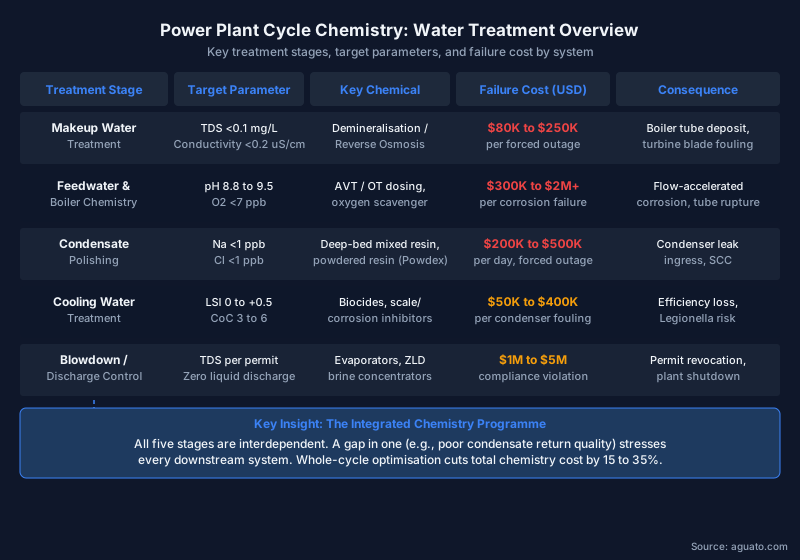
Power plant water treatment covers every point at which water contacts or flows through process equipment, from the intake pipe to the effluent discharge. The six core stages are: (1) raw water pretreatment and storage, (2) makeup water demineralisation, (3) boiler feedwater chemistry and deaeration, (4) condensate polishing, (5) cooling water treatment, and (6) blowdown and wastewater discharge management. Each stage has its own target parameters, its own chemistry programme, and its own failure mode, but none can be optimised in isolation.
The interdependence runs in both directions. Higher cycles of concentration in the cooling tower increase blowdown TDS, which complicates discharge compliance. Tighter makeup water quality reduces boiler chemistry dosing cost but increases demineralisation CAPEX and regenerant consumption. An operation that genuinely minimises total cost of water across the plant will look quite different from one that minimises each treatment stage independently. A pattern that recurs in industrial installations is that the water treatment system was designed by the lowest-bidder subcontractor and the chemistry programme was specified by the chemical supplier with the biggest rebate, not by the operator's actual cost model.
The [EPRI (Electric Power Research Institute) guidelines on power plant chemistry](dofollow:https://www.epri.com/research/products/000000003002021751) provide the industry-standard framework for integrating these stages into a coherent cycle chemistry programme. For new plant designs, the chemistry programme should be developed in parallel with equipment selection, not after it.
## Makeup water treatment: demineralisation and reverse osmosis
The makeup water system replaces water lost to evaporation, blowdown, and steam consumption. Its quality determines the baseline ionic load entering the steam cycle, which then concentrates in every evaporative surface downstream. Getting it wrong at the makeup stage means fighting chemistry problems everywhere else.
For high-pressure drum boilers above 60 bar and all supercritical units, the required makeup water quality is effectively ultrapure: conductivity below 0.1 microsiemens per centimetre, silica below 20 parts per billion, [sodium](/elements/sodium) below 5 parts per billion. Two technology routes deliver this: ion exchange demineralisation and reverse osmosis followed by mixed-bed polishing.
Ion exchange demineralisation (IEX) uses strong-acid cation and strong-base anion resin in series to exchange all dissolved ions for hydrogen and hydroxide, producing high-purity water. Installed CAPEX for a skid-mounted demineralisation system for a 300 MW plant typically runs $800,000 to $2.5 million depending on raw water TDS, flow rate, and resin configuration. OPEX is dominated by regenerant chemicals (sulphuric acid and sodium hydroxide) at $0.20 to $0.60 per cubic metre of treated water, plus resin replacement every 8 to 12 years.
Reverse osmosis plus mixed-bed polishing (RO + MB) uses a membrane pass to remove 95 to 99% of dissolved solids, then a final mixed-bed polisher to reach ultrapure targets. The RO stage costs $600,000 to $1.8 million for the same plant size, with OPEX of $0.15 to $0.40 per cubic metre driven primarily by energy at 0.3 to 0.6 kWh per cubic metre and membrane replacement every 5 to 7 years. The combined system OPEX is often 20 to 35% lower than standalone IEX because the RO pre-removes the bulk ionic load, reducing regenerant consumption sharply.
Decision threshold: If raw water TDS is below 500 mg/L, standalone IEX on a well-designed regeneration cycle competes well with RO on lifecycle cost. Above 1,000 mg/L, RO pre-treatment becomes almost always more economical. Between 500 and 1,000 mg/L, model both routes with your specific raw water analysis before committing CAPEX. [Browse verified industrial water treatment companies](/industrial-water-treatment-companies) that cover both technologies and can provide independent lifecycle cost comparisons.
The failure mode at this stage is silica leakage. Anion resin exhaustion allows silica to break through before conductivity alarms trigger, because silica leakage precedes conductivity breakthrough by minutes to hours. A single silica excursion that allows 100 to 500 ppb silica into a supercritical boiler can deposit enough silicates on turbine stages to require offline water washing, at a cost of $200,000 to $800,000 per event. Automated silica analysers on the demineraliser outlet are not optional on high-pressure plants.
## Boiler feedwater chemistry: AVT, OT, and phosphate programmes
The boiler feedwater and boiler drum chemistry programme is the most technically complex element of power plant water treatment. Its job is to suppress corrosion across the entire steam-water circuit, from the economiser to the steam drum to the condensate return system, without creating its own scaling or deposition problems. Three chemistry regimes dominate modern power plants, and choosing the wrong one for your metallurgy and boiler design is expensive.
All-volatile treatment (AVT) uses ammonia (or amines) to control pH in the 9.0 to 9.5 range for feedwater, and relies on low [oxygen](/elements/oxygen) levels (below 7 ppb) to suppress corrosion. AVT is the default for most drum boilers with copper alloy heat exchangers, because elevated oxygen corrodes copper. The chemistry is relatively simple, the reagent cost is $0.05 to $0.15 per cubic metre, and the programme is well-characterised. The weakness is flow-accelerated corrosion (FAC) in carbon steel components under reducing conditions, particularly in low-alloy steel headers and economisers. FAC failures cause sudden pipe ruptures, carrying fatality risk and CAPEX replacement costs of $500,000 to $3 million per event.
Oxygenated treatment (OT) injects controlled quantities of oxygen (30 to 150 ppb) into high-purity feedwater to form a protective magnetite/haematite layer on carbon steel surfaces. OT requires feedwater conductivity below 0.15 microsiemens per centimetre to work correctly, which means a high-quality demineraliser or RO + polisher upstream. When OT is applied correctly, it essentially eliminates FAC, extends tube life, and reduces iron transport into the boiler. On [condensate polishing systems](/resources/condensate-polishing-systems) that maintain OT-compatible water purity, long-term chemistry costs drop 15 to 25% compared to AVT regimes. The catch is that any quality excursion, such as a condenser tube leak, immediately compromises the protective oxide and can cause rapid corrosion until OT is suspended and AVT reinstated. OT is standard on modern supercritical and ultra-supercritical units.
Phosphate treatment applies to drum boilers as a drum dosing programme, using tri-sodium or di-sodium phosphate to control pH in the drum and provide a buffer against caustic hide-out. Equilibrium phosphate treatment (EPT) or congruent phosphate treatment (CPT) are the two modern approaches; both avoid free caustic in the drum while maintaining pH 9.0 to 9.8. Phosphate treatment costs $0.10 to $0.30 per cubic metre of steam generated and is appropriate for drum boilers operating below 14 MPa (140 bar). Above 14 MPa, silicate and phosphate solubility interactions make steam contamination from carry-over increasingly problematic, and most operators at that pressure range switch to AVT or OT with volatile-only dosing.
The [IAPWS Technical Guidance Documents on cycle chemistry for fossil and combined-cycle plants](dofollow:https://iapws.org/techguide/tech.html) define the switching criteria between these regimes based on boiler design, metallurgy, and achievable water purity. Any chemistry programme that was not benchmarked against those guidelines in the last five years is worth reviewing.
Across projects we have seen operations that have been running AVT-oxidising incorrectly for years, adding oxygen scavenger to a system with all-stainless metallurgy where it was never needed, at a cost of $40,000 to $80,000 per year in unnecessary reagent spend. Chemistry audits typically pay back within six months.
## Condensate polishing: the contamination firewall
Condensate polishing is the system that prevents a chemistry excursion in the condenser from propagating into the boiler and turbine. When a condenser tube leaks, cooling water enters the condensate at concentrations that can run 50 to 500 times normal ionic levels. Without a condensate polisher, that contaminated water goes directly to the boiler drum. With one, the polishing resin absorbs the ionic load and the plant can continue operating while the leak is isolated.
The financial logic is straightforward. A condensate polishing system for a 500 MW combined-cycle plant costs $1.5 million to $4 million installed. A single forced outage driven by condenser tube leakage and subsequent boiler chemistry failure costs $200,000 to $500,000 per day in lost generation, plus $300,000 to $1 million in boiler cleaning and tube repair. A plant that avoids two outages per decade has more than paid for the polisher.
Full-flow condensate polishing, where the entire condensate stream passes through the resin vessels, is the correct design for any plant above 100 bar. Slip-stream polishing, where only 10 to 30% of condensate is treated, is a cost-reduction shortcut that works only when condenser tube failure probability is very low (all-titanium tubes) and a fast-acting online monitoring system can detect and divert contaminated condensate. See the detailed technical discussion in [condensate polishing systems](/resources/condensate-polishing-systems) for technology selection criteria and CAPEX ranges.
Not sure whether your site needs full-flow or slip-stream polishing? [Post your project](/post-project) and qualified vendors will scope the trade-off against your actual boiler pressure, condenser metallurgy, and operational history.
## Cooling water treatment: scale, corrosion, and biological control
The cooling water circuit is where most power plants spend the largest share of their water treatment chemical budget, and where the most visible failures occur. Cooling towers are open systems exposed to atmospheric CO2, dust, and biological contamination. They concentrate dissolved solids through evaporation at cycles of concentration (CoC) of 3 to 8, which means the chemistry at the top of the concentration cycle is radically different from the raw water chemistry at the inlet.
Three failure mechanisms dominate cooling water systems, and each has a distinct chemistry response.
Scale formation occurs when dissolved calcium, magnesium, and silica reach saturation at elevated temperature and concentration. Calcium carbonate scaling on heat exchanger surfaces reduces heat transfer efficiency by 5 to 15% per millimetre of deposit, adding $30,000 to $150,000 per year in fuel cost on a 200 MW plant and eventually forcing offline cleaning at $50,000 to $200,000 per event. Scale inhibitors, dispersants, and pH control (typically targeting pH 7.5 to 8.5) prevent scale from forming. The Langelier Saturation Index (LSI) is the standard tool; keeping LSI in the 0 to +0.5 range balances scale inhibition against corrosion protection for carbon steel systems.
Corrosion in cooling circuits attacks carbon steel heat exchangers, piping, and structural components. Chloride concentration above 300 to 500 mg/L accelerates pitting on stainless steel. Dissolved oxygen and elevated temperature drive general corrosion. Corrosion inhibitors, including molybdate, phosphonate, azole compounds for copper alloys, and nitrite-based programmes for closed circuits, cost $0.10 to $0.60 per cubic metre of circulating water. Under-dosing to save chemical cost is the most common source of premature heat exchanger failure, with replacement costs of $50,000 to $400,000 per shell-and-tube unit.
Biological fouling and Legionella are the compliance risk that cannot be deferred. Legionella pneumophila thrives in cooling tower water at 20 to 45 degrees Celsius, and an aerosol event from an inadequately treated tower can trigger regulatory intervention, legal liability, and in some jurisdictions criminal prosecution under the duty of care provisions of public health regulations. Oxidising biocides (chlorine, bromine, chlorine dioxide) at 0.5 to 2.0 mg/L free halogen are the backbone of biological control. Non-oxidising biocides rotate in every 4 to 8 weeks to prevent resistance. [Legionella risk assessment](/resources/legionella-risk-assessment) and management under the UK HSE L8 standard and equivalent ASHRAE 188 guidance in North America is a regulatory requirement for all evaporative cooling towers, not a recommendation. [Browse water disinfection providers](/water-disinfection-companies) who specialise in cooling tower biological programmes.
The [US EPA guidance on Cooling Tower Legionella Prevention](dofollow:https://www.epa.gov/sites/default/files/2016-09/documents/legionella_guidance_document_0.pdf) provides the control thresholds and monitoring frequency required for compliance.
## Cooling system technology selection
Cooling system choice is one of the highest-stakes capital decisions in power plant water treatment, and it is usually made at the plant design stage with inadequate consideration of long-term water cost and regulatory trajectory. A decision made in 2010 to install an open evaporative cooling tower at a water-stressed site can become a stranded asset by 2030 if water permit restrictions or surcharges make the tower uneconomical to operate.
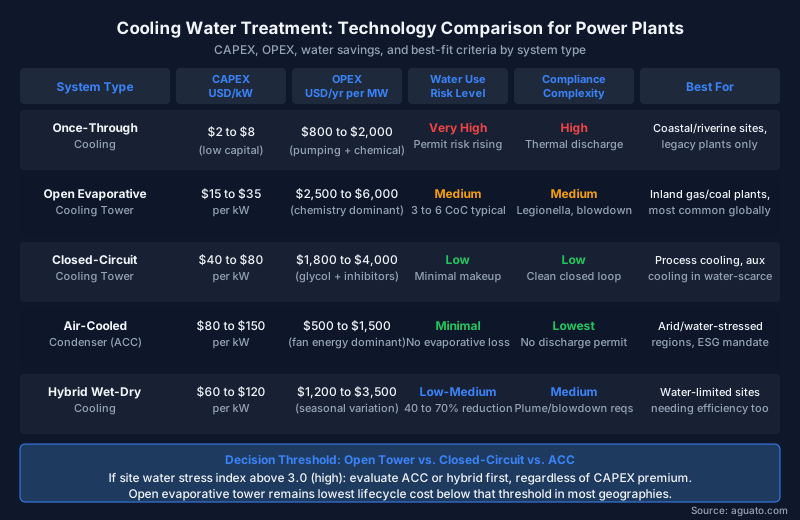
The table in the diagram above captures the full technology comparison. Three decision thresholds that matter commercially:
If site water stress index is above 3.0 (high, per WRI Aqueduct): Evaluate air-cooled condensers (ACC) or hybrid wet-dry systems first, even at the CAPEX premium of $80 to $150 per kW versus $15 to $35 per kW for an open evaporative tower. The OPEX saving on water and compliance will narrow the gap within 10 to 15 years in a seriously water-constrained location, and the regulatory risk of operating a high-consumption system in a stress zone is increasingly hard to insure against.
If ambient temperature regularly exceeds 38 degrees Celsius: ACC efficiency drops sharply in high ambient conditions because the driving temperature differential shrinks. A hybrid wet-dry system, which uses evaporative assistance only on the hottest days, achieves 40 to 70% reduction in water consumption versus a full evaporative tower while maintaining acceptable performance on peak days. CAPEX is $60 to $120 per kW installed.
If the site is inland with reliable water supply and ambient temperatures below 35 degrees Celsius: An open evaporative cooling tower remains the lowest lifecycle cost option in most cases, provided the chemistry programme is properly managed. The primary variable cost is chemical treatment at $2,500 to $6,000 per megawatt per year. Maximising cycles of concentration, from 3 to 5 up to 6 to 8 through careful LSI control, reduces makeup water consumption by 20 to 30% and blowdown volume proportionally, which cuts both water cost and discharge permit burden.
For a 300 MW plant, moving from CoC 4 to CoC 6 saves roughly 15,000 to 25,000 cubic metres of makeup water per year. At $2 to $5 per cubic metre of treated makeup water, that is $30,000 to $125,000 per year in direct cost reduction. The chemistry programme to achieve it typically costs $10,000 to $30,000 per year in additional inhibitor spend. The arithmetic is not close. [Browse cooling tower treatment providers](/cooling-tower-treatment) who specialise in cycle optimisation programmes.
A representative pattern across inland CCGT plants: the original design specified CoC 3 as a conservative operating point. After a cycle optimisation study and rebalanced inhibitor programme, the plant moved to CoC 5.5 within six months, reducing makeup water consumption by 24% and blowdown volume by 40%, with no increase in scale or corrosion incidents. The inhibitor cost increase was $18,000 per year; the water and wastewater treatment cost saving was $140,000 per year.
[cta:nepti-dark]
## Blowdown management and zero liquid discharge
Cooling tower blowdown and boiler blowdown represent the concentrated end of the water cycle. What enters as relatively clean makeup water leaves as a concentrated stream carrying all the dissolved solids, treatment chemicals, and corrosion products that did not stay in the cycle. How this stream is managed defines the plant's discharge permit compliance, wastewater treatment cost, and zero liquid discharge (ZLD) CAPEX exposure.
Cooling tower blowdown typically has TDS of 1,500 to 6,000 mg/L depending on makeup water quality and CoC. At a 500 MW plant with an open tower operating at CoC 5, blowdown flow runs 500 to 1,500 cubic metres per day. Disposing of this to a sewer or surface water body requires a permit, and permits in water-stressed basins are tightening. The current regulatory trend in the US, EU, and parts of Asia is toward limits on blowdown TDS, specific chemical constituents (chromate, molybdate, zinc), and volume.
ZLD systems eliminate liquid discharge by evaporating all blowdown to a dry solid. The brine concentrator reduces blowdown volume by 90 to 95% before a crystalliser or spray dryer handles the final reject. The capital cost of a ZLD system for a 500 MW plant runs $8 million to $25 million depending on feed chemistry and solid disposal requirements. OPEX is high at $1.50 to $4.00 per cubic metre of feed processed, driven by thermal or mechanical vapour compression energy. ZLD is not economically attractive where discharge is feasible, but in zero-discharge permit zones, or where a significant water cost applies to every cubic metre discharged, the economics can close within 10 to 15 years.
The alternative to full ZLD is a high-recovery evaporation and reuse system, where blowdown is partially treated by softening and RO to recover 70 to 90% as usable water before the remaining concentrate is dried. This approach costs $3 million to $10 million for the same plant size with OPEX of $0.80 to $2.00 per cubic metre of feed, and is generally more practical than full ZLD unless the permit requires zero discharge.
Detailed treatment of blowdown chemistry and recovery options is covered in [cooling tower blowdown](/resources/cooling-tower-blowdown) and [zero liquid discharge systems](/resources/zero-liquid-discharge).
## CAPEX and OPEX benchmarks across the treatment cycle
Procurement teams need normalised cost figures to model the total water treatment budget across the plant lifecycle. The ranges below are based on inland power plant conditions with moderate raw water quality (TDS 200 to 600 mg/L) for a reference 300 to 500 MW CCGT unit.
| Treatment Stage | CAPEX (USD) | OPEX (USD/yr) | Primary OPEX Driver | Risk Level | |---|---|---|---|---| | RO + Mixed-bed makeup | $1.2M to $3.5M | $120,000 to $350,000 | Energy + membrane replacement | Medium | | IEX demineralisation | $800K to $2.5M | $180,000 to $500,000 | Regenerant chemicals | Medium | | Boiler feedwater dosing | $150K to $400K | $60,000 to $180,000 | Ammonia / amine reagent | Low | | Condensate polishing | $1.5M to $4M | $200,000 to $600,000 | Resin + regeneration | High (if absent) | | Cooling water treatment | $400K to $1.2M | $750,000 to $3,000,000 | Biocide + scale inhibitor | High | | Blowdown / partial ZLD | $500K to $3M | $80,000 to $400,000 | Energy + disposal | Medium | | Full ZLD (if required) | $8M to $25M | $600,000 to $2,500,000 | Thermal energy | Very High |
The dominant insight from this table: cooling water treatment is the highest recurring OPEX and the hardest to cut without compromising reliability or compliance. It is also the stage where the most improvement is available from better cycle management and chemistry optimisation. A well-run cooling water programme for a 300 MW plant costs $750,000 to $1.2 million per year; a poorly run one costs $1.5 million to $3 million while delivering worse corrosion and scaling outcomes.
Two patterns drive the gap between high and low performers. First, plants that automate cycles-of-concentration control (continuous blowdown modulated against online conductivity) consistently operate at CoC 5 to 7 rather than CoC 3 to 4, saving $80,000 to $200,000 per year in makeup water and chemical cost. Second, plants that run a proper [water quality monitoring programme](/resources/industrial-water-quality-testing) with online instruments rather than weekly manual sampling detect chemistry excursions hours to days earlier, reducing the average cost of a chemistry-related incident by 40 to 60%.
The comparison table also understates one cost that procurement teams consistently overlook: the indirect cost of operational disruption. When a heat exchanger fouls and requires emergency cleaning, the planning, mobilisation, and equipment isolation costs frequently exceed the direct cleaning cost. Fouling rates that look tolerable on a per-unit-area basis compound over a season into a real throughput penalty. Across gas-fired generation portfolios we have reviewed, the untracked performance degradation from inadequately managed cooling water chemistry runs $100,000 to $600,000 per year per plant in fuel burn above design efficiency, even when no cleaning events are formally logged.
A useful sanity check is to compare your plant's actual cooling water chemistry OPEX per megawatt against the benchmarks above. If you are spending less than $2,500 per megawatt per year on cooling water chemistry while operating an open evaporative tower in a hard-water area, it is highly likely that you are underspending on inhibitor and biocide while paying more than you realise in condenser performance loss and unscheduled maintenance. The benchmark range of $2,500 to $6,000 per megawatt per year is the realistic cost of adequate protection; the lower end applies to soft-water sites with conservative operating cycles, the upper end to hard-water inland sites at high CoC with titanium-free heat exchangers.
[Browse industrial water treatment companies](/industrial-water-treatment-companies) with experience across all stages of the power plant water cycle. Not sure which treatment gaps need attention first? [Post your project brief](/post-project) and receive proposals from specialists who can scope each stage against your actual plant conditions and water analysis.
Water treatment programme gaps compound over time. A chemistry excursion that would cost $50,000 to remediate in year one becomes a $500,000 forced outage by year five if the root cause is not addressed. The benchmarks above are the starting point for modelling the gap between current spend and optimised spend.
## Failure scenarios and what they cost
The most expensive water chemistry failures in power plants are not chemistry failures in the narrow sense. They are equipment failures caused by the chemistry being wrong, and they show up as maintenance events, forced outages, and in extreme cases as structural failures. Understanding the mechanism-to-cost chain is the only way to justify the water treatment budget to stakeholders who see chemistry spend as a cost centre.
Scenario 1: Condenser tube failure without condensate polishing. A carbon steel condenser with 15-year-old tubes develops a pinhole leak in one tube. Cooling water at pH 8.0 with 300 mg/L chloride enters the condensate at a rate of 0.5 litres per minute. Without a condensate polisher, the contaminated condensate enters the boiler within minutes. Over 4 to 8 hours of undetected ingress, chloride concentration in the boiler drum rises to 5 to 20 mg/L. The plant is forced to reduce load and eventually shut down for a boiler acid clean. Direct cost: $150,000 to $400,000 for cleaning plus 2 to 4 days of lost generation at $25,000 to $60,000 per day. Correct decision: full-flow condensate polishing at $1.5 million to $4 million installed.
Scenario 2: Flow-accelerated corrosion (FAC) in feedwater piping. An AVT chemistry programme with hydrazine oxygen scavenging is running on a drum boiler with all-carbon steel construction. A feedwater heater drain line experiences wall thinning at a flow-disturbing elbow. After 8 years of operation, the line ruptures, scalding two contract workers and requiring immediate shutdown. Direct cost: $800,000 to $2.5 million in piping replacement, $300,000 to $800,000 in lost generation, and potential liability costs. Root cause: AVT-reducing conditions in all-steel construction require OT or at minimum an engineered FAC monitoring programme with periodic wall thickness measurements.
Scenario 3: Legionella event at a water-cooled condenser plant. A cooling tower with inconsistent biocide dosing and inadequate drift eliminators generates aerosol plume during a summer heatwave. Local public health authority traces an outbreak to the plant, leading to a 10-day shutdown for decontamination, regulatory investigation, and notification costs. Direct cost: $500,000 to $2 million in compliance costs plus $2 million to $5 million in legal exposure. Correct decision: rigorous [legionella risk assessment](/resources/legionella-risk-assessment) programme under ASHRAE 188 / HSE L8, with automated dosing controls and continuous monitoring.
Scenario 4: Silica breakthrough from exhausted anion resin. A demineralisation plant running at the edge of its design throughput exhausts its anion resin three days before a scheduled regeneration. Silica leakage reaches 400 ppb in the makeup water. Over the next 14 days, silica deposits accumulate on the last stages of the steam turbine. Performance loss is 0.8% of rated output before the next scheduled outage surfaces the issue. Turbine water washing costs $180,000; performance recovery takes 3 additional operating weeks. Correct decision: automated silica analysers on the demineraliser outlet with regeneration triggered by silica breakthrough, not elapsed time.
## How to evaluate vendors and proposals
Power plant water treatment is a category where the scope of what a vendor proposes is heavily influenced by what they sell. A chemical company proposes chemistry. An equipment manufacturer proposes equipment. An engineering consultant with no product line to protect is the closest thing to an objective adviser, but even consultants develop preferences for systems they have designed before.
The questions that reveal whether a proposal is genuinely optimised or product-led:
First, has the vendor modelled the full cycle chemistry interaction, or have they scoped only their own system in isolation? A cooling water chemistry proposal that does not discuss the impact of chosen cycles of concentration on blowdown volume and discharge permit compliance is incomplete.
Second, what is the specific energy assumption for the demineralisation system, and how does it compare against the plant's energy cost? Every kilowatt-hour embedded in water treatment has the same cost as electricity sold to the grid. On a 500 MW plant, a 20% improvement in demineraliser energy efficiency is worth $40,000 to $100,000 per year.
Third, what is the resin replacement schedule and cost, and is it included in the 10-year NPV? Resin for a condensate polisher costs $80,000 to $250,000 per replacement set. The vendor's quoted OPEX often excludes it.
Fourth, are the chemistry targets specified as actual analytical limits or as dose rates? Dose-rate specifications lock you into the vendor's chemistry programme. Analytical limits allow you to optimise supplier and dose independently.
[Browse engineering and consulting services](/consulting-services) who provide vendor-independent water treatment audits and procurement support for power plants. The cost of an independent audit is $30,000 to $100,000; the cost of a mis-specified major water treatment system is $500,000 to $5 million in change orders and underperformance.
## FAQ
### What is power plant water treatment and why does it matter?
Power plant water treatment is the full set of chemical and physical processes used to maintain water quality across the steam generation, condensate return, and cooling water circuits of a power station. It matters commercially because chemistry failures are the leading cause of forced outages in steam-cycle generation, accounting for over 40% of unplanned shutdowns. A single forced outage on a 300 MW unit costs $600,000 to $3 million in direct and indirect costs, which means the water chemistry programme is one of the highest-return maintenance investments a plant can make.
### What chemicals are used in power plant boiler water treatment?
The core chemicals in a modern boiler water chemistry programme are pH-adjusting amines (ammonia, neutralising amines such as morpholine or cyclohexylamine), oxygen scavengers (hydrazine in older plants, carbohydrazide or diethylhydroxylamine in newer ones), scale inhibitors (phosphates for drum boilers at medium pressures), and corrosion passivators. For oxygenated treatment regimes used on supercritical units, controlled oxygen injection replaces the reducing agent approach entirely. Chemical cost typically runs $0.05 to $0.20 per cubic metre of feedwater, or $60,000 to $250,000 per year for a 300 MW CCGT plant.
### How often should power plant cooling tower water be tested?
Online instruments for pH, conductivity, oxidant residual, and corrosion potential should be monitored continuously with alarms. Laboratory analysis of a full chemical and microbiological panel should be performed weekly at minimum for operational cooling towers, and within 24 hours of any system change, high-temperature event, or biocide programme disruption. Under ASHRAE 188 and HSE L8 guidance, the water management programme must define specific monitoring frequency and response thresholds, not general good practice. Many compliance failures result from programmes that look adequate on paper but have monitoring gaps of two to four weeks between lab tests.
### What is the difference between makeup water treatment and feedwater treatment in a power plant?
Makeup water treatment refers to the demineralisation or purification of the raw water used to compensate for steam, blowdown, and evaporation losses before it enters the steam cycle. Feedwater treatment refers to the chemical dosing and conditioning of the combined stream of makeup water and returned condensate that actually feeds the boiler or steam generator. Makeup treatment is a physical separation process using ion exchange or reverse osmosis. Feedwater treatment is primarily a chemical dosing programme using amines, oxygen control agents, and occasionally phosphates. Both are required, and a gap in makeup quality directly undermines the effectiveness of the feedwater chemistry programme.
### How do you choose between reverse osmosis and ion exchange for power plant makeup water?
The primary decision variable is raw water TDS. Below 500 mg/L, well-designed ion exchange demineralisation is competitive on lifecycle cost and may be simpler to operate at smaller scale. Above 1,000 mg/L, reverse osmosis pre-treatment followed by mixed-bed polishing typically delivers 20 to 35% lower OPEX because it reduces the ionic load the resin must handle, cutting regenerant chemical consumption significantly. Between 500 and 1,000 mg/L, model both options with your actual water analysis, accounting for energy cost, regenerant disposal cost, and capital financing terms before deciding. Plants with variable raw water TDS due to seasonal flooding or drought should also model worst-case feed conditions, not just averages.
### What causes flow-accelerated corrosion in power plant piping, and how is it prevented?
Flow-accelerated corrosion (FAC) is a dissolution mechanism in which the magnetite protective film on carbon steel piping dissolves faster than it can reform at locations of high fluid velocity or turbulence, typically elbows, tees, and orifice plates in single-phase and two-phase flow. The mechanism is accelerated by low pH, reducing conditions (low dissolved oxygen), elevated temperature (peak risk at 130 to 150 degrees Celsius), and high flow velocity. Prevention requires either raising feedwater pH above 9.2, switching to oxygenated treatment to create a more stable haematite protective layer, upgrading high-risk components to Cr-Mo alloy steel (1.25% chromium substantially eliminates the mechanism), or implementing a structured FAC monitoring programme with periodic wall thickness measurement and predictive retirement of at-risk components.
### What is zero liquid discharge and when does a power plant need it?
Zero liquid discharge (ZLD) is a water management approach where all wastewater and blowdown is treated to recover usable water, leaving only a dry solid for disposal, eliminating any liquid discharge from the plant. Power plants need ZLD when they operate in a permit zone that prohibits liquid discharge to surface water or sewer, or when the combined cost of discharge fees, permit compliance, and freshwater purchase makes ZLD economical over its asset life. The capital cost is high at $8 million to $25 million for a 300 to 500 MW plant, and OPEX runs $1.50 to $4.00 per cubic metre of wastewater processed. ZLD is rarely economical at sites with straightforward discharge options but becomes the only viable solution in regions with zero-discharge regulations or severe freshwater scarcity.