A condenser tube leak in a 500 MW plant costs $200,000 to $500,000 per day offline. Condensate polishing systems stop that. Full CAPEX, OPEX, and technology comparison inside.
Condensate polishing is the final quality gate before returned steam condensate re-enters a high-pressure boiler or steam generator. A single condenser tube leak in a 500 MW combined-cycle plant can introduce enough chloride and [sodium](/elements/sodium) into the condensate stream to force a controlled shutdown within hours, at a cost of $200,000 to $500,000 per day in lost generation. The polishing unit is what stands between that ingress event and the turbine blades.
Most plants that skip condensate polishing do so on CAPEX grounds. The argument sounds reasonable at the time: the condensate is already hot and nearly pure, the incremental purity gain looks marginal in the spec sheet, and the vessels and resin add $500,000 to $1.5 million to an already tight project budget. The problem surfaces later, and expensively. A single forced outage for turbine blade deposit cleaning runs $1 million to $3 million in direct repair costs, plus the generation revenue lost while the unit is offline. Vendors selling bare-bones feedwater systems will not mention that number in their proposal.
This guide covers what condensate polishing systems actually do, the four main technology configurations and when each is appropriate, the CAPEX and OPEX ranges a procurement team needs to model, the failure modes that cause the most expensive damage, and a pressure-based decision framework for determining whether your site needs full-flow or slip-stream polishing. The guide is written for the operations and engineering teams that own the boiler chemistry programme and the capital projects leads who have to defend the polisher line item in a bid.
## The decision in brief
- Polish the condensate above 1,000 psig. A properly specified deep-bed condensate polishing system on a combined-cycle plant operating above 1,000 psig will prevent an average of one forced chemistry-related shutdown event per decade, avoiding $600,000 to $1.5 million per event in direct repair and generation loss costs. - NPV turns positive by year 3 to 5. Across a 20-year operating life, the polisher investment of $1.5 million to $3 million CAPEX delivers a net present value that is positive by year 3 to 5, before accounting for fuel efficiency gains from clean heat transfer surfaces of $80,000 to $200,000 per year. - Count the deferred tube programme. The NPV case also leaves out the extended boiler tube life, which defers a $2 million to $5 million major tube replacement programme by 5 to 10 years.
The biggest cost of doing nothing is not the next chemistry excursion. It is the boiler tube failure that happens after years of undetected sub-specification condensate eroding the oxide film that keeps the steel intact.
## What condensate polishing does and why it matters
Condensate polishing removes dissolved ionic contaminants, corrosion products, and particulate matter from steam condensate before it is recycled as boiler feedwater. In a high-pressure steam cycle, the condensate that returns from turbines and heat exchangers carries trace quantities of sodium, chloride, silica, dissolved iron, [copper](/elements/copper) oxides, and occasionally organic contamination from process side leaks. Those traces are small in absolute terms but corrosive and scaling in the context of a drum operating at 100 to 300 bar.
The business case for polishing rests on three mechanisms. First, ionic contaminants, particularly sodium and chloride from condenser tube leaks, concentrate in the boiler drum during evaporation. At concentration factors of 10 to 30x, they create conditions for caustic stress corrosion cracking and pitting of boiler tubes. Second, iron and copper corrosion products deposit on heat transfer surfaces, reducing thermal efficiency. A 0.1 mm deposit of magnetite on a boiler tube surface can reduce heat transfer by 5 to 8%, adding $80,000 to $200,000 per year in fuel cost on a 200 MW plant. Third, silica that escapes into the steam stream deposits on turbine blades as silicates, requiring offline cleaning at typical costs of $500,000 to $1.5 million per event.
[Browse verified boiler water treatment providers](/boiler-water-treatment-companies) to compare condensate polishing specialists by technology, plant size, and geography before issuing an RFP.
## How a condensate polishing unit works
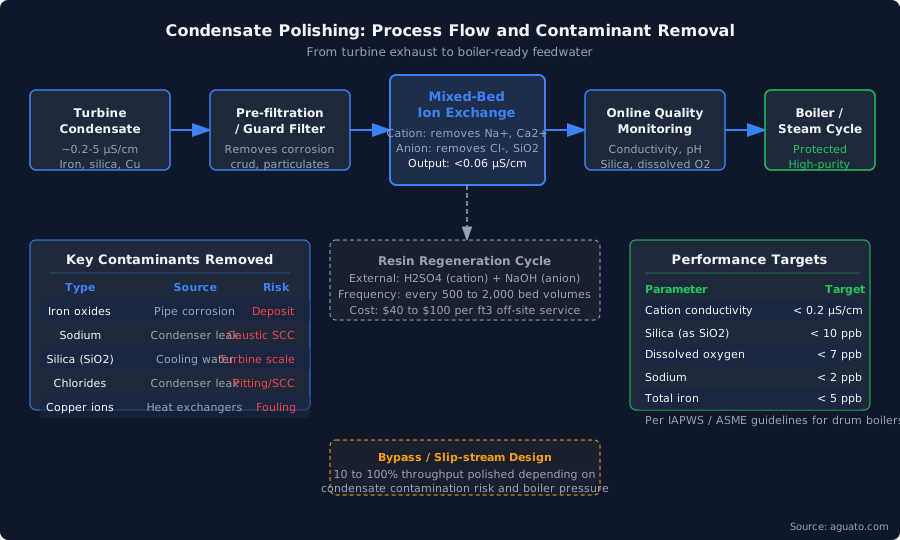
A condensate polishing unit, often abbreviated as CPU, is an ion exchange system positioned in the condensate return line between the condenser hotwell and the deaerator or feedwater heaters. The process logic is straightforward: pass hot condensate through a bed of mixed cation and anion exchange resin, which strips dissolved ions from the water by exchanging them for hydrogen ions (cation resin) and hydroxide ions (anion resin), producing an effluent that is close to chemically pure.
The core ion exchange mechanism draws on the same chemistry used in [industrial ion exchange water treatment](/resources/ion-exchange-water-treatment) systems for other applications, but with design adaptations for the high-temperature, high-flow-rate condensate environment. Condensate typically arrives at 40 to 60 degrees Celsius, which accelerates resin kinetics but also increases the risk of organic fouling and resin degradation if feed quality departs significantly from design. The resin beds are sized for a contact time of 2 to 4 minutes, long enough to achieve ionic leakage below 0.1 parts per billion for sodium and silica.
The output targets the system is designed to meet are governed by the [IAPWS (International Association for the Properties of Water and Steam) guidelines on steam purity and boiler feedwater chemistry](dofollow:https://www.iapws.org/techguide/tech.html) and the ASME boiler chemistry codes. For a drum boiler at pressures above 100 bar, the polished condensate should deliver cation conductivity below 0.2 microsiemens per centimetre, silica below 10 parts per billion, sodium below 2 parts per billion, and dissolved oxygen below 7 parts per billion. Once-through supercritical boilers operate to even tighter limits, typically cation conductivity below 0.06 microsiemens per centimetre.
Pre-filtration is the step that is most often skipped in budget-conscious designs. A guard filter or magnetic separator upstream of the resin vessels removes particulate iron oxides and copper oxides before they load the resin bed. Skipping pre-filtration means corrosion crud reaches the resin and blinds it within weeks rather than months, increasing regeneration frequency and resin replacement cost by 30 to 60%.
## When condensate polishing is required
The decision to install condensate polishing is not binary. It sits on a spectrum from optional (low-pressure package boilers with minimal contamination risk) to mandatory (supercritical once-through units where any ionic ingress causes tube failures). The thresholds that matter commercially are boiler pressure, condenser construction, and the consequence cost of a quality excursion.
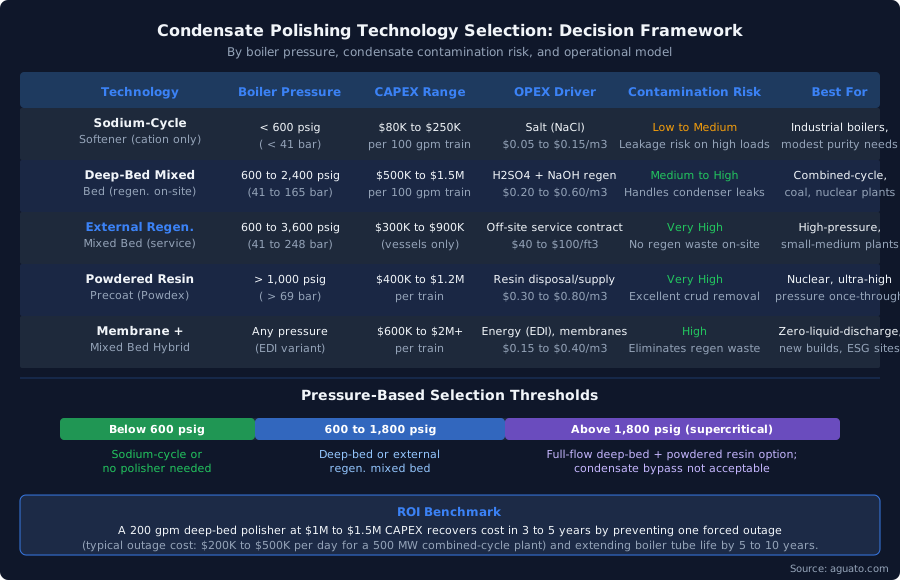
Below 600 psig (41 bar): Most industrial package boilers and process steam generators in this pressure range operate without condensate polishing. The risk profile is manageable with effective boiler water chemical dosing and blowdown control. A sodium-cycle softener on the makeup water line and a good monitoring programme is usually sufficient. The exception is any plant with titanium or copper heat exchangers in the process condensate return, where contamination routes are hard to fully characterise.
600 to 1,800 psig (41 to 124 bar): This pressure range covers most combined-cycle gas turbine (CCGT) heat recovery steam generators (HRSGs). A condenser tube leak in this range can cause a measurable chemistry excursion within 60 to 90 minutes. Condensate polishing is strongly recommended and is standard practice in new CCGT builds. Plants that skip it typically see their first significant boiler chemistry incident within 5 to 10 years.
Above 1,800 psig (124 bar), including supercritical and ultra-supercritical units: Full-flow condensate polishing is not optional. The metal temperature regimes in these boilers mean a single chemistry event can cause tube failure rather than just accelerated corrosion. Most major power generation OEMs include CPU systems as standard in their HRSG and turbine supply contracts for units in this pressure class.
Process condensate return in petrochemical and refining applications: Condensate returned from process heat exchangers carries a different contamination fingerprint, including potential hydrocarbon ingress, ammonia from nitrogen compounds, and ionic contamination from process side leaks. Even at modest boiler pressures, a CPU with activated carbon pre-treatment is often justified where the process condensate return fraction exceeds 30% of total boiler feed.
For [industrial boiler water treatment](/resources/industrial-boiler-water-treatment) programmes that already include blowdown control, scale inhibitors, and oxygen scavenging, condensate polishing is the next logical upgrade when chemistry excursions are recurring or boiler pressure is increasing following a plant upgrade.
[cta:nepti]
## The four main technology configurations
The choice of configuration has a larger impact on lifecycle cost than the choice of resin supplier. Getting the technology selection wrong at the design stage is difficult to correct without replacing vessels and infrastructure.
### Sodium-cycle softener polishing
A sodium-cycle polisher uses a strong acid cation exchange resin in the sodium form. It removes hardness ions (calcium and magnesium) and some heavy metals, but it does not remove sodium itself, and it cannot remove anions like chloride or silica. This makes it appropriate only for boilers below 600 psig where the primary risk is scale deposition rather than corrosion from chloride or caustic attack.
The CAPEX for a sodium-cycle polisher is $80,000 to $250,000 per 100 gallons-per-minute (gpm) train. The regenerant is sodium chloride brine, costing $0.05 to $0.15 per cubic metre of condensate treated. The operational limitation is that it cannot handle condenser tube leak events, and it introduces additional sodium to the treated water, which can contribute to caustic stress corrosion cracking at higher concentrations. Use it for low-pressure industrial steam plants where chloride and silica contamination risk is demonstrably low.
### Deep-bed mixed-bed ion exchange with on-site regeneration
The deep-bed mixed-bed system is the workhorse configuration for CCGT and conventional coal plants at 600 to 2,400 psig. A strong acid cation resin and a strong base anion resin are mixed in a single vessel (or used in series as separate beds). The mixed configuration delivers the purest effluent, typically below 0.06 microsiemens per centimetre cation conductivity, because ionic leakage from the cation bed is immediately captured by the adjacent anion resin.
On-site regeneration uses sulphuric acid for the cation resin and sodium hydroxide for the anion resin. The resins are separated within the vessel using air classification, regenerated separately, and then remixed before the vessel is returned to service. CAPEX for a 100 gpm train, including vessels and regeneration system, runs $500,000 to $1.5 million. OPEX for chemicals and labour averages $0.20 to $0.60 per cubic metre of treated water.
### External regeneration (off-site service model)
In this configuration, polisher vessels are designed for quick-disconnect service. When the resin is exhausted, the vessel is exchanged for a freshly regenerated unit, and the spent resin returns to the service provider's central regeneration facility. No acid or caustic is stored on-site, simplifying chemical handling permitting and eliminating the wastewater treatment requirement for regenerant effluent.
CAPEX is lower at $300,000 to $900,000 per 100 gpm train because there is no on-site regeneration building or chemical infrastructure. The trade-off is that OPEX is higher and less predictable, running $40 to $100 per cubic foot of resin on the service contract, and exchange logistics require planning. The external model suits plants with limited site area, restricted chemical permit headroom, or those that want to outsource the technical management of the resin programme. It is a legitimate choice, not a compromise, for plants where on-site acid and caustic storage creates safety or regulatory complexity.
### Powdered resin (precoat) systems
Powdered resin systems use a very fine-particle-size mixed resin coated onto a filter element. The high surface-area-to-volume ratio gives exceptional kinetics, removing both particulate corrosion products and dissolved ions simultaneously in a single step. The resin is non-regenerable: it is used once and then disposed of.
This configuration is standard in nuclear power applications and in once-through supercritical boilers where allowable ionic leakage is extremely tight. CAPEX runs $400,000 to $1.2 million per train; OPEX is higher at $0.30 to $0.80 per cubic metre of treated condensate. The significant advantage over deep-bed systems is that there is no risk of ionic breakthrough during the regeneration and resin-remixing sequence, which is the single biggest source of off-spec effluent from deep-bed polishers.
The right answer depends on your pressure class, on-site chemical handling constraints, and contamination risk profile. Not sure which configuration fits your site? [Browse verified industrial water treatment companies](/industrial-water-treatment-companies) with HRSG chemistry expertise, filter by technology specialism, and request scoped proposals from 3 to 5 specialists.
## CAPEX and OPEX: what it costs
Condensate polishing is one of the few treatment technologies where the lifecycle cost calculation strongly favours higher upfront investment. The CAPEX spread across the useful life of the asset (typically 20 to 30 years for the vessels, 5 to 10 years for the resin before replacement) is small compared with the avoided cost of a single major chemistry excursion.
CAPEX benchmarks (2025 USD, per 100 gpm train):
- Sodium-cycle softener: $80,000 to $250,000 - Deep-bed mixed bed with on-site regeneration: $500,000 to $1.5 million - External regeneration vessels: $300,000 to $900,000 (vessel cost only; service contract separate) - Powdered resin system: $400,000 to $1.2 million - Membrane-assisted hybrid (electrodeionisation variant): $600,000 to $2 million
A full 200 gpm condensate polishing installation for a 250 to 500 MW plant, including two trains, monitoring instruments, pre-filtration, and the regeneration system, typically runs $1.5 million to $4 million installed.
OPEX breakdown (per cubic metre of treated condensate):
| Cost Item | Sodium-Cycle | Mixed Bed On-Site Regen | External Regen Service | |---|---|---|---| | Regenerant chemicals | $0.05 to $0.15 | $0.10 to $0.30 | included in service | | Off-site service cost | none | none | $0.20 to $0.50 | | Resin replacement (amortised) | $0.02 to $0.05 | $0.04 to $0.10 | $0.04 to $0.10 | | Labour (ops + QA) | $0.02 to $0.06 | $0.05 to $0.15 | $0.02 to $0.06 | | Energy (pumping) | $0.01 to $0.03 | $0.02 to $0.05 | $0.01 to $0.03 | | Total OPEX | $0.10 to $0.29 | $0.21 to $0.60 | $0.27 to $0.69 |
For a 200 MW CCGT plant treating 400 m3/hour of condensate, total OPEX at the mid-range estimate of $0.40 per cubic metre runs approximately $1.4 million per year. That figure sounds significant until it is compared with the alternative: one major turbine deposit cleaning event every 5 to 7 years at $800,000 to $2 million, one unplanned boiler tube repair at $200,000 to $800,000, and incremental fuel costs from deposit-degraded heat transfer of $80,000 to $200,000 per year.
The payback math that procurement teams actually need: A $1.5 million deep-bed polisher installation that prevents one forced outage per decade (at $500,000 per day, 3 days average downtime) delivers a net present value positive outcome in year 2 of operation, before accounting for the fuel efficiency and boiler tube life benefits.
[Operations and maintenance providers](/operations-and-maintenance) who manage condensate polishing programmes can supply 10-year lifecycle cost models based on actual plant operating data, which is a more defensible basis for CAPEX approval than vendor-supplied assumptions.
## Failure modes and what they cost
The most expensive outcome in condensate polishing is not a system failure. It is a system that appears to be working but is delivering subtly off-spec effluent into the boiler undetected.
Resin exhaustion without detection: The most common operational failure is running a mixed-bed vessel beyond its ionic capacity without realising it. The resin front breaks through and the effluent conductivity spikes, but if the online analyser is poorly calibrated or the alarm threshold is set too wide, the event runs undetected for hours or days. The ionic load that reaches the boiler in that window can cause a month's worth of accelerated corrosion. Installing a conductivity analyser with an alarm set at 0.1 microsiemens per centimetre and a redundant silica analyser on the CPU outlet is the minimum monitoring configuration. The instruments cost $30,000 to $80,000 installed, and they recover that cost the first time they catch an excursion before it damages a boiler tube.
Poor regeneration leading to resin contamination: On-site regeneration of mixed beds is technically demanding. If the air classification step is incomplete before chemical injection, acid contacts the anion resin and caustic contacts the cation resin. This causes resin degradation, releasing organic breakdown products that foul downstream heat transfer surfaces and contaminate the boiler water. A contaminated resin bed that passes conductivity checks (because the degradation products are organic rather than ionic) is one of the hardest diagnostic problems in boiler chemistry. The typical outcome is elevated total organic carbon in the boiler and unexplained colour in blowdown. Replacement of a full mixed-bed resin charge costs $80,000 to $300,000 per vessel depending on vessel size.
Condenser tube leak overwhelm: A large condenser tube leak, introducing cooling water at more than 1% of condensate flow, will exhaust a standard mixed-bed polisher within 2 to 8 hours. If the leak is not detected and the CPU is not taken offline and regenerated, ionic contamination bypasses the exhausted resin and enters the boiler. A well-designed CPU installation includes a conductivity analyser on the condensate inlet, a flow-weighted leak detection alarm, and an automatic bypass valve that routes contaminated condensate to drain rather than to the boiler, triggering a controlled load reduction until the leak is isolated. This protection costs roughly $50,000 to $120,000 in instrumentation. A single avoided boiler chemistry event justifies it many times over.
Thermal shock to resin: Condensate temperature excursions above 70 degrees Celsius cause thermal degradation of the anion resin, generating trimethylamine and other organic amines. These are difficult to remove by blowdown and contribute to corrosion of copper alloys in the feedwater system. The temperature excursion is usually caused by a deaerator bypass or a feedwater heater isolation that routes high-temperature extraction steam condensate back to the hotwell. This is a design protection issue, not an operational one, and the fix is a temperature high-trip on the CPU inlet that diverts flow to drain. It is a detail that should be in every CPU design specification but frequently is not.
A pattern that recurs across high-pressure steam installations: the plants with the most difficulty justifying polisher maintenance budgets are the same ones that later present the largest repair bills. The connection is causal. Deferred resin replacement and deferred instrument calibration are the proximate cause of most condensate polishing failures, not equipment design problems.
The [IAPWS technical guidance documents on steam purity and instrumentation](dofollow:https://iapws.org/public/documents/jl_oN/Instrumentation-2024.pdf) provide the contamination limits and monitoring requirements that define the acceptable operating envelope for drum and once-through boilers, and are the authoritative reference for setting CPU alarm thresholds and determining when to initiate controlled load reduction.
## Full-flow versus slip-stream: the design decision
Not every condensate polishing installation treats 100% of the condensate flow. In some plant configurations, a slip-stream design, treating 20 to 50% of the condensate through the CPU and blending with the untreated bypass flow, is an acceptable engineering compromise. The case for slip-stream is primarily hydraulic: the untreated condensate is already of high purity, the polisher's job is to handle contamination excursions rather than continuous polishing duty, and the pressure drop through a full-flow system would require pump upgrades.
The decision on the split fraction should come from the mass balance, not from a round number chosen to reduce vessel count. If the target blended conductivity is 0.1 microsiemens per centimetre, the unpolished stream runs at 0.3 microsiemens per centimetre, and the polished stream exits at 0.05 microsiemens per centimetre, the required polishing fraction calculates to approximately 80%. That is closer to full-flow than most slip-stream proposals acknowledge, and the difference between the two configurations in this scenario is not primarily about cost; it is about the contingency margin when the unpolished stream quality deteriorates.
When full-flow polishing is required: - Boiler pressure above 1,800 psig (once-through and supercritical boilers) - Any plant where a condenser tube leak can introduce chloride or sodium faster than a slip-stream can dilute it to within chemistry limits - Nuclear steam supply systems, where condensate polishing is a regulatory requirement - Plants with titanium or carbon steel condenser tubes (higher leak risk than stainless)
When slip-stream is defensible: - CCGT HRSGs at 600 to 1,200 psig with stainless steel or duplex condenser tubes - Plants where the unpolished condensate conductivity is consistently below 0.5 microsiemens per centimetre and the polisher duty is primarily guard protection - Retrofit situations where hydraulic capacity constraints make full-flow installation impractical without major civil work, and the risk assessment justifies the reduced coverage
The slip-stream configuration should always include automatic flow control so that the polished fraction can be increased to 100% if a chemistry excursion is detected. A fixed-fraction bypass with no ability to increase polishing duty in an emergency is not a genuinely protective design: it is a paper compliance measure.
## Resin selection and regeneration strategy
The resin is the performance-determining component of a condensate polishing system, and it is the component most frequently under-specified at the procurement stage. Vendors selling on CAPEX will propose a standard food-grade mixed resin. The correct specification for a high-pressure application is a premium-grade nuclear or power-grade resin, typically 30 to 50% more expensive per cubic foot, with significantly better thermal stability and capacity retention over 5 to 10 years.
Cation resin selection: A gel-type or macroporous strong acid cation resin with high crosslinking (8 to 10% DVB) for thermal stability at temperatures up to 60 degrees Celsius. Higher crosslinking means slower diffusion kinetics but much better resistance to thermal and osmotic shock. For condensate polishing, the kinetic limitation is acceptable because the condensate is already very pure; the resin does not need to work hard ionically but does need to survive thousands of thermal cycles.
Anion resin selection: A Type I strong base anion resin is the correct specification for condensate polishing. Type I is more thermally stable than Type II, with a maximum continuous operating temperature of approximately 60 degrees Celsius compared with 40 degrees Celsius for Type II, and has better silica removal kinetics at elevated temperatures. Type II anion resin should not be specified for any condensate polishing application where the feedwater operating temperature exceeds 40 degrees Celsius. A surprising number of installed systems were originally equipped with Type II resin and required early replacement for exactly this reason.
Regeneration frequency is the operational parameter most often wrongly estimated in feasibility studies. The correct basis is bed volumes treated per regeneration cycle, not calendar time. A plant with excellent condenser integrity may run 1,000 to 2,000 bed volumes between regenerations; a plant with aging condenser tubes or frequent start-stop cycling may need regeneration every 200 to 500 bed volumes. Using a time-based regeneration schedule rather than a quality-trigger basis either wastes regenerant cost (if scheduled too frequently) or, more dangerously, misses the exhaustion point (if scheduled too infrequently).
For context, [ultrapure water production](/resources/ultrapure-water-production) for semiconductor and pharmaceutical applications uses the same mixed-bed polishing technology as the final stage, and the resin selection and regeneration logic is directly transferable. The difference is that ultrapure water systems typically operate at ambient temperature, extending resin life and reducing the thermal stress component that is the dominant degradation mechanism in condensate polishing duty.
## Real-world sector examples
Combined-cycle gas turbine plant retrofit, Southeast Asia: A 400 MW CCGT plant operating at 1,200 psig ran without condensate polishing for the first three years of operation, relying on high-quality makeup demineralised water and conservative blowdown rates. In year four, a condenser tube leak over a weekend introduced enough chloride to spike the boiler drum chloride concentration from 0.05 to 4.2 mg/L. The chemistry excursion was not caught in time and caused pitting in the economiser tubes. The repair, including scaffold access, tube inspection, and partial replacement, cost $1.4 million and took the plant offline for 12 days, totalling approximately $6 million in combined repair and lost generation costs. A deep-bed mixed-bed CPU installation, retrospectively costed at $1.2 million, would have detected the chloride ingress within 15 minutes of the tube leak starting and triggered an automatic chemistry alarm. The retrofit was installed after the incident. The project engineer's assessment when asked why it was not in the original scope: "the equipment vendor said it was optional for this pressure class."
Nuclear steam supply system, Western Europe: A pressurised water reactor operates full-flow condensate polishing on the secondary circuit with a combination of deep-bed mixed bed and powdered resin precoat technology. Condensate volume is approximately 2,500 m3/hour per reactor unit. The polishing system is sized for a design-basis condenser tube leak of 0.5% of total flow, with automatic isolation and controlled load reduction that activates within 10 minutes of an exceedance alarm. The total CPU CAPEX for the secondary circuit was approximately $8 million per unit at commissioning. It has protected the steam generators from any chemistry-related damage event in 20 years of operation. The cost of a steam generator replacement for a PWR, if chemistry damage required it, would be $300 million to $600 million. The condensate polisher is not a cost centre in this context. It is insurance against an event that would be existential for the plant.
Pharmaceutical process steam recovery, Central Europe: A pharmaceutical manufacturer operating sterilisation autoclaves at 6 bar (approximately 87 psig) specified condensate polishing as part of a site-wide water quality upgrade programme. The rationale was not conventional boiler protection: condensate returned from autoclaves with trace biological contamination required treatment before re-entering the steam boiler. The chosen system was an activated carbon pre-filter followed by a mixed-bed polisher, which removed organics and reduced ionic content to below 1 microsiemens per centimetre. Condensate recovery increased from 40% to 78% of total steam output, reducing makeup water consumption by 38% and cutting the water treatment cost for demineralised water makeup by $120,000 per year. The condensate polisher paid for itself in 3.5 years on water savings alone, before accounting for the energy value of the recovered hot condensate.
## How to evaluate vendors and proposals
The condensate polishing market has a wide range of supplier competence. The large water treatment companies have decades of power plant CPU experience. Smaller regional specialists can be competitive on price but may lack the process guarantee coverage a capital projects team needs for a high-value installation on critical power infrastructure.
What to require in every proposal:
- Effluent quality guarantee stated as an absolute conductivity and silica value at the design condensate flow and temperature, not as a percentage removal from inlet - Resin capacity calculation showing bed volumes per service cycle at design inlet quality, with and without a design-basis condenser tube leak scenario - Regeneration system mass balance, including acid and caustic consumption per cycle and the volume and composition of regenerant effluent - A 10-year lifecycle cost model with resin replacement at year 5 to 7, including major maintenance and vessel inspection - References from plants of equivalent pressure class and condensate volume, with direct contact details (not just case study PDFs)
The [EPRI guidelines on condensate polishing for fossil and combined-cycle plants](dofollow:https://www.epri.com/research/products/000000003002020569) are the most authoritative independent technical reference for power plant CPU design and performance specification. Any credible vendor should be able to map their proposal directly to the EPRI recommendations, and any vendor who has not read the EPRI guidance is not a credible vendor for a high-pressure application.
What vendors will not volunteer: The throughput guarantee is typically stated at average condensate quality. Ask explicitly what happens to effluent quality during a condenser tube leak event at 0.1% and 0.5% cooling water ingress. A system sized only for normal operation will show ionic breakthrough within 2 to 4 hours at 0.5% ingress; a properly sized system sustains effluent conductivity below 0.2 microsiemens per centimetre at the design-basis leak flow. That question alone will differentiate the serious proposals from the volume-priced ones.
Resin warranty: Reputable resin suppliers provide a 3 to 5 year performance warranty on resin capacity, expressed as milliequivalents per litre of new capacity retained. Require this in the supply contract. A vendor who cannot provide a resin capacity warranty is telling you something important about the quality of the resin they are sourcing.
Procurement teams with no prior CPU experience should consider a brief scoping engagement with an independent water chemistry specialist before issuing the RFP. The specification decisions made in the first four weeks of a CPU procurement, particularly on resin type, vessel sizing, and the monitoring package, have a 10 to 15 year cost consequence. [Post your project on Aguato](/post-project) and receive scoped proposals from verified condensate polishing engineers who have no stake in the technology selection, only in giving you the right answer for your plant pressure class and contamination risk profile.
For multi-site procurement with standardisation requirements, [Nepti](/nepti) models your condensate chemistry, pressure class, and contamination risk profile across sites and produces a ranked comparison of technology options with lifecycle cost projections, so you enter vendor negotiations with an independent baseline that is not derived from any vendor's application data.
For a broader view of how condensate polishing integrates with makeup water treatment and chemical dosing, [industrial water treatment companies](/industrial-water-treatment-companies) with integrated boiler water chemistry expertise can scope the full feedwater programme, not just the polisher vessel.
## FAQ
### What is condensate polishing and why is it used in industrial plants?
Condensate polishing is an ion exchange process that removes dissolved ionic contaminants, corrosion products, and particulate matter from steam condensate before it is recycled as boiler feedwater. It is used to protect high-pressure boilers and turbines from corrosion, scaling, and deposit damage caused by trace contaminants including sodium, chloride, silica, and dissolved iron. At pressures above 600 psig, even parts-per-billion concentrations of these contaminants can cause costly damage if they accumulate in the steam cycle over time. The polishing unit is the last line of defence before the feedwater reaches the boiler drum.
### At what boiler pressure is condensate polishing required?
Condensate polishing becomes strongly recommended at boiler pressures above 600 psig (41 bar) and is effectively mandatory above 1,800 psig (124 bar) for once-through and supercritical boilers. Below 600 psig, most industrial plants manage condensate quality through blowdown control and chemical dosing without a polishing unit. Nuclear plants have condensate polishing as a regulatory requirement regardless of pressure class. The correct determination for any specific site requires a risk assessment based on condenser design, condensate contamination history, and the financial consequence of a chemistry excursion.
### What is the difference between a deep-bed mixed-bed polisher and a powdered resin system?
A deep-bed mixed-bed system uses granular cation and anion exchange resin packed in a pressure vessel, regenerated on-site or off-site using acid and caustic. A powdered resin system uses very fine-particle resin coated onto a filter element, which is discarded after one service cycle rather than regenerated. Powdered resin systems offer better particulate removal alongside ionic removal and have no risk of ionic breakthrough during the regeneration sequence, making them preferred for nuclear and ultra-high-pressure applications. Deep-bed systems are more cost-effective at large flow rates and where on-site regeneration infrastructure can be justified.
### How often does condensate polishing resin need to be regenerated or replaced?
Regeneration frequency should be triggered by outlet water quality, not calendar time. A plant with excellent condenser integrity may run 1,000 to 2,000 bed volumes between regeneration cycles, equivalent to 2 to 6 weeks of operation at typical condensate flow rates. A plant with aging condenser tubes or frequent start-stop cycling may need regeneration every 200 to 500 bed volumes. The correct trigger is an outlet conductivity or silica alarm, not an elapsed time schedule. Resin has a useful physical life of 5 to 10 years before capacity loss from thermal and osmotic degradation requires full replacement, at a cost of $80,000 to $300,000 per vessel.
### What contaminants does a condensate polishing system remove?
A mixed-bed condensate polisher removes dissolved sodium, calcium, chloride, sulphate, silica, and other ionic species. It also removes cationic heavy metals including iron, copper, and nickel in their dissolved ionic forms. A guard filter or pre-filtration step upstream of the resin vessels removes particulate iron oxides and copper oxides before they load the resin. Condensate polishers do not effectively remove dissolved gases such as oxygen and carbon dioxide, which are handled by deaerators and chemical oxygen scavenging. They also have limited effectiveness against dissolved organic contamination, which requires an activated carbon pre-treatment stage upstream of the ion exchange vessels.
### How much does a condensate polishing system cost to install and operate?
CAPEX for a deep-bed mixed-bed condensate polishing installation runs $500,000 to $1.5 million per 100 gpm treatment train, including vessels and on-site regeneration equipment. A complete two-train installation for a 200 to 500 MW plant typically costs $1.5 million to $4 million installed. Annual OPEX, including regenerant chemicals, labour, monitoring, and amortised resin replacement, runs $0.20 to $0.60 per cubic metre of treated condensate. For a plant treating 400 m3/hour, that is approximately $700,000 to $2 million per year in total operating cost, typically recovered through avoided outage costs and fuel efficiency gains within 3 to 5 years of commissioning.
### Can condensate polishing be retrofitted to an existing plant?
Yes, condensate polishing can be retrofitted, and it is frequently installed following a chemistry excursion event that demonstrates the risk concretely. The main constraints are hydraulic: the condensate return pipework must have sufficient capacity to route flow through the polisher vessels without excessive pressure drop, and there must be space for the vessels, regeneration equipment, and chemical storage. For plants where hydraulic capacity is limited, a slip-stream retrofit treating 20 to 50% of the condensate flow and blending with the bypass is a practical first step that provides meaningful protection at lower capital cost. Full-flow retrofit is the correct answer for plants above 1,800 psig regardless of hydraulic constraint, because the consequence of a chemistry excursion at that pressure class does not allow for partial protection.