Induced gas flotation handles emulsified oil and suspended solids that gravity separation misses, achieving 10 to 30 ppm effluent oil from 500 to 5,000 ppm feed. When to use it, how to size it, and where it fails.
Gravity separation is the simplest oily water treatment technology and the most commonly over-relied upon. A flat-bottom API separator will remove free oil droplets above approximately 150 microns in diameter efficiently, but it does nothing to emulsified oil below 60 microns, nothing to oil stabilised by surfactants or fines, and nothing to the colloidal solids that carry contamination through the separator and into the effluent stream. Induced gas flotation was developed for exactly this problem, and it has been the standard secondary treatment stage in oilfield produced water systems, offshore platforms, and refinery effluent treatment for decades. It achieves 10 to 30 mg/L effluent oil concentrations from feed streams carrying 500 to 5,000 mg/L, making it the bridge between gravity separation and the membrane or advanced oxidation stages that complete treatment to discharge quality.
The distinction between IGF and dissolved air flotation (DAF) is widely misunderstood. Both use fine gas bubbles to attach to contaminant droplets and float them to the surface, but the mechanism of bubble generation, the bubble size distribution, and the operational profile are different in ways that matter for offshore and oilfield applications. Getting that distinction wrong at the design stage means specifying a system that either underperforms or introduces operational complexity that does not belong on a platform.
This guide covers the operating principles of IGF, when it is the right choice versus alternatives, how to size it, and the failure modes that account for most of the underperforming IGF installations in the field today.
## The decision in brief
- Get the IGF design right before first oil flows. Budget for proper characterisation, correct sizing and chemical programme commissioning at the design stage, because both the exceedance cost and the upgrade cost are avoidable with a properly sized and chemically conditioned IGF. - A permit exceedance is a defined financial liability. A platform discharging produced water at 45 mg/L average oil against a 30 mg/L limit faces, in the North Sea, a notification, investigation and improvement notice costing $200,000 to $500,000, and possibly a production curtailment. - Upgrading an undersized IGF typically costs $300,000 to $800,000. Adding a flotation cell, reoptimising the chemical programme and commissioning the improved system is capital that a correct initial design would not have needed.
The cost of being wrong is several times the cost of being right, and both costs are avoidable at the design stage.
## What IGF does and when it applies
Induced gas flotation is a secondary oil-water separation technology. It is not a primary separator; it is not a polishing stage. It is the intermediate stage that handles the contamination that gravity separation leaves behind and that membranes or activated carbon would foul if not removed upstream.
The application profile for IGF is: feed oil concentration of 200 to 10,000 mg/L, droplet size distribution dominated by droplets smaller than 100 microns, presence of emulsified or surfactant-stabilised oil that gravity cannot separate, and a need for compact footprint in space-constrained environments. The last point, compact footprint, is what makes IGF the technology of choice for offshore platforms and FPSOs, where the density and weight of a conventional vessel, settling time required by a gravity separator, and the civil foundations for a DAF tank are unacceptable.
IGF does not apply when the feed oil content is primarily free oil above 150 microns, in which case an API separator or hydrocyclone will handle it more economically. It does not apply when the discharge requirement is below 5 mg/L oil, which requires further polishing treatment downstream of IGF. And it does not apply when the solids load is dominated by very fine particles below 1 micron, where the bubble-particle collision efficiency of IGF drops sharply and chemical coagulation or membrane filtration is required.
The [oily wastewater treatment](/resources/oily-wastewater-treatment) landscape for industrial facilities covers a range of technologies, and IGF occupies a specific niche within that range. Understanding where that niche starts and ends is the first design decision.
## How induced gas flotation works
In an IGF vessel, gas (air, [nitrogen](/elements/nitrogen), or natural gas from the process stream) is injected at low pressure through a rotating impeller or eduction nozzles that draw gas into the liquid. The shear forces created by the impeller or nozzle break the gas into fine bubbles, typically 0.1 to 1 mm in diameter. These bubbles rise through the water column, colliding with and attaching to oil droplets and suspended solids, reducing the effective density of the droplet-bubble aggregate below that of the bulk water. The aggregate rises to the surface and forms a foam or float pad, which is continuously removed by a rotating skimmer arm into a sludge collection weir.
The flotation efficiency depends on the probability of bubble-particle collision and attachment. This probability increases with: higher bubble concentration (more gas, more collision opportunities), smaller bubble size relative to droplet size, appropriate surface chemistry at the oil-water interface (where coagulant or demulsifier dosing improves attachment probability), and sufficient residence time for bubbles to travel the full depth of the vessel.
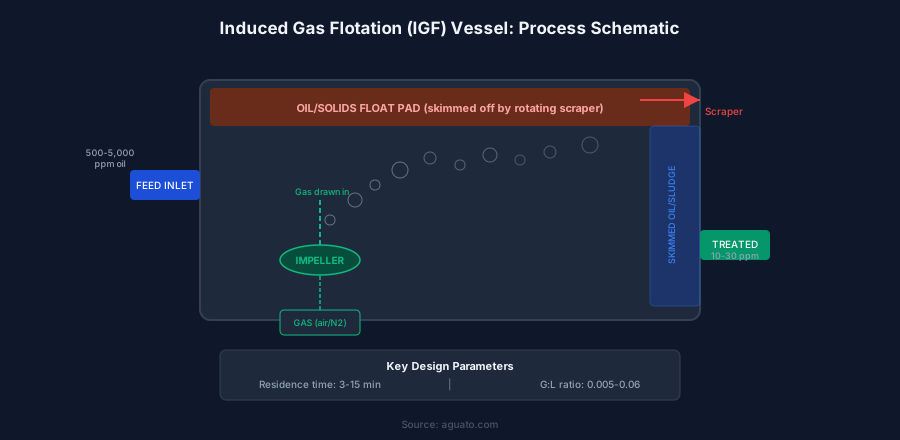
The residence time in an IGF vessel is typically 3 to 15 minutes, which is substantially shorter than the 20 to 60 minutes required in a DAF tank. This shorter residence time, combined with the horizontal flow pattern in most IGF designs, is what gives IGF its compact footprint advantage. The gas-to-liquid ratio (volume of gas per volume of liquid treated) is 0.005 to 0.06 for IGF, lower than DAF because IGF does not dissolve and re-release the gas under pressure.
[cta:nepti-dark]
## IGF vs DAF vs hydrocyclone
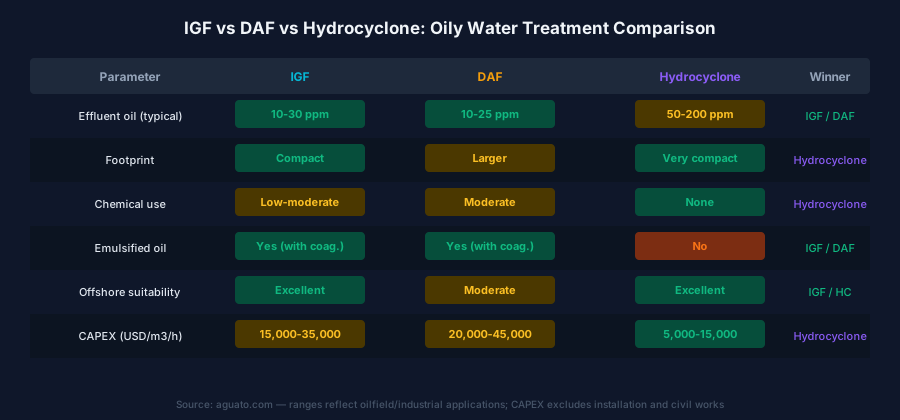
The three technologies that compete for the secondary oily water separation duty are IGF, dissolved air flotation, and hydrocyclones. Each has a distinct operating envelope.
In dissolved air flotation, water is pressurised at 3 to 6 bar in a saturation tank, saturating it with air. When released to atmospheric pressure, the dissolved air comes out of solution as very fine microbubbles of 10 to 100 microns. These smaller bubbles give DAF better collision efficiency with small oil droplets and better clarity in the treated water. The trade-off is higher capital cost, higher energy consumption for the recycle pressurisation, and a system that is sensitive to pressure fluctuations, which creates operational challenges offshore. DAF is the better choice for onshore applications where the feed contains very fine colloidal contamination, space is not critical, and stable pressure supply is available.
Hydrocyclones use centrifugal force to separate oil from water by density difference, and they can remove oil droplets down to approximately 50 microns without any chemicals or gas. They are compact, have no moving parts, have essentially zero operating cost, and are the best choice for removing free oil before a gravity separator or as a first stage before IGF. Their limitation is that they cannot remove emulsified oil below 50 microns at all, which is the specific problem IGF is designed to address.
According to the [American Petroleum Institute's API RP 421 guidance on produced water management](dofollow:https://www.api.org/oil-and-natural-gas/environment/clean-water), the recommended treatment train for oilfield produced water is gravity separation (API separator) followed by induced gas flotation for secondary treatment, with further polishing by walnut shell filtration or other media for discharge to surface water.
The [produced water treatment options for oil and gas](/resources/produced-water-treatment-oil-gas) are detailed in the context of offshore platforms, where IGF's compact footprint makes it the default secondary treatment choice in the industry.
## Produced water and oilfield applications
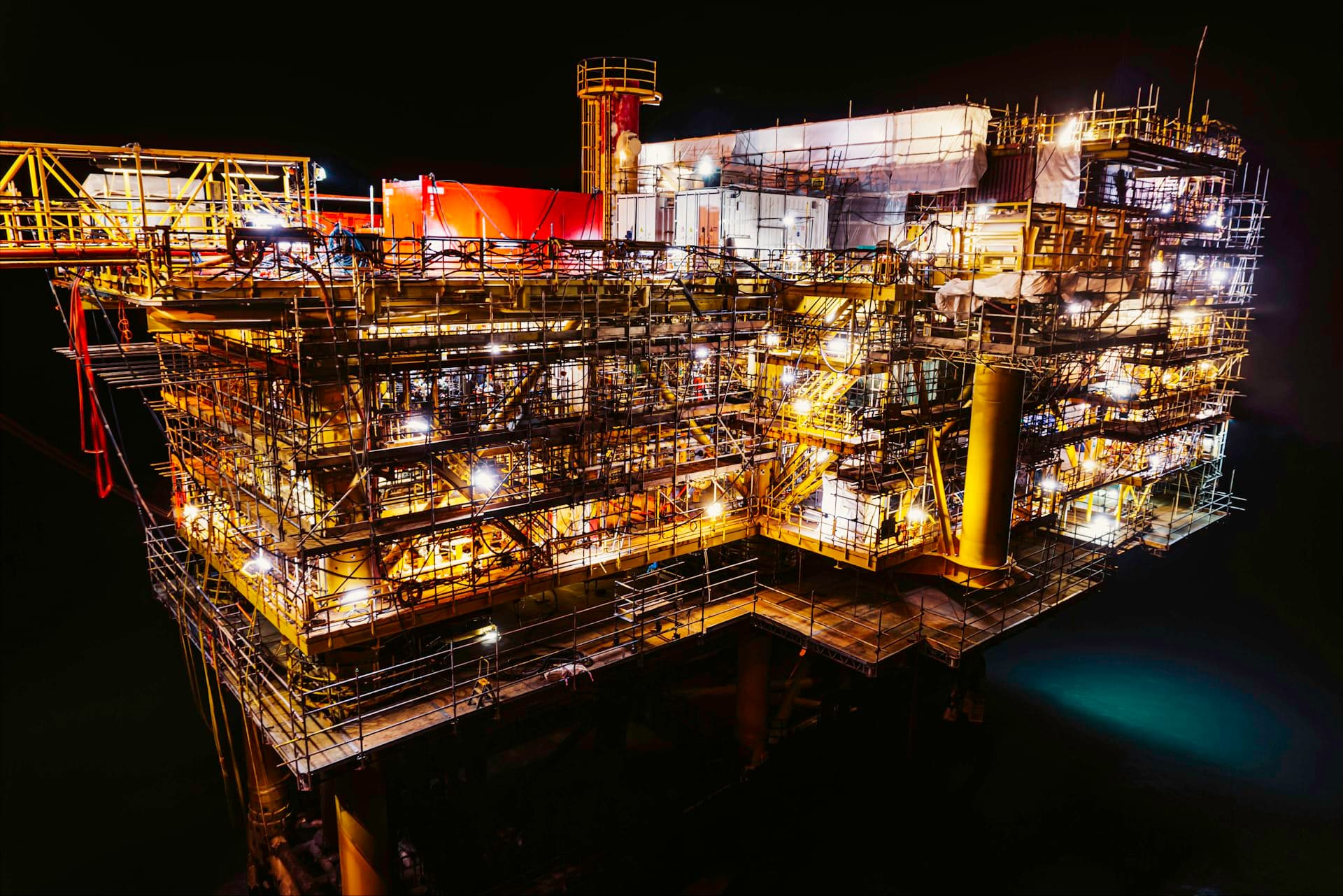
IGF has been used for oilfield produced water treatment since the 1960s, and it remains the dominant secondary separation technology on offshore platforms and FPSOs for three reasons: compact footprint, insensitivity to vessel motion (which disrupts DAF and gravity separation), and the ability to use produced gas from the process stream rather than a separate air supply.
On an offshore platform processing 10,000 barrels per day (approximately 1,590 m3/day) of produced water, the standard treatment train is: degassing drum to remove free gas, hydrocyclone cluster for bulk oil removal, IGF for secondary separation to below 30 mg/L, and walnut shell or nutshell filter as a polishing stage before overboard discharge. The overboard discharge standard in the North Sea under OSPAR is 30 mg/L monthly average oil in produced water, which IGF alone can typically meet in clean produced water, with the polishing stage providing the buffer against peak excursions.
For onshore oilfield produced water with high total dissolved solids and scale-forming tendency, IGF in a closed-system design (using produced gas rather than air) avoids the [oxygen](/elements/oxygen) introduction that can cause sulphide scaling and corrosion in high-H2S streams. The choice of gas for IGF in sour service is an important design decision that onshore oilfield operators often overlook when specifying systems based on offshore designs.
Understanding [offshore produced water treatment](/resources/offshore-produced-water-treatment) requirements in detail is the starting point for any IGF specification in the oil and gas sector, because the discharge standard, the water chemistry, and the process constraints define the required performance envelope of the IGF stage.
## IGF design parameters and sizing
The primary sizing parameter for IGF is the hydraulic loading rate, expressed as m3 of water per hour per m2 of vessel cross-sectional area. Standard IGF vessels are sized at 10 to 30 m3/h/m2 of horizontal surface area, giving a residence time of 3 to 15 minutes depending on vessel depth and flow rate.
For a produced water flow of 1,000 m3/h, a standard design would use one or more IGF cells providing 30 to 100 m2 of surface area, typically achieved with vessels of 2 to 3 metres diameter and 3 to 8 metres length. Most commercial IGF designs use multiple cells in series (2 to 4 stages), which improves oil removal efficiency by ensuring that oil droplets that escape the first flotation stage encounter fresh bubble generation in subsequent stages.
The gas-to-liquid ratio must be high enough to provide adequate bubble coverage but not so high that the turbulence created by excessive gas disrupts the float pad and re-disperses separated oil. The optimum G:L ratio for a given feed chemistry is determined by jar testing during design and adjusted during commissioning. Getting the G:L ratio wrong is one of the most common causes of IGF underperformance.
According to [US EPA effluent guidelines for the offshore oil and gas industry](dofollow:https://www.epa.gov/eg/oil-and-gas-extraction-effluent-guidelines-and-standards), the technology basis for secondary oil removal in produced water treatment is induced gas flotation or equivalent technology achieving 30 mg/L discharge standard.
## Chemical conditioning for IGF
Chemical conditioning, dosed upstream of IGF, significantly improves performance on streams with emulsified oil, oil stabilised by surfactants, or fine suspended solids. The chemicals used are: demulsifiers to break stabilised oil-water emulsions by modifying the interfacial film, coagulants (alum, ferric chloride, or polyelectrolytes) to aggregate fine solids and small oil droplets into larger particles that the bubbles can capture more effectively, and pH correction if the feed is outside the range where the coagulant is effective.
The selection and dosing rate of conditioning chemicals is feed-specific. A chemical programme that works on one produced water source will not necessarily work on another, because the emulsion chemistry depends on the crude oil composition, the injection chemicals used in the reservoir, and the reservoir brine chemistry. Every IGF installation should be designed with jar testing on representative feed samples, and the conditioning chemical programme should be re-optimised when feed chemistry changes.
Over-dosing coagulant is a common mistake that increases sludge volume, accelerates fouling of skimmer arms, and can cause coagulant carryover into the treated effluent, which defeats the purpose of the treatment stage.
## Operations, maintenance, and monitoring
An IGF system is mechanically simple relative to other secondary treatment technologies, but it requires a disciplined monitoring programme to maintain performance over time. The primary maintenance tasks are: impeller wear inspection every 6 to 12 months (worn impellers reduce bubble generation efficiency significantly), skimmer arm alignment and blade condition checks every 3 months, gas supply rate calibration verification monthly, and vessel internal inspection for scale and deposit build-up annually.
Chemical programme monitoring is more important than mechanical maintenance for most IGF systems. The demulsifier and coagulant dosing must be verified against the current feed water chemistry, not the chemistry at commissioning. Produced water chemistry changes seasonally and with well maturity. A monitoring programme that tests only effluent oil and overlooks upstream feed chemistry changes will miss a degrading chemical programme until the effluent exceeds the discharge standard.
For offshore applications, monitoring must account for vessel motion. Most offshore IGF systems include online oil-in-water monitors at the inlet and outlet to provide continuous effluent quality data. The monitor alarms on a high-oil exceedance, triggering operator investigation before the permit limit is reached. The calibration of oil-in-water monitors for the specific crude oil type being produced is critical: monitors calibrated for one crude type may read incorrectly on a different crude, giving false compliance or false exceedances. A quarterly grab sample comparison against the on-line monitor is the validation approach used on most offshore platforms.
For onshore applications in environmental permit zones, the produced water discharge monitoring record must be maintained in a format that satisfies the permit requirements, which in the US typically means daily measurement and reporting for Class II injection wells with surface discharge components. The monitoring record also provides the baseline for detecting chemical programme degradation before it becomes a compliance exceedance.
The operational factor that most commonly limits IGF performance to below its design potential is chemical programme neglect, not mechanical failure. A correctly specified IGF unit with a degraded or wrong demulsifier will consistently produce effluent above 50 mg/L while the operator keeps increasing gas rate to compensate. Gas rate is not the primary performance lever; chemical conditioning is.
## Technology comparison table
| Parameter | IGF | DAF | Hydrocyclone | |---|---|---|---| | Effluent oil (typical) | 10 to 30 ppm | 10 to 25 ppm | 50 to 200 ppm | | Handles emulsified oil | Yes (with coagulant) | Yes (with coagulant) | No | | Footprint | Compact | Larger | Very compact | | Moving parts | Impeller/skimmer | Pump, recycle system | None | | Chemical requirement | Low to moderate | Moderate | None | | Offshore suitability | Excellent | Moderate | Excellent | | Sensitivity to motion | Low | High | Very low | | CAPEX (USD/m3/h) | 15,000 to 35,000 | 20,000 to 45,000 | 5,000 to 15,000 |
## IGF in refinery and industrial applications
IGF is not limited to oilfield produced water. Refineries, petrochemical plants, and other heavy industries generate oily wastewater streams where IGF is the appropriate secondary separation technology. In a refinery, the API separator handles free oil and coarse solids, and the IGF or DAF stage follows to remove the emulsified and fine oil before the effluent goes to biological treatment or direct discharge.
Refinery IGF applications differ from oilfield produced water IGF in important ways. The feed chemistry is more diverse: refinery wastewater contains a range of hydrocarbons from different process units, including heavy fuel oil, crude oil, naphtha, and various distillate fractions, plus surfactants from refinery cleaning operations and caustic from desalting. The emulsion chemistry is therefore more variable and more difficult to optimise for a single demulsifier programme. Refineries with multiple IGF cells often run different chemical programmes on different units depending on which process unit effluent is routing to each cell.
The oil-in-water discharge limit for refineries in the US under EPA effluent guidelines for petroleum refining is 15 mg/L daily maximum and 9.9 mg/L monthly average. In the EU, the Industrial Emissions Directive sets BAT (best available technique) reference values that imply similar performance. IGF with correctly optimised chemical conditioning consistently achieves these limits; IGF without adequate conditioning typically cannot.
For industrial facilities outside the oilfield and refining sectors, IGF is used in: meat processing and rendering (high fat and protein emulsion load), vegetable oil processing (emulsified vegetable oil with surfactants), pharmaceutical manufacturing (oily residues from cleaning operations), and some textile dyeing applications (oily carrier and scrouring bath residues). In each case, the design principle is the same, but the chemical conditioning programme requires fresh jar testing for each application because the emulsion chemistry is entirely different from the oilfield baseline.
[Browse industrial water treatment providers with IGF and oily water separation expertise](/providers) to find companies with experience across the full range of applications.
## Regulatory context and discharge standards for IGF effluent
The discharge standard that IGF must meet depends entirely on the receiving environment and the applicable permit. In the North Sea under OSPAR, the discharge limit for oil in produced water is 30 mg/L monthly average with a 100 mg/L daily maximum. IGF can typically meet the 30 mg/L monthly average without polishing when the chemical programme is optimised and the feed is clean produced water. In the US, the EPA's offshore effluent guidelines under 40 CFR Part 435 set a 42 mg/L daily maximum and a 29 mg/L monthly average for produced water discharged offshore. These are similar to the North Sea limits and are achievable with a properly designed and operated IGF stage.
For onshore oilfield applications in the US, produced water that is not reused in fracturing operations or disposed of by Class II injection requires a National Pollutant Discharge Elimination System (NPDES) permit for surface discharge. NPDES permits for onshore oil and gas produced water are generally not issued by the EPA, meaning surface discharge is typically not a legal option in the US for onshore produced water. This is why injection well disposal dominates US onshore flowback management.
In contrast, the EU and UK regulate produced water discharge through the Water Framework Directive and associated environmental permits, and treatment-to-discharge is a viable option if the treated water can meet permit conditions. In North Sea operations under OSPAR, produced water is allowed to be discharged with the 30 mg/L limit, and IGF remains the core treatment technology to meet this limit cost-effectively.
Understanding [industrial wastewater discharge regulations](/resources/industrial-wastewater-discharge-regulations) in the relevant jurisdiction is an essential first step before any produced water treatment system is designed, because the discharge standard determines the required effluent quality and therefore the required treatment technology combination.
## Where IGF installations fail
Wrong gas type. Air-injection IGF specified on a sour service stream where H2S is present causes the formation of iron sulphide deposits from the oxygen introduced with the air. The deposit accumulates in the vessel, reduces effective volume, fouls the skimmer, and eventually blocks process lines. IGF in sour service must use inert gas (nitrogen) or produced gas.
Inadequate chemical conditioning characterisation. The IGF is specified and commissioned on design flow and oil concentration, but on the actual feed chemistry the demulsifier programme does not work and the effluent oil exceeds the discharge standard. This is predictable and preventable. Every IGF project in a new production environment should include pilot testing or jar testing on representative samples before system specification.
Skimmer and float pad management neglect. The float pad accumulates in the weir section and, if not regularly removed, builds up to the point where it is re-entrained in the treated water by overflow. Float pad removal is an active operational task, not a passive mechanical function. Systems designed with inadequate sludge weir volume and removal frequency for the expected sludge rate fail within weeks of start-up.
Sizing for average flow, not peak flow. An IGF sized for average daily flow will be hydraulically overloaded during peak production periods, reducing residence time below the design value and degrading separation efficiency. The design should be based on peak hourly flow with 15 to 20% headroom.
[Browse produced water treatment providers and IGF specialists](/providers) on the Aguato marketplace to find companies with documented oilfield and industrial flotation experience.
## FAQ
### What is the difference between IGF and DAF?
Both use gas bubbles to float oil and solids to the surface, but DAF dissolves air under pressure and releases it as microbubbles (10 to 100 microns), while IGF induces gas into the liquid mechanically at low pressure to create larger bubbles (0.1 to 1 mm). DAF achieves better clarity for very fine contamination; IGF is more compact and better suited to offshore and motion-affected environments.
### What oil concentration can IGF achieve?
A well-designed and chemically conditioned IGF system typically achieves 10 to 30 mg/L effluent oil from feed concentrations of 200 to 5,000 mg/L. Performance below 15 mg/L consistently requires well-characterised chemical conditioning and correct sizing. To reach below 10 mg/L, downstream polishing such as walnut shell filtration or ultrafiltration is typically required.
### Can IGF be used onshore as well as offshore?
Yes. IGF is used in onshore oilfield produced water treatment, refinery effluent treatment, and some industrial process water applications. Offshore is the dominant application because of IGF's compact footprint and insensitivity to vessel motion, but the technology is equally applicable onshore where footprint is constrained.
### What chemicals are used with IGF?
The standard chemical programme includes a demulsifier to break oil-water emulsions, a coagulant or flocculant to aggregate fine solids and small oil droplets, and sometimes a pH correction chemical. The specific products and dosing rates are feed-specific and should be optimised by jar testing on representative samples before the system is specified.
### How long does an IGF system last, and what maintenance does it require?
An IGF vessel is a simple pressure vessel with few moving parts (impeller shaft and skimmer arm), and correctly maintained systems operate for 15 to 25 years. Primary maintenance tasks are: regular inspection and cleaning of the skimmer mechanism, periodic inspection of the impeller for wear or fouling, chemical programme monitoring and adjustment, and annual vessel internal inspection for corrosion or deposit build-up.
### What is the CAPEX for an IGF system?
Installed CAPEX for an IGF system, including vessel, drives, chemical dosing, instrumentation, and skid package, typically ranges from $15,000 to $35,000 per m3/h of treatment capacity. A system treating 100 m3/h therefore costs $1.5 to $3.5 million installed. This compares to $5,000 to $15,000/m3/h for hydrocyclones and $20,000 to $45,000/m3/h for DAF. Offshore platform IGF installations carry an additional 30 to 60% cost premium for marinisation, ATEX/offshore classification, compact design engineering, and the offshore installation and commissioning scope. An onshore-equivalent IGF at $2 million installed may cost $3 to $3.5 million in a certified offshore package. This premium must be included in any offshore produced water treatment budget from the initial cost estimate stage.
### Is IGF suitable for treating wastewater in food and beverage processing?
Yes, but with important caveats. Food processing wastewater typically contains emulsified animal fat, vegetable oil, or both, along with high suspended solids from flesh and organic residues. IGF and DAF are both commonly used in this sector. The difference from oilfield IGF is the nature of the emulsification: food processing emulsions are typically stabilised by proteins and natural surfactants rather than the chemical surfactants used in oilfield chemistry, which changes the demulsifier chemistry entirely. Cationic coagulants such as aluminium sulphate or ferric chloride are more commonly used in food processing IGF than the demulsifiers used in oilfield applications. The principle is the same; the chemical programme is entirely different.