A hyperscale campus can consume 3 million gallons of cooling water per day. Legionella enforcement starts at $500,000. Full treatment train, CAPEX, OPEX, and reuse strategy inside.
Data center water treatment is the set of chemical, mechanical, and operational controls that keeps cooling water clean, safe, and within permit limits across every watt of IT load a facility supports. A hyperscale campus cooling 50 megawatts of compute can consume 1 to 3 million gallons of makeup water per day. A single Legionella enforcement notice costs $500,000 to $5 million before remediation is complete. A scale-fouled chiller running at 15% below rated efficiency adds $200,000 to $600,000 a year in excess electricity at a mid-tier data center.
The industry spent a decade treating water as a fixed-cost input. That assumption is breaking in three directions at once: water scarcity is closing down cheap freshwater access in Phoenix, Dublin, and Singapore; ESG frameworks are demanding public disclosure of consumption and reuse rates; and increasingly dense compute loads, especially GPU clusters for AI training, are pushing cooling water temperatures and cycles of concentration beyond what legacy chemical programmes were designed to handle. Vendors will recommend whatever they sell. The buyer's job is to model the lifecycle cost of each treatment path against the site's actual water matrix, discharge permit, and uptime contract.
This guide covers the full treatment arc for data center cooling water: what each system type needs, how to choose between open-loop and closed-loop configurations, the treatment chemistry that prevents the four most expensive failure modes, the CAPEX and OPEX ranges that belong in a project budget, a decision framework for water reuse, and the failure scenarios that will cost you more than the treatment plant that would have prevented them. It is written for the operations teams managing cooling water programmes and the procurement and sustainability leads building the business case for a capital upgrade.
## The decision in brief
- Run more cycles of concentration. A data center operating a mid-scale 15 MW cooling system without RO pre-treatment, at 3 cycles of concentration instead of 7 to 8, consumes roughly 65% more makeup water than necessary and pays for the excess at the municipal tariff. - Price the avoidable water. At $1.50 per cubic metre and 300,000 cubic metres per year of avoidable consumption, that is $450,000 per year in direct water cost, plus the higher blowdown disposal or treatment cost. - Install the pre-treatment. The pre-treatment system costs $250,000 to $500,000 installed, and payback is under 18 months at most tariff levels.
The biggest cost of doing nothing is the first Legionella enforcement action or scale-driven chiller outage, which arrives without warning and costs 10 to 20 times the annual treatment budget to resolve.
## Why data center water treatment is different from standard industrial cooling
Data center cooling sits at an unusual intersection of demands: the water volumes are enormous, the process temperatures are moderate (typically 25 to 45 degrees C in the tower basin), and the tolerance for unplanned downtime is measured in minutes, not shifts. A petrochemical plant can schedule a maintenance window for a heat exchanger clean; a hyperscaler running SLAs at five-nines uptime cannot.
The shift to higher-density AI compute changes the thermal profile further. Traditional server air cooling is designed around 20 to 25 kW per rack. GPU clusters for machine learning regularly reach 60 to 100 kW per rack, and some liquid-cooled configurations exceed 200 kW. More heat in the same footprint means more heat rejection demand on the cooling tower or chiller, which concentrates dissolved solids faster and forces tighter chemistry control to maintain cycles of concentration without fouling. The [cooling tower water treatment](/resources/cooling-tower-water-treatment) discipline that worked at 3 cycles of concentration needs to be re-engineered for 6 to 8 cycles in a water-scarce market.
Three things separate a well-run data center water programme from a reactive one. First, the treatment is designed around the actual feed water analysis, not a generic programme a chemical vendor sells off the shelf. Second, the chemistry is monitored continuously or semi-continuously with online instruments, not quarterly grab samples. Third, the programme integrates blowdown volume into the site water balance, so compliance is built in rather than discovered during an audit. [Find verified water quality monitoring and testing providers](/water-quality-testing) who can baseline your site's feed water before committing to a treatment configuration.
## Cooling system types and their water treatment needs
Not all data center cooling water is the same. The treatment requirement depends entirely on which circuit you are protecting.
Open evaporative cooling towers use the latent heat of evaporation to reject heat from the condenser water circuit. They are the dominant heat rejection technology in large-scale data centers, but they expose the circulating water to atmosphere, which means continuous contamination with airborne dust, biological load, and oxygen. Cycles of concentration build as pure water evaporates and dissolved solids concentrate. Without treatment, calcium carbonate, silica, and sulphate scales form on heat exchanger surfaces within weeks. A cooling tower handling [cooling tower blowdown](/resources/cooling-tower-blowdown) correctly can run at 6 to 10 cycles of concentration and consume 30 to 40% less makeup water than a poorly managed tower cycling at 2 to 3.
Closed-loop chilled water systems circulate water between chillers and computer room air handlers or rear-door heat exchangers without atmospheric exposure. The corrosion risk is different: without the oxygen replenishment of an open tower, the concern shifts to pitting corrosion and glycol degradation in systems using antifreeze. The chemistry load is lower but must be managed consistently because closed-loop systems tend to go years between water changes, and a degraded inhibitor package is difficult to detect until damage is visible.
Adiabatic pre-cooling systems spray or evaporate water upstream of air-cooled condensers to reduce entering air temperature by 5 to 12 degrees C during peak summer conditions. They use water intermittently rather than continuously, but the intermittent wetting of pads or nozzles creates biofilm and scale risks that are disproportionate to the volume consumed.
Liquid-cooled racks and rear-door heat exchangers circulate demineralised or deionised water through server chassis in direct contact or near-contact with electronics. The water quality requirement here is ultrapure: conductivity typically below 1 microsiemen per centimetre, with tight pH control and essentially zero suspended solids. The [industrial water chiller](/resources/industrial-water-chiller) that feeds these circuits needs dedicated make-up treatment quite different from the tower chemical programme.
## The four core treatment trains
Every data center cooling water programme is built from some combination of four treatment functions. Getting the sequencing wrong is where most problems originate.
### Pre-treatment: feed water conditioning
Feed water arriving from a municipal supply typically has total dissolved solids (TDS) of 100 to 600 mg/L, hardness of 50 to 300 mg/L as calcium carbonate, and a Langelier Saturation Index (LSI) approaching zero. At 6 cycles of concentration, every parameter multiplies by 6. A feed hardness of 150 mg/L becomes 900 mg/L in the tower basin, which is well into the supersaturated scaling zone without an antiscalant. The decision point is straightforward: if feed water TDS exceeds 300 mg/L or hardness exceeds 150 mg/L, reverse osmosis pre-treatment is almost always required to enable high-cycle operation. Softening alone extends cycles to 4 to 5, but cannot match the 6 to 10 cycles that a water-stressed site needs. [Reverse osmosis systems](/reverse-osmosis-companies) sized for this application typically run at 75 to 80% recovery with antiscalant dosing to prevent membrane fouling.
For ultrapure applications in liquid-cooled racks, the train extends to a polishing loop: RO permeate followed by electrodeionisation or mixed-bed resin to achieve conductivity below 1 microsiemen per centimetre. That level of purity adds $150,000 to $400,000 to the treatment system CAPEX compared with a standard cooling tower programme.
### Scale and corrosion inhibition
The chemistry programme for a [cooling tower treatment](/cooling-tower-treatment) circuit must control three mechanisms simultaneously: calcium carbonate scaling at surfaces above the bulk water temperature, corrosion of steel and copper in mixed-metal systems, and biological growth that creates biofilm as a substrate for Legionella. Phosphonate-based antiscalants dosed at 5 to 15 mg/L extend cycles of concentration without sacrificing heat transfer. Molybdate or azole-based corrosion inhibitors protect copper tubing at 10 to 50 mg/L depending on the water chemistry. These chemicals are not interchangeable between system types: a programme designed for galvanised steel will aggressively attack copper, and vice versa.
A pattern that recurs across data center installations is the use of a single chemical supplier's packaged programme without validating it against the actual water matrix at the design cycles of concentration. The programme passes the lab test and fails in the field because the feed water hardness is higher than the datasheet assumed, or the operating cycles drift above the design point during a peak summer period. The result is scale deposition that costs $150,000 to $600,000 per cleaning event, not counting the energy penalty of reduced heat transfer in the months before the clean is scheduled.
### Biological control
Biocide dosing is the non-negotiable component of any open cooling water programme. [Legionella pneumophila](/resources/legionella-risk-assessment) thrives in water at 20 to 45 degrees C, which precisely matches the basin temperature range of most data center towers. Oxidising biocides such as chlorine, bromine-releasing compounds, or chlorine dioxide are the primary defence. Non-oxidising biocides dosed alternately (typically isothiazolinone-based) prevent the development of resistance and address the sessile biofilm population that oxidisers cannot reach. [According to ASHRAE Standard 188](dofollow:https://www.ashrae.org/technical-resources/bookstore/ansi-ashrae-standard-188-2021-legionellosis-risk-management-for-building-water-systems), every building with a cooling tower must have a written Water Management Plan that defines monitoring frequencies, biocide schedules, and remediation thresholds.
The baseline minimum for a data center cooling tower: monthly colony counts of total viable organisms and Legionella-specific culture; oxidising biocide continuous or three-times-per-week with measured residual; non-oxidising biocide every two to four weeks; quarterly physical inspection of basin sediment and drift eliminators.
### Filtration and side-stream treatment
Tower basin sediment is a reservoir for biological growth. Side-stream filtration continuously removes suspended solids, keeping turbidity below 5 NTU and reducing the nutrient load available to biofilm. A sand or multimedia filter sized for 10% of the circulating flow rate is the standard design point. More aggressive programmes add disc or automatic self-cleaning filters to reach suspended solids below 1 mg/L.
## Technology comparison: choosing your treatment configuration
The single question that drives the technology selection is not "what treatment is best?" but "what is the cost of each option over 10 years at the projected water quality and volume?"
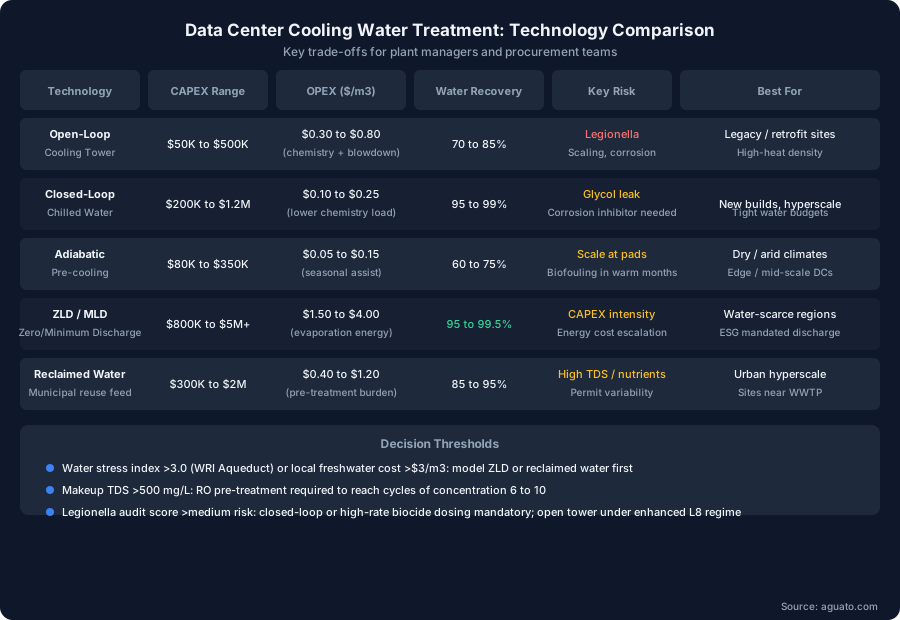
The table above summarises the key trade-offs. The decision thresholds embedded in it are worth making explicit:
- If the site's feed water TDS exceeds 500 mg/L, RO pre-treatment is required to achieve cycles of concentration above 5. Without it, the scaling chemistry becomes unmanageable even with heavy antiscalant loading, and blowdown volumes consume too much water to be economically justifiable. - If local freshwater cost exceeds $3 per cubic metre, or the site is in a World Resources Institute Aqueduct High Stress zone (score above 3.0), zero liquid discharge or reclaimed water should be modelled before committing to a conventional evaporative tower programme. - If the site plan includes AI compute racks at 60 kW or above per rack, liquid cooling circuits will be required, and the water quality specification for those circuits is fundamentally different from the tower programme. They are separate systems requiring separate treatment.
Across projects we have seen, the most expensive mistake is treating these as a single budget line without distinguishing the tower programme from the precision cooling circuit. The tower can tolerate TDS in the hundreds of milligrams per litre with proper chemistry; the liquid cooling loop cannot tolerate TDS above 2 to 5 mg/L without accelerating corrosion.
Not sure which configuration fits your site water matrix and cooling load? [Browse verified industrial water treatment companies](/industrial-water-treatment-companies) on Aguato, filter by technology, and request scoped proposals from 3 to 5 specialists before locking the design.
## CAPEX and OPEX: what it actually costs
The budgeting error that kills programmes before they start is combining CAPEX and OPEX into a vague "water treatment cost" without separating the one-time investment from the ongoing chemistry and maintenance spend. They answer different questions for different people.
CAPEX ranges by system type (2024 to 2025 USD, site-installed):
| System component | Small DC (1 to 5 MW IT load) | Mid-scale (5 to 20 MW) | Hyperscale (20 MW+) | |---|---|---|---| | Chemical dosing + controls | $30K to $80K | $80K to $200K | $200K to $600K | | Side-stream sand filtration | $20K to $60K | $60K to $150K | $150K to $400K | | RO pre-treatment system | $80K to $200K | $200K to $600K | $600K to $2M | | Softening (as alternative to RO) | $30K to $100K | $100K to $300K | $300K to $800K | | Closed-loop chilled water treatment | $40K to $120K | $120K to $350K | $350K to $1M | | Ultrapure loop (liquid cooling) | $150K to $400K | $400K to $1.2M | $1.2M to $4M | | ZLD/MLD system | $800K to $2M | $2M to $5M | $5M to $15M |
OPEX per cubic metre of cooling water treated (annual steady state):
Chemistry and biocide: $0.20 to $0.60 per m3. Side-stream filtration media replacement: $0.05 to $0.15 per m3. RO membrane replacement (prorated over 5-year life): $0.10 to $0.25 per m3. Energy for RO and ancillary pumping: $0.08 to $0.18 per m3 at $0.08 per kWh. Labour for monitoring and chemical handling: $0.10 to $0.30 per m3 at a 10 MW site. Total blended OPEX excluding energy for the cooling tower itself: $0.50 to $1.30 per m3 of makeup water treated.
The payback on RO pre-treatment versus blowdown-heavy operation at 3 cycles of concentration is typically 2.5 to 4 years for sites where municipal water costs $1.50 per m3 or above. At $3 per m3 or above (common in Singapore, parts of the UK, and drought-declared US regions), payback can fall below 18 months.
[cta:nepti]
## Water reuse and recycling strategies
Data centers are among the largest non-agricultural water consumers in many urban markets, which makes them a visible target for regulators and a material ESG exposure for operators. The operational answer is to close the water loop as tightly as the economics allow.
Reclaimed municipal water (recycled water) offers the lowest-cost path to reduced freshwater dependency for sites near a wastewater treatment plant. Reclaimed water typically has TDS of 400 to 900 mg/L, elevated nitrogen and phosphorus, and a biological load that requires disinfection before entering the cooling circuit. The treatment cost is higher than municipal potable water, but the tariff for reclaimed water is typically 40 to 60% of the potable rate, generating a net saving of $0.50 to $1.20 per m3 at high volume. The risk is nutrient-driven algal growth and biofouling, which requires a more aggressive biocide programme and more frequent basin cleaning. [Industrial water reuse and recycling](/resources/industrial-water-reuse-recycling) at scale requires pre-treatment sizing and permit negotiation with the local utility before the supply is bankable.
Condensate recovery from CRAC and CRAH units is an underutilised source of high-purity water in humid climates. Air conditioning condensate is essentially distilled water with conductivity below 30 microsiemens per centimetre. A 10 MW data center in a subtropical climate can generate 5,000 to 15,000 gallons per day of condensate that, with minimal treatment and a collection system costing $30,000 to $100,000, can substitute for a meaningful fraction of cooling tower makeup. The payback is typically under two years.
Blowdown treatment and recycle closes the loop further. Tower blowdown concentrated to 6 to 8 cycles has TDS in the range of 600 to 1,800 mg/L, which is within the feed range of a brackish-water RO system. Recovering 75 to 80% of blowdown volume reduces net discharge by 75% and can push overall site water recovery above 90%. The capital cost of a blowdown RO train is $200,000 to $600,000 for a mid-scale site, with an OPEX of $0.60 to $1.40 per m3 recovered.
A real-world pattern across hyperscale campuses in water-stressed US markets: operators who invested in blowdown recycle and condensate recovery in 2021 to 2023 are reporting 20 to 35% reductions in freshwater intake, with paybacks averaging 3.5 years. The same operators are ahead of incoming state-level disclosure requirements rather than scrambling to respond to them. [Post your water reuse project](/post-project) and qualified providers will scope the trade-off against your actual consumption and permit numbers.
The [US Environmental Protection Agency's WaterSense programme for data centers](dofollow:https://www.epa.gov/watersense) provides benchmark water usage effectiveness (WUE) targets that inform both the design standard and the ESG reporting baseline. A well-treated, high-cycle site should achieve WUE of 0.2 to 0.5 litres per kWh; a poorly managed site running at 3 cycles of concentration will typically exceed 1.5 litres per kWh.
## Failure modes and what they cost
Understanding failure modes is more useful than a list of best practices, because it puts a dollar number on the risk of inaction.
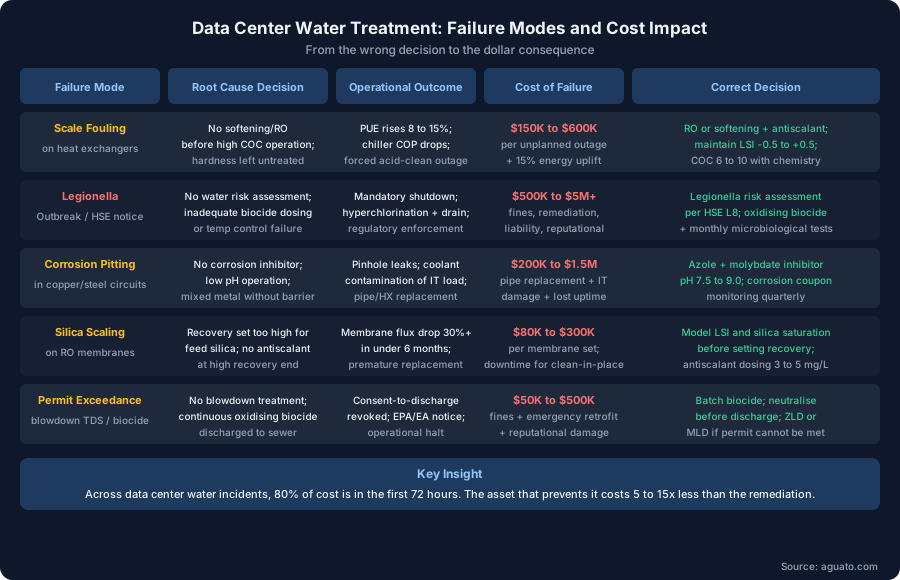
The five failure modes mapped in the diagram above share a structural pattern: each one begins with a procurement decision that was made on CAPEX grounds and ends with an operational cost that is 5 to 20 times larger. Scale fouling starts with "we'll use softener instead of RO and run at lower cycles," and ends with a $600,000 acid-clean outage plus six months of elevated energy bills. Legionella starts with "the tower vendor said the standard programme covers it," and ends with an HSE enforcement notice and $2 million in remediation and legal costs.
A representative pattern across colocation data centers: operators who inherit a facility with an undocumented water treatment programme typically discover the deficiency when they conduct their first Legionella culture test and receive a result above the 100 CFU/litre action threshold. The remediation sequence is hyperchlorination, drain, physical clean, refill, re-dose, re-test. The direct cost is $80,000 to $200,000. The indirect cost is the operational disruption to tenants and the reputational signal to prospective customers that water risk management was not a priority.
The right decision is not to maximise CAPEX on treatment. It is to accurately cost the failure and spend the fraction that prevents it. A $120,000 investment in proper dosing controls, monitoring instruments, and a quarterly third-party audit for a 10 MW site is a 25 to 50 to 1 return against the expected value of the failures it prevents.
## Legionella risk in data center cooling
Legionella deserves its own section because it is the failure mode that operates outside the normal cost-benefit calculus. Scale fouling is expensive. Legionella exposure carries criminal liability.
The risk factors specific to data center cooling are well documented. Basin temperatures in the 25 to 40 degrees C range are optimal for Legionella growth. Drift from cooling towers can carry aerosolised organisms to occupied areas and building air intakes. Stagnant zones in oversized towers during low-load operation create warm, low-velocity pockets where biofilm accumulates. Seasonal shutdown and restart cycles, common on smaller adiabatic towers, provide ideal conditions for biofilm to establish between operating periods.
[HSE Approved Code of Practice L8](dofollow:https://www.hse.gov.uk/legionnaires/legionella-l8-acop.htm) in the UK (and ASHRAE 188 in the US) require that every organisation with a cooling tower have a written Water Management Plan, a designated responsible person, risk assessments reviewed annually, and microbiological monitoring at defined frequencies. These are legal obligations, not recommendations. An operator who cannot produce a current Water Management Plan during an inspection faces immediate enforcement action regardless of whether any illness has occurred.
The operational minimum for compliant Legionella control in a data center cooling tower:
- Oxidising biocide ([chlorine](/elements/chlorine) or bromine) dosed to maintain 0.5 to 1.0 mg/L free residual at the tower basin. - Non-oxidising biocide (isothiazolinone or glutaraldehyde) alternated on a two-week to four-week cycle. - Monthly culture samples of basin water and drift eliminator washings; action threshold of 100 CFU/L for Legionella pneumophila serogroup 1; shutdown threshold of 1,000 CFU/L. - Annual physical clean of basin, packing, drift eliminators, and distribution nozzles. - Temperature logging to confirm no deadleg zones are operating below 20 degrees C (cold pipework) or cooling tower inlet below 25 degrees C.
The cost of full compliance for a mid-size data center is $15,000 to $40,000 per year in testing, biocide, and third-party oversight. The cost of non-compliance, in the event of a confirmed case, starts at $500,000 and routinely exceeds $5 million.
## Discharge compliance and permit management
Data center cooling water discharge sits at the intersection of water quality regulations, trade effluent consents, and biocide residual limits that differ by jurisdiction. Getting this wrong creates a compliance liability that can halt operations faster than a cooling failure.
The core variables in discharge management are:
Blowdown chemistry. Blowdown from a treated tower contains concentrated chemistry at levels that may exceed trade effluent consent thresholds for metals (molybdate), phosphorus, and biocide residual. Chlorine residual above 0.5 mg/L is typically prohibited in direct-to-sewer discharge. The fix is dechlorination using sodium metabisulphite or sodium thiosulphate, dosed at the blowdown outlet before discharge.
TDS and conductivity limits. Some jurisdictions cap the conductivity of trade effluent discharged to sewer. Operating at 8 to 10 cycles of concentration with a high-TDS feed can push blowdown conductivity above 2,000 to 3,000 microsiemens per centimetre, triggering consent breach. The pre-emptive solution is a blowdown softening or RO system that either recycles the concentrated stream or reduces TDS before discharge.
Stormwater co-mingling. Data center campuses with open tower basins drain to stormwater systems during heavy rain events. Biocide-contaminated stormwater reaching a watercourse without treatment is a permit breach in most jurisdictions. Containment bunds, controlled discharge routes, and [SuDS and green infrastructure for stormwater management](/resources/suds-green-infrastructure-stormwater) for basin overflow are mandatory, not optional.
[Browse verified water treatment chemical companies](/water-treatment-chemical-companies) who specialise in biocide programmes designed with discharge compliance built in from the chemistry selection stage, rather than retrofitting dechlorination after the fact.
A useful threshold framework for discharge planning: if blowdown volume exceeds 50 cubic metres per day, appoint a permit specialist to review the consent conditions against the proposed chemistry programme before startup. The cost of a permit review is $5,000 to $15,000. The cost of a consent revocation followed by emergency retrofitting is $100,000 to $500,000, plus operational disruption.
## How to evaluate and select providers
The data center water treatment market has a structural problem: most chemical programme providers have a direct financial incentive to recommend the chemistry they manufacture, not the chemistry that is optimal for the site. That misalignment does not make the providers dishonest; it makes independent technical due diligence essential.
A procurement team building an RFP for a data center water treatment programme should require the following at proposal stage:
Feed water analysis. Every proposal must be based on an actual analysis of the site's feed water, not regional averages. Hardness, TDS, silica, iron, manganese, alkalinity, pH, and Legionella culture from the incoming supply. A vendor who proposes a programme without seeing the water analysis is selling a shelf product, not a site-specific solution.
Lifecycle cost modelling. CAPEX of the treatment equipment, annual chemistry cost at proposed dose rates, membrane and media replacement schedule, energy cost of RO and pumping, labour for monitoring and chemical handling, and third-party testing costs. The number that belongs in the procurement decision is the 10-year total cost of ownership, not the chemical spend per year.
Performance guarantees. Scale deposit rate below 0.1 mm per year on the heat exchanger surface. Corrosion rate below 2 mils per year (mpy) for steel, below 0.5 mpy for [copper](/elements/copper). Legionella culture results below 10 CFU/L under the proposed programme, with defined response protocols if results exceed action thresholds.
References from comparable sites. Cooling water chemistry for a 50 MW hyperscale AI campus is not the same as for a 2 MW colocation facility. The reference sites should match in at least two of: IT load size, cooling system type, feed water chemistry, and geography.
Not sure how to frame the technical scope for your site? [Post your project on Aguato](/post-project) with your feed water analysis and cooling load, and qualified water treatment providers will submit scoped proposals against your actual parameters rather than generic assumptions.
The selection decision ultimately comes down to three factors that vendors rarely volunteer: (1) what is the failure mode their programme does not protect against, and what is the cost of that failure; (2) how does the chemistry perform if operating cycles drift above the design point during a heatwave; (3) what is the monitoring protocol that gives the site team early warning before the failure becomes an outage.
A well-structured RFP eliminates providers who cannot answer those three questions with site-specific data. [Browse vetted cooling tower water treatment specialists](/cooling-tower-treatment) and filter by sector experience to build a shortlist before issuing the full tender.
## FAQ
### How much water does a data center use for cooling?
A typical air-cooled hyperscale data center uses 1.5 to 2.5 litres of water per kWh of IT load (WUE of 1.5 to 2.5), primarily through evaporative cooling tower losses. A well-treated site running at 6 to 8 cycles of concentration with side-stream filtration and condensate recovery can achieve WUE of 0.2 to 0.5 litres per kWh. For a 50 MW campus that translates to a difference of 50 to 100 million gallons per year in freshwater consumption, a material number in any water-stressed region and a significant ESG metric under GRI 303 and CDP Water Security disclosures.
### What is the main water treatment requirement for a cooling tower in a data center?
The primary requirements are: scale and corrosion inhibition through antiscalant and inhibitor chemistry dosed against the actual feed water matrix; biological control through oxidising and non-oxidising biocide programmes compliant with ASHRAE 188 or HSE L8; and suspended solids removal through side-stream filtration. The programme must be designed around the actual cycles of concentration the site will operate at, not a conservative default. Running at 3 cycles when 7 are achievable with proper chemistry wastes 50% of makeup water and doubles blowdown volumes.
### When is reverse osmosis required for data center cooling water?
RO pre-treatment is typically required when feed water TDS exceeds 400 to 500 mg/L, when hardness exceeds 150 to 200 mg/L as calcium carbonate, or when silica exceeds 15 to 20 mg/L in the feed, because concentrating these levels to 6 to 8 cycles of concentration pushes scaling chemistry beyond what antiscalants alone can manage. RO is also the pre-treatment of choice for liquid-cooled rack circuits, where the target conductivity of below 1 microsiemen per centimetre cannot be reached by softening alone. The capital cost of a data center RO system ranges from $80,000 for a small facility to over $2 million for a hyperscale application.
### What is Water Usage Effectiveness (WUE) and what is a good target?
WUE is the ratio of site water consumption in litres to IT energy delivery in kWh. It is the water equivalent of Power Usage Effectiveness (PUE). A poorly managed evaporative cooling system will produce WUE above 2.0; a well-optimised cooling programme with high-cycle operation, condensate recovery, and blowdown recycling can achieve WUE below 0.5. The Green Grid and Uptime Institute use WUE as a primary efficiency metric for sustainability benchmarking. Hyperscale operators including major cloud providers have published WUE targets of 0.2 to 1.0 for new campuses, driven by ESG commitments and growing municipal pressure on water withdrawal permits.
### How do you control Legionella in data center cooling towers?
Legionella control requires a multi-barrier approach: a written Water Management Plan, continuous or frequent oxidising biocide dosing to maintain 0.5 to 1.0 mg/L free residual, alternating non-oxidising biocide on a two-week to four-week cycle, monthly microbiological culture testing of basin water, annual physical cleaning of basin and packing, and temperature monitoring to ensure no dead zones operate in the 20 to 45 degrees C growth range. The action threshold under HSE L8 is 100 CFU/L for Legionella pneumophila; at 1,000 CFU/L the tower must be taken offline for treatment before restart. A third-party Legionella risk assessment reviewed annually is a legal requirement in the UK and best practice in all jurisdictions.
### What causes scale on data center heat exchangers and how is it prevented?
Scale on heat exchanger surfaces is caused by the supersaturation of sparingly soluble salts, primarily calcium carbonate, calcium sulphate, and silica, as dissolved solids concentrate through evaporation in the cooling tower. A 1 mm scale layer on a chiller tube reduces heat transfer coefficient by 10 to 20% and raises energy consumption by 8 to 15%. Prevention requires feed water analysis to determine the Langelier Saturation Index and silica saturation ratio at the intended operating cycles, followed by a combination of pre-treatment (softening or RO to reduce the scaling species in the feed) and antiscalant chemistry dosed at 5 to 15 mg/L to extend the supersaturation threshold. Online conductivity monitoring tied to automatic blowdown control maintains cycles at the design point continuously.
### What is the typical payback period for upgrading a data center water treatment system?
Payback depends on the baseline inefficiency and local water cost. RO pre-treatment enabling a step from 3 to 7 cycles of concentration typically pays back in 2 to 4 years at a municipal water cost of $1.50 per cubic metre. Blowdown recycle systems pay back in 2.5 to 4.5 years. Condensate recovery systems, which require minimal capital, often pay back in under 18 months. ZLD or minimum liquid discharge systems, which cost $2 million to $15 million for mid-to-large scale sites, require water scarcity or discharge permit economics to achieve sub-7-year payback. The calculation must include avoided disposal cost, avoided water purchases, and in some cases avoided permit fees or environmental levies, not just the water unit cost alone.