Industrial coagulation-flocculation done wrong costs $250K to $700K over 15 years in over-dosing, sludge disposal, and downstream upsets. Here is the coagulant selection, four-stage design, and procurement framework that protects 15-year TCO.
Coagulation and flocculation are the workhorse pre-treatment steps of industrial wastewater that almost every downstream technology depends on. A correctly designed coagulation stage delivers clarified water with 90 to 98% suspended solids removal, 30 to 70% COD reduction, and 60 to 90% [phosphorus](/elements/phosphorus) removal at a chemistry cost of $0.04 to $0.18 per cubic metre. A poorly designed one consumes 30 to 100% more chemical than it needs, generates 50 to 200% more sludge, and pushes the downstream biological or membrane stage into chronic underperformance. The single most expensive mistake in industrial wastewater design is treating coagulation as a commodity step.
The default specification across the industry is alum at 80 to 150 mg/L, a rapid-mix tank, a flocculator, and a circular clarifier. That template works for municipal wastewater with predictable chemistry. It systematically fails for industrial duty where the feed water carries oil, colour, complex organics, or seasonal load swings. The cost of using the municipal template on an industrial duty is invisible at procurement and shows up as a chronic OPEX overrun in operations year 2 to 4.
This guide gives plant managers, process engineers, and procurement leads the working framework for designing or specifying coagulation-flocculation in industrial wastewater: what each step actually does, the five coagulant families compared on cost and sludge, the four-stage process train with its energy and time parameters, the chemistry that drives coagulant selection, the failure modes that turn a 5-year operating asset into a 2-year regret, and the procurement structure that protects 15-year TCO.
## The decision in brief
- Specify coagulation-flocculation on a structured jar-test campaign, the right coagulant, and 15-year TCO. You typically save $250,000 to $700,000 on a 5,000 m3/day industrial plant across the asset's life, split between three avoided costs. - Stop over-dosing and count the sludge. The largest share, $150,000 to $400,000, is avoided coagulant over-dose, and a further $80,000 to $200,000 is reduced sludge disposal that follows from coagulant selection. - Size the flocculation to the duty. The remaining $50,000 to $200,000 is avoided downstream upset from flocculation that was either oversized or under-designed for the duty the plant actually sees.
The biggest cost of doing nothing is letting the chemistry vendor specify the coagulant by what their supply chain favours rather than what the duty requires, and discovering the difference in operations year 2.
## What coagulation and flocculation actually do
Coagulation is the destabilisation of colloidal and suspended particles by neutralising their electrical surface charge. Most particles in industrial wastewater carry a negative surface charge that keeps them dispersed. Adding a coagulant (typically aluminium or iron salts, or a cationic polymer) introduces positively charged species that neutralise the surface charge and let particles aggregate by van der Waals attraction.
Flocculation is the physical step that follows. Once particles are destabilised by coagulation, gentle mixing lets them collide and stick, building progressively larger floc structures that can be separated from the water by sedimentation, dissolved-air flotation (DAF), or filtration. Coagulation is a chemistry step; flocculation is a physical-kinetics step. Confusing the two is the most common source of design failures.
The two together turn a turbid, colour-bearing, COD-loaded wastewater into a clarified stream suitable for biological treatment, membrane filtration, or direct discharge. They do not remove dissolved species (use [ion exchange](/resources/ion-exchange-water-treatment) for hardness, [reverse osmosis](/resources/reverse-osmosis-systems) for TDS), and they do not handle high-strength organics by themselves (use the secondary biological stage in a [sewage treatment plant (STP)](/resources/industrial-wastewater-treatment) for BOD removal). What they do is take the suspended and colloidal load out of the feed water at a cost much lower than any other unit operation in the plant.
[cta:nepti-dark]
## The four-stage process train
A coagulation-flocculation process train has four sequential stages: rapid mix, floc growth, sedimentation (or flotation), and sludge handling. Each stage has a target residence time, an energy input (expressed as G value, the velocity gradient that quantifies mixing intensity), and a failure mode that the design must avoid.
Most procurement teams treat the four stages as a single black box and let the vendor configure them. That handoff is a structural mistake. The four stages are independent design decisions with different cost-and-risk trade-offs, and the buyer's job is to specify the conditions each stage must meet rather than accept a default configuration.
A pattern that recurs across industrial coagulation projects: the vendor combines a rapid-mix tank, a flocculator, and a clarifier into a single integrated skid with a single design margin. That looks economical at procurement. In operation it means that an underperforming flocculator cannot be diagnosed separately from an undersized clarifier, and the operations team adds chemistry to compensate for both. The fix is to specify each stage independently with its own design parameters (G value for rapid mix, Gt for flocculation, SOR for sedimentation, dewatering target for sludge) so that an operating issue can be traced to the specific stage that needs adjustment. Vendors who push back against stage-level specification are signalling that their margin is concentrated in vendor-defined defaults the buyer cannot audit.
The other framing point: each stage has a distinct failure mode with a distinct cost. Under-mixing in rapid-mix wastes 10 to 30% of coagulant. Over-mixing in floc growth shears flocs and cuts settling efficiency 30 to 60%. Undersized sedimentation produces TSS carryover that the downstream stage absorbs as a chronic load. Underspecified sludge handling generates emergency haulage at 2 to 3x normal disposal cost. The procurement specification has to cover all four failure modes explicitly, not delegate them to "the vendor's standard design".
The four stages also interact in non-obvious ways. A rapid-mix tank that under-disperses the coagulant produces partially neutralised particles that the flocculator cannot grow into settleable flocs, so the apparent failure mode looks like a flocculator problem when the root cause is upstream. A sedimentation clarifier that operates above its design SOR carries pin floc into the polymer dosing point of the next stage, where the operations team adds more polymer to compensate for what is actually a clarifier-sizing issue. Operations teams that diagnose these issues by symptom rather than by the four-stage decomposition typically misattribute the root cause and run the plant in a sustained workaround configuration for years.
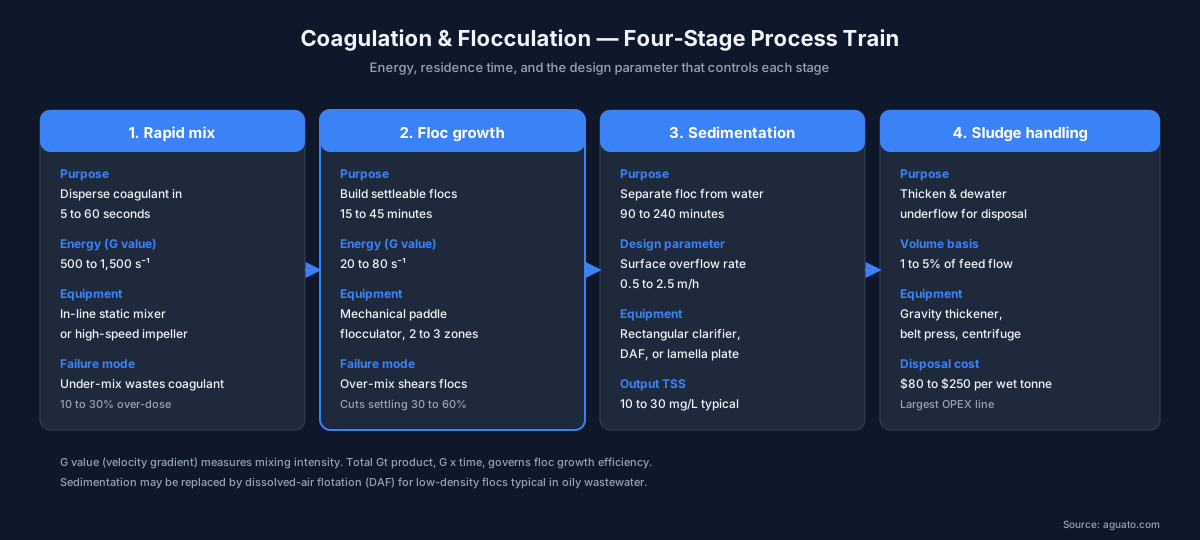
The diagram above maps each stage to its purpose, design parameters, equipment, and failure mode. A few non-obvious points carry the design:
The Gt product (G value × residence time) is the load-bearing design parameter for flocculation. A typical industrial flocculator targets a total Gt of 40,000 to 80,000 (e.g. G = 50 s⁻¹ × 1,200 s = 60,000). Below 30,000 the flocs do not grow large enough to settle; above 120,000 the flocs are over-mixed and shear-broken, defeating the purpose. Vendors that quote a flocculator without specifying G and t separately are leaving the design unconstrained.
Rapid mix energy is high, residence time is short. The point is to disperse coagulant before it hydrolyses. A typical rapid-mix tank has G = 700 to 1,200 s⁻¹ for 10 to 30 seconds. An in-line static mixer is often a better choice because it delivers consistent G across the flow range without the over-dosing buffer of a stirred tank.
Sedimentation surface overflow rate (SOR) is the design parameter that constrains tank size. A SOR of 1.0 m/h means 1 cubic metre of flow per square metre of clarifier per hour. Industrial coagulation-flocculation clarifiers run SOR of 0.5 to 2.5 m/h depending on floc density. A vendor that specifies SOR > 3 m/h on a low-density floc is undersizing the clarifier and the plant will have solids carryover the first time the load deviates from design.
Sludge handling is the OPEX surprise most procurement decks underestimate. Coagulation sludge from a 5,000 m3/day industrial plant produces 30 to 150 tonnes per month of wet underflow at 2 to 5% solids; after dewatering it is 5 to 30 tonnes of cake at 20 to 30% solids; disposal at $80 to $250 per wet tonne adds $30,000 to $90,000 per year to OPEX. The sludge stage typically consumes 20 to 35% of plant CAPEX and the same share of OPEX.
## Coagulant selection: five families compared
Five coagulant families dominate industrial duty: alum, ferric chloride, polyaluminium chloride (PACl), ferric sulfate, and cationic polymer coagulants. Each has a distinct chemistry envelope, cost profile, sludge signature, and risk pattern. The table below summarises the head-to-head comparison.
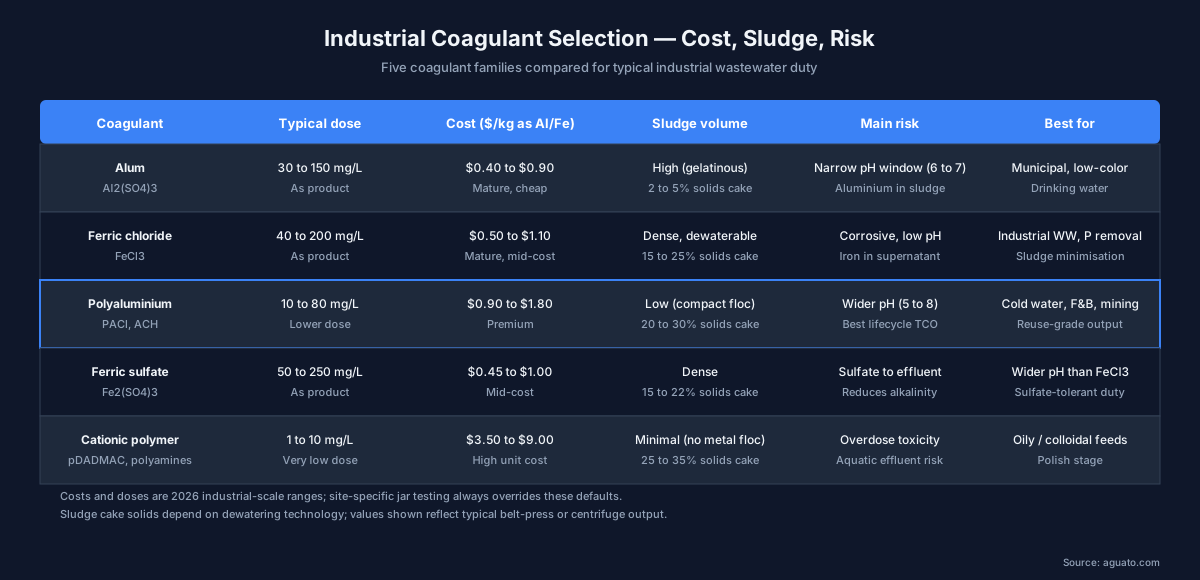
A pattern that recurs in industrial coagulation procurement: the buyer asks for "alum or ferric, whichever is cheaper" and accepts the vendor's recommendation without testing. That handoff misses the structural advantage of polyaluminium chloride (PACl) on industrial duty, which is one of the most under-utilised coagulants in the sector despite being demonstrably superior on 15-year TCO for most non-municipal applications.
Alum (aluminium sulfate) is the cheapest and most mature coagulant per kilogram of product. It is the default for municipal drinking water and produces predictable floc on low-color, low-organic feeds. Its weaknesses are a narrow pH window (6.0 to 7.0 for optimal floc), gelatinous high-volume sludge, and aluminium-residual concerns in any discharge or sludge land-application context. For industrial wastewater, alum is rarely the best answer; it is the cheapest answer measured wrong.
Ferric chloride (FeCl3) is the workhorse of industrial wastewater. It produces dense, dewaterable floc, operates effectively from pH 4 to 7, and handles oily and high-organic feeds better than alum. The trade-offs are corrosiveness (demands fibreglass or 316L stainless feed lines), [iron](/elements/iron) residual in the supernatant if dose is poorly controlled, and a higher unit cost than alum. For phosphorus removal in industrial wastewater, ferric chloride is the standard answer.
Polyaluminium chloride (PACl) and aluminium chlorohydrate (ACH) are the under-specified premium coagulants. They achieve equivalent or better turbidity and colour removal at 30 to 60% lower coagulant dose than alum, produce 20 to 40% less sludge per cubic metre treated, and operate effectively across a wider pH window (5.0 to 8.5). The CAPEX implication is smaller chemical storage, smaller sludge handling, smaller clarifier. The OPEX implication is a higher per-kilogram coagulant cost offset by lower dose and lower sludge disposal. On 15-year TCO for industrial duty, PACl wins more often than the default specification suggests.
Ferric sulfate (Fe2(SO4)3) is a softer-pH alternative to ferric chloride. Sludge characteristics are similar but the sulfate residual in the effluent can be a problem in any duty with downstream RO (sulfate fouls the membranes) or sulfate-limited discharge consent.
Cationic polymer coagulants (pDADMAC, polyamines) are specialty agents used at very low dose (1 to 10 mg/L) on oily or highly colloidal feeds where metal coagulants alone do not destabilise the dispersion. They produce minimal sludge and excellent floc but have a high per-kilogram cost and a real risk of aquatic toxicity if overdosed.
## Flocculant aids and polymer dosing
Flocculant aids are high-molecular-weight polymers (typically anionic polyacrylamide) added downstream of the coagulant to bridge destabilised particles into larger, denser, faster-settling flocs. Doses are typically 0.1 to 1.0 mg/L of active polymer. They are the smallest line in the chemistry budget and one of the largest levers on clarifier performance.
The polymer must be:
- Dosed downstream of the coagulant, after at least 5 to 15 seconds of contact time but before the flocculator - Mixed at low intensity (G = 30 to 60 s⁻¹) to avoid shearing the polymer chains - Specified by molecular weight and charge density appropriate to the floc chemistry, not a generic "polymer"
Vendors who specify only the trade name without disclosing the active polymer chemistry are leaving the buyer unable to qualify a second supplier later. The correct procurement language is "anionic polyacrylamide, molecular weight 10 to 20 million, charge density 10 to 30 mol%", with the trade name as a reference.
## Jar testing and dose optimisation
Jar testing is the gold-standard pre-design exercise for coagulation-flocculation. A typical jar test runs 4 to 6 simultaneous beakers at varied coagulant doses, evaluates floc formation visually and settled-water turbidity quantitatively, and identifies the dose that minimises chemical use while meeting the effluent target. A 2-day jar test campaign typically saves $30,000 to $120,000 per year in coagulant cost on a 5,000 m3/day plant.
The jar test protocol that survives industrial duty:
- Run jars across at least three doses spanning the manufacturer's recommended range - Repeat at the expected pH range and at the seasonal feed water extremes - Measure not just turbidity but COD, colour, phosphorus, and zeta potential where relevant - Validate the optimum at full scale in a 30 to 60-day commissioning campaign before locking the dose
The [American Water Works Association's standard methods for coagulant jar testing](dofollow:https://www.awwa.org/Publications) document the procedure and the parameters; following them produces a dose recommendation that can be defended in any capital review.
## Sludge production and the OPEX line operations teams miss
Sludge disposal is the largest OPEX line in most coagulation-flocculation plants after chemistry. A 5,000 m3/day plant dosing 80 mg/L alum produces roughly 2.5 to 4.5 tonnes per day of wet sludge at 3 to 5% solids; after dewatering to 20% solids it is 400 to 900 kg per day of cake; disposal at $150 per wet tonne is $20,000 to $50,000 per year just for the alum sludge from that one plant.
Sludge minimisation is the lever procurement teams routinely miss. Three structural levers:
- Coagulant selection. PACl produces 20 to 40% less sludge per cubic metre treated than alum at equivalent treatment performance. The lifetime sludge cost difference on a 5,000 m3/day plant is typically $200,000 to $500,000 over 15 years. - Dewatering technology. Belt presses dewater to 18 to 22% solids; centrifuges to 25 to 32%; filter presses to 30 to 40%. Higher dry-solids cake means lower wet tonnes hauled and lower disposal cost. CAPEX rises with dewatering performance; OPEX falls. - Reuse pathway. Coagulation sludge from food and beverage and pulp and paper duty can be land-applied if the trace metal content meets regulatory limits, displacing landfill cost. Sludge from heavy-metal-bearing industrial duty almost always lands in hazardous waste at $400 to $1,200 per tonne, doubling disposal OPEX.
The [EPA's industrial wastewater treatment manuals](dofollow:https://www.epa.gov/eg/effluent-guidelines-and-categorical-pretreatment-standards) cover coagulation sludge classification and disposal pathways by industry, and the same source notes that sludge disposal costs have risen 4 to 7% per year over the past decade across most US jurisdictions.
## Common design and operating errors
Five errors account for most underperforming coagulation-flocculation plants:
Error 1: No jar testing or stale jar test data. Plant designed on the basis of a 5-year-old characterisation; feed water has shifted; coagulant dose is structurally wrong; chemistry OPEX runs 30 to 80% above need.
Error 2: Wrong coagulant for the duty. Alum specified on oily or high-colour feed where ferric chloride or PACl would dominate; chronic underperformance, chronic over-dosing, chronic operator complaints.
Error 3: Under-designed flocculator. Gt product below 30,000 produces small flocs that carry over the clarifier; effluent TSS is 30 to 60% above design and operations adds polymer overdose to compensate.
Error 4: Wrong clarifier surface overflow rate for the floc density. Clarifier sized at 2.5 m/h SOR for a low-density floc that requires 1.0 m/h; solids carry over on every load deviation; the downstream stage receives intermittent slug loads.
Error 5: Underspecified sludge handling. Plant built to spec but with sludge thickening and dewatering at thin margins; within 18 months sludge volumes exceed design and the plant goes on emergency haulage at 2 to 3x normal disposal cost.
## How to specify the procurement
A procurement specification for coagulation-flocculation should fix five things: feed water characterisation across seasonal extremes, target effluent quality, sludge disposal pathway and cost basis, the four-stage Gt budgets, and the chemistry disclosure template (coagulant type with active component, polymer chemistry, dose ranges). With these fixed, vendors propose configurations that can be compared on a 15-year TCO basis.
The leverage in the procurement is in the pre-design jar test, the chemistry disclosure, and the sludge volume guarantee. A vendor who refuses to guarantee floc carryover above a stated SOR or refuses to guarantee a sludge volume per cubic metre treated is signalling that their design margin is thin. A vendor who agrees is signalling confidence in their own modelling. The procurement bond should reflect that. The [Water Environment Federation's manual of practice on coagulation and flocculation](dofollow:https://www.wef.org/resources/publications) is the standard procurement reference for buyers without internal process-design expertise and lets a procurement team write a defensible specification without leaning on a single vendor's proposal as the design basis.
## FAQ
### What is the difference between coagulation and flocculation?
Coagulation is the chemistry step that destabilises colloidal particles by neutralising their surface charge with a coagulant (alum, ferric chloride, PACl, polymer). Flocculation is the physical-kinetics step that follows; gentle mixing lets the destabilised particles collide and aggregate into settleable flocs. Coagulation happens in seconds with high-energy mixing; flocculation happens in tens of minutes with gentle mixing. Confusing the two leads to flocculators sized as coagulant tanks and vice versa, both of which fail.
### Which coagulant should I use for industrial wastewater?
It depends on the duty. For phosphorus removal or oily feeds, ferric chloride or ferric sulfate. For broad-pH industrial wastewater with reuse-grade output, polyaluminium chloride (PACl). For colloidal or hard-to-coagulate feeds where metal salts alone fail, cationic polymer at low dose. For municipal-like wastewater with predictable chemistry, alum is the cheapest option. Always validate the choice with jar testing on the actual feed water rather than defaulting to the most familiar product.
### How much coagulant does an industrial wastewater plant typically dose?
Typical doses are 30 to 250 mg/L of product depending on coagulant and feed strength. Alum 30 to 150 mg/L, ferric chloride 40 to 200 mg/L, ferric sulfate 50 to 250 mg/L, PACl 10 to 80 mg/L (lower because it carries a higher aluminium fraction), cationic polymer 1 to 10 mg/L (used at very low dose as a primary coagulant or coagulant aid). Jar testing on actual feed water is the only reliable way to determine the optimal dose for a specific plant.
### What is jar testing and why does it matter?
Jar testing is a bench-scale procedure where 4 to 6 beakers of feed water are dosed with different coagulant amounts, mixed under controlled conditions, and evaluated for floc formation and clarified-water quality. It identifies the coagulant dose that minimises chemistry cost while meeting the effluent target. A 2-day campaign typically saves $30,000 to $120,000 per year on a 5,000 m3/day plant by preventing the over-dosing that almost every plant operating without recent jar test data exhibits.
### How is the sludge from coagulation-flocculation handled?
Sludge from coagulation-flocculation is collected as clarifier underflow at 2 to 5% solids, thickened (gravity or centrifuge) to 5 to 8% solids, then dewatered (belt press, centrifuge, or filter press) to 20 to 40% solids cake. The cake is disposed to landfill (typical $80 to $250 per wet tonne), incinerated (if heavy-metal-bearing), or land-applied (if regulatory limits permit). Sludge handling typically consumes 20 to 35% of plant CAPEX and the same share of OPEX.
### Can coagulation-flocculation handle oily wastewater?
Partially. Coagulation can break stable oil-in-water emulsions and bring oil to the surface or to a settleable phase, but it is usually combined with dissolved-air flotation (DAF) rather than gravity sedimentation for oily wastewater because the flocs are buoyant. The coagulant of choice for oily feed is typically a metal salt (ferric chloride or PACl) followed by a polymer aid. For very high oil concentrations (>500 mg/L) an upstream gravity separator or API separator is needed before coagulation.
### How do I optimise coagulant dose to minimise sludge?
Three levers: switch to PACl from alum to reduce sludge volume by 20 to 40% at equivalent performance; jar-test regularly (quarterly or after any feed water change) to ensure dose is not above need; and invest in higher-performance dewatering (centrifuge or filter press) to reduce wet tonnes hauled. The combined effect on a 5,000 m3/day plant typically reduces sludge disposal OPEX by 30 to 50%, which is $30,000 to $100,000 per year in real money.