Hotel water treatment covers four high-risk systems simultaneously, and a single Legionella outbreak can cost $2 million in liability, remediation, and lost occupancy. The treatment programme that keeps guests safe and meets health authority standards without overspending.
Hotel water treatment is not a single system. It is four or five parallel treatment obligations running simultaneously in the same building, any one of which can generate a regulatory notice, a guest injury claim, or a Legionella outbreak that closes the property for weeks. A single confirmed Legionella outbreak in a hotel costs $2 million to $8 million on average when you add remediation, legal liability, reputational damage, and occupancy loss during investigation. That figure is not a theoretical worst case. Hotels in North America, Europe, and Australia have paid it. The operational logic that prevents it is straightforward, but it requires a water safety programme that actually runs, not one that lives in a binder.
Most hotel properties treat water safety as a facilities maintenance task. The ones that avoid major incidents treat it as an operational risk management discipline with defined parameters, monitoring frequencies, and escalation triggers. The difference between those two postures is measurable in insurance premiums, health authority inspection outcomes, and long-term brand value.
This guide covers all four major hotel water systems, the treatment programmes and compliance standards that govern each, and the failure modes that turn a manageable programme into a crisis. It is written for facilities managers, hotel general managers, and property owners who need to understand what they are running and what it costs when they are not running it correctly.
## The decision in brief
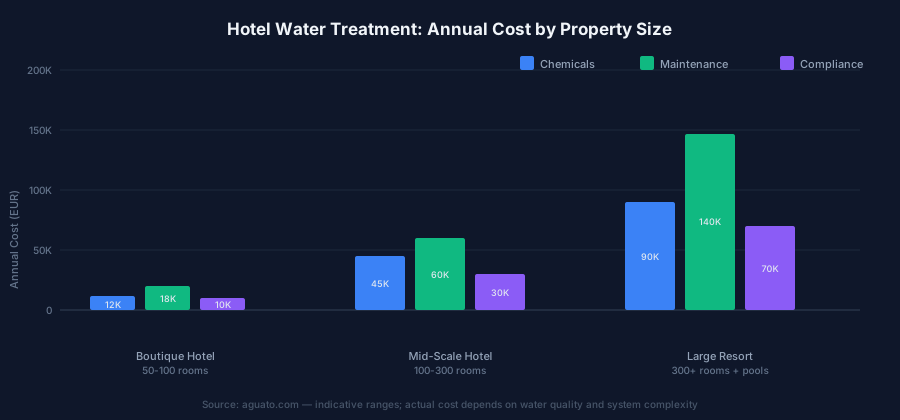
- Run the water safety programme correctly. A 200-room hotel with a rooftop cooling tower spends approximately $40,000 to $80,000 per year on chemicals, monitoring, maintenance and compliance testing across all four water systems. - A single confirmed Legionella outbreak costs millions. The average insurance claim is $2.5 million, a 14-day forced shutdown costs $350,000 to $700,000 in lost revenue, remediation costs $150,000 to $400,000 and legal fees run $200,000 to $800,000. - The reputational hit lasts 12 to 18 months. Occupancy falls by 10 to 25% for 12 to 18 months after the incident, on top of the direct costs, and the programme costs less than 3% of the minimum outbreak cost.
The maths are unambiguous: the programme costs less than 3% of the minimum outbreak cost, and every year it is underfunded that ratio worsens.
## Why hotel water treatment is a distinct discipline
Hotels face a water treatment challenge that most industrial facilities do not: high occupant turnover, variable usage patterns, a guest population that includes immunocompromised individuals who are more susceptible to waterborne illness, and regulatory scrutiny from both public health authorities and international hotel brand standards. A food processing plant with a compromised disinfection system faces a compliance exceedance. A hotel with the same problem faces a guest health incident.
The water systems in a typical mid-scale hotel, 150 to 300 rooms, a pool, a kitchen, and cooling for HVAC, include: a cold-water storage and distribution system, a hot-water generation and circulation system, one or more cooling towers, a swimming pool or spa, a boiler plant for heating and laundry, and potentially a water softener or reverse osmosis system serving the kitchen or laundry. Each system has its own treatment chemistry, monitoring regime, and regulatory framework.
What makes hotel water treatment genuinely complex is the interaction effects. A cold-water main pressure drop that causes stagnation in a guest floor riser creates Legionella risk in the hot water system as well, because thermostatic mixing valves lose their set-point at low flow. A cooling tower that runs with inadequate blowdown concentrates total dissolved solids, which accelerates corrosion and creates biofilm conditions that amplify Legionella risk in the HVAC system. These interactions mean a hotel water safety programme that manages each system in isolation will still fail at the points where they intersect.
Understanding [industrial water risk assessment](/resources/industrial-water-risk-assessment) methodology, developed for complex facilities, is directly applicable to hotel water management. The risk-based approach used in large industrial sites, identifying the highest-risk points, setting control parameters, and monitoring for deviations, is exactly the framework that health authorities require hotels to follow.
## Cooling towers and Legionella compliance
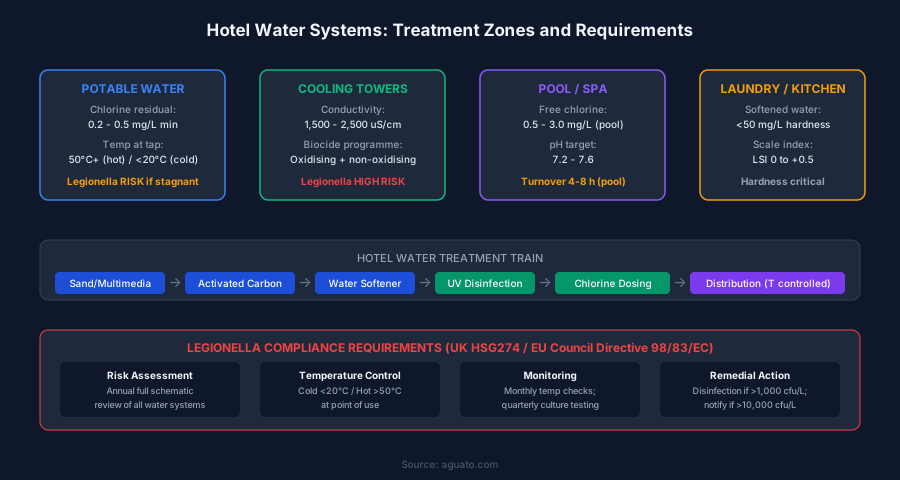
Cooling towers are the highest-risk water system in most hotels because they combine warm water (22 to 45 degrees Celsius, which is the growth range for Legionella pneumophila), a constant supply of nutrients from corrosion products and atmospheric dust, and aerosolisation that carries bacteria into the air around the building. A cooling tower serving a hotel's central HVAC system can produce aerosols that reach guests on balconies, in nearby corridors, and in car parks within 300 metres of the tower.
The treatment programme for hotel cooling towers has four components. Scale and corrosion inhibition keeps the heat-transfer surface clean and prevents the corrosion products that feed biofilm. Blowdown control manages the cycles of concentration, typically targeting conductivity between 1,500 and 2,500 microsiemens per centimetre, which limits the salt concentration that drives corrosion and scaling. Biocide treatment uses an oxidising biocide such as [chlorine](/elements/chlorine) or bromine continuously, supplemented by a non-oxidising biocide on a rotational programme to prevent biocide tolerance. Legionella monitoring requires quarterly culture testing of cooling tower water and immediate action if counts exceed 1,000 colony-forming units per litre, with notification to the health authority if counts reach 10,000 cfu/L.
[cta:nepti-dark]
According to [UK Health and Safety Executive guidance HSG274 on Legionella control](dofollow:https://www.hse.gov.uk/legionnaires/what-you-must-do.htm), duty holders must appoint a competent person responsible for the water safety programme, maintain written risk assessments, and keep records of all monitoring, chemical additions, and maintenance activities. This applies to any organisation that operates a cooling tower, which in the UK means mandatory registration with the local authority.
The [WHO guidelines on Legionella and the prevention of legionellosis](dofollow:https://www.who.int/publications/i/item/9241562978) establish the international evidence base for cooling tower management, and they make a point that facilities managers often miss: the risk is not just from poorly maintained towers, but from correctly maintained towers that develop a localised biofilm in a dead-leg or a low-flow section. Temperature and biocide monitoring alone will not detect a biofilm colony in a stagnant section of pipework that occasionally sloughs off into the main flow.
A [legionella risk assessment](/resources/legionella-risk-assessment) for a hotel must include a full schematic of all water systems, identifying every dead-leg, every infrequently used outlet, every section where flow is intermittent, and every water feature that aerosolises water. The risk assessment drives the written scheme of control, and the written scheme drives the monitoring and maintenance programme. Without the full schematic, the risk assessment is guesswork.
The practical minimum for cooling tower treatment in a hotel is: automated chemical dosing with a conductivity controller and biocide timer, monthly inspections including deposit and biofilm checks, quarterly Legionella culture tests, and an annual physical clean and disinfection. Properties with multiple towers or towers sited near guest-occupied areas should run monthly rather than quarterly Legionella culture tests and should maintain continuous monitoring of key parameters via an online controller.
## Swimming pool and spa water treatment
Hotel pools and spas have different treatment requirements and different failure modes, and treating them as the same system is a reliable path to bather skin and eye problems, regulatory failures, and in the case of spas, a secondary Legionella risk.
For a hotel pool, the primary treatment parameters are: free chlorine residual of 0.5 to 3.0 mg/L (or bromine at 3 to 5 mg/L for indoor pools), pH maintained between 7.2 and 7.6 (outside this range, chlorine disinfection efficiency falls sharply), alkalinity of 80 to 150 mg/L as CaCO3 for pH stability, and [calcium](/elements/calcium) hardness of 200 to 400 mg/L to protect pool surfaces and equipment. Turnover time, the rate at which the entire pool volume passes through filtration and treatment, should be 4 to 8 hours for a hotel pool depending on bather load.
The single most common reason hotel pools fail health authority inspections is insufficient turnover rate, not inadequate chlorine dosing. A pool that turns over in 4 hours at low bather load will fail to maintain chlorine residual at high bather load if the turnover rate is not maintained, because each bather introduces 1 to 2 grams of nitrogen compounds that react with and destroy free chlorine. The treatment programme needs to account for peak bather load, not average bather load.
Spas and hot tubs operate at 36 to 40 degrees Celsius, which dramatically accelerates chlorine decay, evaporation, and organic contamination from bather load. Spa water turnover times should be 30 minutes or less, requiring much higher flow rates than a pool relative to volume. Legionella in spa water is a genuine risk because the aerosolisation is intense (jets and bubble systems) and the temperature is within the growth range. Many jurisdictions require dedicated Legionella monitoring for hotel spas in addition to pools.
For [water disinfection methods](/resources/water-disinfection-methods-comparison) in pools, the practical choice is between chlorine-based chemistry, UV plus chlorine, and, in some markets, ozone plus chlorine. UV and ozone both reduce the chlorine demand significantly, which reduces combined chlorine (chloramine) formation, which is the cause of the distinctive smell and eye irritation associated with poorly managed pools. For a hotel pool, a UV system with a low residual chlorine level (0.5 to 1.0 mg/L) gives the best guest experience and the lowest chemical usage. The additional capital cost of UV, typically $8,000 to $25,000 depending on pool volume, pays back in lower chemical costs and fewer bather complaints within 3 to 5 years.
## Potable water and building distribution
Hotel potable water must meet the same quality standards as any public water supply at the point of delivery, but the building distribution system introduces risks that the municipal supply does not. The most significant are temperature-related Legionella growth and chemical contamination from old pipework.
The key temperature rules are: hot water storage at 60 degrees Celsius minimum, hot water at all taps within 1 minute at a minimum of 50 degrees Celsius, and cold water at storage and throughout distribution at less than 20 degrees Celsius. The zone between 20 and 45 degrees Celsius is the Legionella growth zone. A building distribution system that allows hot water to cool in infrequently used guest room risers, or cold water to warm in a plant room near hot services, is creating Legionella conditions.
The problem of stagnant pipework is not unique to old hotels. New-build hotels with long dead-legs serving rooms that were taken out of service, or with oversized cold-water storage tanks sized for peak occupancy that sit half-full at low occupancy, have the same risk as older buildings with legacy pipe layouts. The risk assessment and the written scheme of control must address flow management as well as chemistry.
For hard-water areas, building softeners serving guest rooms and kitchens prevent scale in shower heads, which is not only an aesthetic issue but a hygiene issue: scale inside shower heads creates the surface area for biofilm growth and protects Legionella from disinfection. [Industrial water quality testing](/resources/industrial-water-quality-testing) protocols, adapted to the hotel context, are the correct approach for monitoring chemical and microbiological quality across a complex distribution system.
The [CDC guidance on building water systems](dofollow:https://www.cdc.gov/legionella/wmp/index.html) provides a practical framework for developing a hotel water management plan, covering device inventory, control measures, monitoring, and documentation requirements. Following this framework is no longer optional in the United States for facilities that serve vulnerable populations, including hotels, which legally defines as anyone who may be more susceptible to infection.
## Water softening, filtration, and specialty treatment
Water softening is not just a comfort issue in hotels; it is a maintenance economics issue with a quantifiable return. A hotel in a hard-water area, typically hardness above 200 mg/L calcium carbonate, without central softening or point-of-use treatment will experience premature failure of guest room fixtures, scale build-up in shower heads that creates Legionella risk, scaling of heat exchangers in the pool heating system, and accelerated replacement cycles for laundry equipment and kitchen appliances.
The standard approach for hotels in hard-water areas is a central twin-vessel softener on the incoming cold main, sized to handle the peak demand flow rate, with a bypass for the irrigation system (plants benefit from calcium and magnesium) and the fire system (softened water can be corrosive to dry-pipe sprinkler systems). A properly designed centralised softener for a 250-room hotel with a pool and laundry typically treats 20 to 40 cubic metres per hour at peak demand, with a softener vessel each side of 1,500 to 2,500 litres of resin volume and brine regeneration every 1 to 3 days.
For specific applications where very high-quality water is needed, reverse osmosis provides the additional reduction in dissolved solids that softening alone cannot achieve. Coffee machines, steamers, ice machines, and high-specification spa treatments all benefit from RO water in the range of 50 to 150 mg/L total dissolved solids, with stable low hardness. The operational cost of RO at a hotel scale is modest: energy is typically 0.3 to 0.5 kWh per cubic metre and membrane replacement is every 3 to 5 years.
For properties with ornamental water features, fountains, and decorative pools in lobbies or public areas, these systems are often overlooked in water treatment audits. They represent significant Legionella risk because they aerosolise water in guest areas and are often operated at temperatures between 15 and 25 degrees Celsius, exactly the growth zone. Any decorative water feature that creates aerosol or spray must be included in the Legionella risk assessment and managed with appropriate biocide dosing and temperature monitoring. The instinct to treat them as decorative features rather than water systems is consistently a mistake.
Understanding [chemical dosing and control systems](/resources/chemical-dosing-control-systems) is directly relevant to the automated dosing infrastructure that a hotel water treatment programme requires. Reliable automated dosing with appropriate alarms is the difference between a programme that runs reliably and one that depends on staff remembering to add chemicals manually.
## Boiler and HVAC water treatment
Hotel boilers serving space heating and laundry operate at much lower pressure than industrial steam systems, typically below 10 bar, but they still require proper water treatment to prevent scale and corrosion. Scale of 1mm on boiler heat-transfer surfaces increases fuel consumption by approximately 7 to 10%. A hotel boiler operating 365 days a year with 1mm of scale is wasting $8,000 to $25,000 in fuel annually, depending on hotel size and energy costs.
The treatment programme for hotel boilers covers: feedwater softening or deaeration to reduce scale-forming ions and dissolved oxygen, internal corrosion inhibitor dosing, and regular blowdown to control dissolved and suspended solids concentration. The key water quality targets are hardness below 10 mg/L in the feedwater, pH in the boiler water of 10.5 to 12.0, and conductivity management through blowdown. For hotels using direct-fired hot-water systems rather than steam boilers, closed-circuit corrosion inhibitor treatment for the heating circuits is the primary need.
For [HVAC water treatment](/resources/hvac-water-treatment), the chilled water circuit serving air-handling units typically uses closed-circuit treatment, inhibitor dosed at 2,000 to 3,000 mg/L and pH maintained at 8.5 to 10.0 to protect the ferrous and non-ferrous metals in the circuit. A chilled water circuit that runs without inhibitor treatment will show visible red discolouration from iron corrosion within 12 to 18 months, and the corrosion products will foul heat-exchanger surfaces within 2 to 3 years, reducing cooling efficiency by 15 to 30%.
## Laundry and kitchen water treatment
Hotels with in-house laundry operations, and most resort properties do, require softened water for washing and rinsing. Hard water above 150 mg/L calcium carbonate reduces detergent efficiency by 20 to 40%, increases chemical consumption to compensate, leaves mineral deposits on linen that cause premature fabric degradation, and scales laundry equipment requiring early replacement. A 200-room hotel with in-house laundry processing 500 to 800 kilograms of linen per day will save $15,000 to $40,000 per year in detergent and equipment maintenance costs by softening the laundry water.
For kitchen applications, reverse osmosis or carbon filtration is used for ice machines, coffee and espresso machines, and steam ovens. Hard water in espresso machines causes scale build-up in boilers and group heads, requiring descaling every 3 to 6 weeks and replacing internal components every 12 to 18 months. A proper water treatment point at each machine extends machine life by 3 to 5 years and reduces service callout costs significantly.
Understanding [how to choose the right industrial water treatment](/resources/how-to-choose-industrial-water-treatment) approach is directly applicable here. The principle is the same whether for a large industrial process or a hotel laundry: characterise the source water, identify the contaminants that drive the treatment cost, and size the system to handle peak demand, not average demand.
## Managing water treatment across multiple properties and ownership structures
Hotels that are part of international brands or managed under franchise agreements face an additional complexity: brand standards that set minimum water quality and safety requirements, audit processes that verify compliance, and potential franchise termination clauses if health authority enforcement actions occur. Understanding what those brand standards require and building a property-level programme that meets them, rather than the regulatory minimum, is the correct approach for branded properties.
For independently owned hotels or properties under management agreements, the responsibility for the water safety programme rests with the property owner as the duty holder. Management companies typically provide operational oversight but the legal liability for health authority enforcement, personal injury claims, and property regulatory compliance falls to the property owner unless the management agreement explicitly transfers it. This distinction is not always clear at the property-management contract stage and has caused significant disputes when a water-related incident occurs.
Portfolio management of water treatment across multiple properties requires a centralised approach to programme standards, chemical procurement, and monitoring records. Properties that manage each site in isolation, with different contractors, different chemical programmes, and different monitoring formats, cannot demonstrate portfolio-level compliance and cannot aggregate the data needed to identify systemic issues across the estate. A central water safety management function, even if it is a single dedicated person reviewing standardised reports from site contractors, is cost-effective for portfolios above 5 to 10 properties.
The [water treatment pilot project](/resources/water-treatment-pilot-project) framework is applicable when a property owner wants to evaluate a new water treatment approach, a new chemical programme, or a new technology for one or more of the hotel water systems before committing to a wider rollout. Running a controlled trial on one property before standardising across a portfolio reduces the risk of a programme change that improves one system while degrading another.
## Where hotel water programmes fail
The failure modes in hotel water management are consistent across property types and geographies. They are almost never technical failures in the equipment itself. They are programme failures, where the water treatment system exists but the monitoring, maintenance, and escalation protocols are either not defined, not followed, or not funded.
Failure mode 1: Paper compliance. The written scheme of control is completed once by a water hygiene consultant and filed. Monitoring records are completed by facilities staff who understand the recording requirement but not the significance of the results. The programme exists on paper. It does not exist in practice. This is the most common failure mode and the one that leads to health authority enforcement action, because it is visible in any audit that compares recorded results against building system reality.
Failure mode 2: Occupancy-driven neglect. During low-occupancy periods such as winter for beach resorts or weekdays for conference hotels, guest rooms sit unused for days or weeks, and the potable water system stagnates. Return to high occupancy flushes the stagnant water without prior disinfection. The risk window is the first 48 to 72 hours of high occupancy after a long low-occupancy period.
Failure mode 3: Chemical programme complacency. The cooling tower chemical dosing programme was set up and commissioned correctly. Over time, the dosing pump calibration drifts, the chemical tank runs dry during a weekend, the biocide programme stops being alternated because it requires manual intervention. The programme degrades incrementally until a monitoring result reveals a problem that has been developing for months.
Failure mode 4: Underfunding. Hotel water treatment is classified as a cost centre, not a capital investment. Annual programme costs are squeezed during low-occupancy periods. The monitoring frequency is reduced. The annual physical clean of the cooling towers is deferred. The first evidence of the problem is a positive Legionella culture result at 5,000 cfu/L, which triggers an immediate shutdown, emergency treatment, and a health authority investigation that costs 10 to 20 times what the deferred maintenance would have cost.
[Browse water treatment providers who specialise in hotels and commercial buildings](/providers) to find contractors with demonstrable experience in hospitality water safety, not just industrial water treatment.
## FAQ
### What are the main water treatment risks in a hotel?
The four primary risks are Legionella in cooling towers and hot water systems, pool chemistry failures that cause bather illness, scale and corrosion in boilers and HVAC circuits that damage equipment and reduce efficiency, and potable water quality issues in building distribution systems. Legionella carries the greatest liability exposure because it can cause serious respiratory illness in guests. A comprehensive water safety programme that covers all four systems simultaneously, with defined control parameters, monitoring frequencies, and escalation procedures, is the minimum standard that health authorities and international hotel brands now require as a condition of operation and franchise agreement.
### How often should cooling tower water be tested for Legionella?
At minimum, quarterly culture tests are required under most national frameworks including UK HSG274. Hotels with towers near guest areas, multiple towers, or a previous positive result should test monthly. A proactive programme also includes continuous pH and biocide residual monitoring and monthly physical inspections.
### What temperature should hotel hot water be stored and distributed at?
Hot water should be stored at a minimum of 60 degrees Celsius and delivered at every outlet within 1 minute at a minimum of 50 degrees Celsius. Cold water should be maintained below 20 degrees Celsius throughout distribution. The zone between 20 and 45 degrees Celsius supports Legionella growth and must be eliminated through correct temperature management.
### What is the correct chlorine level for a hotel swimming pool?
Free chlorine should be maintained between 0.5 and 3.0 mg/L at a pH of 7.2 to 7.6. At pH above 7.6, chlorine becomes significantly less effective as a disinfectant. For spas operating at 36 to 40 degrees Celsius, higher chlorine residuals are needed because of accelerated decay, and turnover time should be 30 minutes or less.
### How much should a hotel budget for water treatment per year?
A 200-room hotel with a pool, cooling tower, and in-house laundry should budget $40,000 to $80,000 per year for a complete water safety programme covering all systems. A boutique property without cooling towers or a pool can manage with $20,000 to $40,000. Large resort properties with multiple pools and cooling systems often spend $150,000 to $300,000 per year on water treatment and compliance.
### Is hotel water treatment regulated differently from industrial water treatment?
The regulatory framework is different but the technical principles are the same. Hotels are governed by public health legislation (the duty to protect guests from waterborne illness) and, in most jurisdictions, specific Legionella control legislation rather than environmental discharge regulations. The [water quality testing](/water-quality-testing) requirements, monitoring frequencies, and record-keeping obligations are typically more prescriptive than for industrial sites because of the public-facing nature of the property.