Ceramic membranes cost 5 to 10x more than polymeric on Day 1 but often win on 15-year TCO in oily, hot, and aggressive-CIP duty. Here is the property comparison and procurement framework to pick the right one.
The ceramic vs polymeric membrane decision is a 15-year financial commitment dressed up as a technology choice. A 1,000 m3/day ultrafiltration skid built with polymeric modules costs $180,000 to $320,000 to install. The equivalent duty in ceramic costs $550,000 to $900,000 on Day 1 and runs for 20+ years without replacement. The right answer is almost never obvious from the price tag. On clean municipal feed water the polymeric system delivers the lowest 15-year TCO. On oily refinery effluent or hot CIP recovery it delivers a slow-rolling cost overrun that nobody booked into the capital case.
The default specification across the membrane industry is polymeric, because vendors who sell polymer modules outnumber ceramic specialists 10 to 1 in most markets, because procurement teams default to the lower CAPEX number when proposals look interchangeable, and because the cost-of-failure data that justifies ceramic is locked inside operating sites rather than in vendor brochures. That information asymmetry is what this article exists to correct.
This guide gives engineering, operations, and procurement teams the working framework for matching membrane material to duty: the eight properties that diverge between ceramic and polymeric, the five application classes where each material wins, the 15-year TCO math that compounds the difference, the failure modes that turn a wrong-material decision into a CFO conversation, and the procurement structure that protects the buyer from being sold the vendor's preferred product rather than the site's right product.
## The decision in brief
- Specify the membrane material on 15-year TCO discipline, not CAPEX-only procurement. Done that way, you typically save $400,000 to $1.2 million on a 500 m3/day duty across the asset's life, split three ways. - Price the replacement cycles and the premature failures. $200,000 to $500,000 of the saving is avoided polymeric replacement cycles when ceramic genuinely wins, and a further $100,000 to $300,000 is avoided premature-failure capital when the duty conditions disfavour the default specification. - Match the cleaning regime to the material. The remaining $100,000 to $400,000 of the saving is CIP chemistry and downtime cost, which is avoided when the cleaning regime is matched to the material in service.
The biggest cost of doing nothing is letting the vendor with the larger sales footprint frame ceramic as exotic and polymeric as standard, even where the lifecycle math runs the other way.
## Ceramic vs polymeric: what the two materials actually are
A ceramic membrane is a multi-channel monolith of inorganic oxide material (typically aluminium oxide, titanium dioxide, zirconium dioxide, or silicon carbide) sintered at 1,200 to 1,600 °C into a rigid porous structure with engineered pore size. A typical module is a 1-metre-long tube with 19 to 151 internal flow channels, total membrane area 0.5 to 9 m² per module, and a price per square metre of $800 to $2,500 installed.
A polymeric membrane is a thin film of organic polymer (typically polyvinylidene fluoride, polyethersulfone, polysulfone, polyacrylonitrile, or cellulose acetate) cast on a non-woven support or extruded as a hollow fibre. A typical hollow-fibre module contains 8,000 to 25,000 fibres of 0.5 to 2 mm diameter, total membrane area 25 to 70 m² per module, and a price per square metre of $60 to $250 installed.
The two materials look like substitutes on a process flow diagram. They are not. Their failure modes, cleaning chemistry tolerance, service life, and capital cost differ by factors of 5 to 20. A vendor that compares them on price per cubic metre of permeate output for the first year of operation is leading the buyer to a wrong conclusion the procurement committee will not see for a decade.
The closest cousin technology for context is described in our [ceramic membranes article](/resources/ceramic-membranes), which covers ceramic-only mechanics, the four channel-density formats, and the duty bands where ceramic alone wins. The current article focuses specifically on the head-to-head decision against polymeric and the duty conditions that flip the answer.
[cta:nepti-dark]
## The eight properties that diverge between materials
Before the table summarises the eight properties, three framing points anchor what the comparison is actually about. First, ceramic and polymeric are not interchangeable formats of the same product; they are different physical objects that happen to occupy the same plant unit. Second, the comparison only makes sense over a 15-year horizon because the structural cost differences (replacement frequency, CIP tolerance, sustainable flux) compound year-over-year and are invisible at the procurement table. Third, the property bands quoted below are the operating reality across hundreds of industrial installations, not the design spec sheet from a single vendor.
A vendor proposal that compares Day-1 price per cubic metre of permeate output for the first year of operation is hiding 90% of the lifecycle cost. The hidden 90% is the difference between a procurement decision made on a CAPEX spreadsheet and a decision made on a 15-year operating model that the operations team will actually live with. The eight properties below are the leverage points where the two models diverge. Treat them as the minimum input set the procurement deck must contain before approving a capital release for the membrane skid.
The eight properties were selected because each one independently shifts the 15-year TCO by more than 5%. Properties that affect the decision by less than 5% (module weight, installation labour, instrumentation overhead) are real but not load-bearing in the procurement decision and are excluded from the headline comparison. Each row maps a property to the typical performance band of ceramic and polymeric and the material that holds the edge on that dimension. Where a property is duty-dependent (sustainable flux varies with feed water; CIP frequency varies with operations discipline) the numbers reflect the median industrial case rather than best- or worst-case operations.
A pattern that recurs in industrial procurement: the property table below converts a "which is better" debate into a "which dominates for this duty" calculation. Five of the eight rows favour ceramic on durability and operating envelope; two favour polymeric on energy and CAPEX; one is a tie on output quality at design flux. The structural shape of the comparison is consistent across every industrial application class. What changes from project to project is how heavily each row is weighted. A refinery weighs thermal range and chemical tolerance heavily; a municipal RO pre-treatment weighs CAPEX and surface-area scalability heavily. The buyer's job is to define those weights against the actual duty conditions before the vendor proposals arrive, not after.
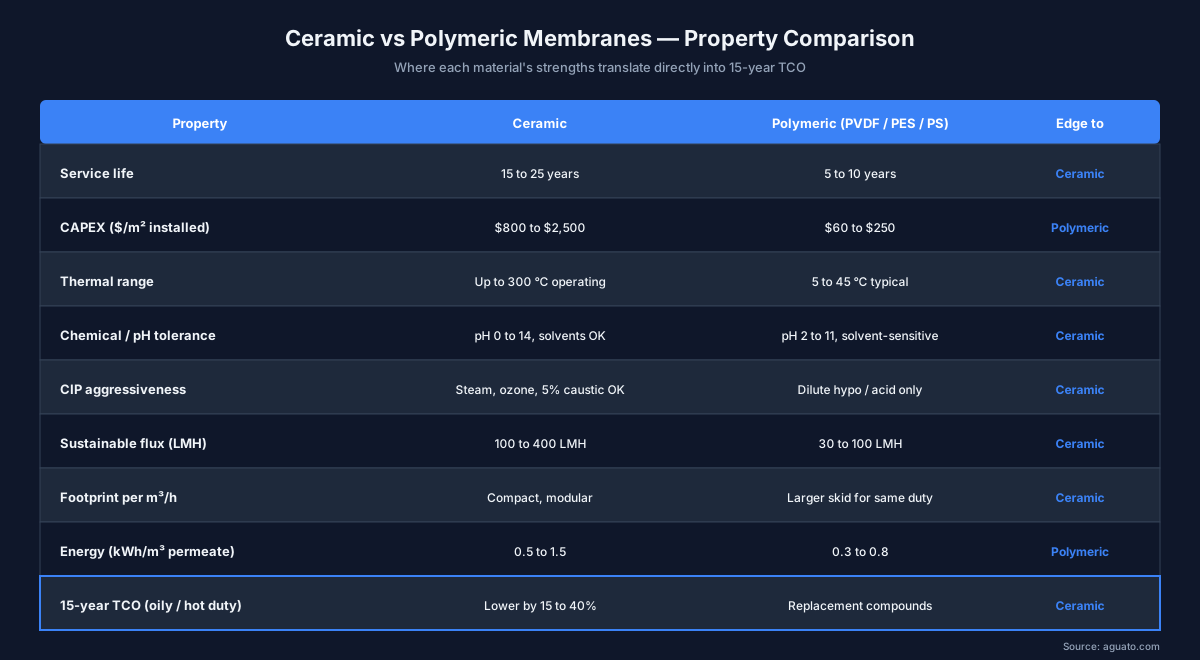
The eight properties cluster into three groups that the procurement decision turns on:
Durability cluster (favours ceramic): service life, thermal tolerance, chemical resistance, CIP aggressiveness. Ceramic outlives polymer by a factor of 2 to 4 in the same duty. A polymeric module that replaces every 6 years against a ceramic that replaces every 20 years buys you three replacement cycles you do not pay for. At $100,000 to $300,000 per replacement cycle on a 1,000 m3/day duty, the OPEX disparity is real money.
Performance cluster (mixed): sustainable flux favours ceramic by 2 to 4x (100 to 400 LMH vs 30 to 100), but energy per cubic metre of permeate slightly favours polymeric (0.3 to 0.8 kWh/m3 vs 0.5 to 1.5). The energy gap matters most in 24x7 high-utilisation plants; the flux gap matters most in footprint-constrained sites where the ceramic skid is 50 to 75% smaller.
Capital cluster (favours polymeric): Day-1 CAPEX is the polymer's structural advantage. A 1,000 m² UF duty costs $200,000 in polymer modules versus $1.2 million in ceramic. The polymer's CAPEX advantage is real and almost always wins the procurement if the buyer measures the wrong thing. The procurement framework section below addresses how to measure the right thing.
The [International Water Association's journal of water reuse and desalination](dofollow:https://iwaponline.com/jwrd) publishes field data showing that ceramic adoption in industrial wastewater and produced water treatment has roughly tripled between 2015 and 2024, driven primarily by lifecycle cost arguments in oily and high-temperature applications.
## When ceramic membranes win, when polymeric wins
The eight properties translate into five application classes where ceramic wins and five where polymeric wins. The duty conditions that flip the recommendation are concrete and operationally measurable: feed water temperature, oil content, solvent presence, fouling-rate trajectory, footprint constraint, and operator skill profile. None of these are ambiguous. A site engineer can collect each of the six inputs in a half-day characterisation campaign and present the procurement decision deck with the answer pre-computed.
Vendors typically frame the decision as a technology preference rather than a duty match. That framing is wrong by construction. The application classes below were derived from observed lifecycle outcomes across hundreds of industrial sites, not from material-supplier marketing. The duty conditions that drive the recommendation are causal, not correlative: a polymer module that operates above 60 °C continuously will lose flux and integrity within months regardless of the brand or the operating team; a ceramic module run in a benign drinking-water polishing duty will outperform on permeate quality but will leave most of its $1,000-per-m² investment unused for the life of the asset.
The diagram below maps the duty conditions to the material recommendation. Use it as the first reference point in any vendor conversation; a vendor whose recommendation contradicts the duty profile on more than one dimension is signalling that they are selling product, not solving a problem.
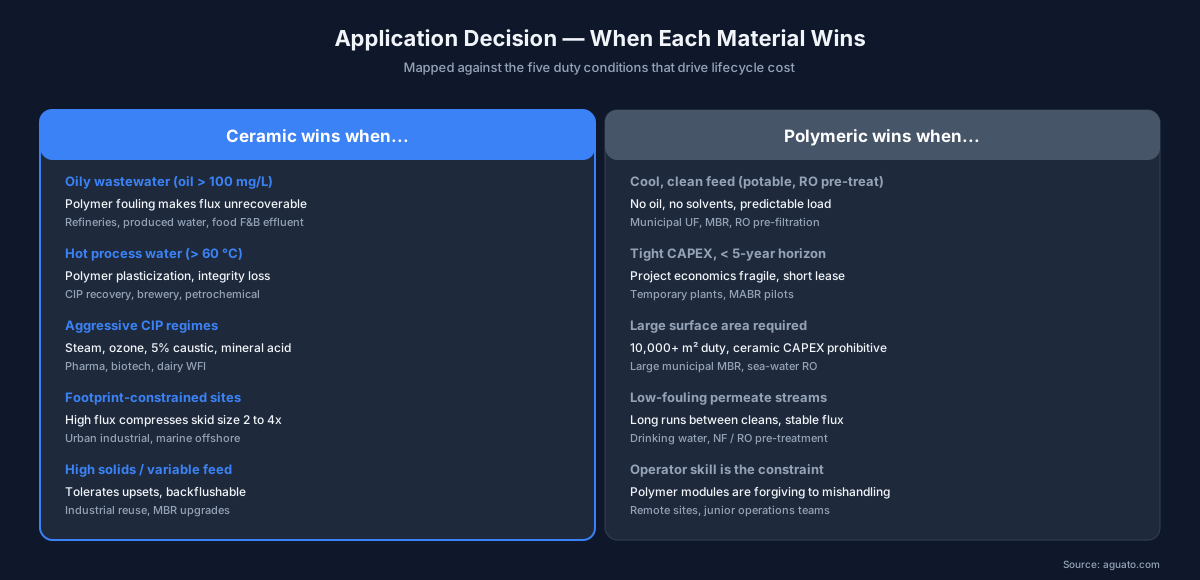
Ceramic wins when at least one of the following is true: the feed water contains free or emulsified oil above 100 mg/L (refinery effluent, produced water, food and beverage waste streams); process temperature is above 60 °C either continuously or in CIP recovery (brewery, pharma, petrochemical); the cleaning regime requires steam, ozone, or 5% caustic at elevated temperature (high-purity dairy, biotech, pharmaceutical); the site is footprint-constrained and a 2 to 4x compression of skid size is worth the CAPEX premium (urban industrial, marine offshore platforms); or the feed water is highly variable in solids load and a backflushable, upset-tolerant module is needed (industrial reuse, MBR retrofits on existing tanks).
Polymeric wins when at least one of the following is true: the feed water is cool (below 45 °C) and clean (oil <50 mg/L, no solvents) such as in municipal UF or RO pre-treatment; the project economics are fragile, the lease is short, or the asset must depreciate over 5 years; the duty requires more than 10,000 m² of installed surface area where ceramic CAPEX becomes prohibitive (large municipal MBR, seawater RO pre-treatment); the permeate stream is intrinsically low-fouling, with long stable runs between cleans (drinking water, NF or RO pre-treatment downstream of clarification); or the operations team is junior or remote and the cleaning regime needs to be forgiving rather than aggressive.
The grey area between the two lists is real. A site that has two of the five ceramic-win conditions and two of the five polymeric-win conditions is exactly the project where a vendor's preference wins the procurement and the buyer pays for the bias for 15 years. That is the case that demands a structured TCO comparison rather than vendor advocacy.
## 15-year TCO math: how the materials compound over time
The 15-year total cost of ownership comparison is where the material decision earns or loses its money. The table below normalises three typical duty cases to a 500 m3/day basis (1,000 m² installed surface area at sustainable flux) in 2025 USD and projects the 15-year TCO for each.
| Duty case | Material | CAPEX | Replacement cycles | 15-yr energy | 15-yr CIP | 15-yr TCO | |---|---|---|---|---|---|---| | Cool clean RO pre-treat | Polymeric | $200K | 2 ($100K each) | $310K | $90K | $800K | | Cool clean RO pre-treat | Ceramic | $1.2M | 0 | $470K | $60K | $1.73M | | Hot CIP recovery (60+ °C) | Polymeric | $200K | 4 ($150K each) | $370K | $260K | $1.43M | | Hot CIP recovery (60+ °C) | Ceramic | $1.2M | 0 | $450K | $130K | $1.78M | | Oily produced water | Polymeric | $250K | 5 ($180K each) | $380K | $440K | $1.97M | | Oily produced water | Ceramic | $1.3M | 0 | $480K | $180K | $1.96M |
A few non-obvious patterns drop out of this comparison. On a cool, clean, low-fouling duty, polymeric wins by roughly $930,000 over 15 years on a 500 m3/day duty. Ceramic is genuinely overspecified for this case and any vendor pushing ceramic into a municipal UF pre-treatment role is selling features the buyer will not use. On a hot CIP-recovery duty the materials cross at roughly year 11 and ceramic edges polymeric by $350,000 over the full horizon. On an oily produced-water duty the materials converge to roughly the same 15-year TCO, but with very different cash-flow profiles: ceramic front-loads the CAPEX; polymeric back-loads it into a 5-year replacement cycle that operations teams routinely under-budget.
The CIP cost line is the one most often missed. Polymeric modules in fouling-intensive duty need 30 to 60 CIP cycles per year, each cycle consuming $200 to $500 in chemistry and 4 to 12 hours of plant downtime. Ceramic in the same duty needs 8 to 20 CIPs per year and tolerates aggressive in-place steam or ozone regimes that polymer cannot survive. The 15-year cumulative CIP cost difference is typically $200,000 to $500,000 on a 500 m3/day duty, which is the chunk of money that surfaces in operations year 6 to 10 and reshapes the lifecycle case after the fact.
## Failure modes specific to each material
Each material has a characteristic failure mode pattern that procurement teams should know before specifying. Knowing the failure modes is the cheapest way to evaluate a vendor: a vendor who cannot describe the failure modes of their own product in plain language is the vendor whose project goes sideways.
Polymer failure modes include flux decline that does not recover after CIP (typically caused by foulant penetration into the polymer matrix), fibre breakage on hollow-fibre modules (often after 4 to 6 years of cumulative stress from gas-flush backwashes), integrity loss after exposure to incompatible chemistry (chlorine for PES, hydrocarbons for PVDF, high pH for cellulose-based films), and slow plasticization at sustained temperatures above 45 °C that turns a 10-year design life into a 4 to 6-year reality. Polymer failures often manifest as gradually rising trans-membrane pressure for the same flux, with the curve flattening only after replacement. See [membrane fouling prevention](/resources/membrane-fouling-prevention) for the operating regime that maximises polymer service life.
Ceramic failure modes are mechanical and rare but expensive. Channel-blocking by oversized particulates that bypassed pre-screening (occurs once or twice per asset lifetime, recovered by sequential CIP), thermal-shock cracking from cold water hitting a hot module (operator-procedure failure, recovered by module replacement at $5,000 to $15,000 each), monolith fracture under improper installation torque (vendor commissioning failure), and o-ring or potting compound degradation in solvent-exposure applications (usually fixed by retrofitting Viton or perfluoroelastomer seals). Ceramic does not fail by gradual flux decline the way polymer does; it either runs or it does not.
The asymmetry matters for operations planning. Polymer plants need a replacement budget line because the failure is scheduled. Ceramic plants need a contingency line because the failure is unscheduled but rare. Conflating the two budget shapes is one of the most common errors in lifecycle cost modelling for membrane plants.
## Operator skill and the cleaning regime trade-off
The cleaning regime trade-off is the under-appreciated lever in the material decision. Polymer modules cannot tolerate aggressive cleaning and therefore demand a fouling-prevention operations discipline upstream: tight feed-water quality, frequent low-aggressiveness CIPs, pre-treatment that removes oil and oxidants before they reach the membrane. Ceramic modules tolerate aggressive cleaning and therefore allow a recovery-oriented operations discipline: looser feed-water specification, less frequent but more aggressive CIPs, ozone and steam in the cleaning toolkit.
The procurement implication: if the operations team running the asset is junior, remote, or shared across multiple plants without dedicated membrane expertise, ceramic's tolerance for aggressive recovery cleaning is operationally cheaper even when the CAPEX disfavours it. If the operations team is experienced and dedicated, polymer's lower CAPEX and tighter cleaning discipline can deliver the better 15-year outcome.
This is also where the [membrane filtration provider category](/membrane-filtration-companies) selection matters. A provider that specifies one material exclusively will frame the operations discipline as "what our product needs". A provider that offers both will frame it as "what your operations team can sustain". The latter framing is almost always closer to the truth of what wins on 15-year TCO.
According to the [American Water Works Association's manuals on membrane treatment](dofollow:https://www.awwa.org/Publications) the most-cited operator-side cause of premature polymer module failure is undisciplined CIP frequency, not incoming water quality. The same source notes that ceramic operating issues correlate with installation and commissioning quality, not steady-state operations, which is consistent with the failure-mode pattern above.
## How to specify a fair head-to-head procurement
A fair head-to-head between ceramic and polymeric vendors requires the buyer to specify outputs, not technology, and to enforce a 15-year TCO disclosure format. Three rules govern this:
Rule 1: Specify the duty and the constraints, not the material. Tell vendors the feed water characterisation (with seasonal variation), the required permeate quality, the CIP-recovery regime the operations team will actually run, the footprint envelope, and the discharge consent. Do not pre-specify ceramic or polymeric. Either material can compete.
Rule 2: Demand a 15-year cost-of-ownership response in a fixed template. Every vendor proposal must include CAPEX broken down by skid, module, and ancillaries; annual energy at the specified flux; annual chemistry per CIP cycle and assumed CIP frequency; replacement cycle and unit cost for the module; and a sustained-flux guarantee at a stated trans-membrane pressure. Without this template the buyer cannot reconstruct lifecycle cost and the comparison becomes vendor-led.
Rule 3: Insist on a sustained-flux performance bond. A vendor who commits contractually to delivering 100 LMH (polymer) or 300 LMH (ceramic) at a maximum trans-membrane pressure for 5 years is signalling confidence in their own modelling. Performance bonds typically run 5 to 10% of contract value. A vendor that resists is signalling that their sustained-flux assumption was optimistic.
For a structured starting point on writing the procurement, [post your project](/post-project) and qualified ceramic and polymeric specialists will scope the trade-off against your actual feed water, footprint, and operations capability rather than generic ranges. The leverage in the procurement comes from forcing both material camps to bid on the same problem, not from picking the material before the RFP goes out. The [US Department of Energy's industrial water assessment guidance](dofollow:https://www.energy.gov/eere/iedo/industrial-water-management) recommends documenting the lifecycle-cost basis for any membrane material decision as part of an industrial water-management audit, which provides cover for the procurement team in any subsequent capital review.
The CFO Hook below collapses the entire framework into a single number the finance team can defend.
## FAQ
### What is the main difference between ceramic and polymeric membranes?
Ceramic membranes are rigid inorganic monoliths sintered from oxide ceramics; polymeric membranes are flexible films cast from organic polymers. The two materials differ by factors of 5 to 20 in service life, chemical tolerance, thermal range, and CAPEX. Ceramic outlasts polymeric by 2 to 4x in the same duty but costs 5 to 10x more per square metre installed. The decision turns on whether the duty conditions trigger ceramic's structural advantages or whether the feed water is benign enough that polymeric's lower CAPEX wins on 15-year TCO.
### Are ceramic membranes always more expensive than polymeric?
Yes on CAPEX, often no on 15-year TCO. Day-1 ceramic CAPEX runs $800 to $2,500 per m² installed against $60 to $250 per m² for polymeric. On benign duty (cool, clean, low-fouling) polymeric also wins on TCO. On harsh duty (oily, hot, aggressive CIP, footprint-constrained) ceramic's 20-year service life and aggressive cleaning tolerance close the gap and frequently flip the answer.
### How long do ceramic membranes last compared to polymeric?
Ceramic membranes operate for 15 to 25 years in industrial duty when installed correctly and protected from thermal shock. Polymeric membranes typically run 5 to 10 years before replacement; aggressive CIP regimes and high temperatures compress that to 3 to 6 years. The ratio is roughly 3:1 in ceramic's favour for service life, which directly translates into avoided replacement CAPEX cycles over the asset's life.
### Can polymeric membranes handle hot or oily wastewater?
Marginally and unreliably. Polymeric modules above 45 °C lose flux and integrity over months; above 60 °C the loss accelerates and the design life is no longer credible. Polymer in oily wastewater (oil >100 mg/L) fouls irreversibly within weeks to months because the oil penetrates the polymer matrix and standard CIP cannot recover the flux. Both conditions are ceramic-favouring by default.
### Which material is better for industrial water reuse projects?
It depends on the source water and the reuse quality requirement. For cooling tower blowdown reuse or condensate polishing where the feed is cool and clean, polymeric UF is the standard answer. For refinery, petrochemical, food and beverage, or pharmaceutical reuse where the feed carries oil, solvents, or aggressive chemistry, ceramic is the more durable answer and frequently wins on 15-year TCO. The decision should be made against the actual feed characterisation, not the project category.
### Is the higher flux of ceramic membranes always an advantage?
Higher flux is an advantage when it compresses skid footprint, when it allows fewer modules to handle the same duty (reducing instrumentation and connection complexity), or when the operations team can sustain the high flux without driving fouling. It is not an advantage when the system is operated below its sustainable flux ceiling, which is a common occurrence in conservative operations regimes. A ceramic plant run at 80 LMH instead of its design 300 LMH is paying for capability it is not using.
### How do I run a fair comparison between ceramic and polymeric vendors?
Specify the duty (feed water characterisation, permeate target, CIP regime, footprint, consent) and the cost-disclosure template (CAPEX broken down, energy, CIP chemistry, replacement cycle, sustained-flux guarantee) and let both material camps bid on the same problem. Demand a performance bond tied to sustained flux. The buyer's job is to specify the problem; the vendor's job is to propose the material. Pre-specifying the material before the RFP forfeits the leverage of competition.