The IMO 2020 sulphur cap made scrubbers the alternative to switching fuels, but closed-loop systems generate wash water that must be treated before discharge or storage. What operators and fleet managers need to know about scrubber water treatment.
The IMO's 2020 global sulphur cap reduced the permitted sulphur content of marine fuel from 3.5% to 0.5% overnight, the most significant regulatory change in the shipping industry in decades. Fleet operators faced a binary choice: switch to expensive low-sulphur fuel oil (LSFO) at a premium of $150 to $350 per tonne over high-sulphur fuel oil (HSFO), or retrofit their vessels with exhaust gas cleaning systems (EGCS, commonly called scrubbers) that clean the exhaust and allow continued use of cheaper HSFO. More than 5,000 vessels chose the scrubber route. The economics were compelling when LSFO and HSFO prices diverged, but many operators who chose scrubbers underestimated the regulatory complexity that comes with the wash water those scrubbers generate.
A closed-loop scrubber on a large container ship generates 0.5 to 2 cubic metres of contaminated wash water per megawatt of engine output per day. A vessel with 15 MW of installed power produces 8 to 30 cubic metres of wash water per day that contains polycyclic aromatic hydrocarbons (PAH), particulate matter, heavy metals, and nitrates at concentrations well above permitted discharge levels. Managing that water, treating it, storing it, and disposing of it at port, is a continuous operational obligation that the initial scrubber investment decision did not always adequately account for.
This article explains the difference between open-loop and closed-loop scrubber systems, the wash water treatment requirements for closed-loop operation, the regulatory framework governing scrubber water discharge, and where the water treatment component of scrubber projects fails.
## The decision in brief
- Evaluate the trading route before installation and specify hybrid. An operator who does so saves both the $1.5 to $3 million per vessel upgrade cost and the cumulative forced fuel premium on restricted-port calls. - Open-loop savings are exposed to route restrictions. A 10-vessel fleet retrofitted in 2018 to 2020 saved approximately $2.5 to $5 million per vessel per year at a $300 per tonne HSFO-LSFO spread, yet by 2022 half of those vessels were trading where open-loop discharge is restricted. - Each forced switch to compliant fuel costs $3,000 to $15,000 per day. Whether the vessel enters a restricted port without a closed-loop option or the scrubber is bypassed for maintenance, the additional fuel premium accumulates on every such call.
Update the trading route analysis annually as port restriction lists expand, and reassess any further configuration change against current and projected HSFO-LSFO spreads.
## Why ships need scrubber wash water treatment
An EGCS scrubber removes sulphur dioxide from engine exhaust by washing the gas with water. The water absorbs the SO2 and other contaminants from the exhaust, including particulate matter, PAH, and heavy metals, and becomes the contaminated wash water that must be managed. The scrubber achieves its air quality objective by transferring the pollution from the air to the water, and the question that follows is what happens to that water.
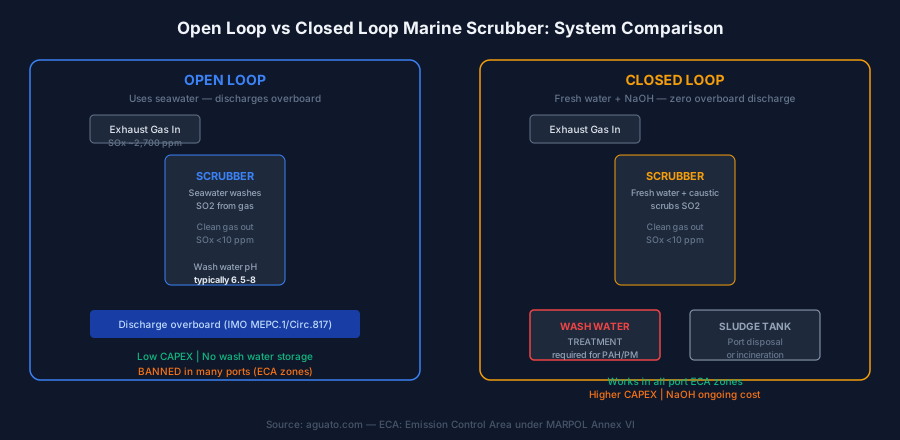
In an open-loop system, the answer is straightforward: seawater is used as the wash medium, and the used wash water is discharged directly back to the sea after a check that it meets the IMO's minimum discharge criteria. In a closed-loop system, the wash water is recirculated through a holding tank with caustic soda (NaOH) addition to neutralise the absorbed acid, and the accumulated blowdown is treated and either discharged at sea (where regulations permit) or retained for port disposal. The hybrid system, which most new scrubber installations favour, can operate in either mode and switches to closed-loop operation in restricted areas.
The [industrial wastewater discharge regulations](/resources/industrial-wastewater-discharge-regulations) that govern marine scrubber discharge are set at the international level by IMO and implemented at the national and port level, creating a patchwork of requirements that fleet operators must navigate in real time.
## Open loop vs closed loop: the core difference
An open-loop scrubber draws seawater from overboard, uses it to scrub exhaust gas, and discharges the used wash water overboard after passing it through a treatment loop to meet the IMO discharge criteria. The discharge criteria under IMO MEPC.1/Circ.817 require: pH not less than 6.5 at 4 metres from the discharge point (or pH not less than 6.5 at the ship's side if the mixing model cannot be applied), polycyclic aromatic hydrocarbons (PAH) as phenanthrene equivalents below 50 micrograms per litre, turbidity below 25 FTU, and nitrates at a defined maximum above background seawater levels.
Open-loop scrubbers are only permitted in areas where wash water discharge is allowed. An increasing number of ports, coastal zones, and enclosed seas prohibit open-loop operation: California's state waters, Singapore's port limits, China's inland waterways, ports in Belgium, Germany, and several others have enacted local restrictions that go beyond the IMO baseline. A vessel operating with an open-loop-only scrubber that enters a prohibited zone faces a choice between stopping the scrubber (which requires switching to compliant fuel) or operating in violation of port regulations.
A closed-loop scrubber recirculates wash water through a treatment and neutralisation system. The wash water absorbs SO2 from the exhaust, is routed to a process tank where NaOH is dosed to neutralise the acidity, and is then recirculated. A portion of the recirculating water (the blowdown) is continuously or periodically removed to maintain the dissolved solids and contaminant concentrations in the loop below operating limits. The blowdown water must be treated before discharge or retained in a residue tank for port disposal.
The operational implication that many operators underestimate is that closed-loop operation requires active management of the treatment system, chemical stocks, and sludge disposal logistics at every port call. This is not a passive system that runs without attention; it is a water treatment plant on a moving vessel.
## Closed-loop wash water treatment train
The wash water treatment train for a closed-loop scrubber typically has five stages, each targeting a specific contaminant or characteristic.
Stage 1: Settling. The wash water is routed to a settling or clarification tank where the majority of particulate matter and coarse solids are removed by gravity. This stage reduces the load on downstream treatment stages and removes the largest solid particles that would otherwise accumulate in the recirculation loop.
Stage 2: DAF or IGF. Dissolved air flotation or induced gas flotation removes the remaining fine particulates, oil, and some PAH components. A [dissolved air flotation](/resources/dissolved-air-flotation-daf) unit on a vessel must be designed to operate in the motion conditions of a ship at sea, which means pressure stability, stable chemical dosing despite vessel pitch and roll, and a float-pad removal system that functions at up to 15 degrees of constant heel.
Stage 3: Filtration. Multimedia filtration or activated carbon removes PAH below the 50 micrograms per litre threshold. Activated carbon is particularly effective for PAH reduction and can also remove heavy metals. Carbon change-out frequency depends on the sulphur content of the fuel and the engine load factor.
Stage 4: pH correction. After NaOH neutralisation in the recirculation loop, the blowdown water typically has a pH of 7 to 9. If discharge is planned, pH is verified and adjusted if necessary to meet the 6.5 minimum at point of discharge.
Stage 5: Sludge handling. The solids removed in stages 1 through 3 accumulate in a sludge tank and must be retained on board for port disposal under MARPOL Annex I, which prohibits overboard discharge of oily residues. The sludge volume is typically 0.1 to 0.3 m3 per MW of engine output per day at normal engine loads.
[cta:nepti-dark]
## IMO MARPOL and port-by-port regulations
The international framework is set by IMO under MARPOL Annex VI, Regulation 14, which establishes the 0.5% global sulphur limit and permits EGCS as an equivalent means of compliance. The specific wash water discharge criteria are set out in IMO MEPC.1/Circ.817, which was issued in 2015 and has been supplemented by flag state and port state guidance since then.
The complication is that the IMO framework sets a floor, not a ceiling. Individual member states and port authorities are free to impose additional restrictions, and many have. A vessel operator relying on IMO MEPC.1/Circ.817 compliance as sufficient for all ports will encounter restrictions they did not anticipate. The practical requirement is to maintain an up-to-date database of port-specific restrictions for every port on the vessel's trading route and to ensure the scrubber management plan is updated when restrictions change.
According to [IMO MARPOL Annex VI](dofollow:https://www.imo.org/en/OurWork/Environment/Pages/Sulphur-oxides-(SOx)-Emission-Control.aspx), the permitted SOx emission level in Emission Control Areas (ECAs) covering North America, the North Sea, the Baltic Sea, and the US Caribbean is 0.1% sulphur equivalent, which requires either ultra-low sulphur fuel or an EGCS achieving the equivalent emission reduction. In open-loop mode in ECA waters, the wash water discharge criteria apply; in closed-loop mode, the blowdown management requirements apply.
For operators trading in waters with port restrictions on open-loop discharge, the hybrid scrubber, which can switch between open and closed-loop modes, is the only configuration that allows both HSFO use in unrestricted waters and closed-loop operation in restricted ports without switching to compliant fuel. The additional cost of the hybrid configuration over open-loop-only is typically $500,000 to $1,500,000 per vessel.
## Economics of open loop vs closed loop vs fuel switching
The fuel cost savings from using HSFO with a scrubber versus LSFO without one depend entirely on the price spread between the two fuel types, which is volatile. In 2020, when IMO 2020 was implemented, the spread was $200 to $350 per tonne. In 2022 to 2023, it narrowed to $50 to $150 per tonne in some periods and widened to $300 per tonne in others. The payback on a scrubber investment ranges from 2 years (wide spread, high fuel consumption) to 8 years (narrow spread, lower fuel consumption), and operators who invested on the assumption of a permanently wide spread have been disappointed.
For closed-loop versus open-loop scrubbers, the economic comparison must account for: additional capital cost ($1.5 to $4 million per vessel), NaOH consumption cost ($0.50 to $2.50 per MWh of engine operation), sludge disposal fees ($50 to $200 per tonne at port), treatment system maintenance, and the avoided cost of switching to compliant fuel in restricted ports.
A vessel trading predominantly in open-ocean routes where open-loop discharge is permitted generates less than $500,000 per year in additional closed-loop operating costs for a typical medium-size vessel. If that vessel encounters restricted ports 10 to 20 times per year and each forced fuel switch costs $10,000, the additional operating cost of the closed-loop system ($500,000/year) exceeds the avoided cost of fuel switching ($100,000 to $200,000/year). The economics in favour of closed-loop operation only become clear when port restriction exposure exceeds approximately 30 to 40 port calls per year in restricted zones.
Hybrid systems, which can operate in either mode, provide the flexibility to optimise fuel strategy for each voyage without stranding the vessel in restricted ports. The $4 to $9 million capital cost is higher than either open-loop or closed-loop alone, but it is the correct investment for vessels on mixed trading routes where both deep-ocean HSFO fuel savings and restricted-port compliance are required. This is exactly the [how to choose industrial water treatment](/resources/how-to-choose-industrial-water-treatment) decision-making logic applied to a marine context.
## Monitoring and compliance requirements
MARPOL requires continuous monitoring of pH and turbidity in scrubber wash water, with data logging to the scrubber monitoring and alarm management system. PAH monitoring is required at defined intervals, typically daily during port approaches and on a schedule during open-ocean operation. Heavy metals monitoring is required but at lower frequency, typically monthly or on a flag state schedule.
The monitoring data must be retained in the vessel's electronic monitoring log for 18 months and produced on request during port state control inspections. Port state control officers in major shipping hubs, including Rotterdam, Singapore, and Houston, specifically target scrubber-fitted vessels for wash water monitoring compliance checks. Non-compliance, including missing monitoring data, exceedances without documented corrective action, or bypassing wash water treatment before discharge, can result in vessel detention.
[Oil and grease removal technology](/resources/oil-grease-removal) principles are directly relevant to the PAH and oil contamination challenge in scrubber wash water. PAH compounds behave like heavy aromatics and respond to the same activated carbon and coagulation/flotation approaches used in industrial oily water treatment.
According to the [Transport & Environment analysis of EGCS wash water impacts](dofollow:https://www.transportenvironment.org/discover/scrubbers-an-evaluation-of-their-fuel-savings-and-environmental-impacts/), the cumulative PAH and particulate load from global scrubber wash water discharge is significant and has driven the port restriction movement. This regulatory trajectory toward stricter wash water standards means that systems designed to just meet today's IMO criteria may not meet the standards that are in force in 5 to 10 years.
## Technology comparison: open loop vs closed loop
| Parameter | Open Loop | Closed Loop | Hybrid | |---|---|---|---| | Capital cost | $1.5 to 4M | $3 to 8M | $4 to 9M | | NaOH consumption | None | 0.5 to 2 kg/MWh | 0.5 to 2 kg/MWh (closed mode) | | Wash water discharge | Overboard (where permitted) | Retained for port disposal | Mode-dependent | | Sludge generation | Low | 0.1 to 0.3 m3/MW/day | 0.1 to 0.3 m3/MW/day | | Port restriction impact | High (restricted in many ports) | None (zero discharge) | Low (can switch modes) | | Treatment system complexity | Low | High | High | | Operating cost premium | Low | $0.50 to $2.50/MWh | $0.50 to $2.50/MWh |
## Sludge management and port reception facilities
The sludge generated by closed-loop scrubber operation is a regulated shipboard waste under MARPOL Annex I, classified as oily residues (sludge). It must be retained in the ship's sludge tank and discharged to port reception facilities or incinerated on board where an incinerator is fitted and the waste specification allows incineration.
The practical complication is that port reception facility availability for scrubber sludge is inconsistent. In major northern European and East Asian ports, dedicated sludge reception with tanker collection is routine. In smaller ports in Southeast Asia, South America, and Africa, sludge reception services may be unavailable, inadequate, or prohibitively expensive. A vessel accumulating 30 tonnes of sludge per month that cannot discharge at planned port calls will fill its sludge tank, forcing early drydocking or diversion to a port with reception facilities.
Sludge tank sizing on retrofitted vessels is consistently too small. When scrubbers were first widely adopted in 2018 to 2020, sludge generation rates were often underestimated in the design phase, and the sludge tanks retrofitted into existing vessels were sized on optimistic assumptions about sludge generation rates at normal operation. Vessels burning high-sulphur fuel at high engine load in the Indian Ocean or Pacific generate sludge at the top of the design range, and retrofitted tanks sized at the low end of that range fill up in 10 to 14 days rather than 20 to 30 days as planned. The result is a logistics crisis when port calls are spaced more than 14 days apart.
For operators, the practical sludge management plan must include: accurate sludge generation rate estimates based on actual fuel sulphur content and engine load profile (not design assumptions), a sludge tank volume that provides at minimum 30 days of storage at the highest expected generation rate, a port call schedule that incorporates sludge disposal logistics, and emergency sludge disposal contacts for ports off the normal trading route.
The interaction between sludge disposal cost and the economics of the scrubber investment is significant. A vessel paying $150 to $200 per tonne for sludge disposal at $100 to $150 of sludge generated per day faces $5,000 to $7,500 per month in sludge disposal costs. This should be included in the payback calculation at the investment decision stage.
## Scrubber water treatment performance verification and port inspections
Port state control officers in major shipping jurisdictions have developed specific inspection protocols for scrubber-fitted vessels that go beyond the standard MARPOL inspection checklist. A port state control inspection of a scrubber-fitted vessel in Rotterdam, Singapore, or Los Angeles will typically include: review of the scrubber monitoring and alarm management system (SMAMS) log for the past 30 days, cross-referencing of pH and turbidity monitoring data with the vessel's engine logbook entries, review of the sludge tank receiving log and any port reception facility certificates, inspection of the wash water treatment system for evidence of correct operation, and a grab sample of the wash water overboard discharge for independent analysis in restricted open-loop areas.
The most common finding in port state control inspections of scrubber vessels is monitoring data gaps: periods where the monitoring log shows no data, which indicate either equipment malfunction or deliberate bypass of the monitoring requirement. Even if the scrubber was operating correctly during those periods, the absence of monitoring data creates a compliance gap that the vessel cannot close without the data. Monitoring continuity is therefore as important as compliance itself.
A secondary finding that has emerged in inspections is the mismatch between on-board monitor readings and shore-based laboratory analysis of grab samples. Where the UV fluorescence on-board PAH monitor reads below 50 micrograms per litre but the independent analysis reads above, the on-board monitor is assumed to be in error and the vessel is cited for the exceedance. Quarterly cross-validation of on-board monitors against external laboratory analysis is the standard that leading operators are now applying, and it should be standard practice for any closed-loop scrubber operation.
The flag state also has oversight responsibilities for scrubber-fitted vessels. Some flag states have issued additional guidance or notification requirements beyond the IMO baseline, and vessels registered in stricter flag states may face additional reporting requirements when operating in ECA zones or restricted ports.
[Use Nepti to model your scrubber wash water treatment requirements based on your vessel's fuel profile and trading routes](/nepti).
## Where marine scrubber water treatment fails
NaOH supply management. A closed-loop scrubber at sea consumes 0.5 to 2 kilograms of NaOH per megawatt-hour of engine operation. A large vessel on a 14-day ocean crossing may need 5 to 15 tonnes of NaOH. Running out of caustic converts the closed-loop system to open-loop without the option to discharge overboard, effectively shutting down the scrubber and forcing a fuel switch that the fuel budget did not account for.
Sludge tank capacity. Closed-loop blowdown sludge accumulates faster than many installation designs anticipated. A vessel trading from Rotterdam to Singapore to Los Angeles, with port calls in ports that restrict open-loop discharge, may accumulate 50 to 150 tonnes of sludge residues before reaching a port that can accept them for disposal. Sludge tank sizing that assumes frequent disposal opportunities is a design assumption that fails on long voyages or in markets with limited sludge reception facilities.
Chemical carryover to discharge. PAH monitoring systems that use UV fluorescence methods (common on vessels) can be fooled by high NaOH or certain coagulant residuals that interfere with the optical reading. Actual PAH concentrations can be at the limit while the on-board analyser shows compliant values. Flag state inspection by independent laboratory analysis has revealed systemic measurement errors on several vessel types.
Activated carbon exhaustion. The activated carbon stage that removes PAH has a finite capacity that depends on PAH loading, which in turn depends on fuel sulphur content and engine load factor. Carbon change-out intervals designed for 3.5% sulphur fuel and full engine load will be met much faster when trading in ECA zones on 0.1% fuel at partial load. The chemistry changes; the maintenance schedule must change with it.
[Post your scrubber water treatment challenge and compare proposals from marine water treatment specialists](/post-project).
## FAQ
### What is an open-loop scrubber and why is it controversial?
An open-loop scrubber uses seawater to absorb sulphur dioxide from engine exhaust and discharges the used wash water back to sea. It is controversial because the wash water contains PAH, heavy metals, and particulate matter at concentrations above background seawater levels, and a growing number of studies suggest cumulative discharges in busy shipping lanes contribute to water quality degradation. Many ports have banned open-loop discharge in their waters as a result.
### What treatment does closed-loop scrubber wash water require?
Closed-loop wash water blowdown requires: settling or clarification for solids removal, dissolved air flotation or induced gas flotation for oil and fine particle removal, activated carbon or multimedia filtration for PAH reduction, pH correction if required, and a sludge holding tank for port disposal of concentrated residues.
### Which ports ban open-loop scrubber discharge?
As of 2024, open-loop discharge is banned in: California (state waters), Singapore (port limits), China (inland waterways and some coastal zones), Belgian ports, German ports, several Baltic Sea ports, and parts of the US East Coast. The list is growing. Fleet operators should maintain a current database of port-specific restrictions for their trading routes rather than relying on a static list.
### How much NaOH does a closed-loop scrubber consume?
Typically 0.5 to 2 kilograms of NaOH per megawatt-hour of engine operation, depending on fuel sulphur content and exhaust gas composition. For a vessel with 15 MW of installed power on a 14-day passage, this equates to 100 to 400 kilograms per day, or 1.4 to 5.6 tonnes per day. NaOH supply logistics are a critical operational planning element for long-range closed-loop operation.
### Can a scrubber be retrofitted with a closed-loop system if originally installed as open-loop?
Yes, but the cost is significant. Upgrading an open-loop scrubber to hybrid capability, which allows both modes of operation, typically costs $1.5 to $3 million per vessel including the recirculation tank, treatment system, and NaOH storage. The business case depends on how much of the vessel's trading route is in restricted-discharge zones and the HSFO-LSFO price differential at the time.
### What happens if scrubber wash water monitoring shows a PAH exceedance?
The vessel must switch to compliant fuel or stop using the scrubber until the issue is diagnosed and resolved. A PAH exceedance above the IMO limit documented in the monitoring log triggers a flag state notification requirement, and port state control officers in major hubs will request the monitoring log at the next port call. Undocumented exceedances or missing monitoring data carry the same penalty as documented violations. The corrective action for a PAH exceedance is typically: switch to closed-loop mode (if not already), increase activated carbon filter change frequency, verify demulsifier dosing on the flotation stage, and run an independent laboratory grab sample to confirm the on-board monitor reading. If the exceedance is confirmed by independent analysis, the scrubber should be shut down until the treatment stage causing the exceedance is repaired or the carbon is replaced. Operating with a known exceedance and continuing to discharge is the definition of non-compliance, regardless of whether port state control has inspected the vessel.
### How does scrubber water treatment interact with ballast water treatment requirements?
They are separate regulatory requirements under separate MARPOL annexes and managed by different treatment systems on board, but they share a common challenge: both require the ship's operator to demonstrate compliance through monitoring records at port state control inspections. Some vessels that have retrofitted both scrubbers and ballast water treatment systems in the same drydocking have found that the electrical load and fresh water demand of both systems simultaneously stresses the ship's utility systems. System integration planning between the scrubber and ballast water treatment teams during the design phase avoids this conflict.