Graphene water filtration is a real technology with measurable advantages in narrow applications, but in 2026 it is not yet a substitute for proven RO, NF, or UF at industrial scale. Here is the honest map.
In every quarterly tech-scouting deck circulating through industrial water teams since 2019, graphene-based filtration sits in the same slot: high-energy lab data, breathless press releases, eye-watering performance claims, and the standing implication that polyamide reverse osmosis and PVDF ultrafiltration are about to be displaced. Six years later, the displacement has not happened. There is not a single commercial-scale graphene desalination plant operating against a multi-decade off-take contract anywhere in the world, and the global water industry continues to specify the same polyamide thin-film composite membranes it has been specifying since the 1980s for greenfield projects worth $500 million to $5 billion.
That gap between the promise and the procurement reality is the central question this article addresses honestly. Graphene water filtration is a real technology with measurable advantages in narrow applications, but at industrial-scale economics in 2026 it is not yet a substitute for the proven incumbents. Specifying it as a primary treatment technology on a 25-year asset is, at this stage, a science-experiment risk wearing the costume of a sustainability story. The procurement teams who get the framing right will save their organisations $2 million to $20 million in avoided early-adopter capital write-downs over the next decade, and the sustainability teams who insist on it anyway will eventually pay that bill.
This guide is written for capital-projects leads being pitched graphene as the answer to their next desalination, water-reuse, or industrial-membrane project, sustainability directors trying to evaluate whether early adoption of graphene technology is a defensible ESG investment or an expensive vanity buy, and R&D managers in the sector who need an honest map of which graphene chemistries are commercially viable, which are pre-commercial pilots, and which remain firmly in academic publishing territory.
## The decision in brief
- Keep graphene in pilot scope through 2030. Keeping graphene-based filtration out of primary-treatment specification on industrial water projects in the 2026 to 2030 window saves $2 million to $20 million in avoided early-adopter capital write-downs over the decade on a multi-site portfolio with five or more capital projects. - Count the OPEX and the retrofit capex. Membrane-replacement OPEX avoidance is worth $800K to $4M and retrofit-installation capex avoidance $600K to $8M across the same portfolio and decade. - Count the schedule and the ESG credibility. Schedule-delay penalty avoidance is worth $400K to $5M, and ESG-reporting credibility preservation is hard to quantify but easy to lose.
The cost of doing nothing is a sustainability narrative driving a primary-treatment specification on a vendor's marketing material without independent pilot validation on your feed water, the source of every six-figure write-down in this article.
## What graphene water filtration actually is
Graphene is a single layer of carbon atoms arranged in a hexagonal lattice, one atom thick, with exceptional mechanical strength and a controllable electronic structure. Graphene water filtration is a family of membrane technologies that uses graphene or graphene-derivative sheets, either as the active separation layer or as a high-surface-area electrode, to perform tasks otherwise done by polymer or ceramic membranes: water purification, ion separation, organic removal, and in some prototype systems, capacitive deionisation. The promise is straightforward in principle: a one-atom-thick membrane should, in theory, deliver dramatically higher water flux at the same selectivity than a polymer membrane that is hundreds of nanometres thick.
In practice, the realisation of that promise has run into manufacturing problems, defect-rate problems, scalability problems, and an industrial-procurement environment that requires 25-year service life data nobody yet has on graphene. The performance numbers reported in academic journals (flux improvements of 5 to 50 times over polyamide RO; effectively perfect ion rejection in single-pore single-event experiments) almost never replicate at module scale. The two-orders-of-magnitude gap between the headline lab number and the field-relevant aggregate number is where almost every "graphene will replace RO" forecast has died.
What is real and what is not. The chemistry of graphene-water interactions is genuinely well-understood. The selectivity mechanisms (size exclusion, charge exclusion, sub-nanometer hydraulic resistance) are reproducible at the bench. What does not reproduce at scale is the manufacturing tolerance: single-defect events in a one-atom membrane create flow shortcuts that destroy selectivity for the whole module. The current generation of graphene-oxide laminates and graphene-on-support composites get around the defect problem by being effectively many-layer composites, which trades the headline flux advantage back for manufacturability. The result is membranes that perform comparably to existing polymer or ceramic options at substantially higher cost. [The US EPA's NPDES framework for industrial water treatment technology evaluation](dofollow:https://www.epa.gov/npdes) provides the regulatory baseline against which any new membrane technology has to be evaluated for compliance use, and that baseline does not give early-adopter technology any credit for promise alone.
[Browse verified providers across membrane filtration, reverse osmosis, and ultrafiltration](/providers) to compare what is actually shippable today against what graphene vendors are promising for 2027 to 2030.
The opinionated view that procurement teams need to hear up front: in 2026, no industrial water project with a budget above $1 million should be specifying graphene-based filtration as the primary technology on the basis of vendor performance claims. Graphene belongs in pilot-scale R&D scopes, in academic-industrial collaboration projects, and in narrow specialty applications where its unique chemistry genuinely solves a problem no incumbent can address. Specifying it for general-purpose water purification, desalination, or industrial reuse on the basis of marketing material is a capital-allocation error that becomes visible only at year 3 or 4 of operation, by which point the recovery cost is in the millions.
## The five main graphene-membrane chemistries
Five distinct graphene chemistries dominate the current commercial-pilot landscape, and each has a different performance profile, manufacturing route, and commercial readiness level. Treating "graphene" as a single technology is the first mistake that leads to bad procurement decisions.
Graphene oxide (GO) laminates are the most commercially mature variant. Graphene oxide is graphene that has been chemically modified to add oxygen functional groups (hydroxyl, carboxyl, epoxy) along its basal plane. Multiple GO sheets are laminated together onto a polymer or ceramic support to form an asymmetric membrane. The inter-layer spacing (typically 0.7 to 1.5 nanometres in the swollen state) determines the molecular weight cut-off, putting GO laminates in the nanofiltration to tight-ultrafiltration range. Pilot deployments exist in desalination pre-treatment, dye separation, and oily wastewater applications.
Nanoporous monolayer graphene is the headline-grabbing variant: a single defect-free graphene sheet with nanopores deliberately engineered through it. In principle, this is the high-flux, high-rejection desalination membrane the industry has been chasing. In practice, manufacturing defect-free monolayer graphene at the square-metre scale required for industrial modules remains unsolved. Lab-scale experiments at centimetre scale show extraordinary flux numbers; the same chemistry at module scale has never reproduced those numbers because the defect density compounds with area.
Graphene-CNT (carbon nanotube) composites combine graphene sheets with carbon nanotubes as a structural reinforcement layer. The composite is more manufacturable than monolayer graphene because the nanotubes provide a mechanical scaffold that tolerates handling. Performance in the ultrafiltration range is competitive with conventional PVDF UF on flux, but at a cost premium of 5 to 15 times. First commercial pilots are running in industrial water reuse, where the higher temperature tolerance and chemical resistance of the composite are worth a price premium over standard polymeric UF.
Reduced graphene oxide (rGO) electrodes for capacitive deionisation (CDI) is a fundamentally different application. Here the graphene is not a separation membrane but an electrode in an electrochemical desalination process. Voltage applied across rGO electrodes adsorbs ions onto the high-surface-area carbon, and reversing the voltage releases them. CDI with rGO electrodes works well in brackish water applications below 5 g/L TDS, in flow rates below 1 MLD. It does not scale to seawater desalination, and the brackish-water market it does address is small relative to RO.
GO on ceramic supports (hybrid asymmetric) is the most procurement-defensible commercial-pilot variant in 2026. A thin GO selective layer is deposited onto a robust ceramic support (alumina, titania, zirconia). The composite combines GO's chemical selectivity with the ceramic support's mechanical robustness and chemical resistance. Industrial pilots are running in oily wastewater, dye-rich effluent, and industrial reuse applications where the chemical resistance of [ceramic membranes](/resources/ceramic-membranes) is genuinely needed but where the selectivity tuning of GO adds value over plain ceramic.
## Technology readiness level by variant
Technology Readiness Level (TRL) is the framework most defence and energy procurement teams use to evaluate where a technology sits between lab and commercial deployment. The scale runs from 1 (basic principles observed) to 9 (system proven in operational environment). The graphene chemistries currently span TRL 3 to TRL 7, which is a wide spread, and getting the TRL right per variant is the first step in any honest evaluation.
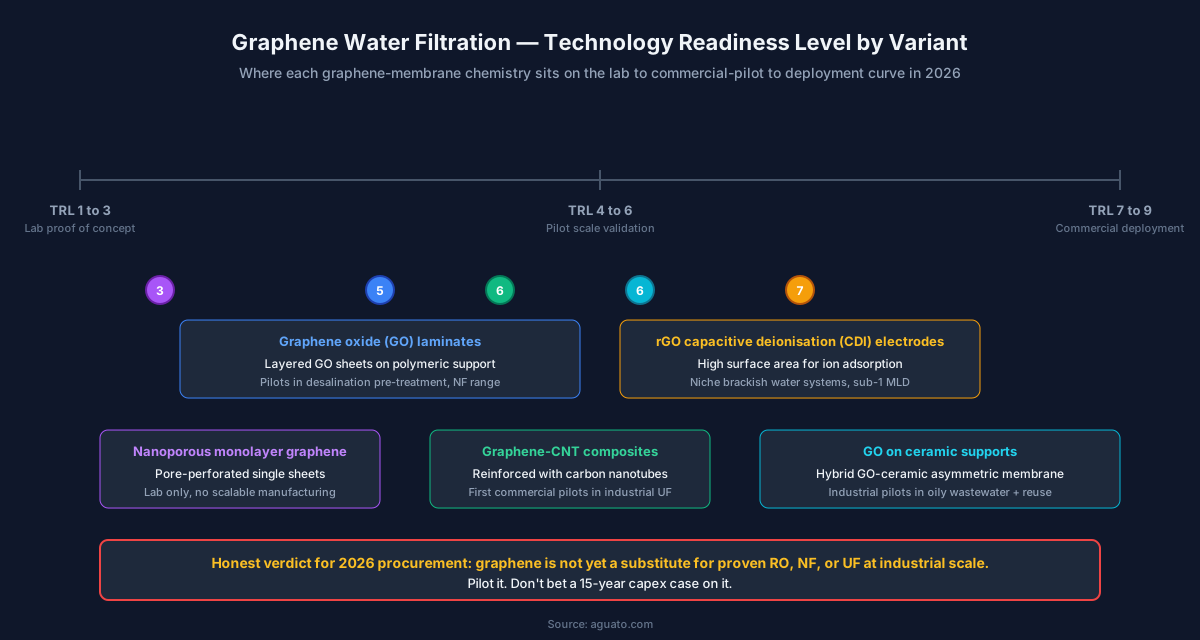
GO laminates sit at TRL 5: validated at pilot scale in relevant environments, with first commercial-scale demonstrations under way but no multi-decade off-take contracts in operation. Nanoporous monolayer graphene sits at TRL 3: principles proven at bench, but no pilot-scale validation in industrial conditions, and the manufacturing path to scale is still an open research question. Graphene-CNT composites sit at TRL 6: technology demonstrated in relevant environment with the first paying commercial pilots running. rGO CDI electrodes sit at TRL 7: niche commercial deployment in brackish water, validated against real customers but not in the seawater desalination scale where the market is. GO-on-ceramic hybrid sits at TRL 6: commercial pilots in oily wastewater and reuse, with multi-year operational data from a handful of installations.
The procurement implication is direct. TRL 5 and below should be inside a pilot scope or a research collaboration. TRL 6 to 7 can be specified on capital projects only with an unusual set of contractual protections: extended warranties, vendor-funded replacement, deferred payment tied to demonstrated performance, and a fallback technology designed into the same site. TRL 8 to 9 is where most industrial water buyers actually want to be, and graphene is not there yet for any variant.
## Where graphene actually competes in 2026 (mostly nowhere yet)
The market segments where graphene has measurable commercial traction in 2026 are narrow. Heavy-metal scavenging from industrial process streams, where GO laminates can be functionalised to selectively adsorb specific metals (mercury, lead, chromium, arsenic) at concentrations below what conventional precipitation can address. PFAS-prototype removal, where graphene's high surface area and tunable chemistry make it a candidate for the most stubborn PFAS species, though no commercial-scale graphene PFAS treatment plant currently operates against an EPA-compliant off-take. Oily wastewater treatment, where the surface chemistry of GO can be engineered to be either hydrophilic or hydrophobic, giving it a selectivity advantage over conventional MF/UF in oil-water emulsions. None of these segments add up to more than 1 to 2% of the global industrial membrane market.
For the dominant market segments, graphene currently does not compete. Seawater desalination remains a polyamide-RO market because the membrane cost, the multi-decade fouling characterisation, and the contractual warranties for ion rejection are all on the side of the incumbent. Industrial brackish-water reuse is a polyamide-RO and nanofiltration market for the same reason. Industrial ultrafiltration is a PVDF/PES market because the flux-per-dollar economics of polymer UF are simply better than any graphene alternative. Drinking-water polishing remains a granular activated carbon and reverse osmosis market because the regulatory framework requires documented service life data that no graphene technology has.
The interesting question is not whether graphene will eventually compete in these dominant segments, it might, but whether it will compete on a 10 to 15-year horizon that matters for current capital-allocation decisions. The honest answer is that the [International Energy Agency's water-energy nexus reports](dofollow:https://www.iea.org/reports/water-energy-nexus) track emerging desalination technologies on roughly that timeline, and graphene-based RO is consistently flagged as commercially viable in the 2032 to 2038 window if manufacturing scales as projected, which is not a horizon that helps a 2026 capital decision.
[cta:nepti-dark]
The horizon question matters more than the technology question because capital-projects teams are not buying performance, they are buying contractually warrantable performance over a known service life at a known cost. The next section translates that frame into a side-by-side benchmark that procurement leads can drop into an RFP-evaluation spreadsheet, with three parameters that swing the lifecycle cost more than any single chemistry claim a graphene vendor will make.
Why the benchmark is harder than it looks. The graphene-membrane field publishes performance numbers on a fragmented set of test conditions: different feed waters, different pressures, different cycle counts, different module configurations. A flux number reported under benign conditions at 5 bar on dilute synthetic feed water is not comparable to a flux number reported on real seawater at 55 bar against a contractually fixed rejection target. The most credible meta-analyses in the field (notably the 2023 Water Research review that aggregated 78 independent pilot studies) discard roughly 40% of published vendor numbers as not-comparable because of test-condition variance. Procurement teams that take vendor data at face value typically end up with capacity that delivers 30 to 50% of the headline flux in actual operating conditions, which is the gap between a viable project and a write-down.
The methodology that matters for procurement is the apples-to-apples comparison on the actual feed-water matrix and operating conditions of the project. That comparison almost always requires running a parallel pilot on site, on real water, in real conditions, for at least 6 to 9 months. A vendor that resists a parallel pilot on the customer's actual feed water is telling the procurement team that they do not have data they can defend, and that signal should override any laboratory performance brochure in the evaluation.
## Graphene vs polyamide RO: the honest benchmark
The benchmark table below compares the average performance of commercially available graphene-based membranes against polyamide RO and polymer UF, using publicly disclosed pilot data and current commercial-pilot pricing as of mid-2026. The data are deliberately conservative on the graphene side: vendor-reported optimal numbers are systematically higher than aggregated independent-pilot numbers, and the table reflects the independent-pilot range. The benchmark methodology aligns with the membrane-performance criteria documented in [the World Health Organisation's drinking water guidelines](dofollow:https://www.who.int/news-room/fact-sheets/detail/drinking-water), which set the regulatory baseline for any new membrane technology aiming at drinking-water polishing or industrial reuse with potable-grade outputs.
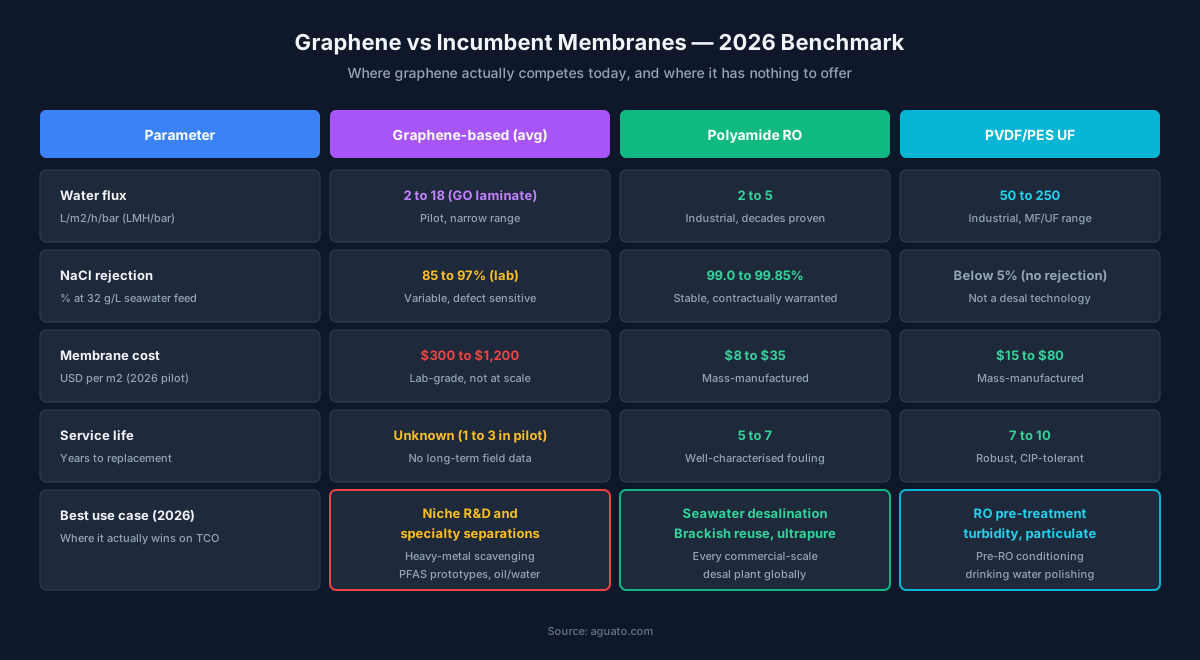
The salt rejection comparison is the most consequential. Polyamide RO routinely delivers 99.0 to 99.85% NaCl rejection on 32 g/L seawater feed and is warranted for that performance over a 5 to 7-year membrane life. The best published graphene-laminate results on the same feed reach 85 to 97% rejection in lab conditions, with field-pilot numbers landing more variably in the 80 to 92% range. A 95% versus 99.5% rejection difference sounds modest, but in desalination it is the difference between needing one stage of treatment and needing two, which is roughly a 40 to 60% capex increase and a 25 to 35% operating cost increase on the same fresh-water output. No procurement team should swap a contractually warranted 99.5% rejection for a pilot 92% rejection on the basis of a flux number.
The cost-per-square-metre comparison is similarly stark. Mass-manufactured polyamide RO sits at $8 to $35 per m2 at industrial volumes. Mass-manufactured PVDF UF sits at $15 to $80 per m2. Graphene-based membranes at current pilot manufacturing volumes run $300 to $1,200 per m2. Even with aggressive scale-up assumptions (graphene costs falling 70% as volumes grow), the unit economics will not reach incumbent parity before 2030 to 2032 on the most optimistic published roadmaps. The cost gap is not a "wait six months" problem; it is a "wait six years" problem, and the dollar spreads on capital projects in that window are material.
The service-life comparison is the one buyers should weigh most heavily. Polyamide RO has 50-plus years of operational data. Field-pilot graphene laminates have 1 to 3 years of operational data at scale, and the fouling, ageing, and chemical-cleaning recovery behaviours over a full 5 to 7-year cycle are not yet characterised against the contractually meaningful failure modes. Specifying a technology on which you have no full-cycle service-life data into a 15 to 25-year asset is a capital-allocation question that needs a board-level conversation, not a marketing-collateral decision.
## Graphene vs UF and NF: the closer competition
The closer head-to-head competition for graphene is in the ultrafiltration and nanofiltration ranges, not in reverse osmosis. UF and NF applications are more tolerant of selectivity variability than RO desalination, the cost gap to graphene is narrower, and the chemical-resistance advantages of graphene-on-ceramic hybrids are genuinely useful in challenging feed-water matrices. This is where the next generation of graphene commercial wins will most likely come from.
For nanofiltration applications (water softening, dye separation, micropollutant removal, brackish water polishing), conventional [nanofiltration membranes](/resources/nanofiltration) deliver well-characterised performance at $20 to $60 per m2 and 5 to 7-year life. GO-on-ceramic hybrids in NF range deliver comparable selectivity at $250 to $800 per m2 with unverified long-term life. The cost penalty pays only in feed matrices where conventional polymeric NF fouls catastrophically: very high TOC, aggressive solvents, oxidising agents, or hot feed water above 60 degrees Celsius where polymer membranes degrade rapidly. Those applications exist, but they are 3 to 5% of the global NF market, not the dominant segment.
For ultrafiltration applications (turbidity removal, pre-RO conditioning, oil-water separation, industrial reuse), conventional PVDF [ultrafiltration](/resources/ultrafiltration) is the dominant technology at $15 to $80 per m2 with 7 to 10-year life. Graphene-CNT composites in the UF range deliver comparable flux and selectivity at $400 to $1,500 per m2 with 1 to 3-year demonstrated life. The applications where the cost premium is defensible are in extreme chemical environments (concentrated acids, hot caustic solutions, mixed solvent streams) where conventional polymer UF cannot survive a year. Those are real applications but they are well below 5% of the global UF market.
Need help evaluating whether a graphene pilot makes sense for your specific feed water and risk tolerance? [Post your project](/post-project) and qualified providers will scope graphene vs incumbent options against your actual numbers, with a documented honest assessment rather than a vendor pitch.
The chemistry verdict is one thing, but it does not survive contact with the manufacturing question. Every promising graphene chemistry runs into the same upstream constraint: industrial water treatment buys membranes by the hundred-thousand square metre, and graphene is not yet made at that scale. The next section dissects the manufacturing gap, because no procurement decision in this field is defensible without understanding the production-volume reality behind the vendor's quote.
## Manufacturing scale: the unsolved problem
The single biggest reason graphene-based filtration has not displaced incumbents at industrial scale is not chemistry, it is manufacturing. To make a commercial-scale desalination plant viable, the membrane manufacturer needs to produce tens of thousands of square metres of consistent, defect-bounded membrane per year per facility. Polyamide RO manufacturers achieve this today on rolling thin-film composite lines producing 5 to 15 million square metres of membrane annually per major facility, with defect rates and selectivity tolerances tracked by SPC processes refined over 40 years.
Graphene at that scale does not yet exist as a manufacturing capability. The chemical vapour deposition (CVD) processes that produce defect-bounded monolayer graphene operate at square-centimetre to small square-metre scale per batch with batch cycle times in hours. The defect rate growth as area increases is one of the open research questions in the field. Scaling CVD to the rolling-line throughput the membrane industry needs is an open materials-science and manufacturing-engineering problem, not a procurement-decision problem.
The exfoliation routes that produce graphene oxide are more scalable than CVD but produce a material that is intrinsically multi-layer and multi-sheet, which is what the GO laminate variants use. Those routes can reach industrial throughput, but the resulting membrane is fundamentally a multi-layer composite rather than a one-atom-thick separation layer, which gives up the headline flux advantage the marketing relies on. The current GO membrane industry is producing multi-layer GO composites with performance comparable to or slightly better than the best polymer membranes, at substantially higher cost, which is not a procurement story that wins on lifecycle economics.
A separate problem is module assembly. Industrial RO uses spiral-wound modules where the membrane is folded, glued, and rolled into pressure vessels at high throughput. Adapting graphene-on-ceramic hybrids into module configurations that can compete with spiral-wound polyamide on per-module cost is an unsolved engineering problem at industrial scale. Most current graphene pilots use flat-sheet or hollow-fibre module formats that work at small scale but do not scale to the throughput of spiral-wound modules.
## Failure scenarios and what they cost
A first failure pattern, observed at multiple early-pilot industrial water reuse sites between 2021 and 2024, is membrane defect propagation. Graphene-based membranes operate with much tighter defect tolerances than polymer membranes. A single contamination event during commissioning that polymer membranes would shrug off creates concentrated flux pathways through graphene composites, dropping system rejection by 15 to 30%. Site recovery typically requires full module replacement at $80,000 to $300,000 per MLD of capacity, plus the lost-production cost during the 4 to 8 weeks of recovery.
A second failure pattern is unverified chemical-cleaning tolerance. Industrial water treatment relies on aggressive CIP (clean-in-place) protocols using high-pH caustic and low-pH acid cleaning to restore membrane permeability after fouling. Polyamide and PVDF tolerance to these protocols is decades-characterised. Graphene-based membranes have published tolerance data ranging from "performs well after 50 CIP cycles" to "degrades 30% after 12 cycles" depending on the variant and the specific cleaning chemistry, and the field-pilot data are not yet rich enough to predict CIP-recovery performance over a 5-year life. Sites that have specified graphene under-budget for CIP-cycle membrane degradation typically report 40 to 80% higher membrane replacement spending in years 2 and 3 than the original budget allowed.
A third failure pattern is the procurement-commitment trap. Several industrial sites in the 2020 to 2023 window specified graphene-membrane systems as the primary treatment for new builds on the basis of vendor performance projections, then encountered performance gaps at year 1 to 2 that required retrofit installation of conventional RO or UF behind the graphene stage. The total project cost on those sites typically ran 60 to 150% above the original budget once the retrofit was complete, and the operational complexity of running two treatment trains in series rather than one created 25 to 40% higher OPEX. The defensive procurement framing is to never spec graphene as the sole technology; either pilot it alongside the proven incumbent, or specify the incumbent and run graphene in a deferred-investment R&D stage that can be added later if performance is proven.
A fourth failure pattern, more political than technical, is the ESG-investment justification trap. A site specifies graphene specifically because of the sustainability narrative attached to it (lower energy consumption, smaller footprint, novel material). Two years later, the performance data shows the actual energy consumption per cubic metre is comparable to incumbent technology and the membrane replacement frequency is higher, which means the lifecycle carbon footprint is worse, not better. The ESG reporting team then has to explain why the green-technology choice produced a worse environmental outcome, which is a reputational cost on top of the financial one.
## When piloting graphene actually makes sense
There are scenarios where piloting graphene-based filtration is genuinely sensible, even at the early commercial-pilot TRL the technology currently sits at. The common factor is that the site has either a problem the incumbent technologies genuinely cannot solve, or a procurement framework that contains the downside risk of an early adoption.
Pilot scenarios where the maths works: a site facing a specialty separation challenge no conventional membrane handles well, such as a specific high-value metal recovery, a refractory PFAS species, or a chemically aggressive feed-water matrix that destroys polymer membranes within 6 months. A site with an R&D scope already funded for evaluating emerging treatment technologies, where the graphene cost sits inside the R&D budget rather than the operational capex. A site partnering with a graphene-membrane manufacturer on a deferred-payment or performance-warranty basis where the financial downside is contractually capped. A multi-site organisation running a single pilot to inform a larger 2028 to 2032 deployment decision, where the pilot cost is small relative to the eventual decision.
Pilot scenarios where the maths does not work: any new build relying on the graphene stage to meet primary compliance limits, any expansion project where conventional technology would deliver the same outcome at lower lifecycle cost, any sustainability-marketing-driven spec on a site that lacks the technical capacity to manage early-adopter risk, and any project where the vendor refuses to put performance guarantees into the contract.
The framing for capital-projects teams is simple: pilot graphene if you can afford to throw away the entire pilot capital cost without project consequence, and only then. If the pilot has to deliver against operational targets to keep the larger project on schedule, the technology readiness level does not yet support that risk profile.
## FAQ
Is graphene-based water filtration commercially available today?
Several variants (GO laminates, graphene-CNT composites, GO-on-ceramic hybrids) are available in commercial-pilot quantities from a handful of specialised manufacturers. None has reached mass-manufactured scale comparable to incumbent polyamide RO or PVDF UF. Pricing per square metre runs 10 to 50 times higher than incumbent technology, with unverified long-term service life.
Will graphene replace polyamide reverse osmosis for desalination?
Not on a procurement-relevant horizon. The most optimistic published roadmaps put commercially viable graphene-RO desalination in the 2032 to 2038 window, contingent on unsolved manufacturing scale-up problems. For any capital project being specified in 2026 to 2030, polyamide RO remains the right answer for seawater and brackish-water desalination.
Does graphene improve water flux significantly over conventional membranes?
In lab-scale single-pore experiments, yes. At commercial module scale, no. The flux advantage of monolayer graphene does not survive the manufacturing defect rate at industrial scale, and the multi-layer composites that do scale do not deliver the headline flux numbers. Real-world module-level flux is comparable to or slightly higher than incumbent polymer membranes at substantially higher cost.
When does it make sense to pilot graphene filtration?
When the site has either a specialty separation challenge no conventional membrane addresses (heavy metals, PFAS, aggressive feed water), an R&D budget for evaluating emerging technologies, a deferred-payment or performance-warranty contract with the manufacturer, or a multi-site programme using the pilot to inform a 2030+ deployment decision. Avoid piloting if the graphene stage has to deliver primary compliance from day one.
What about graphene CDI for desalination?
Capacitive deionisation with rGO electrodes is commercially available for brackish-water applications below 5 g/L TDS and flow rates below 1 MLD. It does not scale to seawater, and the brackish-water market it does address is smaller than polyamide RO's footprint in the same range. CDI is a useful niche, not a desalination replacement.
How much does a graphene pilot project cost?
A modular pilot at 1 to 10 m3/day capacity typically costs $80,000 to $400,000 for equipment plus $40,000 to $150,000 per year for operation, lab analysis, and reporting. Multi-year pilots run 18 to 36 months to gather meaningful service-life data. Budget the total as project R&D, not as part of an operational capex envelope.
Is graphene filtration more sustainable than incumbent technology?
Not in any verifiable way at current performance levels. The published energy-per-cubic-metre numbers are comparable to incumbent technology. The membrane lifecycle carbon footprint is worse because of shorter demonstrated service life and higher manufacturing energy intensity. The sustainability case for graphene rests on projected future performance improvements, not on what is currently shippable.