A poor vendor shortlist costs industrial buyers 20 to 40% in wasted bid cycles and post-award disputes. Here is a structured process to shortlist water treatment companies that holds up to audit.
Selecting the wrong water treatment vendor at the shortlist stage costs industrial buyers between $150,000 and $800,000 in wasted procurement cycles, redesign fees, and post-award contract disputes, according to data compiled from capital project reviews in the chemical and pharmaceutical sectors. The root cause is almost always the same: the shortlist was built on brand familiarity and price, not on a structured assessment of technical capability against the specific duty. By the time the mismatch surfaces in the detailed engineering phase, the project schedule has already slipped by 8 to 14 weeks.
The water treatment vendor market is genuinely fragmented. More than 4,000 companies in the US and EU claim the ability to design and build industrial water treatment systems, but fewer than 15% have delivered a comparable installation at the scale and duty profile that a mid-to-large industrial buyer actually needs. Shortlisting 12 vendors when 3 of them have never built a system above 50 m3/h is not a shortlist. It is a long-list dressed up to look like due diligence. The result is a bloated evaluation process that consumes procurement bandwidth and still lands on a coin-flip at BAFO.
This guide covers how to shortlist water treatment companies with a repeatable, defensible process: how to build the right long-list criteria, how to structure the RFI to surface real capability, how to score bids on a comparable basis, and how to protect your organisation from the vendor-lock and single-source risks that the water treatment market is particularly prone to generating. It is written for plant managers running capital upgrades, procurement leads preparing RFP packages for board approval, and sustainability teams that need multi-site vendor standardisation without sacrificing technical quality.
## The decision in brief
- Invest 10 to 15 days in a staged shortlist. If you invest 10 to 15 days of structured procurement work in a properly staged shortlist process, you recover $180,000 to $420,000 on a typical $1.5 million to $5 million water treatment project. - Count the recovery in three places. The $180,000 to $420,000 comes from avoided bid clarification cycles, redesign fees, and post-award variation costs on a typical $1.5 million to $5 million water treatment project. - Never let the vendor win on ambiguity. Awarding on a poorly structured shortlist is the biggest cost of doing nothing, because the vendor who wins on ambiguity always resolves that ambiguity in their favour.
The resulting variation orders land at a 30 to 60% premium over what the same scope would have cost had it been properly specified and competed at the outset.
## Why most shortlists fail before the RFP goes out
A poor shortlist is not a problem you solve during evaluation. It is a structural flaw that propagates forward through every stage of procurement, inflating cost at each gate. The issue starts when organisations treat the vendor search as a search task rather than a filter task. Searching turns up names. Filtering turns up capability.
A pattern that recurs in industrial installations is the "known vendor" bias, where 70 to 80% of the initial long-list is populated with vendors the procurement team has heard of, rather than vendors who have actually solved the equivalent problem. In sectors with high process specificity, such as pharmaceutical water systems, semiconductor ultrapure water, or offshore produced water treatment, brand recognition is almost entirely decorative. A vendor who has built 200 municipal softening systems has almost no relevant experience for a 99.99% pure water loop in a cleanroom. Treating them as equivalent shortlist candidates wastes evaluation cycles and can push out a genuinely capable niche supplier.
The second failure mode is timeline compression. When procurement is under pressure to hit a project milestone, the RFI stage gets collapsed or skipped entirely, and vendors are invited straight to RFP based on a name-and-price filter. The consequence is a set of bids that cannot be meaningfully compared because each vendor has made different assumptions about feed water chemistry, operating hours, reject disposal, and chemical consumption. Bids that are incomparable are not a basis for award. They are a basis for extended clarification rounds that cost 6 to 10 weeks and often end with the procurement lead picking the most articulate vendor rather than the most capable one.
Getting the shortlist right is the highest-leverage intervention in the entire procurement process. Fix it at the front and the rest of the cycle runs in 60% of the time with 80% fewer disputes.
## Step 1: Define your duty profile before you look at vendors
Before any vendor name goes on a list, the duty profile must be locked. This is the single non-negotiable prerequisite for a meaningful shortlist, and it is the step most organisations skip or leave partially specified.
A complete duty profile for a water treatment procurement covers eight parameters. Feed water chemistry, including TDS, hardness, alkalinity, pH, silica, iron, and any process contaminants specific to your sector. Target product water quality, expressed as a hard specification rather than a reference to "potable" or "softened." Peak and average flow rates in m3/h. Operating temperature range. Discharge or reject disposal constraints. Available footprint and utility connections. Required uptime and maintenance window constraints. And the regulatory framework governing the output, whether that is the [US EPA Effluent Guidelines](dofollow:https://www.epa.gov/eg/industrial-effluent-guidelines-and-standards), a site-specific environmental permit, or a product quality standard such as USP Purified Water.
If your TDS is above 1,000 mg/L, reverse osmosis almost certainly belongs in the technology stack. If your hardness is above 300 mg/L CaCO3 and you have steam boilers, softening is non-negotiable. If your COD is above 500 mg/L and you are discharging to a municipal sewer, biological treatment is not optional. These thresholds are the gate that determines whether a vendor even has the relevant technology in their portfolio. Running a full RFP on a vendor without first checking these gates is how procurement teams spend $40,000 evaluating companies that could not have built the plant.
Post your project brief with these eight parameters attached. [Qualified providers will scope the trade-off against your actual numbers](/post-project) rather than making generic assumptions that inflate contingency pricing.
## Step 2: Build the long-list using structured filters
A useful long-list for an industrial water treatment procurement typically contains 20 to 40 names. Below 20 and you risk missing the best-fit vendor because of search-scope limitations. Above 40 and the RFI becomes unmanageable without automation. The long-list is not an evaluation, it is a screen, and the filters should be hard enough to exclude genuinely irrelevant vendors without being so narrow that they replicate the shortlist outcome before any real assessment has happened.
Four long-list filters work consistently across industrial sectors. Technology portfolio alignment: does the vendor have the relevant technology in their offering, not as a partnership or subcontract, but as a core competency with in-house design capability. Sector references: have they delivered to facilities in your sector or a closely analogous one within the last five years. Geographic service capability: do they have service engineers within a reasonable response radius of the installation site, which matters enormously once the plant is running. Regulatory certification depth: do they hold the relevant third-party certifications for your duty, such as NSF/ANSI 61 for drinking water contact, ISO 9001 for quality management, or CE marking for equipment into the EU.
The [Aguato water treatment marketplace](/water-marketplace) is structured around verified vendor capability by technology and sector, which cuts the long-list build time from 2 to 3 days of desk research to a few hours of structured filtering. Start there rather than assembling names from trade directories that are not updated for capability changes.

The long-list filter should also include a minimum financial stability threshold. A vendor building a $2 million treatment plant who cannot demonstrate at least $5 million in annual revenue represents warranty and performance-bond risk. If they cease trading during the defects liability period, you own an orphaned plant with no manufacturer support. This is not a theoretical risk: a survey of industrial plant managers across the UK and Germany found that 8% had experienced a vendor insolvency within the 24-month warranty window, at an average remediation cost of $95,000 per site.
## Step 3: Run a capability-focused RFI
The request for information (RFI) is where most procurement teams collect the wrong data. Standard RFI templates ask vendors to describe their company, list their certifications, and provide a capability overview. This is qualifications theatre. It tells you that the vendor exists and has a marketing team. It does not tell you whether they can build your plant.
A capability-focused RFI for water treatment procurement asks five specific questions. First: provide three reference installations with a duty profile within 30% of the target flow rate and with a similar feed water TDS. Include the client contact name and phone number. Second: describe your in-house engineering headcount by discipline, specifically process, mechanical, electrical, and controls, and identify which disciplines you subcontract. Third: provide your most recent audited financial accounts or a credit agency rating. Fourth: describe your standard commissioning and acceptance testing protocol. Fifth: identify any components in your standard technology stack that are sole-sourced from a single manufacturer, and explain the contingency if that manufacturer discontinues supply.
The third question eliminates vendors who present references they cannot verify. The second question exposes vendors who are commercial intermediaries rather than engineering firms, a significant population in the water treatment market. The fifth question surfaces supply chain risk before it becomes a problem during fabrication.
Expect 15 to 25% of RFI respondents to drop out rather than answer these questions. That is not a failure of the process. It is the process working.
## Step 4: Score vendors on a weighted matrix
Once RFI responses are in, the scoring matrix determines who makes the shortlist. The matrix should have between 6 and 8 criteria, each with a weighting that reflects the relative importance of that criterion for your specific duty.
For most industrial water treatment procurements, a workable weighting structure is: technical capability match (25%), comparable site references (20%), total cost of ownership modelled over 10 years (20%), service network and response SLA (15%), regulatory certification depth (10%), financial stability (5%), and ESG and water-efficiency track record (5%). Adjust the weights for your context. An uptime-critical continuous process should move Service SLA to 25% and reduce ESG to 2%. A multinational manufacturing group with public water-reduction targets should move ESG to 15% and financial stability to 3%.
Score each criterion from 1 to 5 and multiply by the weight. The resulting score out of 500 determines shortlist position. Vendors scoring below 300 do not proceed regardless of their bid price. A cheap vendor who cannot demonstrate comparable references or adequate service coverage is not a cost saving. It is a cost deferral that lands as a much larger number during operations.
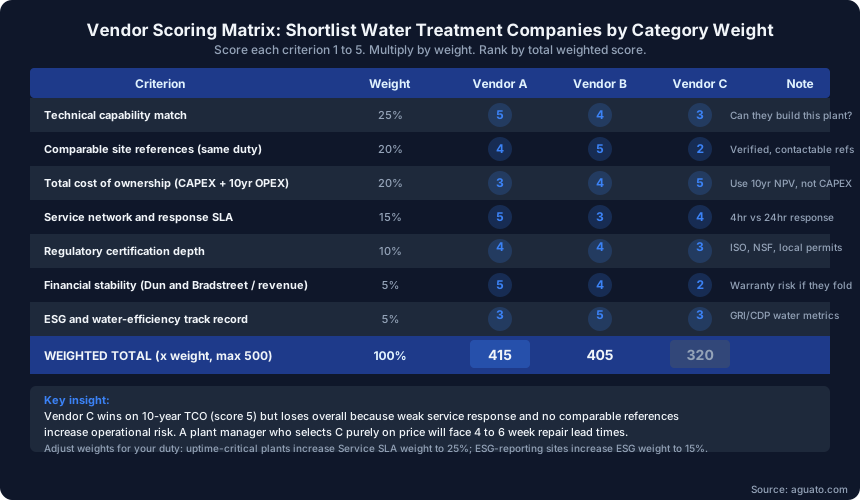
The matrix also creates a defensible audit trail for the award decision, which procurement leads need when the recommended vendor is not the cheapest. "We selected Vendor A at $1.4 million over Vendor C at $1.1 million because Vendor A scored 420 versus 330 on a weighted matrix that put 40% weight on technical capability and service coverage" is a CFO-ready justification. "We thought they were better" is not.
[cta:nepti-dark]
## Step 5: Structure the RFP for comparability, not just compliance
Most water treatment RFPs produce bids that cannot be compared on a like-for-like basis because the scope of supply is not defined with enough precision. Vendor A includes chemical dosing systems in their price. Vendor B excludes them. Vendor A provides a 24-month performance guarantee. Vendor B offers 12 months with an option to extend. Vendor A's OPEX estimate assumes 8,000 hours per year at full load. Vendor B's assumes 6,500 hours. None of these differences are visible in the headline number, but together they represent $200,000 to $600,000 in cost variance over the first five years.
A comparability-focused RFP mandates a standard scope matrix that every vendor must complete, confirming what is and is not included in their price. It requires a standardised OPEX model, typically a 10-year cost table with line items for power, chemicals, membranes and consumables, labour, and maintenance contracts. It specifies the guarantee terms the vendor must offer and asks them to price separately any derogation from those terms. And it requires a performance test protocol that specifies the acceptance conditions, so that vendors are pricing to the same quality standard.
This structure adds 3 to 5 days of preparation time to the RFP. It typically recovers 4 to 8 weeks at the clarification and BAFO stage. More importantly, it produces bids where the cheapest offer is actually the cheapest over the relevant horizon, not just the lowest headline number.
For complex multi-technology systems, consider whether a pre-bid technical workshop adds value. Gathering shortlisted vendors for a 2-hour session to clarify assumptions before bids are submitted reduces bid variance by 20 to 35% in projects above $500,000, based on benchmarks from engineering procurement contractors in the oil-and-gas sector. The investment is 1 to 2 days of project manager time.
The right scope definition depends on your feed water and the operational constraints of your site. [Post your project details](/post-project) and shortlisted providers will respond with scoped proposals built around your specific parameters rather than generic assumptions.
## Technology shortlist comparison: which vendor types suit which duties
Not every water treatment duty needs the same vendor profile. Applying a large EPC contractor to a simple softening project wastes money. Applying a small specialist to a complex multi-stage system with a compliance-critical output creates delivery and warranty risk. The table below maps vendor categories to the duties they handle well.
| Vendor Type | Typical CAPEX Range | Best For | OPEX Risk | Shortlist Risk | |---|---|---|---|---| | Large EPC integrator | $500k to $20M+ | Multi-technology, compliance-critical, pharma, power | Low (backed by T&M contracts) | High cost; may subcontract core technology | | Mid-tier specialist | $100k to $5M | Single-technology depth, food and beverage, municipal | Medium | Verify service network before shortlisting | | Technology OEM with project capability | $50k to $3M | Membrane, RO, softening, UV | Low on own technology | Limited scope; check BOP capability | | Equipment packager / broker | $30k to $2M | Standard modular duty, tight timeline, small sites | High (no in-house engineering) | Do not shortlist for bespoke or regulated duties | | Operations and maintenance contractor | $0 CAPEX (service model) | Opex-only procurement, WaaS, multi-site standardisation | Low | Verify technology-agnostic capability |
The most common shortlist error across industrial buyers is including equipment packagers on lists intended for bespoke engineering projects. Packagers can source and assemble standard modular systems competitively, but they carry no design liability, no in-house process engineering, and in many cases their warranty is only as good as the OEM warranties they pass through. For a $2 million bespoke treatment plant in a regulated sector, that is an unacceptable risk profile.
For help mapping your duty to the right vendor type, the [how to choose industrial water treatment systems](/resources/how-to-choose-industrial-water-treatment) guide covers technology selection criteria and cost benchmarks by application.
## The five shortlist mistakes that inflate project cost
Water treatment procurement generates a remarkably consistent pattern of errors across industries and geographies. These five appear in 80% of cost-overrun post-mortems.
Shortlisting on price at Stage 1. Using indicative budget figures from long-list vendors to filter who gets an RFI guarantees that you include low-ball respondents who will qualify their price heavily during RFP. A vendor who prices a 200 m3/h reverse osmosis system at $180,000 when the realistic range is $280,000 to $420,000 is either misunderstanding the scope or planning to recover the gap through variations. Either outcome costs you more than the savings implied by the initial number.
Omitting operational references. A fabrication reference proves the vendor can build a plant. It does not prove the plant works reliably over time. The most informative reference call asks three questions: how long has the plant been in continuous operation; how many unplanned shutdowns have occurred in the last 12 months; and would you award the next project to the same vendor without re-tendering. The third question tells you everything.
Treating ISO 9001 as a proxy for technical capability. ISO 9001 certifies that the vendor has a documented quality management system. It certifies nothing about the quality of the engineering. A vendor can hold ISO 9001 and consistently over-engineer treatment systems by 40%, producing plants that work but that cost twice what they should to build and operate.
Underweighting service coverage. A plant manager who has experienced a 6-week wait for a replacement membrane cartridge or a critical valve actuator because the vendor has no regional warehouse will never make this mistake again. The uptime cost of a 4-week unplanned shutdown in a food processing facility runs $200,000 to $1.2 million depending on throughput. Service response SLA belongs in the top three evaluation criteria for any continuous-process application.
Skipping the financial health check. The water treatment market has a higher rate of SME insolvency than most capital equipment sectors because project margins are thin, cash flow is lumpy, and payment terms are often back-loaded. A vendor who cannot produce audited accounts or a Dun and Bradstreet rating above a minimum threshold is a balance-sheet risk that shows up inside your warranty period.
For deeper benchmarks on how leading [industrial water treatment companies](/industrial-water-treatment-companies) are structured and what performance data to request from references, the vendor landscape guide on this site covers sector-by-sector supplier profiles.
[The EPA's Clean Water Act technology guidance](dofollow:https://www.epa.gov/cleanwater) provides the regulatory minimum thresholds your shortlisted vendors must be able to meet for discharge compliance, and is a useful cross-check against vendor claims during RFI review.
## How to protect against vendor lock after award
Vendor lock in water treatment occurs when the operating plant is technically or contractually dependent on a single supplier for consumables, spare parts, or service. This is an intentional commercial strategy by some vendors, and the shortlist stage is the last moment you have meaningful negotiating leverage to address it.
Three provisions protect against vendor lock and belong in every RFP. First, an open-architecture clause requiring that all proprietary components be identified in the design documentation, with alternative-source equivalents specified or agreed at award. Second, a spare parts pricing schedule, fixed for a minimum of 5 years, agreed as part of the contract, not left as a post-award commercial conversation. Third, a technology escrow requirement for any custom software or control system, ensuring the operating logic is accessible if the vendor is acquired or ceases trading.
These provisions reduce the headline bid price competitiveness of vendors with a lock strategy, which is exactly the intended effect. A vendor who drops out of contention because of the open-architecture clause was planning to recover margin through sole-source consumable pricing. You have identified them at the shortlist stage rather than two years into operations.
The [most efficient water solution](/resources/most-efficient-water-solution) analysis is useful here: it covers how technology selection affects long-run OPEX and where consumable dependency creates the largest cost exposure over a 10 to 15 year asset life.
For multi-site programmes where vendor standardisation is a goal, the risk of lock is compounded. A vendor who becomes the standard across 8 facilities has significant leverage at every renewal cycle. Building the standardisation framework around technology specifications rather than vendor specifications preserves competitive tension and has been shown to reduce multi-site chemical and consumable costs by 12 to 18% at contract renewal.
[The WHO Guidelines for Drinking Water Quality](dofollow:https://www.who.int/publications/i/item/9789240045064) are the reference framework for any treatment system supplying drinking-grade water and provide a specification baseline that is vendor-independent, making them a useful anchor in an open-architecture procurement.
## Using decision intelligence to compress the shortlist timeline
The shortlist process described above takes 8 to 16 weeks at full pace. For many capital projects, that timeline is the difference between hitting a commissioning date and missing a regulatory deadline or a production ramp. Compressing the timeline without cutting quality requires better data at each stage, not a faster clock.
[Nepti](/nepti) models your water matrix and produces a ranked comparison of technology options with cost projections before the RFI stage. Feed in your duty profile, your feed water chemistry, your discharge constraints, and your site parameters, and the platform returns a technology shortlist with capital and operating cost ranges, a risk profile for each option, and a pre-populated vendor capability matrix for the relevant technology categories. That output compresses Stage 1 and Stage 2 of the procurement framework by 3 to 4 weeks and ensures that your RFI goes to vendors who have actually been assessed for fit, not just vendors who appeared in a trade directory search.
The [Nepti decision intelligence platform](/resources/nepti-decision-intelligence-water-treatment) article covers how the system models water matrix complexity and produces ranked technology comparisons for capital procurement decisions.
The practical value in a shortlist context is not just time saving. It is the reduction of anchoring bias. When procurement teams build long-lists manually, the first 10 vendors on the list disproportionately influence who makes the shortlist, regardless of comparative capability. A model-generated capability ranking is immune to anchoring effects and surfaces vendors who would not have appeared in an unstructured search.
For organisations running multi-site programmes, the platform also supports portfolio-level vendor analysis, identifying which vendors have the capacity and capability to serve multiple facilities simultaneously, which is a critical screening dimension that standard RFI processes rarely capture.
The compressed timeline also matters for the internal approval process. A CFO reviewing a vendor award recommendation that includes a model-generated technology ranking, a comparative CAPEX/OPEX table, and a weighted scoring matrix reaches approval faster than one reviewing a narrative justification, because the quantitative structure answers the questions before they are asked.
For a structured understanding of how decision-support tools integrate into the full procurement cycle for water treatment capital projects, the [Nepti decision intelligence for water treatment procurement](/resources/nepti-decision-intelligence-water-treatment) guide covers the platform architecture and the procurement workflow it supports.
[International Organization for Standardization ISO 14046 Water Footprint](dofollow:https://www.iso.org/standard/43263.html) provides the measurement framework for water efficiency claims that vendors make in their ESG positioning, and is the standard against which those claims should be evaluated during the RFI stage if ESG performance is a weighted criterion.
## FAQ
### How many vendors should be on a water treatment shortlist?
A well-constructed shortlist for an industrial water treatment project contains 4 to 8 vendors at the RFP stage, down from a long-list of 20 to 40. Fewer than 4 creates insufficient competitive tension and risks missing the best-fit supplier. More than 8 dilutes evaluation quality and imposes disproportionate bid cost on vendors who have no realistic chance of winning. The right number depends on the technical specificity of the duty: highly regulated or unusual feed water chemistry will naturally produce a narrower field of genuinely capable vendors.
### What is the most important criterion when shortlisting water treatment companies?
Comparable operational references beat every other criterion for industrial water treatment procurement. A vendor who has built and is currently operating a system within 30% of your flow rate, at a similar feed water quality, in your sector, is demonstrably capable. A vendor with an impressive brochure but no traceable references in your application is a risk that cannot be quantified. Weight references at 20 to 25% of your scoring matrix and require contactable client names as a condition of shortlisting.
### How long should a water treatment vendor shortlist process take?
A properly structured shortlist process from long-list build to RFP issue takes 6 to 10 weeks for projects up to $5 million. Stage 1 long-list filtering takes 2 to 3 days with the right data sources. RFI issuance, response, and scoring takes 2 to 3 weeks. Shortlist selection and RFP preparation takes 2 to 4 weeks. Compressing below 6 weeks typically means skipping the RFI stage, which costs more time later in clarification rounds than it saves at the front.
### What financial checks should I run on a water treatment vendor before shortlisting?
Request the most recent two years of audited accounts, or a credit agency score, and verify that annual revenue is at least 2 to 3 times the contract value. A vendor with $3 million annual revenue building a $2.5 million plant is operating at a project concentration that creates real insolvency risk if the project runs into cash-flow problems. Check for county court judgments or liens in their jurisdiction. A Dun and Bradstreet Paydex score above 70 is a reasonable minimum threshold for vendors on projects above $500,000.
### How do I avoid vendor lock when procuring water treatment systems?
The anti-lock provisions must be written into the RFP, not negotiated after award. Require vendors to identify all sole-sourced proprietary components and provide alternative-source equivalents. Fix spare parts pricing for a minimum of 5 years as a contract schedule. Require technology escrow for any bespoke control software. Vendors with a lock strategy will either price these provisions or decline to bid, both of which are useful signals at the shortlist stage.
### Should I shortlist treatment companies by technology or by application sector?
Shortlist first by technology match to your duty profile, then filter by sector reference. A vendor who has built 50 pharmaceutical water systems but has never designed a reverse osmosis system for your specific feed water chemistry is a worse shortlist choice than a vendor with deep RO capability and a food-and-beverage sector reference. Technology competence is the non-negotiable prerequisite. Sector familiarity reduces commissioning friction and accelerates regulatory approval, but it cannot compensate for a technology capability gap.
### What role do decision-intelligence platforms play in water treatment shortlisting?
Platforms like Nepti compress the early shortlist stages by modelling your water matrix and generating a ranked technology comparison with cost projections before any vendor contact. This replaces 3 to 4 weeks of manual research with a structured output that identifies the relevant technology categories and provides capital and operating cost ranges for each. The vendor matching layer then surfaces pre-screened suppliers who have demonstrated capability in the identified technology categories, eliminating the anchoring bias that affects manual long-list construction.